❌

Normal view

The best cordless vacuum cleaners for a spotless home: 10 tried and tested favourites

30 July 2026 at 10:00

Stick vacuums are a convenient alternative to corded designs, but which model wins for overall cleaning prowess? Our expert reveals all

• The best robot vacuums
•
How to make your vacuum last longer

Choosing a cordless vacuum isn’t a decision that should be taken lightly. You’re likely to keep a vacuum cleaner for years, relying heavily on its ability to suck up dust, crumbs, mud, pet hair and any other dry spillages or sheddings that end up on your floor. Choosing the right model can be the difference between an effective cleaner that’s a delight to pull out of the cupboard and a dud that you dread having to unblock, detangle and clean after every use.

In this review, I took 16 of the leading cordless vacuum cleaners from a range of manufacturers and at various prices and inflicted the same cleaning tests on each one. That takes all the guesswork out of picking your next cleaner: I can tell you exactly which ones picked up the most mess.

Best cordless vacuum cleaner overall:
Shark PowerDetect Clean & Empty IP3251

Continue reading...

© Composite: PR Image

© Composite: PR Image

© Composite: PR Image

A self-emptying, frictionless marvel: Shark PowerDetect Speed Clean and Empty Pet Pro review

28 July 2026 at 10:00

Shark’s cordless vacuum is a whiz at cleaning hard floors and pet hair, but a disarmingly short battery life caught our reviewer off guard

• The best cordless vacuum cleaners – tested

Vacuuming rarely starts with vacuuming. First you have to clear the floor of stray socks and abandoned toys left behind by children, pets or messy partners. Then there’s the irritation of finding the vacuum’s dustbin still full of dirt, or the battery flat because someone forgot to charge it.

The (take a deep breath – long name coming up) Shark PowerDetect Speed Clean and Empty Pet Pro cordless vacuum Ultramarine IA3241UKT certainly won’t pick up the scattered toys for you, but it has been designed to make the job of vacuuming as frictionless as possible.

Continue reading...

© Photograph: Andy Shaw

© Photograph: Andy Shaw

© Photograph: Andy Shaw

I’ve been gaming for 40 years. Here are the best chairs in the UK for comfort, support and serious play

24 July 2026 at 15:00

Whether you’re on PC or a console, level up your setup with our gaming expert’s pick of the best chairs

• The best games of 2026 so far

Comfort is crucial to the gaming experience. It’s hard to focus on blasting aliens or taking Stoke to the Champions League final if your bum has gone to sleep because you’ve been sitting on an old chair for three hours. We’re spending more time playing games than ever before, so good posture matters. If you have set up a dedicated gaming space, then a rickety seat just won’t cut it.

From luxurious ergonomic thrones to cheap-and-cheerful bucket seats, the options available are bewildering. So I set out on an epic quest: to find the most comfortable, durable and stylish gaming chairs. Here’s what I discovered.

Best gaming chair overall:
Secretlab Titan Evo

Best budget gaming chair:
ThunderX3 Solo 360

Continue reading...

© Composite: PR Image

© Composite: PR Image

© Composite: PR Image

Corded vacuums are supposed to be outdated – so why is the Shark Detect Lift-Away XL so good?

19 July 2026 at 13:00

Surprisingly easy to manoeuvre and skilled at cleaning carpet and hard floor, Shark’s upright bagless model is one of the best corded vacuums I’ve tested

• The best vacuum cleaners

Corded vacuum cleaners aren’t as glamorous as their cordless cousins, but swapping battery power for a plug socket has its advantages. The device will never be short of power, so it can keep cleaning for as long as you need it to. Prices also tend to be lower because there’s no expensive battery to factor into the cost.

On the downside, there’s a cable to manage while you clean, and even the longest cords usually need to be switched from one plug socket to another if your home is any larger than a small flat.

Continue reading...

© Photograph: Andy Shaw

© Photograph: Andy Shaw

© Photograph: Andy Shaw

Discovery of Ferric Iron-Bearing Majorite Crystallization from Deep Magma Oceans on Earth and Mars

16 June 2026 at 16:05

In the profound depths of rocky planets like Earth and Mars, the precise chemical states of mantle minerals play a foundational role in shaping planetary evolution. Among these chemical states, the oxidation state of iron profoundly influences mantle melting behaviors, volcanic gas compositions, and ultimately, the nature of a planet’s surface environment. While the elemental presence of iron in the mantle is well-known, the subtle balance between its ferrous (Fe²⁺) and ferric (Fe³⁺) forms remains a challenging frontier to unravel, particularly under the extreme pressures and temperatures encountered in planetary interiors.

The early stages of planetary formation are marked by the existence of a vast magma ocean—a molten silicate layer blanketing the young Earth and Mars. During this epoch, the oxidation state at which iron integrates into forming minerals dictates subsequent mantle properties and evolution. Accurately determining the Fe³⁺ content in minerals crystallized within this magma ocean stands as a critical step toward understanding the oxidation dynamics that influenced core-mantle differentiation and surface volatile release in nascent planets.

A mineral of prime relevance in this context is majorite, a high-pressure silicate phase stable at depths ranging roughly from 500 to 600 kilometers within Earth’s mantle and near the base of the Martian mantle. Its stability under simultaneously high-pressure and high-temperature conditions makes majorite a significant reservoir for iron deep within these planetary interiors. Therefore, quantifying the Fe³⁺ concentration hosted within majorite under early magma ocean conditions bears directly on models of mantle redox evolution and volatile mobility.

Researchers at Ehime University’s Geodynamics Research Center have pioneered the synthesis of Fe³⁺-rich majorite coexisting with molten silicate magma at pressures around 18 gigapascals and temperatures between 2150 and 2200 degrees Celsius. Utilizing a multi-anvil apparatus capable of reproducing these extreme conditions, the team closely simulated the environment of the early magma ocean. High-precision X-ray Absorption Near Edge Structure (XANES) spectroscopy was then employed at the renowned SPring-8 synchrotron facility to accurately assess the valence state of iron within the synthesized majorite crystals.

The findings reveal an unexpectedly high Fe³⁺ content in majorite crystallized from the magma ocean, second only to bridgmanite, Earth’s most abundant lower mantle mineral. This marked enrichment in ferric iron suggests that early mantle minerals could accommodate significant oxidation capacity, challenging earlier assumptions that high-pressure silicates predominantly contain iron in the ferrous state. The implication is that the early mantle harbored more oxidized iron species than previously anticipated, impacting mantle viscosity, melting relations, and the capacity to store volatile elements.

Importantly, as mantle solids ascend toward shallower depths, phase transitions or mineral decompositions can liberate excess Fe³⁺ that no longer fits within the crystal structures. This released ferric iron potentially contributes to the generation of oxidized magmas, influencing volcanic gas emissions and surface oxidation states. Such a mechanism presents a plausible link between deep mantle oxidation states and the chemical makeup of magmas erupted at the surface, offering fresh insights into the geological histories of both Earth and Mars.

The study’s revelations offer a new lens through which to interpret the evolution of mantle oxidation state gradients over geological time. Understanding how iron’s valence shifts across depth-dependent mineralogical boundaries and during mantle convection cycles will refine planetary differentiation models and volatile cycling frameworks. The presence of Fe³⁺-rich majorite highlights a previously underappreciated redox reservoir deep within planetary interiors.

These results not only enhance our appreciation of Earth’s early differentiated mantle but also extend to Mars, where recent seismic and geochemical data point to a similarly complex mantle composition. The redox state plays an outsize role in Martian volcanic outgassing and atmospheric evolution, making this research vital for reconstructing Mars’ geochemical past and assessing its potential habitability.

From a methodological standpoint, the study exemplifies the power of integrating high-pressure experimental petrology with cutting-edge synchrotron techniques. The ability to recreate extreme planetary interior conditions and directly probe valence states in situ offers a transformative approach to addressing longstanding questions about deep Earth and planetary chemistry.

Furthermore, the recognition that Fe³⁺ can be abundant in magma ocean-derived minerals necessitates revisiting thermodynamic and geochemical models of mantle melting and evolution. Oxidation state strongly influences melting temperatures and mantle rheology, thereby controlling convection patterns and surface tectonics. Such feedbacks are essential to comprehend in the broader context of planetary habitability and evolution.

Ultimately, these insights pave the way for multidisciplinary endeavors bridging mineral physics, planetary science, and geochemistry. They underscore the dynamic interplay between deep Earth processes and surface conditions, revealing how the smallest changes in iron’s electron configuration resonate across planetary systems.

This breakthrough in understanding iron’s complex behavior under extreme conditions promises to guide future explorations of terrestrial and extraterrestrial geology. It sets new constraints on the interior states of rocky planets and sharpens our vision of how early planetary environments were sculpted by subtle shifts deep within.

Subject of Research: High-pressure mineralogy and mantle oxidation states in terrestrial and Martian planets.

Article Title: (Not explicitly provided in the original content.)

News Publication Date: (Not indicated in the original content.)

Web References: http://dx.doi.org/10.1029/2025JB033231

References: Journal of Geophysical Research Solid Earth

Image Credits: Hideharu Kuwahara

Keywords:
– Fe³⁺ in mantle minerals
– Majorite synthesis under high pressure
– Magma ocean oxidation states
– Mantle redox evolution
– XANES spectroscopy at SPring-8
– High-pressure experimental petrology
– Earth and Mars mantle comparison
– Ferric iron incorporation in majorite
– Oxidized magma generation
– Planetary interior chemistry
– Lower mantle mineralogy
– Planetary differentiation processes

Simulations of Turbulent Mixing Close One Gap but Open Another

6 May 2026 at 17:00

illustration of a white dwarf surrounded by rocky debris

Nature sometimes behaves in ways that are difficult to recreate in simulations. New research tackles the computational challenge of turbulent mixing and rules out a commonly assumed source of data–model disagreement.

Mixing Up Stellar Interiors

What do Earth’s oceans, red giant stars, and white dwarfs have in common? These are all sites of thermohaline mixing, a form of turbulent mixing that takes place when there is a vertical gradient in both temperature and chemical composition. For example, in Earth’s oceans, water near the surface is warmer and saltier than water in the depths below, setting up an unstable situation prone to mixing.

thermohaline mixing simulation results

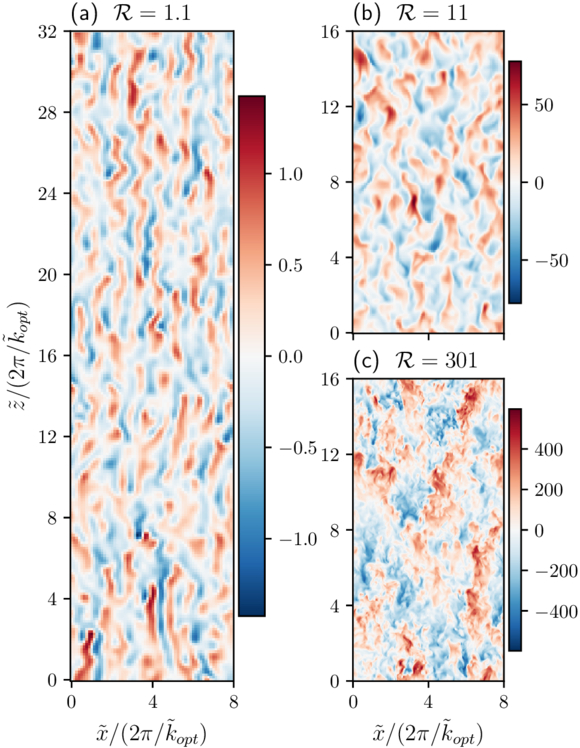
Examples of simulated thermohaline convection. These snapshots show the vertical velocity across a slice through the simulation volume. Click to enlarge. [Fraser 2026]

Thermohaline mixing has been explored in simulations to explain the evolution of red giants’ surface abundances, as well as how quickly rocky debris that accretes onto a white dwarf is absorbed into the star. However, effectively modeling this process in the interiors of stars has proven difficult.

One of the most important parameters for modeling mixing is the Prandtl number, Pr, which is the ratio of viscosity to thermal diffusivity (in other words, a way of describing whether momentum or heat diffuses more quickly within a fluid). For stellar interiors, Pr is around 10−6, but computational limitations have prevented modelers from setting this value lower than around 10−2. When tensions between models and reality arise, this gap between simulated and realistic Pr values is often assumed to be the source of the mismatch.

Bridging the Prandtl Number Gap

In a recent research article, Adrian Fraser (University of Colorado Boulder) aimed to test this assumption. Fraser carried out 3D simulations of thermohaline mixing, using a semi-implicit modeling technique that lowered the computational cost and allowed the simulations to probe Pr values of 10−1, 10−2, 10−3, 10−6, and 0.

comparison of simulations from this work and the benchmark model of thermohaline convection

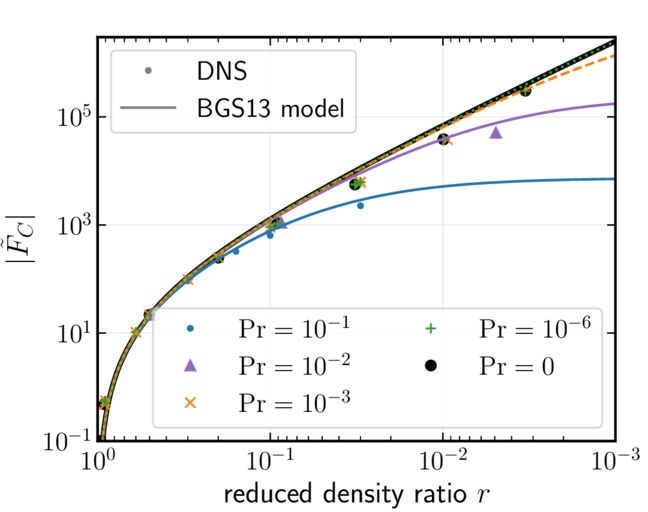
Turbulent compositional flux as a function of reduced density ratio for the simulations from this work (DNS) and the benchmark model of thermohaline convection (BGS13). Click to enlarge. [Adapted from Fraser 2026]

By comparing these results against a benchmark model of thermohaline mixing, this exploration showed that adopting a realistic value of Pr doesn’t dramatically change the dynamics of the system — meaning that data–model incompatibilities can’t be swept under a Prandtl number–shaped rug and must instead be resolved by including additional physics.

Recreating Reality

Where does this leave modelers attempting to recreate the reality of stellar interiors? First, a silver lining of this investigation: Fraser found that setting Pr = 0 delivered nearly identical results to Pr = 10−6. This suggests that valid results can be attained in a much less computationally intensive way, since setting Pr = 0 lowers the complexity of the simulation. While simulations with Pr = 0 may not be appropriate for all scenarios, including systems with strong magnetic fields, it may provide a way forward in certain situations.

For modeling of red giants and white dwarfs, Fraser suggested that incorporating magnetic fields, stellar rotation, or additional sources of mixing may resolve the current discrepancies. In fact, some modeling work has shown that magnetic fields could entirely close the gap between observations and models for red giant surface abundances — suggesting that bringing models and observations into agreement may be within reach.

Citation

“Bridging the Prandtl Number Gap: 3D Simulations of Thermohaline Convection in Astrophysical Regimes,” Adrian E. Fraser 2026 ApJL 1001 L22. doi:10.3847/2041-8213/ae5796

The post Simulations of Turbulent Mixing Close One Gap but Open Another appeared first on AAS Nova.

Standing on a Sub-Neptune

5 November 2025 at 17:00

A rendering of a blue planet in the foreground and a small bright star in the background.

Astronomers often assume that sub-Neptune exoplanets have magma oceans hiding beneath their atmospheres. New research suggests that this might not always be the case.

Puzzling Type of Planet

In the 30 years since the discovery of the first exoplanet, astronomers have come to appreciate that many of the most common planets in our galaxy look nothing like the worlds in our solar system. One type of planet in particular appears to be ubiquitous despite not appearing in our own cosmic neighborhood: sub-Neptunes. As their name suggests these planets are slightly smaller than Neptune, but still much larger than Earth or what we’d expect from a planet composed mostly of rock.

Four planets side by side ordered by increasing size. From left to right, they are Earth, TOI-421 b, GJ 1214 b, and Neptune.

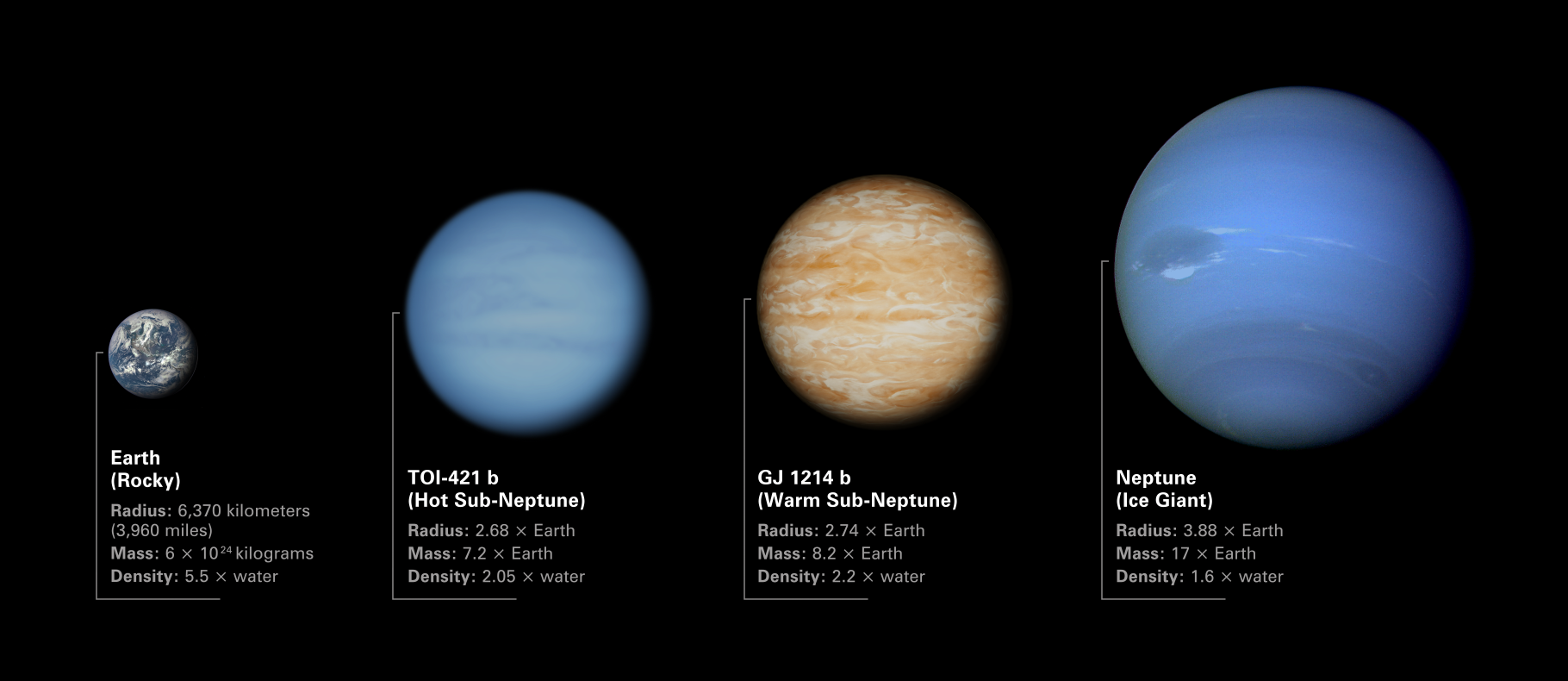
An illustration of how two sub-Neptunes mentioned in this study (TOI-421b and GJ 1214b) compare with planets in our solar system. Click to enlarge. [NASA, ESA, CSA, Dani Player (STScI)]

What sub-Neptunes are made of and how they formed are still mysteries under active investigation by the research community. It is possible that these worlds are mostly rocky and sport puffy, light atmospheres over their surfaces; it’s also possible that these worlds are watery, and that most of their mass comes from heavy, steamy atmospheres. In most cases, though, it’s assumed that the high pressures and temperatures at the surfaces of these worlds foster a permanent, fiery magma ocean.

This key assumption that there’s no solid surface to stand on influences our models about how these planets cool and evolve over time. However, new research led by Bodie Breza (University of Maryland) suggests that this premise might not always be appropriate.

Solid Ground

To test the assumption that every sub-Neptune has a magma ocean, Breza and collaborators simulated hundreds of thousands of feasible exoplanet interiors and atmospheres. Each simulation slightly tweaked various characteristics, like the surface temperature or the planet’s total mass, then checked whether the temperature and pressure conditions at the planet’s surface would leave any rocks in solid or liquid form.

phase diagram for a common rocky material

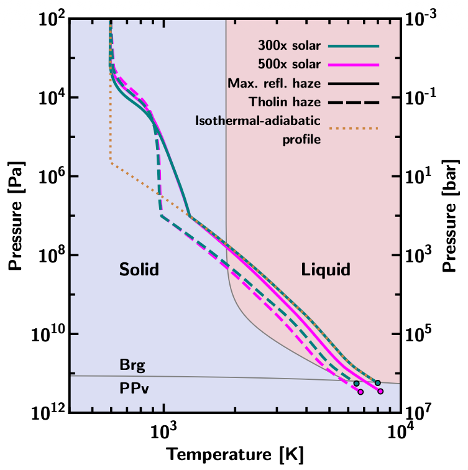
A phase diagram for a common rocky material MgSiO3. The various lines show different model pressure–temperature profiles for the sub-Neptune GJ 1214b, while the circles indicate the location of the atmosphere/surface boundary. All circles fall into the “solid” part of the phase diagram, indicating that GJ 1214b likely has a solid surface. [Breza et al. 2025]

Somewhat surprisingly, the team found that about a third of the models they simulated had solid, not magma, surfaces. They found there were two distinct ways to solidify the magma and create a firm shell. First and most intuitively, if the surface temperature falls low enough, the magma will simply freeze. Second and more intriguingly, they found that a planet can also suppress a magma ocean if its atmosphere is heavy enough to drive up the surface pressure beyond the solid–liquid threshold.

This latter result is particularly insightful in light of recent JWST observations that suggest many sub-Neptunes have heavy atmospheres. These new models suggest that these worlds might have solid surfaces, and that models attempting to explain their compositions should be tweaked to account for this finding. In these early days where astronomers are still puzzling out the most basic properties of these strange worlds, research like this demonstrates the power of using advanced theoretical modeling to help interpret our cutting-edge observations.

Citation

“Not All Sub-Neptune Exoplanets Have Magma Oceans,” Bodie Breza et al 2025 ApJL 993 L46. doi:10.3847/2041-8213/ae0c07

The post Standing on a Sub-Neptune appeared first on AAS Nova.

The best fans to keep you cool in 2026 – tried and tested

3 September 2026 at 15:00

Missed out on a fan this summer? Chill your space with our pick of the best still in stock, including tower and misting models

• The best portable neck and handheld fans
•
Dyson HushJet Mini Cool fan review

Our world is getting hotter. Summer heatwaves are so frequent, they’re stretching the bounds of what we think of as summer. Hot-and-bothered home working and sweaty, sleepless nights are now alarmingly common.

Get a good fan and you can dodge the temptation of air conditioning. Aircon is incredibly effective, but it uses a lot of electricity … and burning fossil fuels is how we got into this mess in the first place. Save money and carbon by opting for a great fan instead.

Continue reading...

© Composite: PR Image

© Composite: PR Image

© Composite: PR Image

❌