Scientists have discovered China’s first known freshwater cave snail, an eyeless species so rare that only three living adults have been found. Deep inside a mountain cave in southwestern China, scientists found an animal that appears built for a world where sunlight never reaches. The tiny freshwater snail has no eyes, almost no color, and [...]
The first study of its kind shows that ecosystems experience far more cumulative heat than standard measurements reveal. A marine heatwave may have an official beginning and end, but the warm water affecting an ecosystem often does not. Like a pot that continues absorbing heat over time, coastal waters can remain unusually warm for weeks [...]
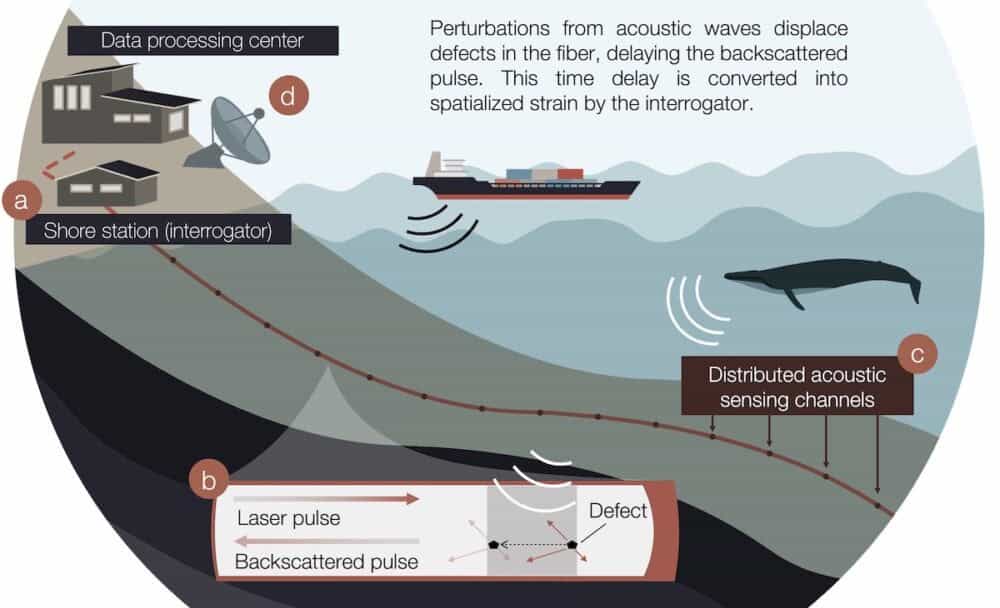
Detecting whale motion Graphic showing a distributed acoustic sensing system that uses fibre-optic cables to help researchers detect ships and whales in the waters near Svalbard. (Courtesy: Léa Bouffaut)
A technique currently used to track whale vocalizations could be adapted to pick up the hydrodynamic pressure fields created as they swim, researchers in Norway have demonstrated. Through analysis of backscattered light in an undersea optical fibre, Robin Rørstadbotnen and Martin Landrø at the Norwegian University of Science and Technology (NTNU) showed how silent whales can be detected as they swim close to the fibre. The duo hopes the discovery could ultimately provide a valuable new tool for whale conservation.
With the combined disruption of climate change and human activity, whales are rapidly being forced into new habitats and migration patterns. To understand these profound shifts in behaviour, conservationists widely rely on a technique named distributed acoustic sensing (DAS), which detects acoustic waves via the strain they induce on optical fibres.
When coherent laser pulses are passed through a fibre, a small portion of laser light is inevitably scattered back to the source by small fluctuations in the fibre’s structure and density. If the fibre is strained by an acoustic wave, the oscillating pressure field imprints a phase shift on this backscattered light, which varies in proportion to the degree of strain.
So far, this approach has been used to pick up whale vocalizations: the loudest sounds produced by any animal, which can travel for thousands of kilometres through the ocean. By analysing backscattered light across the global network of undersea optical fibres, researchers have gathered valuable information about how the habitats and migration paths of these marine mammals are changing.
“At NTNU, we started activity within distributed acoustic sensing in 2016,” Rørstadbotnen describes. “When the Center for Geophysical Forecasting was launched in 2021, this technology became a key field of interest.”
Despite the value of data that can be gathered through whale vocalizations, the approach leaves conservationists with a significant blind spot for the majority of the time when whales are silent. To address this limitation, Rørstadbotnen and Landrø considered how DAS could be adapted to pick up the hydrodynamic pressure and velocity fields constantly being created by the whales moving through the water, which generates ultralow-frequency signals similar to those created by the movement of ships.
To test this idea, the duo revisited scattering data gathered from a seabed optical fibre off the coast of Svalbard in the Norwegian Arctic. After filtering the data for a selected band of frequencies, they carried out frequency–wavenumber analysis to determine how rapidly the signals varied along the length of the fibre. Just as they hoped, “we found that this new approach could be applied to detect silent whales, given that they are swimming close to the fibre optic cable,” Rørstadbotnen says.
Through this analysis, the researchers were able to identify ships crossing the fibre from depths of up to 413 m, and at a maximum distance of 550 m from the fibre. They also managed to determine the vessel speeds and roughly estimate their sizes. Crucially, they were also able to distinguish the speeds and approximate sizes of silent whales swimming less than 40 m away from the fibre, as well as estimating their depths.
“Since we also recorded the acoustic signals in the frequency range from 5 to 100 Hz, we could identify whales when they were vocalizing closer to the sea surface,” Rørstadbotnen describes. “Thereby, we could use this information as a strong indication that the low-frequency signal observed a bit later in time was most likely generated by the whale moving closer to the fibre.”
Having demonstrated this possibility, Rørstadbotnen and Landrø now hope that their technique could provide researchers with a new tool for tracking whales around the world, even when they aren’t vocalizing. “In addition, this method can potentially detect toothed whales that vocalize in the high-frequency band outside what is normally recorded for distributed acoustic sensing,” Rørstadbotnen adds.
Beyond its potential for whale conservation, the duo is also hopeful that the technique could help researchers build up a more extensive picture of marine mammals more generally, along with other vital elements of fast-changing marine ecosystems.
Pollinating insects form a vital part of any ecosystem, enabling the biodiversity that we see on Earth today. However, biodiversity is in rapid decline around the world, and monitoring insect species is a difficult task that often requires some insects to be killed. To support the conservation of biodiversity, which is critical to ensure the sustainability of human civilization, more robust monitoring is required. In a study published in PNAS Nexus, researchers have developed a new method to identify and classify individual insects, based on radar imaging and machine learning.
Radar has long been used to study migrating insects that fly at high altitudes and in large numbers, but such systems typically perform wide-area, long-range monitoring. However, thanks to a combination of millimetre-wave radar and machine learning, narrow focused identification is now possible, by detecting changes in the radar reflection of insects caused by the flapping of their wings.
“Having a background in antenna engineering, there was always the question of whether this technology can be used to address some of the environmental challenges that we’re facing,” says co-lead author Adam Narbudowicz from the Technical University of Denmark. “Some five or six years ago, we started talking with [co-author] Ian [Donohue] about those possibilities, and eventually the idea of micro-Doppler emerged, which seemed feasible from an engineering point of view and could provide some useful data on biodiversity.”
The approach taken in this study doesn’t focus on morphological features of the insects, as these are difficult to detect with radar. Instead, it uses the harmonic patterns generated by the micro-Doppler effect of an insect beating its wings as a detection strategy. Millimetre-wave radar can provide insight into biomechanical characteristics not visible with cameras, and these characteristics are encoded in the harmonic patterns of the wingbeat.
The team used machine learning to improve the accuracy of the identification and incorporated a SHAP (SHapley Additive exPlanations) analysis – an explainable AI tool that interprets and explains key outputs and prioritizes key features – to identify which signal features are the most critical for differentiating insect species. The SHAP analysed each insect across the full spectrum of micro-Doppler harmonics, extracting key features including fundamental wingbeat frequency, energy distributions, cepstral coefficients (sound signals) and how quickly an insect’s wing movement change. These data were then used to train the machine learning model.
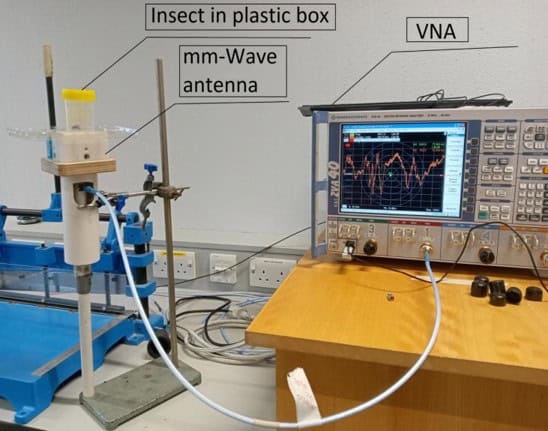
Training the model The radar system used to collect data from insects. (Courtesy: Linta Antony)
The actual process of obtaining this data from the insects involved capturing insects at the Trinity College Dublin campus and placing them in a plastic box on top of a millimetre-wave antenna that recorded their radar signatures. The researchers then released the insects back into the wild. After data capture, the relevant micro-Doppler features were extracted from the data for model training.
The model allowed non-invasive monitoring of different insects and could distinguish between bees and wasps with 96% accuracy. The model also classified five key pollinating insect species – red-tailed bumblebee, buff-tailed bumblebee, moss carder bumblebee, western honeybee and common wasp – with an accuracy of 85%.
“I think the most impressive thing is that we can detect and classify them with such an accuracy. From a biological point of view, it’s impressive how different species beat their wings in different manner, and from an engineering point of view it’s fascinating how different wingbeats affect harmonics of radar micro-Doppler reflections,” says Narbudowicz. “Those differences are of course impossible to see just by looking at spectrograms, but it appears that a sufficiently trained machine learning algorithm can see them.”
Narbudowicz points out that the current study used precise lab-grade transceivers and a relatively controlled set-up, and that the natural next step is to move this technology to outdoor field deployment. “This requires a number of steps,” he explains. “Firstly, the device needs to be miniaturized, and battery operated; the transceiver will be less accurate than the one used in the lab, but a big problem is the ground truth verification, since in the field it can be difficult to verify exactly which species flew over the sensor.”
Despite the greater challenge with deploying the technology in the field today, the researchers suggest that this radar reflection approach could be utilized in the future in a fly-through device, which would make it much easier and cheaper to achieve non-lethal monitoring of insect biodiversity in different environments.
For centuries, ancient seafarers have told tales of fabled lost lands. They have been known by many names—Ultima Thule, Hy-Brasil, the Fortunate Isles, and of course, the legendary lost city of Atlantis.
Now, scientists say Earth’s hidden plumbing system may be feeding one of its strangest ecosystems—an area on the Atlantic seafloor that conjures images of such legendary landscapes lost to time and memory.
Known as the Lost City hydrothermal field, this ancient Atlantic oddity is doing more than just broadening our view on how extremophiles thrive in some of our planet’s least hospitable environments: it offers a potential model for how extraterrestrial life may thrive elsewhere in our solar system.
In a recent paper published in Geophysics, Geochemistry, and Geosystems, an international team of researchers finally discovered the system behind these hydrogen- and methane-rich alkaline hot springs that feed the Lost City ecosystem.
The white carbonate chimneys that emit these gases provide an alternative to sunlight as the Lost City’s primary energy source, allowing life to thrive in a challenging deep ocean environment.
A view of the Lost City hydrothermal vent, located adjacent to the Mid-Atlantic Ridge (Image Credit: Susan Lang, University of South Carolina/National Science Foundation/ROV Jason 2018 WHOI)
Searching Near The Lost City
Those precious nutrients coming from these vents were created by underground reactions. It turns out that the water feeding the Lost City is likely part of a larger underground system, where extreme processes imbue the liquid with essential nutrients.
The discovery came from nearly a mile below the Atlantis Massif, a large block of Earth’s crust that forms an underwater mountain range. This dome-shaped region stretches for 10 miles and rises 14,000 feet above the ocean floor.
Above, a map shows the location of the Lost City on the Atlantis Massif (Image Credit: NOAA)
Geologists believe this formation originated between 1.5 and 2 million years ago, as tectonic plate movement pulled it out from beneath the Mid-Atlantic Ridge, forming a new feature on the ocean floor.
From aboard the Joint Oceanographic Institutions for Deep Earth Sampling (JOIDES) ship Resolution, scientists drilled their 4,160-foot-deep hole about 2,600 feet north of the Lost City. They were intrigued to find that the water recovered from the hole had a chemical composition extremely similar to that of water emerging from the Lost City vents.
Beneath The Ocean Floor
From their drill site, they pumped water from varying depths up to the surface for examination.
Roughly the first 1,500 feet consisted primarily of seawater and freshwater from the drilling process, yet at lower depths, they found water that had risen from beneath the rock. At the deepest depths, up to 80% of the sample came from these subterranean regions.
Their detailed analyses revealed that the water had reacted with the surrounding minerals to gain calcium while losing magnesium, a reaction that would require prolonged exposure to rocks at a temperature of at least 572°F. Despite this finding, the hole was much cooler when the team took their samples.
Typically, a water-rock reaction with gabbroic and ultramafic rock would produce such results that are high in calcium, yet with no magnesium. Other components, such as lithium, rubidium, cesium, and strontium, were found in the water at both the bore site and Lost City.
One of the Lost City’s many carbonate spires is shown in this image from the 2005 Lost City Expedition (Image Credit: IFE, URI-IAO, UW, Lost City Science Party; NOAA/OAR/OER; The Lost City 2005 Expedition)
The findings are consequential for providing the first direct evidence of this extremely hot water circulating beneath the Atlantis Massif through gabbroic and ultramafic rock. In this hidden plumbing system, seawater reaches deep within oceanic plates, providing energy to these deep-sea environments and potentially supporting their microbial life.
Feeding The Lost City
As researchers have now demonstrated that hydrogen-enriched water can naturally form deep within the Earth through rock reactions, researchers say there are major implications for our understanding of the Earth and beyond.
For one, it adds a new element to Earth’s energy cycles, explaining how life persists under such difficult, dark conditions. Secondly, it offers intriguing new ideas about how life might persist in extraterrestrial environments, as humans continue to search for it elsewhere in the cosmos. The strange conditions of the Lost City ecosystem are thought to be a potential model for how life could persist in the global oceans of ice-covered worlds such as Jupiter’s moon Europa or Saturn’s moon Enceladus.
However, some uncertainty about the samples does remain. Seawater, freshwater, and drilling contaminants were present in the samples, and the exact proportions attributable to gabbro or ultramafic rock are unknown. Also, while this is evidence for an underground connection between the borehole and the Lost City chimneys, it is not conclusive proof that they are connected.
Plans are already underway to return once the borehole has stabilized to collect pristine samples that will allow researchers to answer questions about where and how these reactions occur, as well as the amount of energy they add to the water. From the most inhospitable regions on Earth to the quest for organisms among the stars, the research underway deep within our oceans is providing new answers to how such life persists.
Micah Hanks, Editor in Chief of The Debrief, also contributed to this reporting.
Ryan Whalen covers science and technology for The Debrief. He holds an MA in History and a Master of Library and Information Science with a certificate in Data Science. He can be contacted at ryan@thedebrief.org, and follow him on Twitter @mdntwvlf.
A new analysis revisits the Great Barrier Reef’s past losses of Acropora corals, showing that reef decline was not only a modern story of warming oceans. Using historical ecological records alongside climate-linked environmental data, the study links earlier episodes of Acropora mortality to shifting variability in ocean conditions—factors that can amplify heat stress even before today’s extremes fully arrive. The findings suggest that the reef’s vulnerability has deep roots, shaped by how the atmosphere and oceans interact over time.
The researchers focus on Acropora, a genus that forms structurally complex habitats and supports high biodiversity. When these branching corals die, the consequences cascade: shelter and food sources shrink, juvenile recruitment becomes harder, and reef recovery slows. Their approach connects mortality signals across time to measures of climate variability, aiming to distinguish natural swings from persistent human-driven pressures.
Clues come from patterns consistent with stress events driven by warmer-than-usual water, altered temperature dynamics, and changing conditions that influence coral physiology. Importantly, the work frames these stressors as interacting rather than acting alone. Climate variability can raise the frequency and severity of harmful conditions, while human impacts provide chronic background stress that reduces coral resilience.
The study emphasizes that anthropogenic impacts—such as local water-quality degradation and other human pressures—can intensify the damage caused during climate-driven heat or disturbance events. In this view, the reef does not simply “survive” or “collapse” based on temperature alone; it fails when multiple stressors converge, tipping corals past thresholds for survival and regrowth.
This “multi-stressor” model matters for forecasts. If past mortality aligns with periods of heightened climate variability, then future reef risk depends not only on long-term warming trends but also on how variability evolves. That means management strategies must be tuned to both the climate signal and the local pressures that determine how quickly corals can bounce back after shocks.
The authors also highlight that historical mortality patterns can function like a preview of likely future dynamics. Instead of treating recent bleaching as the first chapter, the analysis portrays a longer timeline of stress accumulation. The reef’s trajectory, they argue, reflects a system that has repeatedly been strained and partially recovered—until cumulative impacts made recovery less complete.
With the Great Barrier Reef facing intensifying marine heatwaves, this work adds urgency to climate mitigation and local conservation. It suggests that reducing human pressures can buy time by strengthening coral tolerance, even as global temperatures continue to rise. In viral science terms, the message is clear: the reef’s past predicts its future—and human actions can still change the ending.
Subject of Research: Great Barrier Reef coral (Acropora) mortality
Article Title: Past Acropora mortality on the Great Barrier Reef linked to climate variability and anthropogenic impacts.
Article References: Clark, T.R., Leonard, N.D., Jupiter, S.D. et al. (2026). Commun Earth Environ. https://doi.org/10.1038/s43247-026-03800-9
Image Credits: AI Generated
DOI: 10.1038/s43247-026-03800-9
Thousands of metres below the ocean’s surface, there are tiny waves moving through the water. Much like breaking waves at the beach, these small waves within the ocean must eventually break. When they do, they create turbulence and mixing, similar to what you feel from a big wave breaking on the beach. This might seem […]
A decade-long search through Taiwan’s remote forests led to the discovery of East Asia’s tallest tree and hundreds of other towering giants. An 84-meter-tall tree is surprisingly easy to miss. Hidden within Taiwan’s steep mountains and dense old-growth forests are some of the tallest trees on Earth, including giant conifers that rise higher than a [...]
In a groundbreaking new study published in Nature Communications, researchers Ampuero, Stríkis, Meckler, and colleagues have unveiled compelling evidence of rapid warming in South America during the last deglaciation, a period roughly spanning from 20,000 to 10,000 years ago. This revelation not only reshapes our understanding of ancient climate dynamics in the Southern Hemisphere but also provides critical insights relevant to modern climate change scenarios. The study harnesses a suite of advanced geochemical proxies and high-resolution sediment analyses to reconstruct past temperature variations with unprecedented precision, shedding light on the complex interplay of atmospheric and oceanic processes that drove rapid temperature shifts during this critical juncture in Earth’s climate history.
The last deglaciation marks the transition from the Last Glacial Maximum (LGM), characterized by extensive ice sheets and colder global temperatures, to the relatively warmer Holocene epoch. While the general timeline of global warming during this period has been well documented, the rate and regional variability of temperature changes in South America remained less clear. This research addresses that gap by focusing on paleoclimatic archives from the Andes and adjacent lowlands, areas particularly sensitive to past climate fluctuations due to their unique topography and atmospheric circulation patterns. The team’s integration of isotopic measurements, sediment core analyses, and climate modeling has allowed them to track rapid temperature increases occurring in discrete pulses rather than gradual trends.
One of the study’s central findings is that the warming episodes in South America during the deglaciation were not synchronous with the Northern Hemisphere, suggesting a nuanced asynchronous behavior in global climate systems. This asynchrony challenges prevailing assumptions derived from mid-latitude and polar records predominantly from the Northern Hemisphere. The evidence points to a scenario where atmospheric teleconnections, influenced by shifts in the Intertropical Convergence Zone (ITCZ), played a vital role in redistributing heat between hemispheres. Changes in the ITCZ’s position and intensity appear to have triggered alterations in monsoonal patterns and precipitation regimes across tropical and subtropical South America, thereby accelerating warming trends.
Delving deeper into the proxies used, the research team employed oxygen isotope ratios (δ18O) from speleothems and lacustrine carbonate deposits, alongside organic biomarkers preserved in lake sediments. These proxies are invaluable for reconstructing past temperature and hydrological conditions. Their fine temporal resolution enabled the team to detect rapid warming events occurring over mere decades to centuries, contrasting starkly with previously assumed millennial-scale trends. This high-resolution data challenges the paradigm that post-glacial warming was a slow and steady process, underscoring the climate system’s capacity for abrupt state shifts driven by complex feedback mechanisms.
The study posits that these rapid warming events are linked to deglacial reductions in ice volume combined with rising greenhouse gas concentrations, which collectively enhanced atmospheric temperatures. However, the mechanisms responsible for regional heterogeneity in warming intensity remain a frontier of research. The authors hypothesize that the interplay between the South Atlantic Ocean’s temperature gradients and the Andes’ orographic effects created microclimates that either amplified or moderated warming signals locally. These insights highlight the intricacies of Earth’s cryosphere-atmosphere interactions, emphasizing that regional response to global forcings can diverge dramatically.
Crucially, the study carries significant implications for understanding future climate trajectories. The past rapid warming episodes provide analogs for the rate and spatial distribution of modern anthropogenic warming, especially in mountainous and tropical regions. Given that South America supports critical biodiversity hotspots and large human populations dependent on glacial-fed water resources, these findings raise concerns about the vulnerability of such systems to contemporary climate disruptions. They also stress the importance of refining climate models to incorporate regional heterogeneities and abrupt transitions observed in past climates to improve future predictions.
The methodologies applied in this study exemplify advancements in paleoclimatology. High-precision radiometric dating techniques, including uranium-thorium series and radiocarbon calibrations, ensured robust chronological frameworks. Simultaneously, the use of compound-specific isotope analyses allowed disentanglement of temperature signals from confounding hydrological changes. By merging empirical data with state-of-the-art climate model simulations, the research provides a comprehensive narrative that integrates proxy evidence with theoretical climate dynamics, fostering an interdisciplinary understanding crucial for reconstructing past climates.
This investigation also revisits the role of Southern Hemisphere westerly winds during glacial terminations. These winds, known to influence oceanic upwelling and atmospheric moisture transport, appear to have shifted latitudinally and intensified during warming intervals, enhancing the carbon cycle feedback through increased ocean-atmosphere exchange. Such shifts would have profound implications for regional precipitation and temperature patterns, echoing the complex feedback loops that amplify climate variability. The interplay between atmospheric circulation changes and deglacial warming elucidated in this work refines our grasp of the mechanisms driving rapid climate shifts in South America.
The detailed record of warming patterns obtained from Andean ice cores and sediment cores also reveals that local climate responses were amplified by feedback mechanisms related to vegetation changes and soil moisture dynamics. As temperatures rose, altered precipitation regimes induced shifts in ecosystem composition and land surface properties, which in turn influenced regional albedo and evapotranspiration rates. These biophysical feedbacks likely intensified warming pulses, creating nonlinear climate responses that challenge the linear projections often found in simplified models. The study’s recognition of these processes underscores the need to consider feedback loops when analyzing both past and future climate events.
Furthermore, the research highlights the influence of meltwater pulses originating from retreating glaciers on ocean circulation patterns in the South Atlantic, which may have contributed to abrupt changes in the Atlantic Meridional Overturning Circulation (AMOC). These oceanic perturbations would have cascaded into atmospheric circulation anomalies, further modulating temperature regimes. The integration of paleohydrological and oceanographic data thus provides a multidimensional perspective on how coupled ocean-atmosphere-cryosphere systems orchestrated climate variability during the last deglaciation.
The findings provoke new questions about thresholds and tipping points in paleoclimatic systems. The demonstrated rapid warming episodes suggest that even small incremental increases in external forcings can trigger disproportionately large climate responses once feedbacks are engaged. Such insights are vital for modern climate science, particularly in understanding the potential for abrupt, nonlinear climate transitions under ongoing anthropogenic pressures. By decoding the clues encoded in South America’s geological record, the study enhances our ability to forecast and mitigate the risks associated with rapid climatic changes.
Notably, this work emphasizes the importance of cross-continental and hemispheric comparisons in paleoclimatic studies. By juxtaposing South American data with Northern Hemisphere and Antarctic records, the researchers have contextualized regional warming events within the broader global climate narrative. This comparative approach reveals asynchronous yet interconnected patterns of deglacial warming, challenging simplistic notions of uniform climate shifts and advocating for more intricate, region-specific assessments of past climate dynamics.
In conclusion, the study by Ampuero et al. represents a significant stride in reconstructing past climate change with regional fidelity and temporal precision. Their identification of rapid warming intervals during the last deglaciation in South America not only enriches the scientific understanding of glacial-interglacial transitions but also provides vital lessons for the present and future. The intricate linkages among atmospheric circulation, oceanic processes, and terrestrial feedbacks revealed by this study underscore the intricacy of Earth’s climate system and the urgency of addressing rapid environmental changes from a holistic perspective. Future research inspired by this work will undoubtedly deepen insights into the mechanisms of abrupt climate change and help refine predictive climate models essential for safeguarding vulnerable ecosystems and societies.
—
Subject of Research: Paleoclimatic reconstruction of rapid warming events in South America during the last deglaciation.
Article Title: Rapid warming in South America during the last deglaciation.
Article References:
Ampuero, A., Stríkis, N.M., Meckler, A.N. et al. Rapid warming in South America during the last deglaciation. Nat Commun (2026). https://doi.org/10.1038/s41467-026-74093-x
In a groundbreaking study set to reshape our understanding of polar carbon dynamics, researchers have uncovered that the lithology of catchment areas along the Antarctic Peninsula plays a pivotal role in regulating the net carbon balance of these fragile ecosystems. This revelation not only challenges previous assumptions regarding carbon sequestration in polar regions but also highlights the complex interplay between geology and climate change in one of the planet’s most sensitive areas.
For decades, scientists have grappled with accurately quantifying carbon fluxes in polar environments due to the extreme conditions and limited accessibility. The Antarctic Peninsula, stretching northwards from the main Antarctic continent, represents a unique geophysical interface where ice, rock, and ocean converge. Prior research predominantly focused on biological and climatic factors controlling carbon balance but seldom accounted for the geochemical contributions borne from the underlying lithology. This new research sets a transformative precedent by rigorously dissecting how rock types influence carbon absorption and release processes, thereby painting a more nuanced picture of the peninsula’s carbon budget.
The study relied heavily on state-of-the-art field measurements coupled with advanced geochemical modeling to parse out the contributions of catchment lithology—essentially the rock makeup and mineral composition of drainage basins—to net carbon balance. Geological substrates act not only as passive backdrops but as active participants in biogeochemical cycles. Chemical weathering of silicate and carbonate minerals can sequester atmospheric carbon dioxide, while other rock forms may facilitate carbon release via mineral dissolution or hydrological transport mechanisms. The research team meticulously sampled various catchment zones along the peninsula, integrating data from frozen soils, sediment runoff, and meltwater streams to decode these lithological influences.
One of the most striking findings from the investigation was the spatial variability of carbon fluxes directly correlated with geological heterogeneity. Catchments dominated by silicate-rich bedrock exhibited higher carbon sequestration capabilities through rock weathering processes compared to those underlain by carbonate lithologies, which tend to release carbon dioxide during dissolution. This variability suggests that predictions of polar carbon dynamics need to incorporate detailed geological maps and lithological classifications for greater precision. Such insights could significantly improve climate models that currently struggle with polar region parameterization.
Moreover, the researchers illuminated the role of mineral weathering as a long-term sink for atmospheric CO2, contrasting the widely documented biological sinks such as phytoplankton blooms and moss growth. In particular, the slow yet persistent process of silicate mineral weathering draws down carbon dioxide, converting it into bicarbonate ions that are flushed into the ocean. This naturally occurring geological carbon pump could be particularly impactful in the Antarctic Peninsula where rapid glacial retreat exposes fresh silicate rock surfaces, enhancing weathering rates. These observations offer compelling evidence that geological processes may buffer climate change effects, at least regionally, by locking away carbon in mineral forms.
Intriguingly, temporal data spanning multiple melt seasons revealed that net carbon balance is highly sensitive to seasonal variations in temperature and hydrology, which themselves are modulated by lithological factors. For example, catchments composed of permeable volcanic rocks exhibited more pronounced meltwater infiltration, accelerating mineral weathering and carbon sequestration during warm months. Conversely, less permeable sedimentary formations tended to trap water and organic carbon within soils, affecting the timing and magnitude of CO2 fluxes to the atmosphere. This complex feedback between lithology, hydrology, and climate underscores the necessity of interdisciplinary approaches when assessing polar carbon systems.
The implications of these findings reverberate far beyond academic curiosity. As the Antarctic Peninsula experiences some of the fastest warming rates on Earth, understanding the controls on carbon balance is critical for forecasting future climate trajectories. If lithological variability leads to differential carbon sequestration zones, then localized geological disruptions caused by melting glaciers or human activity could substantially alter regional carbon budgets. This knowledge is paramount for policymakers designing effective climate mitigation strategies, particularly in sensitive high-latitude environments where carbon feedbacks may accelerate global warming.
In addition to geochemical and climatological impacts, the study also highlights the potential for emerging technologies such as remote sensing and machine learning to map lithological controls at unprecedented resolution. By integrating satellite imagery with field data, researchers can create predictive models that swiftly identify carbon hotspots and areas vulnerable to carbon loss. This approach holds promise not only for Antarctic research but for global efforts to monitor and manage terrestrial carbon stocks in the face of escalating environmental change.
Furthermore, the interdisciplinary team behind this research underscores the importance of collaboration across geology, ecology, and atmospheric science disciplines. Only through such synergies can the subtle yet powerful effects of geological substrates on biogeochemical cycles be fully appreciated. This holistic perspective marks a paradigm shift in polar science, encouraging future studies to transcend traditional boundaries between earth sciences and climate research.
The work also invites a reevaluation of how catchment-scale processes are incorporated into Earth system models. Historically, these models have neglected fine-scale lithological heterogeneities, instead favoring generalized assumptions about soil and sediment carbon storage. The evidence provided by this study advocates for embedding lithological parameters into model architectures, enabling more accurate simulations of polar carbon dynamics under variable climatic scenarios. Such advancements are vital for anticipating tipping points in Antarctic ecosystems where abrupt changes could trigger widespread carbon release.
As global attention intensifies on polar regions as bellwethers of climate change, the intricate connection between rocks beneath our feet and atmospheric carbon cycles comes sharply into focus. The Antarctic Peninsula serves as a natural laboratory, revealing that the geology beneath evolving ice landscapes is not merely inert background but an active, dynamic component influencing the Earth’s carbon footprint. These insights champion a new era where geosciences play a central role in unraveling planetary carbon mysteries and inform global climate stewardship.
To realize the full potential of these findings, continuous monitoring and expanded field campaigns will be indispensable. The study sets a benchmark for future Antarctic research by demonstrating how integrative methodologies can decode complex environmental phenomena. With accelerating climate pressures threatening polar ecosystems, unraveling the lithological control on carbon balance becomes not just an academic endeavor but an urgent imperative for humanity’s environmental resilience.
In conclusion, this landmark research elegantly reveals how the mineral composition and geological characteristics of Antarctic catchments exert profound control over carbon exchanges between land, atmosphere, and ocean. By amalgamating detailed geochemical analyses with ecological and climatic data, the study enriches our comprehension of polar carbon cycling and offers tangible pathways to improve global climate models. As the Antarctic Peninsula continues to reshape itself under warming skies, understanding the lithological underpinnings of its carbon dynamics will be essential for predicting its role in the Earth’s future climate narrative.
Subject of Research: Geology and carbon cycling in the Antarctic Peninsula catchments
Article Title: Catchment lithology controls net carbon balance along the Antarctic Peninsula
Article References:
He, S., Zhang, X., Hu, H. et al. Catchment lithology controls net carbon balance along the Antarctic Peninsula. Nat Commun (2026). https://doi.org/10.1038/s41467-026-74667-9
The Greenland Ice Sheet, one of the planet’s largest reservoirs of freshwater, has become the focal point of groundbreaking research revealing a hitherto underestimated phenomenon: pervasive and expanding glacier algal blooms. Recent advanced modeling conducted by scientists Williamson and Tedstone has shed new light on the spatial extent and environmental implications of these microscopic organisms thriving on the ice. This emerging evidence disrupts prior assumptions about glacier ecosystems and poses significant concerns regarding future ice sheet dynamics amid climate warming.
Glacier algae, photosynthetic microorganisms adapted to extreme cold, dark, and nutrient-poor environments, have traditionally been considered minor ecological players in polar regions. However, their capacity to proliferate in biofilms across the ice surface influences the ice’s physical properties profoundly. The team utilized sophisticated climate-ice modeling tools coupling biological growth parameters to simulate algal bloom dynamics across Greenland’s vast ice sheet. This holistic approach enabled quantification of bloom distribution and intensity under current and projected climatic scenarios, opening avenues to assess feedback mechanisms in cryosphere systems.
The researchers addressed key variables including temperature fluctuations, solar radiation, meltwater availability, and nutrient influx that regulate glacier algal growth. By integrating these parameters, their model replicated repeated satellite observations indicating that algal blooms have become ubiquitous rather than occasional phenomena on the ice sheet’s surface. Importantly, this newfound ubiquity corresponds with notable increases in the ice’s albedo reduction, a process by which the darkened ice absorbs significantly more solar energy, accelerating melting rates substantially.
One of the critical breakthroughs of the study is the identification of a positive feedback loop involving glacier algae expansion and ice melt intensification. As temperatures rise, the expanded meltwater ponds create optimal microhabitats, facilitating rapid algal growth. This dark biomass, in turn, reduces reflectance, trapping more heat and thus promoting further meltwater generation—a cascading effect that amplifies ice mass loss. The implications for sea-level rise are profound since even marginal increases in melt rates compound over the Greenland Ice Sheet’s immense area.
The modeling framework also underscores the spatial variability of algal bloom intensity. Coastal fringes and lower elevation zones experience the highest biomass accumulation due to warmer temperatures and longer melt seasons. Conversely, high-altitude sites see more sporadic blooms, limited by colder conditions and shorter windows of liquid water presence. However, the projection models suggest an altitudinal upward expansion of these biological communities as climate warming persists, potentially transforming previously cryotoxic zones into hospitable environments for microbial colonization.
Further analysis revealed complex interactions between algal species composition and their pigmentation, which influence their light-absorption properties. Some glacier algae produce dark pigments like purpurogallin, a bioactive compound that enhances solar radiation absorption, contributing disproportionately to albedo reduction relative to their biomass. This biochemical adaptation illustrates the tightly coupled biological-physical dynamics on ice surfaces and the potential for microbe-driven modulation of glacier energy balance.
The study also incorporates insights from remote sensing technologies, including multispectral satellite instruments capable of detecting subtle color changes on the Greenland Ice Sheet indicative of blooming events. These observational datasets, validated against in-situ measurements, provided empirical support for the model’s predictive accuracy. Such integration of fieldwork and computational modeling represents a cutting-edge methodology in cryoecology, enabling researchers to quantify glacier surface biological phenomena at unprecedented spatial and temporal resolutions.
Climate models incorporating these glacier algal dynamics expose an alarming acceleration in the Greenland Ice Sheet’s mass loss trajectory. Inclusion of biological factors leads to revised melt projections that surpass prior estimates relying solely on physical ice melt processes. This insight challenges the traditional paradigms of cryosphere modeling and calls for a multidisciplinary approach that fully integrates biogeochemical and microbial influences into climate impact assessments.
From an ecological perspective, expanding glacier algal blooms signify a broader shift in polar microbial ecosystems in response to anthropogenic climate change. These vibrant microbial mats not only modify the physical environment but also participate actively in the cycling of nutrients and carbon on the ice surface, potentially altering biogeochemical fluxes at regional and global scales. The expansion of such biota may herald a new era of glacier ecology, where microbial life increasingly shapes cryospheric processes.
The researchers caution that while current models provide a vital baseline, uncertainties remain regarding the precise sensitivity of glacier algae to evolving environmental parameters such as nutrient availability from atmospheric deposition and meltwater chemistry alterations. Future investigations will need to incorporate microbial genomic and metabolic studies to refine growth kinetics and adaptive resilience under multifactorial stress conditions driven by climate variability.
The potential ramifications of glacier algal blooms extend beyond Greenland. Similar processes may be occurring or will develop in ice masses worldwide, including mountain glaciers and Antarctic ice shelves. This raises critical questions about representativeness and transferability of observational and modeling findings across different cryoenvironments. Continued interdisciplinary research is essential to globally map biological-cryosphere interactions and predict their contributions to ice sheet stability and sea-level rise.
Ultimately, the work by Williamson and Tedstone adds a vital piece to the puzzle of how biological life interacts with Earth’s changing cryosphere. Their modeling of ubiquitous and expanding glacier algal blooms challenges us to reconsider ice sheets not merely as inert reservoirs of frozen water, but as dynamic ecosystems intricately entwined with climate processes. As climate warming intensifies, these microscopic organisms emerge as influential agents capable of reshaping the trajectories of some of the planet’s most critical and vulnerable landscapes.
Their findings call for immediate attention from climate scientists, ecologists, and policymakers alike, highlighting the need to integrate biological feedbacks into predictive models and mitigation strategies. Understanding and managing the consequences of expanding glacier algal blooms may prove crucial for preserving polar environments and moderating global sea-level rise in the coming decades.
In essence, Greenland’s ice sheet is not just melting — it is biologically darkening and transforming in ways that complicate our understanding of climate change impacts. The intersection of microbial ecology and glaciology unveiled by this study signals a paradigm shift that underscores the intricate complexity of Earth’s systems and the unforeseen drivers accelerating environmental change.
Subject of Research: Glacier algal blooms on the Greenland Ice Sheet and their impacts on ice melt and albedo reduction.
Article Title: Ubiquitous and expanding glacier algal blooms modelled around the Greenland Ice Sheet.
Article References:
Williamson, C.J., Tedstone, A.J. Ubiquitous and expanding glacier algal blooms modelled around the Greenland Ice Sheet. Commun Earth Environ (2026). https://doi.org/10.1038/s43247-026-03758-8

 Login

 Scientists have discovered China’s first known freshwater cave snail, an eyeless species so rare that only three living adults have been found. Deep inside a mountain cave in southwestern China, scientists found an animal that appears built for a world where sunlight never reaches. The tiny freshwater snail has no eyes, almost no color, and [...]