❌

Normal view

Water Found in Stellar Envelope Near the Milky Way’s Central Black Hole

11 August 2026 at 20:24

Astronomers using NASA’s James Webb Space Telescope have discovered water molecules inside the enormous envelope of gas and dust surrounding IRS 3, an aging star located remarkably close to the supermassive black hole at the centre of the Milky Way. The finding challenges the long-held assumption that the intense radiation and gravitational turbulence around Sagittarius A, commonly known as Sgr A, would prevent molecules from surviving in such a hostile environment.

IRS 3 lies about 0.6 light-years from Sgr A*, a distance equivalent to roughly 42,000 times the separation between Earth and the Sun. In everyday terms, that is an immense distance. On the scale of the Galactic Centre, however, it places the star in the immediate neighbourhood of a black hole containing approximately four million times the mass of the Sun. The region is crowded with stars, powerful magnetic fields, energetic particles and rapidly changing radiation, making IRS 3 an exceptional natural laboratory for studying how stars evolve under extreme conditions.

The observations were conducted with the Mid-Infrared Instrument, or MIRI, aboard the James Webb Space Telescope. Mid-infrared light is particularly useful for investigating cool dust and molecules that absorb and re-emit radiation at characteristic wavelengths. By analysing the infrared spectrum of IRS 3, researchers led by PD Dr Florian Peißker of the University of Cologne identified the chemical and physical properties of the material surrounding the star with far greater detail than previous observations allowed.

What makes IRS 3 especially striking is the scale of its circumstellar envelope. The structure extends to a radius of approximately 10,000 astronomical units, where one astronomical unit is the average distance between Earth and the Sun. Such envelopes are common around mature, evolved stars, but IRS 3 appears to be unusually isolated in the immediate vicinity of Sgr A*. Its enormous shell of material therefore stands out against a dense background containing millions of other stars.

The new observations indicate that IRS 3 is undergoing a phase known as a superwind. This is a brief but dramatic stage in the late evolution of certain stars, particularly asymptotic giant branch stars. During this phase, powerful stellar winds carry gas and newly formed dust away from the star at extremely high rates. Over periods of only a few centuries, the star can lose a substantial fraction of its outer layers, transforming its surroundings into a thick, expanding envelope that will eventually disperse into interstellar space.

According to the research team, IRS 3 is losing material at a rate equivalent to the mass of Earth every 18 days. Although the comparison makes the scale easier to imagine, the total outflow is far more significant when considered over astronomical timescales. The steady loss of gas and dust explains why the envelope is both unusually large and dense. It also provides the raw material in which molecules can form, shielded within cooler regions of the expanding stellar outflow.

The detection of water is the most surprising aspect of the study. Near Sgr A*, ultraviolet radiation, X-rays and high-energy particles are expected to break apart fragile molecules. Water molecules can be destroyed when energetic photons dissociate them into their constituent atoms, particularly in exposed regions close to powerful sources of radiation. Yet the MIRI observations show that water exists within the envelope of IRS 3, suggesting that the dense outflow from the star creates protected pockets where molecular chemistry can proceed.

This discovery does not mean that the Galactic Centre is a calm or hospitable environment. Instead, it demonstrates that stellar mass loss can temporarily create its own chemical refuge. The material expelled by IRS 3 increases the density of gas and dust around the star, allowing some regions of the envelope to absorb damaging radiation. Within these shielded zones, atoms can combine on dust grains or in the gas phase, producing molecules that would otherwise be rapidly destroyed. The finding offers a new view of how evolved stars may enrich even the most violent regions of a galaxy.

The researchers say that IRS 3 may be actively supplying the area around Sgr A* with elements and molecules that later become part of the broader interstellar medium. Water itself is not evidence of life, but it is a crucial ingredient in planetary formation and a central component of the chemistry that precedes biology. As the envelope expands, some of its contents will eventually mix with surrounding gas, potentially influencing the composition of future stars, planets and smaller bodies formed in the Galactic Centre.

The study, published in Astronomy & Astrophysics, also highlights the scientific value of observing the Milky Way’s centre at infrared wavelengths. Visible light is heavily obscured by dust along the line of sight, while infrared radiation can pass through much of that material and reveal otherwise hidden structures. Future observations with METIS, a next-generation mid-infrared instrument being developed for the Extremely Large Telescope in Chile, could provide sharper views of IRS 3’s envelope, measure its winds in greater detail and determine how its molecular content changes over time. For now, the star’s unexpected water-rich cocoon is offering astronomers a rare glimpse of stellar chemistry unfolding beside one of the most extreme objects in the universe.

Subject of Research: Not applicable

Article Title: Dust production in the harsh environment of Sgr A* – MIRI/JWST observation of the O-rich asymptotic giant branch star IRS 3

News Publication Date: 11-Aug-2026

Web References: https://doi.org/10.1051/0004-6361/202660243

References: Astronomy & Astrophysics

Image Credits: ESO/F. Peissker

Keywords

James Webb Space Telescope, JWST, MIRI, IRS 3, Sagittarius A, Sgr A, Milky Way, Galactic Centre, water molecules, superwind, asymptotic giant branch star, stellar evolution, circumstellar envelope, dust production, black hole, infrared astronomy, Extremely Large Telescope

A New Catalog of Stellar Rotation Periods for Over a Million Stars

1 July 2026 at 18:22

TESS in space

Stellar rotation is a crucial aspect of not only stellar evolution but also exoplanet science, and a recent study has built the largest catalog of stellar rotation periods to date.

Stellar Opportunities with TESS

Since its launch in 2018, the Transiting Exoplanet Survey Satellite (TESS) has scoured the sky, searching for the signature recurring dip in starlight caused by planetary companions. While the primary goal of TESS is to discover exoplanets, the satellite’s mapping of the entire sky has created a rich database of high-quality photometry for millions of stars. These observations offer ample opportunity for scientists to study stellar properties and behavior across the Milky Way.

In particular, stellar rotation is a key property that traces a star’s age, magnetic activity, and internal structure. For exoplanet science, stellar rotation is both a help and a hindrance: it allows us to study how exoplanets may evolve over time with their host stars, but stellar activity can mimic or drown out planet signals, making them harder to detect. A few studies have investigated stellar rotation periods with TESS, looking at specific star clusters and known planet hosts. To date, however, no existing study has produced a larger catalog of TESS rotation periods — a product that would provide a wealth of information for both exoplanet and stellar evolution science.

Creating a Catalog

TESS All-Sky Rotation Survey

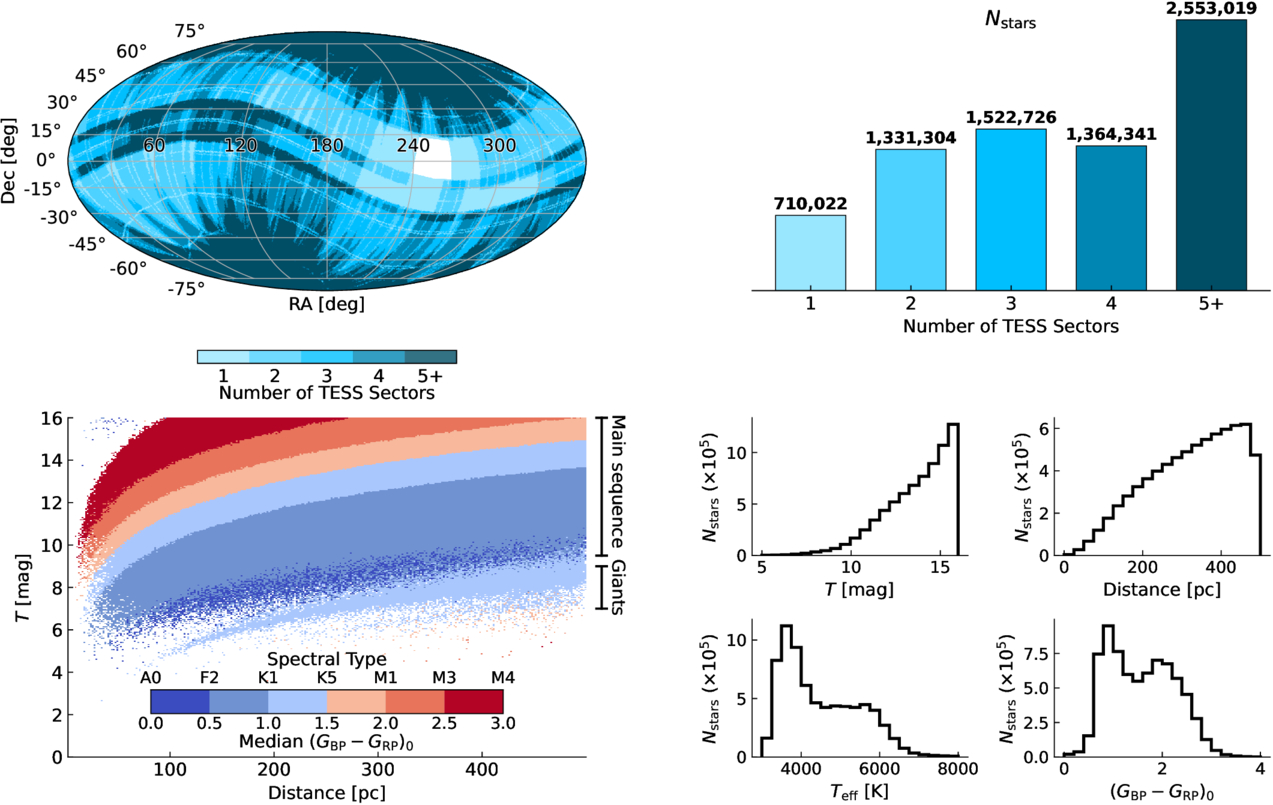
Target sample summary showing the TESS sky coverage (top left), histogram of number of TESS observations per star (top right), TESS magnitude as a function of distance to the star (bottom left), and histograms of magnitude, distance, temperature, and color across the sample (bottom right). Click to enlarge. [Boyle et al 2026]

Seeking to build a flux- and distance-limited catalog of TESS rotation periods, Andrew W. Boyle (The University of North Carolina at Chapel Hill) and collaborators used TESS full-frame images to survey the local neighborhood for stellar variability. To measure reliable stellar rotation periods for as large and diverse a sample as possible, the authors made selection cuts in brightness, distance, and data availability to build a target sample of 7,481,412 stars. They generated light curves for each observation of each star and searched them for periodicity, or repeated variation in brightness.

Not all brightness variations present in a star’s light curve are due to stellar variability — instrumental systematics and artifacts from the spacecraft’s orbital period can produce periodic variability. To combat this, the authors created a classification algorithm to select sources whose periodicity is most likely due to true stellar variability rather than instrumental or observational effects. Pairing this classification with some additional validation criteria, the authors built the TESS All-Sky Rotation Survey (TARS), a catalog of periods for 1,046,317 stars within about 1,600 light-years of our Sun.

Map of fast rotators in TARS sample

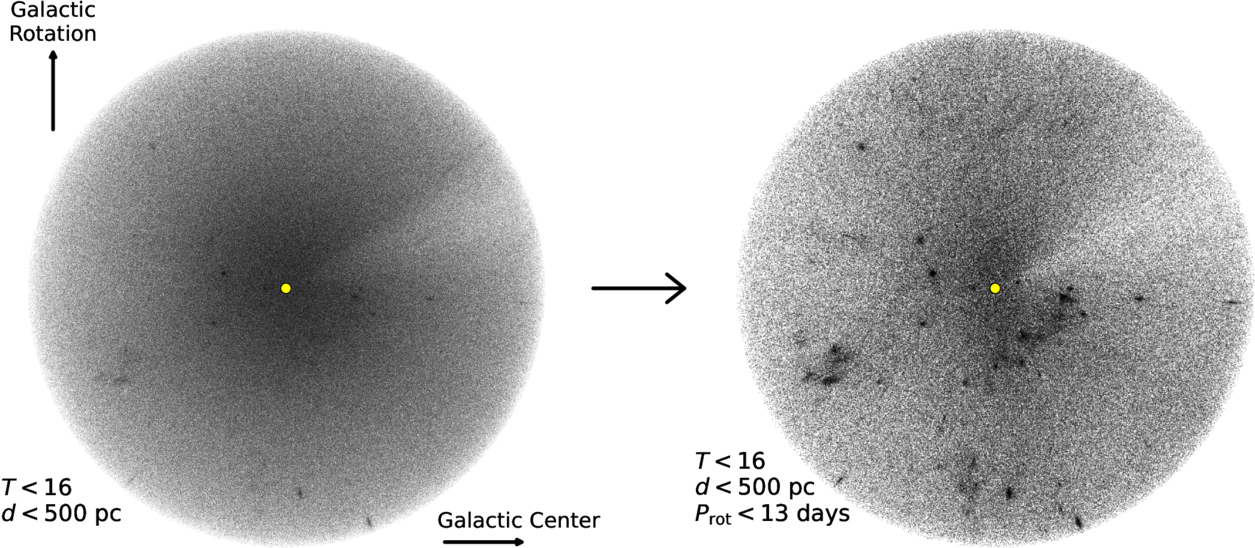
Map of all TARS stars within about 1,600 light-years of the Sun (left) and only the fast-rotating stars in the survey, highlighting clustered populations (right). Click to enlarge. [Boyle et al 2026]

Implications of TARS

Looking more finely at the TARS catalog, the authors provided additional quality cuts to remove other potential sources of stellar variability like binary companions or pulsations. The authors estimated that roughly 93% of their measured periods are due to stellar rotation, which expands the number of stars with known rotation periods by a factor of 2.3 within about 325 light-years and by a factor of 4.0 within about 1,600 light-years. As the largest homogeneous catalog of stellar rotation periods to date, TARS lays the groundwork for studies of stellar evolution, exoplanet discovery and evolution, and even Milky Way structure. For example, the authors found that when mapping the fast-rotating, typically younger stars in TARS, the location of young stellar associations in the local neighborhood became significantly clearer. This underscores the importance of this catalog for a range of science goals, and future work will only improve upon the data provided by TARS.

Citation

“The TESS All-Sky Rotation Survey: Periods for 1,046,317 Stars within 500 pc,” Andrew W. Boyle et al 2026 ApJS 284 75. doi:10.3847/1538-4365/ae6657

The post A New Catalog of Stellar Rotation Periods for Over a Million Stars appeared first on AAS Nova.

Simulations of Turbulent Mixing Close One Gap but Open Another

6 May 2026 at 17:00

illustration of a white dwarf surrounded by rocky debris

Nature sometimes behaves in ways that are difficult to recreate in simulations. New research tackles the computational challenge of turbulent mixing and rules out a commonly assumed source of data–model disagreement.

Mixing Up Stellar Interiors

What do Earth’s oceans, red giant stars, and white dwarfs have in common? These are all sites of thermohaline mixing, a form of turbulent mixing that takes place when there is a vertical gradient in both temperature and chemical composition. For example, in Earth’s oceans, water near the surface is warmer and saltier than water in the depths below, setting up an unstable situation prone to mixing.

thermohaline mixing simulation results

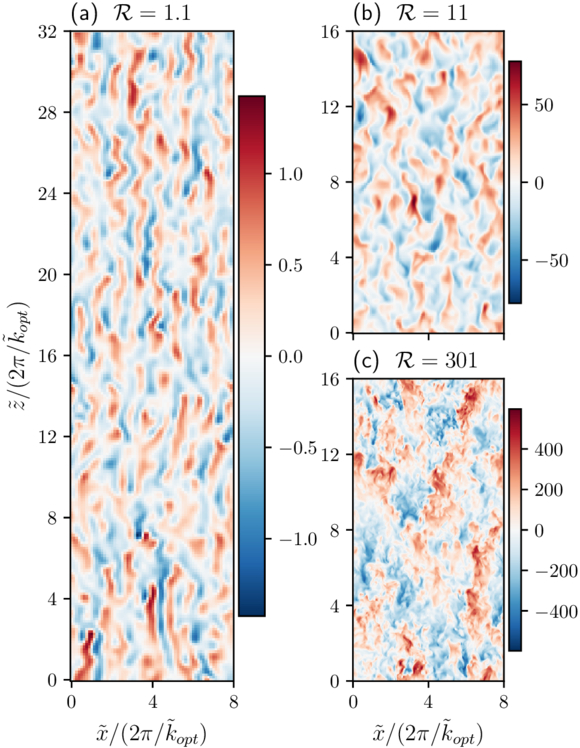
Examples of simulated thermohaline convection. These snapshots show the vertical velocity across a slice through the simulation volume. Click to enlarge. [Fraser 2026]

Thermohaline mixing has been explored in simulations to explain the evolution of red giants’ surface abundances, as well as how quickly rocky debris that accretes onto a white dwarf is absorbed into the star. However, effectively modeling this process in the interiors of stars has proven difficult.

One of the most important parameters for modeling mixing is the Prandtl number, Pr, which is the ratio of viscosity to thermal diffusivity (in other words, a way of describing whether momentum or heat diffuses more quickly within a fluid). For stellar interiors, Pr is around 10−6, but computational limitations have prevented modelers from setting this value lower than around 10−2. When tensions between models and reality arise, this gap between simulated and realistic Pr values is often assumed to be the source of the mismatch.

Bridging the Prandtl Number Gap

In a recent research article, Adrian Fraser (University of Colorado Boulder) aimed to test this assumption. Fraser carried out 3D simulations of thermohaline mixing, using a semi-implicit modeling technique that lowered the computational cost and allowed the simulations to probe Pr values of 10−1, 10−2, 10−3, 10−6, and 0.

comparison of simulations from this work and the benchmark model of thermohaline convection

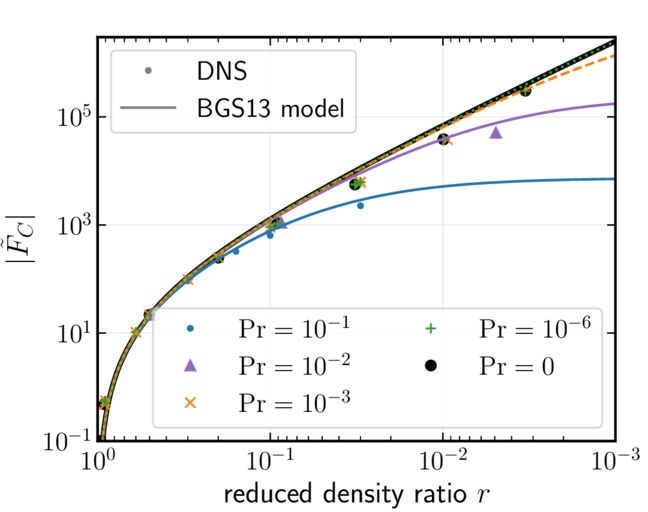
Turbulent compositional flux as a function of reduced density ratio for the simulations from this work (DNS) and the benchmark model of thermohaline convection (BGS13). Click to enlarge. [Adapted from Fraser 2026]

By comparing these results against a benchmark model of thermohaline mixing, this exploration showed that adopting a realistic value of Pr doesn’t dramatically change the dynamics of the system — meaning that data–model incompatibilities can’t be swept under a Prandtl number–shaped rug and must instead be resolved by including additional physics.

Recreating Reality

Where does this leave modelers attempting to recreate the reality of stellar interiors? First, a silver lining of this investigation: Fraser found that setting Pr = 0 delivered nearly identical results to Pr = 10−6. This suggests that valid results can be attained in a much less computationally intensive way, since setting Pr = 0 lowers the complexity of the simulation. While simulations with Pr = 0 may not be appropriate for all scenarios, including systems with strong magnetic fields, it may provide a way forward in certain situations.

For modeling of red giants and white dwarfs, Fraser suggested that incorporating magnetic fields, stellar rotation, or additional sources of mixing may resolve the current discrepancies. In fact, some modeling work has shown that magnetic fields could entirely close the gap between observations and models for red giant surface abundances — suggesting that bringing models and observations into agreement may be within reach.

Citation

“Bridging the Prandtl Number Gap: 3D Simulations of Thermohaline Convection in Astrophysical Regimes,” Adrian E. Fraser 2026 ApJL 1001 L22. doi:10.3847/2041-8213/ae5796

The post Simulations of Turbulent Mixing Close One Gap but Open Another appeared first on AAS Nova.

Water Vapor Around a Sizzling Supergiant: High-Resolution Spectroscopy of B[e] Supergiant LHA 115-S 18

17 April 2026 at 17:00

blue supergiant

Prior to exploding, massive stars advance through action-packed evolutionary stages that are exciting but often difficult to fully decipher. A recent study focuses on a unique late-stage star to better understand its properties and evolution.

To B[e] a Supergiant

HD 62623 disk image

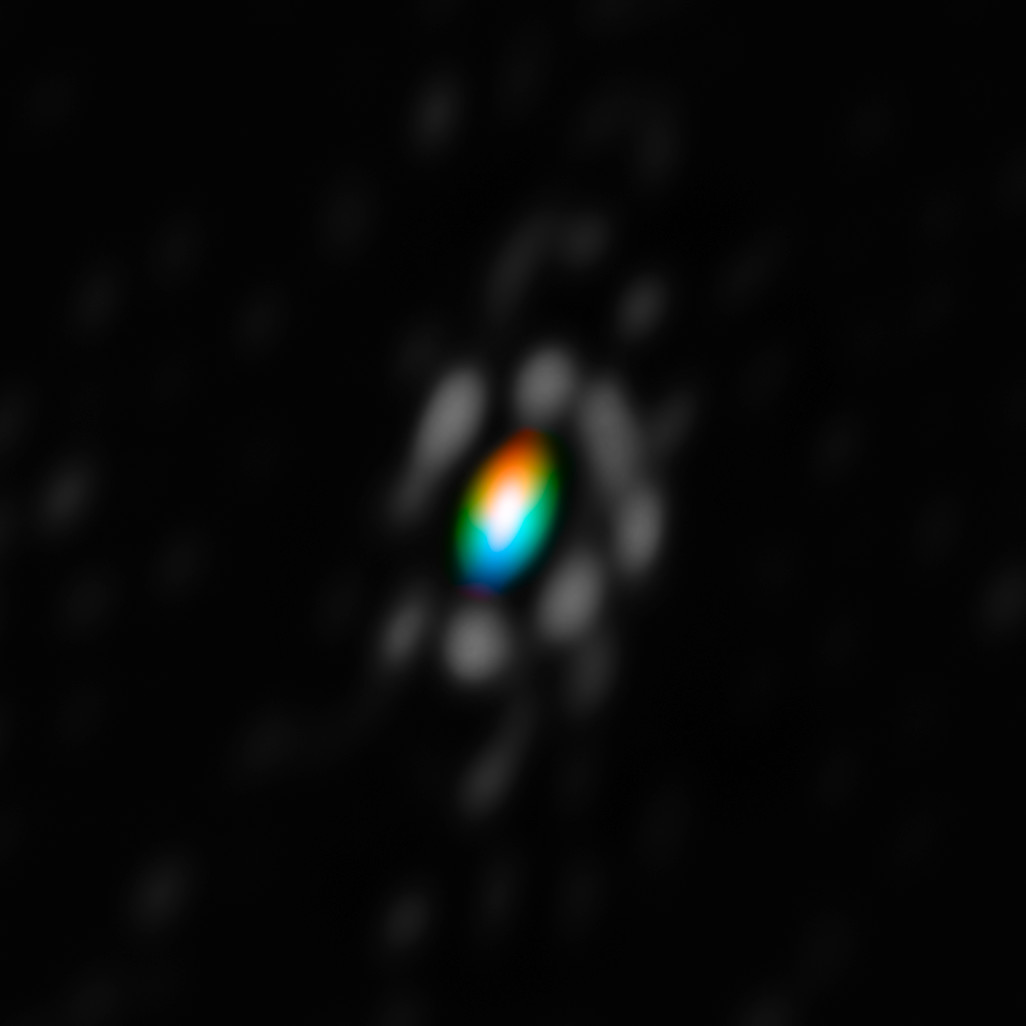
Very Large Telescope Interferometer image of the circumstellar disk around the B[e] supergiant star HD 62623. The colors indicate the rotation of the disk with blue coming toward us and red going away. [ESO/F. Millour; CC BY 4.0]

After depleting their cores of hydrogen, massive stars journey off the main sequence through a series of evolutionary phases before ending in dramatic supernova explosions. A massive star’s post-main-sequence evolution is intense, often sloughing off layers of material that can settle into a circumstellar disk. The B[e] supergiant phase describes a blue supergiant star surrounded by a cool, dense circumstellar disk where oxygen is more abundant than carbon. These environments often lock up carbon atoms in carbon monoxide molecules, leaving excess oxygen available to form other molecules including SiO, TiO, and water vapor. These molecules can survive under different physical conditions, making them key tracers of the environments around B[e] supergiants.

One particularly interesting B[e] supergiant, LHA 115-S 18, has been the subject of numerous studies but remains poorly constrained. The star exhibits significant variability both in brightness and emission features on timescales of days to years, and previous works have suggested that the star may have an as-yet unconfirmed binary companion. Molecular line emission from CO and TiO have been identified in LHA 115-S 18, indicating a circumstellar disk, but to date, water vapor emission has not been identified in any B[e] supergiant. Identifying more complex oxygen-bearing molecules like water will further reveal the physical properties and possible binary companion of LHA 115-S 18.

Identifying Emission in LHA 115-S 18

To characterize the emission around LHA 115-S 18, María Laura Arias (Institute of Astrophysics La Plata; National University of La Plata) and collaborators obtained high-resolution near-infrared spectroscopy of the star using the Immersion Grating Infrared Spectrometer on the Gemini South telescope. From the high-resolution spectra, the team identified several atomic emission lines indicative of the star’s gaseous envelope, revealing the structure of material around the star: an inner hot disk of ionized material and an outer cool disk of neutral material. Looking at molecular emission from carbon monoxide — a tracer of both gas motions and stellar age — the authors confirmed the presence of a rotating ring of gas around LHA 115-S 18 and determined that the star is an evolved, post–red supergiant object.

LHA 115-S 18 spectrum

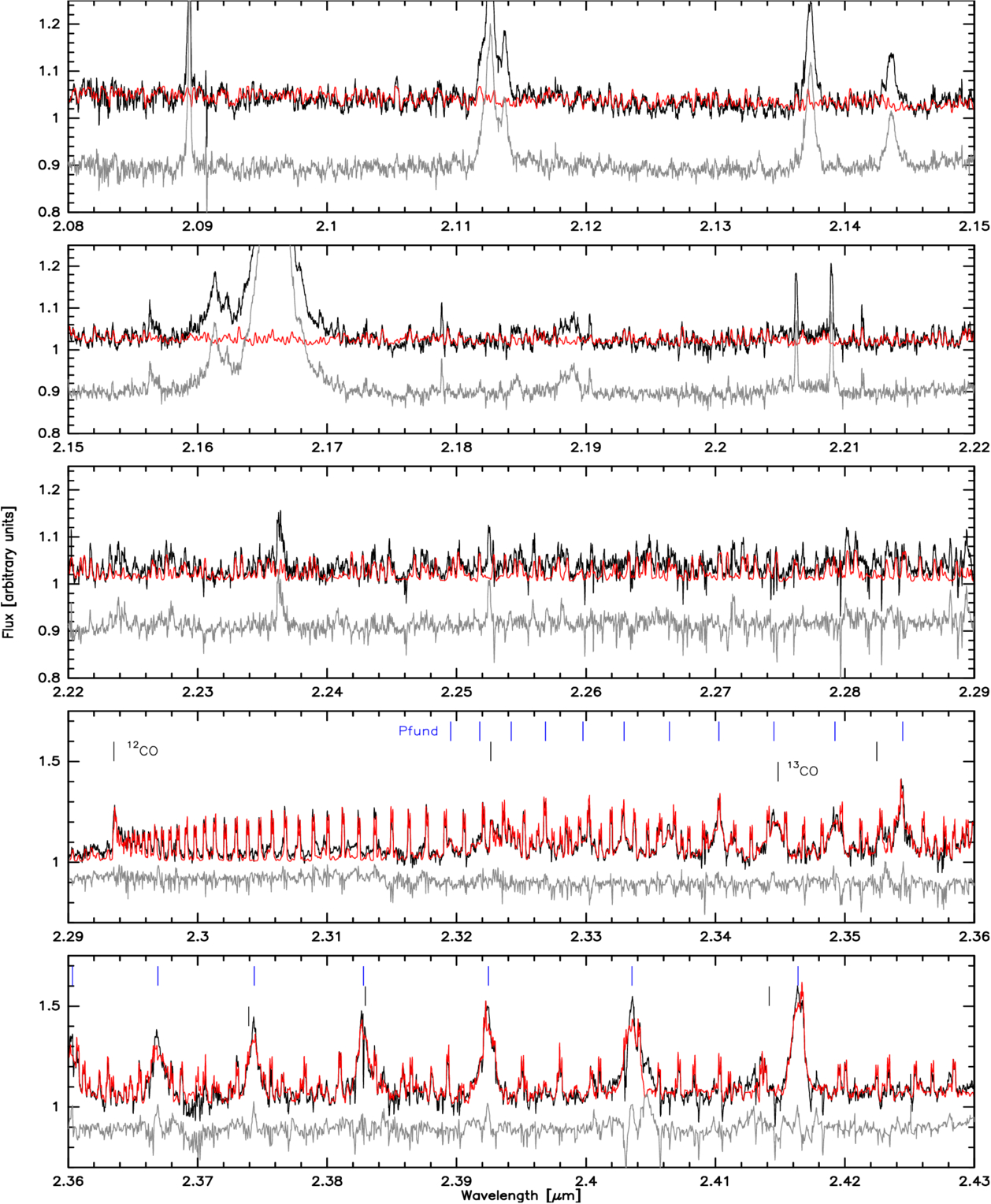
Spectrum of LHA 115-S 18 (black) with the model spectrum composed of water vapor (red, top three panels) and water vapor, CO, and hydrogen emission (red, bottom two panels) overplotted as well as residuals (gray). [Arias et al 2026]

Through computing a synthetic spectrum to compare to the observed spectrum, the authors identified many water vapor emission lines in the circumstellar environment around LHA 115-S 18. While water vapor has been detected in other evolved late-type stars, this is the first detection of water vapor from a B[e] supergiant star. For water vapor to survive the star’s intense radiation, it must exist in a dense, cool, heavily shielded disk around the B[e] supergiant.

Sustaining a cool disk around such a hot star indicates that the circumstellar environment around LHA 115-S 18 is complex and likely shaped by binary interaction. With emission features characteristic of both cool and hot evolved stars, this particular B[e] supergiant presents itself as a unique object holding critical insights into the late-stage evolution of massive stars. Further multiwavelength observations of LHA 115-S 18 will constrain its potential binarity and reveal a possible evolutionary link between B[e] supergiants and other late-stage evolutionary phases of massive stars.

Citation

“High-resolution Near-Infrared Spectroscopy of the B[e] Supergiant LHA 115-S 18: Discovery of Hot Water Vapor Emission,” María Laura Arias et al 2026 ApJL 1000 L49. doi:10.3847/2041-8213/ae524a

The post Water Vapor Around a Sizzling Supergiant: High-Resolution Spectroscopy of B[e] Supergiant LHA 115-S 18 appeared first on AAS Nova.

Featured Image: JWST Examines the Ring Nebula

2 June 2025 at 17:00

Ring Nebula

The iconic and widely photographed Ring Nebula is one of the most recognizable planetary nebulae: short-lived, often brilliantly colored nebulae that form when low- to intermediate-mass stars shed their outer layers. The three images above show the central region of the Ring Nebula through the eyes of JWST’s Mid Infrared Instrument. The leftmost image clearly shows the Ring Nebula’s central star: a hot, crystallized stellar core called a white dwarf. In a recent research article, Raghvendra Sahai (Jet Propulsion Laboratory) and collaborators analyzed these JWST observations, leading to the discovery of a dusty disk around the Ring Nebula’s central star. This is just the second time that a resolved disk has been discovered around the central star of a planetary nebula. Disks with radii from 0.01 to 1,000 au have been found around evolved stars in the asymptotic giant branch phase through the planetary nebula phase, but it’s not yet clear how these disks form and how long they last. Most intriguingly, the presence of disks around highly evolved stars raises the possibility of a second phase of planet formation. To learn more about the JWST observations of the Ring Nebula, and what they tell us about the properties of the central star and its disk, be sure to check out the full research article linked below.

Citation

“JWST Observations of the Ring Nebula (NGC 6720). III. A Dusty Disk Around Its Central Star,” Raghvendra Sahai et al 2025 ApJ 985 101. doi:10.3847/1538-4357/adc91c

The post Featured Image: JWST Examines the Ring Nebula appeared first on AAS Nova.

First Confirmed Planet in a White Dwarf’s “Forbidden Zone”

9 May 2025 at 17:00

white dwarf WD 1856+534

Using JWST, researchers have spotted a freezing cold 5.2-Jupiter-mass exoplanet orbiting an old white dwarf at a distance of just 0.02 au. With a temperature of 186K (−125℉/−87℃), this is the coldest exoplanet whose light has been directly detected.

The Fate of Sun-Like Stars

Low- to intermediate-mass stars eventually evolve into red giants and then white dwarfs: crystallized, superheated stellar cores that slowly cool and fade over millennia. What happens to the planets around stars that evolve into white dwarfs is an open question, one that can be answered by detecting and characterizing the planets that remain in these systems.

Planets orbiting at radii beyond 2 au are expected to weather their host star’s transition to a red giant, and dedicated searches for white-dwarf exoplanets have revealed a small number of planets at this safe distance. Observations have also begun to hint at planets orbiting white dwarfs more closely — within the “forbidden zone” thought to be scoured out by the host star’s transformation into a red giant — and researchers have now confirmed the presence of a planet eking out an existence extremely close to its white dwarf host.

Companion Detection

plot of infrared excess for WD 1856+534

Excess infrared emission of WD 1856+534b and WD 0310-688b, a planet candidate. The blue lines show the white dwarfs from the MIRI Exoplanets Orbiting WDs (MEOW) survey with no infrared excess. [Limbach et al. 2025]

The white dwarf WD 1856+534 is located roughly 82 light-years away. In 2020, researchers using data from the Transiting Exoplanet Survey Satellite and a handful of ground-based telescopes detected a Jupiter-sized object orbiting WD 1856+534 every 1.4 days at a distance of just 0.02 au — nearly 30 times closer than Mercury is to the Sun.

The original observations couldn’t discern whether the object, cataloged as WD 1856+534b, was a massive exoplanet or a low-mass brown dwarf. Now, a team led by Mary Anne Limbach (University of Michigan) has performed follow-up observations of the system. Using JWST’s Mid-Infrared Instrument (MIRI), Limbach’s team detected WD 1856+534b by subtracting a detailed model of the white dwarf’s flux from the observed flux. The object’s faint thermal glow was detected with an overall statistical significance of 5.7 sigma.

Temperature and radius of WD 1856+534b compared to other exoplanets and solar system planets

Temperature and radius of WD 1856+534b (yellow star) compared to several known exoplanets, solar system planets, and free-floating planets (FFPs). Click to enlarge. [Limbach et al. 2025]

Brown Dwarf or Planet?

By modeling this thermal emission, Limbach and collaborators definitively showed that WD 1856+534b is a planet. Its mass is likely around 5.2 Jupiter masses, though masses between 0.84 and 5.9 Jupiter masses are possible. With an exceedingly chilly temperature of just 186K — only 60K warmer than Jupiter — WD 1856+534b is the coldest exoplanet whose emission has been directly detected.

Because WD 1856+534b couldn’t have survived its host star’s transformation into a red giant at its current position, it must have migrated inward from a more distant orbit. The cause of this migration isn’t yet clear, though common-envelope evolution or gravitational nudges from another planet or star may have played a role. Upcoming JWST observations that probe WD 1856+534b’s atmosphere and search for other planets in the system could provide answers.

Citation

“Thermal Emission and Confirmation of the Frigid White Dwarf Exoplanet WD 1856+534 b,” Mary Anne Limbach et al 2025 ApJL 984 L28. doi:10.3847/2041-8213/adc9ad

The post First Confirmed Planet in a White Dwarf’s “Forbidden Zone” appeared first on AAS Nova.

Scientists Discover Two Strange Dead Stars That Defy Astronomical Expectations

White Dwarf Dead Star Superdense CoreResearchers say the isolated white dwarfs Gandalf and Moon-Sized define a new class of stellar remnant because they share five traits, including X-ray emission. Across the immense scale of the Universe, a single unusual object can prompt astronomers to look for others like it, sometimes leading to the recognition of an entirely new class of [...]
❌