
❌

Normal view

After 24 years, Return to Castle Wolfenstein is finally distributed uncut in Germany — game was censored due to strict laws regarding Nazi symbolism

9 August 2026 at 11:40

Some announcements arrive with fireworks, while others show up as a single easily missed tweet during a flurry of QuakeCon announcements to quietly close one of the longest-running oddities in PC gaming. After roughly 25 years, Return to Castle Wolfenstein (RTCW) is finally available in Germany in its original, uncut form. Bethesda Deutschland dropped the news amidst its QuakeCon announcements, bringing an end to a censorship saga regarding Nazi symbolism that stretches all the way back to the game's original 2001 release.

A Return to Castle Wolfenstein screenshot showing the Norway level and the submarine you board at the end.

The game's environments are surprisingly varied despite the relatively primitive technology in use. This level is set in Norway. (Image credit: Bethesda Softworks)

If you weren't around for PC gaming in 2001, it's hard to overstate how different the landscape looked. NVIDIA's GeForce 3 had only recently introduced programmable shaders to consumer graphics cards, the ATI Radeon 8500 was fresh competition, Windows XP was brand new, and legendary pioneers 3dfx had just disappeared after being acquired by NVIDIA. Broadband internet was becoming more common, but plenty of multiplayer sessions still happened over LANs, and a Pentium III or Athlon paired with 256 MB of RAM was enough to run one of the latest engine technology showcases.

Built on id Tech 3, perhaps better known as the tech that powered the incredible Quake III Arena, Grey Matter's Return to Castle Wolfenstein looked fantastic for its day, and it also inherited the series' unmistakable identity. See, ever since Castle Wolfenstein in 1981, and even more so after Wolfenstein 3D essentially invented the first-person shooter as we know it a decade later, the games have been about one thing above all else: shooting Nazis.

That identity created a problem in Germany. For decades, games depicting Nazi symbolism faced legal and regulatory hurdles that films did not, resulting in a heavily modified German version. In RTCW, swastikas disappeared, Nazi organizations were renamed, Heinrich Himmler became the fictional "Heinrich Höller," and references to the Third Reich gave way to the equally fictional "Wolf Clan."

At first glance, that sounds like the sort of censorship that simply strips away context, yet RTCW was already a strange game. The opening hours suggest a relatively grounded World War II action title. You wake up in a prison with a knife, you fight Nazis in a castle, and things seem normal for about a whole hour before rapidly veering into supernatural pulp. Within a few missions, you're fighting zombies, exploring haunted crypts, and watching the SS dabble in increasingly implausible occult experiments.

An RTCW screenshot showing the final boss, Heinrich I, flanked by several undead enemies.

The final boss Heinrich is barely mentioned before the end of the game, making him quite a surprise if you aren't paying close attention to the story. (Image credit: Alan Chan/MobyGames)

By the end, the final boss isn't Hitler (mech suit or no) or a secret superweapon, but Heinrich I, historically known as Henry the Fowler. He was a real 10th-century German king, supposedly resurrected in the game through dark ritual. He's also somewhat infamously a surprisingly manageable final boss, making for a finish both absurd and anticlimactic after the game's escalating parade of undead knights and bizarre experiments.

Seen through that lens, the censored version accidentally became a different story. Instead of Nazis attempting to exploit medieval occult power, it played more like an ancient secret society preserving itself across the centuries before trying to resurrect its long-dead founder. It's arguably a cleaner fantasy premise. The "Wolf Clan" makes more narrative sense once the game fully commits to gothic horror. However, it does make the opening chapters, where an OSS Ranger is somehow investigating a shadowy organization seemingly unrelated to the wider war, a bit awkward.

The catch, of course, is that it stops feeling much like Wolfenstein. The series' DNA is inseparable from infiltrating Nazi strongholds and sabotaging increasingly desperate attempts to turn the tide of World War II. Remove that element, and the title itself starts to feel like an artifact from another game series altogether.

A screenshot of a briefing screen from Return to Castle Wolfenstein, showing how detailed the mission briefings were.

These surprisingly detailed mission briefings had to be fully reworked for the German version of the game. (Image credit: Bethesda Softworks)

It's a curious example of something that occasionally happens with censorship across entertainment. More often than not, edits simply leave a work feeling diminished. Every so often, though, these constraints produce something unexpectedly memorable. The Texas Chain Saw Massacre owes much of its enduring reputation to how much horror it leaves to implication rather than explicit gore, and that decision was made due to the ratings board. Similarly, action film edits for TV often cut gory death scenes, which can ironically improve the pacing of the film.

Return to Castle Wolfenstein belongs in that same conversation, albeit for different reasons. The German version wasn't a better version of the game in any objective sense, but it accidentally shifted the genre. Instead of occult Nazis, it became a story about an ancient cult whose descendants had survived into the modern era. That's a premise that I personally find more appealing and even internally consistent, even if it comes at the expense of the series' defining theme.

A RealRTCW mod screenshot showing improved texturing and lighting over the base game.

The RealRTCW mod offers widescreen support and improved texturing and lighting over the base game. (Image credit: RealRTCW Team)

So, after a quarter of a century, German players can finally buy the same uncensored game that much of the rest of the world has had since 2001. It's ironic, and it's about time, too. While Germany relaxed its gaming rules in 2018, allowing modern entries like The New Order to go uncut in 2019, Grey Matter's 2001 classic remained stuck in censorship limbo until now. For game preservation, historical authenticity, and simple consumer choice, that's unquestionably the right outcome. Yet it also marks the quiet retirement of one of gaming's strangest alternate versions; a release that, through a combination of legal necessity and narrative coincidence, accidentally stumbled into telling a very different and potentially more compelling story.

Folks in Germany should now be able to pick up the uncensored version of the classic game on sale for just two dollars at Steam and GOG, or you can get a bundle that includes the original Wolfenstein 3D for just a dollar more. If you grab it, make sure to check out the RealRTCW overhaul mod that radically improves the game with modern features like proper widescreen support and cleaner OpenAL audio.

Atari ST Public Floppy Database now open for everyone — online archive originally designed for ST flash cart packed with classics and homebrew

8 August 2026 at 13:15

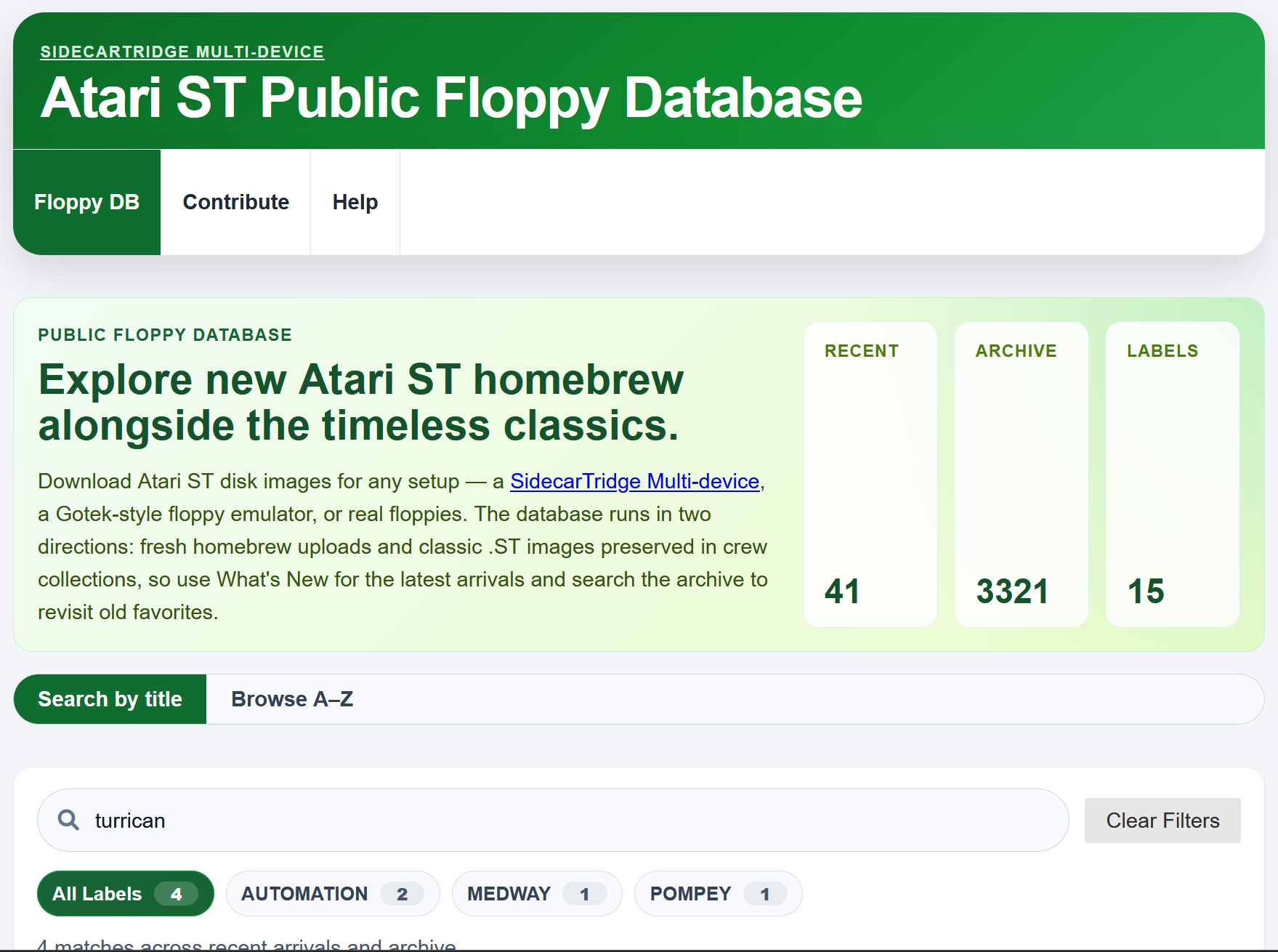
An extensive Atari ST floppy disk database can now easily be accessed by all netizens. Originally created to serve floppy images to the owners of the SidecarTridge multi‑function hardware add‑on for the Atari ST family (ST, STE, Mega ST, TT, Falcon), anyone can now browse, search, and download the .ST files to use with other hardware, emulators, or even to rewrite the disk images to actual floppies.

The Atari ST Public Floppy Database browser from the SidecarTridge Multi-device is now open on the web to everyone.Until now, searching that community-curated archive of floppy images meant firing up your Atari ST with a SidecarTridge Multi-device. The search lived inside the…July 21, 2026

After reading the announcement, I decided to check out the online repository. My favorite old platformer series was there, with more than one disk featuring the legendary Turrican and Turrican II releases. I also checked and confirmed public domain/shareware favorites like Gravity Force were available, as was Llamatron, and the mono high-resolution Bolo. Some things I looked for, like the Stupendous Demo, seemed to be missing, as were serious art and DTP tools I used to dabble with in the 90s.

Atari ST screenshots

(Image credit: Tom's Hardware)

The database is pleasingly new and regularly maintained, though. For example, it has 41 Atari ST disks flagged as recent arrivals. These are a mix of old releases being added, and some extremely new titles like new homebrew games, and a collection of demos released at Sommerhack 2026 just last month.

As indicated in the intro, this disk database was originally collated for direct access via hardware designed to bring several modern conveniences to those who still cling to original Atari ST-family computers. The SidecarTridge slots into the computer’s cartridge port, hence the name. It is much more than a ‘Gotek-style’ flash card floppy loader, though. This Raspberry Pi Pico W RP2040 microcontroller-powered device can also load different ROMs (the Atari ST’s entire OS and GEM desktop were loaded from ROM for super-fast,t no-disk-needed booting) via its microSD card slot. It also provides hard disk emulation, networking features (Wi-Fi for downloading Atari ST Public Floppy Database disks), access to RTC, and modern keyboards, mice, and other peripherals.

Microsoft Paint used as a 'monitor' to run Doom at up to 35 fps, project released by firm's Azure CTO — runs actual Doom engine and loads real shareware DOOM1.WAD

2 August 2026 at 15:14

Another day another Doom port, but the new DoomPaint stands out from the crowd for a few reasons. Firstly, it has been developed by Mark Russinovich, the Microsoft Azure CTO. Secondly, DoomPaint runs the actual original shareware Doom release using MS Paint as the monitor or viewport for in-game action. That’s different, and it is remarkable to read that the OLE clipboard hack behind this latest Doom escapade allows the game to run at a fair pace, up to 35 FPS, but might also sometimes be “spreadsheet-tier,” according to the author.

“The actual Doom engine (ViZDoom) runs the real shareware DOOM1.WAD — with the BSD-licensed Freedoom WADs covering the episodes shareware doesn't ship — and renders headlessly,” explains Russinovich on the project GitHub page. “Every frame is placed on the Windows clipboard and pasted into Paint's canvas as a genuine document edit.” The Microsoft CTO adds that the relatively low frame rate “is part of the charm” of DoomPaint, but 35 FPS isn’t bad, if you can make it, especially in 1990s PC gaming terms.

There are files, resources and instructions on how to run DoomPaint on the GitHub site. Depending on your machine you may be able to run this version of Doom at a full 35 FPS at 320 x 200, or even 640 x 400 pixels. It even includes sound and music.

Towards the end of the README file, Russinovich says that “Paint renders the game but does not compute it. Paint computes nothing. Paint has never computed anything. That's the joke.” DoomPaint is distributed under the MIT license.

Russinovich started at Microsoft in 2006, where he’s transformed SysInternals into the backbone of Windows diagnostics. More recently he’s shaped Azure’s architecture, security, and reliability. Over the past year he has, accidentally or by design, become well known as a leading voice behind addressing the many shortcomings of Windows 11.

It's therefore kind of surprising that this busy CTO has time to fiddle with projects like DoomPaint. However, the most dedicated coding and computer enthusiasts will also code and compute in their spare time.

Commemorative golden Doom floppy disks go up for pre-order — pair of limited edition dummy ‘imitation gold plating’ disks and a box are $30 at GameStop

2 August 2026 at 13:45

GameStop has listed a Doom Floppy Disk Limited Edition Imitation Gold Plated Replica at $29.99. Let’s unpick that for a moment. These are imitation floppy disks coated in imitation gold, delivered in a commemorative box. There’s a display stand included, too. However, these are non-functioning 'floppy disks' inspired by the Doom v1.2 shareware release and don’t contain any game data. Doom's single-level ‘Knee‑Deep in the Dead’ shareware release is still free to download, though, as it has been for many years.

Doom Floppy Disk Limited Edition Imitation Gold Plated Replica
GameStop and Fanattik
Doom Floppy Disk Limited Edition Imitation Gold Plated Replica
GameStop and Fanattik
Doom Floppy Disk Limited Edition Imitation Gold Plated Replica
GameStop and Fanattik

“What's more retro than obsolete technology?” asks Fanattik, the collectibles maker behind this useless physical media. “Celebrating the humble 3½-inch, 1.44 MB floppy disk that the game was originally released on back in 1993, this limited edition Doom Floppy Disk Replica plated with imitation gold comes in a box displaying the original game artwork, has a display stand included, and is individually numbered as one of 5,000 worldwide.” Pre-orders are now open at GameStop in the US for $29.99 or directly from Fanattik in the UK at £19.99.

The 89 x 89 mm dimensions of the golden-but-not-gold and 3.5-inch-but-not-floppies make them at least the correct size. However, if I were buying fake floppies, I think I would appreciate a movable protective sliding mechanism and the write-protect cutout toggle to move, so I could fidget with them from time to time.

Also, in some ways, it is ironic that game media is now being licensed and hawked to fans, at non-trivial prices, without any game data contained on them. This seems to be a growing trend as the games industry moves inexorably to a digital-only future. People still covet the physical media so much that they are now willing to pay for it, even without any game data or download code being associated with it.

The original Doom v1.2 shareware edition was released on two floppy disks in Feb 1994, and it is famous for adding modem support to this seminal game. If you paid and registered Doom v1.2, you would get four floppy disks from id Software containing the full three-episode campaign. The registered release disk set stayed on four floppies until the CD-ROM era.

97 untouched Duck Hunt and Super Mario Bros. cartridges worth thousands discovered in retro shop storage room — never-before-seen version of popular NES games include five perfect 10 PSA items

A retro shop owner based in Waukesha, Wisconsin, located some 15 miles west of Milwaukee, discovered that he was holding on to a rare stash of NES carts in his storage room. According to Nintendo Wire, these cartridges were never-before-seen versions of Duck Hunt and Super Mario Bros., which were some of the most popular games on the Nintendo Entertainment System. What’s more important is that these haven’t been opened, and the original owner said that these supposedly came directly from Nintendo of America. Their condition is so pristine that PSA (Professional Sports Authenticator) gave them extremely high grades of no less than 9.6, with five units getting the coveted perfect 10.

Kevin Braun, the owner of the retro shop OneStopWonders, said that a person sold him the cartridges years ago and that they’ve just been sitting untouched in his storage unit. The man said that his grandfather owned a business that recovered precious metals from circuit boards, and that this box was supposedly sold to him for salvaging. It’s unknown how it ended up in storage instead of recycling, but Braun bought it from the seller, thinking he could resell it in his shop for around $10 to $15 each.

Thankfully, he forgot about these cartridges until his friend and EIC of Nintendo Wire, Jason Ganos, got a chance to look at them. When he saw the carts for the first time, Ganos knew that he was looking at something special but didn’t realize how exceptional they were until he shared the find on a high-end gaming Facebook group. Two different people working as directors at different grading companies then reached out to him, telling him that there was something strange about these cartridges. They then asked for more photos of one cartridge and the manual and even told him to disassemble one unit for a deeper inspection.

This is where he discovered that these cartridges were some of the last produced units made during the 40th week of 1993. The manuals weren’t seen before, either, with the back page saying, “maintenance or service,” whereas previous known versions said, “maintenance or repair.” Because of these finds, he proceeded to take a flight to PSA in California early the next morning, where the grading company confirmed its authenticity.

It seems that the cartridges in the box were made as replacements for warranty repairs or refurbished consoles, or as part of a bundle that never saw release. We would never know which is true, though, unless Nintendo of America confirms why they were made. If you’re an avid collector or simply want to get your hands on an original Nintendo game that hasn’t been released, three carts will be auctioned off at Goldin Auctions starting August 12.

It’s unclear how much these carts will go for, but it’s estimated that they’d cost at least four digits, with the perfect 10s possibly hitting five digits. This is possible, given that an ultra-rare NES Gold Nintendo World Championships cartridge auction sat at $77,000 and probably sold for a much higher price. So, if you want to get your hands on this, you’d better have a war chest of at least $100,000 to guarantee that you can get one — just don’t blow on it if you insert it in your NES console and it doesn’t work for the first time.

❌