
❌

Normal view

GPS particle detectors track space radiation over two decades

24 July 2026 at 11:58

Researchers in China have cross-calibrated radiation detectors on 25 navigation satellites. Data from two decades of measurements have been combined to create a record of the flux of relativistic electrons that impinges on Earth’s atmosphere. The technique can be applied to other satellite data, and could boost our understanding of the threat that this radiation poses to satellites and shed light on the solar processes that generate the electron flux.

The Global Positioning System (GPS) uses signals from a constellation of satellites to locate the position of receivers on the Earth’s surface to within several metres. There are currently 32 GPS satellites orbiting about 20,000 km above the Earth and each of them carries a radiation detector. These detectors allow scientists to observe changes in radiation levels in space. Much of this radiation comes in the form of high-energy electrons from the Sun, which can disrupt the operation of satellites and even damage them.

The electron flux rises and falls with the solar cycle. This has a period of about 11 years and involves the waxing and waning of sunspots, solar flares and coronal mass ejections.

For those who design and operate satellites, it is crucial to understand this electron flux. However, it has proven difficult to make full use of the data generated by these detectors because the instruments had not been cross calibrated. Indeed, measurement values of high-energy electrons can vary between satellites by several orders of magnitude when the flux is low. One important issue is that not all satellites use the same detectors – with two different instruments having been deployed.

Cross calibration

Now, researchers in China have done a cross-calibration of the particle detectors on 25 GPS satellites. The result is a calibrated dataset of relativistic-electron flux that spans two complete solar cycles (2000–2020).

To do this, the team looked at two different measurements made by the detectors. One is the differential electron flux at 2 MeV arriving from one specific direction. The other is the integral electron flux electrons arriving from all directions at energies greater than 2 MeV.

Because electron flux is affected by Earth’s magnetic field, the team had to consider its effect on measurements. This was done using a concept called magnetic local time, which accounts for the fact that Earth’s magnetic poles are offset from our planet’s axis of rotation.

The team used a satellite called NS59 as the reference for their study because its detector has produced a consistent set of data from 2004 – overlapping in time all other satellites in the study. By doing several statistical analyses, the team was able incorporate data from 24 of the 25 satellites. One detector, however, remained problematic and the researchers recommend that data from this satellite not be used.

The team says that their technique can now be used to cross-calibrate the detectors at other energies – there are 14 differential and 29 integral channels that can be also be analysed. They have already used the same techniques to cross-calibrate the GPS data with measurements made by satellites in  China’s BeiDou positioning system  and observations made by NASA’s two Van Allen Probes.

The research is described in Satellite Navigation.

The post GPS particle detectors track space radiation over two decades appeared first on Physics World.
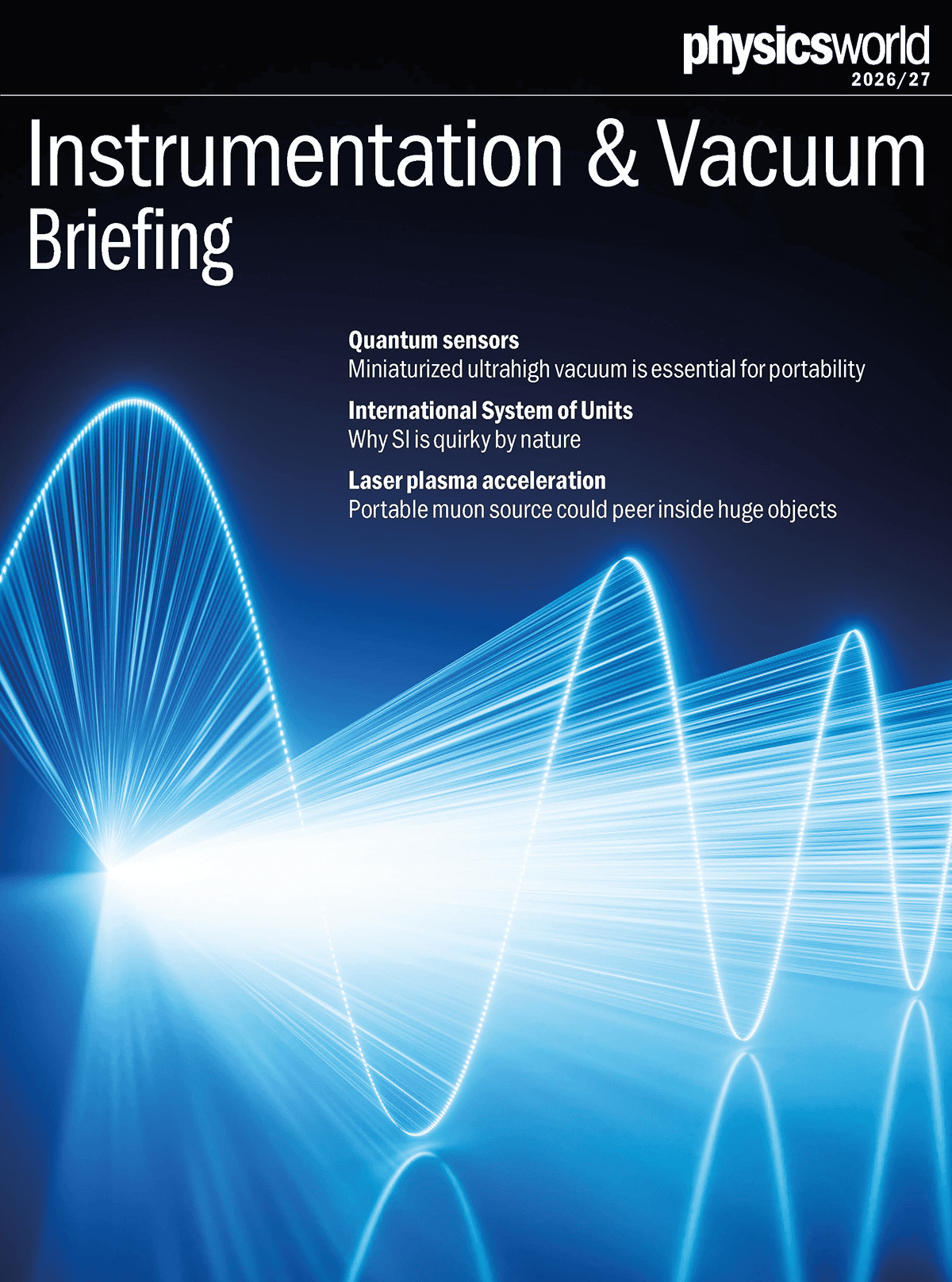
The 2026 Physics World Instrumentation & Vacuum Briefing is out now

15 July 2026 at 09:55

The free-to-read Physics World Instrumentation and Vacuum and Briefing 2026 is now available. It includes R&D updates, interviews that explore technology commercialization, and a fun look at the quirky side of SI units.

One topic covered in the briefing is the world of quantum sensors. Over the years, physicists have developed some amazing quantum sensors, but many of the technologies have stayed in the lab because of the challenges of miniaturizing key components. With ultrahigh vacuum (UHV) playing an important role in quantum sensors based on cold atoms, Florence Concepcion of the UK-based firm Aquark talks about her mission to reduce the size and energy consumption of UHV systems.

Elsewhere in the issue, we look at how manipulating individual living cells plays an important role in biology and medicine. Trouble is, cells tend to stick together when grown in vitro and separating them often involves using harsh chemicals that can damage cells or modify their properties. In a special interview, Luke Cox, who co-founded the UK-based firm Impulsonics, discusses its system that uses ultrasound to gently separate living cells.

Physics World Instrumentation & Vacuum 2026 coverAnother entrepreneur featured in this briefing is Brian Pogue, co-founder of DoseOptics. The US-based company has developed a system that detects the extremely faint Cherenkov light that is emitted when a radiotherapy beam strikes a patient’s skin. This allows the radiotherapy to be monitored in real time, ensuring that the beam passes through the target tissue and avoids healthy areas of the body.

Also included is a look at the use of intense laser light to accelerate particles. Find out how researchers in the US have created a compact, free electron laser that is driven by a laser plasma accelerator (LPA) – and it has also been used to create a beam of muons.

Finally, you can explore some of the curiosities of the International System of Units (SI), which is the bedrock of metrology. Although SI and its predecessors have been honed and re-defined over the centuries, it still has some surprising quirks. Ben Stein from the US National Institute of Standards and Technology explores some of these oddities including how the candela was derived from the brightness of a candle made from whale fat and beeswax – and the ongoing debate about using the dimensionless radian as the SI derived unit for planar angle.

The post The 2026 <em>Physics World Instrumentation & Vacuum Briefing</em> is out now appeared first on Physics World.

How AI is transforming human robots

8 June 2026 at 11:00

It was fantastic to see the men’s marathon world record being broken in London at the end of April when Kenya’s Sabastian Sawe became the first person to officially complete the run in under two hours. It’s an achievement that a whole generation of world-class runners had had their eyes on, with Sawe completing the race in a headline-grabbing 1:59:30.

Perhaps less attention was given to another achievement a week earlier, which saw a humanoid robot run the Beijing E-Town half-marathon in 50:26, breaking the human record by almost seven minutes. What’s particularly impressive is that at the inaugural event in 2025, the robot winner took 2:40:42 to complete the race, with many robot entrants failing even to reach the finishing line.

In just one year, in other words, the robot half-marathon record has been slashed by more than two-thirds, an unthinkable feat in human terms. What’s more, the rules between the first and second robotic competitions were tightened. They now favour robots that can run on their own (rather than via remote control) and penalize those that need to be taken off course to have their batteries changed.

Giant steps

My mind began spinning, trying to work out what must have happened over the past year to realize such advancements. How did we go from remote-controlled, slow and clunky robots to autonomous, agile and sleek devices? It turns out that these increases in speed and endurance have been driven by a combination of better hardware, specialized designs and advanced algorithms.

Robots now benefit from powerful actuators enabling higher torque and faster movement of its hips and knees. Anatomical designs have also been optimizied to mirror biological efficiencies by, for example, using lightweight limbs and lower torso components to minimize the energy lost when a robot’s foot strikes the ground.

Other changes include the use of liquid cooling technologies to stop a robot from getting too hot during prolonged activity and finding ways to mimic highly efficient natural bipeds, such as an emu or ostrich. Improved AI and control software have also allowed robots to navigate varied terrain and stay stable autonomously, rather than relying on remote operation.

AI answers

Of all these developments, I believe the most significant is the expanding use of AI. To me, it seems that AI will be the enabler for robots to become more “human”. In China, humanoid robots are already being developed to automate what is dubbed the hardest task in the car industry – the final assembly stage.

This work typically consists of real people carrying out highly labour-intensive tasks such as installing wiring harnesses, fitting a vehicle’s interior trim and instruments, or bringing its engine and chassis together. Being super-precise tasks that require manual dexterity, this work has previously been thought too complex for robots.

However, through a combination of imitation learning, simulation and real-time human guidance, it’s now becoming conceivable for robotic devices to do this kind of work. Underpinning this aspiration are what are known as  Vision-Language-Action (VLA) models, which process camera images together with natural language or text descriptions and translate these into physical actions.

Having emerged relatively recently from work at AI firm Google DeepMind, VLA models differ from traditional, task-specific programming robotics by offering generalization and the ability to handle novelty. They are seen as the next big thing in AI because they bridge the gap between understanding the world (vision and language) and interacting with it (action) – potentially letting robots do tasks they have not been explicitly trained on.

VLAs typically rely on existing Vision-Language-Models (VLMs), which provide a combined knowledge of text (large language models) and images (computer vision models). The VLA model is then fine-tuned on task-specific data to learn a mapping of visual observations and text instructions to create the desired robot action.

One challenge in training VLAs is getting enough data with appropriate visual and contextual information. It may be gleaned from real robots (imitation) but it can also be generated by human guidance or teleoperation – a manual process involving humans “showing” robots how to do a specific task. The task is time-consuming, having to be performed deliberately and repeatedly using equipment that captures appropriate levels of data quantity and quality.

A third option is to build virtual simulation environments to train the models and optimize robotic movements. As VLAs inherently learn to associate higher-level cognition with lower-level physical actions, the trend will be to move from fixed, pre-programmed scripts towards AI and large-scale simulation training. The result: robots that become more autonomous and versatile in real-world situations.

We are all getting used to AI becoming an increasing part of our everyday life – think how much GenerativeAI models have improved since they first appeared a few years ago. But I wonder what will be next for robots as they become capable of moving independently and spontaneously, having the ability to operate with full autonomy within dynamic human environments, such as homes and factories.

When we – eventually – experience the full physical embodiment of Artificial General Intelligence, will it be like living on the filmset of I, Robot or Blade Runner, with humans and humanoids coexisting and, in some cases indiscernible? Several years ago, this was something I did not expect to see in my lifetime. But in April it just got one giant leap – or at least one half-marathon – closer.

The post How AI is transforming human robots appeared first on Physics World.

New bolometer achieves sub-zeptojoule resolution

23 May 2026 at 12:57

A bolometer that can measure absorbed energy at a resolution of less than a zeptojoule (10−21 J) has been unveiled by Mikko Möttönen and colleagues at Finland’s Aalto University.  Their device could soon enable researchers to measure the energy of individual lower-energy photons – leading to new opportunities in quantum computing and information processing.

A bolometer detects radiation using two main components: an absorber, which heats up as it captures incoming radiation, and a thermometer, which converts this temperature rise into a measurable electrical signal. Bolometers are some of the most sensitive radiation detectors in use today.

Indeed, high-performance bolometers based on nonlinear oscillators, superconducting qubits or Josephson junctions are sensitive enough to detect individual microwave photons with energies of about 10−23 J. However, these devices are not able to resolve photon energies very well and only work over certain photon energy ranges.

Normal sandwich

A Josephson junction comprises a normal (non-superconducting) material sandwiched between two superconductors. Thanks to the proximity effect, superconducting Cooper pairs of electrons can penetrate some distance into the normal material. So, if the normal material is narrow enough, a supercurrent will flow across the junction.

“We started to build bolometers based on so-called proximity superconductivity around 2010 when I obtained my European Research Council Starting Grant,” says Möttönen.

In the team’s previous bolometer design, the normal material (a metal) absorbs photons, thereby increasing the temperature of the Josephson junction. This results in a shift in the impedance of the junction – and this shift is measured and related to the amount of energy absorbed. A key feature of this approach is the integration of the absorber and thermometer functions into a single structure.

In their latest study, Möttönen’s team has expanded their design to include multiple junctions. “We used gold-palladium (AuPd) and aluminium as the materials such that we can independently engineer the absorber part of the device from the thermometer part,” he describes. “We can optimize the strength of the superconductivity in the thermometer for high sensitivity.”

Impedance match

Their design consists of a AuPd nanowire (a normal metal), split into two segments. The first acts as an absorber and is tuned to match the impedance of the transmission line delivering microwave photons. This ensures that the highest possible amount of microwave power is transferred to the nanowire, across a broad range of photon energies.

The other nanowire segment acts as the thermometer. Superconducting aluminium islands are placed next to the nanowire, creating a series of Josephson junctions. By measuring inductance shifts across the junctions the team determined the energies of single photons at resolutions smaller than 1 zJ.

The researchers are hopeful that their design will be developed to create practical detectors of single lower-energy photons – and potentially other types of particle. This would be especially useful for calibrating the components of quantum computers.

“We will use this sensor in what I refer to as an autonomous quantum processing unit to measure qubits at millikelvin temperatures and feed back to information through millikelvin controllers and microwave sources,” Möttönen says. “This will dramatically reduce the price of quantum computers in the future.” The detector design could be also adjusted to receive telecom signals at the single-photon level – providing an ideal platform for the ultra-secure communication method of quantum key distribution.

The post New bolometer achieves sub-zeptojoule resolution appeared first on Physics World.

❌