
❌

Normal view

Launch Into a New School Year With NASA

10 August 2026 at 14:59
4 Min Read

Launch Into a New School Year With NASA

An illustration of two astronauts inside a spacecraft, looking at a screen that says "Back to School with NASA"

A new school year brings fresh opportunities to get involved with NASA. Whether you’re curious about space or eager to build real STEM skills, NASA offers a world of experiences putting you close to the action. As we enter a new golden age of exploration, there’s no better time to jump in, try something bold, and see where your curiosity takes you.

Gain Hands-On NASA Experience

NASA opens the door to authentic mission experiences through internships and student challenges. As members of the NASA team, interns work on genuine agency projects and gain industry-ready skills, all with the guidance of NASA mentors. Visit NASA’s internships website to learn more about current vacancies, deadlines, eligibility requirements, and more.

Through NASA’s student challenges and competitions, student teams tackle some of the critical technical hurdles facing mission planners. Flex your innovative muscles and sharpen your collaborative and problem-solving skills while developing, prototyping, and testing your team’s designs. Check out the full list of NASA STEM challenges and opportunities, choose one that fits your interests, and assemble your team.
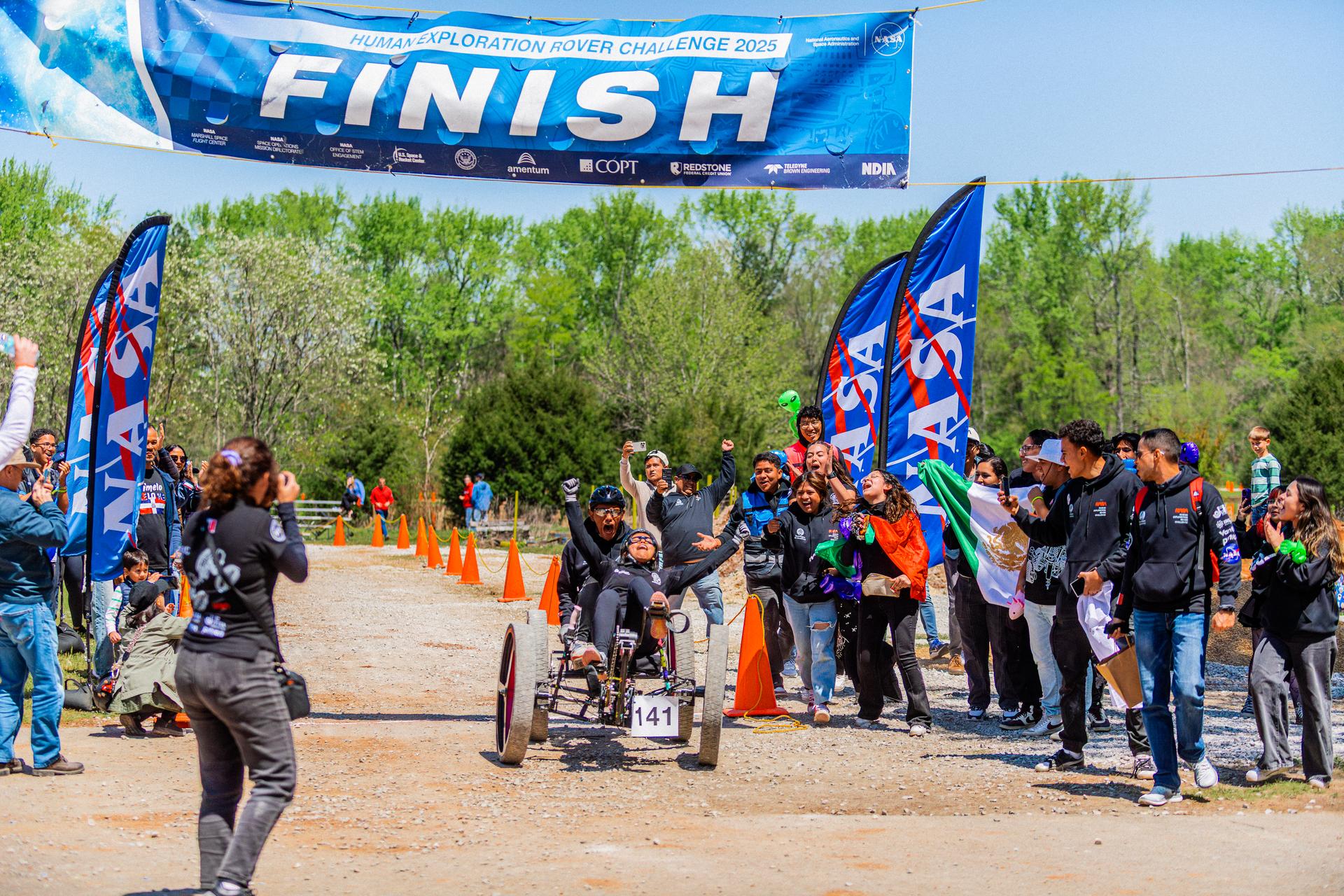
More than 500 students with 75 teams from around the world participated in the 31st year of NASA’s Human Exploration Rover Challenge (HERC) on April 11 and April 12, 2025, near NASA’s Marshall Space Flight Center in Huntsville, Alabama. Participating teams represented 35 colleges and universities, 38 high schools, and two middle schools from 20 states, Puerto Rico, and 16 other nations. NASA expanded the 2025 challenge to include a remote-control division - named Remote-Operated Vehicular Research - and invited middle school students to participate. Teams were awarded points based on navigating a half-mile obstacle course, conducting mission-specific task challenges, and completing multiple safety and design reviews with NASA engineers.
Students cross the finish line in their human-powered rover during the 2025 Human Exploration Rover Challenge at NASA’s Marshall Space Flight Center in Huntsville, Alabama
USSRC/Emily Riddle

Discover Technical Careers at NASA

The future of aerospace depends on a steady pipeline of skilled technical experts ready to make missions and ideas a reality. NASA invites students in high school, community college, and career technical education programs to join in-person and virtual events to explore these important career paths.
 
NASA Career Technical Education Days bring students on-site to meet NASA skilled technical workers who share what their jobs are like, how they built their careers, and the skills, training, and certifications that have helped them succeed. During NASA’s Next Gen STEM Virtual Career Connections , students interact live with technical experts supporting the agency’s missions. Students and teachers can learn more on the Next Gen STEM for Careers website.

A technician performs welding on a spacecraft transporter at NASA’s Kennedy Space Center in Florida.
NASA/Ben Smegelsky

Contribute to NASA Science as a Citizen Scientist

NASA’s Science Mission Directorate invites you to help make real discoveries through science projects powered by volunteers. Join from anywhere, whenever it fits your schedule, and start working with authentic mission data. Help identify comets and asteroids, hunt for binary star systems, and more. Find the project that’s right for you on the list of current citizen science projects.

Keep Up With NASA Missions and Discoveries

Don’t miss out on NASA’s biggest mission milestones this school year! Up first is the Nancy Grace Roman Space Telescope, scheduled to launch no earlier than 7:20 a.m. EDT on Sunday, Aug. 30. This powerful new observatory has a field of view at least 100 times larger than the Hubble Space Telescope. Be a virtual guest for launch and learn more about the telescope with fun activities provided by NASA’s Science Mission Directorate. You can also sign up to be a virtual guest for NASA’s next crewed launch to the International Space Station, SpaceX Crew-13, set to launch in September.

And be sure to follow NASA’s continuing crew training and hardware preparations for Artemis III. Set to launch into Earth orbit in 2027, the flight will test rendezvous and docking capabilities with commercial human landing systems – landers that will carry astronauts to the lunar surface on Artemis IV and future missions to the Moon.
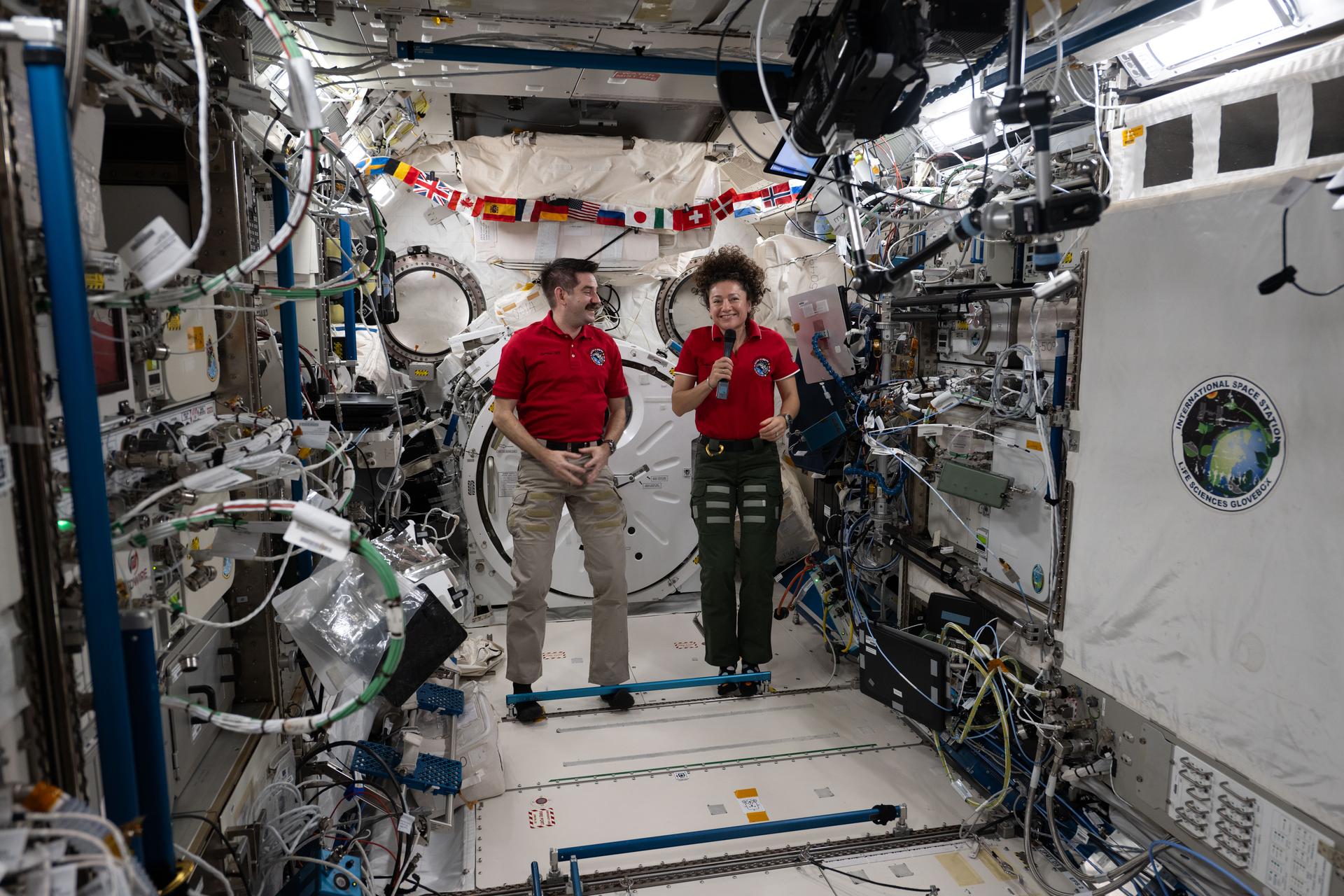
NASA astronauts Jack Hathaway and Jessica Meir, both Expedition 74 flight engineers, answer questions inside the International Space Station’s Kibo laboratory module during a live downlink event with Connecticut Public Radio. Hathaway is a native of South Windsor, Connecticut, while Meir is from Caribou, Maine.
NASA astronauts Jack Hathaway and Jessica Meir answer questions inside the International Space Station’s Kibo laboratory module during a live downlink event in May 2026.
NASA

Stay Engaged With NASA

Schools, classrooms, and community-based student groups have further options to engage with NASA and its people. Through In-Flight STEM Downlinks, students have their pre-recorded questions answered live by astronauts aboard the International Space Station, demonstrating how STEM careers reach far beyond Earth. Additionally, the NASA Engages public outreach program connects agency experts with student audiences to share mission and science updates, helping people discover how NASA’s work unfolds and how they can be part of the journey.

This school year, whether you’re interested in aerospace jobs or eager to dive into authentic STEM challenges, you’ll find an array of activities and career exploration tools on NASA’s Learning Resources website. Explore exciting NASA student opportunities and subscribe to the weekly NASA EXPRESS email newsletter for the latest NASA STEM opportunities and updates!

Ils recréent une recette vieille de 2 000 ans, ils l'appliquent sur une dent ...

9 August 2026 at 17:00
Des dents d'un noir profond, entretenues pendant toute une vie. Au nord du Vietnam, des crânes vieux de 2 000 ans viennent de livrer la recette : du fer, des tanins végétaux, et plusieurs semaines de patience. Une pratique esthétique que l'on croyait bien plus récente, et qui n'a jamais...

Patient bizarre : un cure-dent coincé au mauvais endroit provoquait des douleurs jusque dans sa jambe

8 August 2026 at 19:02
Au Japon, un homme de 67 ans a consulté son médecin traitant pour des douleurs à la fesse et à la cuisse droites, dont il souffrait depuis deux mois. Un scanner a révélé la cause de ces symptômes : un cure-dent coincé dans un endroit pour le moins inattendu.

Study explores long-term care residents’ experiences transitioning to emergency departments

2 August 2026 at 04:47

Long-term care residents moving from a nursing facility to an emergency department enter one of the most complex transitions in modern healthcare. The journey may begin with a sudden change in consciousness, breathing, mobility, pain, or behavior, but it quickly becomes a transfer of information, responsibility, and risk between institutions. A new qualitative study published in BMC Geriatrics examines how this cross-setting transition is experienced by the people involved, highlighting a vulnerable point in the healthcare system that is often treated as a routine logistical event.

The study, led by PC Hsu, LY.A. Chen, and YC Chen and colleagues, focuses on residents of long-term care facilities who are transferred to emergency departments. Unlike quantitative research, which typically measures outcomes such as admission rates, waiting times, or mortality, qualitative research investigates how individuals interpret and experience a process. Through this approach, researchers can identify communication breakdowns, conflicting expectations, emotional pressures, and practical barriers that may not appear in hospital databases.

For older adults living in long-term care, an emergency transfer can be medically necessary but physically and psychologically destabilizing. Many residents live with multiple chronic conditions, frailty, dementia, sensory impairment, or limited ability to communicate. These characteristics can make it difficult for them to describe symptoms, understand unfamiliar surroundings, or participate directly in decisions. The emergency department, meanwhile, is designed for rapid assessment and acute treatment, not always for the slower, highly individualized care needs of frail older people.

The transition also creates a handover challenge. Clinical information must travel with the resident, including medication lists, allergies, advance-care preferences, baseline cognitive and functional status, recent symptoms, and the reason for transfer. If any of this information is incomplete, delayed, or misunderstood, clinicians may have to reconstruct the patient’s history under intense time pressure. This can lead to duplicated tests, inappropriate medication decisions, delays in treatment, or care plans that fail to reflect the resident’s usual condition.

A central technical issue is the difference between a patient’s baseline and an acute change. A resident with dementia may appear confused in the emergency department even when their behavior is consistent with their usual state. Conversely, a subtle change in alertness or mobility may indicate infection, dehydration, stroke, or another serious condition. Without reliable baseline information from long-term care staff or family members, emergency clinicians may struggle to distinguish chronic impairment from delirium, a sudden disturbance in attention and cognition associated with substantial risks in older adults.

By examining experiences across care settings, the research addresses the concept of continuity of care. Continuity is not simply the transfer of documents; it includes consistency in clinical goals, communication, decision-making, and personal knowledge of the resident. A successful transition requires coordination among long-term care workers, emergency medical services, hospital clinicians, residents, and families. Each group may possess only part of the relevant information, making the quality of interaction between them as important as the technology used to transmit records.

The study’s qualitative design is particularly valuable because transitions are shaped by human factors. Staff may face time constraints, staffing shortages, unclear responsibilities, or different documentation systems. Families may experience anxiety when they are asked to make urgent decisions without a complete explanation of the resident’s condition. Residents may feel disoriented or powerless as they move between unfamiliar environments. Capturing these perspectives can reveal why formal protocols sometimes fail in practice, even when they appear comprehensive on paper.

The findings are relevant to a wider healthcare challenge: populations are aging while medical care is becoming increasingly fragmented. Long-term care facilities and hospitals often operate under separate administrative structures, with different workflows, electronic records, professional cultures, and performance measures. Emergency departments may focus on rapid diagnosis and disposition, whereas long-term care teams emphasize daily function, prevention, and quality of life. The transition between these systems can therefore become a vulnerable interface where important context is lost.

Improving that interface could involve standardized transfer forms, interoperable electronic records, direct clinician-to-clinician communication, clearer escalation pathways, and explicit documentation of a resident’s baseline function and care preferences. Yet the study’s focus on lived experience suggests that technical solutions alone may not be sufficient. Better transitions also depend on mutual understanding, shared accountability, and recognition that a transfer is not an isolated event but a continuum extending from the long-term care facility to the emergency department and back again.

As healthcare systems search for ways to reduce preventable harm among older adults, the experience of cross-setting transitions deserves greater attention. The study by Hsu, Chen, Chen, and colleagues places this often-overlooked process at the center of inquiry. Its subject is not merely how residents are transported, but how information, clinical judgment, dignity, and responsibility move with them. That perspective may help health services design emergency transfers that are safer, more coordinated, and more responsive to the realities of long-term care.

Subject of Research: Cross-setting care transitions of long-term care residents to the emergency department.

Article Title: The experience of cross-setting care transitions of long-term care residents to the emergency department: a qualitative study

Article References: Hsu, PC., Chen, LY.A., Chen, YC. et al. “The experience of cross-setting care transitions of long-term care residents to the emergency department: a qualitative study.” BMC Geriatrics (2026). https://doi.org/10.1186/s12877-026-08059-5

Image Credits: AI Generated

DOI: 10.1186/s12877-026-08059-5

Et si les Néandertaliens soignaient déjà les caries il y a 60 000 ans ?

25 July 2026 at 09:00
Il y a 60 000 ans, un Néandertalien s'est fait percer une dent pour soigner une carie. Découverte dans une grotte de Sibérie, cette molaire porte la plus ancienne trace d'intervention dentaire connue. Un geste précis, réalisé à l'aide d'une pierre taillée, qui bouscule encore l'image de nos...

AI companies want to water down Australia’s copyright laws. Artists are outraged, Labor is split

Anthony Albanese will deliver a landmark speech on AI this week as MPs are torn between attracting datacentre investment and protecting the rights of creatives

When Anna Funder stood before a pack of journalists at Parliament House this month, she presented herself not just as a writer but also a “victim of crime”.

The Stasiland author was using the analogy to illustrate how technology companies have flagrantly “hoovered up” her literary works for their own profit.

Continue reading...

© Composite: Victoria Hart/AAP/Getty Images

© Composite: Victoria Hart/AAP/Getty Images

© Composite: Victoria Hart/AAP/Getty Images

NASA Knows: What Is Mass Distribution?

9 June 2026 at 15:26
4 Min Read

NASA Knows: What Is Mass Distribution?

An outline of a soccer ball with Distribution of Mass title

This article is for students grades 5-8.

Mass distribution affects everything from galaxy shapes to aircraft design to planetary rotation. It’s used to map stars in our universe, figure out what planets are made of, and even to determine how luggage is loaded onto an airplane.

Mass distribution can be a tricky thing to understand. So, let’s explore it using an everyday example: a soccer ball.

How Does Mass Distribution Affect Center of Mass?

Have you ever kicked a soccer ball and wondered why it curves, spins, or sometimes wobbles? Mass distribution plays a part.

On the outside, soccer balls look simple – a series of geometric shapes woven together in a pattern. But on the inside, they are carefully engineered. The key to a great soccer ball is something you can’t see: how the mass is distributed inside the ball.

When engineers build a soccer ball, they try to make sure its mass is evenly balanced in all areas. This is because the way a ball spins and flies depends on how its mass is arranged. If one part of the ball is slightly heavier, its center of mass shifts. If the ball’s center of mass isn’t precisely balanced, the ball won’t move smoothly.

______________________________________________________________________

Words to Know

mass: the measurement of the amount of matter in an object

mass distribution: how mass is spread within an object

center of mass: the unique point around which the mass of an object is perfectly balanced

______________________________________________________________________

How Is Mass Distribution Measured?

Scientists and engineers use tools like precision scales, computer models, and repeated testing to determine an object’s mass distribution. These efforts help them design balanced airplanes, rockets, and even soccer balls. Their goal is to achieve dynamic balance, meaning the object can travel smoothly without unexpected movements.

How Does Gravity Affect How We Study Mass Distribution?

On Earth, gravity hides some of the details about how objects move. In microgravity, astronauts can observe motion more clearly. In 2019, Adidas partnered with NASA and sent soccer balls to the International Space Station.

Astronauts conducted tests to help engineers confirm their designs and understand the physics behind ball motion in ways they simply can’t on Earth. The results of the space station experiments have already helped improve the accuracy and consistency of modern soccer balls.

Try It Yourself

You don’t need to go to space to explore the physics of a ball in motion. Try this experiment at home or school:

  • Grab different types of sports balls (soccer ball, basketball, tennis ball)
  • Spin each one on the ground or between your hands
  • Watch for wobbling, flipping, or smooth spinning

Can you tell which balls are well balanced? Or which ones might have uneven mass distribution?

Career Corner

Are you interested in a career that explores the science and engineering of mass distribution? Many different occupations can help you strike the perfect balance. Here are a few examples:

Computer-Aided Design (CAD) Technician/Drafter: These specialists convert sketches and engineering designs into technical drawings. They use powerful computer software to create detailed 3D and 2D drawings of objects. A two-year associate degree from a technical or community college is key to this career path.

Computational fluid dynamics engineer: These engineers use computer simulation tools to model and analyze fluid behavior in real-world situations. They might study airflow around sport ball designs or explore ways to improve aircraft wings. They need a strong background in engineering and the ability to analyze complex problems.

Physicist: These scientists study matter and energy. They develop models and theories to explain how things work, conduct experiments, and use math to better understand the universe. A career in physics demands a strong understanding of math and complex problem-solving and usually requires an advanced college degree.

More to Explore:

The post NASA Knows: What Is Mass Distribution? appeared first on NASA Science.

NASA Knows: What Is Mass Distribution?

9 June 2026 at 15:26
4 Min Read

NASA Knows: What Is Mass Distribution?

An outline of a soccer ball with Distribution of Mass title

This article is for students grades 5-8.

Mass distribution affects everything from galaxy shapes to aircraft design to planetary rotation. It’s used to map stars in our universe, figure out what planets are made of, and even to determine how luggage is loaded onto an airplane.

Mass distribution can be a tricky thing to understand. So, let’s explore it using an everyday example: a soccer ball.

How Does Mass Distribution Affect Center of Mass?

Have you ever kicked a soccer ball and wondered why it curves, spins, or sometimes wobbles? Mass distribution plays a part.

On the outside, soccer balls look simple – a series of geometric shapes woven together in a pattern. But on the inside, they are carefully engineered. The key to a great soccer ball is something you can’t see: how the mass is distributed inside the ball.

When engineers build a soccer ball, they try to make sure its mass is evenly balanced in all areas. This is because the way a ball spins and flies depends on how its mass is arranged. If one part of the ball is slightly heavier, its center of mass shifts. If the ball’s center of mass isn’t precisely balanced, the ball won’t move smoothly.

______________________________________________________________________

Words to Know

mass: the measurement of the amount of matter in an object

mass distribution: how mass is spread within an object

center of mass: the unique point around which the mass of an object is perfectly balanced

______________________________________________________________________

How Is Mass Distribution Measured?

Scientists and engineers use tools like precision scales, computer models, and repeated testing to determine an object’s mass distribution. These efforts help them design balanced airplanes, rockets, and even soccer balls. Their goal is to achieve dynamic balance, meaning the object can travel smoothly without unexpected movements.

How Does Gravity Affect How We Study Mass Distribution?

On Earth, gravity hides some of the details about how objects move. In microgravity, astronauts can observe motion more clearly. In 2019, Adidas partnered with NASA and sent soccer balls to the International Space Station.

Astronauts conducted tests to help engineers confirm their designs and understand the physics behind ball motion in ways they simply can’t on Earth. The results of the space station experiments have already helped improve the accuracy and consistency of modern soccer balls.

Try It Yourself

You don’t need to go to space to explore the physics of a ball in motion. Try this experiment at home or school:

  • Grab different types of sports balls (soccer ball, basketball, tennis ball)
  • Spin each one on the ground or between your hands
  • Watch for wobbling, flipping, or smooth spinning

Can you tell which balls are well balanced? Or which ones might have uneven mass distribution?

Career Corner

Are you interested in a career that explores the science and engineering of mass distribution? Many different occupations can help you strike the perfect balance. Here are a few examples:

Computer-Aided Design (CAD) Technician/Drafter: These specialists convert sketches and engineering designs into technical drawings. They use powerful computer software to create detailed 3D and 2D drawings of objects. A two-year associate degree from a technical or community college is key to this career path.

Computational fluid dynamics engineer: These engineers use computer simulation tools to model and analyze fluid behavior in real-world situations. They might study airflow around sport ball designs or explore ways to improve aircraft wings. They need a strong background in engineering and the ability to analyze complex problems.

Physicist: These scientists study matter and energy. They develop models and theories to explain how things work, conduct experiments, and use math to better understand the universe. A career in physics demands a strong understanding of math and complex problem-solving and usually requires an advanced college degree.

More to Explore:

💾

Have you ever kicked a soccer ball and wondered why it curves, spins, or sometimes wobbles? NASA astronaut Jessica Meir aboard the International Space Statio...
❌