Login

ChatGPT Work and ChatGPT Classic
John Gruber, earlier this week:
When ChatGPT is attached to an open document in another app, it’s not a snapshot at the moment of attachment, like what you’d get by copying and pasting the whole thing into the chat, or by dragging the current version of the file into the chat. It’s a live ongoing attachment, so as the attached document/note changes, ChatGPT sees the changes. It’s such a great feature, and I don’t think it exists on any platform but the Mac. And it couldn’t exist on iOS, by design, doesn’t allow for inter-application communication.
OpenAI today announced ChatGPT Work, a ChatGPT agent with built-in Codex that can complete tasks across web, mobile, and desktop using information from your apps. ChatGPT Work can execute multi-step tasks, using scheduling to work independently. Like Claude Cowork, ChatGPT can use your computer to do tasks in the background across apps.
[…]
With OpenAI merging Codex and ChatGPT, there is a new ChatGPT desktop app that’s available across Mac and Windows. Users who have the Codex app installed can update it to turn it into the new ChatGPT desktop app. The existing ChatGPT desktop app is being renamed ChatGPT Classic.
You can watch today’s livestream announcement video below[…]
[…]
It’s possible to have ChatGPT Classic, ChatGPT, and Codex installed, but the way forward seems to be just running the new ChatGPT desktop app. Codex users can still use the Codex app icon, but the app will be called ChatGPT.
The ChatGPT Classic app looks more native Mac-like, so that might be an issue for users.
LOL @ OpenAI replacing the native AppKit ChatGPT app with the Electron Codex app after @gruber’s recent posts on the topic 😂
(It’s almost like Apple doesn’t have clear messaging on the right way to build native desktop apps anymore, and, if Apple doesn’t know, why on earth would third-party developers make that investment)
The rollout of the unified ChatGPT for Mac app really isn’t going well on X/Reddit 🥶
They kinda fumbled it and I think Anthropic did a slightly better job on first try. Even OpenAI’s existing iOS app makes more sense than their new Mac layout right now.
The difference between “normal” chatbot chats, Work/Cowork harnesses with connectors, and Code/Codex local threads and filesystem access is the new UX hell for these companies.
The chat experience is ChatGPT. Now it’s squirreled away in a sub section of a sub pane inside a vastly more-complex app. It’s hard to imagine anybody who actually wants to use ChatGPT wants to use it this way, Electron or not. And as a Codex user, I resent having my Codex deleted and renamed ‘ChatGPT’ instead. I don’t want my ‘chats’ anywhere near my ‘work’. This feels like a stupid move that will decimate casual ChatGPT desktop usage
Looks like I picked the wrong week to quit sniffing glue.
See also: Dithering.
Previously:
Update (2026-07-13): Tony Arnold:
Oh yeah, the new ChatGPT app is as bad as first impressions made it out to be. It’s not just a slow, RAM hungry shell of a thing, but the design and UX are a poorly thought out kitchen sink approach.
Codex has never been great, but this is a confusing mess.
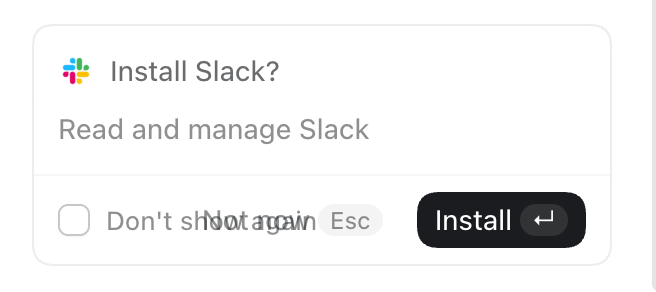
Wow, what a total mess. What is the difference between a project, a task and a chat? Why did chats get a crappy floating window but tasks and projects don’t? Why does choosing ‘plugins’ get me ‘templates’? Am I not allowed to finish ‘setup’ if I don’t use Slack or Google Drive? Why…
Via John Gruber (Mastodon):
OpenAI’s internal org chart is a complete disorganized mess. This new app perfectly reflects that.
The old ChatGPT app was focused. That’s the app that still ships for mobile (which includes iPad, which tells you whether OpenAI thinks iPad is a real computer or a big iPhone), and is, for some Mac users, left installed on their systems as “ChatGPT Classic”. The new app is an incredibly confusing sloppy mess. At a glance it looks like a polished app. But the UI is just slop. It has the veneer of a polished app without actually being organized or structured or labeled in ways that add clarity and coherence.
So I don’t see “the prompt in the app to download the new ChatGPT desktop app”. If I download the new app manually, I get a disk image. After mounting the disk image, the instructions say to double-click the “ChatGPT” app on the disk image — not to drag it to the Applications folder. If I do that while the old ChatGPT app is still running, it bounces back and forth a few times but nothing new gets installed and nothing old gets removed or renamed. I’m just left with the classic ChatGPT app, still named “ChatGPT”.
If I run the installer on the disk image when the old ChatGPT app is not running, the old app gets replaced by the new one in my Applications folder, and the old app is moved to the Trash. There is no app named “ChatGPT Classic”.
I mean, their Help document does say “the new app may install alongside your current app”, and “if both remained installed”, so they seem just as confused as I am.
Update (2026-07-14): Adam Engst:
And as much as I’ve been focusing more of my attention on Anthropic’s Claude because of concerns I have about OpenAI and its management, ChatGPT has more active users (~1.1 billion) than Google’s Gemini (~900 million), and many more than Claude (~245 million, in part because it’s more focused on enterprise uses).
As such, it’s worth noting three recent changes with ChatGPT: a massively confusing app replacement, the end of the ChatGPT Atlas Web browser, and improvements to ChatGPT Voice.
Update (2026-07-17): M.G. Siegler:
Let’s give OpenAI some credit, once they realize they made a mistake, they act quickly to correct it. Today’s case in point: with an update, ChatGPT now features ChatGPT once again. No, that’s not a joke, and yes, it does speak to a very obvious self-own.
How in the world did they ship this without sync?
[…]
Bringing back “chat” to ChatGPT is literally the least they needed to do. Hiding chat in an obscure corner of the interface from an app named “ChatGPT” would be like removing text editing from TextEdit.