❌

Normal view

Scientists Have Made a Sweet Discovery in Interstellar Space, Offering Clues to Mystery of Life’s Origins

15 July 2026 at 12:59

Scientists have discovered an abundance of molecules in the cosmos, but for the first time ever, they were able to detect one in interstellar space very familiar to us here on Earth: sugar. 

The discovery, made in the vast clouds of gas and dust between stars, could help scientists better understand how some of the chemical ingredients necessary for life formed long before Earth existed.

Researchers at the Centro de Astrobiología, part of the Spanish National Research Council (CSIC), identified the sugar molecule erythrulose within the interstellar medium.

Sugars are considered fundamental building blocks of life. On Earth, they play vital biological roles, including forming the backbone of RNA and contributing to the chemistry that ultimately supports DNA, while also serving as an important source of energy. Scientists studying the origins of life have long sought to understand how the first sugars formed, since they are essential ingredients in the molecules associated with life’s earliest development.

“The detection of erythrulose is very exciting because it opens up the possibility of discovering in space other sugars such as ribose, which is part of RNA, and other important molecules for the origin of life,” says Carlos Briones, co-author of the study, in a statement. 

Even so, one major question remains: where did the first biologically important sugars originate?

Previous studies have identified sugars such as ribose and glucose in meteorites and asteroid samples, suggesting that some organic compounds may have been delivered to the early Earth from space. Until now, however, no sugar had been directly detected in the cold molecular clouds where stars and planets form.

The newly identified molecule, erythrulose, was found in the molecular cloud G+0.693−0.027 near the center of the Milky Way. On Earth, erythrulose is a naturally occurring four-carbon ketose sugar.

The discovery was made using highly sensitive radio astronomy observations from the Yebes Observatory’s 40-meter radio telescope and the 30-meter telescope operated by the Institute for Radio Astronomy in the Millimeter Range. Researchers analyzed the unique radio signatures, or spectral fingerprints, emitted by molecules in space.

The team identified 12 spectral lines matching laboratory measurements of erythrulose, confirming the molecule’s presence.

The findings also challenge some existing ideas about how complex molecules form in space. Scientists have generally proposed that interstellar chemistry builds larger molecules by gradually adding carbon atoms. Yet erythrulose proved to be more abundant than related three-carbon sugars that researchers expected would appear first.

“This finding was unexpected, as the prevailing view in astrochemistry is that interstellar molecules grow in size through the sequential addition of carbon atoms,” said Izaskun Jimenez Serra (CAB), the lead author of the recent study. 

Instead, the researchers found that erythrulose could form inside icy dust grains from simpler two-carbon alcohols and aldehydes. These frozen environments may function as natural chemical laboratories, allowing increasingly complex organic molecules to develop over time.

The team estimates that during the Late Heavy Bombardment—roughly 4.1 to 3.8 billion years ago, when Earth experienced intense asteroid and comet impacts—between 500,000 and 50 million tonnes of erythrulose may have been delivered to the planet’s surface.

The discovery adds another piece to the puzzle of life’s origins, suggesting that some of its essential ingredients may have arrived with something surprisingly sweet.

This paper was published in the journal Nature Astronomy.

Chrissy Newton is a PR professional and the founder of VOCAB Communications. She currently appears on The Discovery Channel and Max and hosts the Rebelliously Curious podcast, which can be found on YouTube and on all audio podcast streaming platforms. Follow her on X: @ChrissyNewton, Instagram: @BeingChrissyNewton, and chrissynewton.com. To contact Chrissy with a story, please email chrissy @ thedebrief.org.

New Spectral Signs of Buckyballs Discovered in Planetary Nebula

24 June 2026 at 17:00

illustration of buckyballs in a planetary nebula

Fullerenes — a class of molecules composed entirely of interconnected carbon atoms — are the largest molecules definitively detected in space. Researchers using JWST to study a planetary nebula have found new spectral features from a fullerene composed of 60 carbon atoms, offering another way to study how these molecules form and survive in space.

Full of Fullerenes

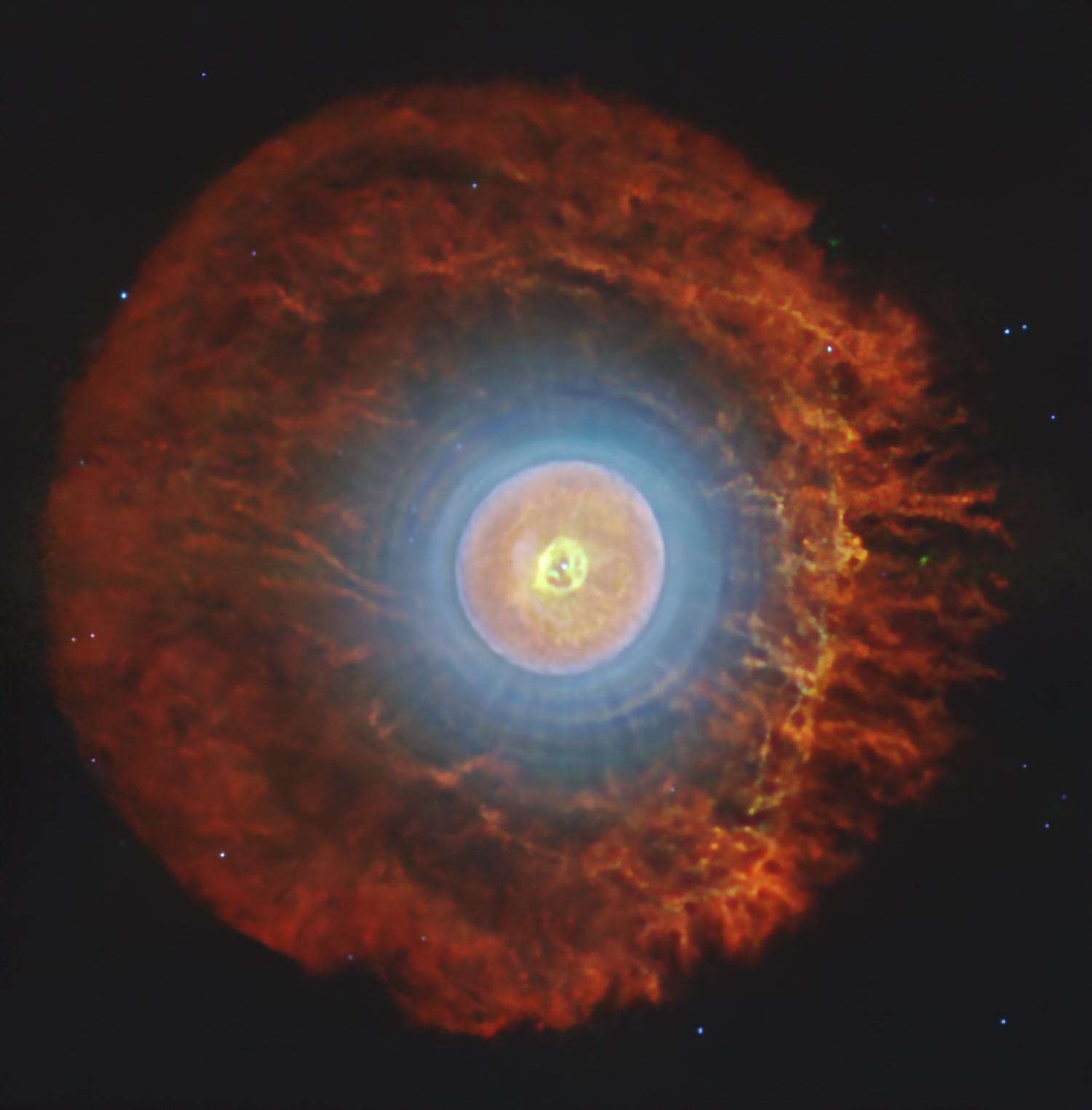
planetary nebula Tc 1

Planetary nebula Tc 1 as seen by JWST. [NASA / ESA / CSA / Western University, J. Cami]

The planetary nebula Tc 1 holds special significance in the field of astrochemistry. More than a decade ago, researchers using the Spitzer Space Telescope studied this wispy nebula illuminated by the core of a dead star. These observations led to the first confident identification of molecules called fullerenes in space. Fullerenes are large molecules constructed from interconnected rings of carbon atoms, forming hollow spheres, rugby-ball shapes, and long tubes. Spheroidal fullerenes, especially C60, are commonly referred to as buckyballs.

Since that discovery, Tc 1 has been a hot spot for studies of buckyballs. However, researchers are still puzzling over how these large molecules form and survive in harsh space environments.

closeup of planetary nebula Tc 1

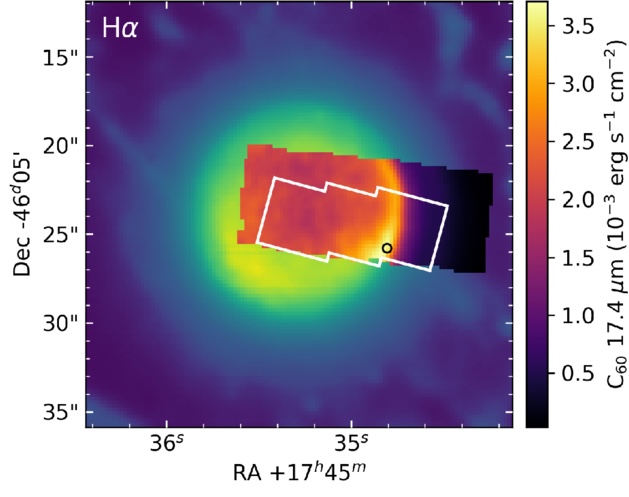
A closeup of the center of Tc 1, showing the region observed with JWST’s Mid-Infrared Instrument (black-to-yellow color scale) and Near-Infrared Spectrograph (white outline). The background color scale shows the nebula’s H-alpha emission as seen by the Very Large Telescope. [Adapted from Giese et al. 2026]

From Spitzer to JWST

Morgan Giese (The University of Western Ontario) and collaborators recently reported on the results of a JWST observing program that aimed to understand how fullerenes respond to changes in their environment. The team mapped the distribution of C60 molecules at varying distances from the powerful ionizing radiation of Tc 1’s central star.

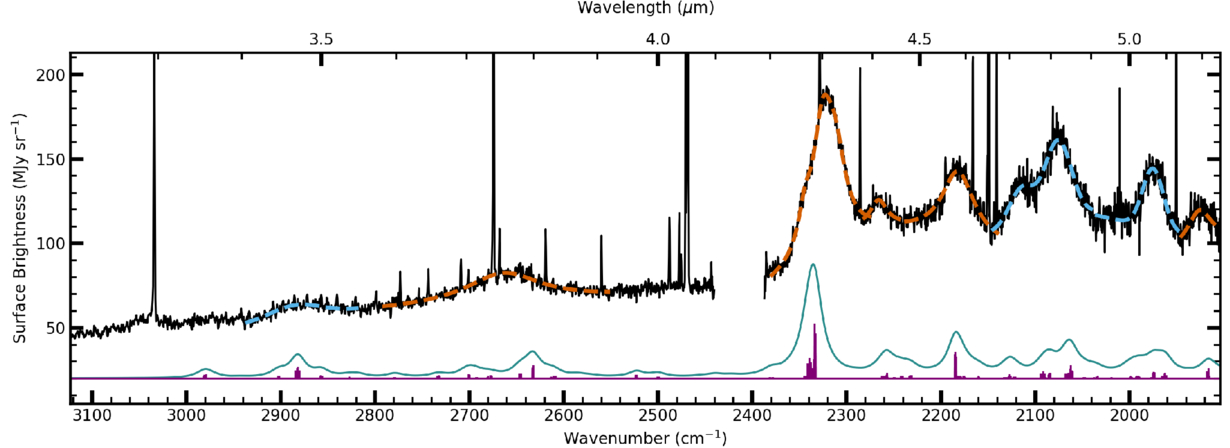
The team successfully spotted the emission features from the fullerene C60 seen in earlier observations, but they also turned up something unexpected: a handful of prominent emission features from 3.5 to 5.2 microns that had not been reported previously.

Feature Presentation

What’s the source of these emission features? The distribution of the emission provides a strong clue: known spectral features from fullerenes C60 and C70 are concentrated in a narrow, bright ring around the center of the nebula, with diffuse emission suffusing the rest of the nebula — and the newfound spectral features follow the same distribution.

JWST spectrum of Tc 1

JWST spectrum of Tc 1 (black line) extracted from the area indicated by a black circle in the previous image. The orange and blue dashed lines show fits to the newfound emission bands, and the results of the anharmonic calculations are shown as the teal line below the JWST spectrum. Click to enlarge. [Giese et al. 2026]

This evidence hints that C60 or C70 is the source of these new features, but Giese’s team took the investigation a step further. Using anharmonic quantum chemical calculations, they computed the spectrum of C60‘s combination bands, which arise when multiple vibrational modes are excited at the same time. This is the first time this type of spectrum has been calculated for C60, and the authors found good agreement between their computed spectrum and the JWST spectrum, providing further evidence that C60 is the source of these bands.

Giese and coauthors found that 17% of the energy emitted by the C60 molecules in Tc 1 is released in these  combination bands, suggesting that these features must be taken into account when modeling the cooling of C60 molecules. The discovery of new fullerene spectral features also has implications for future studies of these molecules: since these features appear in a wavelength range where features from other complex molecules like polycyclic aromatic hydrocarbons are weak, these newly identified bands provide a promising way to spot and study fullerenes across space environments.

Citation

“Detection of C60 Combination Bands in the Near-IR Spectrum of Tc 1,” Morgan M. Giese et al 2026 ApJL 1004 L32. doi:10.3847/2041-8213/ae76d5

The post New Spectral Signs of Buckyballs Discovered in Planetary Nebula appeared first on AAS Nova.

Featured Image: A Spiral Cloud in the Milky Way

22 June 2026 at 17:00

image of a multicolored nebula

The image above shows a newly discovered molecular cloud. This cloud was discovered through the Milky Way Imaging Scroll Painting project, which uses a 13.7-meter millimeter telescope to survey molecular clouds in our galaxy. Xuepeng Chen (Purple Mountain Observatory; University of Science and Technology of China) and collaborators came upon this cloud in survey data from a region of the Milky Way opposite the galactic center. The newfound cloud is roughly 5,400 light-years away, spans an area of 245 by 294 light-years, and contains an estimated 80,000 solar masses. The most remarkable feature of the cloud is its structure: it appears to have a central cavity, an elliptical disk-like body, and spiral arms. Chen’s team has suggested that the cloud owes its surprising structure to density wave theory — the same process thought to govern the formation of spiral arms in galaxies — but other possibilities such as collisions between molecular clouds can’t yet be ruled out. To learn more about the properties of this unusual molecular cloud, be sure to check out the full research article linked below.

Citation

“Discovery of a Giant Spiral Molecular Cloud in the Galactic Anticenter,” Xuepeng Chen et al 2026 AJ 172 4. doi:10.3847/1538-3881/ae6800

The post Featured Image: A Spiral Cloud in the Milky Way appeared first on AAS Nova.

Mapping a Molecular Building Block in a Pre-Stellar Core

13 February 2026 at 17:00

Taurus Molecular Cloud

To probe the chemistry of cold pre-stellar cores, researchers investigated Lynds 1544 and made the first-ever spatially resolved map of methanimine — a simple molecule that may be involved in the formation of amino acids in space — in this environment.

Astrochemistry at Work

chemical structure of methanimine

The chemical structure of methanimine, CH2NH. [Ben Mills]

Peering across the galaxy, astronomers have discovered a broad and growing array of molecules, revealing the rich chemistry taking place everywhere from molecular clouds to protoplanetary disks. A central question in astrochemistry is where, when, and how molecules form in space, and how molecules might survive the various phases of star formation and be incorporated into newborn planetary systems, where they could play a role in the construction of complex organic molecules necessary for life.

Today’s research article, led by Yuxin Lin (Max Planck Institute for Extraterrestrial Physics), focuses on a molecule called methanimine (CH2NH). CH2NH is the simplest molecule in a class of nitrogen-containing compounds called imines, and it’s thought to be an important stepping-stone in the creation of amino acids.

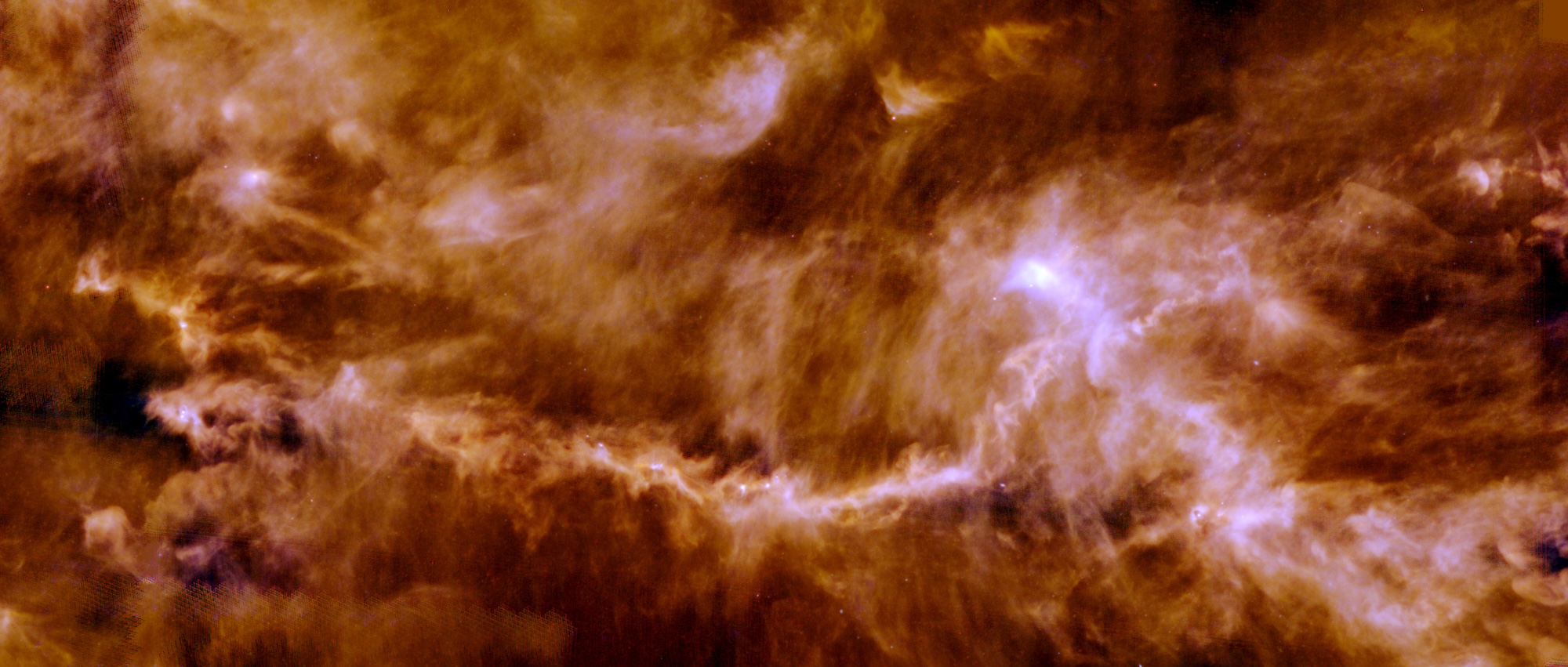
Taurus Molecular Cloud

A Herschel Space Observatory view of the Taurus Molecular Cloud, where L1544 resides. This star-forming region is about 450 light-years away. [ESA/Herschel/PACS, SPIRE/Gould Belt survey Key Programme/Palmeirim et al. 2013]

First Spatially Resolved Map

Lin and collaborators searched for CH2NH within Lynds 1544 (L1544), a pre-stellar core in the nearby Taurus Molecular Cloud. Pre-stellar cores — condensed, gravitationally bound clumps of cold gas within a molecular cloud — represent an early stage in the process of star formation, just before the gas collapses to form a protostar.

L1544 has been the subject of many astrochemical investigations, and previous studies have revealed that it contains a complex, chemically differentiated envelope surrounding a dense core in which many chemical species have frozen out onto dust grains, leaving the gas depleted of these species.

Using the Institute for Radio Astronomy in the Millimetre Range 30-meter radio telescope, Lin’s team mapped the distribution of CH2NH across L1544. This isn’t the first time that CH2NH has been detected in a cold pre-stellar core, but it’s the first time that the molecule has been mapped in a spatially resolved way in such an environment. This allows researchers to compare the distribution of CH2NH to other molecules in the core and build an understanding of the chemistry behind its formation.

The Chemistry of CH2NH

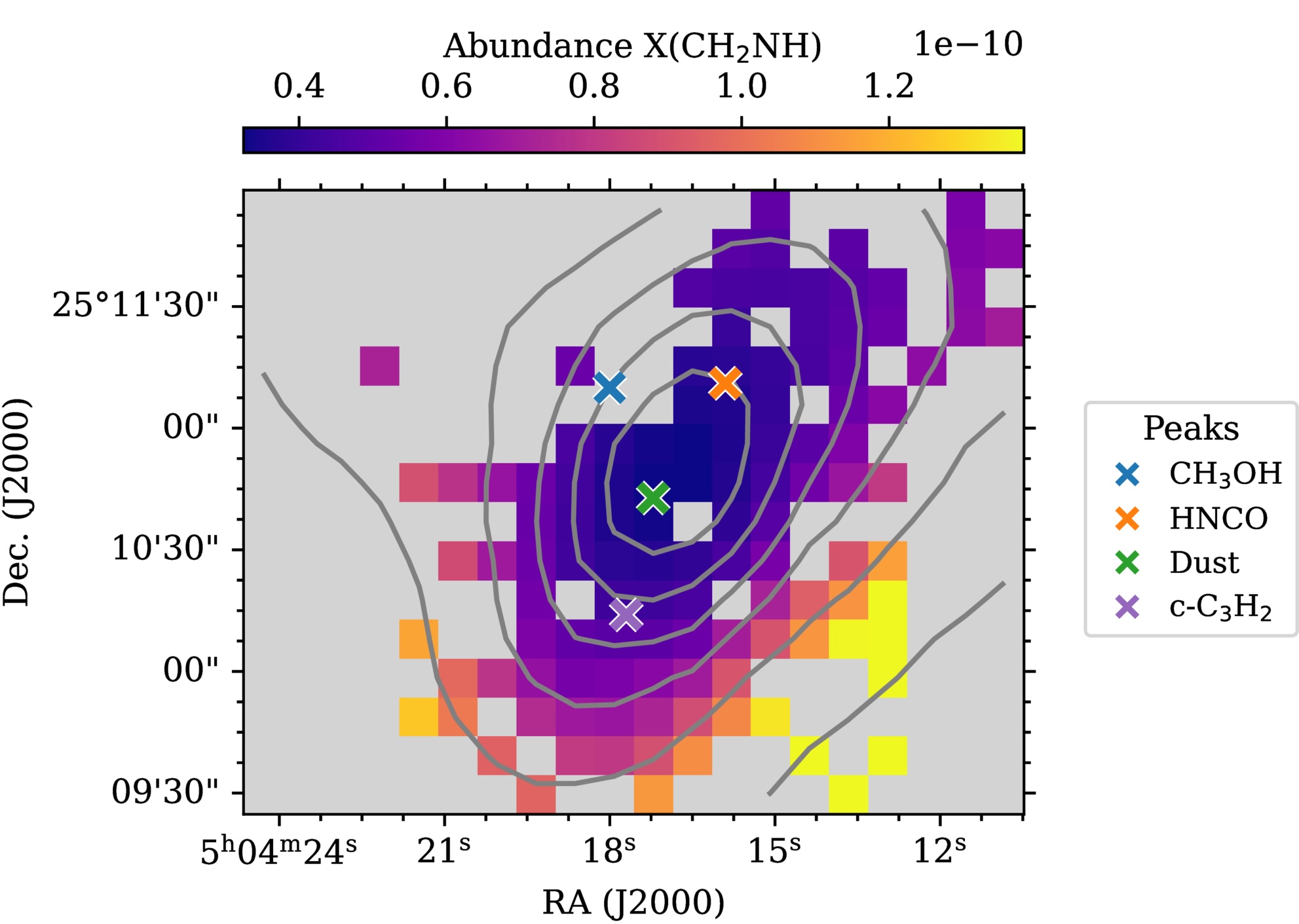
abundance of methanimine in L1544

Abundance of CH2NH in L1544. The contours indicate the column density of molecular hydrogen. The crosses show where the emission from other chemical species is at its peak. Click to enlarge. [Adapted from Lin et al. 2026]

The new observations show that CH2NH can be found throughout L1544, with clear spatial trends in the molecule’s abundance: higher near the outer layers of the core, lower near the center. Using chemical models to aid their analysis, Lin’s team showed that the observed distribution suggests formation pathways driven by moderate amounts of ultraviolet radiation.

In the outer layers of the core, where the gas is less dense, ultraviolet light creates reactive chemical species called radicals that can spur the formation of CH2NH. In the interior of the core, dense gas prevents the incursion of ultraviolet light. This means that few radicals are created that can help form CH2NH molecules, and the molecules that do form tend to freeze out onto dust grains, disappearing from the gas.

The discovery of CH2NH throughout L1544 suggests that the precursors to complex organic molecules can form during the cold, calm pre-stellar core phase of star formation, allowing these molecules to be inherited by nascent planetary systems.

Citation

“First Mapping of Prebiotic Molecule CH2NH in a Prestellar Core,” Yuxin Lin et al 2026 ApJL 996 L32. doi:10.3847/2041-8213/ae2c76

The post Mapping a Molecular Building Block in a Pre-Stellar Core appeared first on AAS Nova.

Featured Image: Hubble Revisits the Crab Nebula

9 February 2026 at 17:00

Hubble Space Telescope image of the Crab Nebula

In 1999–2000, the Hubble Space Telescope captured what was then the most detailed image ever taken of the Crab Nebula. In the quarter-century since the release of that image, the nebula — the remnant of a star observed to explode as a supernova in July 1054 — has been slowly unfurling and changing as the ejected stellar material expands into space. Now, as reported in a research article by William Blair (Johns Hopkins University) and collaborators, astronomers have turned Hubble’s inquisitive eye toward the Crab Nebula once again. One of the new images is shown above (click for the full view!). By comparing the new and old Hubble images, Blair’s team uncovered dramatic changes in the nebula’s intricate filamentary structure. These changes are due to the nebula’s three-dimensional expansion as well as evolution in the density of its knots and filaments. To learn more about the new Hubble portrait of the Crab Nebula, be sure to check out the full article linked below.

Citation

“The Crab Nebula Revisited Using HST/WFC3,” William P. Blair et al 2026 ApJ 997 81. doi:10.3847/1538-4357/ae2adc

The post Featured Image: Hubble Revisits the Crab Nebula appeared first on AAS Nova.

Featured Image: JWST Expands the Search for Extragalactic Supernova Remnants

29 September 2025 at 17:00

Out to what distance can we resolve the structure of a supernova remnant in the infrared? Until recently, it was only possible to do so for remnants in the Milky Way and the Magellanic Clouds, but JWST has now extended that capability to other nearby galaxies. In a recent research article, Sumit Sarbadhicary (The Ohio State University) and collaborators used JWST to study supernova remnants in the Triangulum Galaxy (Messier 33), a small spiral galaxy that is 2.7 million light-years away. The study area contained 40 supernova remnants that were previously identified at other wavelengths. The image above shows a portion of the galaxy’s southern spiral arm, where each white circle indicates a known supernova remnant. Infrared observations of supernova remnants are critical for understanding the physics of the interstellar medium and the composition, formation, and destruction of dust. To learn more about how JWST has pushed the limits of our search for extragalactic supernova remnants, and for details on each of the remnants detected by JWST in the Triangulum Galaxy, be sure to check out the full research article linked below.

Citation

“A First Look at Spatially Resolved Infrared Supernova Remnants in M33 with JWST,” Sumit K. Sarbadhicary et al 2025 ApJ 989 138. doi:10.3847/1538-4357/adec7a

The post Featured Image: JWST Expands the Search for Extragalactic Supernova Remnants appeared first on AAS Nova.

Written in the Gas: Jet Feedback in a Voorwerp Galaxy

18 July 2025 at 17:00

NGC 5972

Editor’s Note: Astrobites is a graduate-student-run organization that digests astrophysical literature for undergraduate students. As part of the partnership between the AAS and astrobites, we occasionally repost astrobites content here at AAS Nova. We hope you enjoy this post from astrobites; the original can be viewed at astrobites.org.

Title: Jet-Mode Feedback in NGC 5972: Insights from Resolved MUSE, GMRT, and VLA Observations
Authors: Arshi Ali et al.
First Author’s Institution: Savitribai Phule Pune University
Status: Published in ApJ

Voorwerp Galaxies as Laboratories for Active Galactic Nuclei

Supermassive black holes are believed to reside at the centers of nearly all massive galaxies. As supermassive black holes accrete matter, they can release enormous amounts of energy in the form of radiation, winds, and relativistic jets — powering active galactic nuclei and influencing their host galaxies. This process, known as active galactic nucleus feedback, can regulate star formation and the properties of the gas in the interstellar medium, making it a key mechanism for shaping how galaxies form and evolve over cosmic time.

Of the many diverse manifestations of active galactic nuclei, radio “loud” galaxies stand out as powerful laboratories for studying feedback in action. Not only do these galaxies have characteristic [O III] emission lines, but they also host intense radio-emitting lobes of gas that extend well beyond the structure of the galaxy, indicative of jets. (Today’s article refers to these lobes as the extended emission-line region or EELR.)

Originally discovered by a schoolteacher, Voorwerp galaxies are a special category of radio galaxies that are candidate sites of active galactic nucleus activity in terms of their emission-line signatures. Moreover, they exhibit intriguing clouds of ionized gas that may have originated from jets. Figure 1 shows some examples of Voorwerp galaxies. Exploring these galaxies can shed light on how jets interact with the interstellar medium, a major player in active galactic nucleus feedback.

trio of Voorwerp galaxies

Figure 1: Voorwerp galaxies are compelling laboratories for exploring the interaction between jets and the interstellar medium. Examples are Hanny’s Voorwerp (left), NGC 5972 (middle), and the Teacup Quasar (right). [NASA, ESA, W. Keel (University of Alabama), and the Galaxy Zoo Team; NASA, ESA, and W. Keel (University of Alabama, Tuscaloosa); NASA, ESA, and W. Keel (University of Alabama, Tuscaloosa)]

Today’s article focuses on the physical and kinematic properties of one particular Voorwerp galaxy, NGC 5972. This galaxy is interesting for its bizarre, helical structure of ionized gas, as well as hints of a rich history of active galactic nucleus activity. Could jet feedback have played a significant role in the evolution of this galaxy?

Evidence for Relativistic Jets in NGC 5972

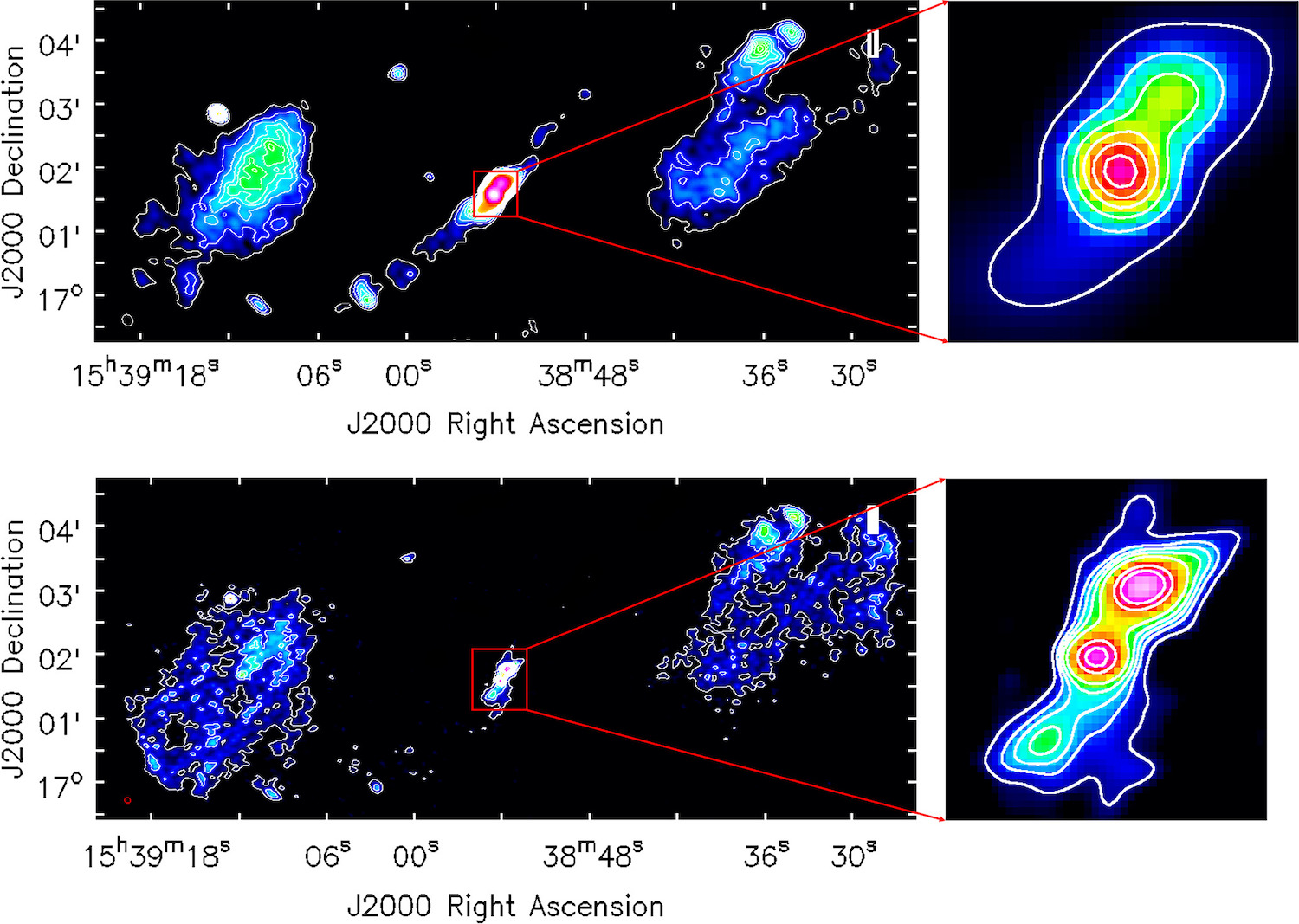
To study the interstellar medium of the Voorwerp galaxy, the authors combined observations from multiple instruments that probe different phases of the galaxy’s gas. Specifically, they used data from the Very Large Telescope (VLT), the Giant Metrewave Radio Telescope (GMRT), and the Very Large Array (VLA) to create maps of the ionized gas emission, allowing them to trace the structures and movement of the gas and jet material. Together, these datasets offer a comprehensive, multi-wavelength view of how the radio jet shaped the surrounding interstellar medium. The maps of NGC 5972, shown in Figure 2, display an impressive spiraling structure that could be the result of prolonged active galactic nucleus activity.

radio emission of NGC 5972

Figure 2: The radio emission of NGC 5972 reveals the extended helical, spiral structure of the ionized gas, where the inner jets are connected to the outer lobes (top: VLA, bottom: GMRT). This suggests that the intriguing shape of NGC 5972 could have originated from active galactic nucleus jets. [Ali et al. 2025]

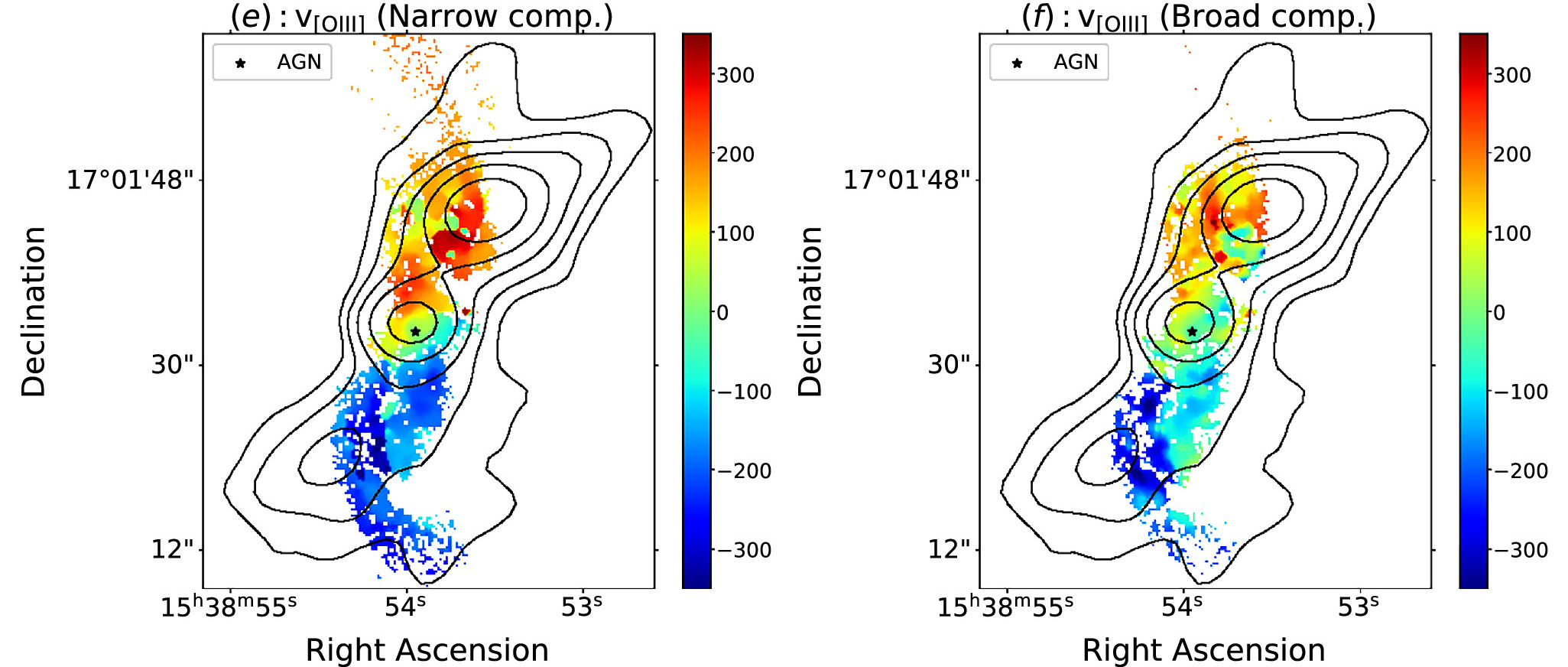
When the authors examined the extended emission-line region, they found that the velocity profiles (shown in Figure 3) are closely aligned with the direction of where we would expect to find a radio jet. The enhanced velocities around the jet region likely represent gas that is outflowing due to feedback. The expected amount of energy from a radio jet would have been capable of driving outflows at these velocities.
velocity profiles of the OIII emission lines

Figure 3: The velocity profiles of NGC 5972’s [O III] emission lines, a characteristic signature of the active galactic nucleus’s extended emission-line region. The velocities are aligned and enhanced along the jet axis, indicating that active galactic nucleus feedback influenced the gas by powering jets and outflows. [Adapted from Ali et al. 2025]

While the structure and movement of the ionized gas give promising hints of jet feedback, astronomers use a tool called Baldwin–Phillips–Terlevich (BPT) analysis to figure out what exactly is ionizing the gas. By comparing the ratio of different emission lines, we can categorize whether the galaxy’s gas was primarily ionized by radiation from an active galactic nucleus, stars, or other processes. The results of the BPT analysis are shown in the left panel of Figure 4.
sources of ionized gas in NGC 5972

Figure 4: The left panel shows the ionizing sources of the gas in NGC 5972. While the gas along the jet axis is ionized by radiation from the active galactic nucleus (orange in the diagram), the regions transverse to the jet are ionized by shock waves (blue). Moreover, the gas in the jet regions is more turbulent, as shown in the right panel. [Adapted from Ali et al. 2025]

In the case of NGC 5972, the radio jet is mostly ionized by radiation from the active galactic nucleus! However, the gas perpendicular to the jet shows a different signature — one that matches shock waves rather than strong radiation. In addition, the gas in the shock region is more turbulent (right panel of Figure 4). This suggests that the radio jet is not just a byproduct of the active galactic nucleus — it actively disturbs and heats the surrounding gas by way of shocks. This dual process of jet-induced shocks creates a richer picture of how supermassive black holes interact with the interstellar medium.

Putting the Story of NGC 5972 Together

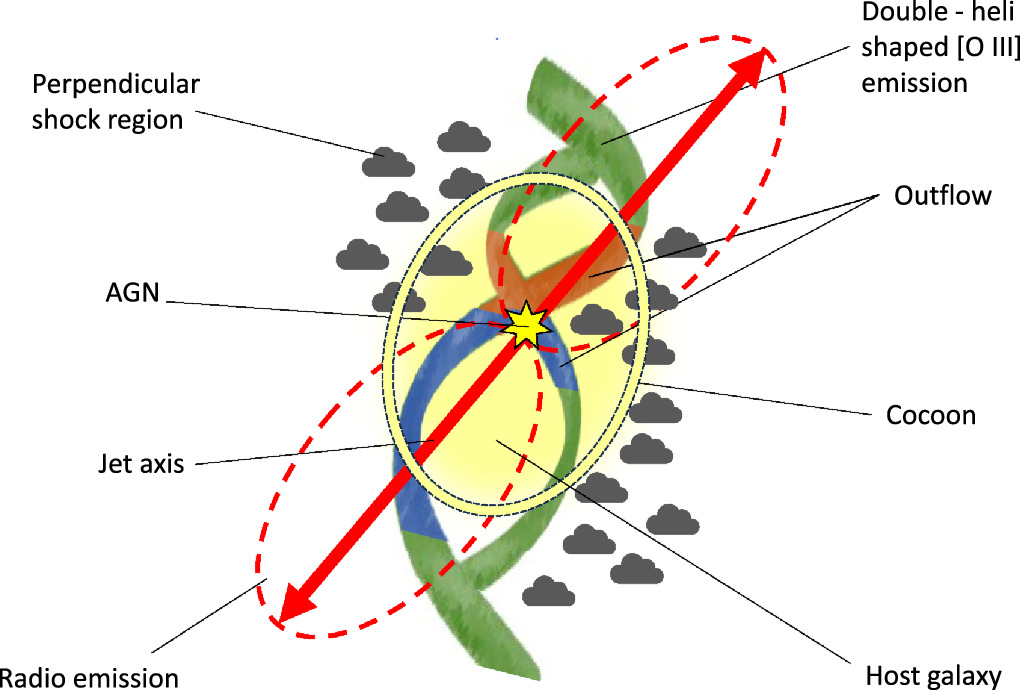
These findings suggest that jet-driven feedback plays a crucial role in shaping the extended emission-line region of NGC 5972 (see Figure 5 for a summary). The interaction between the radio jet and the surrounding gas not only sustains ionization but also influences the gas structure. To further unravel the jet’s impact, future high-resolution radio observations will be essential, providing deeper insights into how active galactic nucleus–driven jets function.

cartoon diagram of NGC 5972

Figure 5: Cartoon schematic diagram showing various mechanisms at play in NGC 5972, including the active galactic nucleus jets, shocks, and outflows. [Ali et al. 2025]

NGC 5972 is more than just a bizarre-looking galaxy — it’s a time capsule, preserving the memory of a powerful supermassive black hole and revealing how its energy continues to shape the galaxy.

Original astrobite edited by Alexandra Masegian.

About the author, Shalini Kurinchi-Vendhan:

After studying astrophysics and literature at Caltech, I moved onto a Fulbright Fellowship in Heidelberg, Germany. I’m passionate about using computer simulations to explore supermassive black holes and galaxy evolution—but I also love poetry and traveling.

The post Written in the Gas: Jet Feedback in a Voorwerp Galaxy appeared first on AAS Nova.

You Shall Not Pass! Active Galactic Nucleus Jets Through the Interstellar Medium

8 July 2025 at 17:00

active galaxy Hercules A

Editor’s Note: Astrobites is a graduate-student-run organization that digests astrophysical literature for undergraduate students. As part of the partnership between the AAS and astrobites, we occasionally repost astrobites content here at AAS Nova. We hope you enjoy this post from astrobites; the original can be viewed at astrobites.org.

Title: You Shall Not Pass! The Propagation of Low-/Moderate-Powered Jets Through a Turbulent Interstellar Medium
Authors: Olga Borodina et al.
First Author’s Institution: Center for Astrophysics | Harvard & Smithsonian
Status: Published in ApJ

The central black holes of some galaxies are surrounded by accretion disks of hot infalling gas. In cases when the accretion disk is massive and highly energetic, this central system forms an active galactic nucleus that outshines the rest of the galaxy. Active galactic nucleus feedback is the process of energetic interactions between the central supermassive black hole and its surroundings. Active galactic nuclei are essential for galaxy quenching, and correctly modeling their contribution is important for accurate cosmological simulations.

Active galactic nuclei release the energy from their accretion via winds, which are widespread outflows, and jets. Jets are collimated, fast outflows of baryonic matter that can spread out from hundreds to tens of thousands of parsecs from their origin. There’s a big range in power for jets, ranging from a low end of around 1038 erg/s to a high end of 1046 erg/s. For context, our Sun emits at about 1033 erg/s.

As jets pass through their host galaxy, they interact with the gas and dust of the interstellar medium. There isn’t a lot of observational evidence for what goes on in that interaction, as the scale of resolution needed is so small — on the order of parsecs within the galaxy. Cosmological simulations don’t model scales small enough to accurately simulate these interactions, and they instead rely on feedback models that implement the macroscale effects. This means we could be missing part of the picture. Today’s article considers galaxy-scale numeric models for jets passing through a turbulent interstellar medium to study how the jet is affected by the gas and dust.

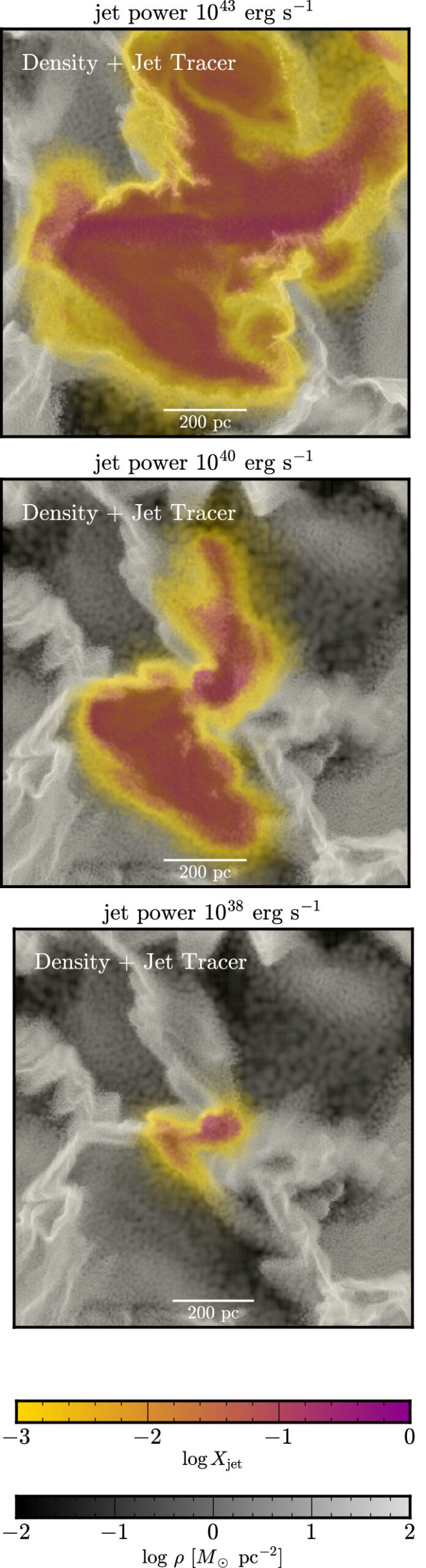
To do this, the authors used the Arepo code, which has an adaptive mesh setup that improves the resolution in areas that need it. They set up a 2-kiloparsec-cubed box full of gas with properties based on real galaxies’ interstellar media. This study is unique compared to other works because the authors use a filamentary structure for the interstellar medium, while previous studies used a clumpy structure. This filamentary structure reflects our actual Milky Way’s interstellar medium and creates more low-density cavities for the jet to interact with. The authors studied three jet powers on the low to intermediate end, of 1038, 1040, and 1043 erg/s. This is also unique to the study, as many works look at higher-powered jets, which produce large-scale radio galaxies, despite lower powers being more common. The jets were launched along the x-axis and had a tracer set up to track their positions through time.

propagation of jets into the interstellar medium

Figure 1: From top to bottom, the high to low power jets, which are traced in color against the background interstellar medium density in grayscale. The lower power jets are stalled by the interstellar medium and do not make it as far out in the simulation space. [Adapted from Borodina et al. 2025]

This study found three different outcomes for the three jet powers (see Figure 1), and these general conclusions held up even when the authors changed the initial randomized structure of the interstellar medium.

The highest-power jets, 1043 erg/s, were easily able to pass through the turbulent environment and reach the outer boundary of the simulation. They mostly traveled along the axis that the jet was launched along, with some lateral expansion.

The intermediate-power jets, 1040 erg/s, were highly disrupted and redirected from the axis they were launched along. The jets bent, filled the low-density cavities between the filaments, and produced bubble-like shapes. These jets did make it all the way to the simulation boundary, but at later times and not along the axis they were initialized on. These intermediate-power jets don’t have enough ram pressure — the pressure against the gas due to the jet’s motion — to push through the turbulent structure of the interstellar medium, and they have to fill pre-existing cavities rather than plowing their own. The authors developed an analytic model for the minimum energy needed for jets to be able to plow through the interstellar medium, at approximately 1041 erg/s.

The jets in the lowest-power case, 1038 erg/s, were stalled out by the interstellar medium within the first kiloparsec of travel. They couldn’t penetrate the higher-density regions of the interstellar medium the way the 1040 erg/s case could, and they couldn’t make it to lower-density cavities to expand into.

All three of these cases were slower and shorter than the same power of jets run in a non-turbulent simulation, with the most significant disruption in the lowest-powered jets. This work demonstrates that a turbulent interstellar medium–jet interaction can be the sole cause of observed asymmetric and bent active galactic nucleus jets. By improving our understanding of this small-scale interaction, the authors are contributing to making better active galactic nucleus feedback models in cosmological simulations.

Original astrobite edited by Ansh Gupta.


About the author, Lindsey Gordon:

Lindsey Gordon is a fourth-year PhD candidate at the University of Minnesota. She works on active galactic nucleus jets, radio relics, magnetohydrodynamics simulations, and how to use AI to study all those things better.

The post You Shall Not Pass! Active Galactic Nucleus Jets Through the Interstellar Medium appeared first on AAS Nova.

❌