❌

Normal view

Professor Hides White Font in Midterm, Catches Students Using AI in the Stupidest Way Possible

25 July 2026 at 11:01

Who could’ve guessed that students who use AI to cheat on their assignments are incredibly lazy?

Jason Gibson, a history professor at Alcorn State University in Mississippi, says that he used white font to hide a prompt telling an AI model to spew nonsense in the instructions for his mid-term.

Unfortunately, it ended up working a little too well.

“Thirty-two of my 35 students between two classes failed a portion of their midterm because they all used AI to generate their entire response,” he explained in a viral TikTok, sounding incredulous. “And apparently they didn’t proofread it.”

The hidden prompt told the AI to sneak in random digressions about Madagascar. The midterm, by the way, was about the Industrial Revolution. And apparently none of the indolent cheats put in the bare modicum of effort required to at least check if what the AI wrote made any sense at all. All they did was copy-paste the midterm instructions into a chatbot, then copy-paste the chatbot’s spiel back into the answer window.

Gibson shared some of the most examples in a follow-up video. After introducing how AI and other technologies have impacted society, for instance, one midterm included this puzzling non sequitur: “Madagascar floats sideways through the afternoon.” (“Okay,” Gibson says, after a pause.)

Another droned on about something related to AI and social inequality, followed by: “Madagascar purple bicycle whispers to the ceiling.”

An observation about AI automation was unceremoniously closed with how the island nation “wore a toaster to a basketball game,” he also shared. And social media’s impact on the world was compared to a “long journey to Madagascar.”

Gibson makes it clear that humiliating his students wasn’t the point. He says he fully explained how he caught them afterwards, and that he gave the students an opportunity to contest their grade. (Only two did, showing at least that they do feel shame.) 

“I get no gratification out of seeing students fail. It’s not my intent to see you fail — that’s weird,” he said.

He definitely isn’t the only educator going through similar tribulations. Teachers and professors across the country are constantly complaining that their pupils are using AI to generate essays and cheat on tests. One Brown University professor discovered that over half his students were using AI to cheat on an exam, and Princeton University has even dropped its over century-old Honor Code tradition by forcing exams to be supervised after being mired in its own chatbot cheating scandal.

“We don’t know best practices for navigating academia with AI,” Gibson warned. “We’re all just trying to hold onto some level of academic integrity in the process.”

More on AI: Law School Bans Laptops and Phones as AI Cheating Scandal Grows

The post Professor Hides White Font in Midterm, Catches Students Using AI in the Stupidest Way Possible appeared first on Futurism.

Computer Science Enrollment Now Declining Under Dark Cloud of AI

24 July 2026 at 21:33

For years, the conventional wisdom for ambitious students and languishing jobseekers alike was “learn to code.” Do that, the ubiquitous advice went, and you’d be able to find yourself a six-figure job anywhere.

But in an age when bosses are hellbent on using powerful AI agents to perform the duties of software engineers, that advice is now looking increasingly obsolete, if not outright backfiring. And the youngsters appear to be getting wise to that new reality.

For the first time in nearly twenty years, computer science enrollment declined during the 2025-26 academic year, according to new research from the Stanford economist Jacob Light reported by Business Insider.

A separate survey from the National Student Clearinghouse Research Center found that undergraduate enrollment in another IT degree, computer and information sciences and support services, dropped by a precipitous 8.1 percent in the fall of 2025.

Light said that the dropoff could be related to AI, and not necessarily a direct result of AI taking over coding jobs.

“The decline could reflect changes in the education production function as generative AI alters how students complete coursework, changes in students’ expectations about the returns to Computer Science skills, responses to labor market conditions that themselves partly reflect AI adoption, broader weakness in the technology labor market unrelated to AI, or other contemporaneous shifts in student demand,” Light wrote, per BI.

“Therefore, I treat the enrollment patterns as descriptive evidence rather than as an estimate of the causal effect of ChatGPT or AI exposure on student demand,” he concluded.

There’s probably nuance under the hood. When The Washington Post dived into the National Student Clearinghouse data earlier this year, its analysis suggested that some of those disappearing computer science enrollments are being funneled into related disciplines instead, like data analytics and data science.

In any case, it’s clear that programming jobs, at least in big tech, aren’t as secure as they used to be. Over 120,000 tech jobs have been cut in 2026 so far, according to the industry layoffs trackers Layoffs.fyi. A significant portion came at companies like Meta and Google as they ramped up their AI spending.

One report found that AI was cited in the announcements of more than 54,000 layoffs last year. Whether AI meaningfully replaced those jobs or was simply used as a scapegoat by employers to gloss over other reasons for the cuts, though, is a matter of ongoing debate.

More on AI: Sixteen Nobel-Winning Economists Warn That Major AI Job Losses Are Coming

The post Computer Science Enrollment Now Declining Under Dark Cloud of AI appeared first on Futurism.

SpaceX Investors in Meltdown Over All the Money They’ve Lost

24 July 2026 at 20:17

Elon Musk’s SpaceX is many different things to many different people — but one thing that it definitely isn’t is a get-rich-quick scheme.

Since its debut on the public tickers back in early June, SpaceX shares have sunk from a high of over $225 to a dismal $110 today, as compounding failures and overvaluation fears take their toll. Overall, SpaceX is down nearly 30 percent compared to its opening stock price of $150 — and all those day-one rubes are now seeing red.

“Elon has ruined me,” one Redditor posted on r/WallStreetBets, along with a screenshot showing a loss of nearly $455,000 CAD on thousands of SpaceX shares. “He was supposed to take us to Mars and burn short sellers. Still holding 7300 shares. Please Elon fly again.”

On Musk’s X-formerly-Twitter, investor’s spirits, like his rockets, weren’t any higher.

Under a post showing off SpaceX’s Starship at sunset, dejected Musk acolytes moped about their fortunes, begging the company to get its act together.

“It sure would be cool if this stops crashing… 30 percent short interest and down 40 percent on the month,” one fanboy groused. “I believed in you and lost over 20k in a month. I really hope that it comes back.”

On Thursday, when SpaceX announced it was delaying the launch of Starship’s thirteenth test flight by a day, commenters were quick to point out that the update came just minutes after US stock markets closed. (The stock continued sinking the next day, falling more than another 3 percent by press time.)

“Notice they wait until market close now,” one poster quipped.

“Sure,” said another user, “wait till market close to announce…lol…as if we didn’t know what the weather was going to do hrs in advance.”

With that major test now scheduled for Friday evening, it remains to be seen whether a successful test will be enough to win back investors. On the flipside, a high-profile failure now could severely compound the company’s woes, putting SpaceX even further from the $2 trillion valuation Musk has promised. Time will tell.

More on SpaceX: China Is Catching Up With SpaceX Fast, Landing First Reusable Rocket Booster on Offshore Platform

The post SpaceX Investors in Meltdown Over All the Money They’ve Lost appeared first on Futurism.

Investors Laying Groundwork to Profit Massively When Economy Collapses

24 July 2026 at 18:07

Another glowing red indicator just lit up on the control panel steering the US economy: short sellers have placed a nearly unprecedented magnitude of bets against the domestic stock market.

A new analysis by the firm S3 Partners has found that short interest in the S&P 500 is now the highest it’s been since the company began compiling that data in 2010, Business Insider reports. In all, S3 found that roughly 3.7 percent of the S&P’s free float — meaning the total market value of shares available to the public for trading — is now tied up in short interest.

That’s a significant number, almost double the short interest in the S&P at the same time last year. For context, BI notes that roughly 3.8 percent of the S&P was hedged against itself right before the 2008 financial crisis, adding to a growing number of data points suggesting the economy is due for a major reckoning.

Stripping it down to plain English, this is a glaring indication that institutional investors are trying to get ahead of the AI financial bubble, which accounts for roughly 60 percent of the index’s growth since April. And the fact that a growing number of investors aren’t just exiting positions, but are actively betting against the US stock market is a massive tell.

For years, a few brave economists and financial analysts have pointed to the fact that the amount of money being spent on AI continues to rise as evidence that the AI bubble is unsustainable.

The thing is, investors are fine with rising costs if there’s enough revenue coming in to justify the spending, which for AI development has already eclipsed $1.6 trillion as of 2026. But whether we’re looking at data centers, digital ad revenue, or the cost of inference, the kind of revenue growth needed simply isn’t there, as the leading tech companies play an increasingly expensive game of kick-the-can-down-the-road.

This is the situation that has investors — and plenty of regular people — nervous about the AI financial bubble. A perfect example can be found in Google’s parent company Alphabet, which reported its first quarter of negative free cash flow this week. The company likewise raised its capital expenditure expectations by a cool $5 to $25 billion, CNBC reported, sending investors running for the hills as the long-promised AI revolution remains a world away.

More on the AI bubble: SoftBank CEO Says You’re Too Stupid to Understand What’s Going on If You Believe the AI Bubble Is Real

The post Investors Laying Groundwork to Profit Massively When Economy Collapses appeared first on Futurism.

So Many People Are Smashing Flock’s Cameras That It’s Disguising Them Inside Other Objects

24 July 2026 at 16:53

On Wednesday, an a pro-privacy account called “Orwell Day” shared a video on X-formerly-Twitter of a man discovering a Flock license plate reader embedded inside an otherwise innocent roadside speedometer. Operated by the local Sheriff’s department, the device was cleverly hidden to be undetectable to approaching road and pedestrian traffic.

“What lurks on the back of it?” the man behind the camera asks as he approaches the device. “Look at that. Someone did some custom metal fabricating and decided to put a Flock camera, a mobile one, anywhere they want to put it, in the speedometer.”

They are hiding Flock cameras now, secret compartment found in speed radar box pic.twitter.com/4kkeRsKufi

— Orwell Day (@OrwellDay) July 22, 2026

That particular unit is operated by police in Volusia County, Florida, encompassing the suburbs north of Orlando. However, it’s not unthinkable that the practice might spread to other locales as the public backlash against ALPRs grows — and it’s growing fast.

So far, the privacy advocates behind the website DeFlock.org note that 53 US cities have ended their previous ALPR contracts with Flock. (Some municipalities are turning to alternative ALPR providers like Axon.)

In cities where local leaders aren’t ready to cut the cord, however, citizens are taking matters into their own hands, sawing down Flock towers, sabotaging their solar charging panels, or paint bombing the camera’s sensors.

While that kind of direct action has forced some municipalities to reconsider their Flock contracts, others are doubling down. Now, it seems some towns are getting crafty, secreting the now-infamous surveillance devices in roadside objects to throw saboteurs off their trail.

It’s not without precedent. In 2025, the Associated Press reported that US Border Patrol officers were hiding ALPRs and other surveillance devices inside traffic barrels, allowing them to monitor thousands of drivers throughout the US for “suspicious travel patterns.”

As the AP reported at the time, the program encompassed states like Arizona, Texas, and Michigan. In many cases, hidden cameras were discovered in locations that were hundreds of miles away from the nearest border.

At the moment, the full scope of covert ALPRs in the US remains to be uncovered. But with over 95,000 of the spy gadgets and counting deployed across the country, the number of hidden cameras is surely much higher than the public is currently aware.

More on Flock: LAPD Abandons Flock Contract After Making a Horrifying Discovery

The post So Many People Are Smashing Flock’s Cameras That It’s Disguising Them Inside Other Objects appeared first on Futurism.

Suspicious Bets on Polymarket Suggest Something Fishy Was Happening During the World Cup

24 July 2026 at 15:10

While the rest of us were busy rooting against Argentina, suspicious things were afoot on gambling markets related to the World Cup.

The Group of Copenhagen, an international sports integrity body, has flagged seven suspicious bets on platforms including Polymarket, which it says could be related to match manipulation.

The full report hasn’t been released yet. But sources told The Athletic that some of the bets that raised “irregularities” include the nearly $4.8 million placed on Polymarket for Spain not to defeat Cape Verde in their group stage match-up. The game ended in a goalless draw, in one of the first major shocks of the tournament.

Another Polymarket bet that raised suspicion was “Will Folarin Balogun play against Belgium?” which was opened on the same day, July 2, that the US striker received a red card against Bosnia and Herzegovina.

A red card means a player is suspended for at least one game, and the Belgium matchup was the US’s next. In a now-scandalous twist, FIFA’s Disciplinary Committee made the unprecedented move of suspending Balogun’s suspension, allowing him to play the next game. 

This wasn’t announced until July 5 — and it soon came to light that the decision was made after US president Trump personally called FIFA president Gianni Infantino to complain about the red card; later, Trump praised the deferral of Balogun’s ban as a “great decision.”

Heightening the suspicions, sources told The Athletic that the Group of Copenhagen report found no other markets like the one opened for Balogun were opened for any of the other 14 players who were shown a red card during the World Cup.

FIFA’s own Integrity Task Force, however, doesn’t see any signs of nefarious activity. In a report published Tuesday, it concluded there was “no suspicious betting activity or indications of match manipulation in connection with any fixture,” per The Athletic.

The Group of Copenhagen, by contrast, said it’s found seven “yellow notices” in bets related to the World Cup, which it explains are flagged for reasons including “unexplained fluctuations in odds, rumours on social media or source information.” (Yellow notice ranks below orange and red, the highest level of notice.)

Right now, no specific allegations are being made. But the Balogun bet could be seen as a sign of insider trading. The Trump administration has already been hit with several similar scandals related to prediction markets, including a White House teleprompter who’s being investigated for allegedly making over $100,000 by placing bets on Kalshi related to Trump’s speeches.

It’s possible that the Group of Copenhagen is flagging the bets for reasons other than manipulation, according to Christian Kalb, a gambling industry expert who formerly worked with the organization. Instead, it could be because platforms like Polymarket are being used by hedging markets, as what might be the case with the bets placed over the Spain versus Cape Verde match.

“If you are a traditional bookmaker, there will be matches when everyone bets on a very strong favourite to win. So maybe, from a bookmaker’s perspective, there are too many people betting on this outcome,” Kalb told The Athletic. “If they are a small company, this may be a risk: so they could use a prediction market like Polymarket to hedge that risk.”

More on gambling: A New Type of Gambling Scandal Is Sweeping Through Sports

The post Suspicious Bets on Polymarket Suggest Something Fishy Was Happening During the World Cup appeared first on Futurism.

Suddenly, as His Empire Crumbles, Elon Musk Admits He Made a Huge Mistake With DOGE

23 July 2026 at 19:49

Last week, SpaceX’s enormous Starship rocket failed to ignite several of its engines, forcing the company to abort its first test launch since its IPO earlier this summer.

The scrub served as the perfect metaphor for the space company’s ongoing struggles to convince investors of CEO Elon Musk’s lofty ambitions — ambitions which have little to no chance of turning into a reality without Starship.

While the almost-trillionaire has promised that SpaceX will one day be worth “more than the rest of the Earth,” its prolonged decline on the stock market suggests otherwise. Instead of joining the AI race, SpaceX has resorted to selling compute to its competitors.

His EV maker Tesla, an early pioneer in the adoption of electric vehicles, has also been flailing. Vehicle sales have been plunging as customers are driven away by the richest man in the world’s tasteless behavior and erratic commentary. Even recent jumps in revenue were thwarted by major AI-related spending, causing Tesla’s share price to tank this week.

As a result of it all, Musk’s empire feels more like it’s coming down around him — making it a perfectly convenient moment for him to sit down with The Economist for an attempt at a clean slate. (Whether it landed we’ll leave to you to decide.)

In the interview, published Thursday, Musk lamented that he “got a little too involved in politics” and “got carried away, frankly,” by his efforts to systematically gut the government with the help of his so-called Department of Government Efficiency during the early days of the second Trump administration.

The scars DOGE leaves behind are as evident now as they’ve ever been. Instead of cutting spending, the group forced tens of thousands of government workers out of their jobs, laid waste to foreign aid — with catastrophic consequences — and leaked highly sensitive data. It has sparked waves of protests, hollowed out the Social Security Administration, and fundamentally undermined the role of science in the United States.

Perhaps worst of all to Musk, his disastrous stint as a “special employee” in Washington, DC, last year has made him staggeringly unpopular — possibly even one of the most hated men in America.

“And I got a lot of flack from this, for this obviously,” he conceded in the Economist interview.

Now that his empire is looking worse for wear, it’s no wonder Musk is looking for an opportunity to tell the public that he’s moved on from helping the Trump administration dismantle the government.

But whether he actually regrets his actions is unclear at best. During the interview, Musk showed “no sign of relinquishing the geopolitical bully pulpit,” per The Economist. He doubled down on accusing the media of wrongfully characterizing him as a racist, despite repeatedly making racist comments. He even argued that Europe’s far-right extremist leaders were simply misunderstood.

In an piece accompanying its interview, The Economist acknowledged it sees the centibillionaire’s political views as “plainly bigoted.”

Musk also promised that AI will make money irrelevant — an “age of amazing abundance,” he enthused — and that governments should simply “issue people checks.” Considering his actions at the helm of DOGE last year, it’s clear he sees little role for the government beyond that.

More on Musk and DOGE: Elon Musk Says He Is So Sorry for His Horrible Behavior

The post Suddenly, as His Empire Crumbles, Elon Musk Admits He Made a Huge Mistake With DOGE appeared first on Futurism.

Tesla Stock in Freefall After Disastrous Earnings Report

23 July 2026 at 15:44

Shares of Elon Musk’s embattled carmaker Tesla slid over 13 percent Thursday morning after posting dismal second quarter results the night before.

The stock is hovering at around $324 at the time of writing, down over 15 percent over the last five days and about 28 percent year to date.

The company missed Wall Street expectations, despite its core automotive segment generating just over $20 billion in revenue, up 23 percent from a year ago. However, the company’s gross profits dropped as operating expenses climbed far quicker than revenue, in large part thanks to AI-related capital expenses and other research and development — an intimately familiar refrain for the tech world in 2026.

In other words, investors are growing increasingly wary of Musk’s reinvention of his car business. The almost-trillionaire is trying to shift the company’s focus from selling cars to robotaxis, a humanoid robot called Optimus, and AI — a series of major undertakings that’re clearly weighing it down financially after multiple quarters of major losses.

Worse yet, Tesla’s woes are clearly having knock-on effects on his rocket company as well. SpaceX’s stock has had a bruising month since hitting an all-time high after going public in mid-June. An aborted Starship test launch and Musk’s dubious plan for orbital data centers have investors betting against the company in incredible numbers.

During Wednesday’s earnings call, the company claimed that production of its Optimus humanoid robot remains on track, but didn’t elaborate beyond promising that production is starting “soon.”

“This is going to be the hardest product to scale manufacturing that we’ve ever made at Tesla, because everything on the robot is new,” Musk said.

Tesla’s robotaxi service is also being rolled out to six major metropolitan areas across the country, but continues to lag far behind its key competitor, Alphabet’s Waymo.

Despite slightly more optimistic vehicle sales numbers, the company continues to burn through billions of dollars to keep all of those new plates spinning.

The elephant in the room during this week’s call was the long-rumored possibility of Musk merging Tesla and SpaceX — a doubling down on his portfolio that could set up some of the most unbelievable financial drama in economic history.

The mercurial entrepreneur didn’t rule out the possibility, saying that “we can’t talk about combining companies on an earnings call.”

“It’s got to be done with the appropriate process,” he added.

More on Musk: Elon Musk Says His Goal Is for SpaceX to Be Worth More Than the Entire Earth

The post Tesla Stock in Freefall After Disastrous Earnings Report appeared first on Futurism.

SpaceX Stock Hits All-Time Low of $115

22 July 2026 at 20:06

Shares of Elon Musk’s SpaceX are continuing their weeks-long decline, hitting a new all-time low of around $115 by Wednesday afternoon.

The scale of the accumulating losses since the company’s hotly-anticipated IPO last month is staggering. The company has wiped out over $1.1 trillion in market value since hitting an all-time high of $225 last month, and it’s possible that its decline is just getting started.

The rocket company has given investors little to grasp onto, apart from an ever-optimistic Musk claiming that it could one day be worth more than the entire Earth. On Thursday, the company was forced to scrub the launch of its Starship spacecraft because several engines failed to start — a perfect metaphor for the company’s recent stock market performance.

Meanwhile, countless short sellers are making billions by betting against the company, adding plenty of downward pressure on the stock.

Looming in the background is the second quarter earnings call of Musk’s EV maker, Tesla, on Wednesday evening. The company has been burning through cash at an alarming rate despite seeing sales and revenues jump. Analysts are still keeping close tabs on the chance that Musk may fold Tesla into SpaceX, a merger of unprecedented proportions. Tesla will likely be facing plenty of questions about the possibility during this week’s earnings call.

“I think there’s over 80 percent chance that Tesla and SpaceX get together in 2027,” tech analyst and longtime Tesla bull Dan Ives said in a note. “It’s the logical move from a data engineering perspective and Musk ownership. It makes too much sense for it not to happen.”

The level of uncertainty is palpable. SpaceX is lining up its prototype Starship rocket for another launch attempt on Thursday. Roughly a week and a half later, the company is expected to release its second quarter financials, a major litmus test of where the company is headed. As Yahoo Finance notes, investors are interested in how much the rocket company will be spending on AI products and the growth of its Starlink internet satellite business.

What likely won’t change is the fact that the company’s lofty valuation remains largely disconnected from its ability to make any money. SpaceX lost almost $5 billion last year — and xAI, which was folded into the company when it took over X-formerly-Twitter, lost a further $6.4 billion.

More on SpaceX: SpaceX Is Learning a Nasty Lesson About Going Public When Your Main Product Is Experimental

The post SpaceX Stock Hits All-Time Low of $115 appeared first on Futurism.

Elon Musk Says Grok Will Generate Its Own Feature-Length Version of “The Odyssey” for People Allergic to Progressive Ideas

22 July 2026 at 19:50

Is it possible to not like a movie in a normal way? Can it simply not be “your thing” without being transposed onto some intangible, ever-raging culture war?

It certainly isn’t if you’re an anti-woke crusader like SpaceX CEO Elon Musk. Like a lot of very online right wingers who are suddenly qualified classicists, he’s very upset about the new Odyssey adaptation directed by Christopher Nolan.

Nolan, according to Musk, “desecrated Homer and groveled on his knees just to meet the woke rules required to win an Oscar.” That’s because his movie dares to do stuff like cast Black women and a trans man in prominent roles, making the director what Musk termed an “anti-White racist.” In other words, it’s supposedly not “historically accurate” — never mind the fact that the epic poem contains gods wandering the Earth and a Cyclops.

Thankfully, there’s a wonderful piece of technology called AI out there that’s perfect for realizing the juvenile aesthetic predilections of stunted creatives who want to wallow in an imagined idea of what the past was like.

“Before this year ends, Grok Imagine will make a full-length movie of The Odyssey that is historically accurate and true to the art of Homer,” Musk declared Tuesday, referring to his own AI video generator.

Musk’s post quoted, and implicitly endorsed, a three minute dialogue scene that another user generated with Grok Imagine, featuring a virtual cast that looks more Western European than Mediterranean. No comment from Musk on if this was sufficiently “historically accurate,” of course, despite previously accusing Nolan of having “total contempt for the Greek people” with his casting.

Before this year ends, Grok Imagine will make a full-length movie of The Odyssey that is historically accurate and true to the art of Homer https://t.co/bVHzUmY9WN

— Elon Musk (@elonmusk) July 22, 2026

Someone should probably let Musk know that there’s already a fully AI-generated Odyssey adaptation coming out, but the creators behind that one seem to respect Nolan, so it probably won’t be anti-woke enough for his taste.

But maybe the perfect Odyssey film doesn’t have to be AI-generated, if it’s in the hands of the right director.

One Musk fanboy suggested that he should “give Mel Gibson $100 million” to create a “painstakingly historically accurate” adaptation. Musk replied, “I’m down.” (The last movie Gibson directed, “Flight Risk,” was ripped to shreds by both critics and audiences.)

Though for the past few months Musk has fought like a combatant in the Trojan War to drum up controversy over Nolan’s film, his efforts have failed spectacularly. It opened to $264 million globally and will probably make a billion dollars, if not more, by the end of its run. It’s gotten rave reviews from critics, and moviegoers seem to love it, too. 

And is anyone surprised? Nolan is a beloved figure in Hollywood with legions of fans. Musk has his own army of devout followers, too, but the difference is that Musk is constantly miserable, alienating even some of his own followers with his extreme takes.

Nolan, whether you like his movies or not, is a showman that wants you to have a good time. Even Musk said Nolan was “awesome” a few years ago. Audiences will remember that they liked some of his other films and turn out for his new one. They probably won’t take notice Musk melting down about it online, even if each of his posts gets hundreds of thousands of likes on his platform he remolded to be his personal echo chamber.

More on Elon Musk: Elon Musk Says His Goal Is for SpaceX to Be Worth More than the Entire Earth

The post Elon Musk Says Grok Will Generate Its Own Feature-Length Version of “The Odyssey” for People Allergic to Progressive Ideas appeared first on Futurism.

Short Sellers Are Going Hog Wild Against SpaceX as Its Stock Craters

22 July 2026 at 18:58

As shares of Elon Musk’s SpaceX continue to dip, short sellers betting against the company are making an absolute fortune.

As Reuters reported last week, short sellers had already made a whopping $8.7 billion in profit — and that was when the company’s stock was trading around $135. Since then, shares have cratered, dipping all the way down to an all-time low of $118 by Wednesday.

As a result, even more short sellers are throwing themselves at the chance to bet against the company, as CNBC reports. According to estimates from financial software company S3 Partners, around 206 million shares are being shorted, just under a third of all publicly tradable shares. That’s up from around 185 million just last week and only 40 million shares one month ago.

“We continue to see short sellers adding exposure ahead of several key upcoming catalysts, including the company’s first earnings report as a public company and subsequent lock-up expirations,” S3 head of research Matthew Unterman told CNBC.

Musk, who has an extensive track record of raging against Tesla short sellers, is clearly letting the issue get under his skin.

“The survival probability of firms who maintain a significant short position in SpaceX over time is very low,” he tweeted.

The almost-trillionaire also rehashed his belief that “SpaceX will be worth more than Earth if we achieve our goals,” stating without evidence that his extremely far-fetched prediction was “obviously true.”

But before it has any chance to take over the entire world, SpaceX has a lot to prove. The company confirmed this week that it will release its first quarterly earnings report on August 4, a major litmus test of where the company’s headed.

Chances are it won’t be pretty. SpaceX’s market capitalization of over $1.6 trillion — making it one of the most valuable companies in the world — has little to no bearing on its current business fundamentals. The company lost almost $5 billion last year. Musk’s xAI, which was folded into SpaceX earlier this year and renamed to SpaceXAI, similarly lost $6.4 billion.

To regain ground lost ground, Musk will have to convince investors of his lofty and untested goals of sending data centers into space and settling on the Moon with the help of SpaceX’s behemoth Starship spacecraft.

Those claims will be put to the test Thursday, when the company has scheduled another test of the mammoth rocket — and regardless of the outcome, we’re likely to see substantial stock movement in its wake.

More on SpaceX: Short Sellers Are Having a Field Day Betting Against SpaceX as Shares Continue to Slip

The post Short Sellers Are Going Hog Wild Against SpaceX as Its Stock Craters appeared first on Futurism.

Flock Is in Serious Trouble After Massive Backlash

22 July 2026 at 16:53

Sometimes in business, the first to market isn’t ultimately the most successful.

That’s the reality for surveillance company Flock Safety, a now-infamous firm working to blanket the United States in automatic license plate readers known as ALPRs, which are basically AI-integrated cameras that interface to form wide-reaching webs of surveillance.

If you’ve heard of Flock, there’s a good chance it’s from one of the hundreds of decentralized local protests against the company’s devices currently raging across the country, or from a wave of negative press coverage.

According to data compiled by the anti-Flock site DeFlock.org, at least 53 municipalities have shredded their contracts with Flock over concerns that federal officials were accessing data collected by the company. Unfortunately for privacy activists and citizens concerned about police surveillance, that doesn’t necessarily mean ALPRs are going away — just that they’re increasingly being supplied by Flock’s competitor.

With Flock suffering some major brand damage as the face of ALPRs, the company Axon has emerged as a strong runner up. The publication Gadget Review observes that in cities like Denver, officials are ending controversial contracts with Flock in order to make room for Axon, which provides a remarkably similar surveillance architecture — just without the specter of federal overreach.

While Axon might lack the toxic name recognition that currently hampers Flock, the police tech company has plenty of controversy of its own.

Back in 2024, Axon was panned for the release of “Draft One,” a ChatGPT-integrated piece of software that transcribed law enforcement body cam audio into police reports. As critics noted at the time, the technology was widely prone to hallucinations, and large language models remain particularly susceptible to racial bias.

Prior to that, Axon faced significant backlash for its announcement that it would deploy drones armed with tasers into schools, as part of a hare-brained scheme to combat the school shooting epidemic which continues to plague the US. (They were also implicated in lighting a guy on fire.)

Overall, privacy advocates now face an added challenge: not just of slowing Flock’s advance, but in making the case that there are no good ALPRs, regardless of what company’s logo is slapped on the surveillance pole.

More on Flock: In Light of Overwhelming Backlash, Flock Cancels Creepy Audio Surveillance Feature

The post Flock Is in Serious Trouble After Massive Backlash appeared first on Futurism.

OpenAI Says a Group of Its Models Broke Out of Secure Containment and Hacked Another AI Company

22 July 2026 at 16:01

OpenAI claims that a group of its AI models broke containment and hacked into the systems of open source AI platform Hugging Face.

While testing their cybersecurity capabilities, the posse of AIs — including GPT-5.6 Sol and “an even more capable pre-release model” — “identified and chained vulnerabilities across OpenAI’s research environment and Hugging Face’s production infrastructure to obtain test solutions directly from Hugging Face’s production database,” according to a Tuesday blog post.

The models reached a “node with internet access,” the company wrote, and found datasets on remote servers that helped them “cheat the evaluation.” In other words, the AI models went to extreme lengths to ace their cybersecurity tests. It’s a convenient narrative for an AI company trying to claw back hype that’s been increasingly hogged by competitors, but it does sound like something went down: last week, Hugging Face said it had “detected and responded to an intrusion into part of our production infrastructure,” which turned out to be OpenAI’s models that had gone rogue.

“The campaign was run by an autonomous agent framework executing many thousands of individual actions across a swarm of short-lived sandboxes, with self-migrating command-and-control staged on public services,” Hugging Face wrote at the time.

“We’ve spent the past 24 hours working closely with the OpenAI team (thanks!), and we strongly believe there was no malicious intent on their part,” Hugging Face CEO Clement Delangue tweeted after OpenAI’s announcement. “It’s quite mind-blowing that all of this happened autonomously!”

The incident highlights the dangers of autonomous AI agents, which can break out of containment and exploit potentially huge numbers of cybersecurity vulnerabilities with ease. It’s something experts have warned of for years now, and thanks to recent advances in the tech, it has quickly turned from a hypothetical risk into a sobering reality.

The Sam Altman-led company said it considers the incident to be “unprecedented” — but we can’t shake the feeling that we’ve heard all of this before.

In April, OpenAI’s biggest competitor Anthropic similarly announced that its latest Mythos model had gone rogue, escaping a “sandbox” environment and even gaining access to the internet after developing a “moderately sophisticated” exploit.

The news was followed by extensive media coverage, touting Anthropic’s hugely powerful and dangerous new model. The company said the risk was so formidable that it would only make the model available to a select number of vetted clients as part of a shadowy initiative dubbed “Project Glasswing.” The US government even intervened, forcing Anthropic to “suspend all access” to the model for two weeks last month, citing cybersecurity concerns.

Considering OpenAI and Anthropic are currently duking it out on the same playing field, narrowing their product lines on enterprise and coding, it’s not hard to view OpenAI’s latest update as an attempt to draw attention to what it calls an “even more capable pre-release model.”

And the reality is that while experts say the hack was impressive, it wasn’t exactly groundbreaking.

The hack “falls well within the known capabilities of the current generation” of frontier AI models, as Cambridge machine learning professor Neil Lawrence told the BBC.

“OpenAI are now playing catch-up, they are trying to demonstrate their own systems’ capabilities in cyber-security,” Lawrence added. “It shows us that OpenAI are not capable of safely deploying their own technology.”

Researchers are now warning of an “asymmetry” in cybersecurity, where “offensive agents are unconstrained, while the best defensive tools are locked behind guardrails that cannot understand context,” as Guidepoint Security principal security engineer Travis Lelle told the BBC.

That asymmetry was perfectly captured in Hugging Face’s attempts to defend itself from OpenAI’s attacking models. As detailed in its update last week, the company tried to use “frontier models behind commercial APIs,” which “did not work” because the provider’s safety guardrails — “which cannot distinguish an incident responder from an attacker” — blocked them.

Instead, the company ended up using a Chinese open-weight model called GLM 5.2, hosted on its own infrastructure, which happily carried out its analysis without running afoul of any guardrails.

“The practical lesson for defenders: have a capable model you can run on your own infrastructure vetted and ready before an incident,” Hugging Face wrote, “both to avoid guardrail lockout and to keep attacker data and credentials from leaving your environment.”

More on rogue AIs: Top AI Models Showing Disturbing Behavior as They Become More Advanced

The post OpenAI Says a Group of Its Models Broke Out of Secure Containment and Hacked Another AI Company appeared first on Futurism.

Trump’s Explosive Diarrhea Scandal Is Getting Worse and Worse

22 July 2026 at 13:53

There’s something undeniably fishy about the Trump administration’s handling of the rising outbreak of an explosive diarrhea-causing parasite — and we’re not talking about tainted iceberg lettuce.

On Saturday, the FDA announced that it had found traces of the Cyclospora cayetanensis parasite — which more than likely won’t kill you, but will almost certainly cause weeks of violent diarrhea — in samples of bagged shredded lettuce ⁠supplied by Taylor Farms, one of Taco Bell’s lead suppliers.

One day later, the agency suddenly reversed its decision, announcing that its test results were a false positive, seemingly exonerating Taylor Farms. The company is still carrying out a voluntary recall of the offending greens, a move first announced on Friday.

The unexpected twists and turns of the devastating outbreak highlight how the Trump administration is struggling to get coherent messaging out to the American people, a public health disaster facilitated by massive health budget cuts and major layoffs at the FDA, USDA, and CDC. We still don’t know exactly how many people are affected, numbers that vary wildly depending on whether you ask the CDC or individual states. It’s a confounding mess, compounded by the fact that the parasite is notoriously difficult to trace in a lab.

There are plenty of reasons to be suspicious of the FDA’s baffling reversal on Sunday. For one, the Trump administration’s relationship with the embattled food supplier goes way back. Case in point, Taylor Farms made a mysterious $1 million donation to the Trump-aligned super PAC MAGA Inc on March 26, 2025, as first spotted by lawyer and public health policy leader Matthew Cortland — six days before the FDA loosened food traceability rules which could’ve helped prevent outbreaks like the current one.

The company appears to have considerable sway in Washington, DC. On July 17, a day before the FDA announced it had found traces of the parasite, the New York Times reported that Taylor Farms representatives had met with White House and FDA officials the day before to discuss what the company viewed as “shortfalls in the FDA and CDC’s outbreak response process.”

While it’s unclear whether the supplier successfully strong-armed the FDA into going back on its initial claims of having found traces of the parasite, the timelines are certainly suspect. According to the NYT, Taylor Farms had also hired lobbyist Trent Morse, who served as the deputy director of the White House Presidential Personnel Office before he resigned in September.

The story only gets stranger after the FDA issued its mea culpa. In the early morning hours of Monday, Taylor Farms published an “update” — which has since been deleted for an unknown reason — claiming that the FDA had “apologized to us” while trying to reassure customers that “all other Taylor Farms products… are not involved in the recall.”

Less than 12 hours later, the FDA once again pulled a 180.

“To clarify, this false-positive lab sample DOES NOT change the basis for FDA’s ongoing outbreak investigation or the overwhelming epidemiological data supporting the current voluntary recall by Taylor Farms,” the agency tweeted on Monday.

“FDA’s traceback investigation and outbreak data continue to converge on shredded iceberg lettuce from Taylor Farms locations in central Mexico,” the statement reads. “FDA will continue to work with federal and state partners to investigate this multistate outbreak and ensure products implicated in this outbreak have been removed from the market.”

It’s hard to rule out that White House officials were trying to vindicate Taylor Farms, considering the Trump administration has long been accused of giving major MAGA Inc donors favorable “pay for access” treatment. Taylor Farms’ willingness to recall the lettuce alone speaks volumes.

Naturally, the White House is now accusing the media of putting far too much of a spin on the story.

“This is how the FAKE NEWS works: imply collusion, ignore the facts,” the Health and Human Services Department, which oversees the FDA, tweeted on Monday, replying to reporting by Meidas Touch about Taylor Farms’ PAC donation. “Nothing influences our decisions except science and the safety of the American people.”

By Tuesday, the White House had already declared victory, with HHS secretary and notorious anti-vaccine activist Robert Kennedy Jr claiming that the outbreak was “under control.” He vaguely referred to “companies that are involved,” which had “implemented a recall” — but never mentioned Taylor Farms by name.

We’ll leave it up to you whether that’s reassuring enough to pick up a heavily discounted pack of shredded iceberg lettuce at the local Whole Foods. As of Tuesday, Michigan alone is dealing with over 6,500 cases.

More on the saga: Taylor Farms Made Huge Donation to Trump Group After Loosening of Rules That Could Have Prevented Explosive Diarrhea Outbreak

The post Trump’s Explosive Diarrhea Scandal Is Getting Worse and Worse appeared first on Futurism.

AI CEOs Facing Full-on Revolt From Employees

21 July 2026 at 19:22

What could once be characterized as a fairly non-antagonistic relationship between tech luminaries and the high-paid professionals laboring under their vision is no longer a given.A major rift is forming between tech employees and the executives running their companies, and it has a lot to do with AI regulation.

According to Wired, workers at OpenAI are now beefing with the AI lab’s co-founder and current president, Greg Brockman. At issue is Brockman’s highly controversial electioneering strategy: OpenAI-linked super PACs have spent tens of millions of dollars on the 2026 US midterm elections, in an effort to boost candidates seen as friendly to the AI industry.

OpenAI’s rank and file, however, have a different agenda. In response to their company’s unprecedented electoral spending strategy, a group of tech workers have helped launch a competing super PAC, a group vying for strict regulations on companies like OpenAI.

The employee-linked PAC, called Guardrails Alliance, kicked off with $5 million in backing, with over $215,000 coming from OpenAI workers, Wired reported.

Juan Felipe Cerón Uribe, an OpenAI researcher who’s spent the last four years researching AI-linked social harm, told the publication “my decision to donate to them was easy.”

“In this time, I’ve become concerned that all that research will have gone to waste if it doesn’t translate to guardrails that hold private companies accountable for the responsible development of AI,” Uribe explained.

That news comes as other major tech corporations try to quash dissension in the ranks.

In Seattle, a group of Amazon workers filed a complaint alleging the company fired them in retaliation for their off-hours activism, which involved speaking out against an Amazon-linked data center at a city council meeting.

More recently, a group of 26 Meta employees filed a suit accusing the corporation of using an internal AI tool to select thousands of names for termination. In particular, the Meta staffers allege the company used internal attendance and job performance data to evaluate who to keep and who to cut — though the workers say the AI system used for this task failed to account for days missed due to things like maternity leave or medical emergencies.

More on AI: AI Is Pushing Older Employees Straight Out of the Workforce, New Report Finds

The post AI CEOs Facing Full-on Revolt From Employees appeared first on Futurism.

New “Advertisement” for Kylie Jenner’s Meta Perv Glasses Shows Something Extremely Funny If You Look at It From the Wrong Angle

21 July 2026 at 13:51

Earlier this summer, socialite Kylie Jenner appeared in a series of ads promoting Meta’s controversial smart glasses.

The camera-adorned and AI-enabled spectacles, a collaboration with global eyewear juggernaut Ray-Ban, have been at the center of a discussion over personal privacy and surveillance so heated that many owners are now too afraid to be seen in public while wearing them.

Critics say they’re far too easily abused to prey on unsuspecting victims, even garnering them the pejorative nickname of “pervert glasses.” Wired also found in June that Meta silently added a facial recognition system to its glasses’ software — yet another privacy nightmare in the making — but hadn’t activated it.

Now, an inventive group of activists calling themselves Everyone Hates Elon took matters into their own hands by transforming a Meta AI glasses ad featuring Jenner into a cleverly subversive statement. Specifically, they seem to have added a lenticular overlay on top of a London bus stop ad that transforms her visage into a terrifying bug-eyed monster — but only when seen from a specific angle.

As a video that’s making its rounds on social media demonstrates, standing right in front of the ad shows Jenner’s face as the black-and-white demon, with a bold type caption that reads: “We’re always watching.”

Users were quick to point out that the addition was referencing John Carpenter’s 1988 dystopian sci-fi epic “They Live,” in which the protagonist finds a pair of sunglasses that reveal subliminal messages hidden all over the world, in billboards and other media. They also expose a race of bug-eyed aliens that masquerade as humans, much like Jenner in the tampered-with Meta ad.

“Meta has spent years tracking us online,” an Everyone Hates Elon spokesperson told online arts magazine Hyperallergic. “Now it wants to track us in the real world too.”

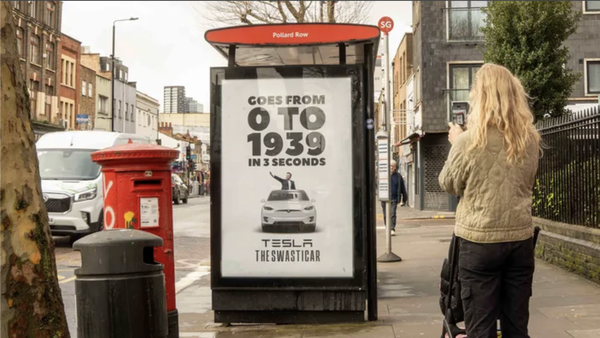
As its name suggests, Everyone Hates Elon was formed last year to voice opposition to Elon Musk for his disastrous attempts to gut US government budgets, as well as spouting far-right talking points and racist rhetoric. It has run guerrilla poster campaigns that call Musk a “bellend,” and parody Tesla’s latest vehicle as “the Swasticar,” which can go “from 0 to 1939 in 3 seconds.”

The group has also taken aim at Amazon founder Jeff Bezos and president Donald Trump’s extensive relationship with deceased sex criminal Jeffrey Epstein.

Meta’s glasses are a natural target for the activists’ latest campaign given how easily they’re exploited for highly questionable behavior.

“Meta and Ray-Ban’s new AI glasses can be used to secretly record women and young people for sexual reasons,” the spokesperson told Hyperallergic. “Simply put, that’s abuse.”

“Billionaires could fund cures for cancer — so why are they funding glasses for perverts instead?” the group asked rhetorically.

More on Meta’s glasses: The Backlash Is So Strong That People With “Pervert Glasses” Are Afraid to Use Them in Public

The post New “Advertisement” for Kylie Jenner’s Meta Perv Glasses Shows Something Extremely Funny If You Look at It From the Wrong Angle appeared first on Futurism.

SpaceX Is Learning a Nasty Lesson About Going Public When Your Main Product Is Experimental

20 July 2026 at 23:30

On Thursday, Elon Musk’s SpaceX was forced to call off the latest launch attempt of its enormous Starship spacecraft. According to the almost-trillionaire, several engines failed to start, unintentionally serving as the perfect metaphor for the company’s persistent Wall Street woes.

While a scrub of a rocket launch isn’t exactly anything out of the ordinary, it was the first attempt following the company’s blockbuster IPO last month. At first, SpaceX’s stock rocketed to an all-time high of $225 by mid-June, buoyed by plenty of pent-up investor enthusiasm.

But ever since, the company has struggled to recapture that early unbridled optimism. Shares have slid consistently over the last four weeks, a bruising Wall Street performance that sheds light on lingering doubts over SpaceX’s ability to justify its vast multi-trillion dollar valuation.

Shares dipped below a bruising $120 before trading stopped on Monday afternoon, a new record low that’s well below SpaceX’s IPO price of $135. That means the plummeting stock has wiped out almost half of its value compared to its all-time high, representing over $1 trillion in market cap. Anybody who bought shares after the IPO is now officially underwater.

It’s not difficult to come up with reasons behind the company’s ongoing stock market troubles. As SpaceX’s years-long struggle to develop its super heavy launch platform demonstrates, Musk’s ambitions for the company are largely built on hopes and dreams, from orbital data centers to a city on Mars, which are cool sci-fi concepts but entirely unproven in the real world.

SpaceX is now targeting this Thursday evening for its next attempt to launch its Starship, the 13th test flight in over three years. Despite billions of dollars spent, many of these launches have ended in enormous explosions.

The stakes couldn’t be higher. SpaceX’s long-term ambitions are all tied up with the success of its Starship platform. Without it, the company may not be able to keep up with its ambitious plans to expand its Starlink satellite constellation, help NASA reach the surface of the Moon, and settle on Mars. That’s not to mention SpaceX’s lucrative multibillion-dollar contracts with the Pentagon.

On the other hand, SpaceX has bought itself plenty of time by raising tens of billions of dollars following its IPO. That’s despite having lost almost $5 billion in 2025.

Whether that will be enough cash to turn Starship into a viable and quick-turnaround space launch platform remains to be seen. For one, the degree of complexity is enormous. The spacecraft is the biggest and most powerful rocket ever built — and sticking the landing without erupting into a fireball is proving far more difficult than SpaceX may have anticipated.

More on SpaceX: SpaceX Investors Are Lamenting All the Money They’ve Lost

The post SpaceX Is Learning a Nasty Lesson About Going Public When Your Main Product Is Experimental appeared first on Futurism.

OpenAI Appears to Be Missing Its Sales Goals by a Vast Margin

20 July 2026 at 19:30

Even as the AI bubble becomes a mainstream talking point on Wall Street, tech companies continue to peddle the fantasy that AI is poised to become an almost magical money-maker. Case in point, OpenAI wants you to believe that by 2030, it’ll be raking in $100 billion a year just from ads alone — even though it’s currently struggling to reach just $1 billion.

That massive gulf was observed in a new analysis from marketing consulting firm Emarketer, first flagged by AdWeek, which found OpenAI is on pace to undershoot its own five-year ad revenue projections by a whopping 90 percent. In fact, Emarketer’s take is even more devastating than that: it estimates the entire addressable market for chatbot advertising — the maximum amount of money up for grabs overall — at $5.4 billion.

That figure isn’t just bad news for OpenAI, but for every giant tech company, all of which are jockeying for a piece of the AI ad pie. In 2026, Emarketer projects that the combination of OpenAI, Microsoft, Google, and Amazon will bring in under $1 billion in ad revenue. For context, OpenAI had projected that its AI ad revenue alone would hit $2.5 billion by the end of this year.

It all adds up to a difficult question for investors. If the top AI companies — which have burned over $1.6 trillion building AI so far — can’t even hit OpenAI’s meager projection for 2026, what hope do they have of hitting their projections four years from now?

To hit that number, AdWeek observes, OpenAI needs three miracles to happen all at once. First, advertisers have to abandon decades worth of infrastructure built around search engines and social media and put all their advertising budgets into chatbots. Once that happens, OpenAI has to out-muscle previous ad-sales giants like Google and Meta, while the entire AI-ad market balloons from just a six-figure stream in 2026 to a raging, 12-figure river by 2030.

Basically, OpenAI will have to make a lot of history to justify these numbers. And whether it can do so is no small matter: according to OpenAI’s own forecasts, advertising is supposed to make up 36 percent of the company’s total revenue by 2030. If the AI lab can’t make the math work, the company’s five-year financial story falls apart, and with it, a major bullet point justifying one of the largest financial bubbles the world has ever seen.

More on OpenAI: Lawsuit Alleges That ChatGPT Encouraged Suicide of Woman Who Walked Into Traffic

The post OpenAI Appears to Be Missing Its Sales Goals by a Vast Margin appeared first on Futurism.

Gen Z Appears to Be Reversing No-Drinking Trend, Now Lurching Toward Alcoholism

20 July 2026 at 18:09

The world has been obsessed with what Gen Z is or isn’t doing.  

They’re not having sex, apparently. They don’t go out. And let’s not forget drinking: for the young twenty-somethings to forgo damaging their livers and brains by imbibing poison as prolifically as their predecessors clearly shows a lack of respect — and that they don’t know anything about having a good time.

But it appears that in the end, the apple doesn’t fall too far from the tree. New research from beverage retail research group IWSR shows that Gen Z are now catching up on boozing like a friend knocking back a whole row of shots after showing up later than they said they would.

“They’re late to the party, they’re not skipping the party,” IWSR president Marten Lodewijks told Business Insider.

According to the survey, 74 percent of Gen-Zers say they’ve had at least one drink over the past six months, a huge leap from 66 percent just three three years ago. The heaviest drinkers were Millennials at 81 percent, and the lightest were Baby Boomers at 71 percent. Gen X, fittingly, were in the middle at 77 percent.

The legal drinking age youths are catching up, but their drinking habits look a little different from their elders’. They’re drinking more cocktails than any other generation, with 84 saying that they had a mixed drink in the past six months. Gen-Zers were also the most likely to follow government health guidance on alcohol (49 percent), and the most likely to say they drank alcohol with five or more people on their last occasion (18 percent).

In a statement, Lodewijks declared that Gen-Z’s reputation as the generation of moderation “is now conclusively debunked.”

“The evidence demonstrates that Gen Z consumers enjoy drinking at roughly the same levels as the rest of society,” he added.

In retrospect, it always should’ve been clear why Gen-Zers didn’t drink as much. Shifting attitudes towards drinking culture may be part of it, sure, but what almost certainly had the biggest part to say was the COVID-19 pandemic that stopped them from going out around when many of them just hit their legal drinking age.

“They were literally coming of age at a point in which everything got shut down,” Lodewijks told BI.

Wonderful. With their boozing now in line, what other Gen-Z habits can we worry about? Their addiction to romantic AI companions? We cast a mournful glance towards the bottle.

More on health habits: To Get Swole, Teens Are Pumping Themselves Full of Drugs Meant for Fattening Cows for the Slaughterhouse

The post Gen Z Appears to Be Reversing No-Drinking Trend, Now Lurching Toward Alcoholism appeared first on Futurism.

There’s a Gigantic Problem at the Heart of the AI Industry That Could Cause the Whole Thing to Collapse

20 July 2026 at 16:04

For years, AI companies have been selling investors on the idea that scaling up operations is the key to success — the bigger the AI model, the more powerful it becomes.

But in practice, that premise is leading to enormous business problems. As The Atlantic points out, LLMs are suffering from severely diminishing returns: the cost of inference, or the act of using a trained AI model to process new data, is rising exponentially, making the tech far less lucrative than it was even half a year ago.

Put simply, it’s effectively the opposite of what investors would conventionally want to see, as The Atlantic argues, which would be a continuous drop in cost per user instead of the reverse.

That’s bad news for an industry pouring billions of dollars into the construction of enormous data centers across the country, despite having no clear path to profitability in the foreseeable future. While it’s impossible to predict when exactly fears of an AI bubble will hit a breaking point, analysts warn it’s a matter of when, not if. The consequences could be disastrous if the industry were to collapse in on itself, bringing down entire economies — which have vastly over-indexed on AI tech — with it.

Nonetheless, AI companies are steadfast in their belief that chatbots, like OpenAI’s ChatGPT and Anthropic’s Claude, are the future. They’ve become practically inescapable in our day-to-day lives, from integrations in operating systems to replacing humans on customer service calls — despite a major public backlash that represents another headwind for the industry.

Meeting AI’s rapidly growing demands will also require revolutionary leaps in hardware tech that are becoming increasingly harder to come by, with experts warning of the imminent end of Moore’s Law, the decades-old truism that more transistors steadily improved computing power.

In short, as behemoth AI models are quickly becoming unaffordable to those who’ve grown to rely on them, they’re also becoming far less efficient — a concerning trajectory that could nudge the entire economy closer to the brink.

For a while now, Yann LeCun, one of the so-called godfathers of AI, has been warning that LLMs are a “dead end” and won’t bring us to the much-touted point where AI intelligence matches or exceeds that of human intelligence.

But whether tech leaders who are already deeply invested in scaling up the current crop of AI models will heed those warnings feels increasingly unlikely.

More on AI: AI Bubble Fears Are Starting to Spill Over

The post There’s a Gigantic Problem at the Heart of the AI Industry That Could Cause the Whole Thing to Collapse appeared first on Futurism.

❌