❌

Normal view

What time is SpaceX's Starship Flight 13 launch on July 20? (Full mission timeline)

15 July 2026 at 11:00

SpaceX is just a few days away from its first Starship test flight of the summer, and if you're hoping to watch the world's largest rocket lift off, you'll need to know where and when to tune in. But don't worry β€” we've got you covered.

The next Starship test flight, called Flight 13 (SpaceX doesn't appear to be superstitious), is scheduled to launch from the company's test site in Starbase, Texas near Boca Chica Beach on Monday, July 20. Liftoff is set for 6:45 p.m. EDT (2245 GMT).

As its name suggests, the upcoming flight will be the 13th test launch overall of SpaceX's Starship megarocket. It will be the second such flight this year, after the May 22 launch of Starship Flight 12. SpaceX is designing Starship, which stands more than 400 feet (121 meters) tall, to be a fully reusable rocket capable of launching missions to the moon, Mars or beyond.

NASA picked Starship to land its Artemis IV astronauts on the moon by 2028, and SpaceX has sold at least one Starship passenger flight to Mars as well. But before SpaceX can carry astronauts to other worlds with Starship, it has to complete a series of suborbital flights and, eventually, reach Earth orbit for in-flight fueling tests, docking demonstrations and more.

SpaceX's Starship Flight 13 is a suborbital test that will be the second flight of SpaceX's new V3 Starship. Below you'll find details on what time Flight 13 will launch, what the mission will do and a full timeline for the mission.

What time is SpaceX's Starship Flight 13 launch?

A towering SpaceX Starship Flight 12 rocket lifts off into a blue sky belching twin plumes of smoke

(Image credit: SpaceX)

SpaceX is currently targeting the launch of Starship Flight 13 for no earlier than 6:45 p.m. EDT (2245 GMT) on Monday, July 20. (The company originally tried to lift off on Thursday, July 16, but that attempt was aborted at the last second.) However, the exact timing of the launch could change.

That's because SpaceX has a 90-minute window in which to launch Flight 13 from Starbase Pad 2. Liftoff could occur anytime between 6:45 p.m. and 8:15 p.m. EDT (2245 to 0015 GMT). SpaceX's launch webcast will begin 30 minutes before liftoff.

And remember, SpaceX likely has backup days, so the launch could slip a bit if needed. In that case, it would likely lift off at the same time β€” 6:45 p.m. EDT β€” and have a 90-minute window, as on the coming attempt.

Related: Read our SpaceX Starship and Super Heavy guide for a detailed look

Starship Die Cast Rocket Model Was $47.99 Now $39.99 on Amazon.

Even if you can't see SpaceX's Starship in person, you can score a model of your own. Standing at 13.77 inches (35 cm), this is a 1:375 ratio of SpaceX's Starship as a desktop model. The materials here are alloy steel and it weighs just 225g.View Deal

Can I watch SpaceX's Starship Flight 13 launch?

Yes, you'll be able to watch SpaceX's Starship Flight 13 launch online, but you'll have your pick on where to watch.

SpaceX will provide its own livestream of the launch via its X account and the official Flight 13 mission page. If everything is on time, that livestream will begin at 6:15 p.m. EDT (2215 GMT) β€” 30 minutes before the planned Flight 13 liftoff.

Space.com will simulcast the SpaceX Flight 13 launch webcast on this page, as well as an our homepage and YouTube channel.

A prelaunch show

Now, if you need to get your Starship Flight 13 fix earlier than SpaceX's stream, a good place to look is the NASASpaceflight show: Its livestream will start several hours before liftoff.

The NASASpaceflight launch webcast will begin on July 20 at 3:45 p.m. EDT (1945 GMT). NASASpaceflight has a wealth of cameras installed around SpaceX's Starbase test facility, and the company will share up-close views and live commentary for many preflight activities.

In-person launch options

While SpaceX does not have an official Starship launch viewing site, there are several places where you can see the launch in person around the Starbase area.

For first-time spectators, I recommend watching Starship launch from near the Cameron County Amphitheater at Isla Blanca Park on South Padre Island, which is just across the bay from Starbase. The rocky beaches around the amphitheater offer a clear line of sight of the Starship launch pad, and there are often spectators on boats out of nearby Port Isabel offering a picturesque view. It's about 5 miles (8 kilometers) from the launch site, and the park has bathrooms.

The traffic getting to South Padre Island (if you're not staying at a hotel on the island) can be heavy on launch days, so another option is watching from the shore in Port Isabel, which is home to Hopper Haus, a SpaceX-themed bar and grill that I can confirm makes awesome burgers.

There is also a shoreline stretch of Highway 48 between Brownsville and Port Isabel, from 6 to 8 miles (10 to 13 km) from the launch site, where you can pull up for the day to watch the launch. It's just the side of the highway, so you won't find amenities like bathrooms there. You can learn more about that at the site SpaceLaunchSchedule.com.

If you're looking for a more rustic experience (and have cash for a $200 ticket, though kids under 17 are $40), you can camp at the Rocket Ranch, which is 3.8 miles (6.1 km) from the Starbase launch site, and camp there for one day and night. It has two viewing locations available, one at an "Outpost" and the other on the campground itself. The Outpost location is the closest and has "unmatched media service," so you can stay connected. Larger four-day camping packages are also available. The ticket includes bus transportation from the ranch campground to a viewing site and back for one launch attempt. I've actually never visited this ranch, but I wanted to include it so you know it's an option. Be sure to read the full Rocket Ranch FAQ so you know what to expect.

How long is SpaceX's Starship Flight 13?

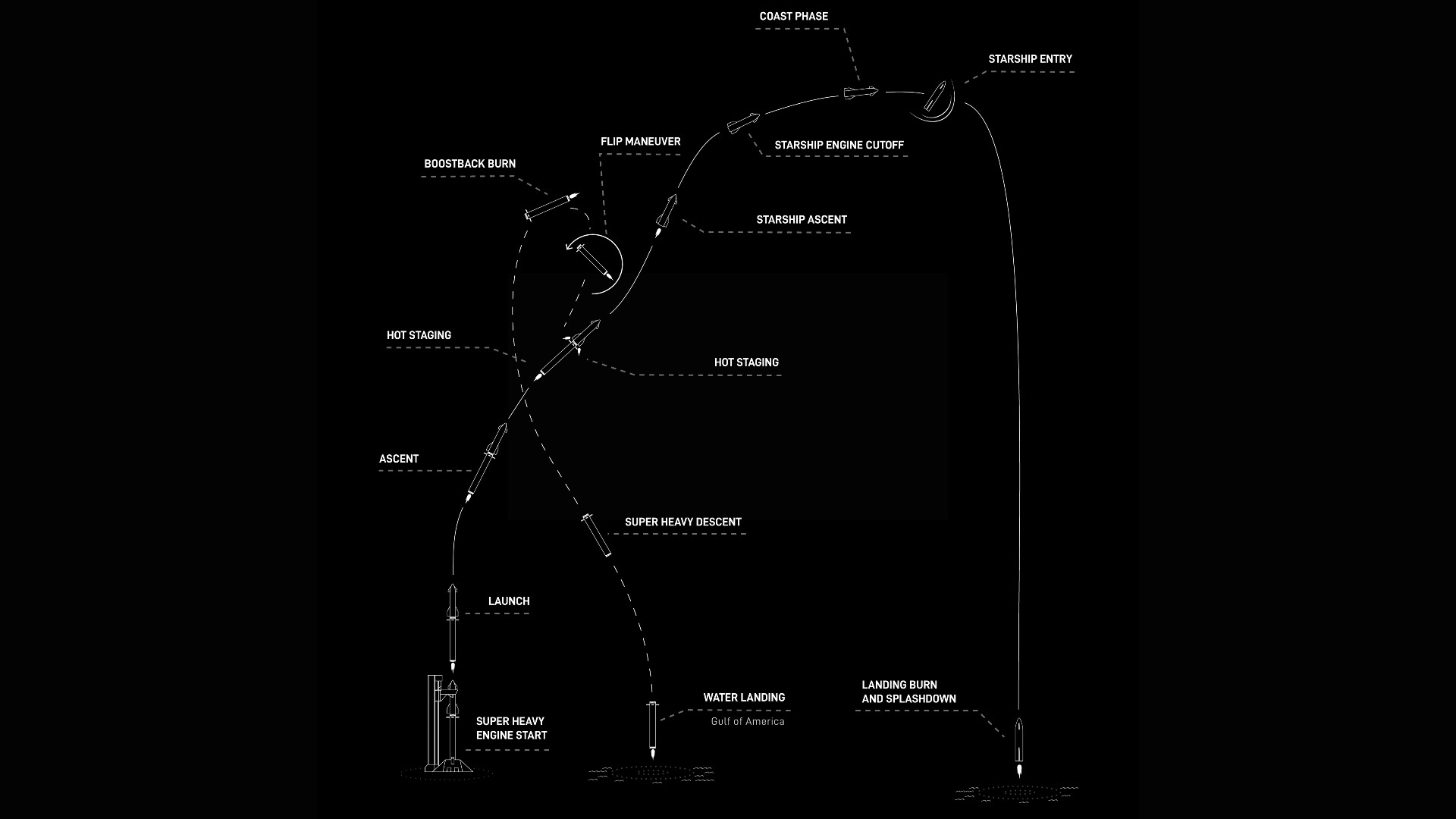
A flight profile showing the stages of SpaceX's Starship Flight 13  test flight.

A diagram showing SpaceX's Flight 13 Starship mission profile. The flight should last just over 1 hour. (Image credit: SpaceX)

SpaceX's Starship Flight 13 test flight will last just over 1 hour and 5 minutes and should follow the same mission profile as the company's last test, Flight 12, in May. This will be the second flight of SpaceX's new Starship Version 3, or V3.

During Flight 12, the giant Super Heavy booster stage failed to return to Earth properly for a controlled landing and splashdown in the Gulf of Mexico (which the Trump Administration has renamed the Gulf of America). Instead, the booster crashed into the ocean.

"The booster’s primary test objective will be executing a successful launch, ascent, stage separation, boostback burn, and landing burn at an offshore landing point in the Gulf of America," SpaceX wrote in a mission overview. "There have been several modifications to hardware and software to address issues seen on the previous flight."

Starship Flight 13 will launch from SpaceX's new Pad 2 at Starbase, which the company upgraded with shorter, faster "chopsticks" β€” capture arms that can catch returning Starship Super Heavy boosters and Ship upper stages during landing, as well as lift vehicles into place on the pad for launch. Check out our full overview on how SpaceX changed Starship for V3 here.

SpaceX Starship Flight 13 Launch Timeline

TIME (Hr:Min:Sec)

EVENT

T-0:50:00

Flight director polls for fueling

T-0:37:30

Ship liquid oxygen loading begins

T-0:37:00

Super Heavy liquid oxygen loading begins

T-0:35:25

Super Heavy liquid methane loading begins

T-0:34:48

Ship liquid methane loading begins

T-00:21:30

Raptor engine chilldown begins on Ship and Super Heavy

T-00:02:50

Super Heavy fueling complete

T-00:02:10

Ship fueling complete

T-00:0:30

Flight Director GO for launch poll

T-00:00:17

Flame deflector activation

T-00:00:03

Booster ignition sequence startup

T-00:00:00

Liftoff ("Excitement Guaranteed," SpaceX says)

Starship Flight 13 Mission Timeline

TIME (Hr:Min:Sec)

FLIGHT EVENT

T+00:00

Liftoff!

T+00:58

Ship/Super Heavy reach "Max Q"

T+02:18

Super Heavy main engine cutoff

T+02:21

Hot-staging separation/Ship Raptor engine ignition

T+02:25

Super Heavy boostback burn startup

T+03:03

Super Heavy boostback burn engine shutdown

T+06:27

Super Heavy landing burn startup

T+06:53

Super Heavy landing burn shutdown (followed by splashdown)

T+08:05

Starship engine cutoff

T+16:40

Payload deploy demo starts

T+27:29

Payload deploy demo complete

T+38:58

Ship engine relight demonstration

T+47:30

Ship reentry

T+01:02:23

Ship transonic

T+01:03:01

Ship is subsonic

T+01:05:01

Landing burn start

T+01:05:03

Landing flip

T+01:05:12

Landing burn three to two engines

T+01:05:19

Landing burn two to one engines

T+01:05:26

"An exciting landing!" SpaceX says.

SpaceX will not try to reach orbit with Starship Flight 13 or return its Ship back to Earth for a capture at the launch pad. Instead, both vehicles aim to make controlled descent and water landings, before falling over and sliding into the sea.

While the Super Heavy booster will splash down in the Gulf of Mexico off the coast of Boca Chica, the Ship upper stage will follow a suborbital trajectory for a target splashdown in the Indian Ocean off the coast of Western Australia.

During the flight, the Ship vehicle will attempt to deploy 20 Starlink V3 satellites, the company's newer and larger satellite-internet units, but they won't reach orbit. They will follow Starship's suborbital trajectory back down to Earth and burn up in the atmosphere.

Six of the Starlink V3 satellites are equipped with cameras to record live views of Starship and its heat shield and beam them back to Earth for analysis.

"For the first time, Starship will carry V3 Starlink satellites to space, which aim to greatly expand the network's capacity and user speeds. As part of this initial test, Starship is planned to deploy 20 satellites which will extend solar arrays and antennas and will attempt to connect with the larger Starlink constellation via high-capacity lasers," SpaceX wrote in the mission overview. "The Starlink satellites will be on the same suborbital trajectory as Starship and are expected to demise upon reentry approximately 20 minutes after deployment."

What if Starship Flight 13 can't launch?

If SpaceX can't launch Starship Flight 13 on July 20, the company likely has multiple backup opportunities. So, if bad weather or another technical issue delays launch, SpaceX could try again in the coming days.

Whichever date SpaceX launches Starship Flight 13, you will be able to follow the mission on Space.com. Be sure to return to Space.com on launch day for complete Starship Flight 13 coverage.

Editor's note: This story was updated at 1:15 p.m. ET on July 17 with the new target launch date of July 20.

Space.com just launched an app! Get your inside scoop on space exploration

23 June 2026 at 21:04

Hey, space fans! For over 25 years, we here at Space.com have dedicated ourselves to bringing you the best space mission news, astronomical discoveries, night sky guides and out-of-this-world sci-fi. Now, we're launching into a whole new frontier. Yes, we have an app.

Our new Space.com app is available free on Android on the Google Play store and for iOS via the Apple Store and includes the same great coverage that you'll find on your laptop or desktop, but now in the palm of your hand.

Are you wondering how to prepare for this summer's great total solar eclipse in August? We've got that. How about NASA's plans to launch the first-ever commercial spacecraft to rescue a falling space telescope? We've got that. (That Swift Boost mission will launch this Saturday, June 27, by the way.) And if you're wondering just how close Steven Spielberg's "Disclosure Day" is to how the U.S. government could handle the real discovery of E.T. in real life, we even have that. The Space.com app also allows you to curate your space news experience by picking your favorite news categories and saving articles and features for later reading.

If you download our Space.com app, register for free and get your daily space news fix, but are still left wondering how you can better support the amazing work of our news and reviews team, there is a way. Our Space.com app has an ad-free version available for a small recurring monthly fee (or one annual subscription) that helps support or live on-site coverage of space missions like NASA's upcoming Artemis 3 moon lander test flight and more.

I'm extremely excited to welcome you to our Space.com app and look forward to any thoughts and feedback you might have about it. Have a question, comment or complaint? You can let me know directly through my email above or below.

Thank you all for your interest in space and for supporting Space.com over the years. We look forward to another 25 years and more of taking you out of this world, every day.

Sincerely,

Tariq Malik
Editor-in-Chief, Space.com
tmalik@space.com

'No one thought it was going to be possible.' A space telescope is falling out of space. This is NASA's daring plan to save it. (video)

19 June 2026 at 17:00

WALLOPS ISLAND, Va. β€” For over 20 years, NASA's Swift space observatory has been conducting prolific science in orbit, hunting for signs of gamma-ray bursts β€” the most powerful explosions in the universe. Now, it's falling to Earth, doomed to a fiery death by the end of the year as its orbit decays.

But maybe not.

NASA, it turns out, has a daring rescue mission in the works, something never before attempted in space: the Swift Boost mission. The endeavor calls for an untested spacecraft built by the Arizona company Katalyst Space Technologies to rendezvous and dock with Swift β€” something the observatory was never designed to do β€” before the observatory falls back to Earth.

A split image of NASA's Swift observatory in orbit and the Katalyst spacecraft that will save it from falling out of space.

NASA’s Neil Gehrels Swift Observatory is falling out of space. NASA has a daring plan to save it with a spacecraft built by Katalyst Space. (Image credit: NASA)

If all goes well, Katalyst's space tug (it's called Link) will lift the Swift observatory into a higher, safer orbit β€” one that will add years of life to the aging space telescope's mission. Liftoff is officially set for June 27, with Link launching on the last-ever Pegasus XL rocket, an air-launched booster built by Northrop Grumman.

"Frankly, I have to be honest: No one thought it was going to be possible," Shawn Domagal-Goldman, NASA's Astrophysics Division director, told reporters here on Wednesday (June 17). "No one thought we would get as far as we've already gotten today."

What stands out most is how quickly the mission came together.

NASA’s Neil Gehrels Swift Observatory, shown in this artist’s concept, orbits Earth as it studies the ever-changing universe.

NASA’s Neil Gehrels Swift Observatory, shown in this artist’s concept, orbits Earth as it studies the ever-changing universe. Launched in 2004, the space telescope's days are numbered as it is falling out of space. (Image credit: NASA’s Goddard Space Flight Center Conceptual Image Lab)

It was just in September 2025 that NASA picked Katalyst to build a spacecraft capable of boosting Swift on a budget of $30 million. That was nine months ago. And now, the finished Link spacecraft β€” with its three robotic arms, three main Hall thrusters and a suite of other instruments β€” is packed aboard its Pegasus XL rocket and tucked on the belly of its L-1011 Stargazer carrier plane for a trip to its launch site in the South Pacific's Kwajalein Atoll.

"In the last nine months, we have gone from a clean sheet to a spacecraft that is currently integrated on a rocket on an airplane, ready to go to Kwaj for launch," said Kieran Wilson, Link's principal investigator at Katalyst Space, on Wednesday. "This is an absolutely unprecedented development timeline for this program."

Yet that "swift" timeline, if you will, is essential if NASA is to rescue the Swift space observatory.

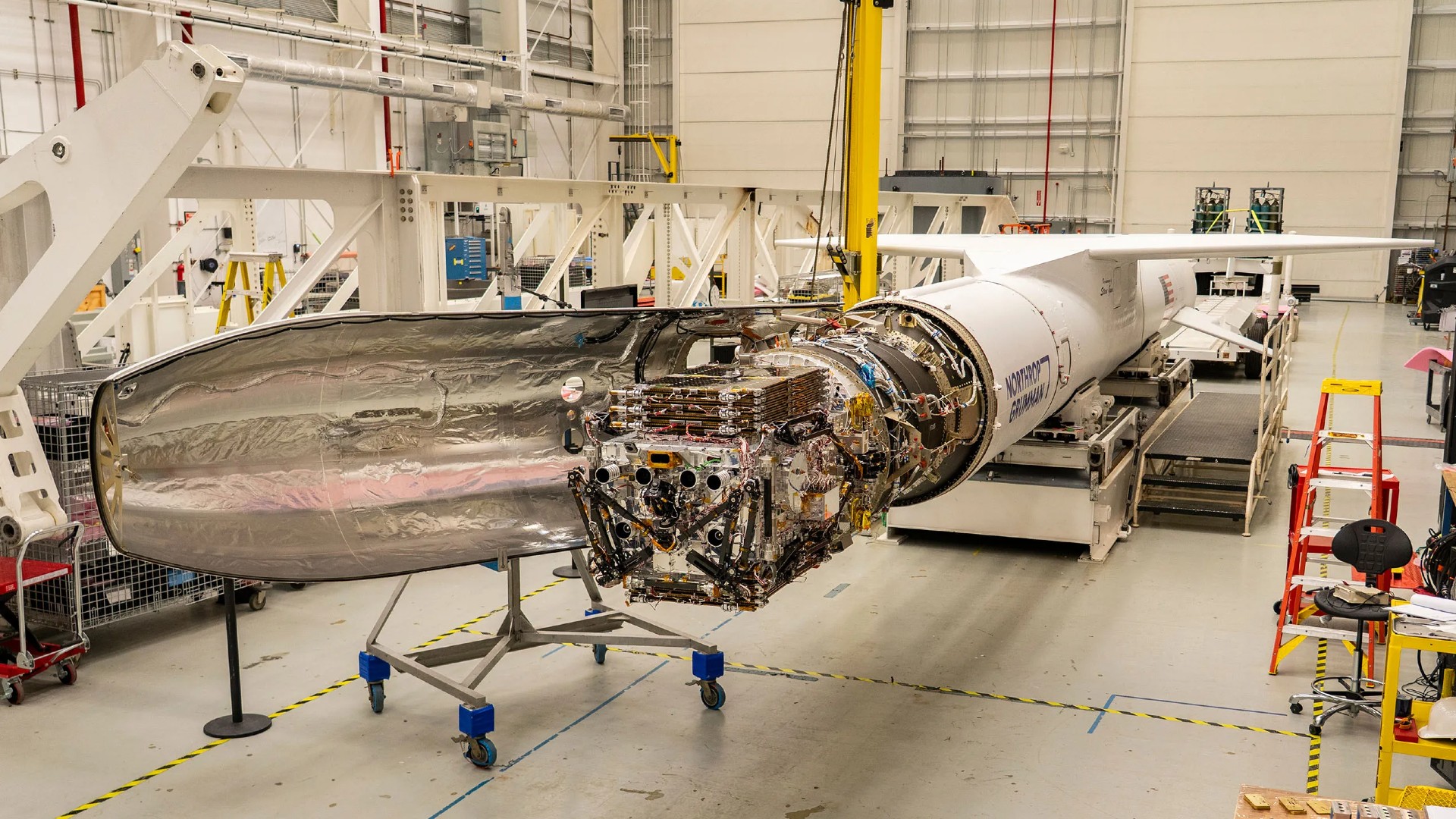
a long white rocket sits horizontal inside a hanger with its nose cone open, exposing a satellite with many components and actuators folded up into a dense rectangular shape

Katalyst Space's LINK robotic servicing satellite awaits encapsulation inside a Northrop Grumman Pegasus XL rocket on June 8, 2026, at NASA's Wallops Flight Facility in Virginia. (Image credit: NASA/Ron Beard)

NASA originally launched Swift (its full name is the Neil Gehrels Swift Observatory, after its late principal investigator) in 2004 on a $250 million mission to search the sky for gamma-ray bursts and other high-energy astrophysics phenomena in the cosmos. From its original orbit about 375 miles (600 kilometers) above Earth, Swift was a silent sentinel, ready to quickly pivot to new targets with unprecedented speed.

"Swift was designed to study gamma-ray bursts, short-lived flashes of high-energy light that release more energy in just a few seconds than the sun will in its entire lifetime," Swift principal investigator Brad Cenko told reporters Wednesday. "It's been extremely successful in this regard, detecting over 2,000 of these sources all the way out to the edge of the visible universe."

It was Swift that helped scientists confirm without a doubt that the heaviest elements we know of, including the shiny gold and platinum in the jewelry you're wearing right now, were forged by these explosive cosmic events, Cenko said. Swift was expected to last two years in orbit. It's well into its second decade now, and still in good health β€” well, except for that "falling out of space" part.

You see, Swift doesn't have thrusters, or a propulsion system of any kind. And over the years, an increase in solar activity β€” space weather from the sun β€” has puffed up Earth's atmosphere to create more drag on Swift than expected, pulling it down from its initial orbit.

Last year, the Swift mission team realized the space telescope was falling faster than expected. Without a rescue mission, Swift would crash to Earth by the end of this summer.

"It was okay for a generic spacecraft to come out of orbit," Domagal-Goldman said. "But this was not just any spacecraft. This is an observatory with unique capabilities for astrophysics … It is a swift observatory that can quickly pivot across the night sky to find things that go boom in the night."

"So we decided, yeah, we want to go save this one this time because of how special it is," he added.

Artist's illustration of Katalyst Space Technologies' servicing spacecraft approaching and capturing NASA's Swift space observatory on an orbit-boosting mission.

Artist's illustration of Katalyst Space Technologies' Link servicing spacecraft approaching and capturing NASA's Swift space observatory on an orbit-boosting mission. (Image credit: Katalyst Space Technologies)

A lot has to go right for Katalyst's Link spacecraft to rescue Swift.

The 937-pound (425-kilogram) spacecraft will launch into an initial testing orbit on June 27 and perform a series of checkouts to ensure that its basic systems (three main engines, 16 reaction control thrusters, solar arrays, robotic arms) are all working properly.

"We'll have a commissioning period of a few weeks, after which we will begin maneuvers in order to approach Swift," Wilson said.

Once Link reaches Swift's orbit, it will perform a series of proximity operations, dock, and then raise the space observatory to its initial orbit over the period of a several months. If that goes to plan, Swift could be back to performing science by this fall, Cenko said. (The telescope has been in a low-power mode to preserve what orbit it can since February.)

If Link is successful, Swift could get another five or more years of life in space. Link, meanwhile, will detach and be intentionally deorbited (meaning it will fall to Earth on purpose) to end its mission.

"All this is challenging and risky," Wilson said. "There's a lot of spacecraft that have had far longer development cycles with far more funding behind them that have failed for mundane reasons."

A lot of simple things can go wrong.

For example, the solar arrays on Link might malfunction, Wilson said. Swift has been in orbit for so long, its protective insulation blankets may be as brittle as glass and break when Link's robotic arms grab on, he added.

Engineers from Katalyst stabilize their LINK robotic servicing spacecraft as it moves into a vibration chamber at NASA's Goddard Space Flight Center on April 15, 2026.

Engineers from Katalyst stabilize their Link robotic servicing spacecraft as it moves into a vibration chamber at NASA's Goddard Space Flight Center on April 15, 2026. (Image credit: NASA/Scott Wiessinger)

And then there's the sun. It was increased solar activity that put Swift in its perilous situation. That activity is ongoing. In fact, Swift may be one big solar storm away from doom if the sun fires off a major storm before Katalyst's Link can reach it.

Swift is on track to fall below an altitude of 186 miles (300 km) by October. At that point, it may be too low for Link to reach the observatory. A surprise solar storm could accelerate that fall, but NASA remains hopeful.

"At the moment, we think we have several months where Swift will be at a sufficiently high altitude to give Katalyst folks a great chance to capture and boost us," Cenko said.

Katalyst is banking on the future need for spacecraft servicing and life extension in space. This week, the company raised $12 million in funding to develop an even more capable spacecraft called Nexus, which it plans to "expand satellite servicing to multi-orbit, multi-mission operations."

"Over the last decade or so, we've gotten very good at launching things into space," said Robert Lamontagne, Katalyst's vice president for strategic partnerships. "Katalyst is here really to kind of demark the end of that throwaway model, and the start of a new model."

The first test flight of a Nexus mission could launch in 2027. Its target: a U.S. Space Force satellite called Rooster in geostationary orbit 22,236 miles (35,786 km) above Earth, much higher than the Swift observatory. That Nexus-1 mission will launch atop an Ariane 6 rocket next year.

❌