❌

Normal view

Apple Financial Statements: Products vs. Services

21 July 2026 at 21:27

John Gruber (Mastodon, 2):

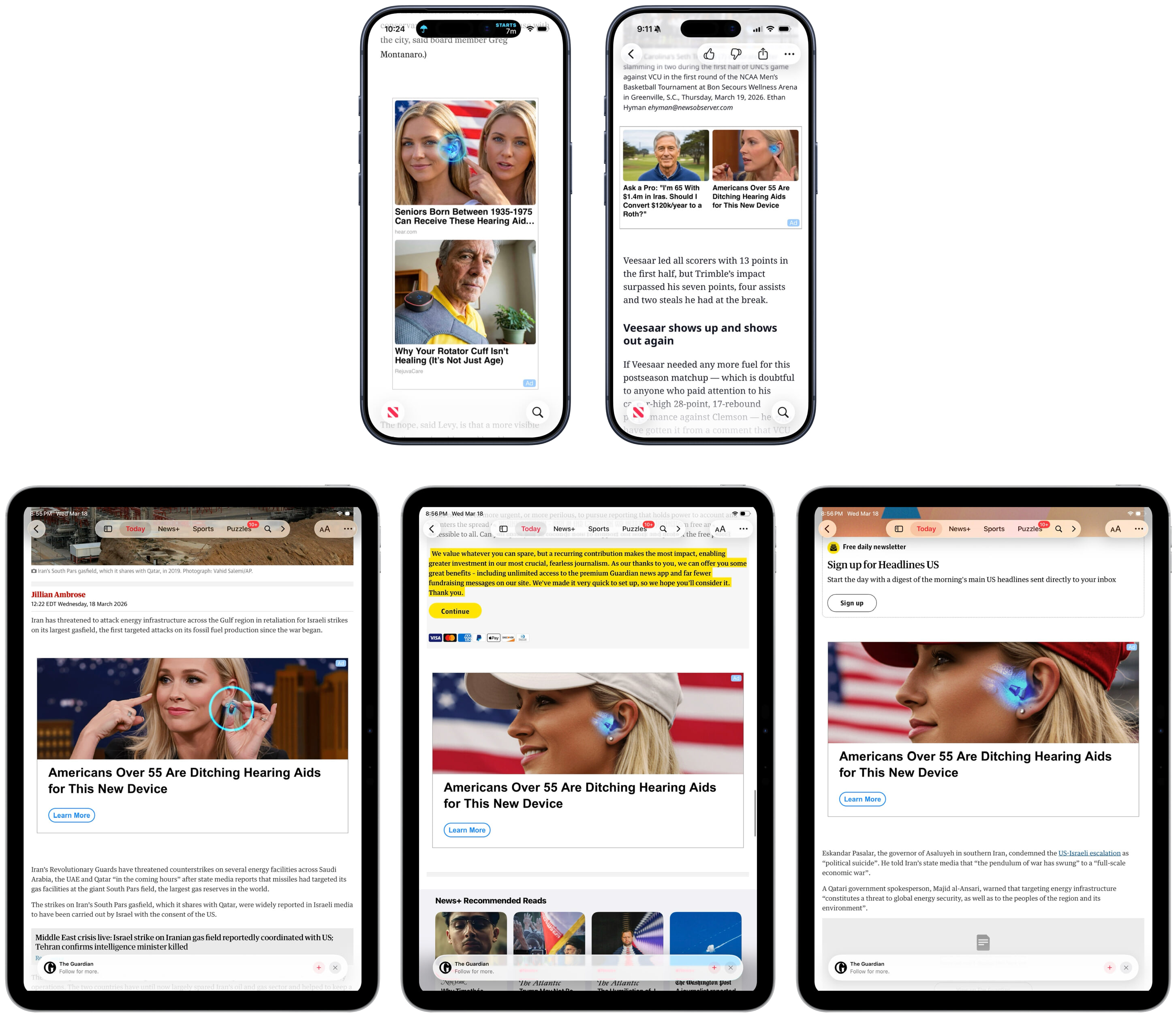
Some of [Cook’s letter] remains true, but has lost some truthiness — and truthiness matters. But some of it is no longer true, period. It’s no longer just “one small part” of Apple’s business that serves advertisers. Here in 2026, search results in the App Store not only show paid ads — frequently for casinos — but the search results are visually dominated by paid ads now that Apple has added a second ad to results. Apple News+ is a paid subscription that offers a genuinely great value for the number of paywalled publishers whose content it includes, but articles on the News app tend to include the weirdest AI-generated ads on the Internet. (How many young blond women am I supposed to believe need hearing aids?) And — at this writing, still “coming soon” — Apple is launching ads on Apple Maps. Apple Maps remains free of charge to use, so according to Tim Cook, we’re not the customer. We’re the product. Or, if you prefer, our frustration is the product.

[…]

The ratio of ads to organic results in App Store search — especially when measured in screen area — is clearly not aligned with Cook’s 2014 statement that “Our software and services are designed to make our devices better. Plain and simple.” Obviously not. App Store search today is designed primarily to generate more revenue for Apple. That’s not criminal, but it’s a change.

[…]

What gave Tim Cook’s privacy letter heft in 2014 wasn’t just the clarity of its plain language, but the fact that you didn’t have to take his word for it that the ads Apple showed you respected your privacy, because Apple didn’t show you ads in 2014. Apple today can’t say that.

[…]

John Ternus should return Apple’s privacy policy to its 2014 clarity. The trust Apple would earn from such a move would far out-value whatever revenue these ads pad to their already hefty and ever-increasing quarterly Services numbers.

I wish that were the case, but I fear this is kind of a Hotelling’s Law situation, where Apple can get most of the benefit by being just slightly better on this axis. Where else do its customers have to go?

Jeff Johnson (Mastodon):

In the second fiscal quarter of 2018, services generated $9 billion in revenue (net sales), whereas in Q2 2026, that amount had grown to $31 billion! In this blog post, I want to focus on understanding the relative financial importance of products and services for Apple.

[…]

In 2025, services were 42% of Apple gross margin. How does 26% of net sales become 42% of gross margin? The explanation is that services have a much lower cost of sales. The products gross margin was 37% of products net sales, while the services gross margin was an astonishing 75% of services net sales. In other words, Apple services are almost pure profit!

Does this 75% account for TV and movie production costs?

With persistent general inflation, consumers do not have unlimited money to spend on Apple products. At least in the near future, it’s reasonable to question how much further room is available for growth in profits from Apple products. To satisfy the demands of investors, Apple executives including CEO-elect John Ternus may be forced to rely even more than before on growth in services, which do not face as much pressure on cost of sales as hardware products.

Previously:

Apple reportedly pursuing AI chip company acquisitions

15 July 2026 at 17:39

chips

Apple is quietly shopping for AI chip companies. According to a new report from The Information, the company has been approaching chip startups and consulting with bankers about potential acquisitions — a notable shift for a firm long known for its reluctance to make big hardware buys.

The move comes as Apple grapples with limitations in its current AI infrastructure. Its Private Cloud Compute servers, which power parts of Apple Intelligence, currently rely on internally designed M2 Ultra chips. These have proven insufficient for handling larger, more demanding AI models.

The Siri Overhaul Problem

One concrete example stands out: Apple has been working on a major Siri overhaul powered in part by Google’s Gemini models through a partnership. When engineers tried running these advanced models on Apple’s own servers, the M-series hardware fell short. As a result, more complex Siri tasks are now routing through Nvidia GPUs hosted in Google’s cloud infrastructure.

This dependency clashes with Apple’s long-standing preference for controlling its own silicon and protecting user privacy through on-device and Private Cloud Compute processing.

Baltra Delayed

Internally, Apple has been developing its first dedicated AI server chip, codenamed Baltra. The company had originally targeted a 2026 launch, but the timeline has slipped. Baltra is designed as a purpose-built server ASIC (with Broadcom contributing key networking and interconnect technology) to reduce reliance on third-party GPUs for cloud AI workloads.

The reported pursuit of acquisitions suggests Apple wants to accelerate progress on its next-generation server silicon — either by bringing in specialized talent and IP or by acquiring teams that have already solved similar challenges.

A Rare Shift in M&A Approach

Apple has historically avoided large acquisitions, preferring to build technology in-house. Its most recent notable deal was the January 2026 acquisition of Israeli audio AI startup Q.ai (reportedly valued around $2 billion). With roughly $45.6 billion in cash and cash equivalents as of late March 2026, Apple certainly has the financial firepower if it chooses to move.

This new interest in chip startups marks a pragmatic acknowledgment that the AI hardware race — particularly in data center-scale inference and training — moves extremely fast. While Apple excels at designing efficient mobile and laptop chips, scaling specialized AI accelerators for servers is a different challenge that hyperscalers like Google, Amazon, and Meta have been tackling for years.

Broader Context

This development comes just days after Apple announced a major multi-year expansion of its partnership with Broadcom, worth more than $30 billion. The deal includes custom silicon components and supports U.S. manufacturing expansion in Colorado. It underscores Apple’s broader push to strengthen its custom silicon capabilities while also highlighting how much it still relies on external partners for certain advanced technologies.

What It Means

If Apple follows through on acquisitions, it could help close the gap in its cloud AI infrastructure faster than organic development alone would allow. Success here would support more ambitious on-device and private-cloud AI features without heavy dependence on external clouds and GPUs.

It would also represent a meaningful evolution in Apple’s strategy: from a company that largely designs its own chips from scratch to one willing to acquire specialized expertise to stay competitive in the AI era.

The coming months will reveal whether these discussions lead to actual deals — and whether they can meaningfully accelerate Apple’s ability to run sophisticated AI models on its own terms.

MacDailyNews Take: The mad scramble to catch up continues. Hopefully, new Apple CEO John Ternus can quickly kick things back into high gear after far too many years of coasting along in neutral.


‎
Please help support MacDailyNews — and enjoy subscriber-only articles, comments, chat, and more — by subscribing to our Substack: macdailynews.substack.com. Thank you!

Support MacDailyNews at no extra cost to you by using this link to shop at Amazon.

The post Apple reportedly pursuing AI chip company acquisitions appeared first on MacDailyNews.

❌