
❌

Normal view

Hazard Detection Lidar System Goes to the Moon

12 June 2026 at 18:41

Hazard Detection Lidar System Goes to the Moon

A flight testing success story

Enabling landers to autonomously identify the safest sites to touch down

Moon craters and their surrounding areas are high-value destinations for lunar missions since they may contain important resources and valuable science targets. However, these sites are also home to dangers such as steep slopes that are difficult to see in the challenging lighting conditions. As a result, selecting landing sites on lunar surfaces is a critical component for NASA’s CLPS (Commercial Lunar Payload Services) missions. A new technology tested through NASA’s Flight Opportunities program is set to go to the Moon and help provide a safe and precise landing.

Astrobotic Technology’s Hazard Detection (HD) Lidar system scans and analyzes the terrain in real-time, enabling landers to autonomously map and select the safest landing sites. Lidar stands for light detection and ranging. The Pittsburgh-headquartered company will use its HD Lidar system when its Griffin lunar lander delivers science and technology payloads to the Moon during its CLPS delivery to the lunar south pole.

With Flight Opportunities support, Astrobotic first tested an engineering model of its advanced HD Lidar sensor in November 2024, confirming its ability to select a safe landing site by detecting and avoiding slopes, rough areas, and potential hazards. This flight test provided the Astrobotic team valuable data on the system’s performance, which was later leveraged by a second flight test in March 2026 with an integrated hazard detection and guidance, navigation, and control (GNC) system to further validate the system ahead of its first lunar mission scheduled for later this year. These flight tests helped the company advance the technology for use on its CLPS mission.

Preparing for Griffin Mission One | Flight testing lidar hazard detection video | Additional information

Preparing for Griffin Mission One

The Astrobotic Griffin Mission One will launch aboard a SpaceX Falcon Heavy rocket from Launch Complex 39A at NASA’s Kennedy Space Center in Florida to deliver NASA payloads to the lunar south pole.

Astrobotic’s HD Lidar system is designed to detect hazards as small as 5.9 inches (15 cm) and slopes greater than 10° to identify potential hazards, such as craters or large rocks. During the lander’s final descent phase, the spacecraft performs a stationary hover at an altitude of 100 meters — about the height of a 30-story building — while pointing its lidar toward the intended landing site. During the hover, the lidar scans the terrain, applies motion correction to account for changes in the spacecraft’s position and attitude, and processes the results into a hazard map used to identify the safest available landing location. The spacecraft then maneuvers to the selected landing site and proceeds with touchdown.
 
Astrobotic’s HD Lidar system works in tandem with its terrain relative navigation (TRN) sensor system, which takes live photos of the surface and compares them to an onboard map derived from orbital images to determine the spacecraft’s location above the lunar surface. In preparation for the CLPS mission, Astrobotic fully integrated its HD Lidar and TRN camera into its Griffin lander and demonstrated a successful soft landing simulation using Astrobotic’s Griffin Mission One production flatsat — a platform built with engineering models of the actual flight avionics.

Learn more about the Griffin Mission One CLPS delivery about Preparing for Griffin Mission One
Astrobotic’s Griffin-1 lunar lander on a raised platform inside a spacecraft integration facility beneath a large Astrobotic logo mounted on the wall.
Astrobotic’s Griffin lunar lander inside the company’s integration facility. The lander uses Hazard Detection Lidar technology tested with support of NASA’s Flight Opportunities program.
Astrobotic

Advancing Hazard Detection Lidar Through Flight Testing

NASA’s Flight Opportunities program supported testing of Astrobotic’s HD Lidar as part of its mission to demonstrate promising technologies for space exploration, scientific discovery, and the expansion of space commerce. During the flight test on Nov. 11, 2024, an engineering model of the HD Lidar sensor successfully collected data over Astrobotic’s Lunar Surface Proving Ground while mounted on the company’s Xodiac reusable vertical takeoff vertical landing rocket. During the flight, the HD Lidar system processed the 3D lidar point cloud data into a terrain hazard map and helped verify lidar communications, settings, and controls under relevant conditions.

This flight test enabled Astrobotic to make a significant advancement in demonstrating space exploration technology capabilities, and the company applied lessons from this test directly to its lunar lander missions.

Learn more about the HD Lidar 2024 flight test

Additional Information

CLPS Flight: Astrobotic Griffin-1

Moon Missions for Flight-Tested Doppler Lidar

Moon - North Polar Mosaic, Color

Commercial Lunar Payload Services Blog

Challenger Astronauts Memorialized on the Moon

NASA Tests New Ways to Stick the Landing in Challenging Terrain

Flight test planning using simulated scans from Xodiac historical flight data and Lidar Hazard Detection scan settings in simulation.
Astrobotic
The Hazard Detection Lidar payload, as integrated on the top of Xodiac. The lidar is the box on the left pointed down towards the ground; This pointing angle enables it to view the surface of the Lunar Surface Proving Ground during the flight test.
Astrobotic
Astrobotic’s Griffin-1 lunar lander inside a spacecraft integration facility.
Astrobotic’s Griffin lunar lander is seen inside the company’s integration facility.
Astrobotic

Learn More About Flight Opportunities

Earthrise as seen from lunar orbit

More Technology Transitions

Learn about other technologies that have advanced their readiness through testing with Flight Opportunities.

World View’s Stratollite high-altitude balloon is inflated on the launch pad.

Access Flight Testing

Learn more about how to flight test your technology, instrument, or experiment with the Flight Opportunities program.

Engineer testing the suborbital rocket.

Flight Providers

Learn about the commercial flight providers that engage with the Flight Opportunities program.

The post Hazard Detection Lidar System Goes to the Moon appeared first on NASA Science.
NASA Announces Winners of 2026 University Innovation Competition 

5 June 2026 at 21:17
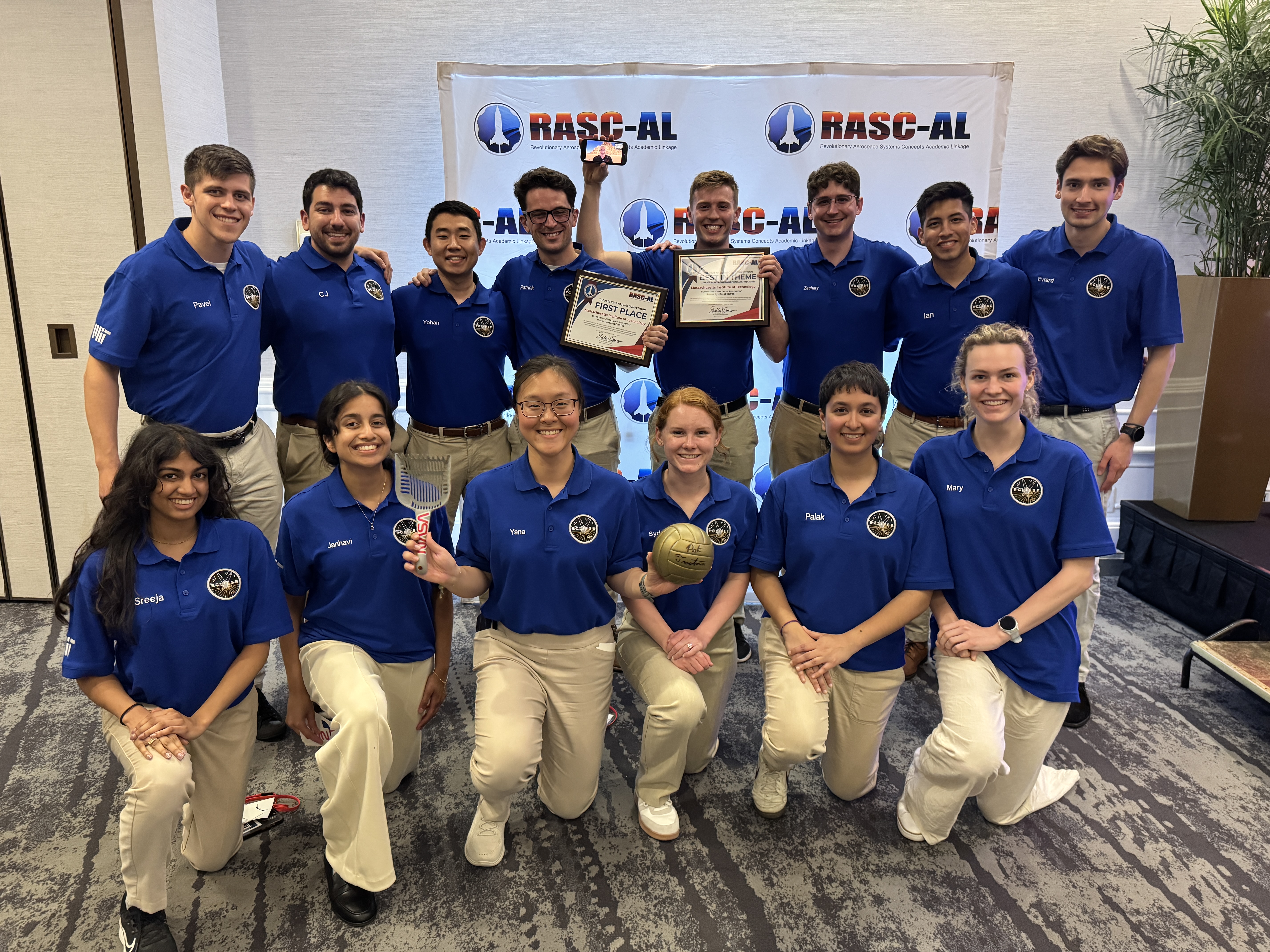
A group of 14 students wearing blue polo shirts smile at the camera while holding the first place certificate for winning the NASA RASC-AL challenge.
The Massachusetts Institute of Technology team that won the 2026 RASC-AL competition for their project, Exploration-Class Lunar Integrated Power SystEm.
Credit: National Institute of Aerospace

NASA announced the Massachusetts Institute of Technology project, Exploration-Class Lunar Integrated Power SystEm, as the first place winner for the 2026 Revolutionary Aerospace Systems Concepts – Academic Linkage (RASC-AL) competition, which challenges students to bridge gaps in aerospace technology by innovating new system concepts and prototypes. 

Another team from the same university won second place overall for their project, Mars Exploration Layered Infrastructure for Operations, Research, and Advancement, while Virginia Polytechnic Institute and State University took third place with the Mars Pylon Network.  

Empowering the next generation, the competition also supports the agency’s workforce development priorities by offering university teams hands-on experience in mission architecture development, systems engineering, and technical communication. 

“The winning teams demonstrated how academic innovation can support Artemis mission goals,” said Daniel Mazanek, program sponsor for RASC-AL and senior space systems engineer, NASA’s Langley Research Center in Hampton, Virginia. “Their work highlights the important role student research plays in shaping future space exploration, and the results showcase how disciplined analysis can elevate innovative ideas into viable exploration concepts.”  

Fourteen finalists attended the multi-day RASC-AL Forum in Cocoa Beach, Florida, and gave formal presentations outlining their mission architectures, technology solutions, and supporting analysis. These discussions provided students with real-time engineering feedback, exposing them to the rigor and scrutiny applied to human spaceflight concepts under development within the agency. 

Awards were presented to teams demonstrating the highest levels of technical rigor, innovation, and mission alignment. In addition to the top prizes, other awards included: 

  • Best in Communications, Position, Navigation, and Time Architectures for Mars Surface Operations Theme: Massachusetts Institute of Technology 
    Mars Exploration Layered Infrastructure for Operations, Research, and Advancement MELIORA)
  • Best in Lunar Sample Return Concept Theme: South Dakota State University 
    Sample Extraction of Lunar Elements for Network Entry (SELENE)
  • Best in Lunar Surface Power and Power Management and Distribution Architectures Theme: Massachusetts Institute of Technology 
    Exploration-Class Lunar Integrated Power SystEm (ECLIPSE) 
  • Best in Lunar Technology Demonstrations Leveraging Common Infrastructure Theme: Massachusetts Institute of Technology 
    CLPS-enabled Highly-autonomous End-to-End isruSystem Evaluations to Build Understanding and Resilient Growth by Experimenting with Regolith (CHEESEBURGER) 
  • Best Prototype: 

    Embry-Riddle Aeronautical University, Worldwide Campus 
    Advanced Utilization of Resources for Energy & Viability Off-Earth (Project AUREVO)
    University of Illinois, Urbana-Champaign with Leonardo de Vinci Engineering School 
    Mining and Advanced Transformation of Regolith for Infrastructure and eXpansion (MATRIX) 

“The RASC-AL program allows students to demonstrate their ability to transform innovative concepts into technically sound studies, with emphasis on technical rigor, clear communication, and systems-level thinking,” said Christopher Jones,  program sponsor for RASC-AL and chief technologist for the Systems Analysis and Concepts Directorate at NASA Langley. “These are the hallmarks of effective engineering that we’re looking for and reflect the standards required for real-world aerospace problem-solving,”  

The NASA RASC-AL competition represents a cross-agency collaboration. The competition is administered by the National Institute of Aerospace and managed by the NASA Tournament Lab, part of the agency’s Prizes, Challenges, and Crowdsourcing Program.  

For more information, visit:  

https://go.nasa.gov/3GS1OGm

The post NASA Announces Winners of 2026 University Innovation Competition  appeared first on NASA Science.

NASA Announces Winners of 2026 University Innovation Competition 

5 June 2026 at 21:17
A group of 14 students wearing blue polo shirts smile at the camera while holding the first place certificate for winning the NASA RASC-AL challenge.
The Massachusetts Institute of Technology team that won the 2026 RASC-AL competition for their project, Exploration-Class Lunar Integrated Power SystEm.
Credit: National Institute of Aerospace

NASA announced the Massachusetts Institute of Technology project, Exploration-Class Lunar Integrated Power SystEm, as the first place winner for the 2026 Revolutionary Aerospace Systems Concepts – Academic Linkage (RASC-AL) competition, which challenges students to bridge gaps in aerospace technology by innovating new system concepts and prototypes. 

Another team from the same university won second place overall for their project, Mars Exploration Layered Infrastructure for Operations, Research, and Advancement, while Virginia Polytechnic Institute and State University took third place with the Mars Pylon Network.  

Empowering the next generation, the competition also supports the agency’s workforce development priorities by offering university teams hands-on experience in mission architecture development, systems engineering, and technical communication. 

“The winning teams demonstrated how academic innovation can support Artemis mission goals,” said Daniel Mazanek, program sponsor for RASC-AL and senior space systems engineer, NASA’s Langley Research Center in Hampton, Virginia. “Their work highlights the important role student research plays in shaping future space exploration, and the results showcase how disciplined analysis can elevate innovative ideas into viable exploration concepts.”  

Fourteen finalists attended the multi-day RASC-AL Forum in Cocoa Beach, Florida, and gave formal presentations outlining their mission architectures, technology solutions, and supporting analysis. These discussions provided students with real-time engineering feedback, exposing them to the rigor and scrutiny applied to human spaceflight concepts under development within the agency. 

Awards were presented to teams demonstrating the highest levels of technical rigor, innovation, and mission alignment. In addition to the top prizes, other awards included: 

  • Best in Communications, Position, Navigation, and Time Architectures for Mars Surface Operations Theme: Massachusetts Institute of Technology 
    Mars Exploration Layered Infrastructure for Operations, Research, and Advancement MELIORA)
  • Best in Lunar Sample Return Concept Theme: South Dakota State University 
    Sample Extraction of Lunar Elements for Network Entry (SELENE)
  • Best in Lunar Surface Power and Power Management and Distribution Architectures Theme: Massachusetts Institute of Technology 
    Exploration-Class Lunar Integrated Power SystEm (ECLIPSE) 
  • Best in Lunar Technology Demonstrations Leveraging Common Infrastructure Theme: Massachusetts Institute of Technology 
    CLPS-enabled Highly-autonomous End-to-End isruSystem Evaluations to Build Understanding and Resilient Growth by Experimenting with Regolith (CHEESEBURGER) 
  • Best Prototype: 

    Embry-Riddle Aeronautical University, Worldwide Campus 
    Advanced Utilization of Resources for Energy & Viability Off-Earth (Project AUREVO)
    University of Illinois, Urbana-Champaign with Leonardo de Vinci Engineering School 
    Mining and Advanced Transformation of Regolith for Infrastructure and eXpansion (MATRIX) 

“The RASC-AL program allows students to demonstrate their ability to transform innovative concepts into technically sound studies, with emphasis on technical rigor, clear communication, and systems-level thinking,” said Christopher Jones,  program sponsor for RASC-AL and chief technologist for the Systems Analysis and Concepts Directorate at NASA Langley. “These are the hallmarks of effective engineering that we’re looking for and reflect the standards required for real-world aerospace problem-solving,”  

The NASA RASC-AL competition represents a cross-agency collaboration. The competition is administered by the National Institute of Aerospace and managed by the NASA Tournament Lab, part of the agency’s Prizes, Challenges, and Crowdsourcing Program.  

For more information, visit:  

https://go.nasa.gov/3GS1OGm

❌