❌

Normal view

Black Eye Galaxy

12 June 2026 at 14:59
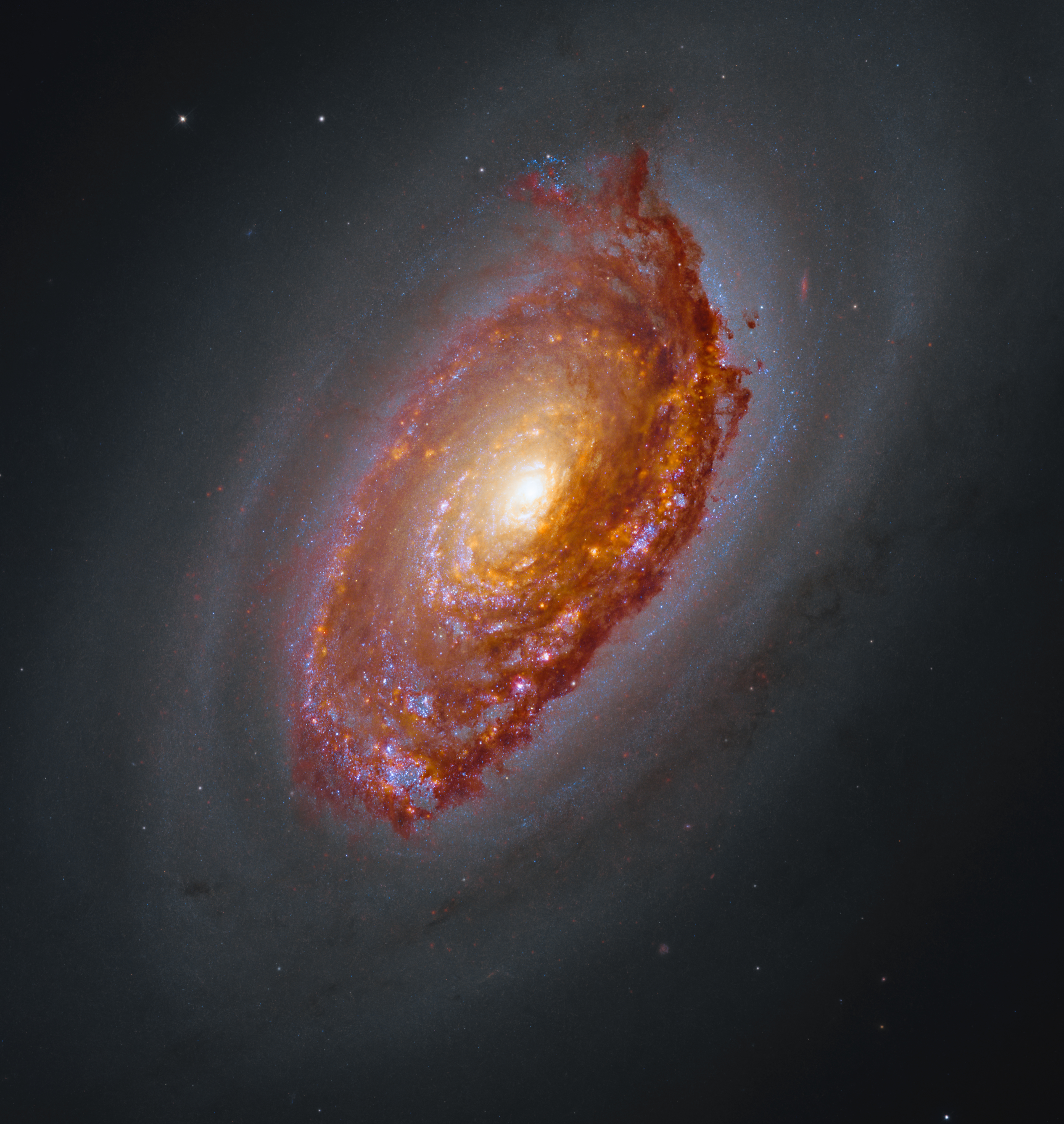
Hubble and Webb image of M64. A massive spiral galaxy glows with a yellow core, surrounded by arms full of orange-brown dust and pink and blue patches of star formation. Framed by a haze of dark dust, the galaxy shines against black space dotted with a few stars.
Easily identified by the spectacular band of dark dust that partially obscures its bright core, Messier 64, or the Black Eye Galaxy, is characterized by its bizarre internal motion.
NASA, CSA, ESA, F. Belfiore (European Southern Observatory – Germany), J. Lee (Space Telescope Science Institute), A. Leroy (The Ohio State University), and D. Thilker (The Johns Hopkins University); Processing: Gladys Kober (NASA/Catholic University of America)

This March 20, 2026, image of Messier 64, or the Black Eye Galaxy, is a composite view from NASA’s Hubble Space Telescope and James Webb Space Telescope. It shows Messier 64 captured at near- and mid-infrared wavelengths by Webb, while Hubble’s image shows the galaxy in ultraviolet, visible, and near-infrared light.

Messier 64 is characterized by its bizarre internal motion. The gas in the outer regions of this spiral galaxy is rotating in the opposite direction from the gas and stars in its inner regions. This strange behavior may be the result of a merger between M64 and a satellite galaxy over a billion years ago.

Image credit: NASA, CSA, ESA, F. Belfiore (European Southern Observatory – Germany), J. Lee (Space Telescope Science Institute), A. Leroy (The Ohio State University), and D. Thilker (The Johns Hopkins University); Processing: Gladys Kober (NASA/Catholic University of America)

The post Black Eye Galaxy appeared first on NASA Science.

Black Eye Galaxy

12 June 2026 at 14:59
Hubble and Webb image of M64. A massive spiral galaxy glows with a yellow core, surrounded by arms full of orange-brown dust and pink and blue patches of star formation. Framed by a haze of dark dust, the galaxy shines against black space dotted with a few stars.
Easily identified by the spectacular band of dark dust that partially obscures its bright core, Messier 64, or the Black Eye Galaxy, is characterized by its bizarre internal motion.
NASA, CSA, ESA, F. Belfiore (European Southern Observatory – Germany), J. Lee (Space Telescope Science Institute), A. Leroy (The Ohio State University), and D. Thilker (The Johns Hopkins University); Processing: Gladys Kober (NASA/Catholic University of America)

This March 20, 2026, image of Messier 64, or the Black Eye Galaxy, is a composite view from NASA’s Hubble Space Telescope and James Webb Space Telescope. It shows Messier 64 captured at near- and mid-infrared wavelengths by Webb, while Hubble’s image shows the galaxy in ultraviolet, visible, and near-infrared light.

Messier 64 is characterized by its bizarre internal motion. The gas in the outer regions of this spiral galaxy is rotating in the opposite direction from the gas and stars in its inner regions. This strange behavior may be the result of a merger between M64 and a satellite galaxy over a billion years ago.

Image credit: NASA, CSA, ESA, F. Belfiore (European Southern Observatory – Germany), J. Lee (Space Telescope Science Institute), A. Leroy (The Ohio State University), and D. Thilker (The Johns Hopkins University); Processing: Gladys Kober (NASA/Catholic University of America)

Featured Image: Fractals and Flocculence

10 November 2025 at 17:00

eight images of spiral galaxies

Displayed above are eight galaxies imaged by the Sloan Digital Sky Survey. Although all of these galaxies are spiral galaxies, there are large differences between them: the top row shows grand-design spirals, which feature well-defined arms, and the bottom row shows flocculent spirals, which have feathery or patchy arms. Recently, a team led by Biju Saha (Indian Institute of Science, Education and Research) explored whether grand-design and flocculent spirals could be classified by their fractal dimension. With intricate structures on scales large and small, spiral galaxies are fractal-like, and fractal dimension is a way of quantifying the complexity of their structure. Saha and collaborators found a statistically significant difference in the median fractal dimension of their samples of grand-design and flocculent spirals, suggesting that this mathematical method can help distinguish between the two types of spirals. To learn more about how fractal dimension is calculated from galaxy images, and what these results might mean for how spiral arms form, be sure to check out the full research article linked below.

Citation

β€œCan Fractal Dimension Distinguish Between Grand-Design and Flocculent Spiral Arms?” Biju Saha et al 2025 ApJ 991 63. doi:10.3847/1538-4357/adf840

The post Featured Image: Fractals and Flocculence appeared first on AAS Nova.

Cosmic Asymmetry Revealed: Spiral Galaxy Spin Directions and Clustering of Quartets of Galaxies

4 February 2025 at 22:06
Recent studies reveal asymmetries in the universe, challenging big bang assumptions. Research from the JWST indicates a significant predominance of clockwise-rotating spiral galaxies, with implications questioning new physics. Additionally, tetrahedral arrangements of galaxies suggest non-random clustering, hinting at a created order in the cosmos.

❌