❌

Normal view

Cytoskeletal Oscillator Drives Neuronal Polarity Formation Intrinsically

9 July 2026 at 05:07

A groundbreaking study unveils how the ARP2/3 complex orchestrates the dynamic behavior of neurites, providing fresh insights into neuronal growth and polarity. Researchers utilized advanced optogenetic tools to manipulate RAC1, an upstream regulator of ARP2/3, revealing spatially distinct roles of actin assembly in neuronal morphology.

By employing photoactivatable RAC1 (PA-RAC1), the team demonstrated that ARP2/3-mediated actin assembly at neurite tips promotes growth cone activation and neurite extension. Local activation of PA-RAC1 triggered robust growth cone dynamics, driving neurite elongation. Conversely, activation of a dominant-negative RAC1 mutant led to collapse of the growth cone and neurite retraction, underscoring ARP2/3’s role in sustaining neurite advancement.

Intriguingly, PA-RAC1 activation at the soma induced lamellipodia formation reminiscent of nascent actin waves, which were associated with neurite retraction events. This phenomenon mirrored intrinsic cellular behaviors where somatic actin waves correspond with retracting neurites. The study elegantly showed that the emergence of these waves reduced somatic actin patch intensity, indicating a tightly regulated cytoskeletal oscillator mechanism.

The authors further explored the effects of ARP2/3 inhibition using CK-666 perfusion at distinct cellular locales. When applied over the soma and proximal neurites, CK-666 induced neurite retraction, whereas neurites outside this region continued growing unabated. Notably, actin waves were initiated in neurites outside the inhibited zone, propagating retrogradely toward the soma but dissipating upon entering CK-666-exposed areas. This highlights a spatial dependence of ARP2/3 activity for wave initiation and propagation.

Remarkably, simultaneous activation of PA-RAC1 at multiple growth cones revealed competitive dynamics in actin assembly, with enhanced growth cone activity limited to one or two sites. This suggests an intrinsic cellular mechanism balancing cytoskeletal resources and neurite growth across the complex neuronal arborization.

Together, these findings articulate a dual role for ARP2/3: driving actin wave initiation at the soma that triggers neurite retraction, and supporting growth cone expansion at neurite tips to promote extension. This oscillatory interplay mediated by ARP2/3 and RAC1 underscores the cytoskeleton’s fundamental role in establishing neuronal polarity.

This study not only provides a mechanistic framework for how neurons spatially regulate growth and retraction but also suggests that intrinsic cytoskeletal oscillators underpin the dynamic remodeling necessary for proper neuronal circuit formation. These insights pave the way for future investigations into cytoskeletal dysregulation in neurodevelopmental disorders and neuronal regeneration strategies.

The precise spatial control of actin dynamics mediated by ARP2/3 complex activity advances our understanding of neuronal development, highlighting how local cytoskeletal modulators can dictate overall neuronal architecture through oscillatory growth behaviors.


Subject of Research: Neuronal cytoskeletal dynamics and polarity establishment

Article Title: An intrinsic cytoskeletal oscillator establishes neuronal polarity

Article References:
Lin, Tc., Coles, C.H., Alfadil, E. et al. An intrinsic cytoskeletal oscillator establishes neuronal polarity. Nature (2026). https://doi.org/10.1038/s41586-026-10755-6

Image Credits: AI Generated

DOI: https://doi.org/10.1038/s41586-026-10755-6

Western Europe Had Its Hottest June on Record

9 July 2026 at 03:00
An unusually early heat wave smashed records across France, Britain and Spain. Temperatures in some areas are starting to soar again.

© Kin Cheung/Associated Press

Riding a hot train in London on June 24. Average temperatures across Western Europe last month were 3.05 degrees Celsius, or 5.5 degrees Fahrenheit, above the mean from recent decades.

Climate Change Fueling Europe’s Ferocious Heat Wave, Scientists Find

26 June 2026 at 05:01
A scientific analysis concluded that such high temperatures, across so much of the continent, would “not have been possible” without global warming.

© Christophe Archambault/Agence France-Presse — Getty Images

A shady passageway on Tuesday in Bordeaux, France, where temperatures reached 108 degrees Fahrenheit, or roughly 42 Celsius.

Why Is Europe the Fastest-Warming Continent

24 June 2026 at 18:59
The burning of fossil fuels is raising temperatures worldwide, but local factors, on land and at sea, determine which regions warm most rapidly.

© Toby Shepheard/Agence France-Presse — Getty Images

Morning commuters on the London Bridge on Wednesday, where temperatures reached 96 degrees Fahrenheit, the hottest recorded June day in the United Kingdom.

An Influx of Climate Cash

23 June 2026 at 21:18
Many philanthropists are backing away from climate giving. But one is writing very big checks.

© Justin Tallis/Agence France-Presse — Getty Images

Michael Bloomberg, the billionaire and former mayor of New York City, at a climate forum in London on Tuesday.

Europe Created Heat-Wave Protections. Now Comes the ‘Crash Test.’

23 June 2026 at 10:02
Searing temperatures in Western Europe are drawing comparisons to 2003, when a deadly heat wave sparked a reckoning.

© Thibault Camus/Associated Press

A visitor to the Palace of Versailles in France on Monday, where temperatures exceeded 104 degrees Fahrenheit.

Preventive Health Shields Older Adults from Heat Depression

20 June 2026 at 00:25

As global temperatures continue to rise at an alarming rate, the intersection of climate change and mental health has emerged as a critical area of concern, especially for vulnerable populations such as older adults. Recent research spearheaded by Liu, Zheng, Yang, and their colleagues sheds new light on the pivotal role that preventive health services utilization plays in safeguarding the mental well-being of older adults against the adverse effects of heat exposure. Their groundbreaking study, soon to be published in BMC Geriatrics, presents a comprehensive analysis that underscores the protective capacities afforded by healthcare interventions in mitigating heat-related depressive symptoms in aging populations.

The study begins by contrasting the escalating frequency and intensity of heatwaves worldwide with the growing demographic segment of older adults, who are physiologically and socially predisposed to the detrimental consequences of prolonged heat exposure. While the direct physiological impacts of heat on mortality and morbidity among the elderly have been well established, the researchers delve into a less explored yet profoundly significant domain: the influence of heat events on mental health, particularly depression. This focus addresses a critical knowledge gap in geriatric public health and climate adaptation strategies.

Employing an extensive dataset that integrates meteorological records, health service utilization patterns, and mental health assessments among older adults, the research team employs advanced statistical modeling to elucidate the complex interplay between heat exposure and mental health outcomes. Their methodological approach moves beyond correlation, venturing into causal inference by leveraging longitudinal data that tracks changes in depressive symptoms relative to heatwave durations and intensities, while accounting for confounding variables such as socioeconomic status, pre-existing health conditions, and social support networks.

One of the most striking revelations from the study is the demonstrable efficacy of preventive health services in diminishing the risk and severity of heat-induced depression. Preventive health services here include routine health check-ups, mental health screenings, access to cooling resources, and educational outreach about heat risk management. The researchers highlight that older adults who consistently engage with these services show a statistically significant reduction in the onset and exacerbation of depressive symptoms during and after heatwave periods, compared to their counterparts with limited or no engagement with preventive care.

The biological underpinnings of this protective effect are multifaceted. Heat stress has been implicated in disrupting circadian rhythms, elevating systemic inflammation, and altering neurotransmitter dynamics—all contributing factors to the pathophysiology of depression. Preventive health services facilitate early detection and management of these physiological disturbances through medication adjustments, psychosocial support, and proactive lifestyle guidance tailored to individuals’ needs during heatwaves.

Moreover, the study affirms that preventive health services extend beyond mere clinical interaction; they foster social connectedness and behavioral resilience, which act as crucial buffers against the psychological toll of environmental stressors. Regular contact with healthcare providers and community health programs enhances health literacy, empowers older adults to implement adaptive behaviors—such as hydration strategies and temperature regulation—and reduces feelings of isolation, which is a known risk factor for depression in aging populations.

In addition to individual-level benefits, the research contextualizes the broader public health implications. The integration of preventive health services into climate resilience frameworks presents a scalable, cost-effective strategy to combat the mental health impacts of extreme heat in aging societies. By embedding these services within primary care and community health infrastructures, policymakers can ensure equitable access for high-risk groups, thereby mitigating disparities exacerbated by social determinants of health and geographic vulnerabilities.

The findings also bear important implications for the design of digital health technologies and telemedicine platforms. These tools can enhance the reach and efficacy of preventive services by facilitating remote monitoring, delivering personalized health education, and enabling timely interventions during heatwave alerts. The researchers advocate for the incorporation of climate-sensitive modules into existing healthcare protocols to address the nuanced needs of older adults facing climate-related stressors.

Furthermore, the study underscores the necessity of multidisciplinary collaboration between climatologists, geriatricians, mental health specialists, and public health strategists to develop holistic interventions that encompass environmental, physiological, and psychosocial dimensions. The authors argue that traditional siloed approaches are ill-equipped to address the complex challenges posed by climate change-induced health risks and that integrated policies are paramount.

Another key contribution of this research is its emphasis on the heterogeneity within older adult populations. The analysis reveals that factors such as age stratification, comorbidities, and socio-economic status modulate the degree of vulnerability and responsiveness to preventive interventions. Tailoring preventive health services to these nuances enhances their effectiveness, highlighting the value of precision public health approaches in the era of climate change.

This study also broadens the scientific discourse by framing depression as a significant climate-sensitive health outcome that demands urgent attention from the global health community. While much focus has been placed on cardiorespiratory and heat stroke-related illnesses, mental health outcomes often remain overshadowed, despite their pervasive impact on quality of life and functional independence in older adults. Elevating mental health in the climate-health agenda is a profound step forward underscored by this work.

Additionally, Liu and colleagues offer methodological innovations by integrating environmental exposure metrics with validated geriatric depression scales and health service utilization records. Their analytical techniques—including the use of time-series analyses and mediation modeling—set new standards for rigor in environmental mental health research. Such methodological advancements facilitate the detection of subtle intervention effects that could be overlooked in conventional epidemiological studies.

The research also addresses potential barriers to the effective uptake of preventive services among older adults. Issues such as healthcare accessibility, cultural perceptions of mental health, and educational disparities are examined as critical factors influencing utilization rates. The findings suggest targeted outreach and culturally sensitive programming are essential components to optimize service delivery and engagement.

Importantly, the implications extend beyond immediate health outcomes, touching on broader societal challenges posed by an aging global population amid accelerating climate change. Mental health stability in older adults is linked to decreased healthcare costs, reduced caregiver burden, and sustained community participation—all vital components for maintaining social cohesion and economic vitality in heat-impacted regions.

The study concludes with a call for urgent action to embed preventive health services within climate adaptation policies and health systems strengthening frameworks worldwide. The authors stress that timely investment in such services not only safeguards mental health but also embodies a proactive approach to safeguarding human dignity in the face of unprecedented environmental changes.

In sum, this pioneering research by Liu et al. provides an indispensable evidence base highlighting preventive health services as a vital defense mechanism against heat-related depressive risks in older adults. Its insights pave the way for innovative, evidence-driven interventions that can transform the climate resilience landscape, ensuring the psychological well-being of our elders as they confront the relentless challenges of a warming world.


Subject of Research: The role of preventive health services utilization in protecting older adults from heat-related depressive risks.

Article Title: Uncovering the role of preventive health services utilization in protecting older adults from heat-related depressive risks.

Article References: Liu, S., Zheng, J., Yang, F. et al. Uncovering the role of preventive health services utilization in protecting older adults from heat-related depressive risks. BMC Geriatr (2026). https://doi.org/10.1186/s12877-026-07828-6

Image Credits: AI Generated

Astronomers Unveil Record-Breaking Haul of 161 New Black Hole Collisions

12 June 2026 at 19:57
Gravitational Waves IllustrationA new gravitational-wave catalogue reports 161 additional black hole mergers, bringing the total to 390 detections. Scientists at the University of Glasgow’s Institute for Gravitational Research are celebrating the release of a major new collection of gravitational wave discoveries, a milestone that highlights the rapid growth of gravitational astronomy. The latest Gravitational Wave Transient Catalogue [...]

The history of tsunami-causing earthquakes in Japan

11 June 2026 at 12:00

In 2011, miles of rock shifted deep underwater in the Japan Trench, causing an earthquake that deformed the seafloor and caused a devastating tsunami. Off the Eastern Coast of the Tōhoku region in Japan, a huge piece of the Earth’s crust carrying the Pacific Ocean, known as a tectonic plate, is forcing itself beneath Japan and into the Earth’s interior. Researchers think rock from this plate pushed against rock far beneath Japan, building pressure until it became too great. The lower plate slipped, spreading energy from the slip site and causing the earthquake. 

Plate slip can cause 2 types of outcomes. The first occurs kilometers deep in the Earth’s crust, causing earthquakes too small to trigger tsunamis. The second type causes extreme slip events that begin deep in the crust, like the 2011 event that extended into the Japan Trench and warped the seafloor. The moving seafloor displaces seawater, causing a tsunami. These events are referred to as slip-to-the-trench style earthquakes.

Researchers think this phenomenon is not unique to 2011, as Japan has a long history of tsunami-causing earthquakes. Charlotte Pizer and colleagues investigated sediment from the Japan Trench to unearth the geologic history of slip-to-the-trench style earthquakes.

In between earthquakes, Japanese islands continuously shed sediment that fills the trench, forming horizontal layers. Slip-to-the-trench earthquakes bend and fold these layers. The team hypothesized that if they found these folds in the Japan Trench and dated them, they could catalogue the record of slip-to-the-trench style earthquakes in the area.

Earthquakes like these occur repeatedly, meaning that younger ones can erase folds caused by older ones. To account for this overprinting, the researchers chose a study site within the Japan Trench about 100 kilometers (60 miles) north of where the most severe earthquakes occur. This site is only mildly deformed by slip-to-the-trench earthquakes since it’s so far from their source, making it easier for the team to identify individual events. 

Pizer and her group pieced together data collected from this site by previous researchers to reconstruct Japan’s earthquake history. They compiled 3 main types of data. Two of these were images of sediment layers in the trench constructed from reflections of vibrations sent into the ground, called seismic profiles. 

The first seismic profile captured the full trench, over 1 kilometer deep (about 0.6 miles), at 5-meter (16-feet) resolution. Using this method, any layers smaller than 5 meters thick won’t appear in the image. The second seismic profile captured only the top 40 meters (130 feet) of sediment, but could detect layers as thin as 10 centimeters (4 inches). 

The final type of data they used came from a 36-meter (120-foot) long cylinder of sediment extracted from the bottom of the trench, called a sediment core. Researchers in the past tied layers within this sediment core to historic earthquake events. They showed that it recorded 2 specific earthquakes in the area, the Kyotoku earthquake of 1454 CE, and the Jogan earthquake of 869 CE, both of which likely caused tsunamis. 

Pizer’s team could observe the depth of the Kyotoku and Jogan earthquake layers taken from the sediment core in their high-resolution seismic profile of the trench. In these high-resolution data, they noticed that deformation occurred in the sediment up to the layer marking the Jogan earthquake, but not above it, meaning deformation of the trench happened during this 869 CE event. 

The high-resolution data were only able to image sediments from recent earthquakes since 869 CE, but the low-resolution profile, which imaged the full trench, was able to capture the deeper, older record. When they looked deeper into the trench sediment, the researchers noticed that deformation from the 869 CE event had spread from where the tectonic plate is colliding with Japan. They saw at least 6 more similarly deformed layers, implying each was its own slip-to-the-trench event, although the dates of these events are unknown.

Pizer and colleagues concluded that slip-to-the-trench earthquakes are long-standing, common events in the Japan Trench. They hope future scientists will continue to research this site to better assess tsunami risks in Japan.


The post The history of tsunami-causing earthquakes in Japan appeared first on Sciworthy.

Third Star’s the Charm: Most Merging Black Holes Might Be in Triple Systems

27 May 2026 at 17:00

Illustration of merging black holes

Where do black hole mergers happen? Recent research finds evidence that most black hole mergers occur in triple systems containing a close inner binary and a more distant third party.

Assembling Merging Black Holes

Thanks to the combined efforts of the LIGO, Virgo, and KAGRA gravitational wave detectors, we’ve now collected the subtle signals from several hundred pairs of merging stellar-mass black holes. As this collection of spacetime ripples continues to grow, researchers are seeking to understand how these merging black hole pairs were assembled.

In the simplest scenario, pairs of high-mass stars independently evolve into black holes, lose momentum by emitting gravitational waves, and meld into one another. But the population of merging black holes likely contains contributions from multiple sources, including multiple-star systems, the disks surrounding accreting supermassive black holes, and black holes that have already experienced a merger. Which of these merging populations is reflected in our catalog of gravitational wave events?

Modeling Challenges

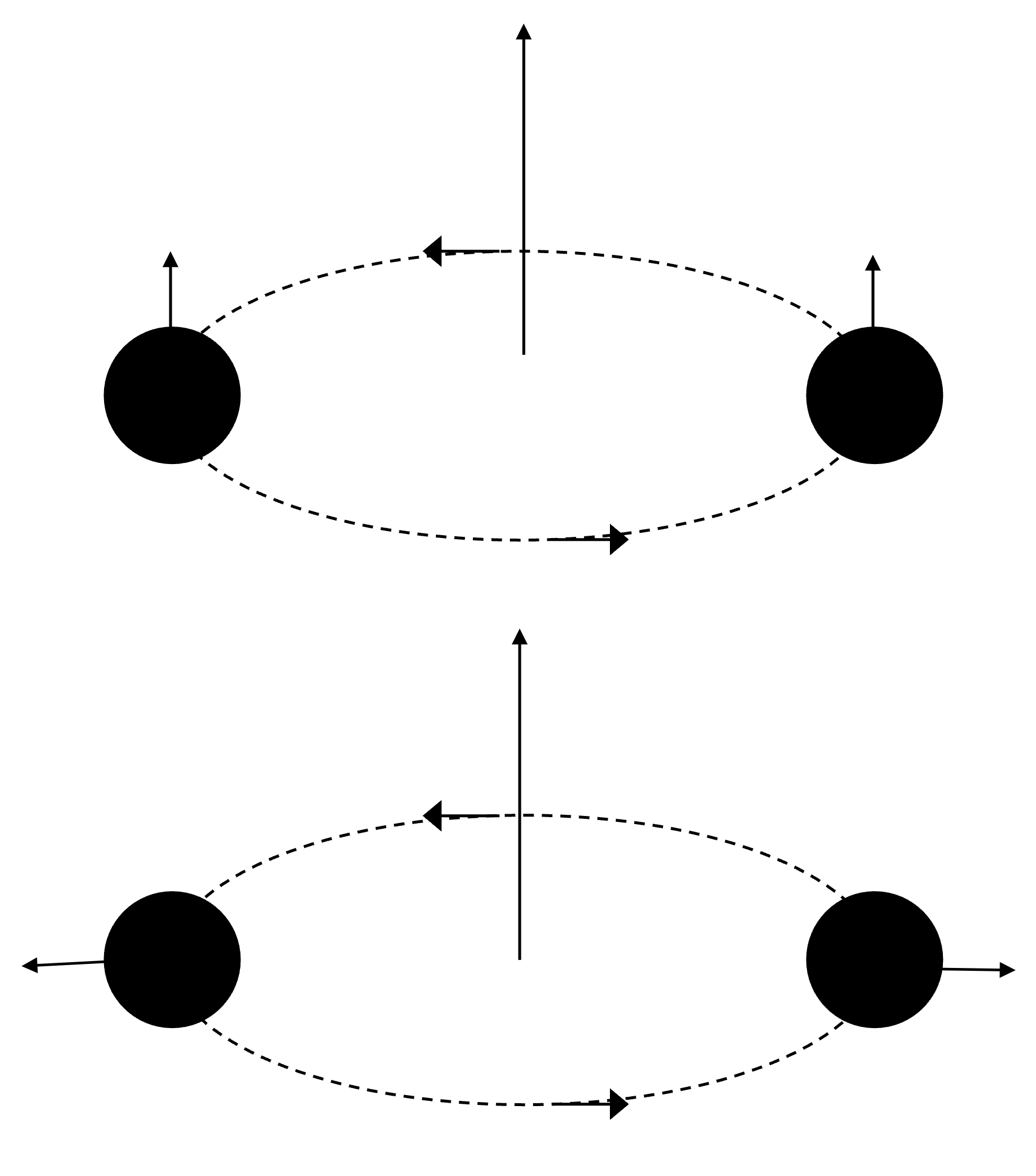
spin–orbit tilt diagram

A black hole binary system with aligned spins and orbit (top) and a binary with spins tilted by 90 degrees (bottom). [AAS Nova/Kerry Hensley]

In theory, this question can be answered by extracting the properties of merging black holes — mass, spin, and the like — from gravitational wave observations and comparing these properties against model predictions from different formation pathways. In reality, this is exceedingly difficult, as certain merger pathways can produce a wide variety of results, depending on assumptions or fine tuning.

So far, the increasingly large pool of gravitational wave detections tentatively points to a feature that could illuminate the sites of black hole mergers: a peak in the spin–orbit tilt distribution around 90 degrees. This feature has been most confidently extracted from nonparametric analyses, which do not make assumptions about the population of merging black holes, but it has also been hinted at in parametric analyses, which do make population-level assumptions.

Triple-System Feature

To investigate this feature further, a team led by Jakob Stegmann (Max Planck Institute for Astrophysics) performed a new, astrophysically motivated parametric analysis of the most recent catalog of gravitational wave detections from LIGO, Virgo, and KAGRA.

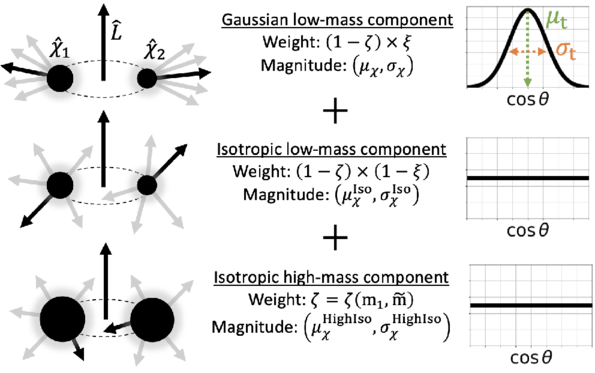
black hole populations used in modeling the observed spin–orbit tilt distribution

The three populations in the team’s modeling. [Stegmann et al. 2026]

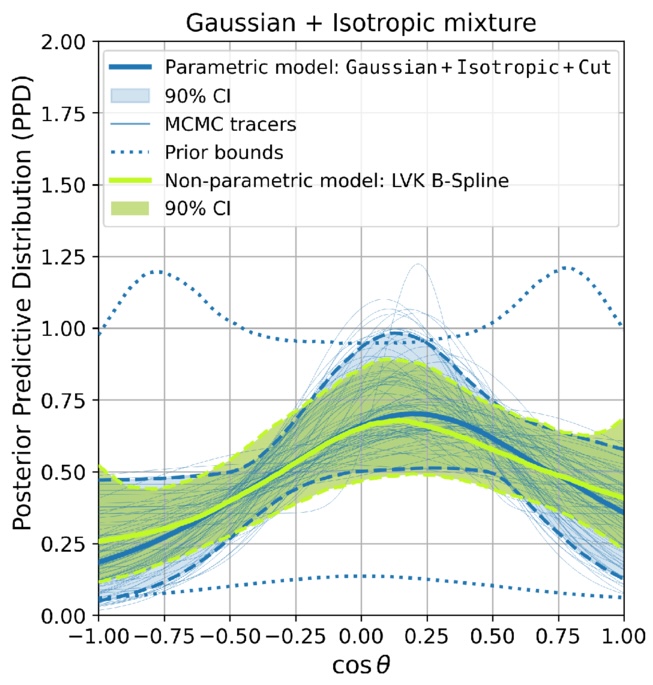
Their modeling tests combinations of multiple populations, including mergers in isolated binary systems, triple-star systems, and dense environments like star clusters. They also include a potential contribution from higher-mass mergers involving black holes that have merged previously. Using this framework, Stegmann’s team found that the observed spin–orbit tilt distribution is best matched by a model dominated by mergers in triple-star systems, with some contribution from other sources.
Posterior predictive distribution of black hole spin–orbit tilts

Posterior predictive distribution of black hole spin–orbit tilts. Both the authors’ modeling (solid blue line) and the nonparametric modeling performed by the LIGO–Virgo–KAGRA collaboration (solid green line) find evidence for a peak in the spin–orbit tilt distribution near cosθ = 0. [Adapted from Stegmann et al. 2026]

Specifically, this finding suggests that most mergers occur in hierarchical triple systems, which naturally predict an excess of 90-degree spin–orbit tilts without any fine tuning. Hierarchical triples contain an inner close binary with a distant outer companion; in these systems, relativistic spin precession, gravitational wave emission, and oscillations in eccentricity and inclination work to tilt the black holes in the inner binary by 90 degrees.

Stegmann and collaborators pointed out that the triple-system scenario aligns well with other properties of the observed population of black hole mergers, such as the mass and effective spin distributions. This scenario may also be necessary to explain certain merging pairs that might have had slightly eccentric orbits at the moment of merging. If future gravitational wave observations strengthen the evidence for a peak in the spin–orbit tilt distribution near 90 degrees, it will have profound implications for how and where black holes merge in our universe.

Citation

“Gravitational-Wave Observations Suggest Most Black Hole Mergers Form in Triples,” Jakob Stegmann et al 2026 ApJL 1000 L59. doi:10.3847/2041-8213/ae52ec

The post Third Star’s the Charm: Most Merging Black Holes Might Be in Triple Systems appeared first on AAS Nova.

An Impostor Explosion

27 March 2026 at 16:00

A rendering of two purple jets streaming away from a central explosion.

Over many centuries of observing the night sky, astronomers have found only a single visible afterglow of a collision between neutron stars. For a few days in the summer of 2025, it seemed like observers may have found another of these treasured but elusive prizes; unfortunately, the promising candidate turned out to be a supernova in disguise.

A Rare Prize

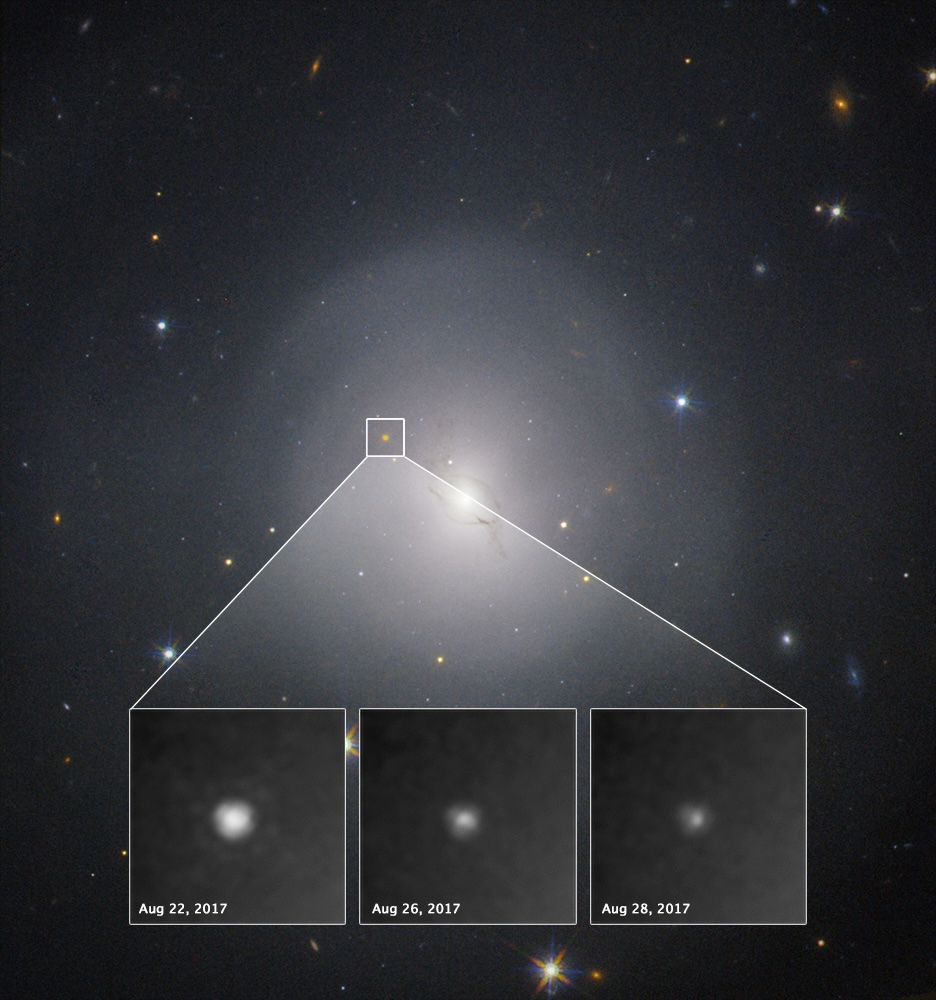
kilonova as seen by Hubble

These images from the Hubble Space Telescope show the fading light of the kilonova associated with the gravitational wave event GW170817. [NASA and ESA Acknowledgment: A. Levan (U. Warwick), N. Tanvir (U. Leicester), and A. Fruchter and O. Fox (STScI)]

When two neutron stars (the ultra-dense remnants of massive stellar explosions) spiral together and collide, the cataclysm is energetic enough to release strong gravitational waves, forge heavy elements, and briefly glow across the electromagnetic spectrum. These events are called kilonovae, and they’re quite rare; while we may have detected a handful at high energies, there is only one event for which astronomers managed to record both gravitational waves and an optical transient.

That one kilonova, found back in 2017, taught astronomers much about how heavy elements are formed and left the scientific community hungry for more data. Since then, each time a gravitational wave detector like LIGO reports that it may have spotted a neutron star merger, telescopes across the world scramble to look in the probable region of the sky, hoping to find the short-lived electromagnetic counterpart.

Too Good to Be True

On 18 August 2025, the LIGO/Virgo/KAGRA collaboration sent out an alert that it may have detected a neutron star–neutron star merger. The odds that their signal was real weren’t great, and the researchers gave it just a 29% chance of being a genuine astrophysical signal. Still, given the potential payoff of finding the next kilonova, several telescopes quickly began searches for the optical counterpart. The gravitational wave signal suggested that the event likely came from a curved patch of sky delightfully referred to as the “northern banana,” and after trawling that region for a few nights, astronomers hauled in 47 new transients. Any one of these could have been the kilonova, and all of them received extensive follow-up observations.

A team led by James Gillanders (University of Oxford) recently summarized some of these follow-up observations carried out with the Pan-STARRS and ATLAS telescopes. In the initial exciting few days after the alert went out, one candidate transient stood out as the most promising. Named AT2025ulz, it was first spotted by the Zwicky Transient Facility and initially started fading rapidly and changing colors, just as models of kilonovae predict. For four days, it seemed like the world may have witnessed its second-ever kilonova. But then the telescopes began their fifth night of observations.

Supernova Unmasked

A scatter plot showing a rapidly fading, then reversing and spiking, light curve.

The light curve of SN2025ulz. Note that the source appeared to grow brighter again after about 5 days. Click to enlarge. [Gillanders et al. 2025]

The light curve of AT2025ulz, after fading steadily in the preceding days, suddenly turned upwards; in other words, whatever was causing the transient got brighter. Models of kilonova evolution predict no such brightening, but Type IIb supernovae are known to follow just this behavior. AT2025ulz showed itself to be another run-of-the-mill stellar explosion, not the sought-after fireworks of two neutron stars slamming together.

Frustrating as this particular result may be, the effort was far from wasted. The team could use their non-detection of the true kilonova to place limits on its timing and peak magnitude, assuming it existed in the first place. And, as gravitational wave detectors grow more sensitive and alerts like this more common, hindsight will likely frame this scramble as a dress rehearsal for an ultimately successful kilonova recovery effort. Until then, astronomers will keep searching, and will keep their guard up against cosmic impostors.

Citation

“Pan-STARRS Follow-Up of the Gravitational-Wave Event S250818k and the Light Curve of SN2025ulz,” J. H. Gillanders et al 2025 ApJL 995 L27. doi:10.3847/2041-8213/ae2125

The post An Impostor Explosion appeared first on AAS Nova.

❌