❌

Normal view

NASA’s New Horizons Spacecraft Wakes from Hibernation in Good Health

7 July 2026 at 18:48

3 min read

NASA’s New Horizons Spacecraft Wakes from Hibernation in Good Health

Following its longest hibernation period ever of nearly a year, NASA’s New Horizons spacecraft has emerged in good health and is ready to begin transmitting science data gathered in the distant Kuiper Belt far beyond Pluto.

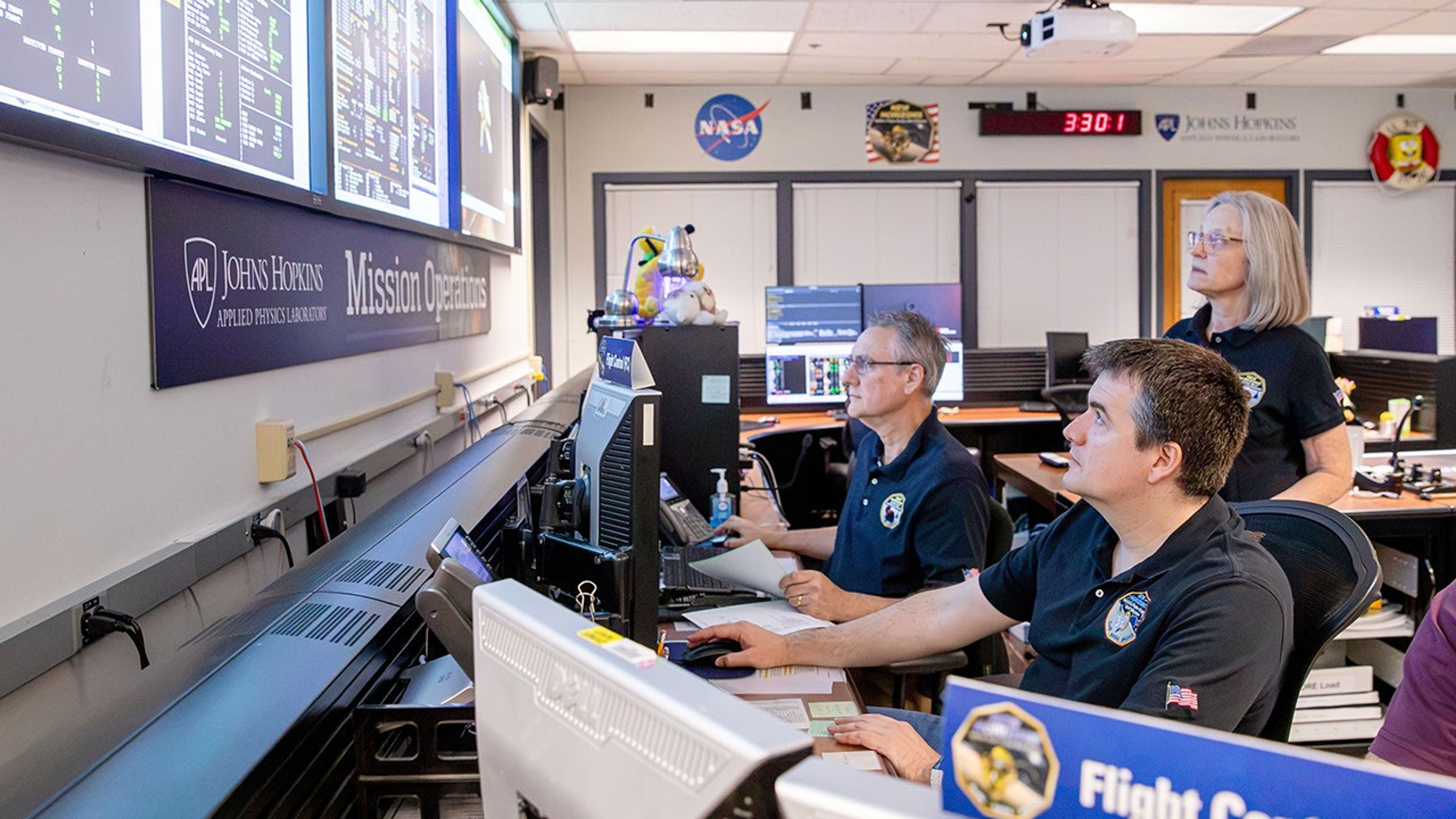
Flight operators at computers in a mission control center monitor spacecraft data on large wall displays.
From left, flight controllers Mark Lahr and Josh Albers, and Mission Operations Manager Alice Bowman, monitor telemetry streaming from NASA’s New Horizons spacecraft to the mission operations center at the Johns Hopkins Applied Physics Laboratory in Laurel, Maryland, on June 24, 2026. Now approximately 5.9 billion miles (9.5 billion kilometers) from Earth, New Horizons is ready to begin transmitting science data after being awakened from its longest ever, nearly yearlong hibernation period.
NASA/Johns Hopkins APL/SwRI/Justin Gladden

On June 23, flight controllers at the Johns Hopkins Applied Physics Laboratory (APL) in Laurel, Maryland, confirmed New Horizons, acting on stored commands uplinked to its main computer last July, had safely awakened from a 321‑day hibernation period that began Aug. 7. With the spacecraft now approximately 5.9 billion miles (9.5 billion kilometers) from Earth, the radio signals carrying that confirmation took about 8 hours and 52 minutes to reach the APL Mission Operations Center via NASA’s Deep Space Network station near Madrid, Spain.

The mission team typically places New Horizons in resource‑saving hibernation mode during long cruise periods. While the spacecraft is hibernating, operators do not send commands or retrieve data, but the spacecraft continues gathering and storing data around the clock from its heliospheric plasma sensors, Solar Wind at Pluto and the Pluto Energetic Particle Spectrometer Science Investigation, as well as its space dust detector, the Venetia Burney Student Dust Counter.

Alice Bowman, the New Horizons mission operations manager at APL, said the spacecraft reported back to Earth, via the Deep Space Network, with a weekly status beacon. “Every status report through this hibernation period was ‘green,’ meaning all was well aboard New Horizons each and every week,” she said.

As New Horizons resumes active operations, Bowman noted, the team will begin downlinking spacecraft health and safety data, followed by data from the three scientific instruments. In about three weeks, the spacecraft’s onboard Alice ultraviolet spectrograph will look at the hydrogen gas distribution in the outer heliosphere, while the Solar Wind at Pluto, the Pluto Energetic Particle Spectrometer Science Investigation, and the Venetia Burney Student Dust Counter instruments continue their measurements, and the ground team conducts a series of spacecraft and instrument checkouts.

The team also is completing upgrades to the ground‑system software that will make it easier to maintain operations of the spacecraft. Tests are already underway and are expected to continue through the year.

New Horizons is operating on updated autonomy logic designed for operations farther from the Sun and to accommodate the expected reduction in power and the naturally occurring increase in radio‑signal travel time.

The NASA spacecraft’s exploration of this distant region of the solar system marks the latest step in a journey that began in January 2006 with the fastest launch on record; a flyby of Jupiter in February 2007 that included stunning views of the gas giant and its moons; the first exploration through the Pluto system in July 2015; the first exploration of a Kuiper Belt object, Arrokoth, in January 2019, and unique studies of the Sun’s outer heliosphere and dozens of additional Kuiper Belt objects since then.

For more information on NASA’s New Horizons mission, visit:

https://science.nasa.gov/mission/new-horizons/

Meta Halts Employee-Tracking Program After Employee Data Exposed

23 June 2026 at 16:58
Meta pauses MCI after private conversations and employee data were exposed inside the company, renewing concerns over AI training and workplace monitoring.

VPN sans abonnement : existe-t-il des solutions fiables sans engagement ?

21 June 2026 at 11:30
Payer un abonnement tous les mois pour utiliser un VPN n’attire pas forcément tout le monde. Beaucoup d’utilisateurs cherchent aujourd’hui une solution plus souple. Une offre gratuite, un plan sans engagement ou une version limitée peuvent suffire pour protéger ses données sur internet, regarder...

CyberGhost - Asteroid Day : chiffrer les recherches, forums et ressources en ligne des passionnés d’espace

21 June 2026 at 07:30
À l’occasion de l’Asteroid Day, les passionnés d’espace multiplient les recherches en ligne, entre bases de données d’objets célestes, forums spécialisés et contenus scientifiques parfois très pointus. Cette exploration permanente de l’univers s’accompagne pourtant d’un enjeu discret mais réel :...

NordVPN - ICML 2026 : sécuriser les accès GitHub, notebooks et services cloud des chercheurs en IA

20 June 2026 at 07:30
L’ICML 2026 réunit la communauté internationale de l’intelligence artificielle autour des avancées en machine learning, avec un travail de recherche qui repose de plus en plus sur des environnements distribués : dépôts GitHub, notebooks collaboratifs et services cloud. Ces outils, essentiels au...

Rethinking EEG Biomarkers: A Dimensional Brain Disorders View

20 June 2026 at 05:28

In a groundbreaking departure from traditional approaches, researchers have unveiled a transformative perspective on EEG biomarkers for brain disorders, emphasizing a transdiagnostic dimensional framework that promises to revolutionize neuropsychiatric diagnostics and treatment. This pioneering study, conducted by Zebhauser, Heitmann, Henningsen, and colleagues, challenges decades-old conventions that pigeonhole brain disorders strictly according to categorical diagnostic criteria. Instead, it advocates for a more nuanced, continuum-based understanding of brain dysfunctions as reflected in electroencephalographic signals.

The conventional paradigm in neuropsychiatry has long relied upon discrete diagnostic labels—labels which often fall short in capturing the complex, overlapping symptomology exhibited across disorders such as schizophrenia, bipolar disorder, major depressive disorder, and anxiety disorders. Traditional EEG analyses have sought biomarkers confined within these diagnostic categories, leading to inconsistent results and limited clinical utility. The new study confronts these limitations by proposing that EEG biomarkers be analyzed through a dimensional lens that transcends categorical boundaries, enabling detection of underlying neural dysfunctions that span multiple disorders.

Central to this conceptual shift is the transdiagnostic approach, which posits that neurobiological aberrations are shared across different psychiatric conditions and manifest along spectrums of symptom severity and cognitive impairment. Through rigorous computational modeling and advanced signal processing applied to large EEG datasets, the research team delineated patterns of neural oscillatory activity and connectivity that correlate with continuous measures of cognitive and affective dysfunctions, irrespective of diagnostic categories. This approach underscores the shared neurophysiological substrates that traditional categorical classifications often obscure.

Methodologically, the study harnessed sophisticated machine learning algorithms to parse high-dimensional EEG data and extract signal features indicative of brain circuit dysregulation. By focusing on spectral power variations across frequency bands—delta, theta, alpha, beta, and gamma—as well as functional connectivity metrics between cortical networks, the researchers succeeded in identifying biomarkers reflective of symptom dimensions such as cognitive control deficits, emotional dysregulation, and sensory processing anomalies. These dimensions overlap across disorders, suggesting a common pathophysiological mechanism modulated along a continuum.

Importantly, the transdiagnostic dimensional framework enables more personalized and precise characterization of patients’ neural profiles. Instead of forcing diagnoses into rigid boxes, clinicians can now utilize EEG biomarkers to quantify an individual’s specific symptom constellation and severity in real-time. This precision facilitates tailored interventions that target dysfunctional brain networks directly, potentially enhancing treatment efficacy and reducing trial-and-error prescribing that often plagues psychiatric care.

The implications extend beyond diagnosis and treatment optimization. This novel EEG biomarker approach offers a powerful tool for preventative psychiatry by identifying at-risk individuals who may not yet meet full diagnostic criteria but exhibit measurable neural dysfunctions indicative of emerging disorders. By mapping these dimensional brain signatures early, clinicians can intervene preemptively, possibly altering disease trajectories before chronicity sets in.

Moreover, this paradigm fosters an integrative understanding of brain disorders as dynamic states rather than static labels. The EEG biomarkers track fluctuation in cognitive and affective states, capturing the temporal evolution of illness and response to therapy. Such temporally sensitive biomarkers pave the way for real-time monitoring of treatment response and disease progression via non-invasive methods, enhancing clinical decision-making and patient outcomes.

The study also confronts several technical challenges historically hindering EEG’s clinical translation. By developing robust preprocessing pipelines that mitigate artifacts and employing cross-validation techniques to ensure replicability of findings across diverse cohorts, the researchers set new standards for EEG research rigor. Their comprehensive methodology serves as a blueprint for future investigations aiming to unify neurophysiological data with psychiatric phenotypes in a clinically meaningful manner.

Furthermore, by adopting a transdiagnostic dimensional view, the research opens novel avenues for drug development. Pharmaceutical interventions can be engineered to target neural circuits and pathways implicated across multiple disorders, possibly leading to broader spectrum therapeutics with enhanced efficacy. This contrasts with the current trend of developing highly disorder-specific drugs, which may only benefit a subset of patients.

Underpinning this research is the recognition that brain disorders are multifactorial and multifaceted, involving intricate interactions between genetics, environment, and neural circuitry. The EEG biomarkers illuminated by this study reflect emergent properties of large-scale brain networks whose dysfunction cuts across traditional diagnostic divides. This holistic lens aligns with contemporary theories of brain function as distributed and dynamic, rather than localized and static.

Clinically, the transdiagnostic dimensional EEG biomarkers facilitate identification of subtypes within disorders, based on distinct neurophysiological profiles. Such stratification could improve prognostic accuracy and enable stratified clinical trials, ultimately accelerating discovery and application of targeted therapies. This personalized medicine approach marks a considerable leap in the field of psychiatry.

The study’s findings also resonate deeply with the Research Domain Criteria (RDoC) initiative advocated by the National Institute of Mental Health, which promotes research centered on fundamental dimensions of functioning rather than syndromic categories. The demonstrated EEG biomarkers provide tangible neurobiological correlates for RDoC constructs such as cognitive systems and arousal/regulatory systems, making a compelling case for their adoption in clinical and research frameworks.

Ethical and practical considerations emerge as these new EEG biomarkers are integrated into clinical practice. Ensuring equitable access to advanced neurodiagnostic technologies and protecting patient privacy with respect to neural data will be paramount. The authors acknowledge these issues and call for development of guidelines and safeguards alongside technological progress to maximize benefit and minimize harm.

This research heralds a new era in neuropsychiatry, where neural biomarkers derived from accessible EEG recordings become central to understanding, diagnosing, and treating brain disorders as dimensional phenomena. By transcending rigid diagnostic boundaries, this approach reflects the complex reality of brain function and dysfunction, offering hope for more effective, individualized care for millions worldwide impacted by mental illness.

In conclusion, the visionary framework proposed by Zebhauser and colleagues challenges entrenched conventions and illuminates a path forward marked by dimensional precision, cross-disorder integration, and clinically actionable EEG biomarkers. This work stands to reshape the landscape of psychiatric neuroscience and catalyze a shift toward truly personalized mental health care.


Subject of Research: EEG biomarkers and their application in a transdiagnostic dimensional framework for brain disorders

Article Title: Rethinking EEG biomarkers of brain disorders: a transdiagnostic dimensional view

Article References: Zebhauser, P.T., Heitmann, H., Henningsen, P. et al. Rethinking EEG biomarkers of brain disorders: a transdiagnostic dimensional view. Transl Psychiatry 16, 316 (2026). https://doi.org/10.1038/s41398-026-04187-z

Image Credits: AI Generated

DOI: 10 June 2026

VPN pour ordinateur portable : NordVPN, CyberGhost, Surfshark ou ExpressVPN, lequel choisir en déplacement ?

19 June 2026 at 12:00
Pour protéger un ordinateur portable en déplacement, NordVPN reste l’option la plus complète, CyberGhost la plus simple à prendre en main, Surfshark la plus intéressante pour couvrir plusieurs appareils à bon prix, tandis qu’ExpressVPN garde un avantage sur la stabilité de connexion. Derrière...

AI for Good : avec ExpressVPN, sécuriser les connexions des professionnels de l’IA

19 June 2026 at 10:00
À l’occasion de l’initiative AI for Good, la sécurité des échanges devient un sujet central pour les professionnels de l’intelligence artificielle. Entre les prompts envoyés aux modèles, les jeux de données partagés et les documents de travail souvent sensibles, la circulation de l’information...

VPN sans abonnement : existe-t-il des solutions fiables sans engagement ?

18 June 2026 at 11:30
Payer un abonnement tous les mois pour utiliser un VPN n’attire pas forcément tout le monde. Beaucoup d’utilisateurs cherchent aujourd’hui une solution plus souple. Une offre gratuite, un plan sans engagement ou une version limitée peuvent suffire pour protéger ses données sur internet, regarder...

Asteroid Day : CyberGhost chiffre les connexions des passionnés d’espace entre conférences, forums et ressources en ligne

18 June 2026 at 07:30
L’Asteroid Day rassemble chaque année chercheurs, passionnés d’astronomie et curieux autour des enjeux liés aux objets célestes. Mais l’événement dépasse désormais largement les conférences physiques : une grande partie des échanges se déroule en ligne, entre retransmissions, forums spécialisés...

Microsoft quer abrir a porta à era dos agentes de IA autónomos no trabalho com o Copilot Cowork

17 June 2026 at 18:19

O Copilot Cowork, que passa a estar disponível a nível internacional, é um agente de IA que promete tratar do trabalho real e ajudar na produtividade. Tarefas que levavam dias a concluir passam agora a ser finalizadas numa manhã, afirma a Microsoft.

The post Microsoft quer abrir a porta à era dos agentes de IA autónomos no trabalho com o Copilot Cowork appeared first on Tek Notícias.

A Humanoid Robot Is About to Run a 24-Hour Store in Hong Kong

17 June 2026 at 17:00
Hong Kong plans a 24-hour convenience store run by Galbot’s Xiao Gai humanoid robot, bringing embodied AI into public retail and customer service.

Elon Musk’s SpaceX to Acquire AI Startup Cursor for $60B

17 June 2026 at 17:00
SpaceX’s reported $60 billion Cursor deal could turn AI coding agents into strategic infrastructure for software teams and frontier model competition.

PLSaoNET: Revolutionizing Industrial Network Training with a Deterministic Approach

17 June 2026 at 15:56

In recent years, the evolution of industrial sensing technologies has been pivotal to the advancement of intelligent manufacturing systems. Among various approaches, artificial neural networks (ANNs) have garnered immense attention due to their remarkable capability to model complex data relationships. However, applying these networks effectively in real-world industrial environments remains a formidable challenge, primarily due to the noisy, nonlinear, and often limited datasets encountered in such settings. Recognizing these constraints, a team of researchers led by Professor Lanxiang Sun at the Shenyang Institute of Automation, Chinese Academy of Sciences, has forged a transformative approach. Their groundbreaking solution, known as the Partial Least Squares-assisted Optimization Network (PLSaoNET), promises to redefine the application of neural networks in industrial sensing by embedding statistical interpretability into the heart of deep learning models.

Traditional neural networks typically commence training through random initialization of weights—a process that, while standard, lacks any guiding framework grounded in data characteristics. This randomness poses inherent limitations, especially when the amount of training data is limited or when the data exhibits high noise levels and nonlinear relationships, both common in industrial scenarios. Such conditions often result in poor generalization and unstable predictive outcomes, thereby hindering practical deployment. The innovation from Professor Sun’s team circumvents these issues through a statistical method known as Partial Least Squares (PLS), a classic tool renowned for its interpretability and robustness in linear regression tasks.

PLS works by extracting latent variables that capture the fundamental relationships between independent variables (input features) and dependent variables (output targets), offering a transparent statistical framework. While PLS excels in linear modeling, it lacks the capability to model complex nonlinear dynamics. The research team ingeniously leveraged the strengths of PLS by integrating its solutions as the initial conditions within a neural network architecture. Specifically, the number of PLS latent variables dictates the number of neurons in the network’s hidden layer, and the PLS-derived weight matrix initializes the neural connections. This initialization endows the neural network with a statistically meaningful starting point, effectively eliminating the guesswork inherent in random weight assignments.

Such a well-founded initialization transforms the learning process from an unfocused blind search into a systematic refinement of the PLS solution, integrating nonlinear modeling capabilities while preserving interpretability. This fusion of statistical rigor and deep learning adaptability addresses one of the fundamental bottlenecks in industrial data modeling, enabling the network to capture both the global trends identified by PLS and the nuanced nonlinear interactions vital for accurate predictions.

Moreover, industrial datasets frequently suffer from uneven label distributions, posing significant challenges during the training of neural networks using stochastic gradient descent. Fluctuations in loss values caused by biased mini-batch samples can lead to instability and degrade the overall learning process. To counter this, the researchers implemented a stratified sampling-based training strategy. In this approach, the entire dataset is divided into strata based on label value ranges, ensuring that each mini-batch during training samples from each stratum proportionally. This methodology smooths gradient updates, fortifying the network’s robustness against skewed data distributions and enhancing training stability substantially.

Professor Sun has emphasized that the primary motivation behind PLSaoNET is not to pursue architectural complexity but to advocate for models that produce stable, reliable outputs even when faced with small, noisy datasets that typify industrial environments. By embedding PLS’s statistical solutions into neural network training, the model’s learning trajectory gains a trustworthy, transparent foundation from which to build more complex representations.

To validate the efficacy of PLSaoNET, the research team conducted comprehensive experiments in two realistic industrial applications: the online monitoring of iron ore concentrate slurry grade using laser-induced breakdown spectroscopy (LIBS), and diesel fuel quality assessment with near-infrared (NIR) spectroscopy. Both cases involve complex spectral data with significant noise and nonlinear characteristics—ideal testbeds to showcase the robustness of PLSaoNET. Results consistently demonstrated superior prediction accuracy and generalization capabilities over traditional PLS regression and conventionally initialized backpropagation neural networks.

A particularly revealing insight emerged from the visualization and analysis of hidden layer weights in the LIBS slurry model. While the PLS model alone lacked precision, the dominant latent variables it extracted aligned clearly with known spectral emission lines from key mineral elements like silicon, magnesium, and iron, reflecting true physical relevance. In contrast, networks initialized randomly exhibited neuron weights that failed to selectively identify meaningful spectral features, resulting in noisy, uninterpretable representations. The PLSaoNET model, however, preserved the interpretability inherent to PLS by focusing attention on these dominant spectral features while simultaneously allowing fine-tuned retraining that accentuated secondary information related to elements like calcium and aluminum. This balance effectively suppresses overfitting and elevates model reliability.

Not content with theoretical validation alone, the team successfully deployed PLSaoNET within a live LIBS slurry analyzer at a mineral processing plant for real-time iron ore concentrate grade monitoring. This real-world application underscores PLSaoNET’s practical value in lowering the barriers to widespread adoption of artificial neural networks in industrial contexts. By anchoring the initial network parameters in statistically meaningful solutions and employing thoughtful training strategies, PLSaoNET represents a crucial step toward integrating cutting-edge AI models into complex, noise-prone industrial environments where data scarcity and variability have historically impeded progress.

Looking beyond its immediate applications, PLSaoNET delivers a broader paradigm shift, suggesting that harmonizing classical statistical techniques with modern deep learning can unlock new frontiers in intelligent industrial sensing. As manufacturing systems increasingly embrace digital transformation, methods like PLSaoNET that offer interpretability, stability, and adaptability will become indispensable tools for building resilient, data-driven infrastructures.

In conclusion, the work by Professor Lanxiang Sun and colleagues embodies a fusion of statistical principled approaches and adaptive machine learning techniques, producing an ANN model that addresses longstanding challenges in industrial data analysis. With its innovative PLS-based initialization and stratified sampling training, PLSaoNET not only enhances predictive performance but also paves the way for more interpretable, reliable AI systems in industrial manufacturing. As industries worldwide continue to seek intelligent sensing solutions that function robustly under real-world constraints, PLSaoNET stands out as a promising, practical breakthrough.


Subject of Research: Advanced artificial neural network design for improved industrial sensing under constraints of small, noisy, and nonlinear datasets.

Article Title: PLSaoNET: A Generalized ANN Model Under PLS Statistical Constraints for Industrial Sensing

News Publication Date: 5-May-2026

Web References:
http://dx.doi.org/10.1016/j.eng.2026.01.032

Image Credits: Lanxiang Sun


Keywords

Industrial sensing, artificial neural networks, partial least squares, PLSaoNET, stratified sampling, nonlinear modeling, intelligent manufacturing, spectral analysis, laser-induced breakdown spectroscopy, near-infrared spectroscopy, deep learning initialization, model interpretability, industrial data analytics

❌