❌

Normal view

NASA’s Chandra Finds Unexpected Fireworks in Aftermath of Stellar Explosions

15 June 2026 at 19:45
6 Min Read

NASA’s Chandra Finds Unexpected Fireworks in Aftermath of Stellar Explosions

A full field composite image of M83 with X-rays from Chandra (red, green, and blue) and optical light data from Hubble (red, green, and blue).
A composite image of the nearby galaxy Messier 83, and short timelapse videos of two curious supernova remnants hidden inside.
X-ray: NASA/CXC/SAO; Optical: NASA/ESA/AURA/STScI, Hubble Heritage Team, W. Blair (STScI/Johns Hopkins University) and R. O’Connell (University of Virginia); Image Processing: NASA/CXC/SAO/A. Jubett, L. Frattare and P. Edmonds

The aftermath of a supernova, a stellar explosion, is usually a slowly fading cloud of hot gas. So when astronomers pointed NASA’s Chandra X-ray Observatory at the nearby galaxy Messier 83 (M83), they did not expect to find a population of supernova remnants, or the debris from these explosions, showing dramatic changes in their brightness. The new results were presented at the American Astronomical Society meeting in Pasadena, California, and published in The Astrophysical Journal.

The galaxy M83, located about 15 million light-years from Earth, is forming stars at a high rate. Researchers analyzed 14 years of Chandra data of the galaxy, spanning 2000 to 2014.

Using this extensive set of data, the researchers caught surprising variations in the X-ray brightness of sources previously identified as supernova remnants. The researchers expected supernova remnants older than a century or so to fade gradually in X-rays, but not change dramatically in brightness.

The team found that roughly half of the 22 X-ray sources associated with supernova remnants in their sample showed changes in X-ray brightness over the 14-year span of observations — a result that was completely unexpected.

“We knew that individual X-ray sources could vary dramatically,” said Andrea Prestwich, of the Catholic University of America who led the study. “But finding that so many supernova remnants were behaving this way was a real surprise. Something unusual is going on in these objects. Pinpointing the cause remains a challenge, as M83’s distance limits the detail we can observe.”

One of the 22 variable supernova remnants has a straightforward explanation: SN 1957D, the debris from a supernova first observed nearly 70 years ago, is ramming into material surrounding the explosion site, producing the observed X-ray flares. But this cannot explain the rest of the sample. There is no evidence to suggest that all 22 remnants were formed within the last century. Something else must be driving the variability.

The most likely explanation is that the team has uncovered a population of stellar survivors stars that lived through their partner’s destruction in a supernova explosion. In this scenario, each variable X-ray source began as a pair of massive stars orbiting each other. The more massive star collapsed and exploded as a supernova, leaving behind a black hole or ultra-dense neutron star. Its companion survived.
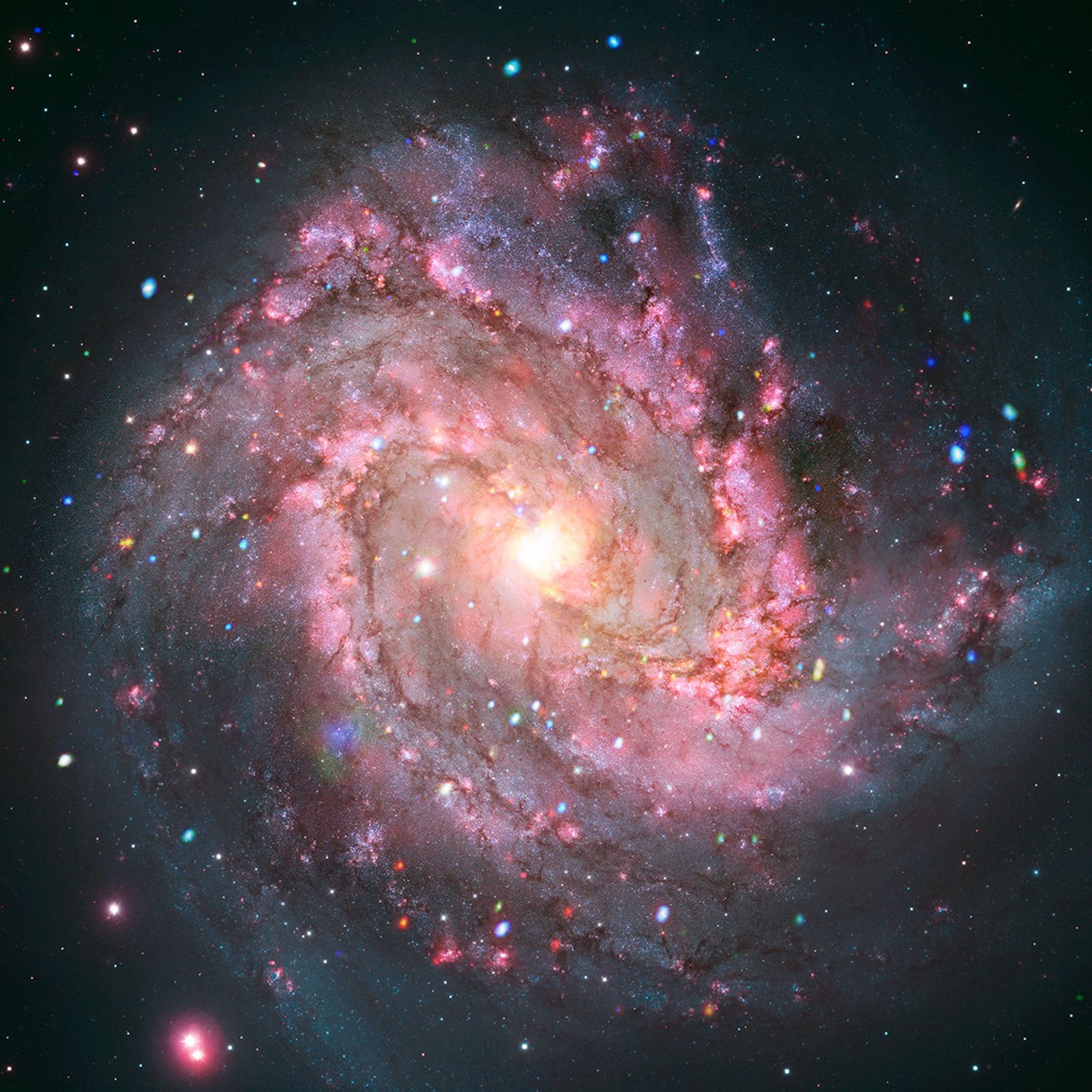
A full field composite image of M83 with X-rays from Chandra (red, green, and blue) and optical light data from Hubble (red, green, and blue).
Galaxy M83 in X-ray and Optical Light.
X-ray: NASA/CXC/SAO; Optical: NASA/ESA/AURA/STScI, Hubble Heritage Team, W. Blair (STScI/Johns Hopkins University) and R. O’Connell (University of Virginia); Image Processing: NASA/CXC/SAO/A. Jubett, L. Frattare and P. Edmonds

“It may be that this galaxy contains a collection of supernova remnants where one massive star survives the supernova and becomes locked into an orbit with a black hole or neutron star,” said co-author Michael McCollough of the Center for Astrophysics | Harvard & Smithsonian (CfA). “The neutron star or black hole can then start pulling material from the massive star’s surface.”

That infalling material is superheated by the intense gravitational pull, producing the X-rays Chandra detects. These types of systems, known as high-mass X-ray binaries (HMXBs), are among the most variable X-ray sources in the universe. Researchers say they may be the cause of the variations seen in M83’s supernova remnants.

Astronomers have known about HMXBs for decades, but the difference with this group in M83 is their connection to supernova remnants. Previously, only a handful of supernova remnants associated with HMXBs had been identified across observations of all galaxies. It is unprecedented to find more than 20 strong candidates in just one galaxy.

The authors found that the variable supernova remnants are in regions with higher concentrations of massive stars than in other parts of the galaxy, increasing the chances of a link between the remnants and HMXBs.

There is another possible explanation: Instead of pulling in material from a companion star, the black hole or neutron star may be recapturing some of the material blasted outward by the original explosion.

“This could be an example of cosmic recycling, where debris from the explosion falls back onto the very object the supernova created,” said co-author Roy Kilgard of Wesleyan University. “And it’s quite possible that both explanations are at play — different sources in our sample may have different origins.”

These results are not unique to M83. A follow-up study of the nearby star-forming galaxy M51 by Zoe Hoiland of Vassar College and Kilgard has uncovered a similar population of variable X-ray sources associated with supernova remnants, suggesting that such systems may be a feature of galaxies undergoing vigorous star formation.
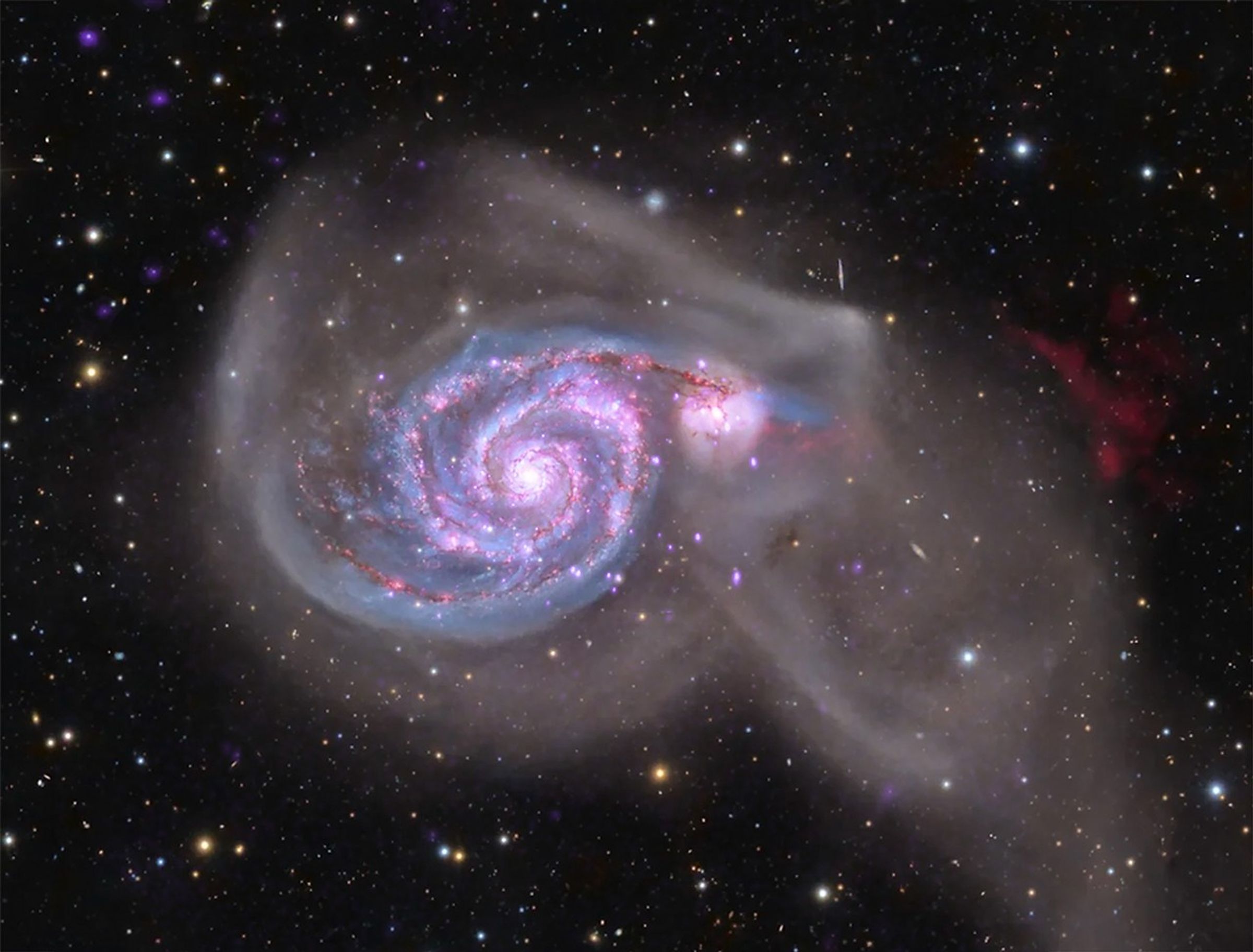
This is a composite image of the galaxy M51 combining data from NASA's Chandra X-ray Observatory (purple) with optical data (red, green and blue) taken with ground-based telescopes by a team of astrophotographers. A surprisingly high number of X-ray sources associated with supernova remnants in M51 show large changes in brightness, similar to the behavior seen in M83.
This is a composite image of the galaxy M51 combining data from NASA’s Chandra X-ray Observatory (purple) with optical data (red, green and blue) taken with ground-based telescopes by a team of astrophotographers. A surprisingly high number of X-ray sources associated with supernova remnants in M51 show large changes in brightness, similar to the behavior seen in M83.
Chandra X-ray Data: NASA/CXC/SAO; Astrobin/Optical Groundbased: C.Björk, T.Bähnck, S.Donoso, J.Gentillon, A. and D.Grelin, S.Guberski, R. Hall, T.Heuberger, J.Jacks, P.Kent, Br.Meyers, W.Ostling, N.Puig, T.Schaeffer, F.Schöfbänker, M.Vasilev

The Chandra data for M83 began with single observations in 2000 and 2001, followed by 10 observations from 2010 to 2011 and another observation in 2014.

NASA’s Marshall Space Flight Center in Huntsville, Alabama, manages the Chandra program. The Smithsonian Astrophysical Observatory’s Chandra X-ray Center controls science operations from Cambridge, Massachusetts, and flight operations from Burlington, Massachusetts.

Visual Description

This release features a composite image of the nearby galaxy Messier 83, and short timelapse videos of two curious supernova remnants hidden inside.

In the composite image, Messier 83, or M83, is shown to have a spiral structure, viewed straight on. At the center is a brilliant white and yellow pool of light. From that light, spiral arms of hot pink cloud corkscrew out in wide, sweeping arches. The galaxy is covered in a faint grey haze, and flecked with red, green, blue, white, and yellow dots.

In an annotated version of the composite image, two tiny dots to our lower right of center are highlighted by white circles. These are two of the supernova remnants being considered by researchers. Each is examined further in a separate timelapse video.

Over a 14-year period from 2000 to 2014, astronomers pointed NASA’s X-ray observatory at the M83 galaxy. They discovered that about half of the X-ray sources believed to be supernova remnants, the aftermath of stellar explosions, were exhibiting dramatic changes in brightness. This result was entirely unexpected.

Those changes in brightness are highlighted in the timelapse videos. In each video, a series of static images flashes by, focused on one of the two X-ray sources once believed to be supernova remnants. In the videos, the X-ray sources appear as bright blue blobs with glowing cores. But in each image, taken months or years apart, the shapes change, as does the intensity of the blue color, and the brightness of the core. By presenting the substantively different images of the same objects one after another in quick succession, short timelapse videos are created.

The most likely explanation for the changes in brightness is that the team has uncovered a population of stellar survivors, stars that lived through an orbiting partner’s destruction in a supernova explosion. Material is being pulled from the surviving star onto the black hole or neutron star that formed in the supernova, a process known to cause rapid changes in X-ray brightness.

Read more from NASA’s Chandra X-ray Observatory

To learn more about NASA’s Chandra mission, visit:

https://science.nasa.gov/chandra

https://chandra.si.edu

News Media Contact

Megan Watzke
Chandra X-ray Center
Cambridge, Mass.
617-496-7998
mwatzke@cfa.harvard.edu

Joel Wallace
Marshall Space Flight Center, Huntsville, Alabama
256-544-0034
joel.w.wallace@nasa.gov

About the Author

Lee Mohon

Share

Details

Last Updated
Jun 16, 2026
Editor
Lee Mohon
Contact
Joel Wallace
Location
Marshall Space Flight Center

NASA’s Chandra Finds Unexpected Fireworks in Aftermath of Stellar Explosions

15 June 2026 at 19:45
6 Min Read

NASA’s Chandra Finds Unexpected Fireworks in Aftermath of Stellar Explosions

A full field composite image of M83 with X-rays from Chandra (red, green, and blue) and optical light data from Hubble (red, green, and blue).
A composite image of the nearby galaxy Messier 83, and short timelapse videos of two curious supernova remnants hidden inside.
X-ray: NASA/CXC/SAO; Optical: NASA/ESA/AURA/STScI, Hubble Heritage Team, W. Blair (STScI/Johns Hopkins University) and R. O'Connell (University of Virginia); Image Processing: NASA/CXC/SAO/A. Jubett, L. Frattare and P. Edmonds

The aftermath of a supernova, a stellar explosion, is usually a slowly fading cloud of hot gas. So when astronomers pointed NASA’s Chandra X-ray Observatory at the nearby galaxy Messier 83 (M83), they did not expect to find a population of supernova remnants, or the debris from these explosions, showing dramatic changes in their brightness. The new results were presented at the American Astronomical Society meeting in Pasadena, California, and published in The Astrophysical Journal.

The galaxy M83, located about 15 million light-years from Earth, is forming stars at a high rate. Researchers analyzed 14 years of Chandra data of the galaxy, spanning 2000 to 2014.

Using this extensive set of data, the researchers caught surprising variations in the X-ray brightness of sources previously identified as supernova remnants. The researchers expected supernova remnants older than a century or so to fade gradually in X-rays, but not change dramatically in brightness.

The team found that roughly half of the 22 X-ray sources associated with supernova remnants in their sample showed changes in X-ray brightness over the 14-year span of observations — a result that was completely unexpected.

“We knew that individual X-ray sources could vary dramatically,” said Andrea Prestwich, of the Catholic University of America who led the study. “But finding that so many supernova remnants were behaving this way was a real surprise. Something unusual is going on in these objects. Pinpointing the cause remains a challenge, as M83’s distance limits the detail we can observe.”

One of the 22 variable supernova remnants has a straightforward explanation: SN 1957D, the debris from a supernova first observed nearly 70 years ago, is ramming into material surrounding the explosion site, producing the observed X-ray flares. But this cannot explain the rest of the sample. There is no evidence to suggest that all 22 remnants were formed within the last century. Something else must be driving the variability.

The most likely explanation is that the team has uncovered a population of stellar survivors stars that lived through their partner’s destruction in a supernova explosion. In this scenario, each variable X-ray source began as a pair of massive stars orbiting each other. The more massive star collapsed and exploded as a supernova, leaving behind a black hole or ultra-dense neutron star. Its companion survived.

A full field composite image of M83 with X-rays from Chandra (red, green, and blue) and optical light data from Hubble (red, green, and blue).
Galaxy M83 in X-ray and Optical Light.
X-ray: NASA/CXC/SAO; Optical: NASA/ESA/AURA/STScI, Hubble Heritage Team, W. Blair (STScI/Johns Hopkins University) and R. O’Connell (University of Virginia); Image Processing: NASA/CXC/SAO/A. Jubett, L. Frattare and P. Edmonds

“It may be that this galaxy contains a collection of supernova remnants where one massive star survives the supernova and becomes locked into an orbit with a black hole or neutron star,” said co-author Michael McCollough of the Center for Astrophysics | Harvard & Smithsonian (CfA). “The neutron star or black hole can then start pulling material from the massive star’s surface.”

That infalling material is superheated by the intense gravitational pull, producing the X-rays Chandra detects. These types of systems, known as high-mass X-ray binaries (HMXBs), are among the most variable X-ray sources in the universe. Researchers say they may be the cause of the variations seen in M83’s supernova remnants.

Astronomers have known about HMXBs for decades, but the difference with this group in M83 is their connection to supernova remnants. Previously, only a handful of supernova remnants associated with HMXBs had been identified across observations of all galaxies. It is unprecedented to find more than 20 strong candidates in just one galaxy.

The authors found that the variable supernova remnants are in regions with higher concentrations of massive stars than in other parts of the galaxy, increasing the chances of a link between the remnants and HMXBs.

There is another possible explanation: Instead of pulling in material from a companion star, the black hole or neutron star may be recapturing some of the material blasted outward by the original explosion.

“This could be an example of cosmic recycling, where debris from the explosion falls back onto the very object the supernova created,” said co-author Roy Kilgard of Wesleyan University. “And it’s quite possible that both explanations are at play — different sources in our sample may have different origins.”

These results are not unique to M83. A follow-up study of the nearby star-forming galaxy M51 by Zoe Hoiland of Vassar College and Kilgard has uncovered a similar population of variable X-ray sources associated with supernova remnants, suggesting that such systems may be a feature of galaxies undergoing vigorous star formation.

This is a composite image of the galaxy M51 combining data from NASA's Chandra X-ray Observatory (purple) with optical data (red, green and blue) taken with ground-based telescopes by a team of astrophotographers. A surprisingly high number of X-ray sources associated with supernova remnants in M51 show large changes in brightness, similar to the behavior seen in M83.
This is a composite image of the galaxy M51 combining data from NASA’s Chandra X-ray Observatory (purple) with optical data (red, green and blue) taken with ground-based telescopes by a team of astrophotographers. A surprisingly high number of X-ray sources associated with supernova remnants in M51 show large changes in brightness, similar to the behavior seen in M83.
Chandra X-ray Data: NASA/CXC/SAO; Astrobin/Optical Groundbased: C.Björk, T.Bähnck, S.Donoso, J.Gentillon, A. and D.Grelin, S.Guberski, R. Hall, T.Heuberger, J.Jacks, P.Kent, Br.Meyers, W.Ostling, N.Puig, T.Schaeffer, F.Schöfbänker, M.Vasilev

The Chandra data for M83 began with single observations in 2000 and 2001, followed by 10 observations from 2010 to 2011 and another observation in 2014.

NASA’s Marshall Space Flight Center in Huntsville, Alabama, manages the Chandra program. The Smithsonian Astrophysical Observatory’s Chandra X-ray Center controls science operations from Cambridge, Massachusetts, and flight operations from Burlington, Massachusetts.

Visual Description

This release features a composite image of the nearby galaxy Messier 83, and short timelapse videos of two curious supernova remnants hidden inside.

In the composite image, Messier 83, or M83, is shown to have a spiral structure, viewed straight on. At the center is a brilliant white and yellow pool of light. From that light, spiral arms of hot pink cloud corkscrew out in wide, sweeping arches. The galaxy is covered in a faint grey haze, and flecked with red, green, blue, white, and yellow dots.

In an annotated version of the composite image, two tiny dots to our lower right of center are highlighted by white circles. These are two of the supernova remnants being considered by researchers. Each is examined further in a separate timelapse video.

Over a 14-year period from 2000 to 2014, astronomers pointed NASA’s X-ray observatory at the M83 galaxy. They discovered that about half of the X-ray sources believed to be supernova remnants, the aftermath of stellar explosions, were exhibiting dramatic changes in brightness. This result was entirely unexpected.

Those changes in brightness are highlighted in the timelapse videos. In each video, a series of static images flashes by, focused on one of the two X-ray sources once believed to be supernova remnants. In the videos, the X-ray sources appear as bright blue blobs with glowing cores. But in each image, taken months or years apart, the shapes change, as does the intensity of the blue color, and the brightness of the core. By presenting the substantively different images of the same objects one after another in quick succession, short timelapse videos are created.

The most likely explanation for the changes in brightness is that the team has uncovered a population of stellar survivors, stars that lived through an orbiting partner’s destruction in a supernova explosion. Material is being pulled from the surviving star onto the black hole or neutron star that formed in the supernova, a process known to cause rapid changes in X-ray brightness.

Read more from NASA’s Chandra X-ray Observatory

To learn more about NASA’s Chandra mission, visit:

https://science.nasa.gov/chandra

https://chandra.si.edu

News Media Contact

Megan Watzke
Chandra X-ray Center
Cambridge, Mass.
617-496-7998
mwatzke@cfa.harvard.edu

Joel Wallace
Marshall Space Flight Center, Huntsville, Alabama
256-544-0034
joel.w.wallace@nasa.gov

About the Author

Lee Mohon

Share

Details

Last Updated
Jun 15, 2026
Editor
Lee Mohon
Contact
Joel Wallace
Location
Marshall Space Flight Center

The post NASA’s Chandra Finds Unexpected Fireworks in Aftermath of Stellar Explosions appeared first on NASA Science.

NASA’s Chandra Discovers Possible Supernova Remnant in Galactic Center

11 June 2026 at 21:41
5 Min Read

NASA’s Chandra Discovers Possible Supernova Remnant in Galactic Center

Astronomers may have uncovered a new supernova remnant in a star-forming region near the center of the Milky Way galaxy using data from Chandra and XMM-Newton. If confirmed, this would be one of the closest supernova remnants to the supermassive black hole in the Galactic Center. This image shows the region where the evidence was found, which contains X-rays from Chandra and XMM-Newton, radio data from the MeerKAT telescope in South Africa, and an optical image from the Pan-STARRS telescopes in Hawaii.

Using data from NASA’s Chandra X-ray Observatory, astronomers may have found a supernova remnant in an intriguing neighborhood in the middle of our galaxy. A paper describing these new findings published in The Astrophysical Journal.

Supernova remnants are the expanding remains of exploded stars and provide elements – like iron, oxygen, and silicon – that are critical for the formation of planets and for life as we know it to form and flourish.

This new supernova remnant, if confirmed, would be one of the closest ever discovered to the supermassive black hole at the central region of the Milky Way galaxy, an exotic region crammed with massive stars, long threads of magnetic fields and dense clouds of gas orbiting rapidly around the Galactic Center.

Astronomers may have uncovered a new supernova remnant in a star-forming region near the center of the Milky Way galaxy using data from Chandra and XMM-Newton. If confirmed, this would be one of the closest supernova remnants to the supermassive black hole in the Galactic Center. This image shows the region where the evidence was found, which contains X-rays from Chandra and XMM-Newton, radio data from the MeerKAT telescope in South Africa, and an optical image from the Pan-STARRS telescopes in Hawaii.

A new composite image of this region contains X-rays from Chandra and ESA’s (European Space Agency’s) XMM-Newton mission (shown in blue) as well as radio data from the MeerKAT telescope (shown in red) in South Africa. These have been combined with an optical image from the Pan-STARRS telescopes in Hawaii (red, green, and blue). The plane of the galaxy runs horizontally from left to right in the image, and the central black hole is off to the left of the image.

The evidence for the new supernova remnant, located about 26,000 light-years from Earth, comes from X-ray data from Chandra and XMM-Newton. The X-ray data reveals a “blob” of X-ray emission that may come from the remains of a massive star that self-destructed as a supernova, buried within the larger cloud of expanding gas.

The location of this suspected supernova remnant in the image is labeled with a circle.

It is in a bubble of gas that has had electrons stripped away from hydrogen – called an “H II region” – surrounding a massive, young star. This bubble is a bright source of radio emission called Sagittarius C.

If this is indeed a supernova remnant, then it is expanding at about two million miles per hour and is at least about 1,700 years old. Previously, observations with NASA’s now-retired SOFIA (Stratospheric Observatory for Infrared Astronomy) mission had shown evidence for an expanding shell of gas surrounding Sagittarius C. This gave astronomers a hint that a stellar explosion had occurred in the same spot.

The long filaments seen in the radio image are caused by energetic particles travelling along magnetic fields that are mostly directed perpendicular to the plane of the galaxy.

The nuclear fusion engines of stars create elements from hydrogen and helium that were abundant at the beginning of the universe. When stars explode at the end of their lives as supernovae, they send these newly synthesized elements into interstellar space and provide material for the next generation of stars and planets.

The team of astronomers searched the X-ray data for signs of increased amounts of key elements in the remnant, which would have been caused by the stellar explosion blasting them into space. While they did not see an enhancement, this could imply that the stellar debris has already mixed with the surrounding gas.

An alternative explanation for the X-ray blob is that the hot gas comes from a collection of massive stars in the region. The authors of the recent study don’t think this explanation is likely, because the X-ray emission from the blob is more than ten times brighter than the X-ray emission of large, known stellar clusters with bright, massive stars.

An additional image shows data from NASA’s James Webb Space Telescope added to the X-ray and radio data. The light blue color represents infrared light from gas in the H II region, and the darker blue depicts X-rays from the supernova remnant candidate, on the right side of the image. X-rays near the center of the image are associated with the H II region, possibly caused by material blown away by massive stars that has heated gas to millions of degrees, producing X-rays.

Sagittarius C, close-up image adding NASA’s James Webb Space Telescope data to the X-ray and radio data.

The study’s authors are Zhenlin Zhu and Mark Morris of the University of California, Los Angeles; Gabriele Ponti of Italy’s National Institute for Astrophysics; and Ping Zhou of Nanjing University in China.

NASA’s Marshall Space Flight Center in Huntsville, Alabama, manages the Chandra program. The Smithsonian Astrophysical Observatory’s Chandra X-ray Center controls science operations from Cambridge, Massachusetts, and flight operations from Burlington, Massachusetts.

Visual Description

This release features a composite image of colorful, overlapping clouds, which suggests to astronomers that a supernova remnant may be buried in gas near the center of our Milky Way galaxy.

Set against a backdrop packed with distant stars and other specks of light are two distinct, overlapping clouds. The larger, visually dominant cloud, is red and multifaceted. It has an irregular shape, and features patches of different textures, including pockets that resemble wispy smoke, tangles of faint red veins, and clear streaking lines. This large cloud of expanding gas represents radio data from the MeerKAT telescope in South Africa.

Overlapping with that red cloud is a cloudy blue blob representing X-ray data from NASA’s Chandra X-ray Observatory and ESA’s XMM-Newton. Astronomers suggest that this blue blob of X-ray emissions is the remains of a massive star destroyed by a supernova.

Read more from NASA’s Chandra X-ray Observatory

To learn more about NASA’s Chandra mission, visit:

https://science.nasa.gov/chandra

https://chandra.si.edu

News Media Contact

Megan Watzke
Chandra X-ray Center
Cambridge, Mass.
617-496-7998
mwatzke@cfa.harvard.edu

Joel Wallace
Marshall Space Flight Center, Huntsville, Alabama
256-544-0034
joel.w.wallace@nasa.gov

About the Author

Lee Mohon

The post NASA’s Chandra Discovers Possible Supernova Remnant in Galactic Center appeared first on NASA Science.

NASA’s Chandra Discovers Possible Supernova Remnant in Galactic Center

11 June 2026 at 21:41
5 Min Read

NASA’s Chandra Discovers Possible Supernova Remnant in Galactic Center

Astronomers may have uncovered a new supernova remnant in a star-forming region near the center of the Milky Way galaxy using data from Chandra and XMM-Newton. If confirmed, this would be one of the closest supernova remnants to the supermassive black hole in the Galactic Center. This image shows the region where the evidence was found, which contains X-rays from Chandra and XMM-Newton, radio data from the MeerKAT telescope in South Africa, and an optical image from the Pan-STARRS telescopes in Hawaii.

Using data from NASA’s Chandra X-ray Observatory, astronomers may have found a supernova remnant in an intriguing neighborhood in the middle of our galaxy. A paper describing these new findings published in The Astrophysical Journal.

Supernova remnants are the expanding remains of exploded stars and provide elements – like iron, oxygen, and silicon – that are critical for the formation of planets and for life as we know it to form and flourish.

This new supernova remnant, if confirmed, would be one of the closest ever discovered to the supermassive black hole at the central region of the Milky Way galaxy, an exotic region crammed with massive stars, long threads of magnetic fields and dense clouds of gas orbiting rapidly around the Galactic Center.

Astronomers may have uncovered a new supernova remnant in a star-forming region near the center of the Milky Way galaxy using data from Chandra and XMM-Newton. If confirmed, this would be one of the closest supernova remnants to the supermassive black hole in the Galactic Center. This image shows the region where the evidence was found, which contains X-rays from Chandra and XMM-Newton, radio data from the MeerKAT telescope in South Africa, and an optical image from the Pan-STARRS telescopes in Hawaii.
X-ray: NASA/CXC/UCLA/Z. Zhu et al.; ESA/XMM-Newton; Optical: PanSTARRS; Radio: MeerKAT; Infrared (JWST): NASA/ESA/CSA/STScI; Image Processing: NASA/CXC/SAO/L. Frattare and P. Edmonds

A new composite image of this region contains X-rays from Chandra and ESA’s (European Space Agency’s) XMM-Newton mission (shown in blue) as well as radio data from the MeerKAT telescope (shown in red) in South Africa. These have been combined with an optical image from the Pan-STARRS telescopes in Hawaii (red, green, and blue). The plane of the galaxy runs horizontally from left to right in the image, and the central black hole is off to the left of the image.

The evidence for the new supernova remnant, located about 26,000 light-years from Earth, comes from X-ray data from Chandra and XMM-Newton. The X-ray data reveals a “blob” of X-ray emission that may come from the remains of a massive star that self-destructed as a supernova, buried within the larger cloud of expanding gas.

The location of this suspected supernova remnant in the image is labeled with a circle.

It is in a bubble of gas that has had electrons stripped away from hydrogen – called an “H II region” – surrounding a massive, young star. This bubble is a bright source of radio emission called Sagittarius C.

If this is indeed a supernova remnant, then it is expanding at about two million miles per hour and is at least about 1,700 years old. Previously, observations with NASA’s now-retired SOFIA (Stratospheric Observatory for Infrared Astronomy) mission had shown evidence for an expanding shell of gas surrounding Sagittarius C. This gave astronomers a hint that a stellar explosion had occurred in the same spot.

The long filaments seen in the radio image are caused by energetic particles travelling along magnetic fields that are mostly directed perpendicular to the plane of the galaxy.

The nuclear fusion engines of stars create elements from hydrogen and helium that were abundant at the beginning of the universe. When stars explode at the end of their lives as supernovae, they send these newly synthesized elements into interstellar space and provide material for the next generation of stars and planets.

The team of astronomers searched the X-ray data for signs of increased amounts of key elements in the remnant, which would have been caused by the stellar explosion blasting them into space. While they did not see an enhancement, this could imply that the stellar debris has already mixed with the surrounding gas.

An alternative explanation for the X-ray blob is that the hot gas comes from a collection of massive stars in the region. The authors of the recent study don’t think this explanation is likely, because the X-ray emission from the blob is more than ten times brighter than the X-ray emission of large, known stellar clusters with bright, massive stars.

An additional image shows data from NASA’s James Webb Space Telescope added to the X-ray and radio data. The light blue color represents infrared light from gas in the H II region, and the darker blue depicts X-rays from the supernova remnant candidate, on the right side of the image. X-rays near the center of the image are associated with the H II region, possibly caused by material blown away by massive stars that has heated gas to millions of degrees, producing X-rays.

Sagittarius C, close-up image adding NASA’s James Webb Space Telescope data to the X-ray and radio data.

The study’s authors are Zhenlin Zhu and Mark Morris of the University of California, Los Angeles; Gabriele Ponti of Italy’s National Institute for Astrophysics; and Ping Zhou of Nanjing University in China.

NASA’s Marshall Space Flight Center in Huntsville, Alabama, manages the Chandra program. The Smithsonian Astrophysical Observatory’s Chandra X-ray Center controls science operations from Cambridge, Massachusetts, and flight operations from Burlington, Massachusetts.

Visual Description

This release features a composite image of colorful, overlapping clouds, which suggests to astronomers that a supernova remnant may be buried in gas near the center of our Milky Way galaxy.

Set against a backdrop packed with distant stars and other specks of light are two distinct, overlapping clouds. The larger, visually dominant cloud, is red and multifaceted. It has an irregular shape, and features patches of different textures, including pockets that resemble wispy smoke, tangles of faint red veins, and clear streaking lines. This large cloud of expanding gas represents radio data from the MeerKAT telescope in South Africa.

Overlapping with that red cloud is a cloudy blue blob representing X-ray data from NASA’s Chandra X-ray Observatory and ESA’s XMM-Newton. Astronomers suggest that this blue blob of X-ray emissions is the remains of a massive star destroyed by a supernova.

Read more from NASA’s Chandra X-ray Observatory

To learn more about NASA’s Chandra mission, visit:

https://science.nasa.gov/chandra

https://chandra.si.edu

News Media Contact

Megan Watzke
Chandra X-ray Center
Cambridge, Mass.
617-496-7998
mwatzke@cfa.harvard.edu

Joel Wallace
Marshall Space Flight Center, Huntsville, Alabama
256-544-0034
joel.w.wallace@nasa.gov

About the Author

Lee Mohon

Share

Details

Last Updated
Jun 12, 2026
Editor
Lee Mohon
Contact
Joel Wallace
Location
Marshall Space Flight Center

I Am Artemis: Elkin Norena

11 June 2026 at 21:07
3 Min Read

I Am Artemis: Elkin Norena

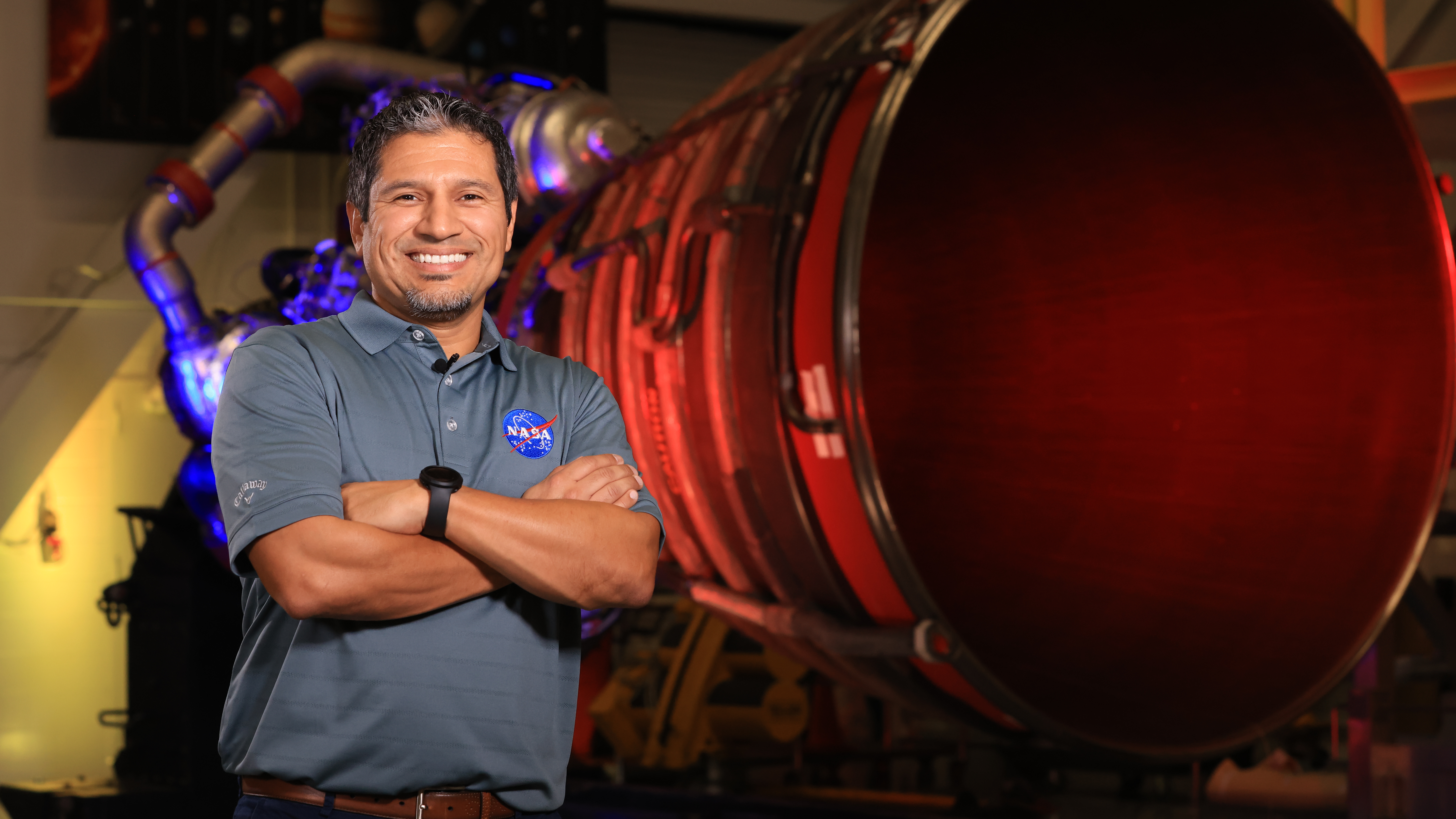
Elkin Norena, who serves as an SLS resident management officer at NASA’s Kennedy Space Center in Florida, stands in front of an RS-25 engine.

Listen to this audio excerpt from Elkin Norena, resident management officer, NASA’s Space Launch System Program:

0:00 / 0:00

NASA’s Elkin Norena has helped the agency launch more than a dozen space shuttle missions – that’s more than a dozen crews to low Earth orbit and more than a dozen historic missions. They were missions that helped build the International Space Station, that provided a final servicing mission to the Hubble Space Telescope, and that performed critical science experiments that improved life right here on Earth.

Today, he continues that work as the manager of the Resident Management Office for SLS at NASA’s Kennedy Space Center in Florida, helping launch America’s rocket – the SLS (Space Launch System) – and the Orion spacecraft with its international quartet of astronauts  on the Artemis II mission to fly by the Moon and return home.

Elkin Norena, who serves as an SLS resident management officer at NASA’s Kennedy Space Center in Florida, stands in front of an RS-25 engine.
NASA

As resident manager, Norena provides onsite SLS support for NASA’s Exploration Ground Systems team that is responsible for preparing, stacking, testing, and launching SLS and Orion. He is also the eyes and ears for the SLS Program, providing an avenue of communications back to the program, which is managed at NASA’s Marshall Space Flight Center in Huntsville, Alabama.

It is the continuation of a childhood dream to be part of space exploration.

“When I was a kid in New Jersey, I watched a space shuttle launch in class one day,” said Norena. “When I watched the power of launch and the brave astronauts going to explore, I knew I had to be a part of that one day. I wanted to become an astronaut.”

The dream to join the space program led the Colombia native to the University of Central Florida in Orlando, where he majored in computer engineering, just miles from the Space Coast and in view of space shuttle launches like the ones he once watched on TV.

When that clock ticks down to T-10 minutes, everybody’s just waiting. You wait for the automated system to kick in. You hold your breath and watch the clock go down to T-0. Then BOOM, launch happens, and you know it was all worth it.

Elkin Norena

Elkin Norena

Resident management officer, NASA Space Launch System Program

Following college, he joined NASA contractor United Space Alliance at NASA Kennedy, and in 2008 he joined the NASA Kennedy team as a civil servant, working on the same spacecraft that inspired him to pursue the space program as a child.

“I started off in the Space Shuttle Program as an electrical engineer. Then I moved into the firing room for 17 different shuttle missions as a flight termination engineer. It was exciting to be part of all those missions and build the International Space Station,” Norena said.

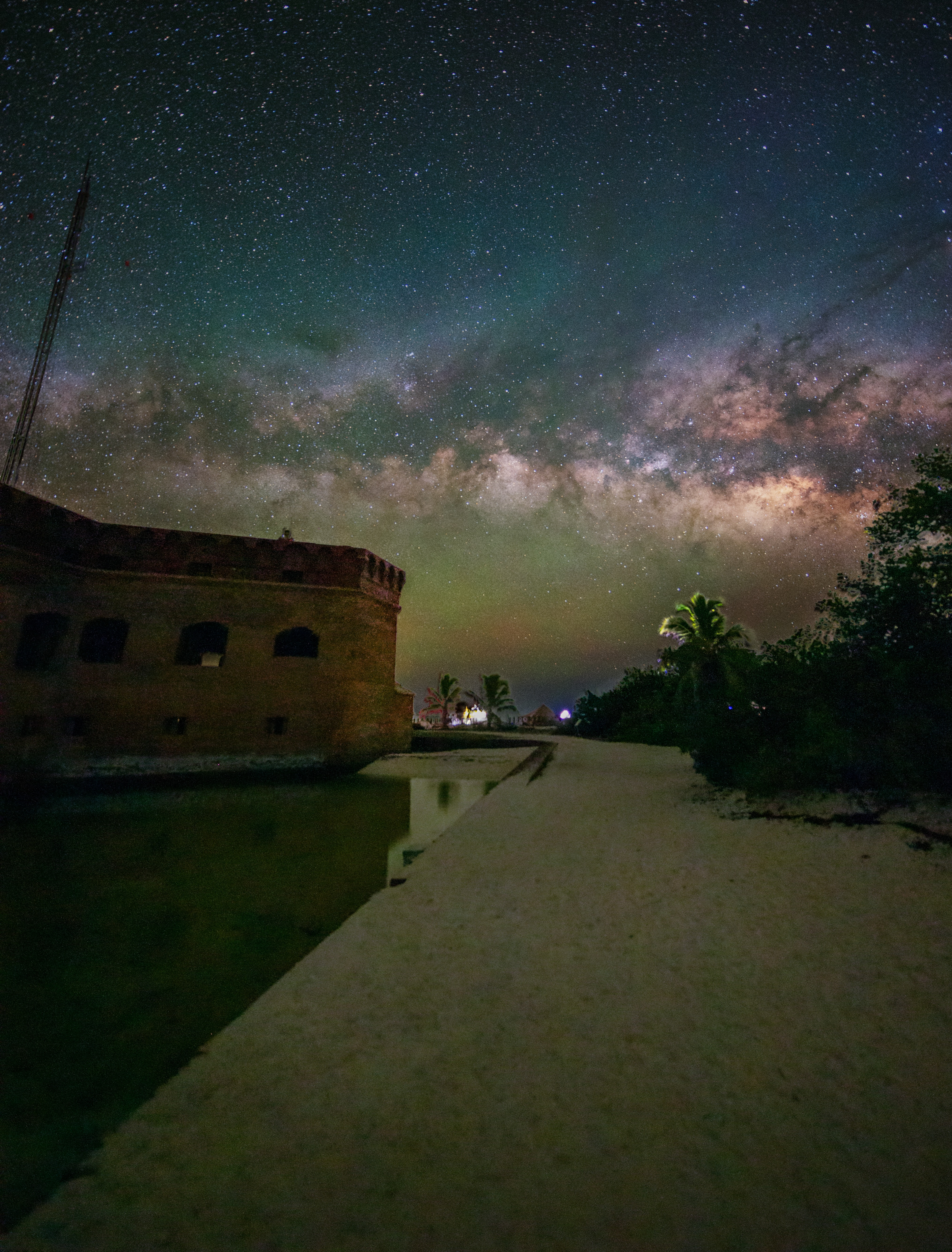
The Milky Way stretches above Dry Tortugas National Park in Florida.
Elkin Norena

Using those experiences, he became one of the original SLS team members. He was a part of the teams that successfully launched Artemis I and II and is now critical to the upcoming Artemis III mission.

Away from the launch pad, Norena’s hobbies orbit around his teenage daughters, participating in their activities. He also keeps a keen eye on space and is an avid astrophotographer.

“I love capturing the Milky Way! I’ve traveled to Utah, New Mexico, Arizona, and all across the western United States,” he said. “A great spot that’s closer for me is Dry Tortugas National Park beyond Key West.”

No matter how he explores space, Norena believes Artemis II is more than just a mission.

“This is historic. I grew up watching the shuttle missions, learning about Apollo, and wanting to be part of those Moon missions. We built the space station. The space shuttle explored space and technology on many levels,” he said. “Now, it’s our turn with Artemis to get back to the Moon, and this time to stay there. I’m excited to be part of the generation that does that.”

About the Author

William Bryan

Communication Strategist

Keep Exploring

Discover More Topics From NASA

The post I Am Artemis: Elkin Norena appeared first on NASA Science.

I Am Artemis: Elkin Norena

11 June 2026 at 21:07
3 Min Read

I Am Artemis: Elkin Norena

Elkin Norena, who serves as an SLS resident management officer at NASA’s Kennedy Space Center in Florida, stands in front of an RS-25 engine.

Listen to this audio excerpt from Elkin Norena, resident management officer, NASA’s Space Launch System Program:

0:00 / 0:00

NASA’s Elkin Norena has helped the agency launch more than a dozen space shuttle missions – that’s more than a dozen crews to low Earth orbit and more than a dozen historic missions. They were missions that helped build the International Space Station, that provided a final servicing mission to the Hubble Space Telescope, and that performed critical science experiments that improved life right here on Earth.

Today, he continues that work as the manager of the Resident Management Office for SLS at NASA’s Kennedy Space Center in Florida, helping launch America’s rocket – the SLS (Space Launch System) – and the Orion spacecraft with its international quartet of astronauts  on the Artemis II mission to fly by the Moon and return home.

Elkin Norena, who serves as an SLS resident management officer at NASA’s Kennedy Space Center in Florida, stands in front of an RS-25 engine.
NASA

As resident manager, Norena provides onsite SLS support for NASA’s Exploration Ground Systems team that is responsible for preparing, stacking, testing, and launching SLS and Orion. He is also the eyes and ears for the SLS Program, providing an avenue of communications back to the program, which is managed at NASA’s Marshall Space Flight Center in Huntsville, Alabama.

It is the continuation of a childhood dream to be part of space exploration.

“When I was a kid in New Jersey, I watched a space shuttle launch in class one day,” said Norena. “When I watched the power of launch and the brave astronauts going to explore, I knew I had to be a part of that one day. I wanted to become an astronaut.”

The dream to join the space program led the Colombia native to the University of Central Florida in Orlando, where he majored in computer engineering, just miles from the Space Coast and in view of space shuttle launches like the ones he once watched on TV.

When that clock ticks down to T-10 minutes, everybody’s just waiting. You wait for the automated system to kick in. You hold your breath and watch the clock go down to T-0. Then BOOM, launch happens, and you know it was all worth it.

Elkin Norena

Elkin Norena

Resident management officer, NASA Space Launch System Program

Following college, he joined NASA contractor United Space Alliance at NASA Kennedy, and in 2008 he joined the NASA Kennedy team as a civil servant, working on the same spacecraft that inspired him to pursue the space program as a child.

“I started off in the Space Shuttle Program as an electrical engineer. Then I moved into the firing room for 17 different shuttle missions as a flight termination engineer. It was exciting to be part of all those missions and build the International Space Station,” Norena said.

The Milky Way stretches above Dry Tortugas National Park in Florida.
Elkin Norena

Using those experiences, he became one of the original SLS team members. He was a part of the teams that successfully launched Artemis I and II and is now critical to the upcoming Artemis III mission.

Away from the launch pad, Norena’s hobbies orbit around his teenage daughters, participating in their activities. He also keeps a keen eye on space and is an avid astrophotographer.

“I love capturing the Milky Way! I’ve traveled to Utah, New Mexico, Arizona, and all across the western United States,” he said. “A great spot that’s closer for me is Dry Tortugas National Park beyond Key West.”

No matter how he explores space, Norena believes Artemis II is more than just a mission.

“This is historic. I grew up watching the shuttle missions, learning about Apollo, and wanting to be part of those Moon missions. We built the space station. The space shuttle explored space and technology on many levels,” he said. “Now, it’s our turn with Artemis to get back to the Moon, and this time to stay there. I’m excited to be part of the generation that does that.”

About the Author

William Bryan

Communication Strategist

Keep Exploring

Discover More Topics From NASA

❌