
❌

Normal view

'No one thought it was going to be possible.' A space telescope is falling out of space. This is NASA's daring plan to save it. (video)

19 June 2026 at 17:00

WALLOPS ISLAND, Va. β€” For over 20 years, NASA's Swift space observatory has been conducting prolific science in orbit, hunting for signs of gamma-ray bursts β€” the most powerful explosions in the universe. Now, it's falling to Earth, doomed to a fiery death by the end of the year as its orbit decays.

But maybe not.

NASA, it turns out, has a daring rescue mission in the works, something never before attempted in space: the Swift Boost mission. The endeavor calls for an untested spacecraft built by the Arizona company Katalyst Space Technologies to rendezvous and dock with Swift β€” something the observatory was never designed to do β€” before the observatory falls back to Earth.

A split image of NASA's Swift observatory in orbit and the Katalyst spacecraft that will save it from falling out of space.

NASA’s Neil Gehrels Swift Observatory is falling out of space. NASA has a daring plan to save it with a spacecraft built by Katalyst Space. (Image credit: NASA)

If all goes well, Katalyst's space tug (it's called Link) will lift the Swift observatory into a higher, safer orbit β€” one that will add years of life to the aging space telescope's mission. Liftoff is officially set for June 27, with Link launching on the last-ever Pegasus XL rocket, an air-launched booster built by Northrop Grumman.

"Frankly, I have to be honest: No one thought it was going to be possible," Shawn Domagal-Goldman, NASA's Astrophysics Division director, told reporters here on Wednesday (June 17). "No one thought we would get as far as we've already gotten today."

What stands out most is how quickly the mission came together.

NASA’s Neil Gehrels Swift Observatory, shown in this artist’s concept, orbits Earth as it studies the ever-changing universe.

NASA’s Neil Gehrels Swift Observatory, shown in this artist’s concept, orbits Earth as it studies the ever-changing universe. Launched in 2004, the space telescope's days are numbered as it is falling out of space. (Image credit: NASA’s Goddard Space Flight Center Conceptual Image Lab)

It was just in September 2025 that NASA picked Katalyst to build a spacecraft capable of boosting Swift on a budget of $30 million. That was nine months ago. And now, the finished Link spacecraft β€” with its three robotic arms, three main Hall thrusters and a suite of other instruments β€” is packed aboard its Pegasus XL rocket and tucked on the belly of its L-1011 Stargazer carrier plane for a trip to its launch site in the South Pacific's Kwajalein Atoll.

"In the last nine months, we have gone from a clean sheet to a spacecraft that is currently integrated on a rocket on an airplane, ready to go to Kwaj for launch," said Kieran Wilson, Link's principal investigator at Katalyst Space, on Wednesday. "This is an absolutely unprecedented development timeline for this program."

Yet that "swift" timeline, if you will, is essential if NASA is to rescue the Swift space observatory.

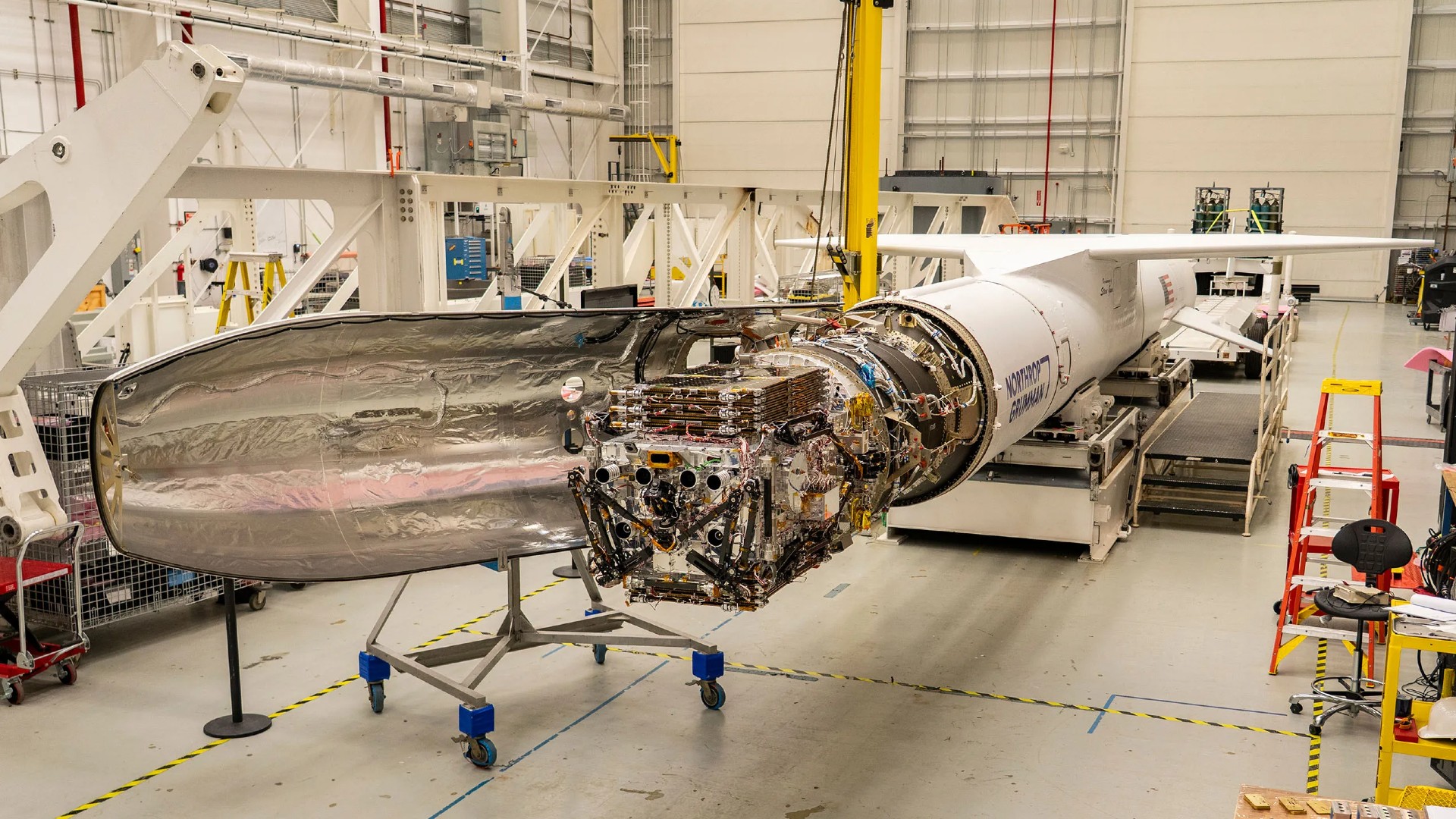
a long white rocket sits horizontal inside a hanger with its nose cone open, exposing a satellite with many components and actuators folded up into a dense rectangular shape

Katalyst Space's LINK robotic servicing satellite awaits encapsulation inside a Northrop Grumman Pegasus XL rocket on June 8, 2026, at NASA's Wallops Flight Facility in Virginia. (Image credit: NASA/Ron Beard)

NASA originally launched Swift (its full name is the Neil Gehrels Swift Observatory, after its late principal investigator) in 2004 on a $250 million mission to search the sky for gamma-ray bursts and other high-energy astrophysics phenomena in the cosmos. From its original orbit about 375 miles (600 kilometers) above Earth, Swift was a silent sentinel, ready to quickly pivot to new targets with unprecedented speed.

"Swift was designed to study gamma-ray bursts, short-lived flashes of high-energy light that release more energy in just a few seconds than the sun will in its entire lifetime," Swift principal investigator Brad Cenko told reporters Wednesday. "It's been extremely successful in this regard, detecting over 2,000 of these sources all the way out to the edge of the visible universe."

It was Swift that helped scientists confirm without a doubt that the heaviest elements we know of, including the shiny gold and platinum in the jewelry you're wearing right now, were forged by these explosive cosmic events, Cenko said. Swift was expected to last two years in orbit. It's well into its second decade now, and still in good health β€” well, except for that "falling out of space" part.

You see, Swift doesn't have thrusters, or a propulsion system of any kind. And over the years, an increase in solar activity β€” space weather from the sun β€” has puffed up Earth's atmosphere to create more drag on Swift than expected, pulling it down from its initial orbit.

Last year, the Swift mission team realized the space telescope was falling faster than expected. Without a rescue mission, Swift would crash to Earth by the end of this summer.

"It was okay for a generic spacecraft to come out of orbit," Domagal-Goldman said. "But this was not just any spacecraft. This is an observatory with unique capabilities for astrophysics … It is a swift observatory that can quickly pivot across the night sky to find things that go boom in the night."

"So we decided, yeah, we want to go save this one this time because of how special it is," he added.

Artist's illustration of Katalyst Space Technologies' servicing spacecraft approaching and capturing NASA's Swift space observatory on an orbit-boosting mission.

Artist's illustration of Katalyst Space Technologies' Link servicing spacecraft approaching and capturing NASA's Swift space observatory on an orbit-boosting mission. (Image credit: Katalyst Space Technologies)

A lot has to go right for Katalyst's Link spacecraft to rescue Swift.

The 937-pound (425-kilogram) spacecraft will launch into an initial testing orbit on June 27 and perform a series of checkouts to ensure that its basic systems (three main engines, 16 reaction control thrusters, solar arrays, robotic arms) are all working properly.

"We'll have a commissioning period of a few weeks, after which we will begin maneuvers in order to approach Swift," Wilson said.

Once Link reaches Swift's orbit, it will perform a series of proximity operations, dock, and then raise the space observatory to its initial orbit over the period of a several months. If that goes to plan, Swift could be back to performing science by this fall, Cenko said. (The telescope has been in a low-power mode to preserve what orbit it can since February.)

If Link is successful, Swift could get another five or more years of life in space. Link, meanwhile, will detach and be intentionally deorbited (meaning it will fall to Earth on purpose) to end its mission.

"All this is challenging and risky," Wilson said. "There's a lot of spacecraft that have had far longer development cycles with far more funding behind them that have failed for mundane reasons."

A lot of simple things can go wrong.

For example, the solar arrays on Link might malfunction, Wilson said. Swift has been in orbit for so long, its protective insulation blankets may be as brittle as glass and break when Link's robotic arms grab on, he added.

Engineers from Katalyst stabilize their LINK robotic servicing spacecraft as it moves into a vibration chamber at NASA's Goddard Space Flight Center on April 15, 2026.

Engineers from Katalyst stabilize their Link robotic servicing spacecraft as it moves into a vibration chamber at NASA's Goddard Space Flight Center on April 15, 2026. (Image credit: NASA/Scott Wiessinger)

And then there's the sun. It was increased solar activity that put Swift in its perilous situation. That activity is ongoing. In fact, Swift may be one big solar storm away from doom if the sun fires off a major storm before Katalyst's Link can reach it.

Swift is on track to fall below an altitude of 186 miles (300 km) by October. At that point, it may be too low for Link to reach the observatory. A surprise solar storm could accelerate that fall, but NASA remains hopeful.

"At the moment, we think we have several months where Swift will be at a sufficiently high altitude to give Katalyst folks a great chance to capture and boost us," Cenko said.

Katalyst is banking on the future need for spacecraft servicing and life extension in space. This week, the company raised $12 million in funding to develop an even more capable spacecraft called Nexus, which it plans to "expand satellite servicing to multi-orbit, multi-mission operations."

"Over the last decade or so, we've gotten very good at launching things into space," said Robert Lamontagne, Katalyst's vice president for strategic partnerships. "Katalyst is here really to kind of demark the end of that throwaway model, and the start of a new model."

The first test flight of a Nexus mission could launch in 2027. Its target: a U.S. Space Force satellite called Rooster in geostationary orbit 22,236 miles (35,786 km) above Earth, much higher than the Swift observatory. That Nexus-1 mission will launch atop an Ariane 6 rocket next year.

SpaceX launches new batch of US spy satellites from California (video)

18 June 2026 at 18:00

SpaceX launched the latest batch of spy satellites for the U.S. government early Friday morning (June 19).

A Falcon 9 rocket lifted off from California's Vandenberg Space Force Base on Friday, at 4:50 a.m. EDT (0850 GMT; 1:50 a.m. local California time).

The launch kicked off a mission for the U.S. National Reconnaissance Office (NRO) called NROL-179.

an uncrewed orbital class rocket lifts off into the pitch black sky, lighting its launch pad below with its orange-white plume

SpaceX launched the NROL-179 mission for the U.S. government early Friday morning (June 19) from Vandenberg Space Force Base in California. (Image credit: SpaceX)

The NRO operates the United States' fleet of spy satellites. NROL-179 was the 14th mission dedicated to building out a new part of that fleet β€” a network the NRO calls its "proliferated architecture."

"To stay ahead of the competition and ensure it can continue to operate in a heightened threat environment, the NRO is modernizing its architecture in space and on the ground β€” delivering more capability faster with increased resilience," agency officials wrote in the NROL-179 press kit.

"A greater number of satellites β€” large and small, government and commercial, in multiple orbits β€” will deliver an order of magnitude more signals and images than is available today," they added.

SpaceX and Northrop Grumman build the "proliferated architecture" satellites. Information about the spacecraft is hard to come by; the NRO has not released details about their activities or orbits.

All of these satellites have reached orbit atop Falcon 9s flying out of Vandenberg, on California's central coast, with the first such mission launching in May 2024.

To plan, the Falcon 9's first stage returned to Earth a little less than eight minutes after liftoff on Friday, touching down at Vandenberg's Landing Zone 4. It was the third flight for this particular booster, according to a SpaceX mission description.

NROL-179 was the 71st Falcon 9 mission of 2026. Fifty-seven of the rocket's launches this year to date have been devoted to building out SpaceX's Starlink broadband megaconstellation in low Earth orbit.

Editor's note: This story was updated on June 19 with news of successful launch.

This Breakthrough Propulsion Technology Could One Day Carry Humans to the Starsβ€”But There’s a Problem

17 June 2026 at 16:42

Future interstellar travelers who hope to reach distant star systems will likely need better propulsion technologies than the chemical rockets humans currently rely on for our exploration of space.

Among the range of proposed alternatives, one potential candidate involves what are called solar light sails, a theoretical propulsion system that relies on pressure generated from solar radiation against a large surface to move a spacecraft.

Such concepts have been proposed since the 1980s, some of which combine the idea of using sunlight as a power source with the implementation of lasers, which could propel such futuristic starships to speeds our best current technologies cannot attain.

However, not all spacecraft propulsion experts are necessarily sold on the idea of solar light sails just yet. According to new findings detailed in a paper by researchers Jiaze Li and Chao Shen of the Harbin Institute of Technology in China, this novel form of propulsion may have a few hurdles to cross before it can attain the near-light-speeds many experts had hoped for.

A Tale of Three Forces

According to Shen and Li’s recent research, a key problem arises once a solar light sail spacecraft begins nearing the speed of light: drag forces resulting from the very source of energy used to propel the devices could place significant limitations on their maximum attainable speeds.

A combination of different forces can be expected to occur as sunlight strikes a light sail, the authors say, which includes incident light, specular reflection, and diffuse scattering.

Incident light describes the physical momentum generated by light energy in the form of photons as they strike the sail, whereas specular reflection describes the momentum produced as photons reflect off the sail. Finally, diffuseΒ scattering is a separate form of momentum generated by photons, which, rather than bouncing away upon impact, is actually absorbed by the sail, the energy from which is thereafter released in random directions.

New Limitations on Solar Light Sails

Based on these primary forces, the authors identifyΒ that once a light sail begins reaching relativistic speeds, it also becomes subjected to intense Doppler effectβ€”the phenomenon that occurs as changes in the frequency of waves result as their source and an object or observer’s distance changes in relation to it.

In the case of solar light sails, the more the frequency of light waves striking the sail decreases, the less the amount of thrust generated by the three forces the paper identifies. In simpler terms, the faster a solar light sail spacecraft attempts to travel, the harder it becomes for it to accelerate.

Relativistic Light Aberration

At approximately 75% of the speed of light, the researchers say that an additional hindrance emerges, as what physicists call relativistic light aberration takes over. This phenomenon, first described by Einstein more than a century ago, involves relativistic corrections of light sources for observers who move at velocities approaching light speed.

In the case of our prospective future solar light sailors, this would mean that the weakest of the three forces impacting the sail (diffuse scattering) would begin to impose an active drag once the sail reaches approximately three-quarters of light speed. While the overall force of lasers helping to propel the light sail would remain positive at this stage in the system’s acceleration, the authors note an inevitable decline in efficiency.

The authors do concede that while their paper examines the radiative dynamics of solar light sail propulsion, it does not account for other factors that may include drag resulting from encounters with materials like gases, dust, or other physical sources (i.e., non-radiative sources), which could also impact overall speeds.

Additional factors worthy of consideration, but which the authors do not directly address in their paper, include the melting point of any materials used for solar light sail propulsion, which could be heated to extreme temperatures due to combined exposure to solar radiation, laser energy, and friction from movement.

Fundamentally, the team reports that their paper β€œprovides a rigorous and in-depth theoretical foundation for lightsail dynamics,” which illustrates that while this future propulsion concept has its merits, we may still be far from seeing its realization for practical space travel.

By outlining the factors that contribute to constraints on light sail propulsion, Li and Shen aim to improve our overall understanding of this prospective future technology, thereby helping engineers to realize its potential for use in space exploration at some point in the future.

The team’s paper, β€œRelativistic Lightsail Propulsion Dynamics,” appeared on the preprint arXiv.org server.

Micah Hanks is the Editor-in-Chief and Co-Founder of The Debrief. A longtime reporter on science, defense, and technology with a focus on space and astronomy, he can be reached atΒ micah@thedebrief.org. Follow him on XΒ @MicahHanks, and atΒ micahhanks.com.

MIT’s New Dual-Mode Rocket System Could Send Tiny Satellites to Mars

MIT Green ThrustersMIT’s new two-in-one space engine could turn tiny satellites into surprisingly capable deep-space explorers. Researchers at MIT are testing a new propulsion technology that could give small satellites a major boost in capability. The system combines two very different forms of spacecraft propulsion in a single package, allowing satellites to perform both rapid maneuvers and [...]

SpaceX just launched β€” and landed β€” a Falcon 9 rocket booster for the 35th time. That's a new record. (video)

A SpaceX Falcon 9 rocket carrying 29 Starlink satellites lifted off from the Cape Canaveral Space Force Station in Florida on Monday, June 8, 2026. The first stage booster flew for a record 35th time.

Alien Spacecraft or Interstellar Comet?

2 September 2025 at 07:54
The discovery of interstellar object 3I/ATLAS raises speculation about its nature, with some suggesting it could be an alien spacecraft. However, most astronomers believe it is a comet. The question highlights differing belief systems regarding the origins of life, with critics emphasizing the necessity of extraordinary evidence for such claims.

Orbs Orbit Aircraft | Faked Imagery, Alien Spacecraft or Covert Military Tech?

21 May 2025 at 04:35
The video clip of orbs circling a passenger plane prompts speculation about its origins, including faked footage, extraterrestrial craft, or military technology. After analysis, I dismiss the latter two due to physical impossibilities, instead propose that these are interdimensional craft linked to the spiritual realm.

❌