The asteroid that wiped out the dinosaurs may have created a vast underground habitat for life that lasted 8 million years
![]()
Discovered in December 2024, the roughly 60-meter-wide asteroid 2024 YR4 was initially thought to have a slim chance of striking Earth in 2032. Further observations ruled out an Earth impact but left open the possibility of a Moon impact. New JWST observations show that 2024 YR4 will speed past both Earth and the Moon without a collision.
In April 2025, we featured a Research Note that described March 2025 JWST observations of 2024 YR4 and characterized the asteroid’s size and albedo. At the close of that article, the authors suggested that further JWST observations in early 2026 could help to refine our understanding of the asteroid’s trajectory and determine whether it would strike the Moon.
On 18 and 26 February 2026, JWST carried out those critical observations. In this dataset, the asteroid is bright enough to be detected confidently, and the background is peppered with a sufficient number of reference stars — two factors necessary to determine the precise track of the asteroid as it zipped through space.
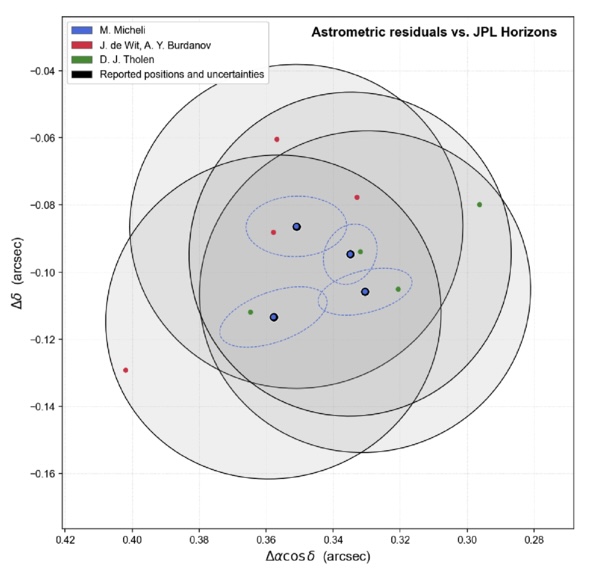
Difference between the position of 2024 YR4 determined in this work using three different reduction methods (red, blue, and green circles) and the position drawn from the existing orbit from the JPL Horizons database. The different analysis methods yielded consistent results. [Adapted from De Wit et al. 2026]
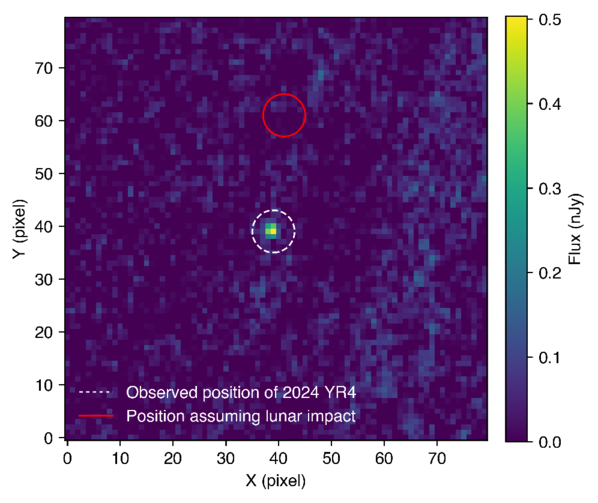
Combining the latest JWST observations with existing data stretching back to the asteroid’s discovery, de Wit and coauthors determined a new, highly precise orbit for the object — one that definitively shows that the asteroid will safely pass by the Moon at a distance of 22,900 ± 800 km in 2032. In addition to ruling out the upcoming lunar impact, the team also ruled out any collisions with Earth in the next 100 years. Phew!
Position of 2024 YR4 as seen by JWST in February 2026 (white dashed circle) compared to the asteroid’s location estimated from existing data (red circle). [De Wit et al. 2026]
This work highlights JWST’s potential as a tool for planetary defense. The February 2026 observations detailed here represent the faintest-ever detection of a near-Earth object, and JWST can detect objects far fainter than ground-based telescopes can. This ability allows JWST to observe potentially hazardous asteroids over a larger swath of their orbits, which translates to earlier trajectory estimation — JWST pinned down 2024 YR4’s orbit two years before the asteroid would have become bright enough for ground-based telescopes to do so.
JWST’s role may be even more important for smaller objects that rapidly become undetectable after discovery. De Wit’s team demonstrated this for a 10-meter-diameter 2024 YR4 clone on the same trajectory; for an object of this size, JWST would be able to rule out an Earth impact before the asteroid became undetectable, but ground-based telescopes could not. With surveys from facilities like Vera C. Rubin Observatory and Near-Earth Object Surveyor set to discover hundreds of thousands of new near-Earth objects, JWST’s role as a hazard assessor will likely be in high demand.
“JWST Observations of Asteroid 2024 YR4 Rule Out a 2032 Lunar Impact and Demonstrate a New Regime for Planetary Defense Follow-Up,” Julien de Wit et al 2026 ApJL 1003 L21. doi:10.3847/2041-8213/ae6a95
The post Asteroid 2024 YR4 Won’t Hit the Moon, New JWST Observations Show appeared first on AAS Nova.
![]()
The Lucy spacecraft, en route to its primary mission targets, zipped past the main-belt asteroid Dinkinesh and revealed its tiny satellite, Selam. New research examines the surfaces and histories of these small rocky worlds.
In 2021, the Lucy spacecraft embarked on a 12-year mission to study several Jupiter trojan asteroids, which share Jupiter’s orbit. The spacecraft won’t have its first encounter with a Jupiter trojan until 2027, but it hasn’t been idle during its long journey. In November 2023, Lucy performed a dress rehearsal of its trojan-encounter maneuvers during a flyby of a 738-meter-wide main-belt asteroid called (152830) Dinkinesh.
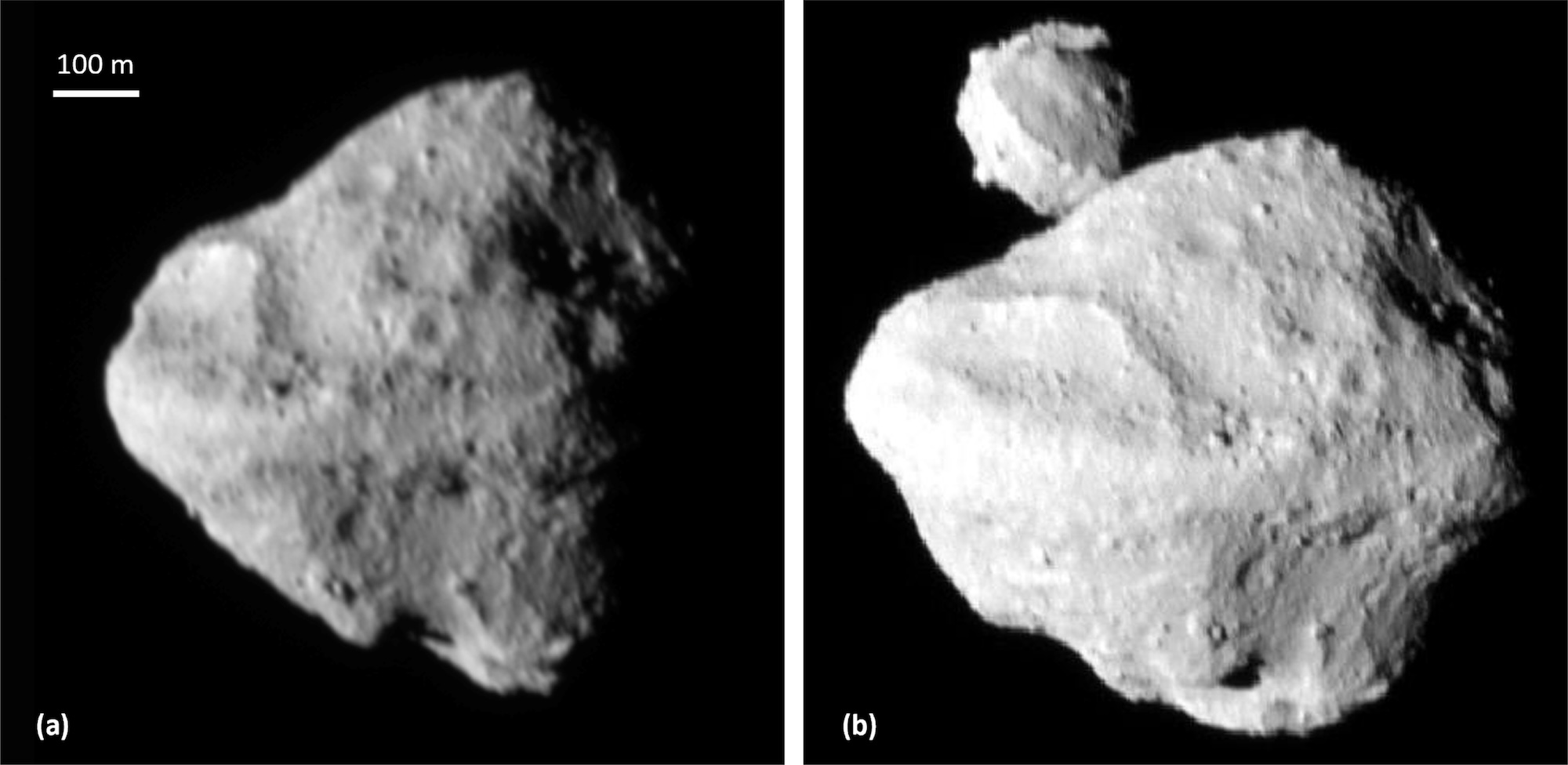
Two images of Dinkinesh from the Lucy mission. The second image features its satellite, Selam. [Bierhaus et al. 2025]
In a recent research article, Edward Bierhaus (Lockheed Martin Space) and collaborators analyzed Lucy flyby images to study the surfaces of Dinkinesh and Selam. The team analyzed global features like troughs and ridges and measured visible craters and boulders.
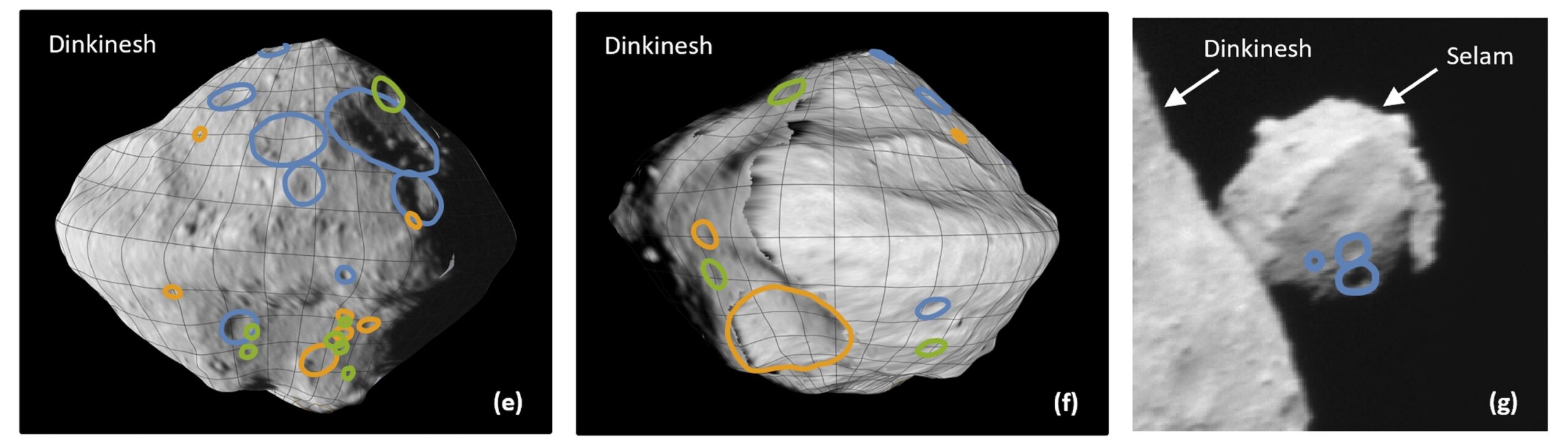
Locations of craters on Dinkinesh and Selam. The blue lines indicate the most confidently identified craters; orange and green lines mark craters identified less confidently. Click to enlarge. [Bierhaus et al. 2025]
The size–frequency distribution of Dinkinesh’s boulders, on the other hand, is somewhat steeper. This discovery may mean that S-type (stony) asteroids like Dinkinesh have different boulder size distributions than C-type (carbonaceous) asteroids.
An analysis of the collisional timescales in the main asteroid belt suggests that Dinkinesh is a fragment of a larger asteroid that was split apart at least once, though it’s not yet possible to say which parent body it might have come from. After splitting off from its parent asteroid, Dinkinesh appears to have been subjected to the Yarkovsky–O’Keefe–Radzievskii–Paddack (YORP) effect. This effect arises when sunlight falls on a small asymmetric asteroid, creating a torque that can alter its spin rate. In extreme cases, the YORP effect can crank up an asteroid’s spin rate so much that it sheds some of its surface material or flies apart altogether.
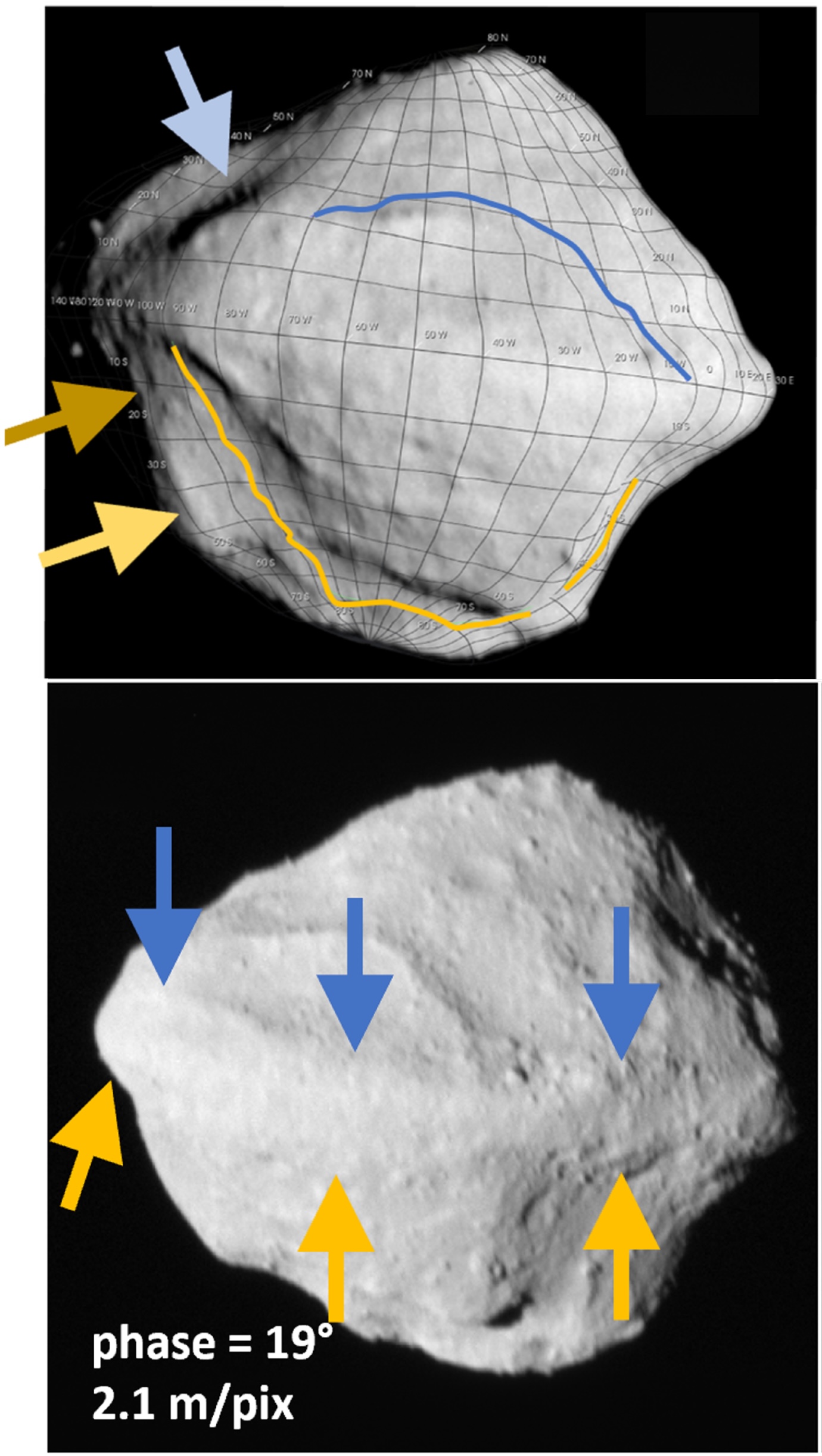
Locations of Sumak Fossa (top) and Fab Dorsum (bottom) indicated with arrows. [Adapted from Bierhaus et al. 2025]
With Lucy en route to its primary objective, there’s still much for us to learn from this mission about the small bodies of our solar system. In the meantime, be sure to check out the full article linked below, as there are far more details about Dinkinesh and Selam than could be included in this short summary!
“The Geology of a Small Main-Belt S-Class Binary Asteroid System: Dinkinesh and Its Contact Binary Satellite Selam as Observed by the Lucy Mission,” E. B. Bierhaus et al 2025 Planet. Sci. J. 6 299. doi:10.3847/PSJ/ae1968
The post Details on Dinkinesh and Its Surprise Satellite from the Lucy Mission appeared first on AAS Nova.
![]()
In September 2022, the Double Asteroid Redirection Test (DART) mission served as the first attempt at redirecting a near-Earth asteroid — an experiment testing humanity’s ability to fend off any threatening Earth-bound asteroids. A recent study presents the first 3D reconstruction of the impact ejecta, suggesting that the blown-out material is more complex than previous models considered.
The DART spacecraft intentionally smashed into Dimorphos, the small and unassuming moon of the larger asteroid Didymos. This space-based crash test aimed to determine if kinetic impactors like DART could successfully change an asteroid’s course through the solar system. Dimorphos’s orbit was indeed shortened by roughly 30 minutes, confirming that ramming an asteroid with a spacecraft could be a viable method of planetary defense. However, determining exactly how much an asteroid’s path will be altered is not necessarily straightforward. When a spacecraft collides with an asteroid, the impactor imparts momentum to the target, and any material excavated from the impact site can also alter the asteroid’s course.
DART’s impact launched a significant spray of rubble, or what researchers call an ejecta curtain. The ejecta curtain is typically modeled as a cone, using a simple geometry to determine its contribution to momentum transfer. However, when looking closely at imaging taken soon after the collision, the real physical structure of the ejecta appears to be more complex. Untangling the true 3D distribution of the ejecta is necessary to understand how momentum was actually distributed among escaping ejecta, better estimate the total mass ejected from Dimorphos, and improve modeling of the Didymos system’s orbit after impact.
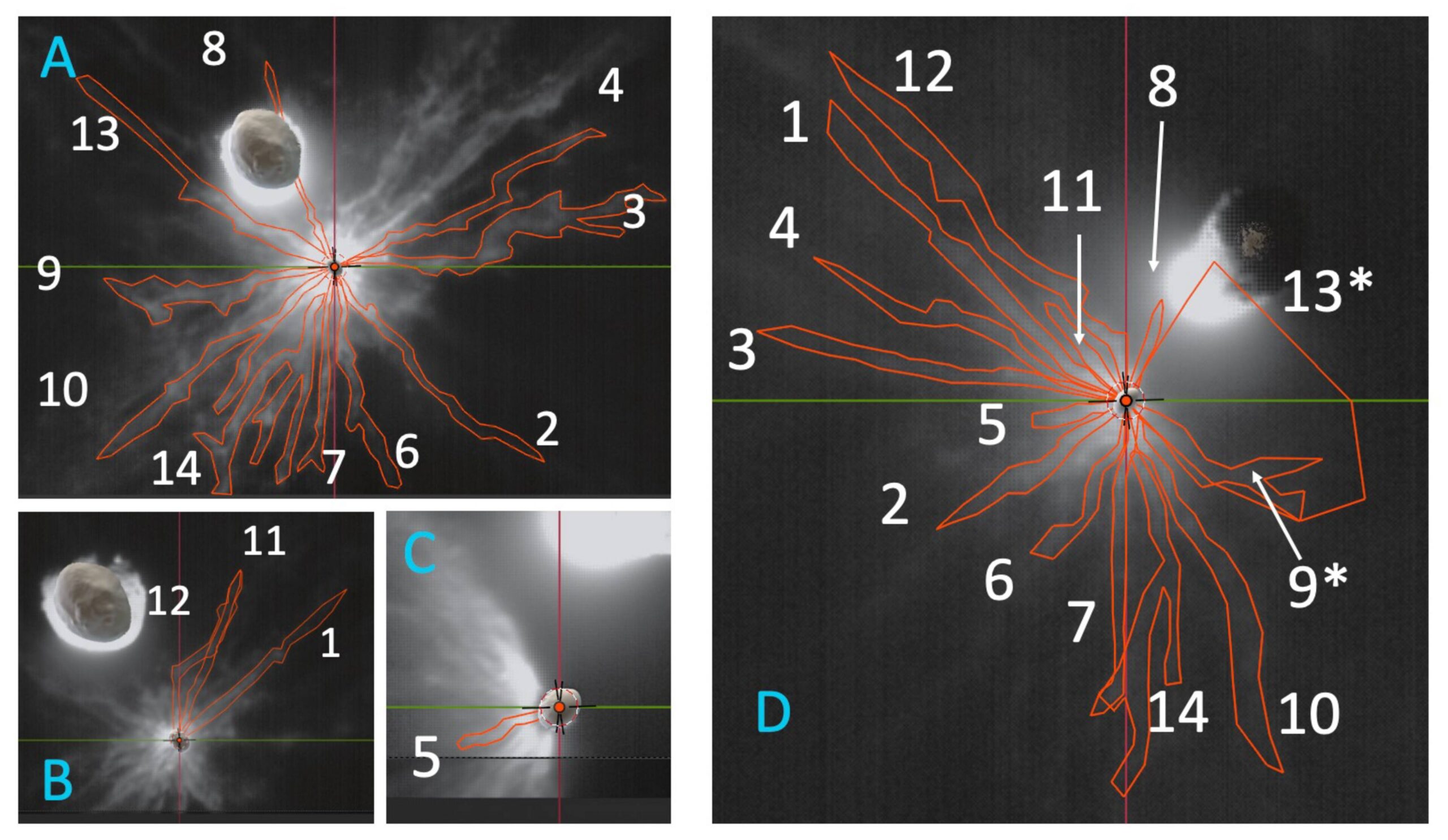
LICIACube images of the DART ejecta curtain with the 14 distinct features identified in this study outlined in red. Click to enlarge. [Deshapriya et al 2026]
Seeking to better characterize the ejecta curtain, a team led by J. D. P. Deshapriya from Italy’s National Institute for Astrophysics used data from the Light Italian CubeSat for Imaging of Asteroids (LICIACube) that flew behind the DART spacecraft to capture images of the system shortly after the impact. After careful image handling to bring out diffuse and faint material, the researchers identified 14 distinct ejecta features across the flyby imaging. LICIACube viewed the aftermath both side on and face on, providing valuable 3D information about the distribution and motion of the ejecta.
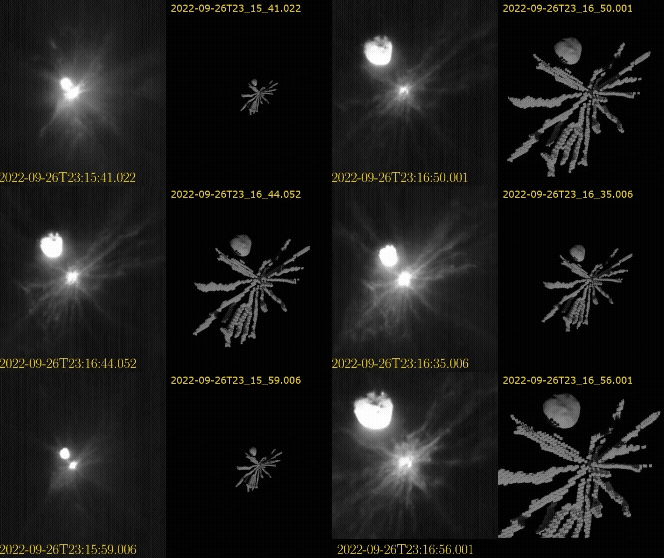
Animation of the DART ejecta as the LICIACube spacecraft approached the impact. The left shows the images taken by the spacecraft, and the right shows the 3D model produced for the ejecta. Click to play animation. [Deshapriya et al 2026]
What does this mean for planetary defense? While simplified symmetric cone models provide helpful approximations for kinetic impactor missions, they do not fully capture the true complexity of the impact. This study shows that local variations in an asteroid’s surface and interior properties can directly influence the resulting ejecta distribution and motion. The true momentum imparted to the target asteroid depends heavily on the specific ejecta material, and these details inform how effective planetary defense missions can be in redirecting asteroids. Incorporating realistic, observation-driven ejecta distributions into modeling frameworks is essential to achieve reliable predictions for future planetary defense missions.
“3D Reconstruction of DART Ejecta at Dimorphos Reveals an Anisotropic, Filamentary Structure,” J. D. P Deshapriya et al 2026 Planet. Sci. J. 7 4. doi:10.3847/PSJ/ae2c64
The post Pulling Back the Curtain on DART Ejecta appeared first on AAS Nova.
![]()
Editor’s Note: Astrobites is a graduate-student-run organization that digests astrophysical literature for undergraduate students. As part of the partnership between the AAS and astrobites, we occasionally repost astrobites content here at AAS Nova. We hope you enjoy this post from astrobites; the original can be viewed at astrobites.org.
Title: High-Speed Boulders and the Debris Field in DART Ejecta
Authors: Tony L. Farnham et al.
First Author’s Institution: University of Maryland
Status: Published in PSJ
In a groundbreaking experiment, NASA’s Double Asteroid Redirection Test (DART) became the first mission to intentionally crash a spacecraft into an asteroid to test whether such an impact could change the asteroid’s path. The target was Dimorphos, a small companion orbiting a larger asteroid called Didymos, located about 11 million kilometers from Earth.
Luckily, neither Dimorphos nor Didymos was ever on any sort of collision course with anything (and they’re still not). But by impacting an object orbiting another, the effect of the collision could more easily be measured and so Dimorphos was chosen as the target. You see, the goal wasn’t destruction, but deflection. The scientists wanted to see if a spacecraft could alter an asteroid’s orbit by striking it — and if so, by how much. When DART slammed into Dimorphos at over 22,500 kilometers per hour, it successfully shortened the asteroid’s roughly 12-hour orbit by about 33 minutes. This confirmed that hitting an asteroid with a spacecraft — in this case scientifically called a kinetic impactor — could be a viable method to redirect a potentially hazardous object in space.
But the change in momentum didn’t just come from the spacecraft itself. Much of the momentum transfer came from the plume of debris — called ejecta — that blasted out from the impact site. This debris, spreading out in multiple directions, added to the total push on the asteroid. Understanding how this ejecta moved exactly is key to calculating the full effect of the impact and was one of the primary goals for the DART mission.
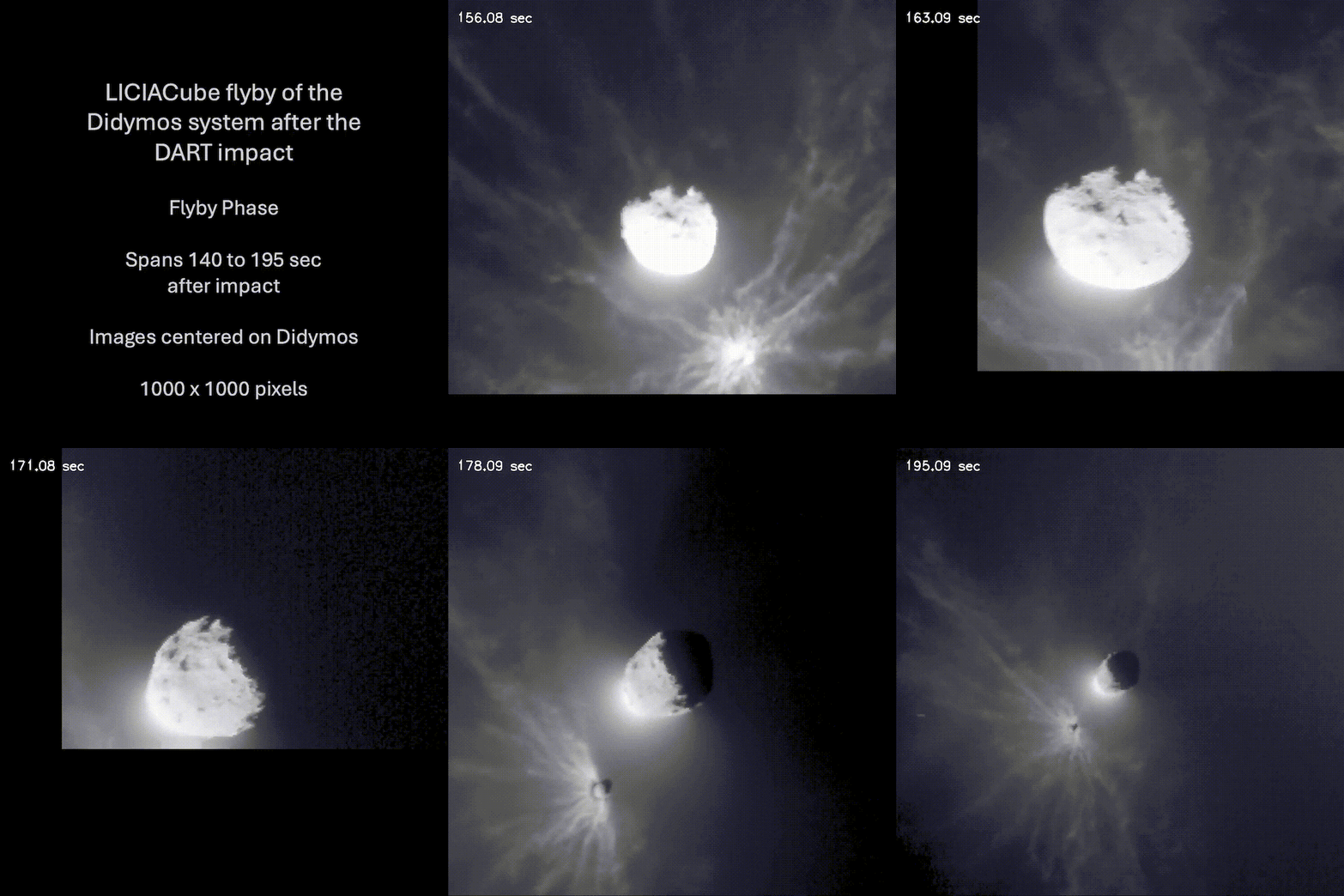
With this exact purpose in mind, a small companion spacecraft called LICIACube (Light Italian Cubesat for Imaging of Asteroids), released by DART two weeks before the crash, flew past moments after the collision. It snapped several images of the debris cloud, as seen in Figure 1, as it raced past. It is with a reanalysis of these images that today’s authors have managed to track a number of boulders in the ejected material.
Figure 1: Animated sequence of images taken by LICIACube as it flew past Didymos and Dimorphos a few minutes after impact by the DART spacecraft. The image is centered on Didymos with the smaller Dimorphos visible for most of the flyby. Large plumes of ejected material are visible, radiating out from the impact site where a very deep crater likely formed. Video provided by the author and subsequently converted to GIF and slowed for use in this bite. [Farnham et al. 2025]
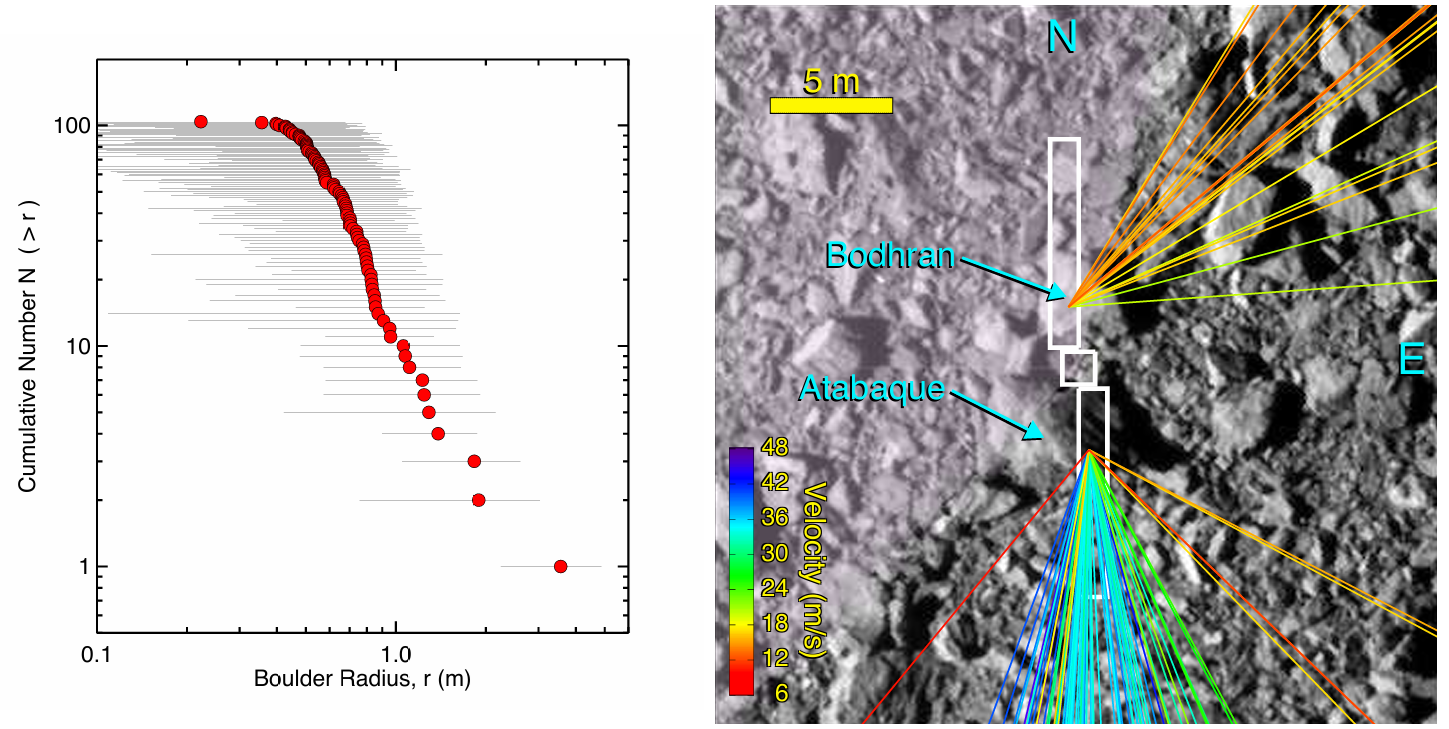
You can say that DART really made an impact — pun intended. It kicked up a lot of material as it struck Dimorphos. In some parts the ejecta plumes are dense enough to block sunlight and even cast shadows on Dimorphos. In the images, like the one seen in Figure 2, the authors were able to make out more than 100 boulders, some as big as 3.6 meters in radius. Tracking the boulders allowed them to calculate velocities and their contribution to the momentum budget. Some of the boulders were ejected at speeds up to nearly 200 kilometers per hour and carried almost as much momentum as the DART craft itself.
Figure 2: The image shows part of the ejected material from the DART impact on Dimorphos at 2 minutes and 40 seconds after impact. A number of boulders are highlighted as they are tracked through the sequence of images from the LICIACube. The boulders are not uniformly distributed but mostly clustered in two distinct populations, with the South Cluster containing around 70% of the measured objects. [Farnham et al. 2025]
The authors also found that the boulders are clustered, suggesting that they were ejected in preferred directions. They conclude that this non-uniform distribution likely changed Dimorphos’s orbital plane. Additionally, the momentum imparted by boulder ejection also likely altered the rotational state of the asteroid, making it tumble around in its orbit.
So what happened? Although there are no constraints on their actual points of origin, the authors suggest that a likely scenario might be that the ejected rocks are the shattered pieces of two large boulders that were seen in some of the last images from the DART spacecraft itself. The two boulders on the surface — named Bodhran and Atabaque after their drum-like shapes — were likely struck by the solar panels as seen in Figure 3.
Figure 3: The right side of the figure shows the impact site for the DART spacecraft just before it hit the surface. The outline of the craft is superimposed on top with the main bus of the craft and with two extended solar panels. Also shown are the authors’ estimated paths for the 104 boulders tracked. They may be the remains of two surface rocks that were shattered upon impact. To the left is the radius distribution for the boulders that were tracked in the study. [Farnham et al. 2025]
The European Space Agency’s Hera mission, now en route and arriving in 2026, aims to carry out an in-depth post-impact analysis. It could determine if Dimorphos is tumbling in its slightly modified orbit and help assess the momentum transfer from the impact debris. All this will contribute to a better understanding of just how much the impact changed the asteroid’s orbit and how much more momentum came from the ejected material than was contributed by the DART spacecraft to Dimorphos. These data will be key to refining asteroid deflection strategies in the case that we might need them in the future. After all, the dinosaurs didn’t have any, and look where it got them!
Original astrobite edited by Chloe Klare.
About the author, Kasper Zoellner:
I have a Master of Science in astronomy and I am currently working towards a PhD in physics and educational science. My greatest passion is the search for exoplanets and how stellar variability may influence the possibility of life. I am also interested in science outreach, education and discussing what sci-fi novel to read next!
The post Shot by the DART and We’re to Blame! Now That Space Rock Won’t Be the Same appeared first on AAS Nova.

![]()
There are more than 37,000 asteroids known to come within 1.3 au of the Sun. Of this near-Earth asteroid population, roughly 2,500 are classified as potentially hazardous — being more than about 140 meters across and coming within 0.05 au of Earth’s orbit (about 20 times the distance between Earth and the Moon). In the image above, Luisa Fernanda Zambrano-Marin (University of Granada and University of Central Florida) and collaborators present observations of 2020 BX12, a potentially hazardous binary asteroid. The larger of the two asteroids in the system was discovered in January 2020 by the Asteroid Terrestrial-impact Last Alert System. About a week after the initial discovery, the 1,000-foot-wide Arecibo Telescope aimed its powerful planetary radar at 2020 BX12 and revealed the asteroid’s small companion. 2020 BX12 was the last of nearly 60 binary or triple near-Earth asteroids discovered with Arecibo before the telescope collapsed in December 2020. As Zambrano-Marin‘s team notes, the loss of Arecibo hampers scientists’ ability to find companions to near-Earth asteroids, which can be critical for determining the properties of these asteroids and guiding our planetary defense strategies. To learn more about this discovery, as well as what the team learned from follow-up spectroscopy, be sure to check out the full research article linked below.
“2020 BX12—The Last Binary Asteroid Discovered at Arecibo,” Luisa Fernanda Zambrano-Marin et al 2025 Planet. Sci. J. 6 91. doi:10.3847/PSJ/adbe39
The post Featured Image: The Last Asteroid Pair Discovered by Arecibo appeared first on AAS Nova.
“Extraterrestrial Cause for the Cretaceous-Tertiary Extinction,” by physicist Luis Alvarez, geologist Walter Alvarez, Frank Asaro, and Helen Michel, was published in Science June 6, 1980. In it, the authors propose that an asteroid crashing to Earth was responsible for the death of the dinosaurs 65 million years ago. (The timeline was later amended to 66Continue reading "June 6, 1980: The asteroid impact theory"
The post June 6, 1980: The asteroid impact theory appeared first on Astronomy Magazine.
Not quite halfway through a six-year sojourn through the Solar System, a NASA spacecraft used a close encounter with Mars last week as a dress rehearsal for its arrival at the Solar System's largest metal asteroid in 2029.
The Psyche mission launched more than two-and-a-half years ago, in October 2023, from Kennedy Space Center, Florida, to kick off a journey of some 2.2 billion miles (3.6 billion km) to reach its unexplored namesake, the asteroid Psyche. The robotic research mission got an initial lift from a powerful SpaceX Falcon Heavy rocket. It uses plasma engines to gradually build up the impulse needed to reach its destination in the asteroid belt, between the orbits of Mars and Jupiter.
A flyby of Mars last Friday gave the spacecraft its most significant boost since launch. Navigators at NASA's Jet Propulsion Laboratory in California set up the spacecraft for a course taking it 2,864 miles (4,609 km) from the Martian surface, well above the planet's tenuous atmosphere. Psyche used Martian gravity like a slingshot to gain enough speed to reshape its orbit around the Sun, putting the probe on a path to intercept its asteroid target.


© NASA/JPL-Caltech/ASU