An international team of paleontologists from Romania, Hungary and Italy has identified a new genus and species of herbivorous, duck-billed dinosaur from an incomplete skeleton unearthed in the Hațeg Basin, a bowl-shaped depression in the Carpathians of present-day Romania.
Baidu’s Apollo Go has received a Level 4 autonomous driving permit in Switzerland for AmiGo, a robotaxi service it is running with Swiss Post’s PostBus, putting the Chinese tech giant ahead of Waymo and Tesla in deploying driverless vehicles into European public transport.
The Federal Roads Office (FEDRO) special permit covers an 80 km² service area across three eastern cantons, and Baidu says the project is on track to become the largest planned automated public transport operation of its kind in Europe.
An international team of researchers led by Dr. Liora Kolska Horwitz of the Hebrew University of Jerusalem’s National Natural History Collections, working at the site of the oldest dated intentional use of fire by ancient human ancestors, South Africa’s Wonderwerk Cave, has found new evidence pushing that date even earlier into prehistory.
The research team behind the potentially history-altering findings said the discovery, which suggests that ancient hominins intentionally controlled fire, resulting in charred animal bones sometime between 1.07 and 1.79 million years ago, provides researchers with previously unavailable insights into how our ancestors first began to harness one of the most important tools in the evolution of human society and culture.
The study also introduced the archaeological community to a promising new method for analyzing burned bone samples by monitoring its light-emitting properties.
Intentional Use of Fire Provided Human Ancestors with a Critical Tool
According to a statement announcing the study, Dr. Horwitz, who is co-director of the Wonderwerk Cave project with Prof. Michael Chazan at the University of Toronto, and colleagues note the historical significance of fire, ranging from warmth and predator protection to extended daylight and the cooking of meat. However, historians have struggled to identify a single moment or historical period where humanity’s ancient ancestors first started to use fire intentionally.
“Evidence of fire from such ancient sites is often subtle and difficult to detect,” Dr. Horwitz explained.
Before the new analysis, the oldest agreed-upon evidence for intentional fire use also came from Wonderwerk Cave. Situated within the Kalahari Desert of South Africa, the cave provided evidence placing fire use to approximately 1 million years ago.
While that study used the most advanced techniques available, the team behind the new study decided to employ a non-invasive process that involves illuminating ancient bone fragments with specific wavelengths of light to determine whether they had been exposed to intense heat. In cases where bones have been heated to fire-like temperatures, the right wavelength of light will cause them to glow.
Remains Likely Left by Homo Erectus
Because evidence from ancient sites is scarce, the team’s non-invasive technique allowed them to study tiny fossilized rodent bones left in the cave by owls without damaging them. The team noted that using remains that accumulated naturally on the ancient cave floor provides an “independent, non-anthropogenic record” of ancient events within the local area.
White (#5 on right) is the most burnt, while yellow-beige (on left #1) is unburnt. Image Credit: Wonderwerk Cave Project.
After exposing the ancient bone to specific wavelengths of light, the team found what they described as “clear signs of burning.” Dr. Horowitz confirmed the findings, noting that the team’s analysis reveals “fire was repeatedly present deep inside Wonderwerk Cave.”
Because the deposits were found over 30 meters deep in the cave, the team ruled out wildfires as a possible source of combustion. The layer also lacked bat guano remains, which the team noted “rules out spontaneous combustion.”
A chemical analysis of the charred bones dated them to between 1.07 and 1.79 million years ago, redating the 2012 findings. Critically, the evidence for ancient fire use was in an archaeological layer “associated with artifacts” from the initial Acheulean period, which is consistent with the dating. If correct, this would make the likeliest early human ancestor that used fire Homo erectus.
Although the findings appear to extend the chronology of one of the earliest known records of fire use associated with hominins by as much as 790,000 years, the research team said the findings do not suggest that these early proto-humans could create fire “at will.” Instead, the likeliest scenario involves early human ancestors collecting fire from natural sources, such as lightning-induced wildfires on the African savanna, and bringing it into the cave.
“The early humans introduced this fire into the cave on multiple occasions and maintained it there before it eventually died out,” the team’s statement explained.
The team did not immediately pinpoint what methods these early hominins used to maintain a burning fire. However, they suggested that burning owl pellets as additional fuel may inadvertently have scorched the rodent bones.
A New Tool for Identifying Traces of Burning
When discussing the implications of the new, earlier date for the first intentional use of fire, Dr. Horwitz said the discovery shows that early human ancestors “were not simply passive observers of natural fires,” but instead were “actively engaging with fire and incorporating it into their lives.”
Beyond offering an earlier date range for early fire use, the work provides clues into how our ancestors used fire before they could make it on their own. The study also debuted a new, non-invasive, portable tool for investigating early fire use, which the study authors note “can be applied to large collections of fossils without damaging them.”
“Our study provides new tools for identifying traces of ancient burning,” Dr. Horwitz explained, with the team adding that application of this new technique to sites around the world “may help clarify the origins and development of one of the most consequential technologies in human history.”
Christopher Plain is a Science Fiction and Fantasy novelist and Head Science Writer at The Debrief. Follow and connect with him on X, learn about his books at plainfiction.com, or email him directly at christopher@thedebrief.org.
A new study has revealed that ancient human ancestors were far more skilled and organized than previously thought. Nearly 800,000 years ago, they were carefully selecting different types of stone for specific tools rather than simply picking up whatever rocks happened to be nearby. The findings suggest that these early humans possessed detailed knowledge of […]
A new soft ultrasound patch is designed to provide long-term, hands-free monitoring of fetal health in real time. Engineers at the University of California, San Diego, have developed a soft, wearable ultrasound patch that can continuously monitor a fetus for hours at a time while maintaining reliable performance even as the fetus and umbilical cord [...]
A new gravitational-wave catalogue reports 161 additional black hole mergers, bringing the total to 390 detections. Scientists at the University of Glasgow’s Institute for Gravitational Research are celebrating the release of a major new collection of gravitational wave discoveries, a milestone that highlights the rapid growth of gravitational astronomy. The latest Gravitational Wave Transient Catalogue [...]
Scientists believe an unusual LIGO detection may be evidence of a primordial black hole, potentially linking these long-theorized objects to the mystery of dark matter. Scientists at the University of Miami believe they may be closing in on evidence for one of the most elusive objects in the universe: primordial black holes. While definitive proof [...]
Editor’s Note: For the remainder of 2025, we’ll be looking at a few selections that we haven’t yet discussed on AAS Nova from among the most-downloaded articles published in AAS journals this year. The usual posting schedule will resume January 2nd.
Search for Gravitational Waves Emitted from SN 2023ixf
Published May 2025
Main takeaway:
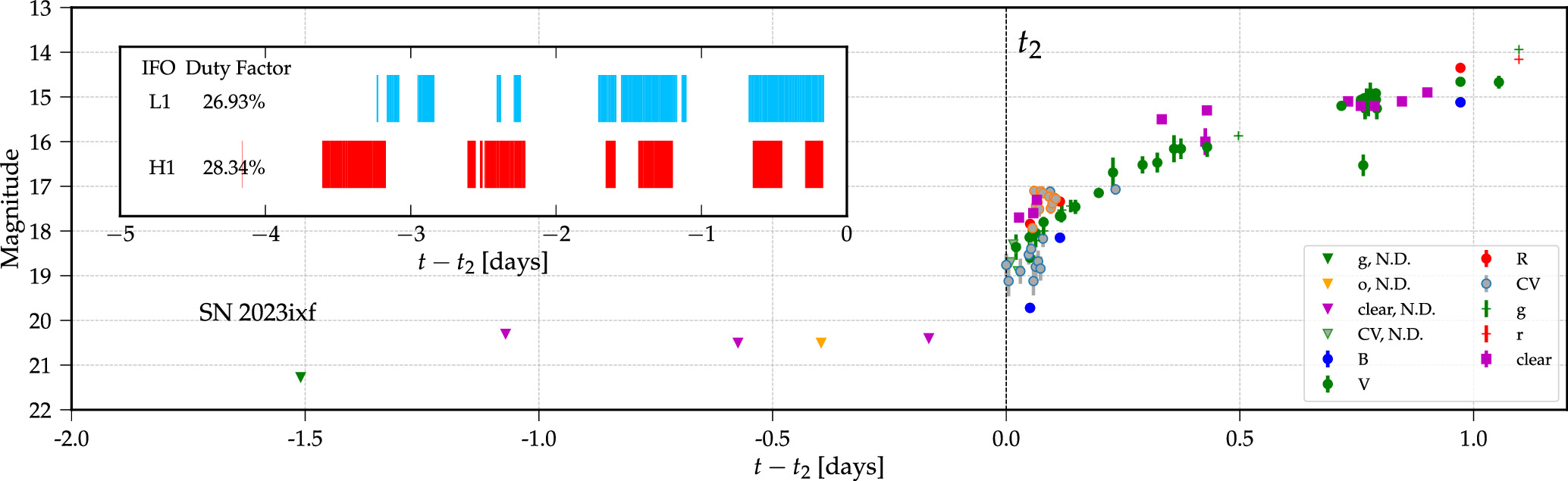
The LIGO, Virgo, and KAGRA collaborations searched for gravitational waves from the core-collapse supernova SN 2023ixf. Though no significant gravitational wave events were detected during times when two or more gravitational wave detectors were online, the non-detection of gravitational waves from this nearby supernova places constraints on the amount of energy emitted by the explosion in the form of gravitational waves, the shape of the proto-neutron star produced in the collapse, and more.
Why it’s interesting:
When a massive star expires in a core-collapse supernova, the collapse of the stellar core into a neutron star or black hole produces gravitational waves. These gravitational waves, along with a stream of neutrinos, should arrive at Earth before the light from the explosion does; gravitational waves and neutrinos can easily escape the dense, roiling ejecta from the explosion, but photons take some time to claw their way through the debris. Gravitational waves from a supernova have never been detected, but the nearby supernova SN 2023ixf, which occurred in a galaxy about 20 million light-years away, offered the best recent opportunity to detect these waves.
Photometric evolution of SN 2023ixf in its early days and gravitational wave coverage leading up to the supernova’s discovery (inset image). [LIGO-Virgo-KAGRA Collaborations 2025]
What we learned from this non-detection:
Using the non-detection of SN 2023ixf, researchers placed stringent constraints on the gravitational wave energy and luminosity of a supernova explosion, but an even closer supernova is still needed to begin to rule out model predictions for these quantities. To estimate the distance out to which we can expect to detect gravitational waves from collapsing stars, the collaboration members injected synthetic supernova signals into their data. The majority of non-rotating explosions can be detected out to about 22,000 light-years — meaning events on the far side of our galaxy remain inaccessible to current detectors — while rapidly rotating explosions should be detectable out to nearly 100,000 light-years, pushing the detection horizon beyond the borders of the Milky Way.
Black holes can have messy family histories, and a recent massive merger challenged astronomers to sort out just how many generations of black holes were involved in the event. Recent research, however, may have untangled the lineages of the two progenitors.
A Massive Collision
Earlier this year, the Laser Interferometer Gravitational-Wave Observatory (LIGO) detected the ripples in spacetime caused by the merger of two black holes somewhere in the distant universe. Though these detections have become increasingly common, this one in particular stood out among the more than 200 reported over the last decade. Named GW231123, this event must have caused more of a splash than a ripple since the two black holes that slammed together were unusually massive; both likely weighed more than 100 times the mass of the Sun. Not only that, each was also spinning unusually rapidly prior to the collision.
According to theory, black holes this large are not supposed to form on their own. When massive stars die, they can collapse into a black hole; but, when really massive stars die, the collapse is so violent that no material is left over to form the black hole. So, when researchers first measured the masses of the black holes involved in GW231123, they knew that the black holes involved couldn’t have formed directly from collapsed stars. Instead, they were likely second-generation black holes, meaning that they themselves formed from previous black hole–black hole mergers.
Merger Mystery
This result was celebrated as evidence of so-called “hierarchical formation,” in which black holes formed in dense environments swarm throughout their star clusters, merging with other black holes they encounter and growing ever larger.
However, there were a couple of complications with this picture. For one, theory predicts that it is challenging to form such rapidly spinning black holes from randomly oriented progenitors, since usually the spins wash out and leave the remnant rotating slowly. For another, the merging process tends to give the final black hole a “kick” that sends it flying rapidly away from the site of the impact, occasionally fast enough to leave the star cluster altogether, meaning second-generation black holes might not be able to merge into subsequent generations.
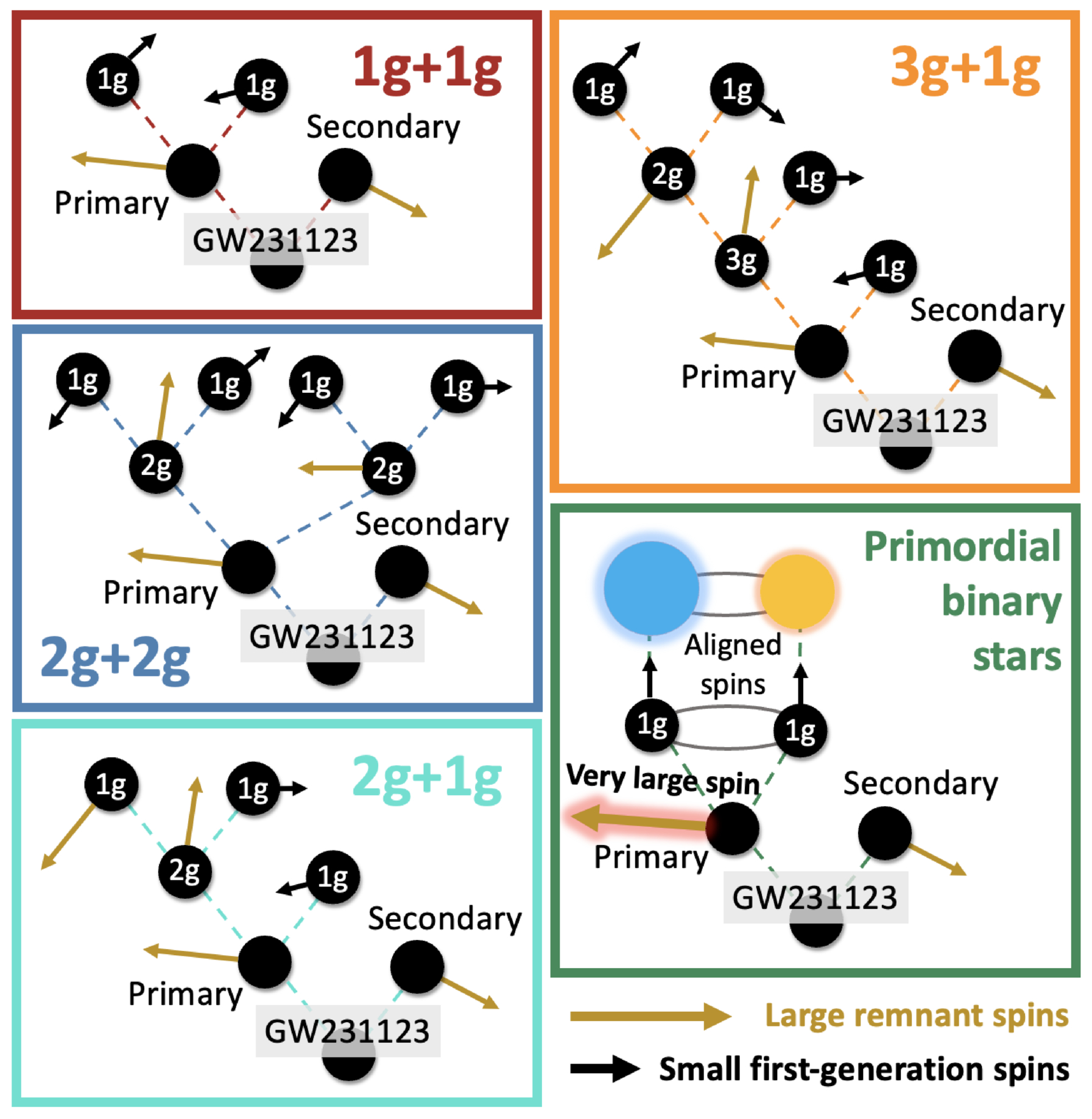
A schematic of various potential black hole family trees. The binary-star origin scenario is shown in the green box. Click to enlarge. [Stegmann et al. 2025]
Born as a Pair
New research led by Jakob Stegmann, Max Planck Institute for Astrophysics, suggests a way around each of these problems. In the team’s model, the two black holes involved in the GW231123 merger didn’t form from isolated black holes in a cluster, but rather from binary stars embedded within that cluster. In this picture, two massive stars were born bound together, orbiting one another within a larger cluster of stars. Crucially for this scenario, the massive primordial stars have aligned spins — an expected outcome of massive binary star evolution.
After both stars in the binary collapsed into black holes, these black holes merged to form a rapidly spinning second-generation black hole. This second-generation black hole eventually encountered another black hole within the cluster and merged to produce the ripples in spacetime we observed as GW231123.
Since black holes born within binary systems are expected to have smaller kicks and faster spins, this scenario neatly explains the properties observed in GW231123. As LIGO keeps listening for more black hole mergers, hopefully similar events will provide more chances to untangle their complex family trees.
Citation
“Resolving Black Hole Family Issues Among the Massive Ancestors of Very High-Spin Gravitational-Wave Events like GW231123,” Jakob Stegmann et al 2025 ApJL992 L226. doi:10.3847/2041-8213/ae0e5f
Meet GW241011 and GW241101, two events from the fourth observing run of the LIGO, Virgo, and KAGRA (LVK) gravitational wave detectors. With rapid spins and mismatched black hole masses, both events provide strong evidence for black hole growth through hierarchical mergers.
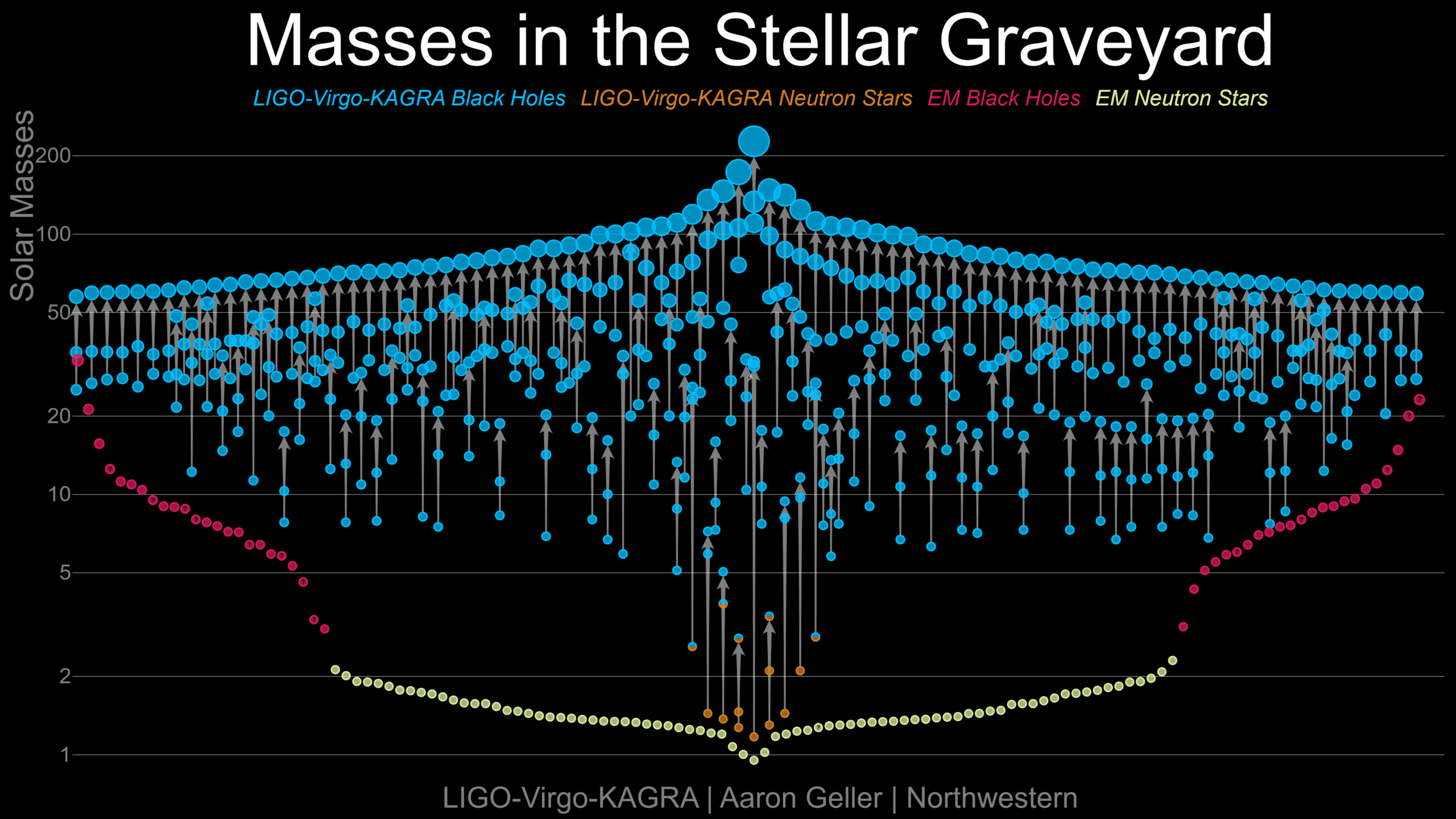
Masses of black holes and neutron stars discovered via gravitational waves (blue and orange circles). The red and yellow circles show the black holes and neutron stars detected through electromagnetic means. Click to enlarge. [LVK/A. Geller/Northwestern]
A Decade of Discovery
Humanity is 10 years into its study of the gravitational wave universe, and detectors across the globe are about to wrap up their fourth observing run. The recently released fourth catalog of gravitational wave transients, GWTC-4.0, more than doubles the number of recorded events.
Today, we’re taking a look at two of the fourth observing run’s gravitational wave events, both of which point to black holes born in dense environments.
Two Detections in the Spotlight
GW241011 and GW241101 are gravitational wave signals that reached Earth in late 2024. Using Bayesian parameter estimation, members of the LVK collaboration determined that each of these two signals arose from the merger of a pair of black holes.
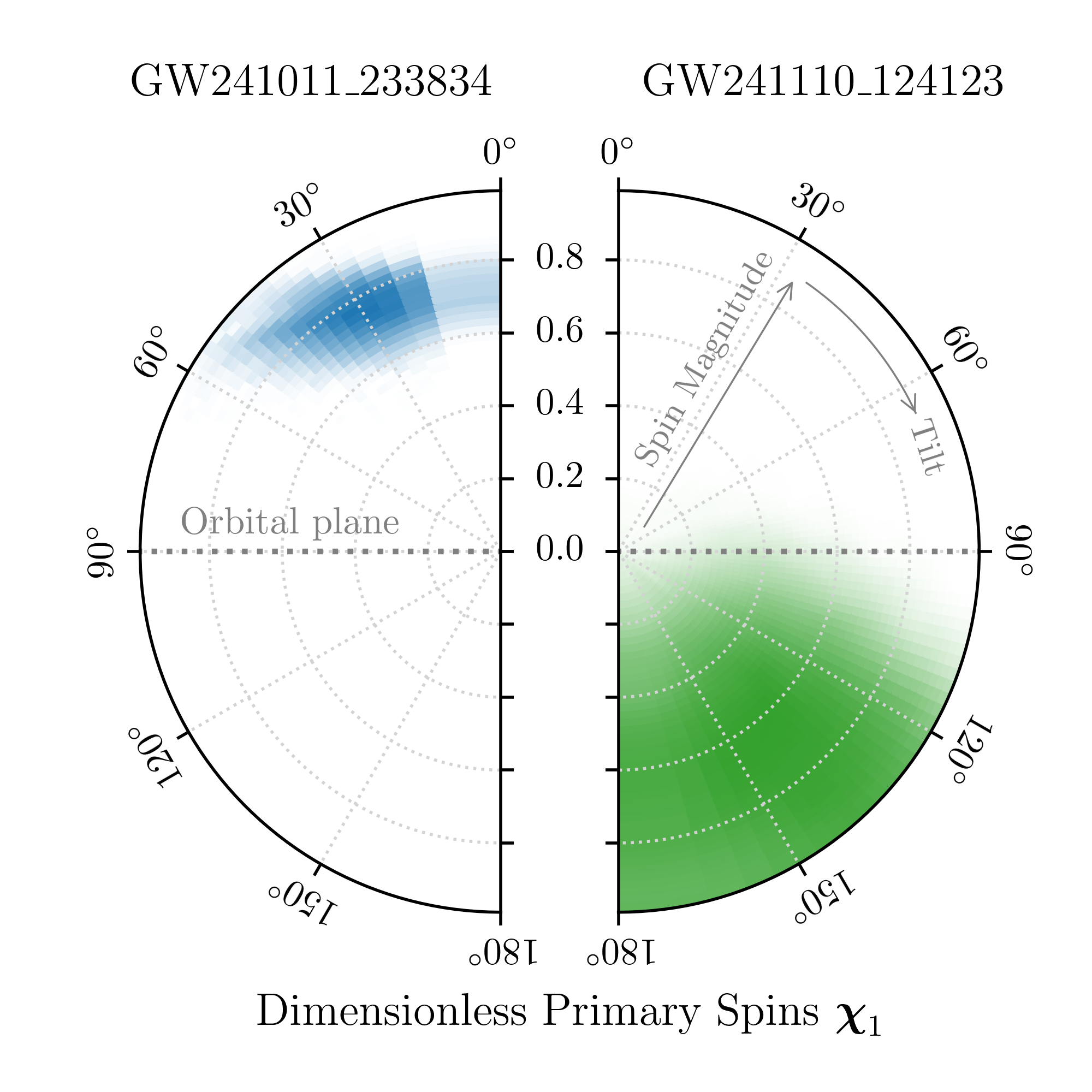
Posterior distributions for the primary black hole’s spin magnitude for GW241011 (left) and GW241101 (right). [LIGO, Virgo, and KAGRA Collaborations 2025]
Though the LVK detectors have by now spotted dozens of coalescing black hole pairs, these two detections stand out. GW241011 is the third-loudest gravitational wave signal ever detected, and its primary (i.e., more massive) black hole has one of the largest and most precisely measured spins among black holes detected via gravitational waves.
GW241101 flips the script: its primary black hole also spins rapidly, but it appears to do so in a direction opposite from the direction in which the black holes orbit. Though its spin isn’t measured as precisely as that of the primary black hole in GW241011, this event still provides the best evidence so far that the spins of some merging black holes are misaligned with their orbital motion.
In addition to their standout spin parameters, these events are also remarkable for the masses involved. In both cases, the larger black hole has a mass of 15–20 solar masses, and the smaller black hole is significantly smaller — about 6 solar masses for GW241011 and 8 solar masses for GW241101.
A Black Hole Genealogy Project
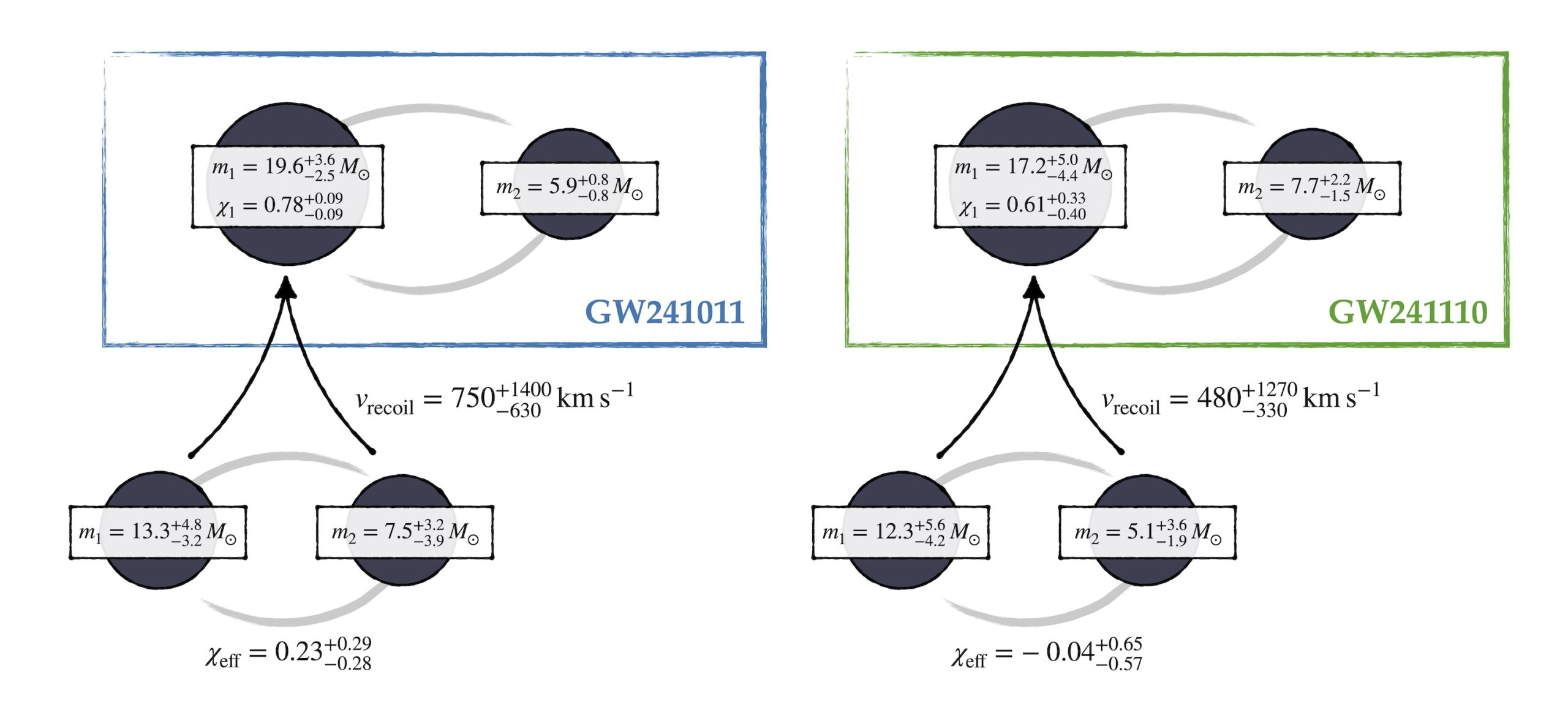
Inferred masses and spins of the ancestors of the primary black holes of GW241011 and GW241101. Click to enlarge. [LIGO, Virgo, and KAGRA Collaborations 2025]
The rapid spins and comparatively large masses of the primary black holes of GW241011 and GW241101 don’t line up with what’s expected for black holes arising in isolated binary systems, unsubjected to outside influences. But they do match expectations for hierarchical mergers, in which one or more of the black holes involved is itself the product of a merger.
If these signals arose from hierarchical mergers, that tells us something about the environment in which the black holes lived. When two black holes merge, the product is expected to spin rapidly and receive a “kick.” For a black hole pair in a loose grouping of stars, this kick would likely boot the merger product out of the group, preventing it from encountering other black holes and merging again.
But in dense environments like compact star clusters, even a good strong kick isn’t enough to overcome the cluster’s escape velocity and launch the resulting black hole on a lonely journey through space. Instead, these black holes are retained in the dense cluster environments of their birth, where they may dance and merge with another black hole partner. While it’s not possible to entirely rule out other origins, such as an isolated pair of massive binary stars, the data strongly support the hierarchical merger scenario.
This discovery yet again demonstrates the ability of our gravitational wave detectors to reveal the lives and histories of black holes throughout our universe. Stay tuned for even more black hole news from the current observing run!
Citation
GW241011 and GW241110: Exploring Binary Formation and Fundamental Physics with Asymmetric, High-Spin Black Hole Coalescences,” A. G. Abac et al 2025 ApJL993 L21. doi:10.3847/2041-8213/ae0d54
Segundo a Google, o Gemini Go é uma versão mais leve do assistente inteligente, concebida para os smartphones Android com especificações mais modestas. A substituição do Google Assistant nos modelos equipados com Android Go será disponibilizada de forma faseada.
A edição especial da consola ROG Xbox Ally X20 foi uma das surpresas na celebração dos 20 anos da marca da Asus dedicada ao gaming, em pacote com os óculos XREAL R1. O design segue a mesma linha dos produtos Edition 20 mas é a experiência de jogo que interessa.
The Bundibugyo virus, a little known type, previously had caused just two small outbreaks. Now it’s at the center of a rapidly widening epidemic in Africa.
Field notebooks from the late Richard Köhler allowed researchers to finally catalog a remarkable fossil tarpon from Aotearoa New Zealand. Recently disclosed notebooks from a late paleontologist supplied the missing details researchers needed to complete their study of a “remarkable” fossil found nearly 30 years ago. Dr. Richard Köhler discovered the fossil fish in 1999 [...]
A newly described fossil goose shows that New Zealand’s bird history involved repeated arrivals, extinctions, and rapid island evolution. A rare fossil goose found in the remains of an ancient lake in Central Otago is changing how scientists understand the bird history of Aotearoa New Zealand, according to a researcher at the University of Otago [...]
Lego is going all out with Star Wars this year, from awesome mid-sided AT-AT through to a whole range of super-interactive Smart Brick-enabled models. Here are the sets I absolutely have to add to my Lego Star Wars collection.
The U.S. oil giant is negotiating a deal to pump oil in Venezuela, ending a standoff with its socialist rulers and marking a victory for President Trump.

 Login