❌

Normal view

Backyard Worlds: Binaries

16 June 2026 at 14:00

Backyard Worlds: Binaries

Most stars in our Milky Way galaxy exist in groups, including pairs or “binaries,” in which two stars orbit each other. Some binaries are stars paired with brown dwarfs, balls of gas more massive than planets without enough mass to sustain nuclear fusion. Finding brown dwarfs in pairs helps scientists deduce their ages and origin stories! Backyard Worlds: Binaries invites you to search images made by NASA’s Wide-field Infrared Survey Explorer (WISE) space telescope to find these vital brown dwarfs in binary systems. Your discoveries will teach us about brown dwarf formation and identify objects that resemble giant planets like Jupiter.

Go to Project Website about Backyard Worlds: Binaries

project task

Examining Images

division

Astrophysics

where

Online

launched

2026

Illustration showing a large, dark red gas‑giant–like world in orbit with a white dwarf shown as a bright white dot. The bright band of the Milky Way stretching across the star‑filled background.
Artist’s rendition of a brown dwarf orbiting a white dwarf (the bright white circle) with the Milky Way in the background.
 NOIRLab/NSF/AURA/P. Marenfeld

What you’ll do

  • Learn how to recognize binary systems and brown dwarfs in images made by NASA’s WISE space telescope. 
  • Click buttons to indicate whether or not they contain binaries. If you see a binary, click a button to indicate whether or not it includes a brown dwarf. Review as many image sets as you like, 
  • If you want to, you can discuss what you have found with other volunteers and scientists in the Talk forum.

Requirements

  • Time: 5-15 minutes to complete the tutorial
  • Equipment: Web-connected device.
  • Knowledge: None. In project tutorial provides all instruction needed.

Get started!

  1. Visit the project website.  
  2. Complete the in-project tutorial to learn how to spot binary systems in short animations of WISE data.
  3. Start identifying candidate binary systems containing a brown dwarf, using a Field Guide reference as necessary.

Learn More

The Backyard Worlds: Binaries Research page gives an overview of the research being pursued and its value towards expanding what we know about how star and planetary systems form. Links throughout this page take the reader to additional sources of information. The Frequently Asked Questions (FAQs) page has additional information relevant to the work of the project. 

You might also like to try Backyard Worlds: Cool Neighbors and Backyard Worlds: Planet 9!

A vibrant logo set against a starry space background. In the center is a colorful, striped planet featuring shades of blue, green, and pink, surrounded by a glowing orange-red ring. A white silhouette of a telescope on a tripod points up toward the planet. Arcing above the planet is the text "BACKYARD WORLDS:" in white, blue-outlined letters. Arcing below is the word "BINARIES" in large, stylized red bubble letters on a white, cloud-like background.

Looping side‑by‑side animation showing two sky images: the original WISE sky view on the left and processed images on the right. Pixelated points labeled as M‑dwarf stars shift position between frames, illustrating how subtracting sequential images reveals moving objects.
Animated images from the Backyard Worlds: Binaries project showing two distinct “dipoles” – single objects moving through space – that appear to be moving together. These dipoles “flip” together, indicating that they are moving in the same direction.
Backyard Worlds: Binaries WISE data.

Get to know the people of Backyard Worlds: Binaries!

Mei Lin

Intern, undergraduate student
Harvard University

Portrait photo of a man wearing a blue shirt and blazer

Aaron Meisner

Staff Astronomer
NSF’s NOIRLab and Harvard University

Zachary Hartman

NASA Postdoctoral Fellow
NASA Ames Research Center

Austin Rothermich

Graduate Student
City University of New York and American Museum of Natural History

Portrait photo of a woman with long curly hair

Jackie Faherty

Astrophysicist / Scientist at American Museum of Natural History

Adam Schneider

United States Naval Observatory

Portrait photo of a smiling man

J. Davy Kirkpatrick

Astronomer, Infrared Processing and Analysis Center (IPAC) at the California Institute of Technology 

Portrait photo of a bearded young man

Dan Caseldon

Citizen scientist and Research Associate, American Museum of Natural History

Arjun Dey

Astronomer, NSF’s NOIRLab 

John Gizis

Observational Astronomer, University of Delaware

The post Backyard Worlds: Binaries appeared first on NASA Science.

Citizen Science Born in the Pandemic: The Hubble Image Similarity Project

2 July 2025 at 17:00

images from the Hubble Image Similarity Project

Motivated by a desire to support community members financially during the coronavirus pandemic, researchers employed 30 local citizen scientists in the Hubble Image Similarity Project. This project quantified the similarities between astronomical images, providing a way to test the results of image-search algorithms.

Seeking Similarities

Eagle Nebula

The Eagle Nebula, pictured here in an image from Kitt Peak National Observatory, is a star-forming region in the Milky Way. [T.A.Rector (NRAO/AUI/NSF and NOIRLab/NSF/AURA) and B.A.Wolpa (NOIRLab/NSF/AURA); CC BY 4.0]

Say you have an image of a star-forming region, featuring eye-catching gas clouds, dense and dusty knots, and newborn stars. How would you go about finding other images that resemble yours?

You might start your search with an astronomical image database, using filters for object type or instrument to sift through thousands and thousands of options. But even filtering out everything but star-forming regions might yield vastly different results, given the widely varying shapes, colors, and sizes of these regions.

Or maybe you’ll feed your image into a neural network that has been trained to spot similar images. The results may seem promising, but how can you tell whether the algorithm has found the images that are the most similar? Would another algorithm do better?

The Hubble Image Similarity Project

Astronomical image collections rarely contain information about similarities between images in their metadata, and while neural networks appear to excel at gathering similar images, the results of these models are generally unverified. The Hubble Image Similarity Project, led by Richard White (Space Telescope Science Institute) and Josh Peek (Space Telescope Science Institute and Johns Hopkins University), addressed these issues with a team of citizen scientists who generated similarity information for astronomical images, providing a quantitative means to test the results of neural networks.

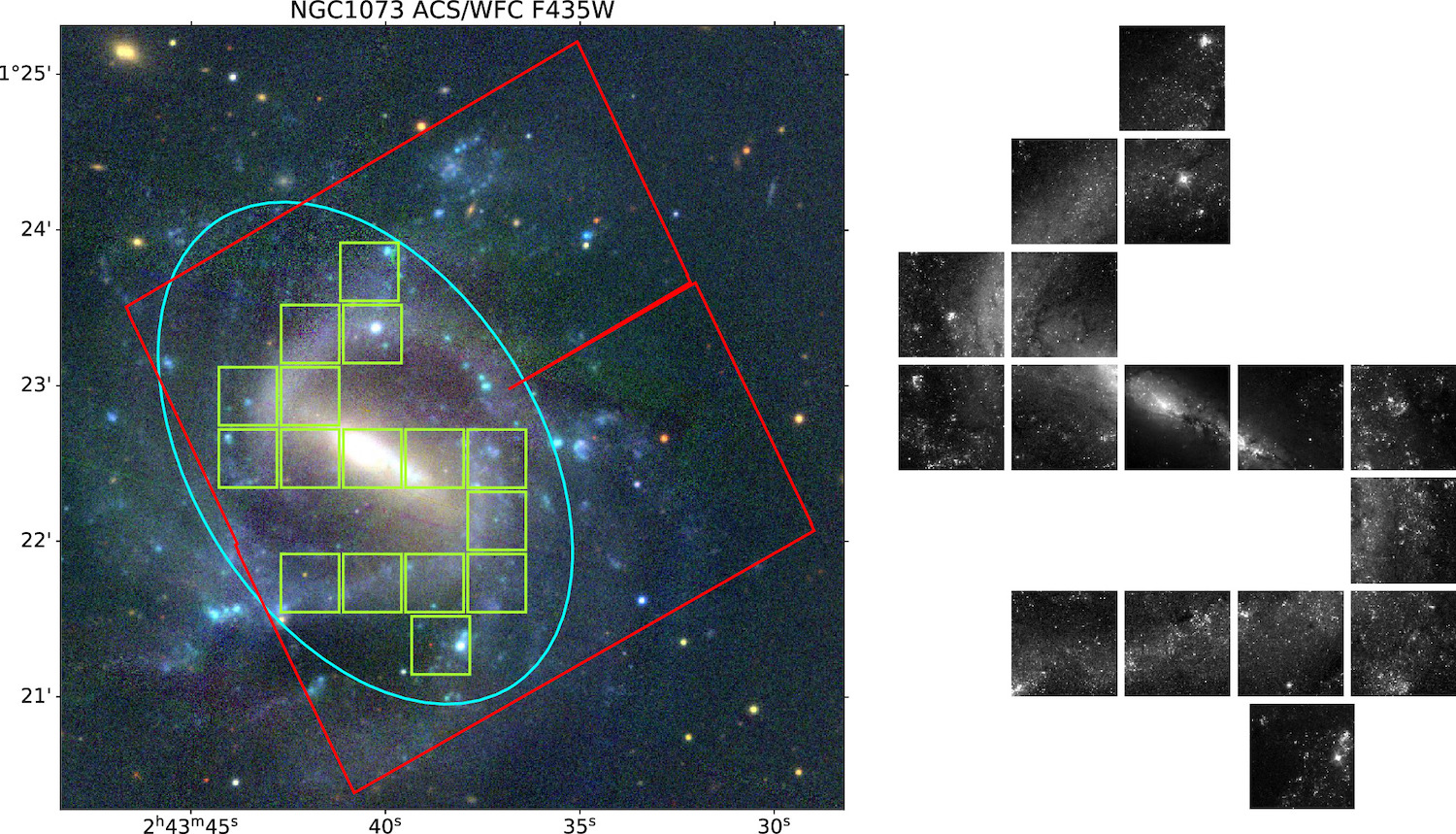
example of how the Hubble Image Similarity Project selects image cutouts for study

An example of individual test images (green squares) extracted from a Hubble Legacy Archive image (red square). Low-contrast areas have been excluded, leaving the galaxy’s spiral arms for analysis. Click to enlarge. [White & Peek 2025]

White and Peek began by amassing a sample of images from the Hubble Legacy Archive. This sample included many different object types, such as galaxies, planetary nebulae, star-forming regions, and star clusters. After trimming and binning the images, converting them to 8-bit grayscale, filtering out low-contrast images, and eliminating satellite trails, image artifacts, and repeated observations of the same patch of sky, 2,098 images of 666 objects remained.

Citizen Scientists, Assemble

White and Peek recruited 30 members of the community within walking distance of the Space Telescope Science Institute to identify similar astronomical images, and the reviewers were paid for their work. In the three phases of the project, reviewers considered test images one at a time and 1) selected all similar images from a set of 15 comparison images, 2) selected the most similar image from a narrowed-down set of 6 comparison images, and finally 3) selected the most similar image from a set of 3 comparison images.

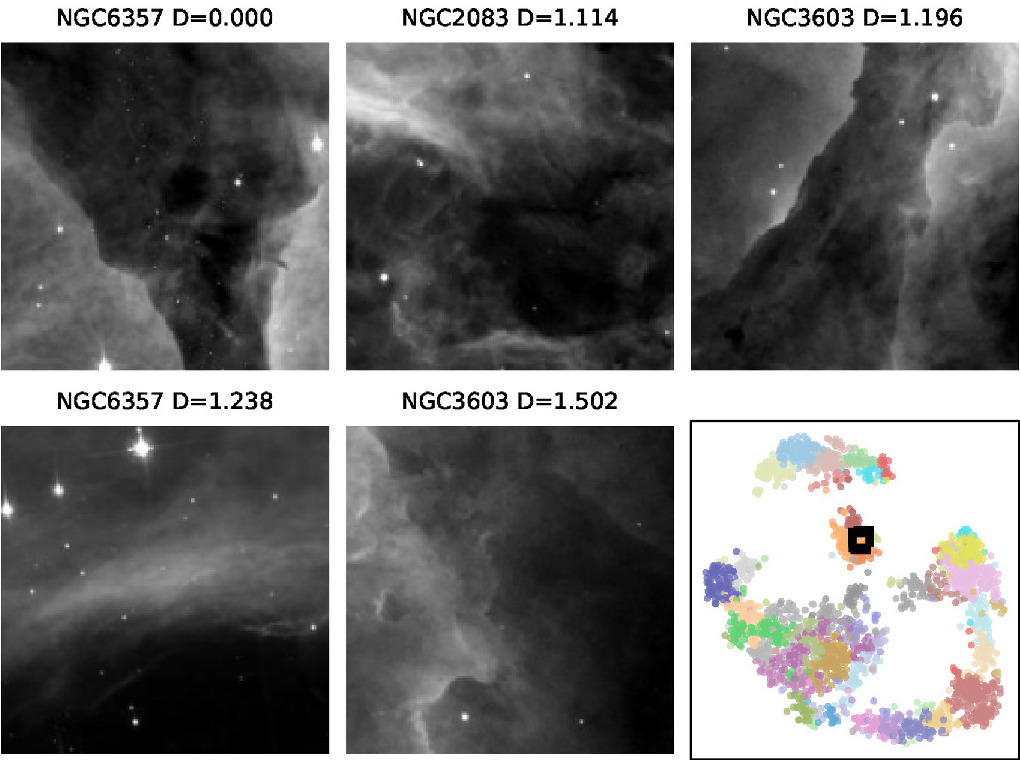
similar images from the Hubble Image Similarity Project and a visualization of the data

Examples of similar images according to the image similarity matrix. In the lower-right corner is a visualization of the similarity data. The semicircle of data points in the bottom half of this visualization represents galaxies, while star clusters occupy the small arc near the top and nebulae sit in the island in the center of the plot. Click to enlarge. [Adapted from White & Peek 2025]

The citizen science team ultimately compared 5.4 million pairs of images, and White and Peek used these comparisons to produce an image similarity matrix. The matrix describes the metaphorical “distance” between the images, with the most similar images being the smallest distance apart.

Similar images resemble one another in terms of structure, texture, and other factors that White and Peek say are “difficult even to describe in words” — for example, the diffuse glow of a galaxy interrupted by a bright star with diffraction spikes, or a nebula speckled with stars and dense dusty clumps. The similarity data from this study are available online and can be used to test the performance of image-search algorithms. In future work, the authors plan to carry out a similar project using images of the Martian landscape.

Citation

“The Hubble Image Similarity Project,” Richard L. White and J. E. G. Peek 2025 AJ 169 306. doi:10.3847/1538-3881/adcb43

The post Citizen Science Born in the Pandemic: The Hubble Image Similarity Project appeared first on AAS Nova.

❌