 Login
Both Men and Women Rate Women’s Faces as More Attractive, Across Multiple Cultures
14 June 2026 at 20:47
 There appears to be a gender attractiveness gap, but it fades away with age.
 There appears to be a gender attractiveness gap, but it fades away with age.
Two elusive groups of millipedes, Siphoniulida and Siphonocryptida, were the last missing pieces in the evolutionary history of Earth’s oldest land animals, according to a team of entomologists led by Virginia Tech.
The post Entomologists Reconstruct Evolutionary History of Millipedes appeared first on Sci.News: Breaking Science News.
A new study suggests evolution stayed stuck for millions of years until sexual reproduction helped unleash a burst of biodiversity. New research suggests that the earliest animals on Earth may have unintentionally slowed the pace of evolution for millions of years. Scientists have found that their reliance on asexual reproduction limited competition and reduced the [...]A newly discovered feathered dinosaur from China may help solve a long-standing mystery surrounding a fossil bed filled with ancient bird remains. For years, one fossil site in northwestern China has posed a mystery. The area contains hundreds of fossilized birds, many remarkably well preserved. Mixed among them are strange clusters of shattered bones compressed [...]
Archaeologists working with the Israeli Antiquities Authority have announced the discovery and excavation of a cave located just outside the town of Fureidis, which has revealed signs of early human presence dating back to between 250,000 and 400,000 years ago.
The team of researchers behind the ongoing excavation said the fortuitous discovery could represent a “time capsule” that has remained sealed for hundreds of thousands of years, offering researchers an unprecedented glimpse into a critical period in human evolution.
According to a statement emailed to The Debrief, the ancient cave, which lies south of Haifa, near the Zikhron Ya’akov interchange, likely dates back to sometime between 400,000 and 250,000 years before present. The team notes that the range would mean it was sealed since the time of the Acheulo-Yabrudian culture, a period when ancient human ancestors began to display several complex tool-making skills, including various stone blade designs which were in use by hominins until around 300,000 years ago, marking the end of the Lower Paleolithic period.
“The culture we are investigating here was characterized by a variety of advanced methods for producing flint tools, including small sharp handaxes, scrapers, and blades,” explained Dr. Kobi Vardi, head of the Prehistory Branch at the Israel Antiquities Authority and the study’s co-director.
Most archaeologists put the African departure date of the last common ancestor of humans and Neanderthals between 700,000 and 500,000 years ago, and the first genetic interbreeding between the two species around 130,000-1,000,000 years ago. Therefore, finding a sealed cave containing relics from the period between these two critical evolutionary junctures offers the research team an unprecedented opportunity.
“We have been fortunate to excavate a unique site of global importance that has been protected from the ravages of time thanks to the exceptional conditions that existed here,” said team member Professor Ron Shimelmitz of the Zinman Institute of Archaeology and the School of Archaeology and Maritime Cultures at the University of Haifa.
Dr. Vardi agreed, noting that “It is very rare to find a site in such a state of preservation.”
“Every prehistorian who visits the site is absolutely thrilled,” he added.
In that same statement, Prof. Shimelmitz noted that the end of the Lower Paleolithic was a “unique time period” before Neanderthals and modern humans became the dominant hominids of the era and spread across “many regions.”
“Only a handful of sites from this important phase have been uncovered in Israel, and the wider Levant, and most of them are inaccessible for research,” the professor explained, adding that marked changes in human physiology, technology, and social organization “foreshadowed the traits and complex behavioral patterns that developed later and characterize both Neanderthals and modern humans.”
One component that helped facilitate the development of complex culture, highlighted by Prof. Shimelmitz, is the transition from ancient humans living in larger groups. He also emphasized the advent of human ancestors “spending longer periods at the same sites.”
Early excavations have already uncovered evidence of what the researcher termed “intensive use of fire.” These early forays have also found signs of prolonged human activity. Prof Shimelmitz said these signs suggest a “complex and rich camp life.”
Dr Vardi said that the ongoing excavation is uncovering animal bones, including ancient specimens of fallow deer, gazelle, and an ancient variety of horse.
Dr. Vardi also noted that these finds were discovered “alongside evidence of the presence of water,” which he suggests may have made the ancient cave an attractive location for hunter-gatherer groups inhabiting the region at the time.
When discussing the implications of their findings, Prof. Shimelmitz first expressed the team’s appreciation for the financial support and enthusiasm shown by the project’s sponsor, the Ayalon Highways Company, “in enabling us to undertake the excavation.”
As for the scientific value of their initial discoveries and the potential for further insights into this period in human history, the professor noted that findings to date are typically associated with “the development of social cooperation and the transmission of knowledge, as part of the processes of human evolution.”
Dr. Vardi echoed those sentiments, while also noting that the ancient cave’s archaeological value “is no less important” than that of the well-known Nahal Me’arot site from the same evolutionarily critical period.
“(This site) will allow us to study in high resolution how humans lived at that time,” the researcher added.
Given the importance the research team put on the site, which included co-leader Amit Gabbay, the Israel Antiquities Authority and the University of Haifa are already putting forth what they describe as a “large-scale research program that seeks to reconstruct how humans lived, adapted to their environment, and developed new lifestyles and technologies over the course of human evolution.”
Along with heralding the site’s scientific value, the researchers highlighted its cultural importance by declaring their goal to make the site “open and accessible to all: to the residents of Fureidis, students at the nearby school, and anyone interested in the prehistory of the region,” once the formal excavations are completed.
Christopher Plain is a Science Fiction and Fantasy novelist and Head Science Writer at The Debrief. Follow and connect with him on X, learn about his books at plainfiction.com, or email him directly at christopher@thedebrief.org.
Ancient Australian fossils indicate that the earliest eukaryotes depended on oxygen, providing new evidence that oxygen helped enable the evolution of complex life. Stored in an open-air warehouse in tropical Darwin, Australia, are dozens of trays containing cylindrical cores of rock. They are from drill holes bored hundreds of meters below the surface by mineral [...]Paleontologists have identified a previously unknown species of amphicyonid -- the extinct family of carnivorous mammals popularly known as bear-dogs -- from two specimens unearthed at a rich fossil site in the Vallès-Penedès Basin near Barcelona, Spain.
The post New Species of Ancient Bear-Dog Identified in Spain appeared first on Sci.News: Breaking Science News.
The carnivorous plant’s speedy reaction time sets it apart from other plants
The post The Venus Flytrap Mystery That Vexed Darwin, Solved appeared first on Nautilus.
We tend to view ourselves and the complex cells that build us as a distinct branch of the tree of life from the compact, seemingly featureless cells of bacteria and archaea. But we've found that our genome is actually a hybrid, a mish-mash of genes from bacteria and archaea, along with some that have evolved in our own lineage.
Scientists gradually settled on a simple explanation for this: the first complex cells were the product of a fusion between archaeal cells and bacteria, with the bacteria ultimately evolving into the mitochondria, a chemical-power-generating structure that still retains a bit of its own genome. Over time, many of the other bacterial genes were transferred to the nucleus of what was becoming what we now call a eukaryote, intermingling with the archaeal genes there.
But a new study has taken a careful look at some of the genes shared by all eukaryotes and comes to the conclusion that the reality is a little more complicated and that there were several waves of gene transfers from bacteria. The big picture of a merger between bacteria and archaea is still right, but it was only part of a picture where gene transfers among species were commonplace.
© MARK GARLICK/SCIENCE PHOTO LIBRARY
Fossils from some of the oldest-known animals on Earth, dating from 574 million years ago (Ediacaran period), suggest that cloning, not competition, dominated the Ediacaran seas, slowing evolution until environmental stress helped drive the rise of sexual reproduction and a burst of biodiversity.
The post Earth’s Earliest Animals May Have Thrived Too Easily to Evolve appeared first on Sci.News: Breaking Science News.
In new research, scientists sequenced and analyzed chromosome-level genomes of the Linnaeus’s two-toed sloth (Choloepus didactylus) and the southern anteater (Tamandua tetradactyla).
The post Secret to Sloths’ Slow Life May Lie in Ancient ‘Jumping Genes’ appeared first on Sci.News: Breaking Science News.
The discovery of Typhlichthys styx shows that cave-adapted species can continue evolving and splitting into new species, with underground aquifers playing a crucial role in that process. Researchers at Yale have identified a previously unknown species of eyeless cavefish, a finding that challenges the long-standing view that caves and other underground habitats are evolutionary dead [...]
DNA evidence points to environmental upheaval as a cause of their Late Pleistocene decline
The post Koalas Were in Trouble Before Humans Arrived in Australia appeared first on Nautilus.
How do massive galaxies form and evolve? A recent study traces the stellar and dust distributions across evolutionary phases of massive galaxies to better understand how massive dusty star-forming galaxies fit into the picture.
Massive galaxies, like the Milky Way or even larger, undergo phases of active star formation and quiescent phases of inactivity, but exactly how these galaxies evolve through these stages is not yet fully understood. Dusty star-forming galaxies, which are undergoing a period of intense star formation and shrouded in dust, might be the missing evolutionary step between star-forming and quiescent phases of massive galaxy evolution.
Currently, the leading explanation for massive galaxy formation and evolution is inside-out growth — star formation and quenching start in the inner regions of a galaxy and progress outward. However, it’s not clear whether dusty star-forming galaxies also follow the favored inside-out pathway, or if they instead proceed outside-in, first growing their disks and then assembling a central bulge.
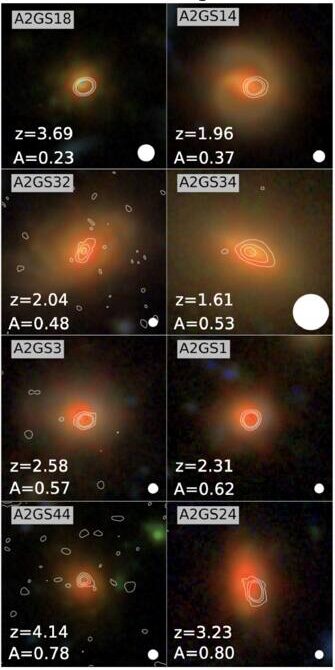
Example of JWST NIRCam images with ALMA contour lines overlaid for select dusty star-forming galaxies in the sample. [Modified from Bodansky et al 2026]
To directly compare the star and dust morphologies across massive galaxies, Sarah Bodansky (University of Massachusetts, Amherst) and collaborators selected a sample of 33 dusty star-forming galaxies from the GOODS-ALMA 2.0 survey that searched the sky for 1.1-mm dust emission as well as star-forming and quiescent comparison samples drawn from JWST observations. Combining the ALMA survey data with JWST imaging, the authors studied the rest-frame optical (stars) and rest-frame near-infrared (dust) morphologies of dusty, star-forming, and quiescent galaxies at redshifts around cosmic noon (a few billion years after the Big Bang).
When comparing optical morphologies, the authors found that dusty star-forming galaxies and typical star-forming galaxies had similar distributions, but their near-infrared morphologies showed clear differences. Dusty galaxies tended to show more compact near-infrared emission, with dust tracing their stellar populations and more concentrated in the galaxies’ central regions. Though clearly different from star-forming galaxies, the authors noted striking similarities between the near-infrared morphologies of the dusty star-forming and quiescent galaxies, especially within their centers.
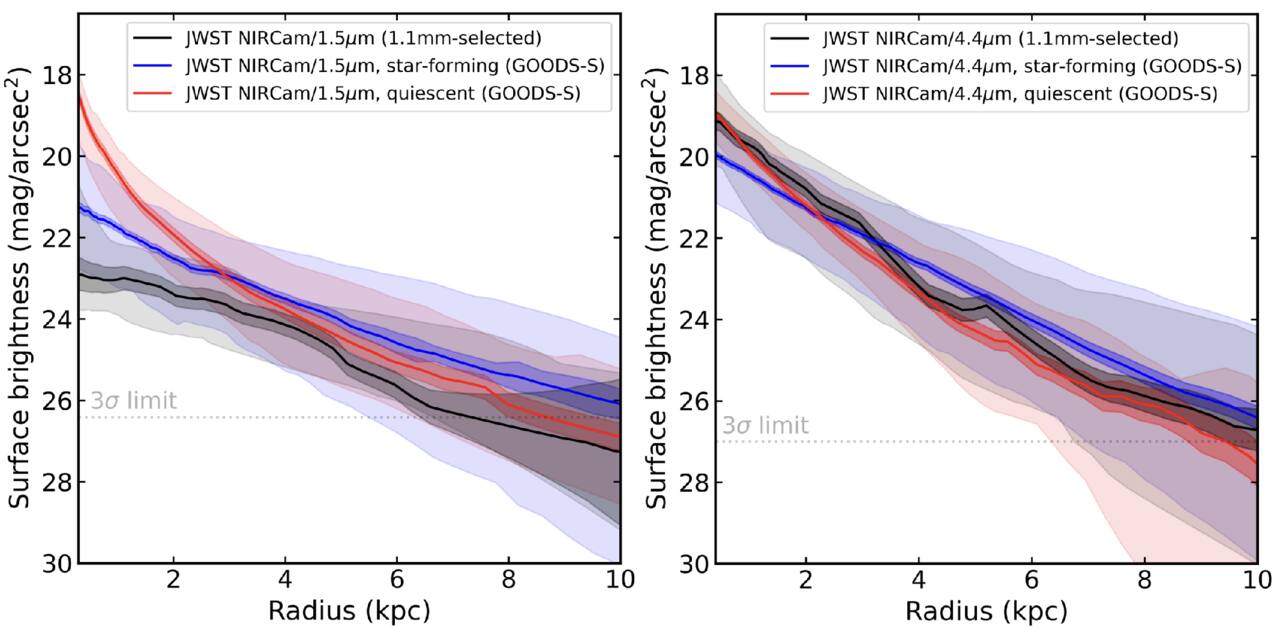
Average surface brightness profiles for the rest-optical (left) and rest-near-infrared (right) for the dusty (black), star-forming (blue), and quiescent (red) galaxies. In the near-infrared, the dusty star-forming galaxy profile appears very similar to the quiescent galaxy profile. [Bodansky et al 2026]
“JWST+ALMA Reveal the Buildup of Stellar Mass in the Cores of Dusty Star-forming Galaxies at Cosmic Noon,” Sarah Bodansky et al 2026 ApJ 1001 235. doi:10.3847/1538-4357/ae4f64
The post Hints for Massive Galaxy Evolution from Dusty Star-Forming Galaxies appeared first on AAS Nova.
Nature sometimes behaves in ways that are difficult to recreate in simulations. New research tackles the computational challenge of turbulent mixing and rules out a commonly assumed source of data–model disagreement.
What do Earth’s oceans, red giant stars, and white dwarfs have in common? These are all sites of thermohaline mixing, a form of turbulent mixing that takes place when there is a vertical gradient in both temperature and chemical composition. For example, in Earth’s oceans, water near the surface is warmer and saltier than water in the depths below, setting up an unstable situation prone to mixing.
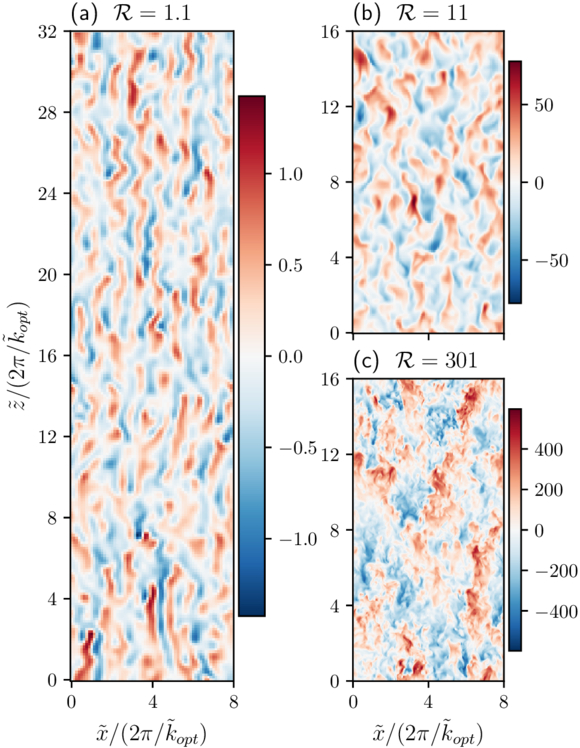
Examples of simulated thermohaline convection. These snapshots show the vertical velocity across a slice through the simulation volume. Click to enlarge. [Fraser 2026]
One of the most important parameters for modeling mixing is the Prandtl number, Pr, which is the ratio of viscosity to thermal diffusivity (in other words, a way of describing whether momentum or heat diffuses more quickly within a fluid). For stellar interiors, Pr is around 10−6, but computational limitations have prevented modelers from setting this value lower than around 10−2. When tensions between models and reality arise, this gap between simulated and realistic Pr values is often assumed to be the source of the mismatch.
In a recent research article, Adrian Fraser (University of Colorado Boulder) aimed to test this assumption. Fraser carried out 3D simulations of thermohaline mixing, using a semi-implicit modeling technique that lowered the computational cost and allowed the simulations to probe Pr values of 10−1, 10−2, 10−3, 10−6, and 0.
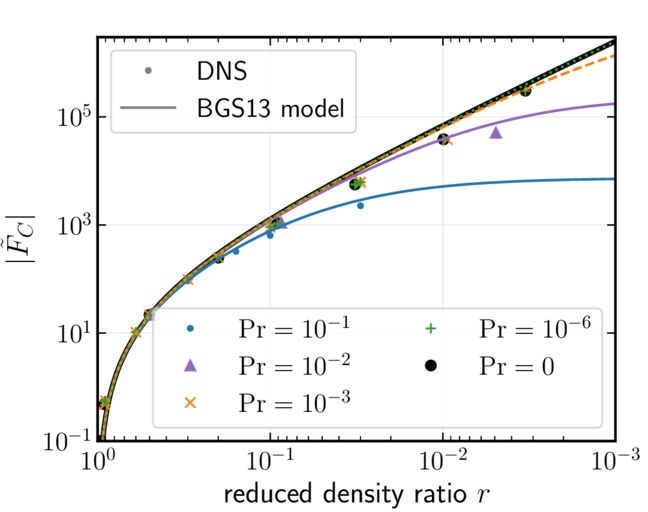
Turbulent compositional flux as a function of reduced density ratio for the simulations from this work (DNS) and the benchmark model of thermohaline convection (BGS13). Click to enlarge. [Adapted from Fraser 2026]
Where does this leave modelers attempting to recreate the reality of stellar interiors? First, a silver lining of this investigation: Fraser found that setting Pr = 0 delivered nearly identical results to Pr = 10−6. This suggests that valid results can be attained in a much less computationally intensive way, since setting Pr = 0 lowers the complexity of the simulation. While simulations with Pr = 0 may not be appropriate for all scenarios, including systems with strong magnetic fields, it may provide a way forward in certain situations.
For modeling of red giants and white dwarfs, Fraser suggested that incorporating magnetic fields, stellar rotation, or additional sources of mixing may resolve the current discrepancies. In fact, some modeling work has shown that magnetic fields could entirely close the gap between observations and models for red giant surface abundances — suggesting that bringing models and observations into agreement may be within reach.
“Bridging the Prandtl Number Gap: 3D Simulations of Thermohaline Convection in Astrophysical Regimes,” Adrian E. Fraser 2026 ApJL 1001 L22. doi:10.3847/2041-8213/ae5796
The post Simulations of Turbulent Mixing Close One Gap but Open Another appeared first on AAS Nova.
How does environment shape a galaxy’s growth and evolution? This is the question explored in a recent study led by Gissel Montaguth (University of São Paulo). Montaguth’s team examined nearly 4,000 galaxies in low-mass, high-mass, and compact galaxy groups, as well as galaxies adrift in the field without belonging to a group. The sampled galaxies were classified as early-type, late-type, transition (generally disk galaxies with quenched star formation), or other (generally elliptical but with lingering star formation). The image above shows six transition galaxies from the sample, three of which show signs of past disturbances (top row). The team found that early-type and “other” galaxies were resilient to changes in environment, but late-type and transition galaxies could be affected by life in close groups. Late-type galaxies in compact groups tended to be somewhat smaller than their loosely grouped or field galaxy counterparts, while transition galaxies showed a significantly steeper stellar mass–size relation in group environments and smaller sizes in groups than in the field. This suggests that transition galaxies are strongly influenced by interactions, mergers, and processes like disk truncation. To learn more about the impact of environment on galaxy properties, be sure to check out the full article linked below.
“Galaxies Caught in Transition: The Role of Group Environment in Shaping the Mass–Size Relation in the Local Universe,” Gissel P. Montaguth et al 2026 ApJ 999 160. doi:10.3847/1538-4357/ae42ca
The post Featured Image: Galaxies Caught in Transition appeared first on AAS Nova.
Galaxies pull in and pump out gas as they form and evolve, but distinguishing between the two directions is tricky. A recent study used emission lines and dust absorption to try to pin it down.
Throughout their lives, galaxies churn gas into stars, stars fuse new metals, supernovae blow enriched material back out, and the cycle repeats. To maintain this process and sustain star formation, a galaxy must fuel up by accreting gas from its surroundings. However, catching galactic gas accretion has proven difficult — both emission from gas falling into the galaxy (inflows) and gas blown out by supernovae (outflows) can appear blueshifted or redshifted along an observer’s sight line, depending on if the flowing material is in front of or behind the galaxy.
While direct evidence of inflows has been identified in the Milky Way, only a few direct detections of inflowing gas in other galaxies exist due to the degeneracy of inflow and outflow emission-line features. Relying on additional absorption measurements, some studies have teased out inflows in other galaxies, but these star formation fuel pumps remain overwhelmingly evasive. The angle at which we observe a galaxy also limits our ability to detect both inflows and outflows, with face-on galaxies best oriented to detect these shifted spectral features. How then do we uncover this critical component of a galaxy’s evolution?
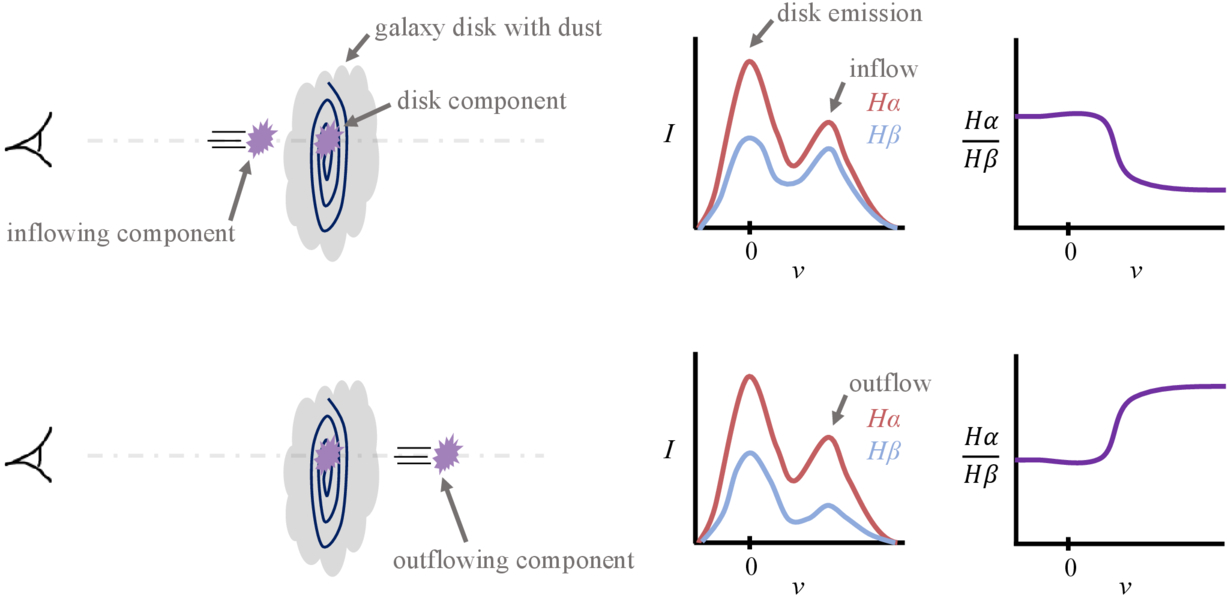
A diagram illustrating the degeneracy in emission spectra of galaxies, with the top panel showing an inflowing component and the bottom panel showing an outflowing component. While the Hα emission is similar, the Hβ emission is more affected by extinction due to dust in the galaxy’s disk, making it possible to identify inflow versus outflow based on the Balmer decrement. Click to enlarge. [Sitaram et al 2026]
Testing this idea, the authors performed a hydrodynamic simulation of an isolated, face-on Milky Way–like galaxy and tracked inflows and outflows over a billion years. From the simulation, they extracted mock spectral observations to measure the ionized gas motions and Hα and Hꞵ emission lines along different sight lines throughout the galaxy. Separating gas components into three categories — inflow, outflow, and in the disk — the authors found that dust extinction does cause noticeable differences in the Balmer decrement depending on a component’s location with respect to the disk.
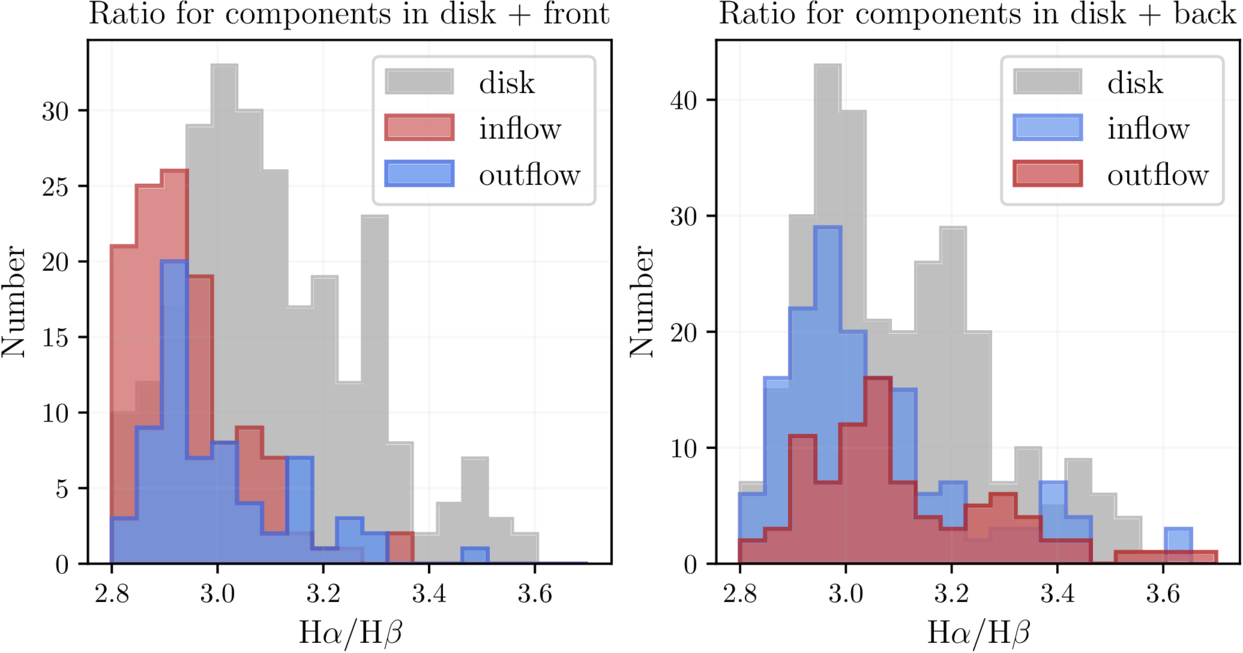
The distribution of Balmer ratios between different components in the interstellar medium and in front of the galaxy (left) and behind the galaxy (right). Material in front of the galaxy shows lower Hα/Hβ ratios. Click to enlarge. [Sitaram et al 2026]
What does this mean for identifying the inflows that provide galaxies with star-forming fuel? The authors reported that components in front of the galaxy — redshifted inflows and blueshifted outflows — tend to exhibit lower Hα/Hꞵ ratios compared to components behind the disk, aligning with the expectation that dust in the disk absorbs Hꞵ. In particular, these front inflows appear to be the most readily distinguished from gas in and behind the galaxy’s disk.
However, things get more complicated for gas behind the galaxy. Because the dust in the simulation is distributed nonuniformly in small clumps throughout the galaxy, it is difficult to distinguish between disk gas and gas behind the galaxy. While future simulations with improved dust modeling are necessary to resolve this issue, this study offers a useful method to distinguish inflow and outflow in dusty face-on galaxies.
“Identifying Signatures of Inflow onto Face-On Galaxies Using Balmer Decrement,” Meghna Sitaram et al 2026 ApJ 1001 87. doi:10.3847/1538-4357/ae5222
The post In or Out? Using Balmer Emission to Distinguish Inflows from Outflows appeared first on AAS Nova.
Prior to exploding, massive stars advance through action-packed evolutionary stages that are exciting but often difficult to fully decipher. A recent study focuses on a unique late-stage star to better understand its properties and evolution.

Very Large Telescope Interferometer image of the circumstellar disk around the B[e] supergiant star HD 62623. The colors indicate the rotation of the disk with blue coming toward us and red going away. [ESO/F. Millour; CC BY 4.0]
One particularly interesting B[e] supergiant, LHA 115-S 18, has been the subject of numerous studies but remains poorly constrained. The star exhibits significant variability both in brightness and emission features on timescales of days to years, and previous works have suggested that the star may have an as-yet unconfirmed binary companion. Molecular line emission from CO and TiO have been identified in LHA 115-S 18, indicating a circumstellar disk, but to date, water vapor emission has not been identified in any B[e] supergiant. Identifying more complex oxygen-bearing molecules like water will further reveal the physical properties and possible binary companion of LHA 115-S 18.
To characterize the emission around LHA 115-S 18, María Laura Arias (Institute of Astrophysics La Plata; National University of La Plata) and collaborators obtained high-resolution near-infrared spectroscopy of the star using the Immersion Grating Infrared Spectrometer on the Gemini South telescope. From the high-resolution spectra, the team identified several atomic emission lines indicative of the star’s gaseous envelope, revealing the structure of material around the star: an inner hot disk of ionized material and an outer cool disk of neutral material. Looking at molecular emission from carbon monoxide — a tracer of both gas motions and stellar age — the authors confirmed the presence of a rotating ring of gas around LHA 115-S 18 and determined that the star is an evolved, post–red supergiant object.
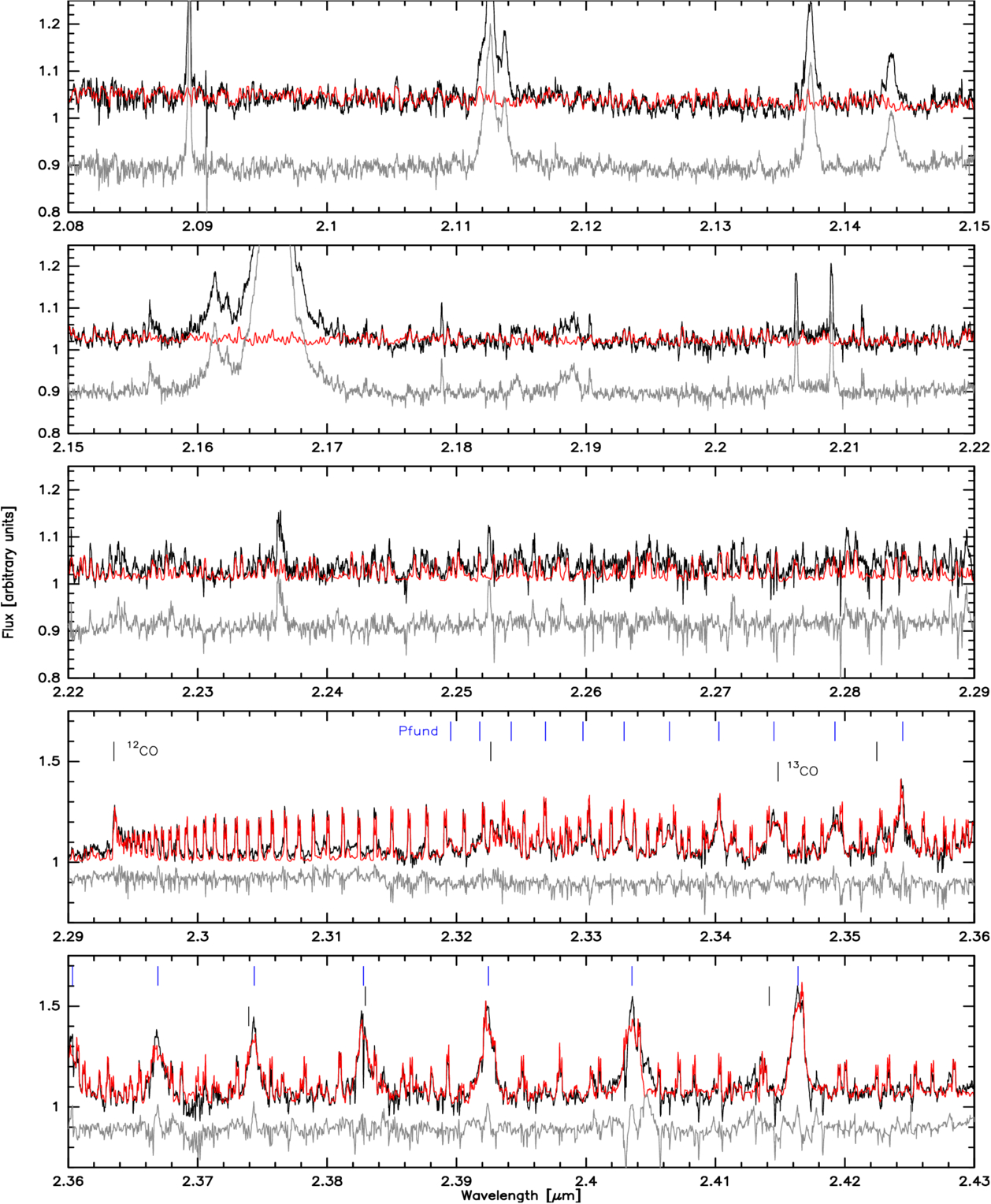
Spectrum of LHA 115-S 18 (black) with the model spectrum composed of water vapor (red, top three panels) and water vapor, CO, and hydrogen emission (red, bottom two panels) overplotted as well as residuals (gray). [Arias et al 2026]
Sustaining a cool disk around such a hot star indicates that the circumstellar environment around LHA 115-S 18 is complex and likely shaped by binary interaction. With emission features characteristic of both cool and hot evolved stars, this particular B[e] supergiant presents itself as a unique object holding critical insights into the late-stage evolution of massive stars. Further multiwavelength observations of LHA 115-S 18 will constrain its potential binarity and reveal a possible evolutionary link between B[e] supergiants and other late-stage evolutionary phases of massive stars.
“High-resolution Near-Infrared Spectroscopy of the B[e] Supergiant LHA 115-S 18: Discovery of Hot Water Vapor Emission,” María Laura Arias et al 2026 ApJL 1000 L49. doi:10.3847/2041-8213/ae524a
The post Water Vapor Around a Sizzling Supergiant: High-Resolution Spectroscopy of B[e] Supergiant LHA 115-S 18 appeared first on AAS Nova.
