❌

Normal view

Evidence for a Delayed Ultraviolet Counterpart to X-Ray Quasiperiodic Eruptions in Ansky

9 June 2026 at 17:00
Hengxiao Guo et al 2026 ApJL 1000 L57
ZTF19acnskyy may be the first X-ray quasiperiodic eruption source to display correlated ultraviolet emission — another strange behavior that researchers must explain for this already unique source.

The post Evidence for a Delayed Ultraviolet Counterpart to X-Ray Quasiperiodic Eruptions in Ansky appeared first on AAS Nova.

The Response of Planetary Atmospheres to the Impact of Icy Comets. III. Impact Driven Atmospheric Escape

8 June 2026 at 17:00
F. Sainsbury-Martinez et al 2026 ApJ 1001 57
Simulations suggest that tidally locked planets have similar atmospheric escape rates to Earth analogs despite having cooler and drier atmospheres near their surfaces.

The post The Response of Planetary Atmospheres to the Impact of Icy Comets. III. Impact Driven Atmospheric Escape appeared first on AAS Nova.

Mass Measurements of the Double Neutron Star System PSR J0641+0448

5 June 2026 at 17:00
Z. L. Yang et al 2026 ApJL 1000 L1
Using the Five-hundred-meter Aperture Spherical radio Telescope, researchers have discovered and measured the spins and masses of a pair of neutron stars using the pulsar timing method.

The post Mass Measurements of the Double Neutron Star System PSR J0641+0448 appeared first on AAS Nova.

The First Dedicated Survey of Atmospheric Escape from Planets Orbiting F Stars

4 June 2026 at 17:00
Morgan Saidel et al 2026 AJ 171 257
A survey of six gas giants orbiting F-type stars suggests that atmospheric escape of these planets is determined by the X-ray and extreme-ultraviolet output of their host stars as well as the Roche filling factor.

The post The First Dedicated Survey of Atmospheric Escape from Planets Orbiting F Stars appeared first on AAS Nova.

Now That’s Metal: How to Spot Stars That Have Swallowed Their Planets

3 June 2026 at 17:00

An illustration of an exoplanet about to be engulfed by its host star

Planets that get too close to their host stars are liable to be engulfed and consumed. New research explores how to identify stars that have had a planetary snack.

It’s Snack Time

Being a planet that closely orbits its star is dangerous, and various dynamical processes can draw a planet inward past the point of no return. When a planet vanishes beneath the surface of its host, it eventually disintegrates within the star, its atoms mixing into the blazing stellar soup.

This outcome is likely extremely common across the universe, and researchers have begun to see evidence for it: stars that appear to have absorbed angular momentum from their planets, white dwarfs with uncanny metals in their spectra, and stars with chemical abundances that don’t match those of their siblings. Now, in a recent publication led by Kaitlyn Lane (Vanderbilt University), researchers seek to find observational signatures of planetary engulfment of rocky exoplanets by main-sequence stars.

Modeling Engulfment

Lane’s team focused on main-sequence stars in the range of 0.5 to 1.4 solar masses, using one-dimensional analytical models to determine which of these stars will most readily display signs of having engulfed a planet. They simulated the stars as they consumed either an Earth-like planet or a super-Earth with the same composition as Earth but 15 times its mass.

illustration of a planet being engulfed by its star

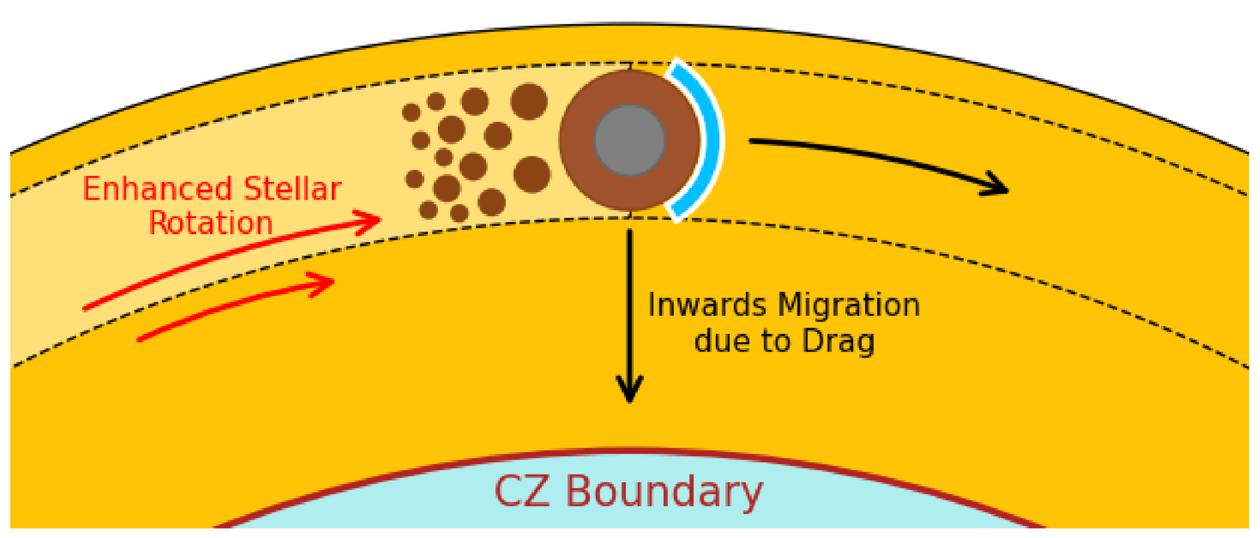
Diagram showing a planet being engulfed by its star and beginning to disintegrate before migrating inward. The boundary between the star’s outer convective zone (CZ) and inner radiative zone is shown. Click to enlarge. [Lane et al. 2026]

At the onset of the model, the engulfment is set to begin, the planet placed tangent to the star’s surface. The planets sink down and orbit just barely within their stars for 1–10 years, their solid surfaces slowly beginning to evaporate.

After that relatively lengthy phase, the process proceeds rapidly: as the planet inches deeper into its star, the drag forces grow stronger and the planet’s demise accelerates, with the planet disintegrating over the course of hours. In the last phase, the planet makes its final plunge and is destroyed in a half hour.

Signs of Planets Past

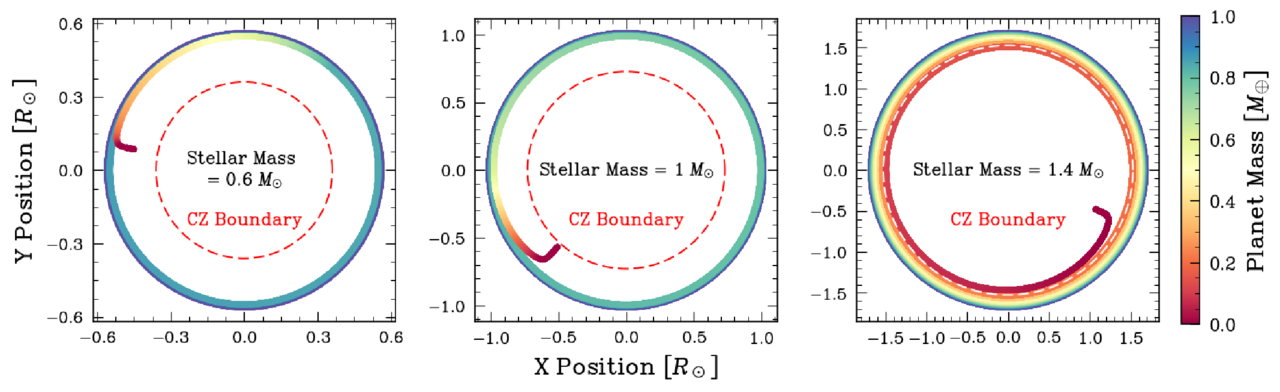
Lane’s team found that the planets tended to be destroyed fully within the outer convective layer of their stars, except in the case of the most massive stars studied here. For more massive stars, the outer convective zone is shallower than it is for the less massive stars, allowing a chunk of each planet to survive the passage through the convective zone to reach the radiative zone below.

simulation results showing planets disintegrating within their host stars

The trajectories of three example cases, showing how the planet loses mass as it spirals inward. In the 1.4-solar-mass case, part of the planet survives to reach the radiative zone, but the shallowness of the star’s convective zone means that the disintegrated planetary material is easier to observe. Click to enlarge. [Lane et al. 2026]

What this translates to, for the purposes of identifying planet-eating stars from afar, is that stars near the top of the mass range studied — from 1.0 to 1.4 solar masses — make the best targets. This is because the tell-tale planetary metals are not overly diluted within the stars’ relatively small convective zones, making these elements easier to detect. In terms of specific metals, the authors found that aluminum, calcium, and vanadium are the best signposts of planetary engulfment, with lithium also making the list.

While the authors acknowledge that there’s more work to be done — they plan to investigate the impacts of planetary engulfment on stellar structure more closely, for example — this work represents an important foray into identifying targets for future studies of stars that have eaten their planets.

Citation

“Observable Metal Pollution in Main-Sequence Stars: Simulations of Rocky Planets Engulfed by Stars in the 0.5 to 1.4 M⊙ Range,” Kaitlyn T. Lane et al 2026 ApJ 1003 67. doi:10.3847/1538-4357/ae5b9a

The post Now That’s Metal: How to Spot Stars That Have Swallowed Their Planets appeared first on AAS Nova.

Measuring the Distances to Asteroids from One Observatory in One Night with Upcoming All-Sky Telescopes

3 June 2026 at 17:00
Maryann Benny Fernandes et al 2026 Planet. Sci. J. 7 76
Using simulations of 20 asteroids from 0.05 to 2.4 au away, researchers demonstrate how the technique of topocentric parallax could be used to determine the distance to an asteroid in a single night.

The post Measuring the Distances to Asteroids from One Observatory in One Night with Upcoming All-Sky Telescopes appeared first on AAS Nova.

Predictions of Imminent Earth Impactors Discovered by LSST

2 June 2026 at 17:00
Ian Chow et al 2026 ApJ 1001 61
Simulations suggest that Rubin Observatory will discover 1–2 meter-size or larger imminent impactors each year, nearly doubling the discovery rate and providing an important set of eyes in the Southern Hemisphere.

The post Predictions of Imminent Earth Impactors Discovered by LSST appeared first on AAS Nova.

Blue Straggler in the Making: An X-Ray Active Binary in Algol Configuration

1 June 2026 at 17:00
A. H. Sheikh et al 2026 ApJL 1002 L29
Researchers have found a rare example of a blue straggler star in the process of formation, providing direct evidence for the formation of these puzzling stars through ongoing mass transfer in a binary system.

The post Blue Straggler in the Making: An X-Ray Active Binary in Algol Configuration appeared first on AAS Nova.

Featured Image: Massive Young Star Clusters, Revealed

1 June 2026 at 17:00

The Antennae galaxies are a nearby pair of interacting galaxies, shown in optical light from the Hubble Space Telescope (left) and in infrared light from JWST (right) in the image above. Between the two galaxies’ bright nuclei, there is a vast and dusty molecular cloud complex that harbors a large number of massive young star clusters — and in a recent article led by Rupali Chandar (University of Toledo), researchers have worked to pin down exactly how many clusters are embedded within the dusty whorls of the Antennae galaxies. The team used JWST to search for emission from star clusters too thickly blanketed with dust to be visible in previous observations by Hubble. They ultimately identified 45 sources, 40 of which were seen for the first time in this study. These star clusters mostly inhabit the overlap region between the two galaxies, are less than 2.5 million years old, and each contain roughly 104–106 solar masses. To learn more about how JWST’s infrared capabilities unveiled young star clusters in these interacting galaxies, be sure to check out the full article linked below.

Citation

“Nowhere Left to Hide: Uncovering All of the Massive Young Embedded Star Clusters in the Antennae with JWST,” Rupali Chandar et al 2026 ApJ 1002 64. doi:10.3847/1538-4357/ae56e8

The post Featured Image: Massive Young Star Clusters, Revealed appeared first on AAS Nova.

Dual Active Galactic Nuclei on 100 kpc Scales from the Million Quasar Catalog

29 May 2026 at 17:00
Zhuojun Deng et al 2026 ApJS 283 70
In a sample of 171 new dual active galactic nuclei, four triplets, and one quadruplet drawn from a catalog of nearly a million quasars, researchers find that roughly 16% of targets exhibit tidal features.

The post Dual Active Galactic Nuclei on 100 kpc Scales from the Million Quasar Catalog appeared first on AAS Nova.

Can the Dust Eclipses in WR 104 Provide Constraints on the System’s Inclination?

28 May 2026 at 17:00
Noel D. Richardson et al 2026 ApJ 1001 34
Researchers find a system inclination of 41.8 degrees for WR 104; this result is at odds with previous interpretations of the system’s dust plume, but a new geometric model reconciles these results.

The post Can the Dust Eclipses in WR 104 Provide Constraints on the System’s Inclination? appeared first on AAS Nova.

The Cosmic-Ray Knee as a Local Signature of Nearby PeVatrons

27 May 2026 at 17:00
Ke Fang and Francis Halzen 2026 ApJL 999 L13
The observed steepening of the cosmic-ray spectrum at ~4 PeV could be a global or local feature; a local feature could be explained by sources located ~1 kpc away with ages of 0.1–1 million years.

The post The Cosmic-Ray Knee as a Local Signature of Nearby PeVatrons appeared first on AAS Nova.

Third Star’s the Charm: Most Merging Black Holes Might Be in Triple Systems

27 May 2026 at 17:00

Illustration of merging black holes

Where do black hole mergers happen? Recent research finds evidence that most black hole mergers occur in triple systems containing a close inner binary and a more distant third party.

Assembling Merging Black Holes

Thanks to the combined efforts of the LIGO, Virgo, and KAGRA gravitational wave detectors, we’ve now collected the subtle signals from several hundred pairs of merging stellar-mass black holes. As this collection of spacetime ripples continues to grow, researchers are seeking to understand how these merging black hole pairs were assembled.

In the simplest scenario, pairs of high-mass stars independently evolve into black holes, lose momentum by emitting gravitational waves, and meld into one another. But the population of merging black holes likely contains contributions from multiple sources, including multiple-star systems, the disks surrounding accreting supermassive black holes, and black holes that have already experienced a merger. Which of these merging populations is reflected in our catalog of gravitational wave events?

Modeling Challenges

spin–orbit tilt diagram

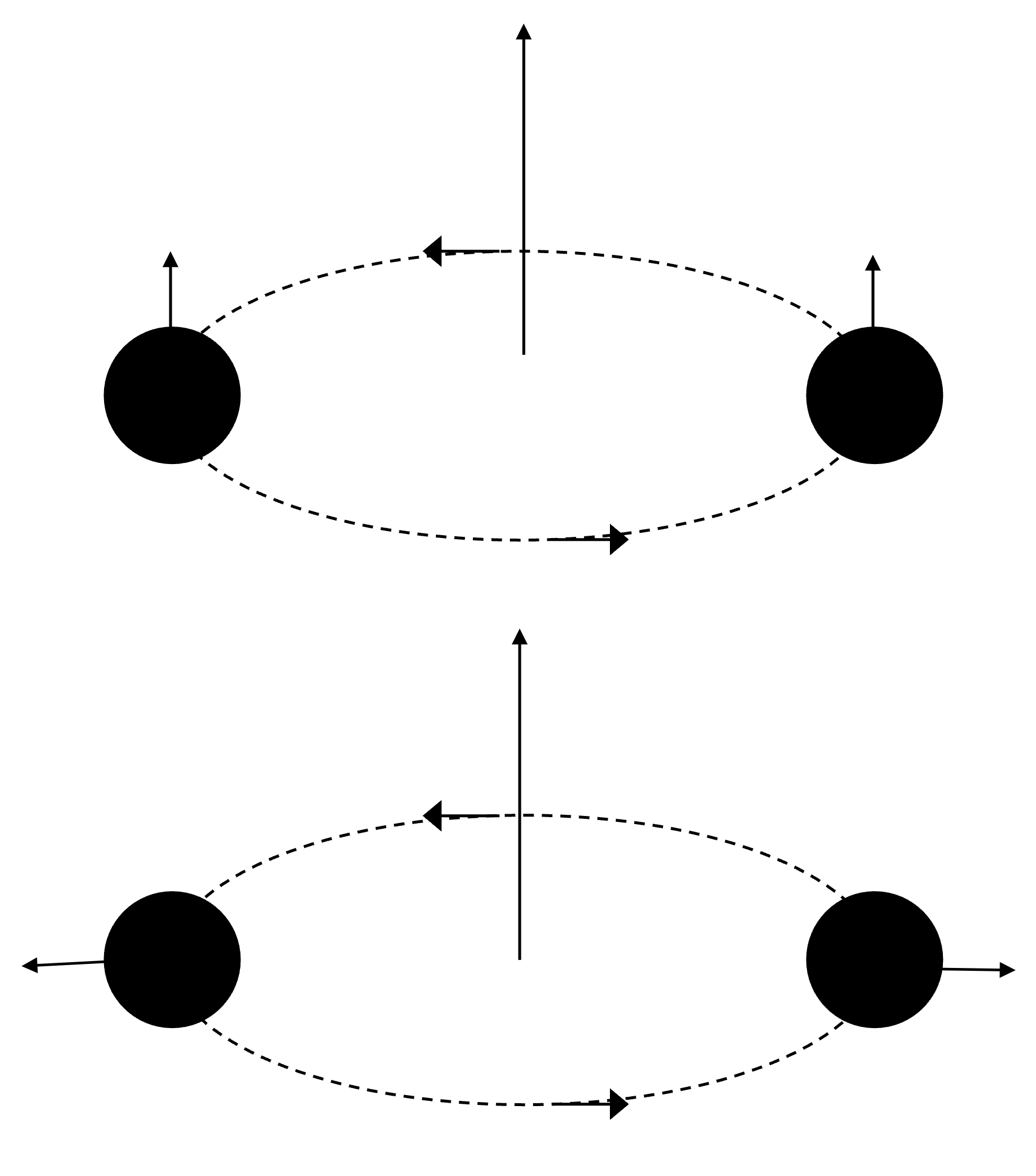
A black hole binary system with aligned spins and orbit (top) and a binary with spins tilted by 90 degrees (bottom). [AAS Nova/Kerry Hensley]

In theory, this question can be answered by extracting the properties of merging black holes — mass, spin, and the like — from gravitational wave observations and comparing these properties against model predictions from different formation pathways. In reality, this is exceedingly difficult, as certain merger pathways can produce a wide variety of results, depending on assumptions or fine tuning.

So far, the increasingly large pool of gravitational wave detections tentatively points to a feature that could illuminate the sites of black hole mergers: a peak in the spin–orbit tilt distribution around 90 degrees. This feature has been most confidently extracted from nonparametric analyses, which do not make assumptions about the population of merging black holes, but it has also been hinted at in parametric analyses, which do make population-level assumptions.

Triple-System Feature

To investigate this feature further, a team led by Jakob Stegmann (Max Planck Institute for Astrophysics) performed a new, astrophysically motivated parametric analysis of the most recent catalog of gravitational wave detections from LIGO, Virgo, and KAGRA.

black hole populations used in modeling the observed spin–orbit tilt distribution

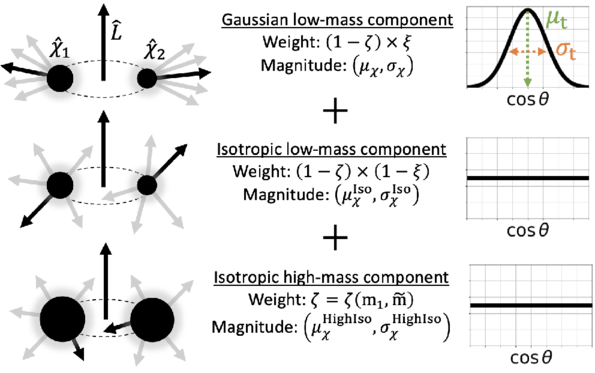
The three populations in the team’s modeling. [Stegmann et al. 2026]

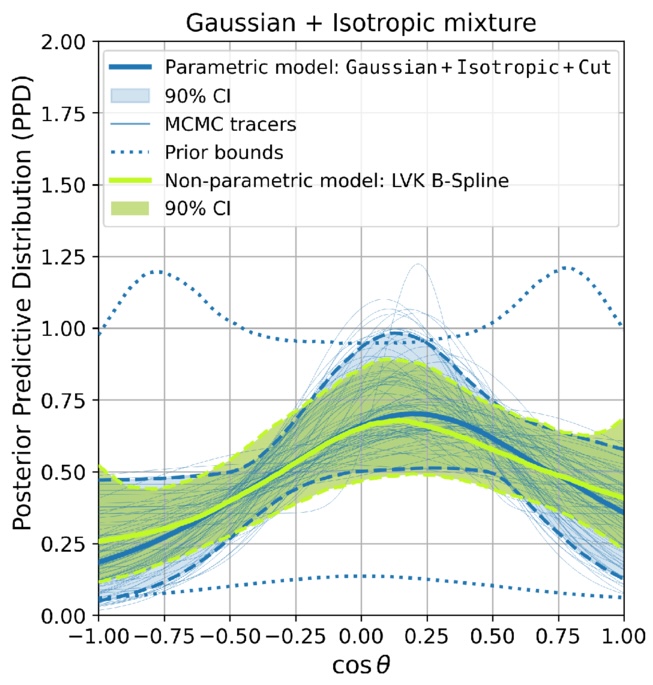
Their modeling tests combinations of multiple populations, including mergers in isolated binary systems, triple-star systems, and dense environments like star clusters. They also include a potential contribution from higher-mass mergers involving black holes that have merged previously. Using this framework, Stegmann’s team found that the observed spin–orbit tilt distribution is best matched by a model dominated by mergers in triple-star systems, with some contribution from other sources.
Posterior predictive distribution of black hole spin–orbit tilts

Posterior predictive distribution of black hole spin–orbit tilts. Both the authors’ modeling (solid blue line) and the nonparametric modeling performed by the LIGO–Virgo–KAGRA collaboration (solid green line) find evidence for a peak in the spin–orbit tilt distribution near cosθ = 0. [Adapted from Stegmann et al. 2026]

Specifically, this finding suggests that most mergers occur in hierarchical triple systems, which naturally predict an excess of 90-degree spin–orbit tilts without any fine tuning. Hierarchical triples contain an inner close binary with a distant outer companion; in these systems, relativistic spin precession, gravitational wave emission, and oscillations in eccentricity and inclination work to tilt the black holes in the inner binary by 90 degrees.

Stegmann and collaborators pointed out that the triple-system scenario aligns well with other properties of the observed population of black hole mergers, such as the mass and effective spin distributions. This scenario may also be necessary to explain certain merging pairs that might have had slightly eccentric orbits at the moment of merging. If future gravitational wave observations strengthen the evidence for a peak in the spin–orbit tilt distribution near 90 degrees, it will have profound implications for how and where black holes merge in our universe.

Citation

“Gravitational-Wave Observations Suggest Most Black Hole Mergers Form in Triples,” Jakob Stegmann et al 2026 ApJL 1000 L59. doi:10.3847/2041-8213/ae52ec

The post Third Star’s the Charm: Most Merging Black Holes Might Be in Triple Systems appeared first on AAS Nova.

Optical Survey for Cislunar Moving Objects Using Image Stacking

26 May 2026 at 17:00
Rongyu Sun et al 2026 AJ 171 247
Using three dedicated telescopes and two spacecraft in the Earth–Moon environment, researchers demonstrate the abilities of an image stacking method to detect space debris.

The post Optical Survey for Cislunar Moving Objects Using Image Stacking appeared first on AAS Nova.

Variability of Europa’s Optical Aurora on Orbital and Multiyear Timescales

22 May 2026 at 17:00
Zachariah Milby et al 2026 Planet. Sci. J. 7 60
Analysis of 10 nights of observations of Europa’s auroral emission suggests that optical auroral brightness may be a proxy for electron density variations, assuming a stable atmospheric composition and density.

The post Variability of Europa’s Optical Aurora on Orbital and Multiyear Timescales appeared first on AAS Nova.

Late-Blooming Magnetars: Awakening as Long-Period Transients After a Dormant Cooling Epoch

21 May 2026 at 17:00
Arthur G. Suvorov et al 2026 ApJ 1000 55
Magnetothermal modeling suggests that neutron stars may remain “silent” at radio frequencies for approximately 100,000 years before activating, potentially as long-period radio transients.

The post Late-Blooming Magnetars: Awakening as Long-Period Transients After a Dormant Cooling Epoch appeared first on AAS Nova.

HD 164604 c: A Second Giant Planet on a 15 Yr Orbit and Constraints on the Planet–Planet Mutual Inclination

20 May 2026 at 17:00
Guang-Yao Xiao et al 2026 AJ 171 209
A newly discovered massive giant planet likely has a retrograde orbit relative to the other known planet in the system, pointing to a potentially violent dynamical history.

The post HD 164604 c: A Second Giant Planet on a 15 Yr Orbit and Constraints on the Planet–Planet Mutual Inclination appeared first on AAS Nova.

Asteroid 2024 YR4 Won’t Hit the Moon, New JWST Observations Show

20 May 2026 at 17:00

asteroid 2024 yr4

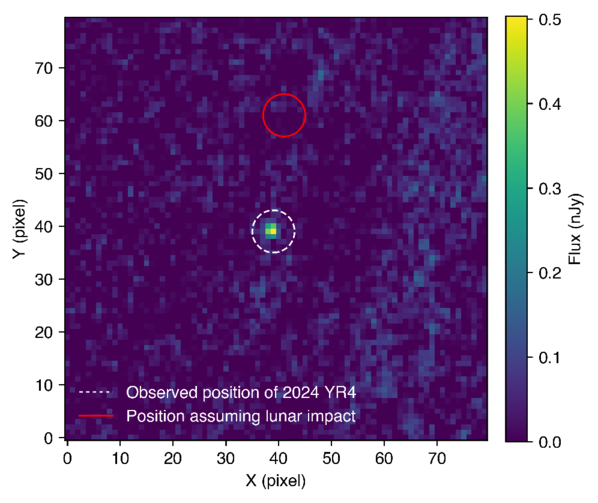
Discovered in December 2024, the roughly 60-meter-wide asteroid 2024 YR4 was initially thought to have a slim chance of striking Earth in 2032. Further observations ruled out an Earth impact but left open the possibility of a Moon impact. New JWST observations show that 2024 YR4 will speed past both Earth and the Moon without a collision.

Another Update on 2024 YR4

In April 2025, we featured a Research Note that described March 2025 JWST observations of 2024 YR4 and characterized the asteroid’s size and albedo. At the close of that article, the authors suggested that further JWST observations in early 2026 could help to refine our understanding of the asteroid’s trajectory and determine whether it would strike the Moon.

On 18 and 26 February 2026, JWST carried out those critical observations. In this dataset, the asteroid is bright enough to be detected confidently, and the background is peppered with a sufficient number of reference stars — two factors necessary to determine the precise track of the asteroid as it zipped through space.

Trajectory Refinement

Difference between estimated and observed position for 2024 YR4

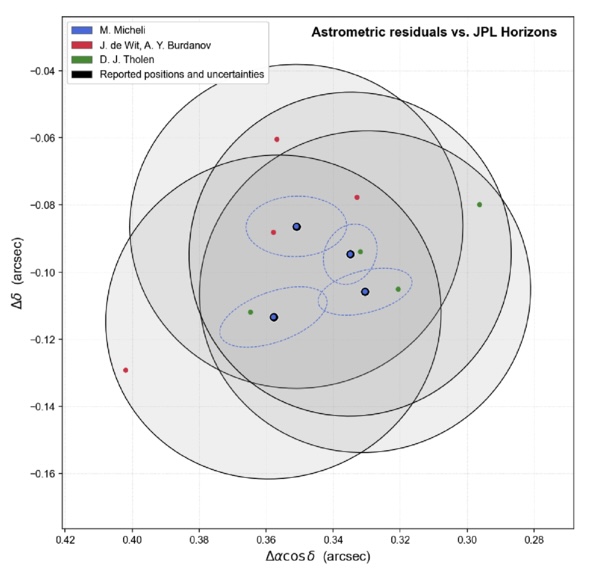
Difference between the position of 2024 YR4 determined in this work using three different reduction methods (red, blue, and green circles) and the position drawn from the existing orbit from the JPL Horizons database. The different analysis methods yielded consistent results. [Adapted from De Wit et al. 2026]

Julien de Wit (Massachusetts Institute of Technology) and collaborators analyzed the new JWST data and determined the asteroid’s position. The team used multiple methods to reduce the data and showed that their results were consistent regardless of the reduction method, ultimately yielding a measurement with an uncertainty of just 50 milliarcseconds. This is a huge improvement over the previous trajectory estimate, which had an uncertainty of 700 milliarcseconds.

Combining the latest JWST observations with existing data stretching back to the asteroid’s discovery, de Wit and coauthors determined a new, highly precise orbit for the object — one that definitively shows that the asteroid will safely pass by the Moon at a distance of 22,900 ± 800 km in 2032. In addition to ruling out the upcoming lunar impact, the team also ruled out any collisions with Earth in the next 100 years. Phew!

2024 YR4 observed and estimated position

Position of 2024 YR4 as seen by JWST in February 2026 (white dashed circle) compared to the asteroid’s location estimated from existing data (red circle). [De Wit et al. 2026]

High-Impact Science

This work highlights JWST’s potential as a tool for planetary defense. The February 2026 observations detailed here represent the faintest-ever detection of a near-Earth object, and JWST can detect objects far fainter than ground-based telescopes can. This ability allows JWST to observe potentially hazardous asteroids over a larger swath of their orbits, which translates to earlier trajectory estimation — JWST pinned down 2024 YR4’s orbit two years before the asteroid would have become bright enough for ground-based telescopes to do so.

JWST’s role may be even more important for smaller objects that rapidly become undetectable after discovery. De Wit’s team demonstrated this for a 10-meter-diameter 2024 YR4 clone on the same trajectory; for an object of this size, JWST would be able to rule out an Earth impact before the asteroid became undetectable, but ground-based telescopes could not. With surveys from facilities like Vera C. Rubin Observatory and Near-Earth Object Surveyor set to discover hundreds of thousands of new near-Earth objects, JWST’s role as a hazard assessor will likely be in high demand.

Citation

“JWST Observations of Asteroid 2024 YR4 Rule Out a 2032 Lunar Impact and Demonstrate a New Regime for Planetary Defense Follow-Up,” Julien de Wit et al 2026 ApJL 1003 L21. doi:10.3847/2041-8213/ae6a95

The post Asteroid 2024 YR4 Won’t Hit the Moon, New JWST Observations Show appeared first on AAS Nova.

IRS 9: The Case for a Dynamically Ejected Star from the Galactic Center

19 May 2026 at 17:00
Matthew W. Hosek Jr. et al 2026 ApJL 999 L34
The galactic center star IRS 9 is locally unbound and was likely placed on its current trajectory by binary supernova disruption, two-body interactions, or stellar collisions.

The post IRS 9: The Case for a Dynamically Ejected Star from the Galactic Center appeared first on AAS Nova.

Magnetic Activity in M-Type Stars Based on LAMOST DR11 and TESS Observations

18 May 2026 at 17:00
Linfeng Ren et al 2026 ApJS 282 29
Chromospheric and photospheric activity in M dwarfs appear to be correlated, with stellar rotation influencing both types of activity and metallicity impacting the intensity of chromospheric activity.

The post Magnetic Activity in M-Type Stars Based on LAMOST DR11 and TESS Observations appeared first on AAS Nova.

❌