
❌

Normal view

How NASA Science and Artemis Are Shaping the 2026 FIFA World Cup 
8 June 2026 at 20:36
Researchers tested soccer balls aboard the International Space Station to study how internal mass affects motion and stability in microgravity.
NASA

As the FIFA World Cup approaches, NASA is bringing space science and engineering to soccer fans worldwide. From June 11 to July 19, 2026, NASA will host an exhibit at FIFA Fan Festival™ Houston where visitors can learn how research aboard the International Space Station benefits life on Earth and experience missions in low Earth orbit, the Moon, and beyond through the Artemis program. 

On June 11, as the FIFA World Cup begins, NASA’s exhibit at Fan Festival Houston will open to the public. The event is free to attend and open for every match of the tournament in East Downtown, Houston. On June 20, Johnson Space Center Director Vanessa Wyche will introduce select Artemis II crew members following their historic mission around the Moon. The crew will participate in World Cup activities ahead of the Netherlands-Sweden match in Houston and will appear on the Fan Festival Houston main stage to share their experience with fans. 

The connection between NASA and the World Cup goes beyond the exhibit floor, reaching all the way to orbit. NASA spinoff technologies are innovations developed for space exploration that go on to shape commercial products and everyday life – even on the soccer field. 

For more than 25 years, research aboard the International Space Station has enabled breakthroughs in science, technology, and human health while advancing innovations that benefit people on Earth. That work includes studies that improve understanding of the aerodynamics and physics involved in soccer ball flight. 

In partnership with the ISS National Laboratory in 2019, researchers used the station’s microgravity environment to study how a soccer ball’s internal mass affects its motion, stability, and rotation. The findings have improved understanding of how embedded technologies, including match-ball sensors, can influence performance during play. The research contributed to studies used in the development and evaluation of soccer balls for major international tournaments, including FIFA World Cup competition. 

Understanding the relationship between an object’s center of mass and its geometric center is key to predicting how free-flying objects move, including spacecraft, satellites, and aircraft. 

Since 2022, Adidas has embedded electronics inside official match balls used in major tournaments. The sensors track speed, position, and contact in real time to support officiating and broadcast technology. But those sensors also add mass in specific locations inside the ball, and uneven mass distribution can affect how a ball moves through the air. 

The space-based research has helped improve understanding of how internal mass, including embedded sensors, can influence stability and rotation in real-world playing conditions. 

This work builds on earlier research into how spinning objects behave in microgravity. 

Engineers at NASA’s Ames Research Center in Silicon Valley, California tested Adidas’ Brazuca ball, developed for the 2014 FIFA World Cup, in wind tunnel conditions at the Fluid Mechanics Laboratory. Researchers studied aerodynamic behavior, including how low-spin kicks can produce “knuckling,” where the ball moves unpredictably due to unstable airflow across the seams. NASA engineers measured the speeds and flow conditions where this effect was most pronounced. 

Adjustments in panel shape, seam depth, and surface texture can influence flight consistency, helping determine whether a ball curves, dips, or holds its line during play. 

Now, NASA and Adidas are presenting that science through a STEMonstration that compares how differently balanced soccer balls spin and move in microgravity. The experiment shows how the same physics that governs motion in space also shape the game millions watch on Earth. 

Through research aboard the International Space Station and technology developed for exploration, NASA continues to demonstrate how discoveries made for space can benefit people on Earth—including athletes and fans participating in the world’s most popular sport. 

Watch the soccer ball STEMonstration video: 

The post How NASA Science and Artemis Are Shaping the 2026 FIFA World Cup  appeared first on NASA Science.
How NASA Science and Artemis Are Shaping the 2026 FIFA World Cup 

8 June 2026 at 20:36
Researchers tested soccer balls aboard the International Space Station to study how internal mass affects motion and stability in microgravity.
NASA

As the FIFA World Cup approaches, NASA is bringing space science and engineering to soccer fans worldwide. From June 11 to July 19, 2026, NASA will host an exhibit at FIFA Fan Festival™ Houston where visitors can learn how research aboard the International Space Station benefits life on Earth and experience missions in low Earth orbit, the Moon, and beyond through the Artemis program. 

On June 11, as the FIFA World Cup begins, NASA’s exhibit at Fan Festival Houston will open to the public. The event is free to attend and open for every match of the tournament in East Downtown, Houston. On June 20, Johnson Space Center Director Vanessa Wyche will introduce select Artemis II crew members following their historic mission around the Moon. The crew will participate in World Cup activities ahead of the Netherlands-Sweden match in Houston and will appear on the Fan Festival Houston main stage to share their experience with fans. 

The connection between NASA and the World Cup goes beyond the exhibit floor, reaching all the way to orbit. NASA spinoff technologies are innovations developed for space exploration that go on to shape commercial products and everyday life – even on the soccer field. 

For more than 25 years, research aboard the International Space Station has enabled breakthroughs in science, technology, and human health while advancing innovations that benefit people on Earth. That work includes studies that improve understanding of the aerodynamics and physics involved in soccer ball flight. 

In partnership with the ISS National Laboratory in 2019, researchers used the station’s microgravity environment to study how a soccer ball’s internal mass affects its motion, stability, and rotation. The findings have improved understanding of how embedded technologies, including match-ball sensors, can influence performance during play. The research contributed to studies used in the development and evaluation of soccer balls for major international tournaments, including FIFA World Cup competition. 

Understanding the relationship between an object’s center of mass and its geometric center is key to predicting how free-flying objects move, including spacecraft, satellites, and aircraft. 

Since 2022, Adidas has embedded electronics inside official match balls used in major tournaments. The sensors track speed, position, and contact in real time to support officiating and broadcast technology. But those sensors also add mass in specific locations inside the ball, and uneven mass distribution can affect how a ball moves through the air. 

The space-based research has helped improve understanding of how internal mass, including embedded sensors, can influence stability and rotation in real-world playing conditions. 

This work builds on earlier research into how spinning objects behave in microgravity. 

Engineers at NASA’s Ames Research Center in Silicon Valley, California tested Adidas’ Brazuca ball, developed for the 2014 FIFA World Cup, in wind tunnel conditions at the Fluid Mechanics Laboratory. Researchers studied aerodynamic behavior, including how low-spin kicks can produce “knuckling,” where the ball moves unpredictably due to unstable airflow across the seams. NASA engineers measured the speeds and flow conditions where this effect was most pronounced. 

Adjustments in panel shape, seam depth, and surface texture can influence flight consistency, helping determine whether a ball curves, dips, or holds its line during play. 

Now, NASA and Adidas are presenting that science through a STEMonstration that compares how differently balanced soccer balls spin and move in microgravity. The experiment shows how the same physics that governs motion in space also shape the game millions watch on Earth. 

Through research aboard the International Space Station and technology developed for exploration, NASA continues to demonstrate how discoveries made for space can benefit people on Earth—including athletes and fans participating in the world’s most popular sport. 

Watch the soccer ball STEMonstration video: 

💾

Have you ever kicked a soccer ball and wondered why it curves, spins, or sometimes wobbles? NASA astronaut Jessica Meir aboard the International Space Statio...

Crew Begins Week with More Cartilage Printing and Plant Harvesting

8 June 2026 at 19:14
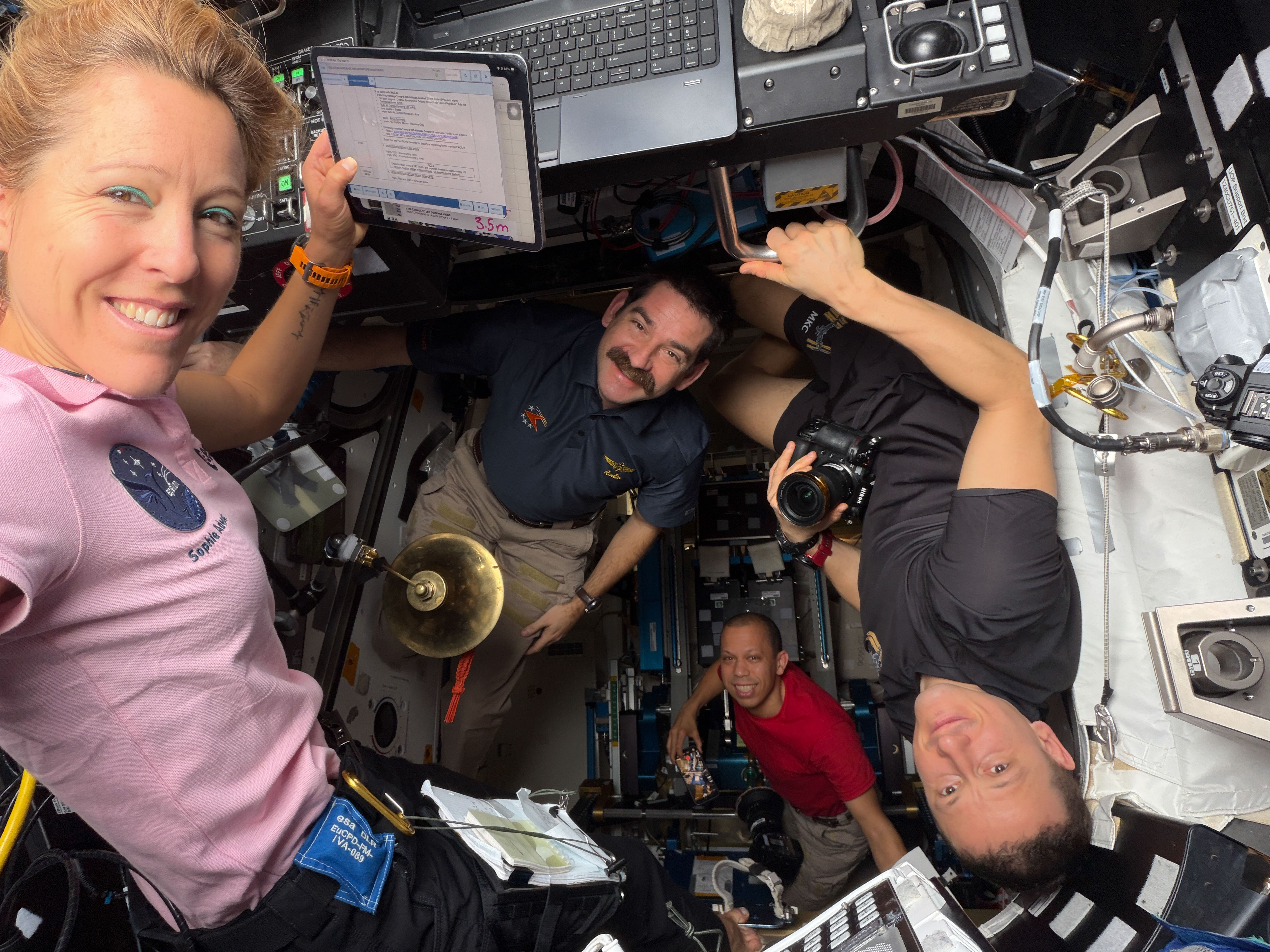
Expedition 74 crew members (from left) Sophie Adenot of ESA (European Space Agency), NASA astronauts Jack Hathaway and Chris Williams, and Roscosmos cosmonaut Sergey Kud‑Sverchkov pose for a portrait together inside the International Space Station’s cupola and Tranquility module.
ESA/Sophie Adenot

Expedition 74 began the week bioprinting human cartilage tissue and harvesting alfalfa plants aboard the International Space Station to advance health and promote self-sustainable space crews. The orbital residents also retrieved materials exposed to the external space environment and conducted their own ultrasound vein scans to continuously learn how living in space affects physics and biology.

NASA flight engineer Jessica Meir opened up the Kibo laboratory module’s Life Science Glovebox on Monday and set up a bioprinter to produce viable cartilage tissues aboard the orbiting laboratory. NASA flight engineer Chris Williams assisted Meir collecting the frozen cartilage samples for thawing then mixing the living cells with a gel-like bioink for placement in a printing cartridge. The biotechnology study tests the manufacturing of cartilage in weightlessness to increase its stability for printing on demand implants using a patient’s own cells to treat a range of health conditions.

Earlier, Williams began his shift with NASA flight engineer Jack Hathaway harvesting alfalfa plants inside the Columbus laboratory module’s Veggie facility. The astronauts collected the plants and roots for photographing, placed the botanical samples inside foil, then stowed them inside a science freezer for later analysis for the Veg-06 study. Insights may lead to the development of advanced methods to grow plants for food on future space missions.

Afterward, Hathaway scanned Williams neck, shoulder, and leg veins using the Ultrasound 3 biomedical device as doctors on the ground monitored in real time. Roscosmos cosmonauts Sergey Kud-Sverchkov and Sergei Mikaev also took turns scanning each other’s veins with the Ultrasound 3. The ultrasound imagery will help researchers protect crew members from space-caused blood clots.

Flight engineer Sophie Adenot of ESA (European Space Agency) and Meir joined each other during the first half of their shift retrieving containers of samples from Kibo’s airlock that were placed outside the orbital outpost for a materials exposure test. The samples included radiation shields, crew suit fabrics, optical fibers, and more to help engineers build robust technologies that can survive harsh environments both on Earth and in space.

Sergey Kud-Sverchkov and Sergei Mikaev, the orbiting lab’s commander and flight engineer, spent the majority of their shift inspecting and servicing the Zvezda service module’s treadmill. The space station’s other treadmill, COLBERT, is located in the Tranquility module.

Roscosmos flight engineer Andrey Fedyaev spent the first half of his shift locating and identifying computer components and video gear in the Zarya module to update the station’s inventory management system. Fedyaev wrapped up his day studying using artificial intelligence tools to boost crew efficiency and communications.

Learn more about station activities by following the space station blog, @space_stationon X, as well as the ISS Facebook and ISS Instagram accounts.

Get the latest from NASA delivered every week. Subscribe here.

The post Crew Begins Week with More Cartilage Printing and Plant Harvesting appeared first on NASA Science.

NASA Provides Update on Space Station Leak

5 June 2026 at 23:01
The station pictured from the SpaceX Crew Dragon
The International Space Station is pictured from the SpaceX Crew Dragon Endeavour during a flyaround on Nov. 8, 2021.

The Zvezda service module’s transfer tunnel, known as the PrK, on the International Space Station has experienced cracks since 2019 that have resulted in small atmosphere leaks and prompted ongoing monitoring and repair efforts by Roscosmos. NASA and Roscosmos have worked together to identify the root cause while Roscosmos has been applying leak mitigation measures, including temporary and permanent sealants.

The week of June 1, during Progress 95 spacecraft cargo operations, Roscosmos noted an increase of the previous leak rate to two pounds per day and identified new suspected leak areas in the PrK. Following this observation, Roscosmos made the decision to begin work toward a more extensive inspection and structural repair effort Friday morning. This revised approach involved cutting a bracket to better access an area identified as a possible leak source for further inspection, using a method that could have resulted in elevated risk to the structure in the area. In response, NASA directed the four SpaceX Crew-12 members and NASA astronaut Chris Williams, who flew to station aboard the Soyuz MS-28 spacecraft, to take a heightened safety posture, known as a safe haven, inside the SpaceX Dragon spacecraft during the procedure.

Later Friday morning, Roscosmos paused and did not perform the structural repair work in favor of conducting additional measurements and data assessments, which included inspection of suspected areas of interest and review of areas where sealant was previously applied. NASA strongly supported that decision, and as a result, following that decision, Crew-12 and Williams ended their safe haven activities and returned to normal operations aboard the orbiting laboratory.

NASA will continue to work with our Russian counterparts, along with the rest of the international partners that support the space station, to assess and ensure a resolution to this matter.

Learn more about station activities by following the space station blog, @space_stationon X, as well as the ISS Facebook and ISS Instagram accounts.

Get the latest from NASA delivered every week. Subscribe here.

The post NASA Provides Update on Space Station Leak appeared first on NASA Science.

❌