More than a decade ago, conservationists began working to preserve a unique population of desert pampas cats that has adapted to the mangroves of Peru’s northern coast. This small, isolated population roams the San Pedro de Vice dry mangroves, a Ramsar Site and South America’s southernmost mangrove ecosystem. “This is a very unique population, because as far as we know, [it] is the only Pampas cat population that lives in a mangrove [habitat],” Alvaro Garcia, co-coordinator of the Pampas Cat Working Group and the Peruvian Desert Cat Project, told Mongabay in an email. The desert pampas cat (Leopardus garleppi), distinctive for its broad face, ranges along a relatively thin band snaking southward from Colombia through Peru and Bolivia, to northern Chile and Argentina. The species is acclimated to dry conditions, so inhabits deserts, grasslands and dry forests, and isn’t found living in mangroves anywhere else aside from this region of Peru. Dry mangrove forests, also called scrub or dwarf mangrove forests, grow in highly saline soils in upper intertidal zones, so lack regular daily flushing by ocean tides. At first, it was thought the dry mangrove-acclimated cats were faring well: “[I]n the mangrove [habitat], we put cameras out for a week, and we got tons of photos,” whereas in other parts of the felid’s range, conservationists barely capture one desert pampas cat image per month, said Cindy Hurtado, co-coordinator of the Pampas Cat Working Group and the Peruvian Desert Cat Project. Based on the photos, the research team assumed the…This article was originally published on Mongabay
SARLAHI, Nepal — Dhruba Prasai, a farmer from Sarlahi district in Nepal’s southern plains, says he’s exhausted from lack of sleep. Every year, nilgai antelopes, wild boars, deer and Asian elephants raid his fields, and if left unguarded at night, they not only feed on standing crops, but also stored harvest. “There is a forest to the west, and our fields are right next to it,” Prasai tells Mongabay. “The nilgai eat the maize, and the deer can’t even stand the sight of wheat and oat grass, they eat it all. If people stay up at night to guard the fields, they run away; otherwise, they come and destroy everything.” Farmers such as Prasai across Madhesh province, considered the country’s breadbasket because of its fertile land, are struggling with growing crop losses from wildlife, but complex procedures and policy gaps make access to relief, which is already limited, difficult. From mid-July 2024 to mid-July 2025, 14,821 cases of ‘human wildlife conflict’ were reported in Madhesh, according to government figures. A total of 134 people and 457 animals lost their lives. Last year, a wild boar ate three tand (storage racks) of maize stored in Prasai’s house. Although forest authorities told him to get a recommendation letter from the local municipal ward office to apply for relief, he didn’t do it. “I haven’t done it; we simply don’t have the time,” he says. Even those who did fill out the forms around the same time have yet to receive relief, he…This article was originally published on Mongabay
In April this year, two Bryde’s whales washed-up dead-on Dyer Island, a small nature reserve located a few kilometers off the coast of Gansbaai in South Africa’s Western Cape province. Both whales carried severe injuries; their vertebrae had been shattered. “It was very clear that it was [vessel] strikes, because both those whales were snapped in half, and you can also see the propeller marks,” Loraine Shuttleworth, head of research at the Dyer Island Conservation Trust, told Mongabay. Two whale strandings linked to ship strikes in one month alone is an unusually high number, Shuttleworth said. A new risk assessment has linked the increase in risk of ships striking whales to the rerouting of maritime traffic around South African coast. Due to the Houthi rebels attacks on ships traversing the Red Sea, which started in 2023, and the more recent fallout from the blockade of the Strait of Hormuz, many cargo companies have rerouted their vessels around the Cape of Good Hope. With greater shipping traffic comes a growing threat to marine species inhabiting the region: collisions with large, fast-moving vessels. Between December 2023 and December 2024, the number of large vessels traveling through South African waters at average speeds above 15 knots (28 kilometers per hour) has quadrupled, satellite data show. The scale of the increased maritime traffic struck scientist Els Vermeulen from the University of Pretoria’s Mammal Research Institute Whale Unit, on a flight into Cape Town in 2025. “It was a beautiful day, and there were just…This article was originally published on Mongabay
BANGKOK — Seven hundred days after activists from the environmental group Mother Nature Cambodia were imprisoned on charges widely regarded as retaliatory for their activism, 73 international and Cambodian civil society organizations have renewed calls for their unconditional release. After a trial lasting just over a month, 10 activists from Mother Nature Cambodia were sentenced on July 2, 2024, to between six and eight years in prison. Only five of the defendants attended the hearings, which saw Long Kuntha, 28, Ly Chandaravuth, 26, Phuon Keoraksmey, 25, and Thun Ratha, 34, each sentenced to six years behind bars for plotting against the government; fellow activist Yim Leanghy, 36, received an eight-year sentence for both plotting against the government and insulting the king. The five activists who did not attend the trial were sentenced in absentia. The appeals hearing for all 10 convicted activists was slated to take place on June 2, but has been postponed indefinitely by the Phnom Penh Court of Appeals. “The MNC5 are incarcerated in prisons in overcrowded and harsh living conditions, separated from each other and spread out all across Cambodia, hundreds of kilometers away from their families and legal counsel,” wrote the 73 NGOs in an open letter addressed to Prime Minister Hun Manet. “The … NGOs who have signed this letter sincerely request you take immediate action to ensure the unjust convictions of these five activists are reversed either prior to or at their upcoming appeals court hearing in Phnom Penh, and that their freedom…This article was originally published on Mongabay
As offshore wind farms expand rapidly in the global renewable energy transition, scientists are studying how these large marine infrastructure projects affect ecosystems beneath the waves. Research from Wageningen University & Research in the Netherlands suggests that offshore wind may bring both risks and benefits for sharks and rays, known collectively as Elasmobranchii, which are highly sensitive to electromagnetic fields (EMFs). A six-year project called “Elasmopower” examined how EMFs from subsea power cables in offshore wind farms affect bottom-dwelling sharks and rays. These species depend on natural electric and magnetic fields for key behaviors such as navigation, prey detection, habitat use and long-distance movement, particularly in low-visibility environments. The studies conducted as part of the Elasmopower project have been published in four papers, with three additional papers currently undergoing peer review. Sharks and rays have specialized electroreceptors called ampullae of Lorenzini. The jelly-filled sensory canals around the head and snout can detect even extremely weak EMFs from prey and predators, water movement, and the Earth’s geomagnetic field, Erwin Winter, a scientist at Wageningen, told Mongabay. This system is central to hunting and orientation, making Elasmobranchii especially relevant for studying EMF exposure from offshore energy infrastructure, Winter added. Erwin Winter, a researcher with the Elasmopower project, presented findings on offshore wind, electromagnetic fields and bottom-dwelling sharks and rays at the Sharks International 2026 conference in Colombo, Sri Lanka, in May. Image by Malaka Rodrigo for Mongabay. During a presentation on a summary of the Elasmopower research at the Sharks International 2026…This article was originally published on Mongabay
The existence of the “polluter pays” principle (PPP) in Bangladesh, at least on paper, dates back to 1992, ever since the country endorsed the Rio Declaration. However, Bangladesh has made little progress in implementing the principle so far. A statement by the incumbent minister for environment, forest and climate change, Abdul Awal Mintoo, saying that regulatory authorities recovered less than half of the total compensation imposed on polluters over the past 16 years, exposed the structural loopholes in environmental governance behind failures in implementing the principle. The minister pointed out that polluters can delay the compensation recovery by applying their right to appeal against the regulatory authorities’ orders. that Mongabay spoke to said that loopholes in the judicial system, weak evidence and economic analysis on pollution, and polluters’ influence must be addressed if the country really wants to implement the PPP. Environmentalist and Dhaka University’s zoology professor Mohammad Firoj Jaman told Mongabay, “Delays in implementation of laws against polluters aggravate environmental pollution, and the hope of reaping the benefits of environmental justice falls flat.” Shanties stand along the bank of Buriganga River in Hazaribagh, Dhaka district, Bangladesh. The area is known for tanneries, the waste from which fill the surrounding land and water. Image by Abir Abdullah/Asian Development Bank via Flickr (CC BY-NC-ND 2.0). Compensation recovery undermines the PPP The PPP binds polluters to bear the costs of managing and remedying the harm they have done to the environment. The concept of PPP was first mentioned in the recommendations of…This article was originally published on Mongabay
CHIRADZULU, Malawi — Diana Sitima’s farm on the outskirts of Malawi’s commercial capital, Blantyre, is both example and an exception. Where neighboring farmers have planted mostly maize for food and for sale in nearby markets, people drive out to buy sweet potato, pigeon peas and vegetables, bananas and avocado, and eggs produced on Sitima’s 3.5-hectare (8.6-acre) property. Sitima started farming in 1993. Unlike her neighbors, farming was a side hustle to begin with: she worked as an office assistant in Blantyre and her husband had a good job with a bank. Over the next seven years, she and her husband took out a series of micro-loans, renting small parcels of land and hiring people from the village to grow tomatoes for sale in the city. Sitima’s efforts went well, and because her family did not have to rely on their harvest for food or an income at that time, she was able to save the money she earned to take a next step. She quit her office job and acquired a farm of her own in Chiradzulu district, 15 kilometers (9 miles) east of the city. “That’s how I made money to be able to buy this land when it was put up for sale in 2006,” she says. While she was still a part-time farmer, Sitima attended several workshops, where she picked up ideas about agroecological farming — an approach combining crops, agroforestry, fish ponds, poultry and livestock, in a self-reinforcing system that protects soil health and reduces the…This article was originally published on Mongabay
Since May 23, more than 200 primates housed at the Lwiro Primates Rehabilitation Center (LPRC) in South Kivu province in the eastern Democratic Republic of Congo (DRC) have been placed under confinement due to the Ebola outbreak. This measure follows the death of a man who tested positive for the virus on May 21. This individual, a resident of Kahungu, located just 2 km (1.2 miles) from the town of Lwiro, where the center is situated, had traveled in early May to neighboring Ituri province. Ituri is the epicenter of the outbreak, which, as of May 27, is linked to more than 200 suspected deaths. A threat for humans and apes The LPRC houses at least 129 chimpanzees and 108 monkeys of various species, including olive baboons (Papio anubis), yellow baboons (Papio cynocephalus), L’Hoest’s monkeys (Cercopithecus l’hoesti), blue monkeys (Cercopithecus mitis), agile mangabeys (Cercocebus agilis) and others. Parrots, turtles and porcupines can also be found there. These primates, rescued from poaching and the illegal wildlife trade, are being kept in confinement even though “for the moment, no cases of Ebola virus transmission from a human to a great ape have been reported,” primatologist Liz Williamson explained in an email to Mongabay. According to the World Health Organization, the Ebola virus is transmitted to humans through close contact with the blood, secretions, organs or other bodily fluids of infected animals. A chimpanzee at the Lwiro Primates Rehabilitation Center, located in South Kivu province in the eastern Democratic Republic of Congo. Image…This article was originally published on Mongabay
Sat Born, 56, recalls freezing at the forest’s entrance when he first saw it. “Its head was this big,” he says, wide-eyed, spreading his hands to show the animal’s size. Recollecting that eventful morning in 2001, Born, who now farms bananas and durians, retraces his steps from his home in Trapeang Chheu Trav village in the rainforests of the Cardamom Mountains in southwestern Cambodia. As he walks up a hill rising above the forest canopy, he points to a spot on the road. “It’s over here. When I saw the tiger, it was 9 a.m.,” he says. “I was really shocked … I couldn’t tell if the tiger was coming towards me.” In 2007, just six years after this fleeting encounter, Cambodia’s last confirmed tiger sighting was logged by a camera trap. In the 1990s, the country was estimated to host hundreds of wild Indochinese tigers, but decades of poaching pressure took a heavy toll. In 2016, tigers (Panthera tigris) were formally declared extinct in Cambodia. That may be set to change with the imminent translocation of a small population of Bengal tigers from India. Although many reintroductions are success stories, this one raises some serious concerns. Why would Cambodia bring in a nonnative tiger? Have the people living in these areas been adequately consulted? Will these translocated tigers be able to adapt to this new habitat? Is there enough prey to sustain them, and if not, how will the government address predation when hungry cats feed on livestock? With…This article was originally published on Mongabay
Thomas Crowther begins his book with a snakebite that was not, in any conventional sense, dangerous. The danger came from interpretation. A misidentified species, a surge of fear, and a body that responded as if the threat were real: numbness spread, panic intensified, and the situation escalated until a second opinion dissolved it almost instantly. The episode is more than an anecdote. It sets the terms of Nature’s Echo, a book that treats cause and effect not as linear sequences so much as loops that can amplify themselves in either direction. Thomas Crowther That idea—feedback loops as the underlying architecture of the natural world—is the organizing principle of the book. Crowther traces it from cosmology to ecology to human psychology, moving across scales with considerable ambition. The early chapters move outward from the origin of matter, suggesting that the same reinforcing processes that allowed stars to form also underpin biological evolution and social behavior. It is an ambitious framing. At its best, it brings a sense of coherence to subjects that are often treated separately. At times, the scope of the framework requires readers to travel across very different domains and scales of thought. The structure reflects that expansiveness. The table of contents alone signals the range: from “Cause and Effect” and “Feedback Loops” through “Resilience and Tipping Points” and into “The Story We Tell Ourselves.” The progression is deliberate. Crowther starts with physical systems, moves into ecological stability, and then into the social and psychological domains where perception begins…This article was originally published on Mongabay
In the global debate over tropical deforestation, the usual cast of villains is well established: agribusiness, global supply chains, cattle ranchers, and governments granting land concessions for political support. One actor rarely appears in this narrative yet has played a consequential role in transforming the South American lowland frontier: The Mennonite agricultural colonist. For more than five decades, Mennonite communities have functioned as systematic agents of agricultural frontier expansion in the Gran Chaco and Andean Amazon, methodically clearing forests, draining wetlands, and catalyzing waves of deforestation that extend far beyond any individual colony. Mennonite communities operate within the law. They purchase land through formal channels, build permanent communities, and transfer agronomic knowledge to surrounding populations. Their values emphasize hard work, communal solidarity, and a theological relationship to land as stewardship. None of this changes the ecological outcome: Wherever a Mennonite colony is established, forests fall. Faith, mobility and colony formation Mennonites are an Anabaptist denomination rooted in the 16-century Reformation, distinguished by pacifism, communal life, and cultural separation from mainstream society. Conservative congregations — whose ancestors moved from Russia to Canada, then to Mexico, Belize and South America — are organized around a local congregation that functions simultaneously as a religious community, governance structure, credit cooperative and social welfare system. When a colony is established, it is an orderly community with collective decision-making, shared infrastructure, and a coherent plan for the future. Forest being cut, burned, and prepared by a Mennonite colony before planting crops. Image courtesy of Mario Silvero.…This article was originally published on Mongabay
The French government recently announced it has greenlit a plan to send its last captive cetaceans — two orcas and 12 dolphins — to zoos and entertainment parks in Spain. These cetaceans live in the Marineland Antibes park on the French Riviera, which closed in 2025. In 2021, France passed a law banning the breeding and keeping of cetaceans in captivity for entertainment shows, which will come into effect on Dec. 2, 2026. The orcas and dolphins at Marineland were the primary draw for visitors. The two orcas (Orcinus orca), Wikie, aged 25, and her son, Keijo, aged 12, were born at Marineland Antibes on the French Riviera and spent all their lives in concrete tanks and performing in display shows. They will now be moved to Loro Parque, a zoo and entertainment park in Tenerife on the Canary Islands. The dolphins will be split up between two parks in Valencia and Málaga on the Spanish mainland, with plans for some of them to return to France’s Beauval Zoo, when it’s ready to have them, according to reporting by Le Monde. A court-appointed expert team found in February 2026 that the concrete tanks in which the orcas lived at Marineland Antibes were in advanced structural decline, and if the mammals weren’t moved soon, they would have to be euthanized. “Faced with this emergency, we are acting to avert the worst,” Mathieu Lefèvre, France’s minister delegate for ecological transition, said in a statement, explaining the rationale for the decision. “Loro Parque…This article was originally published on Mongabay
Katelynn Delos Reyes thought she knew what to expect when Typhoon Sinlaku slammed into Saipan in April. As a lifelong resident of the island, Delos Reyes had survived frequent storms, including Super Typhoon Yutu, the second-strongest in U.S. history. Eight years ago, Yutu’s 274-kmph (about 170-mph) winds devastated her village in the southern end of Saipan. Just three years before that, she survived Typhoon Soudelor. But Sinlaku was different. “At the beginning, it was OK. But later on it wasn’t,” said Delos Reyes, who is Chamorro, Indigenous to the Mariana Islands. A few days before it hit the Commonwealth of the Northern Mariana Islands, or CNMI, on April 14, Sinlaku had tropical-storm winds. That made it what is known in the Marianas as a “banana typhoon” because such storms level banana trees but leave others standing. Then over the weekend, the typhoon rapidly intensified by 120 kmph (75 mph) in just 24 hours before becoming a 298-kmph (about 185-mph) monstrosity and the strongest storm on Earth so far this year. Delos Reyes and her family had done what they could to prepare. They boarded up the windows. They bought gallons of drinking water and filled plastic drums to use in the shower and toilet. Then the storm hit, and Delos Reyes grew scared. The winds, which had weakened to 240 kmph (about 150 mph), ripped the wood from a window. Rainwater gushed through the ceiling and soaked their belongings, including Delos Reyes’ mattress. She and her partner, her mother, her…This article was originally published on Mongabay
The year 2011 marked the first time a land-use restriction order was enforced for the Ituna/Itatá Indigenous Territory, a swath of Brazilian Amazon roughly twice the size of Singapore and home to people living in voluntary isolation. The order was meant to protect the latter by prohibiting unauthorized individuals from entering — but rates of forest loss and invasions grew. In 2019, Ituna/Itatá was one of the Indigenous territories with the highest forest loss, primarily due to illegal land grabbers. In Brazil, land-use restriction orders exist to protect isolated Indigenous peoples and are a temporary tool in cases where the demarcation process to formalize the protected status and boundaries of Indigenous territories are not yet complete. But as recent Mongabay reporting has shown, they’re often renewed many times over for years while the formal land titling stalls, and aren’t always effective at protecting isolated peoples’ lands from invaders. Following one of the latest land-use restriction orders in 2022 for the Ituna/Itatá territory, the area lost 2,211 hectares (5,464 acres) of tree cover, or about 1.5% of its total area, according to satellite analysis by Mongabay. The most recent renewal was in 2025. Brazilian federal public prosecutor Daniel Luís Dalberto, head of the office for recently contacted Indigenous peoples and those living in voluntary isolation, told Mongabay in a recent interview that while the legal measure is important, it should have “a short time frame, until the Indigenous territory is demarcated as quickly as possible,” and should be accompanied by other…This article was originally published on Mongabay
While searching for new Higgs bosons the CMS experiment at the Large Hadron Collider (LHC) may have just found a surprise. They have observed an excess of events that look to be a new particle, and are reporting high statistical evidence for their claim. The only question is what exactly is this new particle?
The search was initially designed to look for new, heavier, versions of the Higgs boson decaying to a top quark and an anti-top quark. Its well known that the Higgs boson of the Standard Model, discovered jointly by ATLAS and CMS in 2012, underlies the mechanism which gives all fundamental particles their masses. The Higgs boson itself interacts with particles in proportion to their mass, preferring heavier particles over lighter ones. It therefore interacts the most strongly with the heaviest known fundamental particle, the top quark, which has a mass of ~173 GeV. The Higgs boson itself only has a bass of 125 GeV, meaning conservation of energy dictates it can’t decay into a top quark-antiquark pair.
However many theories of physics beyond the the Standard Model predict additional Higgs bosons, heavier cousins of the current one. If these new heavy Higgs bosons had a mass larger than 350 GeV, they would likely decay to a top quark-antiquark pair quite often. CMS therefore was analyzed its data searching for this signature, hoping to find signs of a new Higgs boson. To do so, they had scrutinize very carefully the known production of top quark-antiquark pairs, which are produced copiously at the LHC from other processes. If a new particle was being produced and decaying to top quarks, the mass of the new particle would give the top quarks a characteristic energy. One key sign of a new particle would therefore be an excess of top quark-antiquark events at a particular energy, corresponding to the mass of the new particle.
When CMS scrutinized their data looking for such an excess they found one. But curiously right ~350 GeV, the minimum energy required to produce the top quark-antiquark pair. It would be quite the coincidence for a new particle to show up right at this minimum threshold, which made CMS consider alternative possibilities.
A comparison of the observed CMS data and their estimate of backgrounds as a function of the invariant mass of the top quark antiquark system. CMS observes an excess of events at ~350 GeV, which is well fit with a toponium model (red line).
One unorthodox explanation that seems to fit the bill is ‘toponium’, a short lived bound state of the top quark-antiquark pair is being formed. Toponium would be the heaviest version of ‘quarkonia’ we have seen, bound states of quark antiquark pairs that form bound states similar to atoms. We have observed and measured quarkonia states of the other quarks for decades, however it was long thought that the top quark, whose large mass causes it to decay in just 10^(-25) seconds, would decay too quickly to create observable bound state effects at a hadron collider. Toponium production would happen most often if the top quarks were produced just at the energy threshold, such that they don’t any extra energy. These low energy top quarks would spend more time close to each other than normal, rather than immediately flying away, so they could have time to briefly form a toponium state before decaying. However, once small hints of intriguing excesses started appearing in LHC analyses, updated calculations in the last few years suggested that perhaps such an effect could be observable.
These calculations are approximate, and more work is still being done to refine them. But the preliminary predictions they give for the properties of toponium seem to match well with what CMS is seeing, both in terms of the rate of toponium production and the quantum properties of the toponium state (spin and parity).
Still CMS is being cautious before claiming a discovery of toponium. They claim observation of an ‘excess at the top quark pair production threshold’ which is consistent with toponium. However given the limited present data and incomplete theoretical models of toponium, they cannot rule out that the excess they are seeing is coming from a new Higgs-like particle.
CMS measurement tries to disentangle the quantum properties of the observed excess. The x-axis shows the estimated rate of production a ‘pseudoscalar’ particle producing the excess. The y-axis shows a similar estimate for a ‘scalar’ particle. The allowed region for the scalar still includes zero, while the zero pseudoscalar hypothesis is clearly excluded at larger than 5 standard deviations.
Further work will be needed to develop improved theoretical models of toponium, and detailed studies from CMS assessing the properties of their observed excess. The excess will also need confirmation from CMS’s rival LHC experiment, ATLAS, to ensure it has not merely made a mistake in its analysis.
However, the smart money would say this very likely looks like toponium. Which, while not signaling the long sought overthrow of the standard model, would be an unexpected and cool surprise from the LHC. Understanding the properties of this previously-thought-impossible quasiparticle will spawn much fruitful research in the years to come. Physicists love a surprise!
Discloure: The author is a member of the CMS collaboration but did not directly work on this analysis
Erratum 4/15/2025 : The article was updated to clarify that in the theory literature prior to the LHC toponium was thought possible to form, just that it was thought to be too small an effect to be observable. The article previously incorrectly stated it had been previously thought impossible to form
This is the second part of our coverage of the P5 report and its implications for particle physics. To read the first part, click here
One of the thorniest questions in particle physics is ‘What comes after the LHC?’. This was one of the areas people were most uncertain what the P5 report would say. Globally, the field is trying to decide what to do once the LHC winds down in ~2040 While the LHC is scheduled to get an upgrade in the latter half of the decade and run until the end of the 2030’s, the field must start planning now for what comes next. For better or worse, big smash-y things seem to capture a lot of public interest, so the debate over what large collider project to build has gotten heated. Even Elon Musk is tweeting (X-ing?) memes about it.
Famously, the US’s last large accelerator project, the Superconducting Super Collider (SSC), was cancelled in the ’90s partway through its construction. The LHC’s construction itself often faced perilous funding situations, and required a CERN to make the unprecedented move of taking a loan to pay for its construction. So no one takes for granted that future large collider projects will ultimately come to fruition.
Desert or Discovery?
When debating what comes next, dashed hopes of LHC discoveries are top of mind. The LHC experiments were primarily designed to search for the Higgs boson, which they successfully found in 2012. However, many had predicted (perhaps over-confidently) it would also discover a slew of other particles, like those from supersymmetry or those heralding extra-dimensions of spacetime. These predictions stemmed from a favored principle of nature called ‘naturalness’ which argued additional particles nearby in energy to the Higgs were needed to keep its mass at a reasonable value. While there is still much LHC data to analyze, many searches for these particles have been performed so far and no signs of these particles have been seen.
These null results led to some soul-searching within particle physics. The motivations behind the ‘naturalness’ principle that said the Higgs had to be accompanied by other particles has been questioned within the field, and in New York Times op-eds.
No one questions that deep mysteries like the origins of dark matter, matter anti-matter asymmetry, and neutrino masses, remain. But with the Higgs filling in the last piece of the Standard Model, some worry that answers to these questions in the form of new particles may only exist at energy scales entirely out of the reach of human technology. If true, future colliders would have no hope of
A diagram of the particles of the Standard Model laid out as a function of energy. The LHC and other experiments have probed up to around 10^3 GeV, and found all the particles of the Standard Model. Some worry new particles may only exist at the extremely high energies of the Planck or GUT energy scales. This would imply a large large ‘desert’ in energy, many orders of magnitude in which no new particles exist. Figure adapted from here
The situation being faced now is qualitatively different than the pre-LHC era. Prior to the LHC turning on, ‘no lose theorems’, based on the mathematical consistency of the Standard Model, meant that it had to discover the Higgs or some other new particle like it. This made the justification for its construction as bullet-proof as one can get in science; a guaranteed Nobel prize discovery. But now with the last piece of the Standard Model filled in, there are no more free wins; guarantees of the Standard Model’s breakdown don’t occur until energy scales we would need solar-system sized colliders to probe. Now, like all other fields of science, we cannot predict what discoveries we may find with future collider experiments.
Still, optimists hope, and have their reasons to believe, that nature may not be so unkind as to hide its secrets behind walls so far outside our ability to climb. There are compelling models of dark matter that live just outside the energy reach of the LHC, and predict rates too low for direct detection experiments, but would be definitely discovered or ruled out by high energy colliders. The nature of the ‘phase transition’ that occurred in the very early universe, which may explain the prevalence of matter over anti-matter, can also be answered. There are also a slew ofexperimental ‘hints‘, all of which have significant question marks, but could point to new particles within the reach of a future collider.
Many also just advocate for building a future machine to study nature itself, with less emphasis on discovering new particles. They argue that even if we only further confirm the Standard Model, it is a worthwhile endeavor. Though we calculate Standard Model predictions for high energies, unless they are tested in a future collider we will not ‘know’ how if nature actually works like this until we test it in those regimes. They argue this is a fundamental part of the scientific process, and should not be abandoned so easily. Chief among the untested predictions are those surrounding the Higgs boson. The Higgs is a central somewhat mysterious piece of the Standard Model but is difficult to measure precisely in the noisy environment of the LHC. Future colliders would allow us to study it with much better precision, and verify whether it behaves as the Standard Model predicts or not.
Projects
These theoretical debates directly inform what colliders are being proposed and what their scientific case is.
Many are advocating for a “Higgs factory”, a collider of based on clean electron-positron collisions that could be used to study the Higgs in much more detail than the messy proton collisions of the LHC. Such a machine would be sensitive to subtle deviations of Higgs behavior from Standard Model predictions. Such deviations could come from the quantum effects of heavy, yet-undiscovered particles interacting with the Higgs. However, to determine what particles are causing those deviations, its likely one would need a new ‘discovery’ machine which has high enough energy to produce them.
Among the Higgs factory options are the International Linear Collider, a proposed 20km linear machine which would be hosted in Japan. ILC designs have been ‘ready to go’ for the last 10 years but the Japanese government has repeated waffled on whether to approve the project. Sitting in limbo for this long has led to many being pessimistic about the projects future, but certainly many in the global community would be ecstatic to work on such a machine if it was approved.
Designs for the ILC have been ready for nearly a decade, but its unclear if it will receive the greenlight from the Japanese government. Image source
Alternatively, some in the US have proposed building a linear collider based on a ‘cool copper’ cavities (C3) rather than the standard super conducting ones. These copper cavities can achieve more acceleration per meter than the standard super conducting ones, meaning a linear Higgs factory could be constructed with a reduced 8km footprint. A more compact design can significantly cut down on infrastructure costs that governments usually don’t like to use their science funding on. Advocates had proposed it as a cost-effective Higgs factory option, whose small footprint means it could potentially hosted in the US.
The Future-Circular-Collider (FCC), CERN’s successor to the LHC, would kill both birds with one extremely long stone. Similar to the progression from LEP to the LHC, this new proposed 90km collider would run as Higgs factory using electron-positron collisions starting in 2045 before eventually switching to a ~90 TeV proton-proton collider starting in ~2075.
Designs for the massive 90km FCC ring surrounding Geneva
Such a machine would undoubtably answer many of the important questions in particle physics, however many have concerns about the huge infrastructure costs needed to dig such a massive tunnel and the extremely long timescale before direct discoveries could be made. Most of the current field would not be around 50 years from now to see what such a machine finds. The Future-Circular-Collider (FCC), CERN’s successor to the LHC, would kill both birds with one extremely long stone. Similar to the progression from LEP to the LHC, this new proposed 90km collider would run as Higgs factory using electron-positron collisions starting in 2045 before eventually switching to a ~90 TeV proton-proton collider starting in ~2075. Such a machine would undoubtably answer many of the important questions in particle physics, however many have concerns about the extremely long timescale before direct discoveries could be made. Most of the current field would not be around 50 years from now to see what such a machine finds. The FCC is also facing competition as Chinese physicists have proposed a very similar design (CEPC) which could potentially start construction much earlier.
During the snowmass process many in the US starting pushing for an ambitious alternative. They advocated a new type of machine that collides muons, the heavier cousin of electrons. A muon collider could reach the high energies of a discovery machine while also maintaining a clean environment that Higgs measurements can be performed in. However, muons are unstable, and collecting enough of them into formation to form a beam before they decay is a difficult task which has not been done before. The group of dedicated enthusiasts designed t-shirts and Twitter memes to capture the excitement of the community. While everyone agrees such a machine would be amazing, the key technologies necessary for such a collider are less developed than those of electron-positron and proton colliders. However, if the necessary technological hurdles could be overcome, such a machine could turn on decades before the planned proton-proton run of the FCC. It can also presents a much more compact design, at only 10km circumfrence, roughly three times smaller than the LHC. Advocates are particularly excited that this would allow it to be built within the site of Fermilab, the US’s flagship particle physics lab, which would represent a return to collider prominence for the US.
A proposed design for a muon collider. It relies on ambitious new technologies, but could potentially deliver similar physics to the FCC decades sooner and with a ten times smaller footprint. Source
Deliberation & Decision
This plethora of collider options, each coming with a very different vision of the field in 25 years time led to many contentious debates in the community. The extremely long timescales of these projects led to discussions of human lifespans, mortality and legacy being much more being much more prominent than usual scientific discourse.
Ultimately the P5 recommendation walked a fine line through these issues. Their most definitive decision was to recommend against a Higgs factor being hosted in the US, a significant blow to C3 advocates. The panel did recommend US support for any international Higgs factories which come to fruition, at a level ‘commensurate’ with US support for the LHC. What exactly ‘comensurate’ means in this context I’m sure will be debated in the coming years.
However, the big story to many was the panel’s endorsement of the muon collider’s vision. While recognizing the scientific hurdles that would need to be overcome, they called the possibility of muon collider hosted in the US a scientific ‘muon shot‘, that would reap huge gains. They therefore recommended funding for R&D towards they key technological hurdles that need to be addressed.
Because the situation is unclear on both the muon front and international Higgs factory plans, they recommended a follow up panel to convene later this decade when key aspects have clarified. While nothing was decided, many in the muon collider community took the report as a huge positive sign. While just a few years ago many dismissed talk of such a collider as fantastical, now a real path towards its construction has been laid down.
Hitoshi Murayama, chair of the P5 committee, cuts into a ‘Shoot for the Muon’ cake next to a smiling Lia Merminga, the director of Fermilab. Source
While the P5 report is only one step along the path to a future collider, it was an important one. Eyes will now turn towards reports from the different collider advocates. CERN’s FCC ‘feasibility study’, updates around the CEPC and, the International Muon Collider Collaboration detailed design report are all expected in the next few years. These reports will set up the showdown later this decade where concrete funding decisions will be made.
For those interested the full report as well as executive summaries of different areas can be found on the P5 website. Members of the US particle physics community are also encouraged to sign the petition endorsing the recommendations here.
Every year since 1966, particle physicists have gathered in the Alps to unveil and discuss their most important results of the year (and to ski). This year I had the privilege to attend the Moriond QCD session so I thought I would post a recap here. It was a packed agenda spanning 6 days of talks, and featured a lot of great results over many different areas of particle physics, so I’ll have to stick to the highlights here.
FASER Observes First Collider Neutrinos
Perhaps the most exciting result of Moriond came from the FASER experiment, a small detector recently installed in the LHC tunnel downstream from the ATLAS collision point. They announced the first ever observation of neutrinos produced in a collider. Neutrinos are produced all the time in LHC collisions, but because they very rarely interact, and current experiments were not designed to look for them, no one had ever actually observed them in a detector until now. Based on data collected during collisions from last year, FASER observed 153 candidate neutrino events, with a negligible amount of predicted backgrounds; an unmistakable observation.
A neutrino candidate in the FASER emulsion detector. Source
This first observation opens the door for studying the copious high energy neutrinos produced in colliders, which sit in an energy range currently unprobed by other neutrino experiments. The FASER experiment is still very new, so expect more exciting results from them as they continue to analyze their data. A first search for dark photons was also released which should continue to improve with more luminosity. On the neutrino side, they have yet to release full results based on data from their emulsion detector which will allow them to study electron and tau neutrinos in addition to the muon neutrinos this first result is based on.
New ATLAS and CMS Results
The biggest result from the general purpose LHC experiments was ATLAS and CMS bothannouncing that they have observed the simultaneous production of 4 top quarks. This is one of the rarest Standard Model processes ever observed, occurring a thousand times less frequently than a Higgs being produced. Now that it has been observed the two experiments will use Run-3 data to study the process in more detail in order to look for signs of new physics.
Candidate 4 top events from ATLAS (left) and CMS (right).
ATLAS also unveiled an updated measurement of the mass of the W boson. Since CDF announced its measurement last year, and found a value in tension with the Standard Model at ~7-sigma, further W mass measurements have become very important. This ATLAS result was actually a reanalysis of their previous measurement, with improved PDF’s and statistical methods. Though still not as precise as the CDF measurement, these improvements shrunk their errors slightly (from 19 to 16 MeV). The ATLAS measurement reports a value of the W mass in very good agreement with the Standard Model, and approximately 4-sigma in tension with the CDF value. These measurements are very complex, and work is going to be needed to clarify the situation.
CMS had an intriguing excess (2.8-sigma global) in a search for a Higgs-like particle decaying into an electron and muon. This kind of ‘flavor violating’ decay would be a clear indication of physics beyond the Standard Model. Unfortunately it does not seem like ATLAS has any similar excess in their data.
Status of Flavor Anomalies
At the end of 2022, LHCb announced that the golden channel of the flavor anomalies, the R(K) anomaly, had gone away upon further analysis. Many of the flavor physics talks at Moriond seemed to be dealing with this aftermath.
Of the remaining flavor anomalies, R(D), a ratio describing the decay rates of B mesons in final states with D mesons and taus versus D mesons plus muons or electrons, has still been attracting interest. LHCb unveiled a new measurement that focused on hadronically taus and found a value that agreed with the Standard Model prediction. However this new measurement had larger error bars than others so it only brought down the world average slightly. The deviation currently sits at around 3-sigma.
A summary plot showing all the measurements of R(D) and R(D*). The newest LHCb measurement is shown in the red band / error bar on the left. The world average still shows a 3-sigma deviation to the SM prediction
An interesting theory talk pointed out that essentially any new physics which would produce a deviation in R(D) should also produce a deviation in another lepton flavor ratio, R(Λc), because it features the same b->clv transition. However LHCb’s recent measurement of R(Λc) actually found a small deviation in the opposite direction as R(D). The two results are only incompatible at the ~1.5-sigma level for now, but it’s something to continue to keep an eye on if you are following the flavor anomaly saga.
It was nice to see that the newish Belle II experiment is now producing some very nice physics results. The highlight of which was a world-best measurement of the mass of the tau lepton. Look out for more nice Belle II results as they ramp up their luminosity, and hopefully they can weigh in on the R(D) anomaly soon.
A fit to the invariant mass the visible decay products of the tau lepton, used to determine its intrinsic mass. An impressive show of precision from Belle II
Theory Pushes for Precision
The focus of much of the theory talks was about trying to advance our precision in predictions of standard model physics. This ‘bread and butter’ physics is sometimes overlooked in scientific press, but is an absolutely crucial part of the particle physics ecosystem. As experiments reach better and better precision, improved theory calculations are required to accurately model backgrounds, predict signals, and have precise standard model predictions to compare to so that deviations can be spotted. Nice results in this area included evidence for an intrinsic amount of charm quarks inside the proton from the NNPDF collaboration, very precise extraction of CKM matrix elements by using lattice QCD, and twodifferent proposals for dealing with tricky aspects regarding the ‘flavor’ of QCD jets.
Final Thoughts
Those were all the results that stuck out to me. But this is of course a very biased sampling! I am not qualified enough to point out the highlights of the heavy ion sessions or much of the theory presentations. For a more comprehensive overview, I recommend checking out the slides for the excellent experimental and theoretical summary talks. Additionally there was the Moriond Electroweak conference that happened the week before the QCD one, which covers many of the same topics but includes neutrino physics results and dark matter direct detection. Overall it was a very enjoyable conference and really showcased the vibrancy of the field!
When students first learn quantum field theory, the mathematical language the underpins the behavior of elementary particles, they start with the simplest possible interaction you can write down : a particle with no spin and no charge scattering off another copy of itself. One then eventually moves on to the more complicated interactions that describe the behavior of fundamental particles of the Standard Model. They may quickly forget this simplified interaction as a unrealistic toy example, greatly simplified compared to the complexity the real world. Though most interactions that underpin particle physics are indeed quite a bit more complicated, nature does hold a special place for simplicity. This barebones interaction is predicted to occur in exactly one scenario : a Higgs boson scattering off itself. And one of the next big targets for particle physics is to try and observe it.
A Feynman diagram of the simplest possible interaction in quantum field theory, a spin-zero particle interacting with itself.
The Higgs is the only particle without spin in the Standard Model, and the only one that doesn’t carry any type of charge. So even though particles such as gluons can interact with other gluons, its never two of the same kind of gluons (the two interacting gluons will always carry different color charges). The Higgs is the only one that can have this ‘simplest’ form of self-interaction. Prominent theorist Nima Arkani-Hamed has said that the thought of observing this “simplest possible interaction in nature gives [him] goosebumps“.
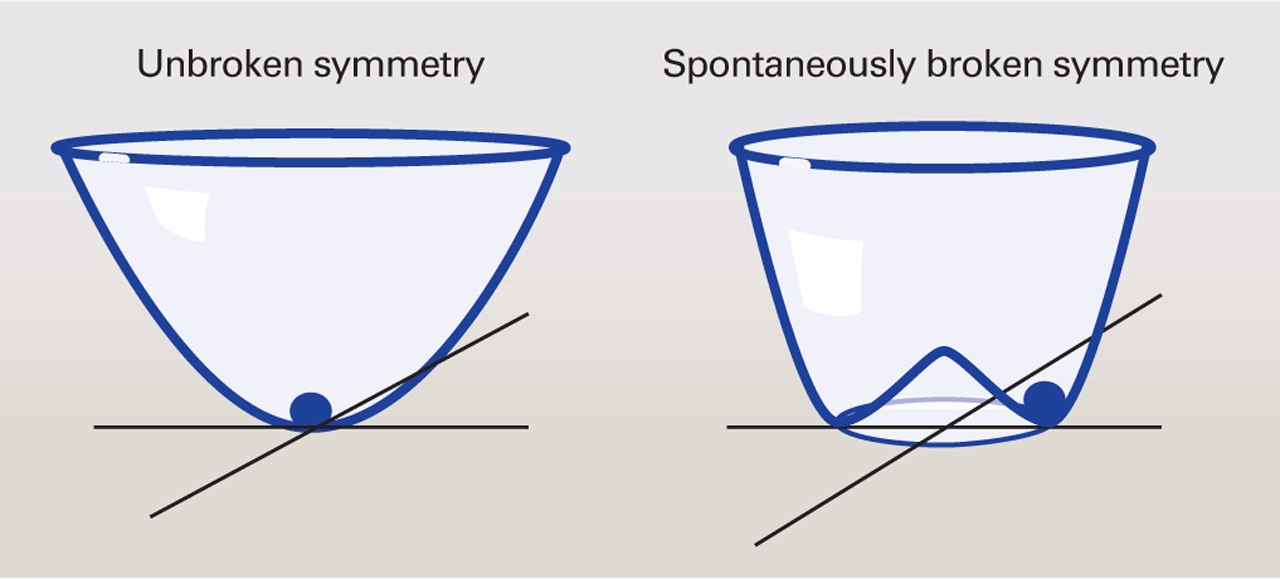
But more than being interesting for its simplicity, this self-interaction of the Higgs underlies a crucial piece of the Standard Model: the story of how particles got their mass. The Standard Model tells us that the reason all fundamental particles have mass is their interaction with the Higgs field. Every particle’s mass is proportional to the strength of the Higgs field. The fact that particles have any mass at all is tied to the fact that the lowest energy state of the Higgs field is at a non-zero value. According to the Standard Model, early in the universe’s history when the temperature were much higher, the Higgs potential had a different shape, with its lowest energy state at field value of zero. At this point all the particles we know about were massless. As the universe cooled the shape of the Higgs potential morphed into a ‘wine bottle’ shape, and the Higgs field moved into the new minimum at non-zero value where it sits today. The symmetry of the initial state, in which the Higgs was at the center of its potential, was ‘spontaneously broken’ as its new minimum, at a location away from the center, breaks the rotation symmetry of the potential. Spontaneous symmetry breaking is a very deep theoretical idea that shows up not just in particle physics but in exotic phases of matter as well (eg superconductors).
A diagram showing the ‘unbroken’ Higgs potential in the very early universe (left) and the ‘wine bottle’ shape it has today (right). When the Higgs at the center of its potential it has a rotational symmetry, there are no preferred directions. But once it finds it new minimum that symmetry is broken. The Higgs now sits at a particular field value away from the center and a preferred direction exists in the system.
This fantastical story of how particle’s gained their masses, one of the crown jewels of the Standard Model, has not yet been confirmed experimentally. So far we have studied the Higgs’s interactions with other particles, and started to confirm the story that it couples to particles in proportion to their mass. But to confirm this story of symmetry breaking we will to need to study the shape of the Higgs’s potential, which we can probe only through its self-interactions. Many theories of physics beyond the Standard Model, particularly those that attempt explain how the universe ended up with so much matter and very little anti-matter, predict modifications to the shape of this potential, further strengthening the importance of this measurement.
Unfortunately observing the Higgs interacting with itself and thus measuring the shape of its potential will be no easy feat. The key way to observe the Higgs’s self-interaction is to look for a single Higgs boson splitting into two. Unfortunately in the Standard Model additional processes that can produce two Higgs bosons quantum mechanically interfere with the Higgs self interaction process which produces two Higgs bosons, leading to a reduced production rate. It is expected that a Higgs boson scattering off itself occurs around 1000 times less often than the already rare processes which produce a single Higgs boson. A few years ago it was projected that by the end of the LHC’s run (with 20 times more data collected than is available today), we may barely be able to observe the Higgs’s self-interaction by combining data from both the major experiments at the LHC (ATLAS and CMS).
Fortunately, thanks to sophisticated new data analysis techniques, LHC experimentalists are currently significantly outpacing the projected sensitivity. In particular, powerful new machine learning methods have allowed physicists to cut away background events mimicking the di-Higgs signal much more than was previously thought possible. Because each of the two Higgs bosons can decay in a variety of ways, the best sensitivity will be obtained by combining multiple different ‘channels’ targeting different decay modes. It is therefore going to take a village of experimentalists each working hard to improve the sensitivity in various different channels to produce the final measurement. However with the current data set, the sensitivity is still a factor of a few away from the Standard Model prediction. Any signs of this process are only expected to come after the LHC gets an upgrade to its collision rate a few years from now.
Current experimental limits on the simultaneous production of two Higgs bosons, a process sensitive to the Higgs’s self-interaction, from ATLAS (left) and CMS (right). The predicted rate from the Standard Model is shown in red in each plot while the current sensitivity is shown with the black lines. This process is searched for in a variety of different decay modes of the Higgs (various rows on each plot). The combined sensitivity across all decay modes for each experiment allows them currently to rule out the production of two Higgs bosons at 3-4 times the rate predicted by the Standard Model. With more data collected both experiments will gain sensitivity to the range predicted by the Standard Model.
While experimentalists will work as hard as they can to study this process at the LHC, to perform a precision measurement of it, and really confirm the ‘wine bottle’ shape of the potential, its likely a new collider will be needed. Studying this process in detail is one of the main motivations to build a new high energy collider, with the current leading candidates being an even bigger proton-proton collider to succeed the LHC or a new type of high energy muon collider.
A depiction of our current uncertainty on the shape of the Higgs potential (center), our expected uncertainty at the end of the LHC (top right) and the projected uncertainty a new muon collider could achieve (bottom right). The Standard Model expectation is the tan line and the brown band shows the experimental uncertainty. Adapted from Nathaniel Craig’s talkhere
The quest to study nature’s simplest interaction will likely span several decades. But this long journey gives particle physicists a roadmap for the future, and a treasure worth traveling great lengths for.
We can’t find the missing five-sixths of the universe called dark matter because it doesn’t collide in detectors — but what if it shakes them? Today’s paper theorizes a new kind of stretchy detector that rapidly shrinks and expands in dark matter’s presence, creating a tiny vibration that can be measured.
Old hypothesis, new effect
Many physicists think dark matter might be made up of axions. These hypothetical particles would simultaneously explain dark matter and solve the “strong CP problem”, another gap in our understanding of particle physics.
Axions are so light that they behave more like a wave than a particle, so most attempts to find them rely on some sort of oscillatory signal they would cause in a detector. Under the right conditions, the omnipresent axion field can cause neutrons to gyrate or create electromagnetic waves, so physicists build experiments that resonate at just the right frequency to pick out these axion-induced oscillations.
Detectors called haloscopes pick up electromagnetic waves of a particular frequency. Looking for axions with a haloscope is like tuning an FM radio and trying to find a particular, very faint song, but without knowing which station it’s on. If physicists can pick out the song from the loud sea of static, the frequency they find it at will tell them the axion’s mass.
If the axion is too light to resonate a haloscope, a different type of resonator will be needed to find it. Today’s paper finds that as axions pass through certain special materials, they exert a minuscule oscillatory tug on the atoms in the material. The authors coined the term “piezoaxionic effect” for this phenomenon, an analogy to the piezoelectric effect in which EM waves pull and stretch out certain crystals, as shown in Fig. 1. In the same way, they write, axion waves should cause crystals to repeatedly stretch and shrink, like a slinky suspended from one end. Again, the frequency of these oscillatory changes in length depends on the axion’s mass. In most cases, they are too small to notice, but if the axion matches the crystal’s resonant frequency, the vibrations might get amplified enough to detect.
Stretchy detectors
Fig. 2: The strength of axion signal to which various experimental probes are sensitive, as a function of the axion’s mass. We expect axions to appear somewhere in the green band, so experiments aim for sensitivities that dip below it. The blue and red bands represent one larger and one smaller set of the proposed stretchy detectors, respectively. The broader gold band highlights what might be achievable if scientists figure out how to vary the detectors’ resonant frequency to match a given axion mass.
The paper proposes a detector made of these crystals that tries to measure their vibrations. Since every piezoaxionic crystal is also piezoelectric, its stretching and shrinking will create an oscillating electrical voltage between its edges. The authors calculated the size of this voltage signal, and compared it with the noise levels they expect if they use fancy quantum sensors for the measurement. This gave them an estimate of the crystals’ sensitivity to axions.
But a given detector is only really sensitive if the axion mass is near its resonant frequency, so it would take lots of detectors to test for a range of masses. Fig. 2 shows the sensitivity of a proposed experiment, which would operate for ten years using two sets of detectors, one with arrays of millimeter-scale crystals (red), and one with arrays of centimeter-scale crystals (blue). The green area shows where we expect axions to live within this two-dimensional space. To discover axions, you need an experiment whose sensitivity dips fully below the green band at their actual mass (which, remember, we don’t know). The gold curve is meant to highlight the technology’s future potential if physicists can figure out a way to tune the resonant frequency of a crystal detector, like tuning a haloscope.
Are axions having a moment?
Axions have been receiving heightened attention recently, since giant detectors buried underground have failed to prove the other leading dark matter theory, that of the weakly interacting massive particle. As that long-favored hypothesis becomes tenuous, many physicists are looking in new directions, and the axion is the readiest alternative.
The vibrational detectors would also probe a different range of axion masses than existing experimental efforts like haloscopes. Since the axion mass is such a huge unknown, a number of different technologies will be required to cover the full range of possibilities. Especially if the tuning of a detector’s resonant frequency becomes possible, this might become a critical new tool for dark matter hunters trying to excavate this parameter space. Perhaps in the coming years, it will be the buzz of one of these vibrating detectors that finally alerts us to dark matter’s true nature.
Gravity, electromagnetism, strong, and weak — these are the beating hearts of the universe, the four fundamental forces. But do we really need the last one for us to exist?
Harnik, Kribs and Perez went about building a world without weak interactions and showed that, indeed, life as we know it could emerge there. This was a counter-proof by example to a famous anthropic argument by Agrawal, Barr, Donoghue and Seckel for the puzzling tininess of the weak scale, i.e. the electroweak hierarchy problem.
Summary of the argument in hep-ph/9707380 that a tiny Higgs mass (in Planck mass units) is necessary for life to develop.
Let’s ask first: would the Sun be there in a weakless universe? Sunshine is the product of proton fusion, and that’s the strong force. However, the reaction chain is ignited by the weak force!
image: Eric G. Blackman
So would no stars shine in a weakless world? Amazingly, there’s another route to trigger stellar burning: deuteron-proton fusion via the strong force! In our world, gas clouds collapsing into stars do not take this option because deuterons are very rare, with protons outnumbering them by 50,000. But we need not carry this, er, weakness into our gedanken universe. We can tune the baryon-to-photon ratio — whose origin is unknown — so that we end up with roughly as many deuterons as protons from the primordial synthesis of nuclei. Harnik et al. go on to show that, as in our universe, elements up to iron can be cooked in weakless stars, that they live for billions of years, and may explode in supernovae that disperse heavy elements into the interstellar medium.
source: hep-ph/0604027
A “weakless” universe is arranged by elevating the electroweak scale or the Higgs vacuum expectation value ($latex \approx$ 246 GeV) to, say, the Planck scale ($latex \approx 10^{19}$ GeV). To get the desired nucleosynthesis, care must be taken to keep the u, d, s quarks and the electron at their usual mass by tuning the Yukawa couplings, which are technically natural.
And let’s not forget dark matter. To make stars, one needs galaxy-like structures. And to make those, density perturbations must be gravitationally condensed by a large population of matter. In the weakless world of Harnik et al., hyperons make up some of the dark matter, but you would also need much other dark stuff such as your favourite non-WIMP.
If you believe in the string landscape, a weakless world isn’t just a hypothetical. Someone somewhere might be speculating about a habitable universe with a fourth fundamental force, explaining to their bemused colleagues: “It’s kinda like the strong force, only weak…”
xkcd.com/1489
Bibliography
Viable range of the mass scale of the standard model V. Agrawal, S. M. Barr, J. F. Donoghue, D. Seckel, Phys.Rev.D 57 (1998) 5480-5492.
A Universe without weak interactions R. Harnik, G. D. Kribs, G. Perez, Phys.Rev.D 74 (2006) 035006
Further reading
Gedanken Worlds without Higgs: QCD-Induced Electroweak Symmetry Breaking C. Quigg, R. Shrock, Phys.Rev.D 79 (2009) 096002
The Multiverse and Particle Physics J. F. Donoghue, Ann.Rev.Nucl.Part.Sci. 66 (2016)
The eighteen arbitrary parameters of the standard model in your everyday life R. N. Cahn, Rev. Mod. Phys. 68, 951 (1996)

 Login