
❌

Normal view

Elon Musk says AI will make a ‘historically accurate’ Odyssey – here’s why that’s impossible

Elon Musk has promised that before the year is out, his AI tool Grok Imagine will produce a full-length film of Homer’s Odyssey that is, in his words, “historically accurate and true to the art of Homer”.

The claim, posted on X in July alongside a three-minute AI-generated scene, arrived days after Christopher Nolan’s blockbuster version reached cinemas worldwide – a film Musk has spent months attacking for being “woke”.

Set aside, for a moment, that The Odyssey is a 2,800-year-old poem that includes a witch who turns men into pigs and a one-eyed giant shepherd, to ask a simpler question: accurate to what?

There are no photographs of ancient Ithaca. There is no footage of the Trojan shore. What we have is stories, poems, pottery and paint, and, more recently, a century of films that imagined the ancient world for us. That is the only material a generative model has ever seen.

So when Grok Imagine – the AI image generator developed by Musk’s xAI company – renders antiquity, it is not reaching back into history. It is reaching for the centre of every image already made about it – the most probable ancient warrior, assembled from Gladiator, Troy and 300 and a hundred years of sword-and-sandal cinema. The result will not look like the past. It will look like other films about the past, averaged out by AI.

And here is the part that should give anyone bandying about the word “accurate” pause. A machine that reaches for the most probable image does not correct our clichés about antiquity. It concentrates them. Ask it for a classical statue and it will hand you gleaming white marble, because that is how we picture the ancient world.

Except the ancient world did not look like that. Greek and Roman sculpture was painted in strong colours – the pristine white marble in our heads is a later idealisation, not the thing itself. An AI model trained on our pictures of the past will reproduce our mistakes about the past – confidently – and give them back to us labelled as truth. That is the opposite of accuracy. It is our own error, upscaled.

Christopher Nolan’s film has grossed over $640 million (£460m) worldwide so far.

The real problem

This is why “historically accurate” is not really a script problem. It is an image problem. Accuracy on screen is delivered through light, lens, skin, texture, cloth and grain – the hundred deliberate decisions a director of photography agonises over in every frame.

A machine makes those decisions too, but it makes them by consensus, by defaulting to the most probable choice. Research on generative AI has already found that it makes individual work feel more creative while making the whole field more similar, everything drifting toward the same middle. The same regression to the mean that flattens prose will flatten the picture. You do not get the accurate past, and you do not get the thrilling lie. You get the average, and the average is where nothing memorable lives.

Which brings me to escapism, and to a tension in my own work I am happy to admit. I research and teach sustainable, naturalistic image-making – stripping away artifice, working with available light. But I have also argued, including in a TED talk, that escapism matters, and that realism is often its enemy.

Take everything excessive and dangerous out of James Bond and you remove the reason anyone watches. Nolan’s Odyssey is not trying to be accurate. It is trying to be exciting – and excitement is a decision. It is a point of view, a piece of the filmmaker put deliberately on the screen.

Heightening is a choice about what to exaggerate, and a choice is exactly what an average cannot make. A machine that lives at the mean can smooth, but it cannot heighten. So the “exciting” AI blockbuster arrives with the one quality excitement depends on already removed.

There is a reason the AI clips flooding our feeds feel flavourless even when they are technically clean. It is not that the tools are young and will improve. It is that averaging is what they do. Watch a real performer and you are watching a human being decide – take a risk, make a choice you might not have made – in front of you.

That is the thing we actually go to films for, and it is precisely the thing an average has no way to contain. Whether audiences keep noticing is the open question. The appetite to make this work is real, because it is cheap. The appetite to watch it is the thing nobody has tested yet. And the unease many people already feel watching AI slop and struggling to say why it repels them, is not naivety. It is a correct response to work that no one made decisions about.

So what is the endgame? Not, I think, simply proving it can be done. If you only wanted to prove a technical point you would not reach for the word accurate – least of all for a poem, where accuracy means nothing. Reaching for accurate is reaching for authority: the right to say what is true.

Musk is a man who publicly objected to the casting of a black actor as Helen of Troy and a trans actor as a Greek warrior. A man who operates within a wider political project about who gets to tell the national story, now claiming that a tool he owns can portray the past as it truly was. Follow that to its end. If his machine decides what is historically accurate, then he decides what the past looked like. And whoever is trusted to author the past is well placed to author the future.

So watch this one with scepticism – not because AI cannot make images, it plainly can, but because “historically accurate” is a claim about truth. And truth is exactly what a machine trained on the average of everything cannot give you. It is also exactly, in this case, what its owner would most like to define.

The Conversation

Jack Shelbourn has received funding from the British Film Institute; the National Lottery; HEIF/University of Lincoln; CoASSH Scholarship, Professional Practice & Research Resources Allocation Fund; and College of Arts Teaching and Learning Fund.

Life in the ancient Arctic: tiny teeth of newly discovered species suggest it was a cradle of mammalian evolution

Artist's impression of the Prince Creek Formation in northern Alaska during the Late Cretaceous period, with small mammal highlighted. James Havens, CC BY-NC-SA

A fossil mammal tooth smaller than a grain of rice does not announce itself loudly. It must be hard won from sediment and stone. Then, under a microscope, it reveals itself – no longer just a speck of blackness but a surface of cusps, ridges and worn edges.

It is a small object, easily missed. Yet five such teeth from northern Alaska, belonging to three newly discovered species of long-extinct rodent-like mammals, hold an unexpectedly large history: of polar environments, shifting continents, winter darkness – and of mammals moving through this world that was colder, stranger and more connected than we once imagined.

The fossil mammal teeth at the centre of my new study with US colleagues come from the Late Cretaceous Prince Creek Formation, around 73 million years ago. At that time, northern Alaska’s palaeolatitude was roughly 80-85°N (10-15° closer to the north pole than it is today).

Our discovery shows the Arctic was not simply a cold, lifeless edge of the Cretaceous world, but a place where mammals adapted, diversified, migrated and originated. It raises deeper questions about what it means for a species to be native to a place whose landscapes, climates and inhabitants are forever changing.

The Arctic is not an empty landscape now, and nor was it in the deep past. It was a distinctive and demanding biome, with months of winter darkness, freezing temperatures and strong seasonality.

Rivers crossed this landscape. Plants grew through the long light of summer. Dinosaurs lived and thrived there, and evidence suggests they reared their young in the Arctic. There was also a diversity of birds, fish and mammals: tenacious denizens of the polar dark.

View of Colville River in northern Alaska
Colville River in northern Alaska, where tiny multituberculate fossilised teeth were discovered. Pat Druckenmiller, CC BY-NC-SA

The teeth we found

Finding miniscule fossil mammals is not the kind of palaeontology that begins with a spectacular skeleton weathering from a cliff. It begins with bulk sediment. Bags and buckets of it.

The material is dug out, washed, sieved through fine screens, dried, then meticulously sorted grain by grain beneath a microscope.

Mammalian palaeontology often depends on fragments: a tooth cusp, a root, a worn edge of enamel. It asks for patience more than drama. The field site may be remote, the landscape vast, but the discovery happens at the scale of a fingertip. It is an act of attention.

The five teeth described in our new study are multituberculates: a group of rodent-like mammals that lived alongside dinosaurs. They are the longest-lived mammal group to date, with a history spanning well over 100 million years. Our own species Homo sapiens, by comparison, is only a few hundred thousand years old.

But their success was not permanent. After surviving for longer than any other mammalian lineage, multituberculates eventually vanished, with their last representatives disappearing around the Eocene-Oligocene boundary, roughly 34 million years ago.

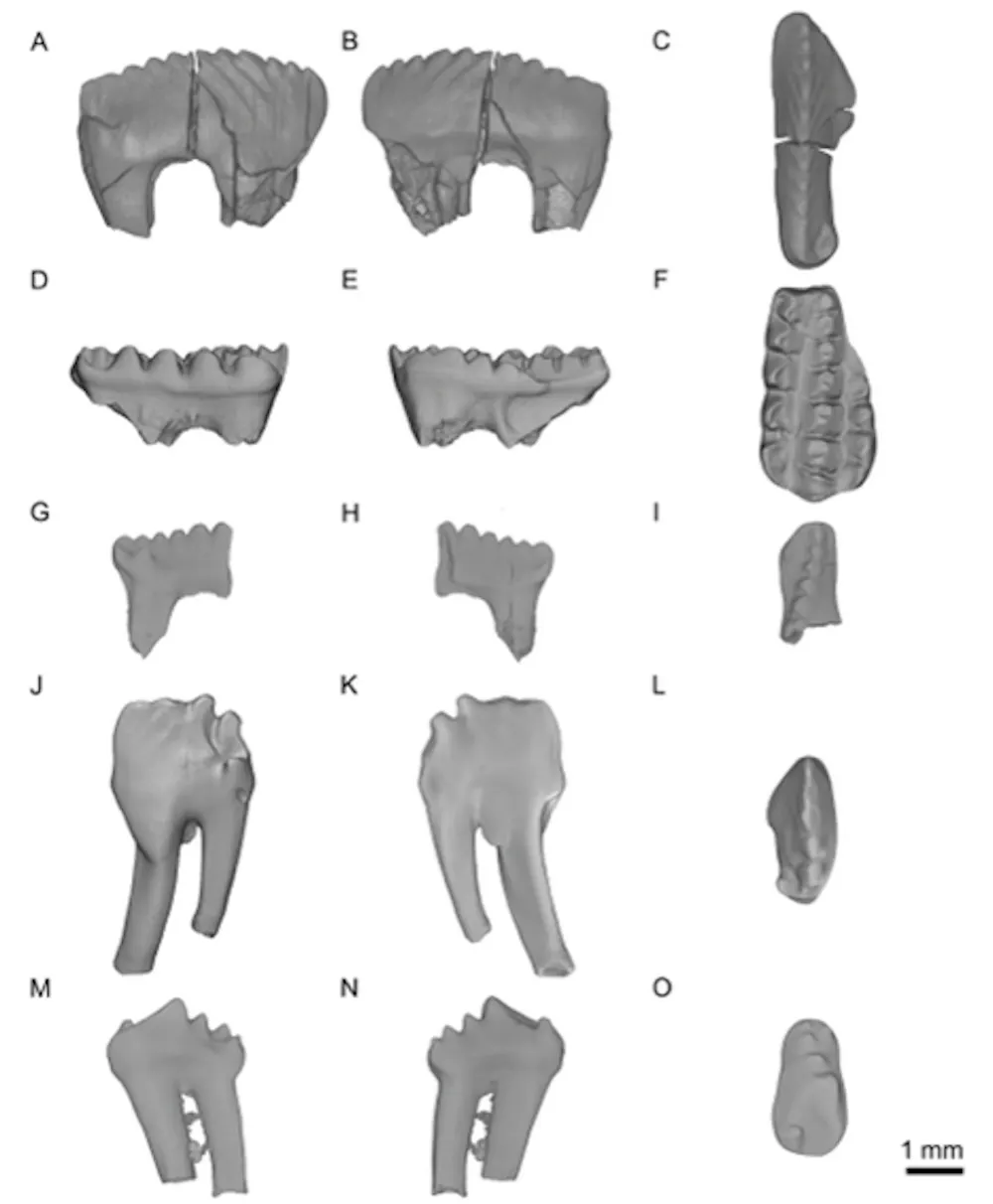
Multiple images of five fossilised teeth.
Views of five fossilised teeth discovered in Alaska’s Prince Creek Formation. Shelley et al (2026), CC BY-NC-SA

The teeth we found at Prince Creek represent three new species: Camurodon borealis, Kaniqsiqcosmodon polaris and Qayaqgruk peregrinus. The last of these sits especially close to the heart of the story.

Qayaqgruk peregrinus has close evolutionary affinities with a group of multituberculates discovered in Mongolia,, indicating that, many millions of years ago, these minute mammals moved between Asia and North America through a polar land corridor.

This was not the world of Pangaea, the single giant continent of earlier Earth history. By 73 million years ago, the continents were taking on more familiar shapes, but they had not yet settled into the map we know today.

North America was split by a shallow inland sea, and its far northwestern edge lay near northeastern Asia, creating a high-latitude corridor through which animals could move between continents.

The Arctic corridor itself was not unknown. Fossils of dinosaurs, birds and some mammals have shown that animals were migrating between Asia and North America during the Cretaceous.

But for multituberculates, the picture was much less clear. Their fossil record left open whether they crossed between the continents early and repeatedly, or only later in the Cretaceous. Qayaqgruk peregrinus helps close that gap.

Its name draws on the language of the Iñupiat, Alaska Native people, from the region where the fossils were found. Qayaq is a legendary Iñupiaq hero and wanderer whose journeys are told in The Epic of Qayaq.

Many of its Mongolian relatives carry the suffix -baatar, meaning hero in Mongolian, so the name also links its Alaskan discovery to its Asian evolutionary affinities.

Kaniqsiqcosmodon polaris is the oldest known member of the Microcosmodontidae family of multituberculates, suggesting this lineage, later known from North America, may have had a polar origin. Camurodon borealis represents the northernmost known occurrence of the North American family Cimolomyidae.

Five teeth are not a complete ecosystem, but they are enough to show these mammals were not occasional strays at the edge of their range. They belonged to the Arctic.

Surviving mass extinction

Survival in this environment was not a passive condition. Multituberculates survived through the end-Cretaceous mass extinction, 66 million years ago, when as much as 75% of all life on Earth went extinct, including the non-avian dinosaurs.

The adaptations that helped these ancient Arctic species live though deep winter cold, short dark days and seasonal scarcity may have given them advantages when the world’s ecosystems were devastated.

This is not to say the Arctic was a refuge in any simple sense. Evolution is rarely simple – it is full of bottlenecks and unexpected openings. But tiny mammals already adapted to seasonal scarcity may have carried some advantages into a disrupted world.

The Alaskan multituberculates did not belong to the Arctic because they had always been there, or because their lineages had never moved. They belonged because they were part of that ecosystem for a time: shaped by its dark, its cold, its flora, its fauna, its seasons and its routes of passage.

Fossils make this kind of belonging harder to define, but more interesting. They give the word indigenous, at least when we use it for species, a chronology: deep time shows that belonging is not always a matter of original presence, but of ecological participation across changing landscapes.

These five multituberculate teeth from the Prince Creek Formation are small enough to vanish in a pinch of sediment. Yet in their enamel are continents, seasons, darkness, ancestry and journeys.

They show that the ancient Arctic was not an evolutionary margin. It was a living biome, a passage between worlds, and part of the deep history of mammalian evolution.

The Conversation

Sarah Shelley does not work for, consult, own shares in or receive funding from any company or organisation that would benefit from this article, and has disclosed no relevant affiliations beyond their academic appointment.

❌