❌

Normal view

Upper Limits on Planet-Induced Gigahertz Radio Emission from Inactive M Dwarfs

16 September 2026 at 17:00

Jackie Villadsen et al 2026 ApJ 1005 51

No bursty radio emission characteristic of star–planet interaction was detected from a sample of five M dwarfs with close-in terrestrial planets, but researchers were able to place limits on the magnetic fields of the planets.

The post Upper Limits on Planet-Induced Gigahertz Radio Emission from Inactive M Dwarfs appeared first on AAS Nova.

The Nineteenth Data Release of the Sloan Digital Sky Survey

15 September 2026 at 17:00

SDSS Collaboration et al 2026 ApJS 285 9

For nearly three decades, the Sloan Digital Sky Survey has collected photometric and spectroscopic data for millions of objects; this article describes the most substantial data release to date for SDSS-V.

The post The Nineteenth Data Release of the Sloan Digital Sky Survey appeared first on AAS Nova.

A Comparison of Lunar AI-Based Crater Databases Using Uniform Criteria

14 September 2026 at 17:00

Stuart J. Robbins and Rachael H. Hoover 2026 Planet. Sci. J. 7 164

A uniform analysis of crater catalogs finds that practically all computer-generated catalogs return worse metrics than manually generated catalogs, though most catalogs do well in some areas and poorly in others.

The post A Comparison of Lunar AI-Based Crater Databases Using Uniform Criteria appeared first on AAS Nova.

Four-Body Gravitational Microlensing Events Involving Both a Binary Lens and a Binary Source

11 September 2026 at 17:00

Cheongho Han et al 2026 ApJ 1004 183

Three newly characterized microlensing events augment the growing list of events involving binary sources and lenses, emphasizing the importance of testing models of this complexity.

The post Four-Body Gravitational Microlensing Events Involving Both a Binary Lens and a Binary Source appeared first on AAS Nova.

Discovery of Sulfur Oxides in the Ejecta of a B[e] Supergiant

10 September 2026 at 17:00

Cristobal Bordiu et al 2026 ApJL 1005 L34

Researchers have detected SO and SO2 for the first time in an early-type evolved star; these results suggest that B[e]supergiants could be useful for studying sulfur chemistry under extreme radiation conditions.

The post Discovery of Sulfur Oxides in the Ejecta of a B[e] Supergiant appeared first on AAS Nova.

When Bright Spots Go Dark

9 September 2026 at 17:00

solar faculae and sunspots imaged at 1400 Angstroms

Light and dark regions speckle the Sun and other stars, complicating the interpretation of exoplanet transmission spectra. New modeling suggests that faculae — bright areas on the visible surface of the Sun — appear dark on cooler stars, adding a new wrinkle to this challenge.

Dark Spot, Bright Spot

solar granules

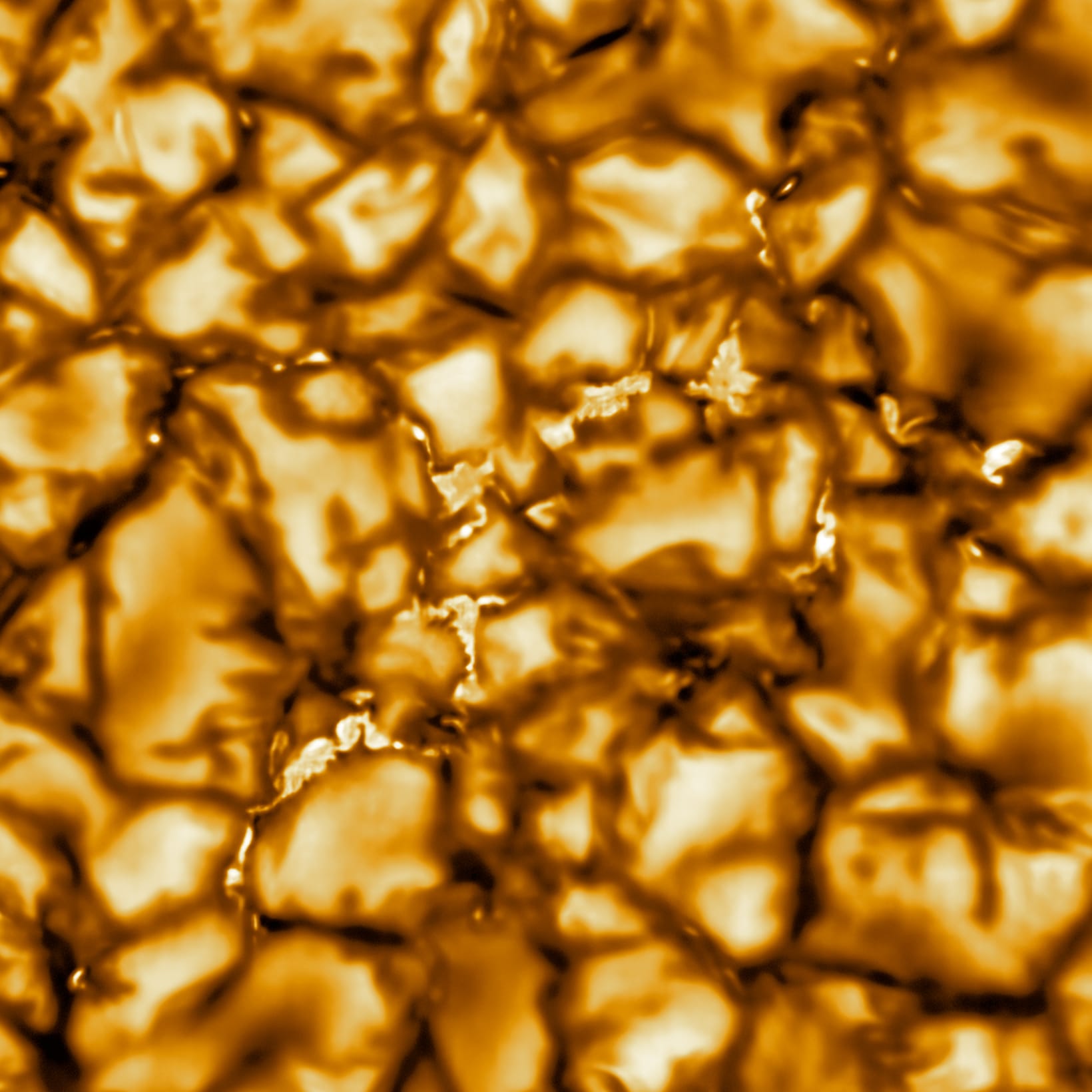
This image from the Daniel K. Inouye Solar Telescope shows solar convective cells called granules. The bright points in the dark lanes between granules are regions of enhanced magnetic field strength. [NSO/AURA/NSF; CC BY 4.0]

It’s an adage as old as exoplanet science itself: know thy star, know thy planet. This recommendation is key when using transmission spectroscopy to tease out the components of an exoplanet’s atmosphere; the backdrop to this process is a rotating star dotted with ever-changing active regions, and the better the star’s behavior is understood, the more reliable the extracted spectrum becomes.

The Sun is freckled with dark spots — sunspots — as well as bright regions called faculae. Sunspots form where the Sun’s magnetic field bubbles up, creating pockets of cooler, less luminous plasma. Solar faculae form in regions of concentrated magnetic field, creating bright spots that line the dark crevasses between convective cells.

Other stars also have starspots and faculae, but thus far, astronomers have no direct observations of faculae on any star except the Sun. Out of necessity, researchers interpreting exoplanet spectra assume that faculae on other stars are similar to those on the Sun — but are they actually?

Would a Facula on Any Other Star Look as Bright?

To explore what faculae might look like on stars other than the Sun, Alexander Shapiro (University of Graz; Max Planck Institute for Solar System Research) and collaborators turned to three-dimensional radiative magnetohydrodynamics simulations and radiative transfer modeling. Their aim was to simulate the appearance and spectra of faculae on stars of spectral type G2, K2, M0, and M4 — from Sun-like to substantially smaller and cooler than the Sun.

simulated faculae on a Sun-like star and a cooler M dwarf

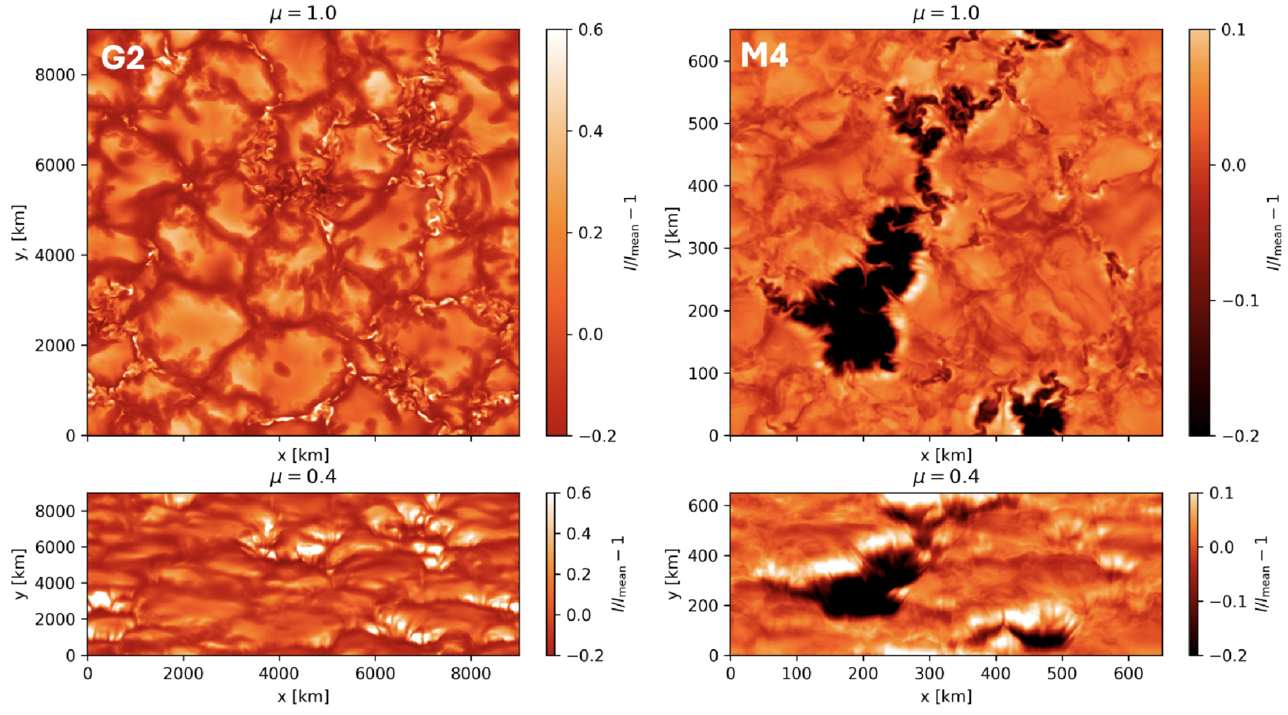
Simulated faculae on a Sun-like star (left) and an M4 star (right). These images show the faculae at 600 nm. Click to enlarge. [Shapiro et al. 2026]

The modeled faculae on the Sun-like G2 star were bright, as expected. On the K2 and M0 star, these features were fainter, with the faculae on the M0 star being roughly as bright as the surrounding stellar surface. On the M4 star, the faculae were darker than surrounding areas, upending the assumption that faculae on all stars are brighter than the stellar surface.

Exoplanetary Effects

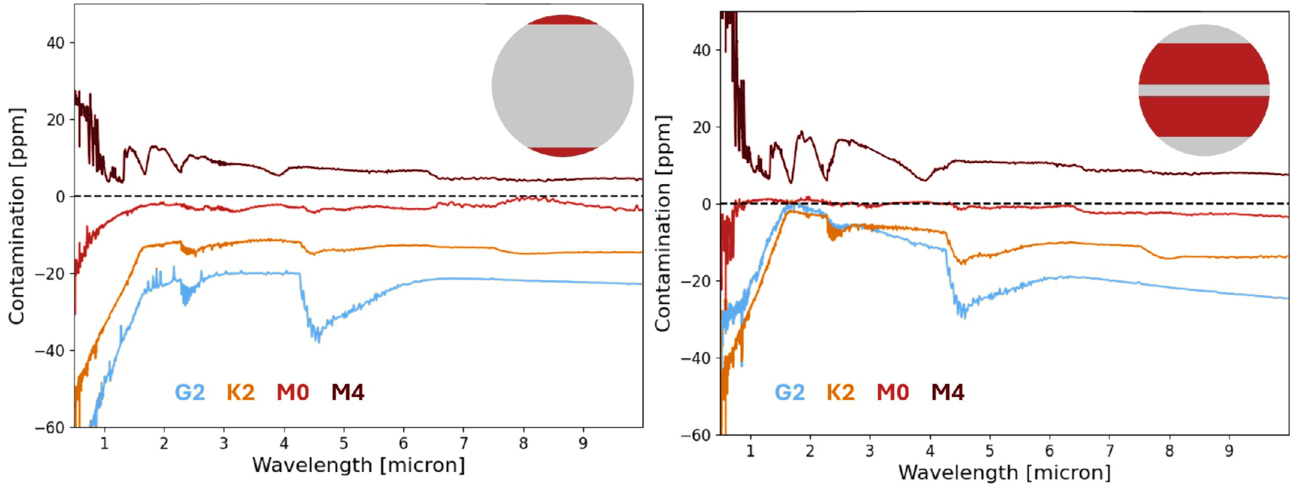
The transition from bright faculae on Sun-like stars to dark faculae on M4-class stars directly affects interpretations of exoplanet transmission spectra. The existence of dark faculae increases the derived exoplanet radius, whereas bright faculae on Sun-like stars decrease the derived radius. The contamination due to the faculae is wavelength dependent, with the largest contamination occurring at shorter wavelengths. This contamination, if not fully accounted for, can mimic spectral features from an exoplanet’s atmosphere.

plot of spectral contamination due to faculae

Contamination of transmission spectra by faculae near a star’s poles (left) and closer to the star’s equator (right). Faculae are bright for the simulated G2, K2, and M0 stars, and they are dark on the simulated M4 star. Click to enlarge. [Shapiro et al. 2026]

What determines whether faculae appear brighter or darker than their surroundings? Using a qualitative framework, Shapiro and coauthors found that the appearance of faculae can be traced to a few competing factors: the strong magnetic fields within faculae prevent the incursion of hotter material (making the spots appear darker), while the magnetic field lowers the opacity of the gas in that region, allowing us to peer deeper and glimpse hotter material (making the spots appear brighter). On cooler stars, effects related to higher surface gas pressure tilt the balance in favor of darker faculae.

Citation

“The Curious Case of Dark Faculae on M Dwarf Stars,” A. I. Shapiro et al 2026 ApJ 1008 24. doi:10.3847/1538-4357/ae7105

The post When Bright Spots Go Dark appeared first on AAS Nova.

Predictive Rankings of the Probability of Hosting a Temperate Terrestrial World for the HWO ExEP Mission Star List

9 September 2026 at 17:00

Jamie Dietrich et al 2026 AJ 172 35

Some systems in the Habitable Worlds Observatory (HWO) Exoplanet Exploration Program (ExEP) Mission Star List have more than a 50% chance of hosting a temperate terrestrial exoplanet.

The post Predictive Rankings of the Probability of Hosting a Temperate Terrestrial World for the HWO ExEP Mission Star List appeared first on AAS Nova.

Long-Term Clustering Pattern of Solar Active Regions and Their Potential Connection with Magneto-Rossby Waves

8 September 2026 at 17:00

Junwei Zhao et al 2026 ApJ 1004 175

More than half of solar magnetic flux appears to emerge in three bands, two of which rotate faster than the Carrington rate; this finding suggests a connection between surface flux and interior dynamical processes.

The post Long-Term Clustering Pattern of Solar Active Regions and Their Potential Connection with Magneto-Rossby Waves appeared first on AAS Nova.

Six New Circumbinary Disk Occultation Candidates from the Zwicky Transient Facility

4 September 2026 at 17:00

Zhecheng Hu et al 2026 ApJS 284 70

Researchers have identified six new candidate circumbinary disk systems, potentially greatly increasing the number of known systems of this type; these system exhibit deep and prolonged dimming episodes.

The post Six New Circumbinary Disk Occultation Candidates from the Zwicky Transient Facility appeared first on AAS Nova.

Hydrogen Airglow from an Escaping Ultrahot Jupiter Atmosphere

3 September 2026 at 17:00

Yapeng Zhang et al 2026 ApJL 1005 L29

Ultra-hot Jupiter KELT-9b possesses an outflow with a mass-loss rate above 1013 g s-1 — one of the highest mass-loss rates measured for a gaseous exoplanet — and a diagnostic hydrogen Balmer line from its dayside.

The post Hydrogen Airglow from an Escaping Ultrahot Jupiter Atmosphere appeared first on AAS Nova.

Modeling the Milky Way Circumnuclear Disk: Rosettes and Rings

2 September 2026 at 17:00

Asad Ukani et al 2026 ApJ 1004 171

Modeling of the Milky Way’s circumnuclear disk of molecular gas suggests that the gas is distributed in a disk with inner and outer radii of 1.0 and 2.9 parsecs and an inclination of 60 degrees.

The post Modeling the Milky Way Circumnuclear Disk: Rosettes and Rings appeared first on AAS Nova.

Smaller Than Earth Habitability Model (STEHM): The Lower Size Limit for Atmosphere Retention in the Habitable Zone

1 September 2026 at 17:00

Michelle L. Hill et al 2026 Planet. Sci. J. 7 140

Planets with radii 20% or possibly 30% smaller than Earth’s radius can maintain atmospheres, with initial carbon content, core radius fraction, initial mantle temperature, and other factors playing a role.

The post Smaller Than Earth Habitability Model (STEHM): The Lower Size Limit for Atmosphere Retention in the Habitable Zone appeared first on AAS Nova.

JWST-TST High Contrast: First Direct Spectroscopy of GJ 504 b Reveals Clouds and Possible Metal Enrichment

31 August 2026 at 17:00

Aneesh Baburaj et al 2026 AJ 172 28

New observations of the coldest directly imaged planetary-mass companion of the pre-JWST era show a potential planetary formation pathway for the 25.2-Jupiter-mass object.

The post JWST-TST High Contrast: First Direct Spectroscopy of GJ 504 b Reveals Clouds and Possible Metal Enrichment appeared first on AAS Nova.

Featured Image: A Pulsar in a Nebula in a Supernova Remnant

31 August 2026 at 17:00

When a massive star collapses, the subsequent supernova can leave behind the star’s condensed core in the form of a neutron star. Some neutron stars are also pulsars, which rotate at incredible speeds, emit beamed radio emission, and expel winds of charged particles. A pulsar’s relativistic charged-particle winds billow around the pulsar as it travels through space — often at a few hundreds of kilometers per second or faster, having received a “kick” when its progenitor star exploded. When these winds interact with the surrounding supernova ejecta or the interstellar medium, the interaction creates a detectable pulsar wind nebula. The image above combines data from the Australian Square Kilometre Array Pathfinder (orange) and Wide-field Infrared Survey Explorer (cyan) to show a pulsar wind nebula, indicated with a white rectangle, within a larger supernova remnant. Sanja Lazarević (Western Sydney University) and collaborators discovered this pulsar wind nebula, which they’ve named “Thunder” in a nod to the supernova remnant’s moniker, “Nimbus.” The cometary shape of the pulsar wind nebula suggests that the pulsar is moving quickly, traveling outward from the center of the explosion that occurred some 30,000–45,000 years ago. To learn more about the discovery and characterization of this pulsar wind nebula, check out the article linked below.

Citation

“EMU Discovery of Thunder: A Bow-Shock PWN Powered by PSR J1631–4722 Escaping the Nimbus SNR (G336.7+0.5),” S. Lazarević et al 2026 ApJ 1007 159. doi:10.3847/1538-4357/ae7f11

The post Featured Image: A Pulsar in a Nebula in a Supernova Remnant appeared first on AAS Nova.

A 14-Yr-Old Mystery: The Peculiar Case of the Engine-Driven SN 2012ap

21 August 2026 at 17:00

Itai Sfaradi et al 2026 ApJL 1005 L19

Recent radio rebrightening of a supernova observed in 2012 suggests that either the progenitor star experienced a past change in mass-loss rate or wind speed, or there is an off-axis relativistic jet present.

The post A 14-Yr-Old Mystery: The Peculiar Case of the Engine-Driven SN 2012ap appeared first on AAS Nova.

Gaia21bja: Pre-Main-Sequence Star with Quasiperiodic Bursts

20 August 2026 at 17:00

Ádám Mátéfy et al 2026 ApJ 1004 142

Gaia21bja is a young stellar object that brightens by up to 1.7 magnitudes during its outbursts, with its luminosity and mass-accretion rate increasing by a factor of 5.5–6 during the bursts.

The post Gaia21bja: Pre-Main-Sequence Star with Quasiperiodic Bursts appeared first on AAS Nova.

Automatic Detection and Segmentation of Coronal Mass Ejections in LASCO C3 Images

19 August 2026 at 17:00

Yunshi Zeng et al 2026 ApJS 284 63

Using more than 50,000 images of coronal mass ejections, researchers have developed a novel machine-learning classification framework applicable to coronal mass ejections.

The post Automatic Detection and Segmentation of Coronal Mass Ejections in LASCO C3 Images appeared first on AAS Nova.

Probing Dust in the Disk of a Growing Giant Planet

19 August 2026 at 17:00

ALMA observations of PDS 70

New research suggests that the circumplanetary disk surrounding the exoplanet PDS 70c contains a ring of dense dust, and the conditions within this ring may allow baby moons to form.

A Disk Within a Disk

closeup of PDS 70c's circumplanetary disk

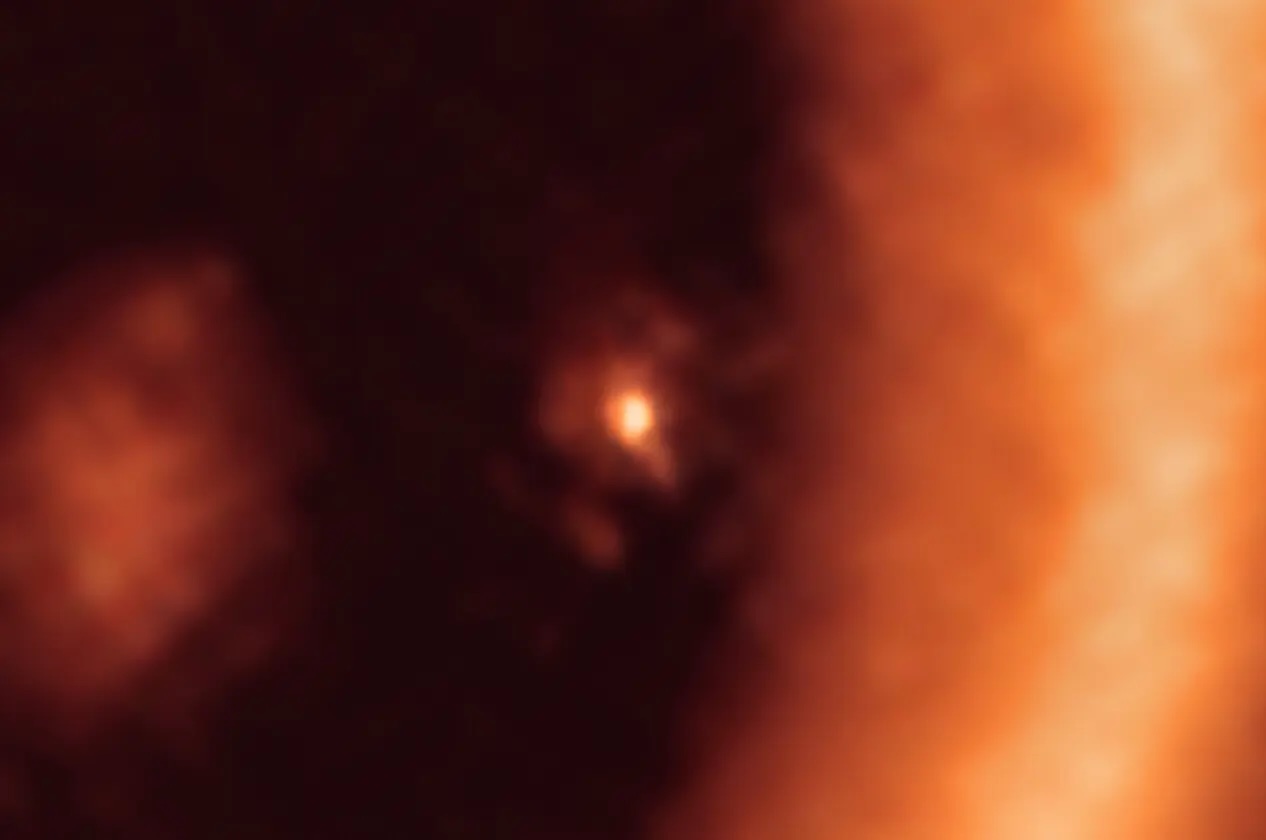
A closeup of PDS 70c’s circumplanetary disk within PDS 70’s protoplanetary disk. [ALMA (ESO/NAOJ/NRAO)/Benisty et al.; CC BY 4.0]

The young star PDS 70 has become famous for its protoplanetary disk and its two growing giant planets, PDS 70b and PDS 70c. At least one of these planets is surrounded by a disk of its own; in 2019, researchers using the Atacama Large Millimeter/submillimeter Array (ALMA) reported the first-ever observation of a circumplanetary disk around PDS 70c, and later observations with ALMA brought clearer views of this disk.

There’s still debate over the exact source of the emission detected by ALMA. Does this emission come from dust, and if so, how is the dust distributed? Is the disk optically thick or optically thin? Does the emission even come from dust, or could it instead be free–free emission from unbound electrons navigating a charged-particle maze?

Dust Diagnosis

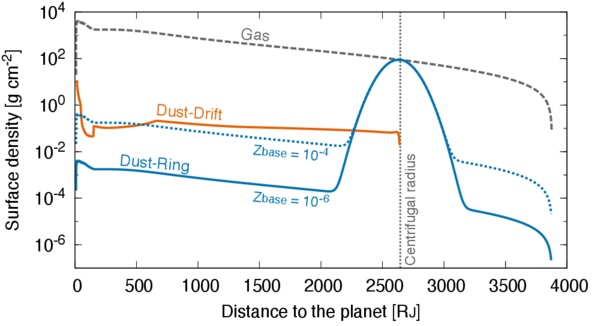
Yuhito Shibaike (Kagoshima University) and collaborators recently examined the hypothesis that the emission from PDS 70c’s circumplanetary disk arises from dust distributed in an optically thick ring. To test this hypothesis, the team explored two possible dust distributions, which they call “drift” and “ring.” In the drift model, dust grains within the circumplanetary disk migrate inward toward the planet, leaving much of the disk optically thin. Modeling suggests that this migration is typical in protoplanetary disks, and it might be common in circumplanetary disks as well.

plot of modeled dust distributions

Dust and gas surface density for the modeled disks in the drift (orange) and ring (blue) models. Click to enlarge. [Adapted from Shibaike et al. 2026]

In the ring model, the dust grains are concentrated within an optically thick ring at a certain distance from the planet. Simulations suggest that the formation of this type of dust ring is feasible, arising from a localized increase in gas density, outflows, or other causes.

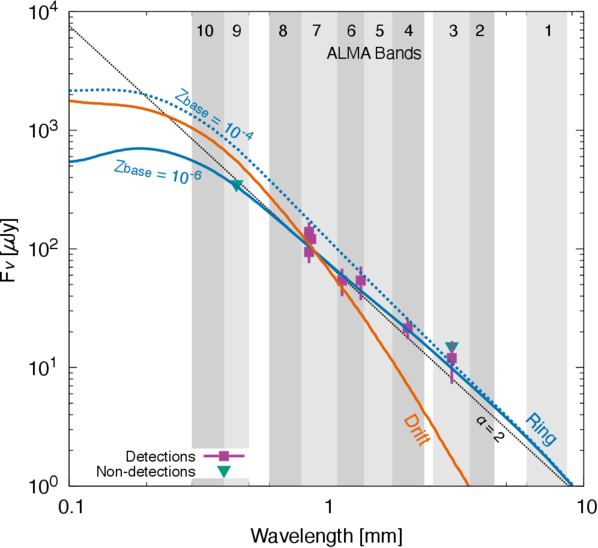
Shibaike and coauthors found that the ring model naturally reproduced the observed spectral energy distribution for a range of reasonable parameters. The drift model, on the other hand, required an unrealistically high dust-to-gas ratio for the material accreted onto the circumplanetary disk from the parent protoplanetary disk to reproduce the observed spectral index.

Future Prospects and Moon-Making Possibilities

comparison of ALMA observations and model predictions

Comparison of ALMA observations (colored symbols) and model predictions (colored lines) from the drift (orange) and ring (blue) models. Click to enlarge. [Adapted from Shibaike et al. 2026]

This work demonstrated the feasibility of the dust-ring model, but it didn’t rule out a contribution due to free–free emission from unbound electrons, which has also been proposed to explain the disk’s appearance. The team noted that distinguishing between thermal dust emission and free–free emission is challenging with existing data, as the two sources produce spectral energy distributions with similar shapes.

Luckily, this likely won’t remain a mystery forever: the next-generation Very Large Array, which is anticipated to begin full science operations in the mid-2030s, should be able to resolve the location of the dust within the circumplanetary disk and illuminate the source of emission.

Finally, if the dust surrounding PDS 70c is concentrated within a ring, what does that mean for the possibility of moons forming within the disk? Shibaike and collaborators found that the conditions within the ring likely satisfy the requirements of both the streaming instability and the gravitational instability, which are required for dust grains to clump together and form the rocky building blocks of baby moons. Perhaps the PDS 70 system will one day be the site of not only a circumplanetary disk, but an exomoon as well!

Citation

“Interpreting ALMA Multiwavelength Continuum Observations of PDS 70 c: An Optically Thick Dust Ring in the Circumplanetary Disk,” Yuhito Shibaike et al 2026 ApJL 1006 L26. doi:10.3847/2041-8213/ae86f5

The post Probing Dust in the Disk of a Growing Giant Planet appeared first on AAS Nova.

Source Surface Height Optimization for Improved Solar Wind Velocity Forecasting Across Solar Cycles 23, 24, and 25

18 August 2026 at 17:00

Sandeep Kumar et al 2026 ApJ 1006 26

By combining ground-based and space-based solar observations, researchers found that solar minimum solar wind predictions require higher source-surface heights than solar maximum predictions.

The post Source Surface Height Optimization for Improved Solar Wind Velocity Forecasting Across Solar Cycles 23, 24, and 25 appeared first on AAS Nova.

Featured Image: The Microquasar and the Manatee

17 August 2026 at 17:00

multiwavelength view of SS 433 / W50

The supernova remnant W50 — nicknamed “the Manatee” because its blobby radio emission resembles an aquatic mammal floating through starry waters — harbors an extreme system at its heart. Near the center of the remnant, the microquasar SS 433 exhibits an immense pair of relativistic jets, likely powered by a stellar-mass black hole accreting material from a companion star. In the image of W50/SS 433 above, radio emission is in red, optical light is in yellow, and soft, medium, and hard X-ray emission are in green, cyan, and magenta, respectively. Brydyn Mac Intyre (University of Manitoba) and collaborators focused on the region circled above, using NuSTAR and XMM-Newton to understand the source of the X-ray emission in that region and the potential for SS 433 to accelerate particles to relativistic velocities. These observations suggest that W50/SS 433 accelerates electrons up to energies of more than 100 teraelectronvolts, and it may launch other particles into the highly sought-after petaelectronvolt range. To learn more about the particle-acceleration possibilities in this remarkable region, be sure to check out the full research article linked below.

Citation

“The Western Jet of SS 433/W50: Hard X-Ray Emission, Spectral Evolution, and Comparison to the Eastern Jet,” Brydyn Mac Intyre et al 2026 ApJ 1006 69. doi:10.3847/1538-4357/ae7a47

The post Featured Image: The Microquasar and the Manatee appeared first on AAS Nova.

❌