❌

Normal view

Where did the galaxy get its carbon?

5 October 2026 at 12:00

Carbon is the 4th most abundant element in the universe. It’s everywhere, from the air you breathe to the carbohydrates in your food to the petroleum in the Earth’s crust. Like most elements, carbon was not created by the Big Bang, but came from 2 different types of stars that fuse lighter elements together. 

Massive stars at least 8 times the Sun’s mass fuse 3 helium atoms into a carbon atom in their cores, through a mechanism called the triple-alpha process. They eventually expel this carbon into space, either through a stream of material called a stellar wind or at the end of their lives during a core-collapse supernova. 

Meanwhile, low-to-intermediate-sized stars between ½ and 8 times the Sun’s mass also induce the triple-alpha process. But unlike massive stars, they produce carbon not in their cores, but in a dense shell of helium that surrounds them during an advanced stage known as the asymptotic giant branch or AGB. AGB stars undergo cycles of swelling and contraction, during which they shed some of their material into space.

While scientists understand these processes, the contribution of each star type to the carbon supply in the universe remains uncertain. To address this, a team of scientists modeled how the chemical elements in the Milky Way Galaxy change over time with different contributions from the 2 carbon-creating processes. They then verified their findings by comparing them with the actual carbon concentration in the Milky Way.

To obtain the benchmark for the Milky Way Galaxy’s carbon content, the team turned to the catalog of stars observed by the Apache Point Observatory Galactic Evolution Experiment (APOGEE) survey. They selected 14,066 stars that were large and bright enough to yield reliable data but, unlike AGB and massive stars, were still at a stage of life when their newly produced carbon was still confined to their cores. The researchers used the carbon in the outer layers of these stars, known as subgiants, as a compositional record of the gas from which they formed, thereby estimating the Galaxy’s carbon content during their formation. 

The scientists started with a computer program developed by another team that models how the Milky Way’s chemistry changes over time. First, the team calculated the potential amount of carbon produced by different types of stars using estimates from earlier studies. Then, they incorporated these results into a model that accounts for how stars form, fuse elements, and release carbon into the Galaxy, using a simulation program called the Versatile Integrator for Chemical Evolution, or VICE. The researchers ran 14 versions of this model, each assuming a different contribution of carbon from AGB stars relative to massive stars.

In their computer model, the Milky Way Galaxy began as a set of 200 concentric rings, each containing its own population of stars, different speeds at which stars form, and varying amounts of gas available to form new stars. The team then stitched these rings together by having stars migrate between them. They allowed these model Galaxies to settle over 10 billion years, then picked a random sample of 14,066 simulated stars to compare their carbon content with carbon in the same number of observed subgiants from APOGEE.

The team’s model most closely reproduced the actual carbon content of the Milky Way’s subgiant stars when AGB stars contribute between 10% and 40% of the Galaxy’s carbon, with the strongest agreement occurring at 15% to 30%. Even though they found that massive stars are the dominant source of carbon, they also found that smaller AGB stars could produce carbon more efficiently than previously thought, though they take longer to become carbon sources than their larger counterparts.

The team concluded that their estimates of how much carbon comes from AGB and massive stars provide a benchmark for future studies, as the connection between the production of elements inside stars and the processes by which those same stars lose mass remains poorly understood. They suggested that future researchers analyze larger sample sizes, examine other galaxies, and use data from future surveys to better understand the chemical history of the universe.

The post Where did the galaxy get its carbon? appeared first on Sciworthy.

Supermassive Black Holes and Stripped Subgiants: Significant Signals for Future Gravitational Wave Detectors

8 August 2025 at 17:00

Current gravitational wave detectors are primarily sensitive to powerful sources like black hole–black hole mergers — what types of events may next-generation gravitational wave detectors reveal? A recent study explores stripped subgiant stars around supermassive black holes and how their gravitational waves may be detected in next-generation missions. 

Inspiraling Stars and Gravitational Waves

The immense gravity of supermassive black holes at the centers of galaxies drives complicated dynamics that could generate so far undetected gravitational wave signals. One predicted source of gravitational waves is a rare event known as an extreme-mass-ratio inspiral (EMRI) — a prolonged inspiraling of a stellar-mass object around a supermassive black hole, driven inward by gravitational waves. EMRIs are thought to arise when a stellar-mass object is captured into a close-in nearly circular orbit around a supermassive black hole, emitting gravitational waves due to the object’s proximity to the black hole. 

To date, most studies have explored EMRIs involving compact objects like black holes, but an EMRI with an inspiraling star is possible, though not yet well explored nor understood. In addition to generating gravitational waves, a stellar EMRI will also emit light as the supermassive black hole rips up siphoned material from the star. These events may explain recent observations of peculiar X-ray transients, but their gravitational wave counterparts remain undetected as EMRIs’ predicted signals fall outside the sensitivity range of current ground-based gravitational wave detectors. However, the Laser Interferometer Space Antenna (LISA), a space-based gravitational wave detector expected to launch in the mid-2030s, will be sensitive to the gravitational waves of EMRIs. In order to properly identify them, we must better understand what to expect.

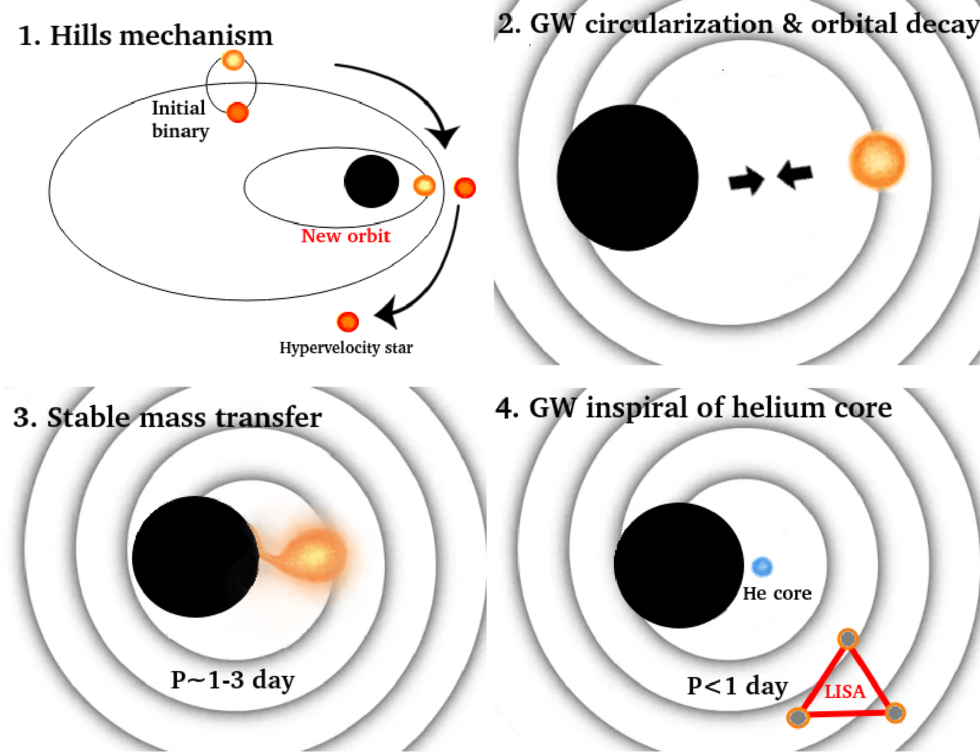
Diagram showing the evolutionary steps of a supermassive black hole capturing a subgiant star that subsequently undergoes mass transfer and gravitational wave-driven inspiral. Click to enlarge. [Olejak et al 2025]

Modeling a Subgiant Inspiral

Seeking to better predict what the gravitational waves of stellar EMRIs may look like and what LISA may detect, Aleksandra Olejak (Max Planck Institute for Astrophysics) and collaborators used stellar evolution code to simulate the evolution of a subgiant star as it transfers mass to a supermassive black hole and gravitational waves draw in its orbit. In their models, the supermassive black hole captures the star through scattering between stars or tidal interactions with a stellar binary in which the black hole catches one star and ejects the other.

Once the star is captured, its orbit becomes circularized around the black hole, pulled in closer over time until mass transfer of the star’s outer envelope begins. During this stage, the gravitational wave signal remains too weak to be detected. However, as the star is stripped down to just a helium core, it contracts and experiences an extended gravitational wave–driven orbital decay.

Possible Detections with LISA

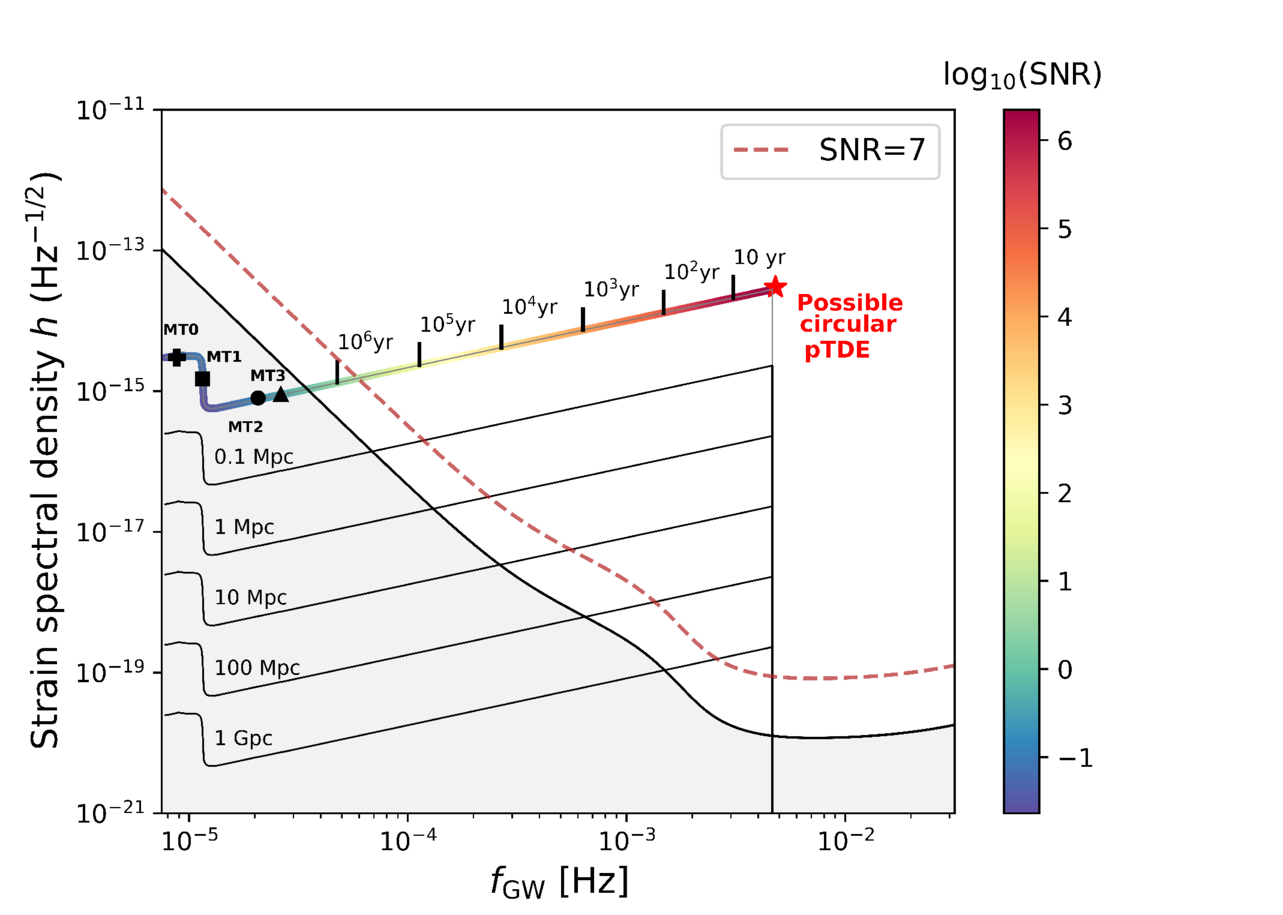
The strain spectral density as a function of the detected frequency of the gravitational wave. The colorful line indicates the signal from a stripped subgiant at the Milky Way’s center, and the gray lines are what would be observed at greater distances. LISA’s sensitivity to gravitational wave signals is shown with the black and red lines with detectable sources falling to the right of or above the line. Click to enlarge. [Olejak et al 2025]

With a better understanding of this process, the authors explored how such a signal compares to LISA’s sensitivity at various distances away from Earth. They found that as a star spirals inward, the gravitational wave signal grows stronger and enters LISA’s detectable frequency range. Stellar EMRIs occurring closer to Earth will result in higher signal-to-noise detections, and the gravitational waves from those occurring within the Milky Way would remain detectable for hundreds of thousands of years. The authors’ analysis revealed that, given their simulations, LISA could detect such an event out to ~3 billion light-years away. They estimate that a few systems involving similarly stripped subgiant stars could be detectable by LISA during a four-year mission, with a 1% chance of our galactic center hosting one.    

This study provides exciting potential for what is possible with LISA, and future detections of gravitational waves will shine further light onto the complicated dynamics of galactic centers and the evolution of stars around supermassive black holes.

Citation

“Supermassive Black Holes Stripping a Subgiant Star Down to Its Helium Core: A New Type of Multimessenger Source for LISA,” Aleksandra Olejak et al 2025 ApJL 987 L11. doi:10.3847/2041-8213/ade432

The post Supermassive Black Holes and Stripped Subgiants: Significant Signals for Future Gravitational Wave Detectors appeared first on AAS Nova.

❌