
 Login

Drawing Back the Curtain on Solar Spicules

The Sun’s surface is peppered with spikes of plasma called spicules that appear to shift and twist over time. Recent simulations suggest a new explanation for the motion of solar spicules.
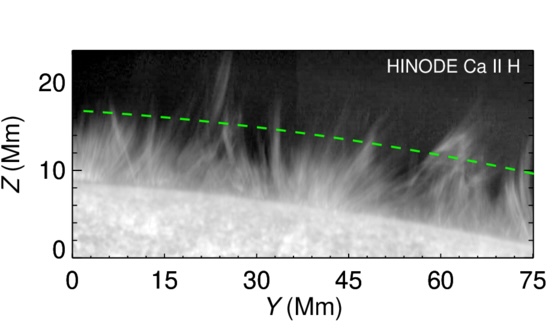
Solar spicules as seen by the Hinode mission. [Adapted from Dey et al. 2026]
Jets in Motion
Solar spicules are tiny jets of solar plasma that last just a few minutes. When viewed along the solar limb, spicules resemble blades of grass blowing in the wind. Observations show these structures moving in a variety of ways: twisting, shifting side to side, splitting, and joining together. Though spicules were first identified more than a century ago, where these motions come from is still up for debate.
In a recent research article, Sahel Dey (University of Newcastle; Indian Institute of Astrophysics; Indian Institute of Science) and collaborators performed 3D magnetohydrodynamics simulations to investigate the source of solar spicules’ motion. The team’s simulations encompassed a volume of 6,000 × 9,000 × 37,000 kilometers that stretched from beneath the visible surface of the Sun up to the lower region of the Sun’s outer atmosphere, or corona. In this region, they applied a uniform vertical magnetic field, mimicking the conditions within a coronal hole, where the Sun’s magnetic field streams outward into the solar system
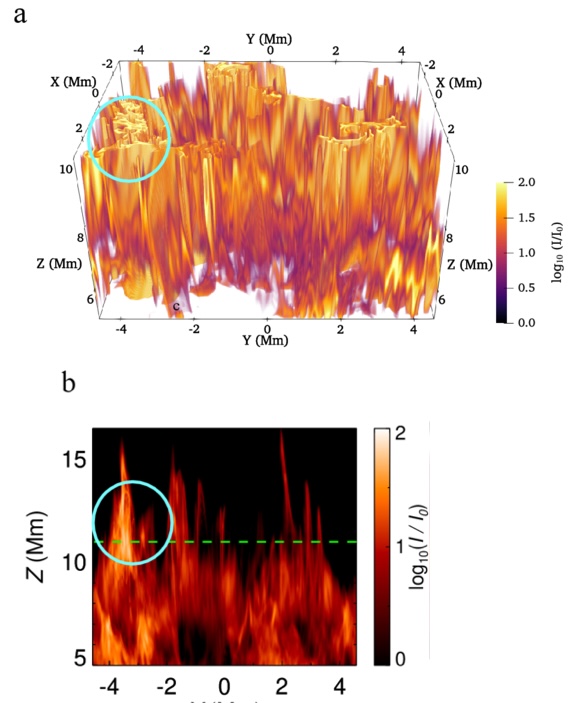
A) A three-dimensional view of simulated solar spicules, showing curtain-like structures. B) Intensity of synthetic emission from the spicules in panel A, integrated along the line of sight. The cyan circle indicates the same region in both panels. [Adapted from Dey et al. 2026]
Simulating Spicules
The jet-like appearance arises when this arrangement is viewed from the side; the team created synthetic images of their simulated spicules that show individual jet-like features. These “jets” have properties similar to those of real spicules, lasting just 5–10 minutes, journeying upward at 20–70 kilometers per second, and reaching heights of 6,000–16,000 kilometers.
These simulations clearly demonstrate that what appear to be individual jets can arise from curtain-like plasma structures. Dey and collaborators showed that this network of spicules evolves over time, buoyed upward from below by a series of shocks, pulled down gradually by gravity, and buffeted by adjacent plasma.
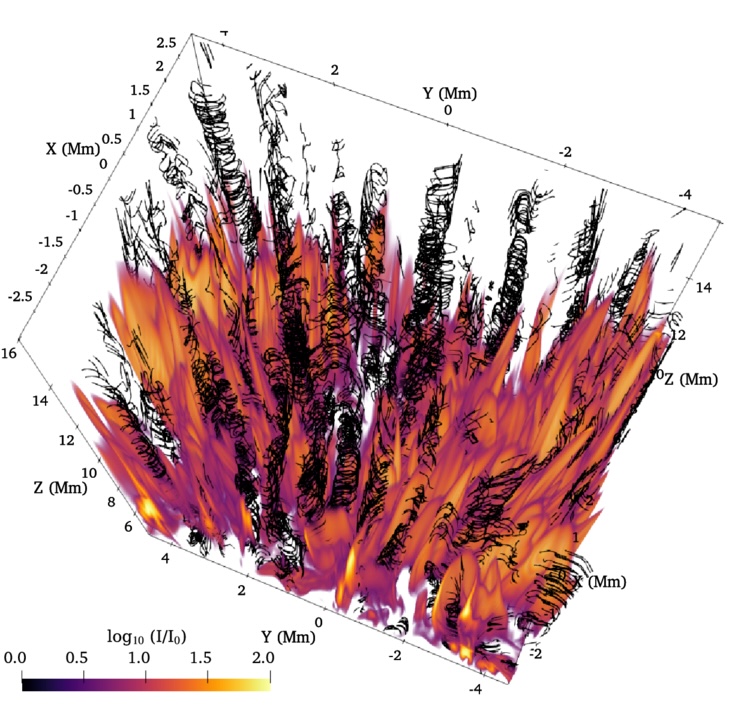
Three-dimensional view of spicules (purple–yellow regions) and coronal swirling conduits (represented by spiraling black lines). [Adapted from Dey et al. 2026]
This work demonstrates that a curtain-like configuration provides a viable explanation for the observed variety of spicule motions. Going forward, it will be critical to test this possibility further, as correctly interpreting the underlying structures of solar spicules is key to understanding how mass and energy are transferred to the solar corona.
Citation
“Solar Spicule Rotation Driven by Plasma Curtain–Vortex Interactions,” Sahel Dey et al 2026 ApJ 1008 132. doi:10.3847/1538-4357/ae8999
The post Drawing Back the Curtain on Solar Spicules appeared first on AAS Nova.
