❌

Normal view

Probing Dust in the Disk of a Growing Giant Planet

19 August 2026 at 17:00

ALMA observations of PDS 70

New research suggests that the circumplanetary disk surrounding the exoplanet PDS 70c contains a ring of dense dust, and the conditions within this ring may allow baby moons to form.

A Disk Within a Disk

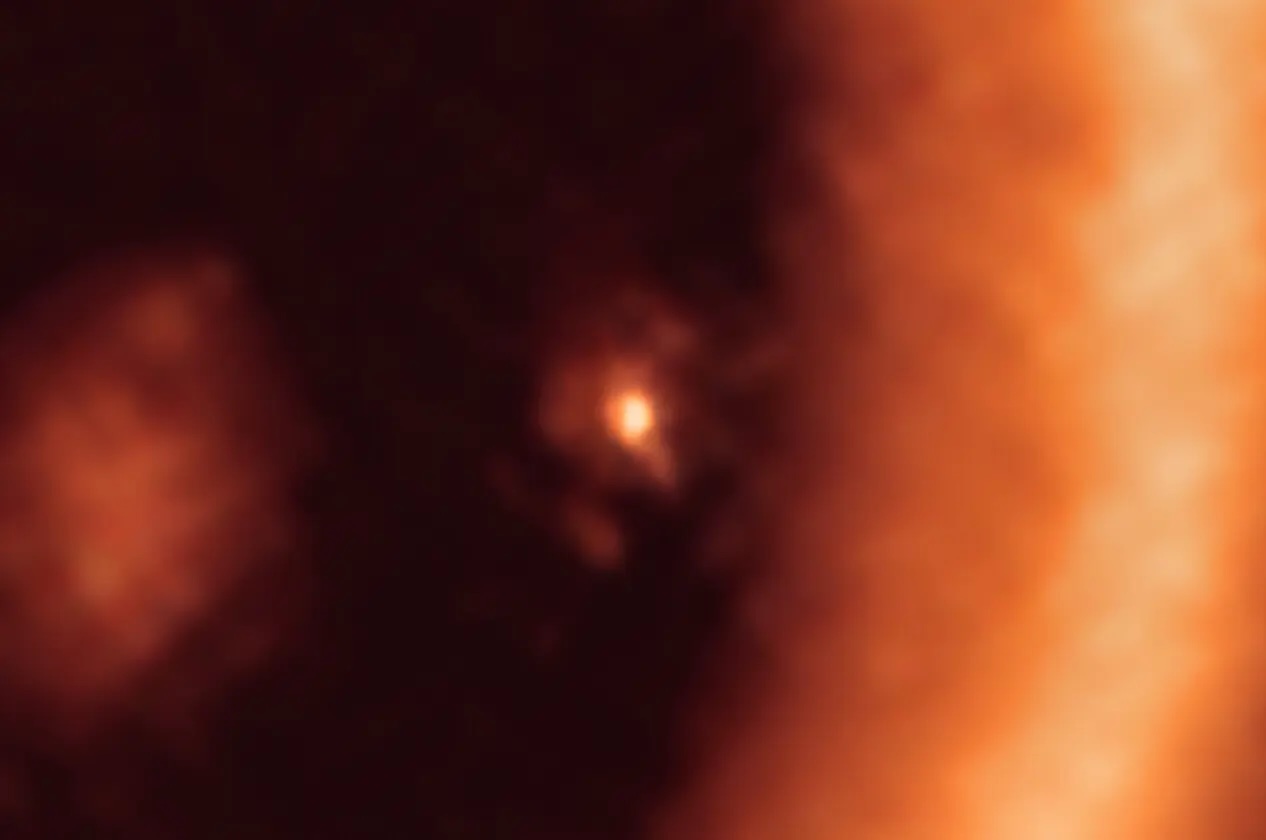
closeup of PDS 70c's circumplanetary disk

A closeup of PDS 70c’s circumplanetary disk within PDS 70’s protoplanetary disk. [ALMA (ESO/NAOJ/NRAO)/Benisty et al.; CC BY 4.0]

The young star PDS 70 has become famous for its protoplanetary disk and its two growing giant planets, PDS 70b and PDS 70c. At least one of these planets is surrounded by a disk of its own; in 2019, researchers using the Atacama Large Millimeter/submillimeter Array (ALMA) reported the first-ever observation of a circumplanetary disk around PDS 70c, and later observations with ALMA brought clearer views of this disk.

There’s still debate over the exact source of the emission detected by ALMA. Does this emission come from dust, and if so, how is the dust distributed? Is the disk optically thick or optically thin? Does the emission even come from dust, or could it instead be free–free emission from unbound electrons navigating a charged-particle maze?

Dust Diagnosis

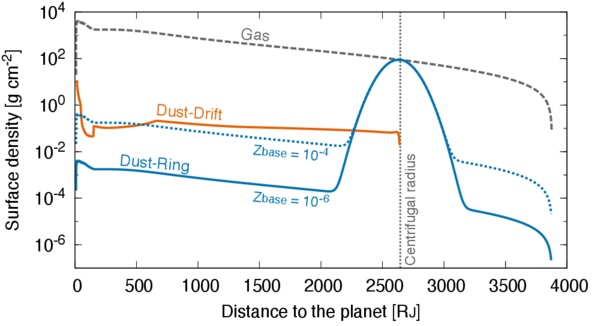
Yuhito Shibaike (Kagoshima University) and collaborators recently examined the hypothesis that the emission from PDS 70c’s circumplanetary disk arises from dust distributed in an optically thick ring. To test this hypothesis, the team explored two possible dust distributions, which they call “drift” and “ring.” In the drift model, dust grains within the circumplanetary disk migrate inward toward the planet, leaving much of the disk optically thin. Modeling suggests that this migration is typical in protoplanetary disks, and it might be common in circumplanetary disks as well.

plot of modeled dust distributions

Dust and gas surface density for the modeled disks in the drift (orange) and ring (blue) models. Click to enlarge. [Adapted from Shibaike et al. 2026]

In the ring model, the dust grains are concentrated within an optically thick ring at a certain distance from the planet. Simulations suggest that the formation of this type of dust ring is feasible, arising from a localized increase in gas density, outflows, or other causes.

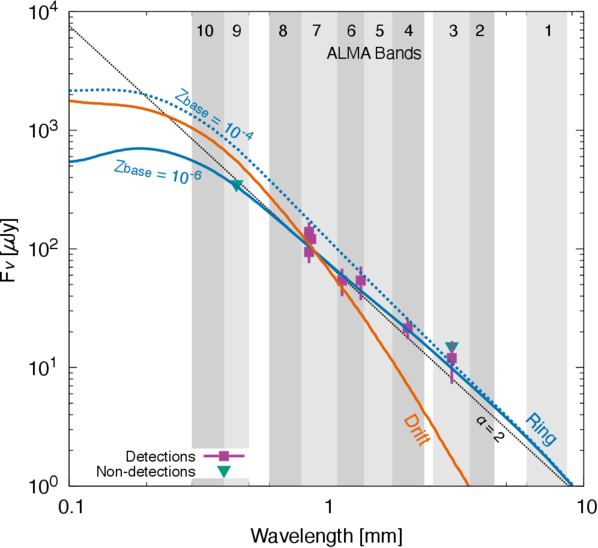
Shibaike and coauthors found that the ring model naturally reproduced the observed spectral energy distribution for a range of reasonable parameters. The drift model, on the other hand, required an unrealistically high dust-to-gas ratio for the material accreted onto the circumplanetary disk from the parent protoplanetary disk to reproduce the observed spectral index.

Future Prospects and Moon-Making Possibilities

comparison of ALMA observations and model predictions

Comparison of ALMA observations (colored symbols) and model predictions (colored lines) from the drift (orange) and ring (blue) models. Click to enlarge. [Adapted from Shibaike et al. 2026]

This work demonstrated the feasibility of the dust-ring model, but it didn’t rule out a contribution due to free–free emission from unbound electrons, which has also been proposed to explain the disk’s appearance. The team noted that distinguishing between thermal dust emission and free–free emission is challenging with existing data, as the two sources produce spectral energy distributions with similar shapes.

Luckily, this likely won’t remain a mystery forever: the next-generation Very Large Array, which is anticipated to begin full science operations in the mid-2030s, should be able to resolve the location of the dust within the circumplanetary disk and illuminate the source of emission.

Finally, if the dust surrounding PDS 70c is concentrated within a ring, what does that mean for the possibility of moons forming within the disk? Shibaike and collaborators found that the conditions within the ring likely satisfy the requirements of both the streaming instability and the gravitational instability, which are required for dust grains to clump together and form the rocky building blocks of baby moons. Perhaps the PDS 70 system will one day be the site of not only a circumplanetary disk, but an exomoon as well!

Citation

“Interpreting ALMA Multiwavelength Continuum Observations of PDS 70 c: An Optically Thick Dust Ring in the Circumplanetary Disk,” Yuhito Shibaike et al 2026 ApJL 1006 L26. doi:10.3847/2041-8213/ae86f5

The post Probing Dust in the Disk of a Growing Giant Planet appeared first on AAS Nova.

Noble Gases Along for the Ride

24 July 2026 at 17:00

A rendering of an orange and grey planet against a dark background.

What can some neon trapped in a chunk of rock tell us about Earth’s formation and the protosolar nebula? Quite a lot, as detailed in a recent study in The Planetary Science Journal.

Noble Mysteries

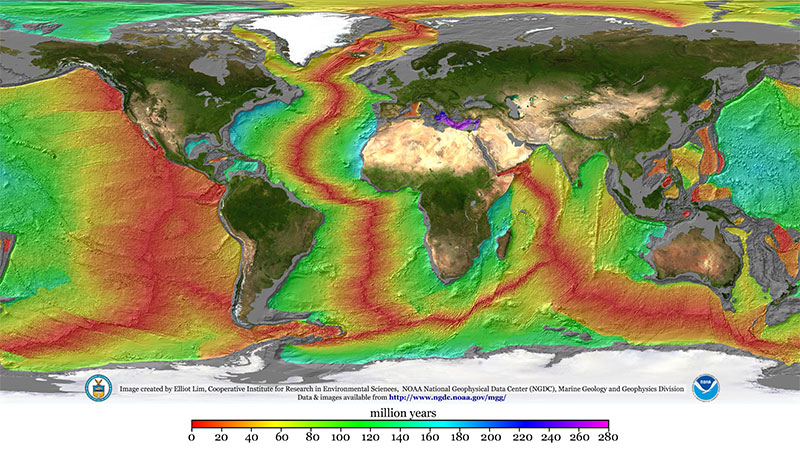
By analyzing rocks pulled from mid-ocean ridges, geologists have concluded that there are tiny amounts of noble gases in the deep interior of Earth. That’s a strange statement upon reflection: how did these gases, which are famously apathetic to essentially all other elements, end up embedded within rocks thousands of kilometers underground? Since their passivity rules out the potential of a chemical reaction that formed them in place, they must have been in the mantle since the very beginning of Earth’s history.

A map of Earth with the continents shown normally but the sea colored according to age.

A map illustrating the age of the seafloor. Mid-ocean ridges stand out clearly in red. By sampling material from these ridges, planetary scientists can infer the composition of Earth’s deep interior. Click to enlarge. [Mr. Elliot Lim, CIRES and NOAA/NCEI]

There are a few scenarios for how this could have happened. Though it’s possible that these inert species were delivered to the early Earth encapsulated within primitive meteorites or in solids contaminated by ions from the solar wind, at least some fraction of these elements likely came directly from the gaseous nebula that surrounded the earliest protoplanets.

That last option is especially exciting to present-day planetary scientists interested in constraining Earth’s formation history because it requires some very specific conditions. Since light noble gases like neon don’t dissolve well in seawater, they must have dissolved into a magma ocean — meaning the nebula was still around when Earth was large enough to have a molten surface. That already restricts us to a very specific time in the solar system’s history, but it doesn’t say much about the specific size of the proto-Earth other than “big,” and it doesn’t say much about the state of the nebula other than “it existed.” Recently, Vincent Savignac and Eve Lee (University of California, San Diego; McGill University) successfully refined these constraints to pin down information about both the early Earth and the nebula that surrounded it.

Infant Earths

Savignac and Lee began by growing a grid of infant Earths on their computers via models of gas accretion and atmosphere–magma interactions. Each simulation started with a different proto-Earth mass and nebular density, and each one yielded a different amount of neon in Earth’s deep interior. Excitingly, only a small handful of the scenarios tested ended up with values similar to those observed.

A cartoon of small cores surrounded by gaseous envelopes eventually merging into the Earth.

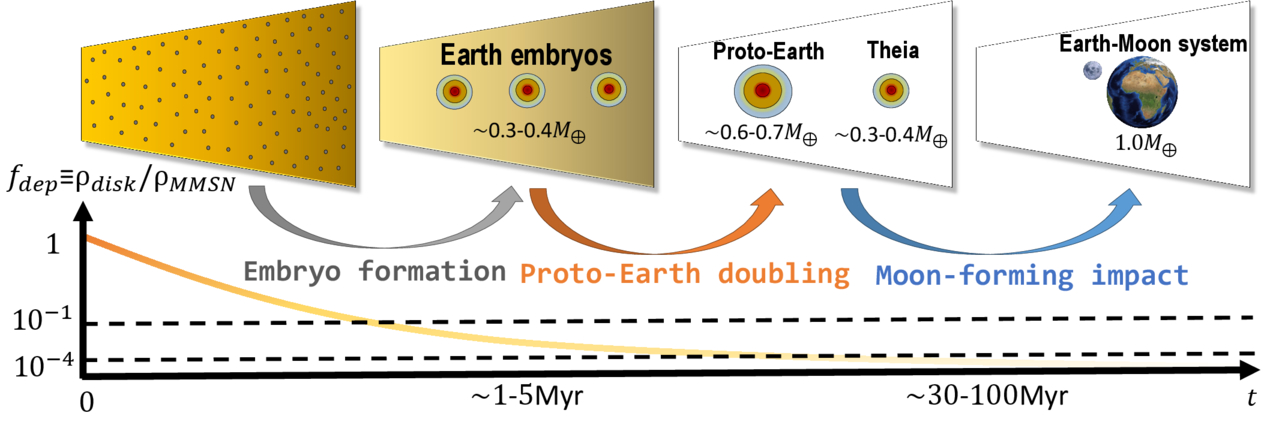
A schematic of Earth’s formation via embryo formation (when the noble gases enter the mantle) followed by mergers. Click to enlarge. [Savignac & Lee 2026]

On the mass axis, the team found a narrow range of acceptable conditions. If a proto-Earth was less than about 20% of Earth’s present-day mass, it couldn’t accrete much gas. This let it cool rapidly, freezing the magma ocean and shutting down neon dissolution before too much could be trapped inside. On the other hand, if a proto-Earth was more than about 40% of Earth’s present-day mass, it would accrete too much gas, stay molten for too long, and be left with too much neon. On the density axis, the researchers found that when the nebula accreted on to the proto-Earth, it must have been fairly depleted compared to its initial density. This implies that the whole process happened at the end of the nebula’s life, just before it was completely blown away by the proto-Sun.

Savignac and Lee demonstrated that these constraints are robust against the later stages of Earth’s evolution. In its later years, Earth either suffered or benefited from a giant impact, depending on your feelings about the Moon, but the researchers showed that this event doesn’t pose a problem for their models. Overall, this study builds a delightful link between rocks from our deep oceans and the particulars of Earth’s formation, demonstrating the unique power of planetary science to tie together different scientific fields.

Citation

“Constructing the Earth’s Formation History Using Deep Mantle Noble Gas Reservoirs,” Vincent Savignac and Eve J. Lee 2026 Planet Sci. J. 7 135. doi:10.3847/PSJ/ae64f7

The post Noble Gases Along for the Ride appeared first on AAS Nova.

Featured Image: Hubble Samples a Dusty Cosmic Sandwich

26 January 2026 at 17:00

protoplanetary disk IRAS23077+6707

Dracula's Chivito

Hubble Space Telescope image of Dracula’s Chivito. [Monsch et al 2026]

The disks of gas and dust that collect around young stars — protoplanetary disks — hold the secrets to how planets form. When a protoplanetary disk is tilted edge-on from our perspective, the disk’s dense, dusty midplane blocks the light from the star at the center, revealing structures like winds and jets wafting off of the disk. Pictured above and to the right is the spectacular edge-on protoplanetary disk IRAS23077+6707, which is also known as Dracula’s Chivito. (Delightfully, the name combines references to the backgrounds of two of the astronomers who identified the object as a protoplanetary disk: one hailing from Transylvania and another from Uruguay, where a sandwich called a chivito is the national dish.) Though the distance to this disk is not known, estimates place it around 1,000 light-years away, which would make the disk about 4,200 au across — larger than any other known protoplanetary disk. Recently, a team led by Kristina Monsch (Center for Astrophysics ∣ Harvard & Smithsonian) published their Hubble Space Telescope observations of Dracula’s Chivito. These observations show in great detail the structure within the disk, including large-scale asymmetries, wispy tendrils, and potential signs of dust grains settling toward the midplane. To learn more about this exceptional protoplanetary disk, be sure to check out the full research article linked below.

Citation

“Hubble Reveals Complex Multiscale Structure in the Edge-On Protoplanetary Disk IRAS23077+6707,” Kristina Monsch et al 2026 ApJ 996 45. doi:10.3847/1538-4357/ae247f

The post Featured Image: Hubble Samples a Dusty Cosmic Sandwich appeared first on AAS Nova.

Researchers Spot a Rare Glowing, Growing Planet

8 October 2025 at 17:00

WISPIT 2b

Have you ever eaten a meal so quickly that you started to glow? Although this behavior likely isn’t relatable for most humans, astronomers are beginning to find more and more baby planets doing just that.

Planetary Glow Up

Planets are, famously, quite large. But astronomers know that they don’t start out that way, and that instead, stars and planetary systems start as wispy collections of dust and gas. This raw material eventually compresses itself into stars and planets and life capable of contemplating such things, but how exactly that happens is not perfectly understood.

A colored-pencil drawing of gas flowing around a planet, with arrows noting the direction of the flow at various points.

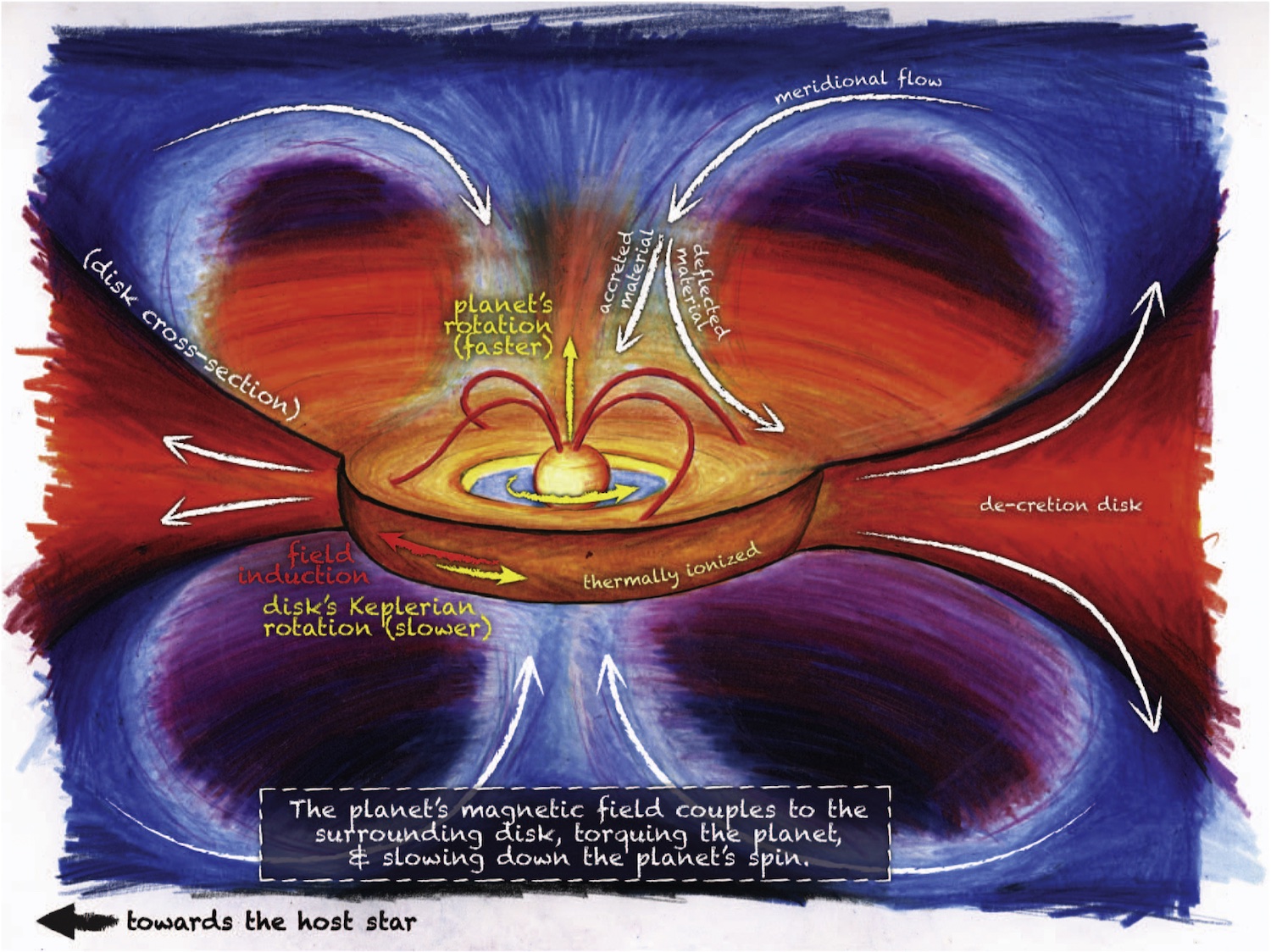
A schematic of some of the processes involved during giant planet formation. Click to enlarge. [Batygin 2018]

Astronomers have the broad contours sketched out at least. Protoplanets destined to become gas giants like Jupiter and Saturn start by gobbling up all the material around them and eventually clear out gaps in the disks in which they are born. What little material flows into these gaps gets sucked onto the planet in a process called accretion, though exactly where this material lands and how gravity and magnetic fields interact is up for debate.

A number of different mechanisms predict that during this process, the protoplanet should emit light at a certain frequency associated with electrons jumping between energy levels in hydrogen atoms — what astronomers call Hα emission. In other words, they should glow at that specific wavelength only when they are accreting, though how strongly and consistently will depend on exactly what is happening around the planet.

These ideas existed only on paper until 2019, when a team first observed two glowing, growing planets around the star PDS 70. Recently, however, a powerful new instrument has begun collecting data, and astronomers just announced it has found another similar protoplanet: WISPIT-2b.

A New Discovery

A team of researchers led by Laird Close (University of Arizona) announced the discovery of this new world after analyzing images taken with the powerful new MagAO-X instrument on one of the 6.5-meter Magellan telescopes in Chile. The team outfitted the camera with a narrow filter that only admitted the Hα emission associated with accretion, then collected thousands of images over about two hours in April 2025. After stacking and post-processing their data, a faint dot jumped out beside the central star, right in the gap between two bright rings in the star’s disk.

A bright dot beside fainter rings of material.

A follow-up image of WISPIT-2b taken with a broader filter. [Laird et al. 2025]

This protoplanet, which the authors name WISPIT-2b in honor of their Wide Separation Planets in Time (WISPIT) survey, is likely about five times the mass of Jupiter and only 5 million years old, making it a baby on astronomical timescales. Based on how strongly it’s glowing, the team estimates that it’s accreting the equivalent of about 100 times the mass of Phobos, Mars’s largest moon, each year. This process won’t continue forever, as eventually the remains of the star’s disk will disperse and the planet will have to go hungry.

This remarkable find is only the third protoplanet unambiguously found to be embedded within a disk, and the first to be found in the gap between rings in a disk. With MagAO-X collecting data and the WISPIT survey underway, we’re likely in store for many other discoveries in the coming years. With enough observations and examples of these growing worlds, astronomers will fill in their models of how exactly giant planets as we know them are formed.

Citation

“Wide Separation Planets in Time (WISPIT): Discovery of a Gap Hα Protoplanet WISPIT 2b with MagAO-X,” Laird M. Close et al 2025 ApJL 990 L9. doi:10.3847/2041-8213/adf7a5

The post Researchers Spot a Rare Glowing, Growing Planet appeared first on AAS Nova.

Escaping the Dust Trap: Simulations of Dust Dynamics in Protoplanetary Disks

25 July 2025 at 17:00

Through detailed simulations of gas and dust, a recent study revealed that the behavior of dust within protoplanetary disks is a bit more complex than previously assumed.

Dust Traps in Protoplanetary Disks

As a planet forms within a protoplanetary disk — dust and gas orbiting a new star — tidal interactions between the budding body and the dusty material surrounding it can create pressure bumps where dust builds up. These dust traps appear as rings in observations of protoplanetary disks.

Dust traps are thought to play a critical role in the disk’s evolution and the early stages of planet formation. Dust traps may prevent solid material from migrating inward, starving the inner disk and impeding planet growth interior to the trap. These reservoirs may also serve as a chemical barrier, keeping volatile materials like water from moving to the inner regions of a disk.

While a perfect dust trap completely isolates material from the rest of the disk, recent observations and 2D simulations have shown that dust traps may be a bit more permeable — leaking smaller sized grains, mixing material, and changing the disk’s appearance. However, these results only account for two dimensions of the complex three-dimensional environment in which dust traps reside. Thus, 3D hydrodynamical simulations are necessary to provide more realistic details of dust dynamics within planet-hosting protoplanetary disks. 

Dusty Simulations

Dust-gas density ratios for 3d models at 1500 orbits

Z-axis averaged dust–gas density ratios (top) and dust–gas surface density ratios for the 3D simulations after 1,500 orbits. For the simulations with higher diffusion and lower planet mass, there is clear leaking of dust beyond the dust trap ring (edges marked with dotted red lines). Click to enlarge. [Huang et al 2025]

In a recent study, Pinghui Huang (Chinese Academy of Sciences; University of Victoria) and collaborators performed multiple 2D and 3D numerical simulations of gas and dust within a protoplanetary disk with a forming planet. The simulations varied the mass of the planet and the level of turbulent diffusion — how well material and energy flow and mix within the gas. These variations allowed the authors to explore how dust traps behave within different types of systems. 

The simulations showed that the embedded planet will perturb the gas and dust, producing density shocks that create gaps and, subsequently, pressure bumps where dust traps coalesce. From their analysis, the authors found that dust traps become leakier at higher levels of diffusion and when the embedded planet is lower in mass. Essentially, if the gas flows and mixes more efficiently, the perturbations of the planet are erased more quickly, and if the planet is sufficiently small, its ability to disrupt the disk is much weaker. Dust remains coupled to the gas, flowing through these weak traps without becoming stuck. Additionally, the 3D simulations show higher amounts of leakage compared to the 2D simulations, which the authors attributed to the asymmetric and complex vertical geometry of the disk.

Trapping over time.

Flux-trapping ratio (left) and mass-trapping ratio (right) as a function of time for the 2D (top) and 3D (bottom) simulations. The higher-mass planet in Model A causes more flux and mass-trapping than the lower-mass planets and more turbulent systems. Additionally, the 3D simulations show significantly lower flux and mass-trapping than the 2D simulations. Click to enlarge. [Huang et al 2025]

Implications and Comparison to Observations

What then are the consequences of leaky dust traps? In planet formation theory, dust traps determine the mass at which a planet creates a sufficient pressure bump that isolates small pebbles and dust exterior to its orbit. For perfect dust traps, this isolation of material from the planet and inner disk creates a clear chemical distinction between the inner and outer disk. However, as shown by the 3D simulations, dust traps are imperfect, allowing small particles to filter through; the authors suggest this may mean that the growing planet slows but does not stop the migration of solid materials in a disk.

Recent observations of protoplanetary disks reveal the presence of larger volatiles within the inner disk. Specifically, the disk PDS 70 shows water emission in its inner disk despite having two confirmed giant planets orbiting in the outer disk. Without leaky dust traps, volatiles like water would be trapped in the pressure bumps created by these planets. However, as the authors have shown, the complex reality of dust dynamics within protoplanetary disks allows heavier elements to leak through, enriching the inner disk. Further observations and detailed 3D simulations will allow astronomers to understand the extent of leaky dust traps and reveal the realistic conditions driving early planet formation.

Citation

“Leaky Dust Traps in Planet-Embedded Protoplanetary Disks,” Pinghui Huang et al 2025 ApJ 988 94. doi:10.3847/1538-4357/addd1f

The post Escaping the Dust Trap: Simulations of Dust Dynamics in Protoplanetary Disks appeared first on AAS Nova.

Astronomers Spot Possible Disk in Rubin Observatory First-Look Image

16 July 2025 at 18:33

Lagoon and Trifid Nebulae

Editor’s Note: Shortly after the publication of this article, we became aware that the disk described in this work was previously discovered by Wei-Hao Wang, as reported in the Astronomer’s Telegram in July 2024.

On 23 June 2025, the public got its first look at images from the NSF–DOE Vera C. Rubin Observatory — and the discoveries are already starting to roll in.

Trifid and Lagoon

Trifid Nebula closeup

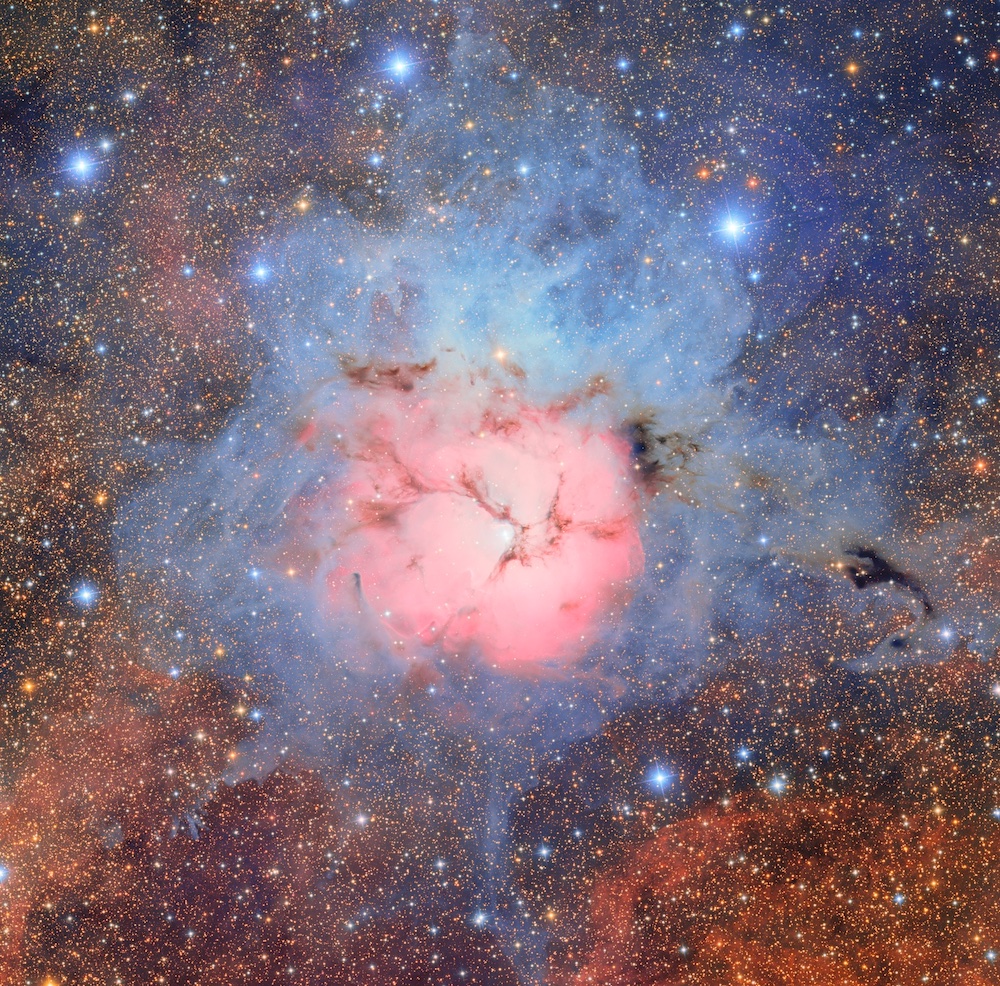
A closeup of the Trifid Nebula from one of the Rubin Observatory first-look images. [Adapted from NSF–DOE Vera C. Rubin Observatory; CC BY 4.0]

One of the first-look images from Rubin features two photogenic star-forming regions in the Milky Way: the Trifid Nebula (Messier 20) and the Lagoon Nebula (Messier 8). The image, which was constructed from 678 exposures totaling 7.2 hours of observations, demonstrates Rubin’s ability to quickly cover large swaths of sky.

The Trifid and Lagoon nebulae are both HII regions, making them ideal places to search for circumstellar and protoplanetary disks, as well as proplyds — protoplanetary disks that are in the process of being evaporated by the intense radiation from nearby massive stars. The glowing gas of an HII region provides the background illumination needed to pick out the silhouettes of dark and dusty disks.

disk candidate

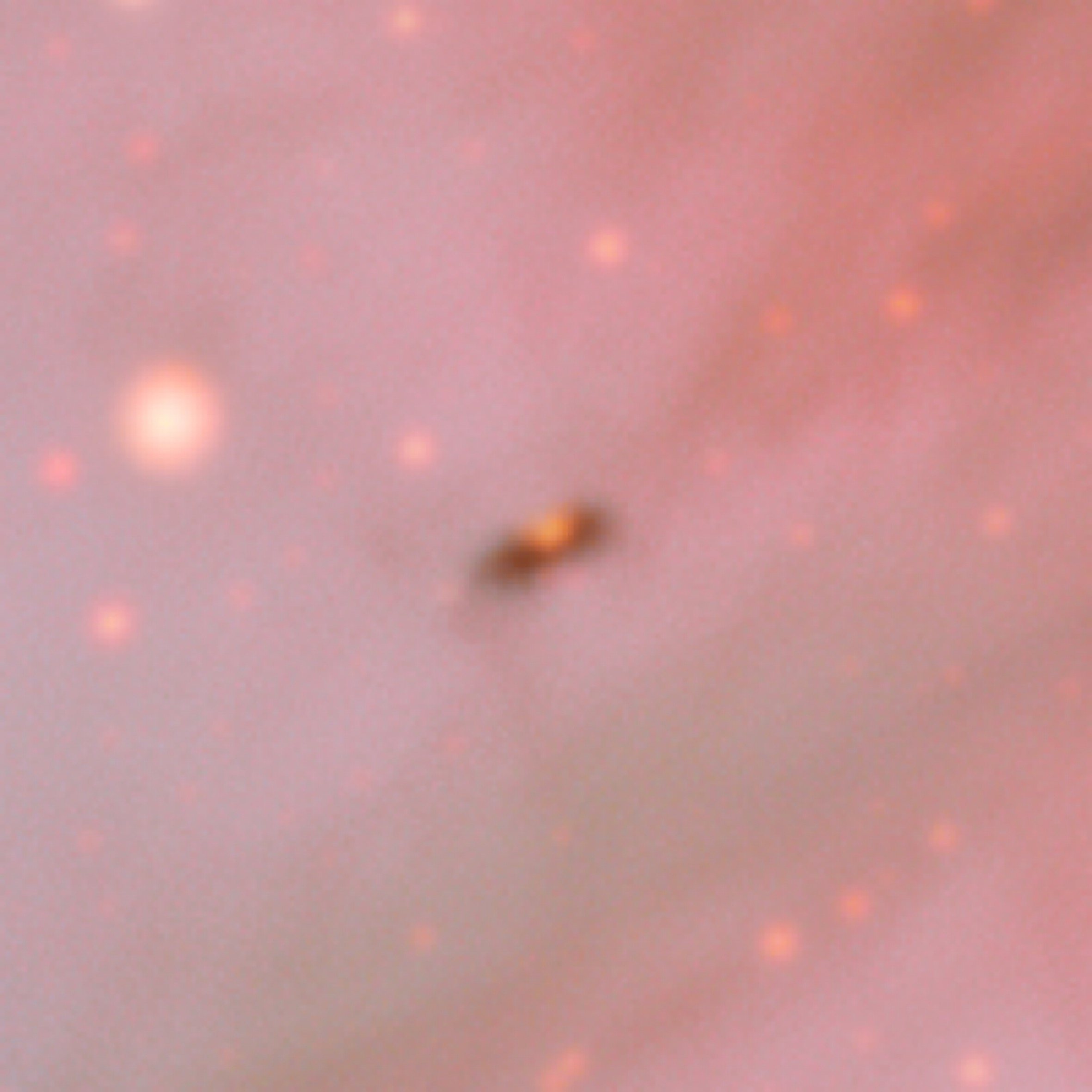
The Trifid Nebula disk candidate identified in this work. [Adapted from Zamani & Rector 2025]

Disk Detected

Published today in the Research Notes of the AAS, Mahdi Zamani (Zamani Scientific Visualizations & Imaging) and Travis Rector (University of Alaska Anchorage) reported the results of their search for proplyds in the Rubin image of the Trifid and Lagoon nebulae. The team detected one candidate circumstellar or protoplanetary disk on the edge of the Trifid Nebula, surrounded by tenuous, filamentary clouds of gas and dust.

The Rubin data don’t show evidence for ionized gas surrounding the disk, so it’s not yet clear if the object should be classified as a proplyd. The disk has a projected distance of 7.5 light-years from HD 164492A, the O-type star whose intense radiation is responsible for energizing the surrounding nebula, and may also be capable of ionizing the disk studied here.

Disk Detected

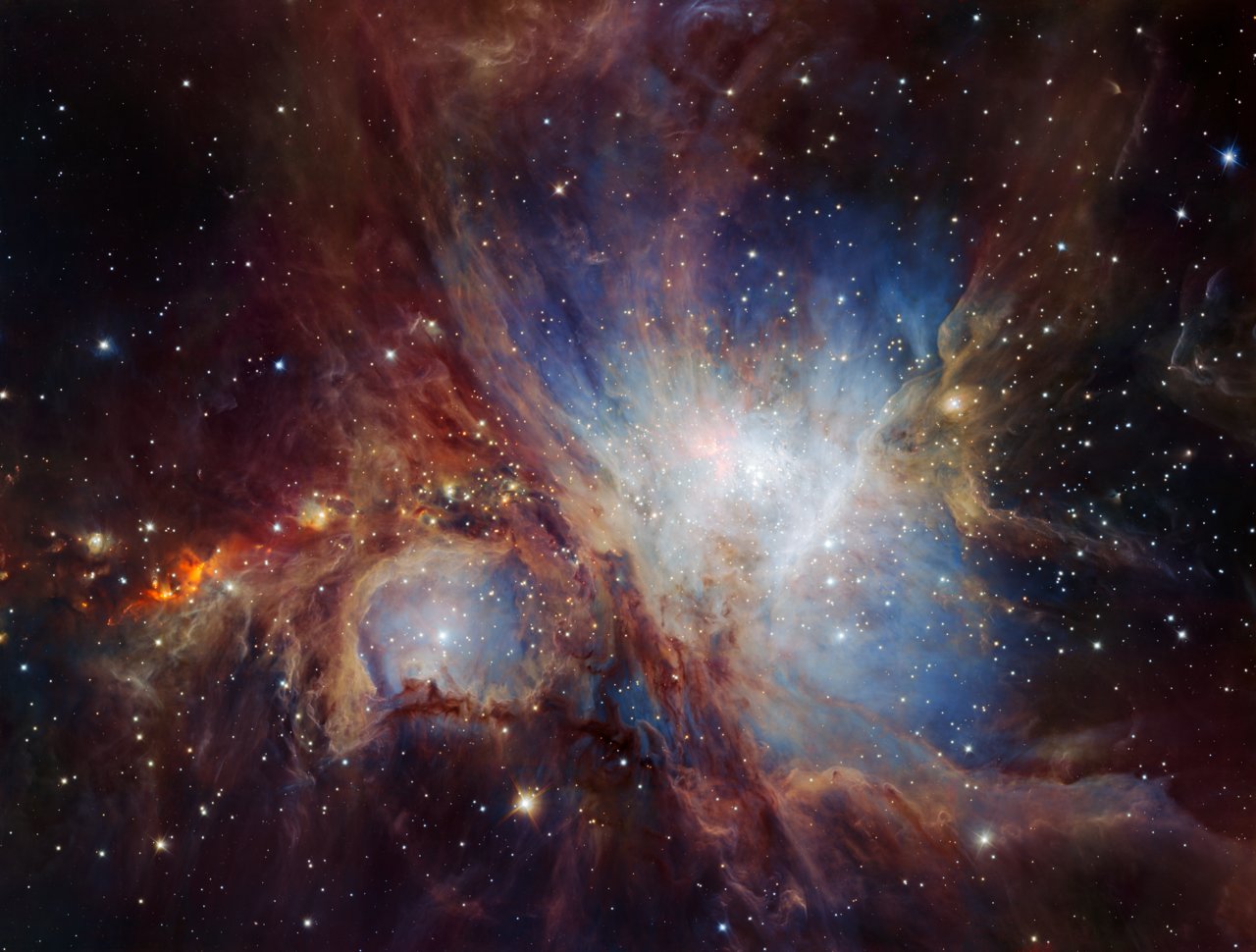
infrared image of the stars and protostars in the orion nebula

The Orion molecular cloud complex is among the most active star-forming regions in the Milky Way, home to hundreds of protostars and thousands of pre-main-sequence stars. [ESO/H. Drass et al.; CC BY 4.0]

This disk candidate is remarkable for both its size and location. With an estimated diameter of 4,000 au, it’s larger than most known circumstellar disks. Finding a disk outside the nearby Orion Nebula is also comparatively rare, since searches in more distant star-forming regions require finer resolution than the nearby Orion Nebula. (Orion is about 1,300 light-years away, and the Trifid Nebula is about 4,000 light-years away.)

Researchers have searched the Trifid Nebula previously for signs of protoplanetary disks, but while those searches found evidence for disks around hot stars near the center of the cluster, this particular disk candidate went undetected. Previous searches likely didn’t cover a large enough area of the nebula, or perhaps lacked the resolution needed to differentiate between the dusty disk and the nearby filamentary gas clouds. With Rubin’s broad field of view and precise resolution, the observatory was well-positioned to spot this disk candidate.

Citation

“The Potential Discovery of a Circumstellar Disk in M20 from Rubin First Look,” Mahdi Zamani and T. A. Rector 2025 Res. Notes AAS 9 172. doi:10.3847/2515-5172/ade982

The post Astronomers Spot Possible Disk in Rubin Observatory First-Look Image appeared first on AAS Nova.

Monthly Roundup: A Deep View of Planet-Forming Disks with ALMA

28 May 2025 at 17:00

radio images of eight protoplanetary disks

Protoplanetary disks, the sites of planet formation around young stars, are rich and complex objects. An in-depth investigation of 15 protoplanetary disks has recently been published in a Focus Issue of the Astrophysical Journal Letters. This investigation leveraged the exquisite resolution and sensitivity of the Atacama Large Millimeter/submillimeter Array (ALMA), a moveable network of 66 radio dishes in the Atacama Desert in Chile.

Featuring high-resolution observations of multiple gas species, updated image processing techniques, and state-of-the-art modeling, the exoALMA project examines the early stages of planet formation, when protoplanets embedded within dusty disks induce rings, gaps, spirals, and other structures.

This Monthly Roundup consists of quick snippets describing each of the currently published research articles in the exoALMA Focus Issue of the Astrophysical Journal Letters. Each snippet links to the corresponding research article, and the Focus Issue landing page is linked at the bottom of this post.

Introducing exoALMA

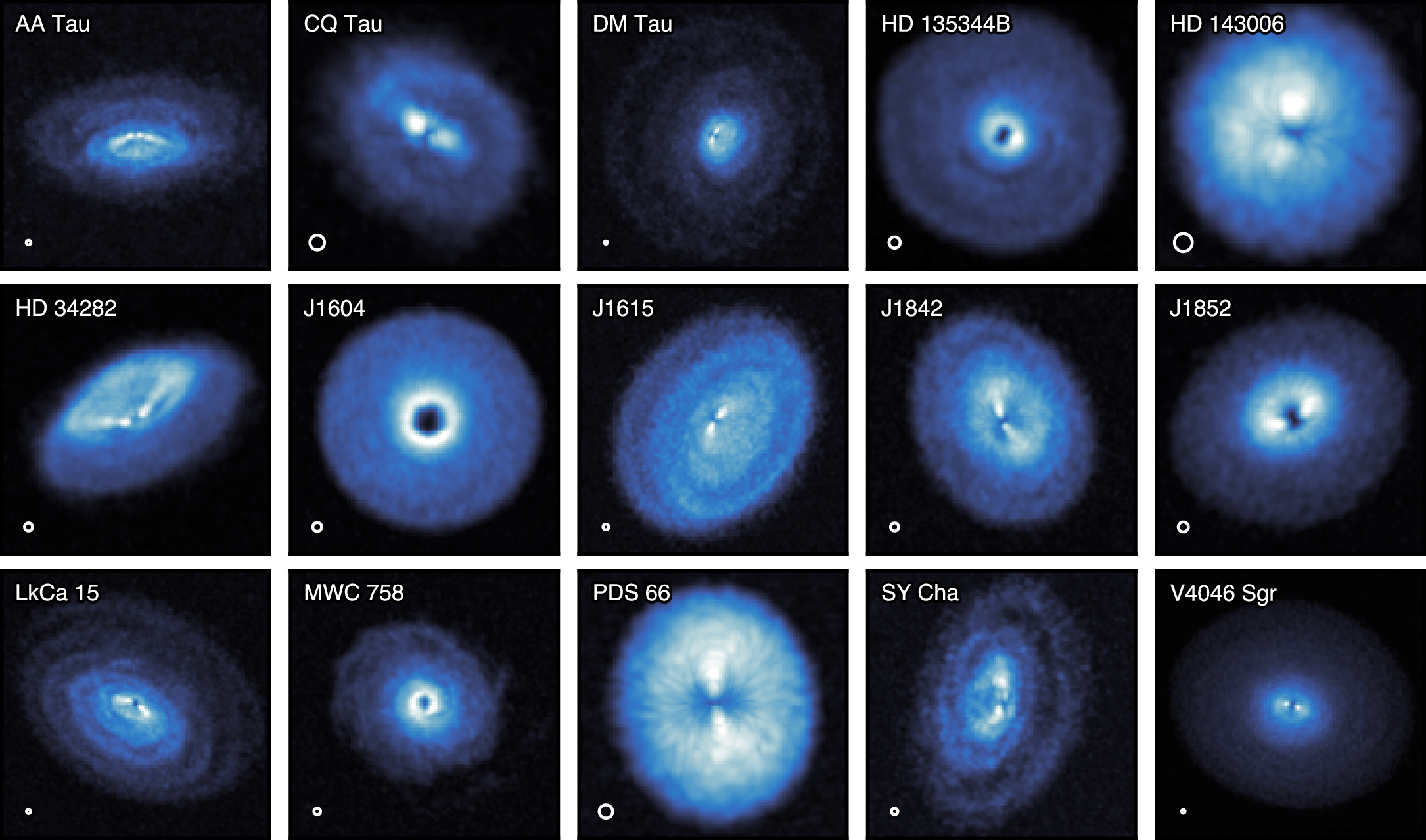
exoALMA disks

The full exoALMA sample. All 15 disks show evidence of substructure in their gas emission. [Teague et al. 2025]

First up, exoALMA project PI Richard Teague (Massachusetts Institute of Technology) and collaborators introduced the survey, the disk sample, and the science goals. The team mapped the dust and gas distributions of 15 protoplanetary disks that were selected for their brightness, large size, lack of obscuration, and low inclination angles. The three key science goals were to 1) detect protoplanets hidden within the disks, 2) study the disks’ dynamical structures, especially as these structures relate to instabilities that can perturb the disks and determine their lifetimes, and 3) determine the disks’ density and temperature structure.

Interpreting interferometric data from ALMA requires special care, as Ryan Loomis (National Radio Astronomy Observatory) and coauthors show in their overview of the data calibration and imaging pipeline. The team described their methods of processing the data, including a recently developed alignment method that greatly reduces the number of artifacts that could be mistaken for planet-induced velocity perturbations.

plot of emitting surface of J1615

Emitting height from images processed using the standard method (CLEAN) and using regularized maximum likelihood (RML). [Adapted from Zawadzki et al. 2025]

Although extreme care was taken not to introduce spurious signals through the calibration process, it’s critical to perform additional tests to confirm that detected signals are real, rather than artifacts. To that end, Brianna Zawadzki (Wesleyan University) and coauthors presented exoALMA images processed with a procedure called regularized maximum likelihood. The regularized maximum likelihood–processed images showed the same non-Keplerian features as the images processed with the standard algorithm, suggesting that these features are real.

Analysis Methods and Toolkit Testing

Analyzing observations of protoplanetary disks is challenging, motivating Thomas Hilder (Monash University) and collaborators to take the first step toward addressing issues like beam smearing, the creation of probabilistic data products, and incorporating a realistic noise model. Using their newly developed methods, the team analyzed several disks in the exoALMA sample, finding velocity substructures at greater velocities than existing methods.

Vertical structure and Keplerian rotation of the exoALMA sample

Vertical structure and Keplerian rotation of the exoALMA sample as inferred from modeling. Click to enlarge. [Izquierdo et al. 2025]

Andrés Izquierdo (University of Florida; Leiden University; European Southern Observatory) and collaborators described their methodology for investigating gas structure in the exoALMA sample. The team’s fitting method allowed them to separate the contribution of a disk’s front and back sides from the rest of its emission, leading to estimates of the orientation and vertical profile of each disk.

Jaehan Bae (University of Florida) and collaborators drew attention to the tools astronomers use to interpret observations of protoplanetary disks — namely, forward models. Bae’s team used five different hydrodynamics models to simulate a protoplanetary disk harboring an embedded giant planet. Then, they used two radiative transfer models to simulate carbon monoxide channel maps and calculate the temperature of the disk. Finally, they extracted the location of the synthetic planet. This investigation ultimately showed good agreements between the model outputs, showing that any combination of the models tested in this work is suitable.

plots of nonaxisymmetry of the exoALMA sample

Residual signal-to-noise ratio for the exoALMA sample, ordered from least to most nonaxisymmetric. Rings and gaps are marked with solid and dashed ellipses, respectively. Click to enlarge. [Curone et al. 2025]

Seeking Structure

A team headed by Pietro Curone (University of Milan; University of Chile) examined the rich ALMA dataset for signs of structure within the disks. The team modeled each disk with an axisymmetric model, then subtracted off the best-fitting model to reveal substructures and asymmetries in the disks. Several features were revealed, including shadows, offsets between inner and outer disks, spiral structures, and crescent-shaped asymmetries. Though one disk, PDS 66, was apparently without any internal structure, this investigation showed that structures are common in this sample of large, bright disks. Further work is needed, however, to explore whether these features are common in the disk population as a whole.

Maria Galloway-Sprietsma (University of Florida) and collaborators identified the disk surfaces that emit particular spectral lines. The team found that 12CO traced the upper atmosphere of the disks, while 13CO — an isotopologue of the more common molecule 12CO — and CS (carbon monosulfide) probed deeper regions. In addition, nearly all of the disks showed evidence of localized substructure, highlighting the need for theoretical work to explain the wide variety of disk structures and behaviors.

Evidence for Planets

exoALMA images of disks with velocity kinks due to the presence of a planet

From top to bottom: velocity kinks associated with an embedded planet; 12CO observations with the identified velocity kinks; filtered ALMA observations, showing the location of the planetary wake; exoALMA continuum emission; and polarimetric images. The blue circles show the locations of the purported planets. Click to enlarge. [Pinte et al. 2025]

Christophe Pinte (University Grenoble Alpes; Monash University) and collaborators analyzed substructures revealed by 12CO emission. These images revealed arcs, spiral arms, and kinks in 13 out of the 15 disks in the sample. Of these, six were consistent with wakes forming due to planets with masses between 1 and 5 Jupiter masses orbiting at 80–310 au.

Charles Gardner (Rice University; Los Alamos National Laboratory) and coauthors focused on LkCa 15, a disk that appears markedly different in dust and gas emission. The disk’s dust continuum emission shows a 40-au-wide region depleted of dust, while the gas emission, traced by CO, shows no depletion of gas in the same region. Though previous infrared observations have suggested that this dust-depleted region could host massive planets, Gardner’s team concluded that a chain of small planets or processes unrelated to planet formation likely excavated the region instead.

A team led by Jochen Stadler (Côte d’Azur University) searched for deviations from Keplerian rotational velocity — potential evidence for embedded protoplanets. The team discovered deviations up to 15% from the background velocity, with deviations appearing at both large and small radial scales. Rings and gaps visible in the dust emission tended to align with gas pressure maxima and minima, respectively. However, the team also found gas pressure structures in the outer disk that were beyond the dust emission and were not accompanied by rings or gaps.

Comparison of kinematic and emission-line-derived masses for the exoALMA sample

Comparison of kinematic and emission-line-derived masses. Click to enlarge. [Trapman et al. 2025]

Masses and Abundances

A team led by Cristiano Longarini (University of Cambridge; University of Milan) put the disks of the exoALMA sample on the scale. By modeling the rotation curves of 12CO and 13CO, the team constrained the masses of 10 disks and their central stars. Leon Trapman (University of Wisconsin-Madison) and collaborators also considered the problem of disk masses. The team used CO and N2H+ emission to measure the gas masses of 11 disks in the exoALMA sample and compared the results to previous kinematic measurements. The two sets of measurements tend to agree within a factor of three.

Giovanni Rosotti (University of Milan) and collaborators introduced a new model that connects the emitting height of CO molecules to the gas surface density and temperature. Unlike existing models, the team’s new model can be applied to optically thick observations. Comparing the results of this new method with dynamical estimates relying on interstellar medium abundances of CO yields lower gas masses, suggesting that the CO abundance in the protoplanetary disks studied is depleted relative to the interstellar medium.

Turbulence, Traps, and Vortices

Protoplanetary disks are expected to experience turbulence, large-scale gas motions, and instabilities. Marcelo Barraza-Alfaro (Massachusetts Institute of Technology) and collaborators investigated whether a program like exoALMA could detect signs of these processes at work. The team used 3D numerical simulations to explore the observational signatures of the vertical shear instability, the magnetorotational instability, and the gravitational instability. They found that rings, arcs, and spirals can arise from instabilities. While spirals present in the disks in the exoALMA sample could feasibly be due to the magnetorotational instability or the gravitational instability, ring-like and arc-like features due to the vertical shear instability were not detected.

Tomohiro Yoshida (National Astronomical Observatory of Japan; The Graduate University for Advanced Studies) and collaborators reported on their detection of pressure-broadened emission-line wings in RX J1604.3−2130 A. This detection allowed the team to constrain the disk’s gas surface density — a critical property related to the mass available to form planets. They also clearly showed a dust ring coinciding with a gas pressure maximum, proving that gas pressure maxima can create dust traps. The gas-to-dust surface density ratio at the location of this dust trap suggests that the disk has already birthed protoplanets or the dust trapping efficiency is low.

dust crescents in four protoplanetary disks

Locations of crescent-shaped dust clumps in the four disks from this study. Click to enlarge. [Adapted from Wölfer et al. 2025]

Vortices are theorized to shepherd dust grains into crescent-shaped traps, providing an environment for dust grains to clump together and grow into planetesimals and eventually planets. Lisa Wölfer (Massachusetts Institute of Technology) and collaborators searched for kinematic signatures of dust-trapping vortices in CO line emission from four disks that exhibit crescent-shaped concentrations of dust. None of the four disks exhibited the clear signature of a vortex, and higher-resolution data or observations of emission lines that trace motions closer to the midplane of the disk may be necessary to probe this signal further.

The full list of articles in this Focus Issue can be found here.

Citation

“exoALMA. I. Science Goals, Project Design, and Data Products,” Richard Teague et al 2025 ApJL 984 L6. doi:10.3847/2041-8213/adc43b

The post Monthly Roundup: A Deep View of Planet-Forming Disks with ALMA appeared first on AAS Nova.

Winds, Jets, and Wigglings from Young Stars and Their Disks

14 May 2025 at 17:00

protoplanetary disk HH 30

New JWST observations provide a detailed look at the jets of four young stars, revealing shocks, mass loss, and wiggly behavior that hints at a hidden binary companion.

Taurus star-forming region

A portion of the Taurus star-forming region. [ESO/Digitized Sky Survey 2. Acknowledgement: Davide De Martin; CC BY 4.0]

From Cloud to Star to Planetary System

The transformation from a turbulent cloud of hydrogen gas to a star circled by planets is complicated. As stars coalesce from their natal clouds, they gather gas from their surroundings and flatten it into a dense, dusty disk. While feeding on the gas from this disk, young stars launch powerful, narrow jets and broad, slower-moving winds. As accretion slows, planets begin to form, getting their start from clumps of dust grains.

In a recent research article, JWST observations give insight into the details of this process, illuminating the winds and jets of the disks surrounding young stars.

JWST’s View

Naman Bajaj (Lunar and Planetary Laboratory, The University of Arizona) and collaborators investigated four protoplanetary disks with JWST’s Near Infrared Spectrograph (NIRSpec). The four disks — Tau 042021, HH 30, FS Tau B, and IRAS 04302 — reside in the Taurus star-forming region, which is 1–2 million years old and roughly 450 light-years away.

JWST images of four protoplanetary disks

JWST images of the four disks as seen in a selection of emission lines. Green contour lines show the location of continuum emission. [Adapted from Bajaj et al. 2025]

Each of these disks displays narrow jets that emerge perpendicularly above and below the disk, nested within broad, cone-shaped winds. The disks were selected for their edge-on appearance, which highlights the jets and winds that emerge from the disk.

Bajaj’s team identified more than 40 emission lines for each disk, allowing them to determine the properties of the jets, such as the density and shock speed. One important aspect that can be gleaned from these observations is an estimate of the mass carried away by the jets. Using three independent methods, the team found that jet mass-loss rates for the four disks was on average a billionth of a solar mass per year.

The Wiggly Jet of Tau 042021

Observed locations of the center of the redshifted and blueshifted jets (circles) as well as a fit to a binary orbit model (green dashed line). [Bajaj et al. 2025]

Though appearing to jut straight out from the disk, each of the jets studied showed signs of side-to-side wiggles. Tau 042021’s jets are especially interesting, displaying mirror-symmetric wiggling, in which the redshifted and blueshifted wiggles mirror one another. At present, the only explanation for these synchronized wiggles is a binary companion. By modeling the jet wiggles as emanating from a star in a binary system, the authors concluded that Tau 042021 likely contains a 0.33-solar-mass star and a 0.07-solar-mass star in a 2.5-year orbit with a separation of 1.35 au.

Bajaj and coauthors presented a rich dataset that illuminates the behavior of jets from young stars, and their work isn’t yet done; this is the second research article the team has produced from these data, and more are in the works.

Citation

“Class I/II Jets with JWST: Mass-Loss Rates, Asymmetries, and Binary-Induced Wigglings,” Naman S. Bajaj et al 2025 AJ 169 296. doi:10.3847/1538-3881/adc73c

The post Winds, Jets, and Wigglings from Young Stars and Their Disks appeared first on AAS Nova.

❌