Login
How to Choose a Modern SEO Agency in 2026: Beyond Blue Links to Dual Visibility
17 September 2026 at 06:08
Selecting a search partner in 2026 requires evaluating far more than traditional keyword rank tracking and basic content


Count AI marketing's hidden rework and maintenance costs before claiming efficiency gains, or risk repeating programmatic's mistake and starving long-term strategy.
The post AI Isn’t Delivering Marketing Efficiency, It’s Repeating Programmatic’s Broken Promise appeared first on Search Engine Journal.
Nordic Spirit has partnered with Co-op Live, one of the UK’s major entertainment venues, in a move that puts a nicotine pouch presence in the UK inside a high-profile live entertainment environment.
The partnership is particularly notable because the UK’s rules governing the advertising and sponsorship of nicotine products are about to change significantly. The Tobacco and Vapes Act 2026 introduces a much broader framework covering the promotion and sponsorship of vaping and nicotine products, with the government intending the new advertising and sponsorship restrictions to take effect on June 1, 2027.
That makes the timing of the Nordic Spirit and Co-op Live deal more interesting than a conventional venue partnership. It arrives during a period when nicotine brands are still able to operate within the existing rules, while preparing for a substantially more restrictive marketing environment.
Nordic Spirit, a nicotine pouch brand, has entered into a partnership with Co-op Live that gives the brand a presence at the Manchester entertainment venue.

Rather than being simply a retail arrangement, the partnership places Nordic Spirit within an entertainment setting where brand visibility and audience engagement are important parts of the commercial relationship.
For Nordic Spirit, the deal provides another way to establish brand awareness among adult nicotine consumers . For Co-op Live, the agreement represents a commercial partnership with a nicotine brand during a period of significant regulatory change across the UK nicotine market.
The timing is therefore an important part of the story.
The UK nicotine market is approaching a major change in how products can be promoted.
The Tobacco and Vapes Act 2026 extends advertising and sponsorship restrictions to nicotine products as well as vaping products. The government’s Department of Health and Social Care says it intends the comprehensive advertising and sponsorship ban to begin on June 1, 2027.
The legislation goes beyond traditional advertising. Section 131 covers sponsorship agreements involving vaping products and nicotine products where contributions are made under an agreement and activities resulting from that agreement promote those products in the UK.
This is important because sponsorship is different from placing a conventional advertisement in a newspaper or on a website.
A sponsorship arrangement can connect a brand with a venue, event, sports organisation or other public-facing activity. Under the new framework, those relationships can therefore become subject to much greater scrutiny when they promote a nicotine product.
The new law represents a substantial expansion of the UK’s approach to nicotine marketing.
The government says the future restrictions will cover advertising, promotion and sponsorship involving vaping and nicotine products. They are intended to apply across the UK.
The legislation also makes clear that sponsorship restrictions can apply when a sponsorship agreement results in activities intended to promote a vaping or nicotine product.
That distinction matters for businesses because the question is not simply whether a company has purchased a conventional advertisement.
The wider issue is whether a commercial arrangement results in promotional activity for a product that falls within the scope of the legislation.
Not necessarily.
This is an important distinction that should not be overlooked.
The government has stated that it intends the comprehensive advertising and sponsorship restrictions to come into force from June 1, 2027. However, the explanatory notes to the legislation state that the commencement of Section 131 is to be specified by regulations.
That means it would be inaccurate to conclude simply that the existing Nordic Spirit and Co-op Live partnership is already prohibited.
Instead, the more useful question is how the arrangement will be treated as the new rules take effect and whether any existing contractual or promotional activity needs to change.
The final practical impact will depend on the commencement regulations, implementation details and guidance available to businesses.
The Nordic Spirit deal illustrates a broader issue in the nicotine industry.
For years, brands have used different forms of visibility to establish consumer awareness, including retail presence, digital communication, events and sponsorships.
The upcoming UK restrictions could significantly reduce the number of channels available for commercial promotion.
That makes existing partnerships particularly interesting.
A venue partnership can involve more than a logo on a wall. Depending on the agreement, it may include branded areas, promotional material, digital exposure, event-related activity or other forms of brand association.
Under a regulatory framework that specifically addresses sponsorship and promotion, businesses will need to assess those elements individually rather than treating the entire arrangement as a simple advertising purchase.
Nicotine pouches have also become increasingly visible in the UK nicotine market.
Unlike traditional tobacco products, nicotine pouches do not contain tobacco. However, the Tobacco and Vapes Act 2026 specifically brings nicotine products within the broader advertising and sponsorship framework. The government’s explanatory notes describe the new rules as extending advertising, promotion and sponsorship restrictions to nicotine products as well as vape aerosol products.
This is a significant development for pouch brands.
It means that the industry’s marketing environment cannot be assessed only by looking at traditional tobacco regulations. Companies selling nicotine pouches will also need to consider the new restrictions that apply specifically to nicotine products.
The government has also announced separate changes affecting the sale and promotion of vaping and nicotine products. From October 29, 2026, new age-of-sale and related restrictions will apply, including restrictions on free distribution intended to promote vaping or nicotine products.
The Nordic Spirit and Co-op Live agreement may become a useful example of the transition taking place in the UK nicotine market.
For brands, the challenge will not simply be finding another advertising channel. Companies will need to reconsider how they build awareness when conventional promotional and sponsorship opportunities become more restricted.
For venues and commercial partners, the issue is equally important.
A partnership involving a nicotine company may require closer review of branding, promotional activity, event integration and contractual obligations. The regulatory question may extend beyond the presence of a brand name to what consumers actually see or experience as a result of the commercial relationship.
That could make compliance more complicated than simply removing an advertisement.
For adult consumers, the most relevant point is that the nicotine pouch market is entering a period of significant regulatory transition.
The Nordic Spirit and Co-op Live partnership itself is only one commercial arrangement. Its wider significance comes from the timing: it demonstrates how nicotine brands are continuing to explore mainstream commercial partnerships while the UK is preparing to impose broader restrictions on advertising and sponsorship.
The government says the future restrictions are designed to reduce the promotion of nicotine and vaping products, particularly in the context of protecting younger people from exposure to marketing.
As implementation approaches, businesses will need to understand not only what products they can sell, but also how those products can legally be promoted.
The Nordic Spirit and Co-op Live partnership is noteworthy because it sits directly within a changing UK nicotine marketing landscape.
The agreement does not, by itself, mean that the partnership is already prohibited. Instead, it highlights the transition from today’s rules toward a system in which advertising and sponsorship of nicotine products are expected to face much tighter restrictions.
The UK’s Tobacco and Vapes Act 2026 provides the legal framework for that change, while the government currently intends the wider advertising and sponsorship restrictions to take effect on June 1, 2027.
For nicotine brands, venues and other commercial partners, the key issue over the coming months will be understanding exactly how existing and future agreements fit within the new rules.
That makes the Nordic Spirit and Co-op Live partnership worth watching—not simply as a brand deal, but as an example of how the UK nicotine industry’s approach to marketing may change before the new restrictions take effect.
The post What the Nordic Spirit-Co-op Live Deal Means for UK Nicotine Sponsorship Rules appeared first on IGeeKphone China Phone, Tablet PC, VR, RC Drone News, Reviews.
Modeled data now fills the gaps left by signal loss, and mistaking estimates for measurements can lead to costly budget misallocation.
The post When Attribution Looks More Precise Than The Data Behind It appeared first on Search Engine Journal.
To spread the word, we announced SoundSource 6 on our blog and sent a mass mailing to our customer list. We also took a more targeted approach, contacting both existing and potential customers who’d previously reached out to us with specific requests. We went back to those folks to let them know about the changes that would interest them most.
[…]
A real live person writes every email response our support team sends, and that human touch takes time. The process is helped along by text snippets, replies that we write once and then reuse and adapt to answer common questions.
[…]
To decide if an email should be sent to a customer, we checked Help Scout’s conversation history, as well as our own custom app for their order history. For example, if someone requested several features across different emails, we’d pick the one that was most impactful, then delete other drafts to avoid inundating them with multiple messages.
Previously:
So I was quite surprised earlier this year when I started to receive personalized pitches from indie developers, a few at first, and now several per week. Many seem to be building apps with AI assistance, but more to the point, they seem to be getting AI help with promoting the apps as well. They often reference our still-current prohibition on press releases with a nominally personal email, but for someone as steeped in words as I am, it’s obvious that an AI is doing the writing.
[…]
At first, this reliance on AI rubbed me the wrong way. But then I realized that it wasn’t really any different than a software company outsourcing its media relations to a PR firm. Those communications had a certain form and set of expectations, and while these new AI-generated messages have a different form, the expectations (coverage) are pretty much the same. AI is simply the new PR agency. Which undoubtedly dismays PR professionals, but there’s still room for those doing PR right.
The problem I have with these new pitches isn’t that the developers used AI to generate them; it’s that they often don’t do it very well.
I’ve noticed a huge increase this year in people pitching me their apps. Many of them seem to have been coded with the assistance of AI. For some app categories, this worries me, and there also seems to be less care taken in following Mac platform conventions. But it’s also exciting to see such a flurry of development, both totally new ideas and fresh takes on old niches. I have a large backlog that I’d like to write about. (There are also many almost indistinguishable variations in certain categories.)
Separately, as Engst says, many of the pitches (and sometimes even the sites) are obviously written by AI. This rubs me the wrong way. I don’t mind at all receiving a generic press release or even a one-liner with a link. But these lengthy e-mails, customized for me, purport to be personal communications when they really aren’t. Sometimes I’ll reply with questions or feedback, and it feels like the entire conversation is with an AI.
When people put in some effort to pitch me their product or article, I’ve always tried to give them a decent reply. Often, I end up learning something or wanting to follow their other work even if I don’t end up writing about what was pitched. This is unfortunately no longer sustainable. There are too many pitches, and it’s demotivating talking to bots. I have to be much more selective about interactions. I appreciate hearing about all the apps, but I’m focusing on the ones that particularly interest me, and I’m less likely to even click the link if it seems like an AI pitch.
Previously:
AI answers now shape choices before anyone reaches your site. Measuring alignment with decision drivers matters more than measuring the clicks that follow.
The post The Metric Most SEOs Are Still Not Measuring In The Age Of AI appeared first on Search Engine Journal.
YouGov data shows Claude and OpenAI doubling Gen Z consideration while U.S. trust in AI assistants sits at 28%, a gap that reshapes GEO plans.
The post Gen Z Now Treats Claude And OpenAI Like Consumer Brands, But Trust Is Still An Issue appeared first on Search Engine Journal.
On July 27, 1955, Joanna Hoffman, a marketing executive who will become Steve Jobs' first right-hand woman, was born in Poland.
(via Cult of Mac - Your source for the latest Apple news, rumors, analysis, reviews, how-tos and deals.)
This to me is proof that Apple leadership is suffering from cognitive dissonance over their slide into advertising. They’re conflating cause and effect. The Apple brand stands for high-quality superior user experiences because the devices and software Apple makes traditionally deliver high-quality superior user experiences. The work Apple ships is what makes the brand what it is. But now they’re stricken with the mindset that it’s the Apple brand that makes something a high-quality superior experience.
[…]
If you refuse to admit that the ads make these services worse, you also can’t admit that there’s a reason to offer an ad-free experience. So the thinking is something like “Apple always focuses on the user experience, and never deliberately makes the user experience worse. Therefore, if an Apple service shows ads, those ads are high quality and don’t detract from the quality of the product or the experience of using it. Therefore, there’s no reason to offer users a paid ad-free tier, because there’s no reason to want to avoid Apple’s ads.”
What a brand stands for can change over time. It’s eventually determined by the products, not the mantras.
Manton Reece (2010):
I feel bad admitting it, because some of my friends are betting on iAd revenue to feed their family, but I’m just not on board with Apple running an advertising network. I don’t want to see ads in my apps, and I don’t want Apple to ever lose even a little of what it means to be a product-driven company.
Previously:
Update (2026-07-28): John Gruber (Mastodon):
The whole thing is funny because at a fundamental level we all just know in our bones that Apple never even considered putting “Intel Inside” stickers on Macs.
[…]
Apple still treats its hardware with that level of respect. With reverence. iPhones don’t even say “iPhone” on the hardware. No model or serial numbers. No small print. Just an Apple logo on the back.
[…]
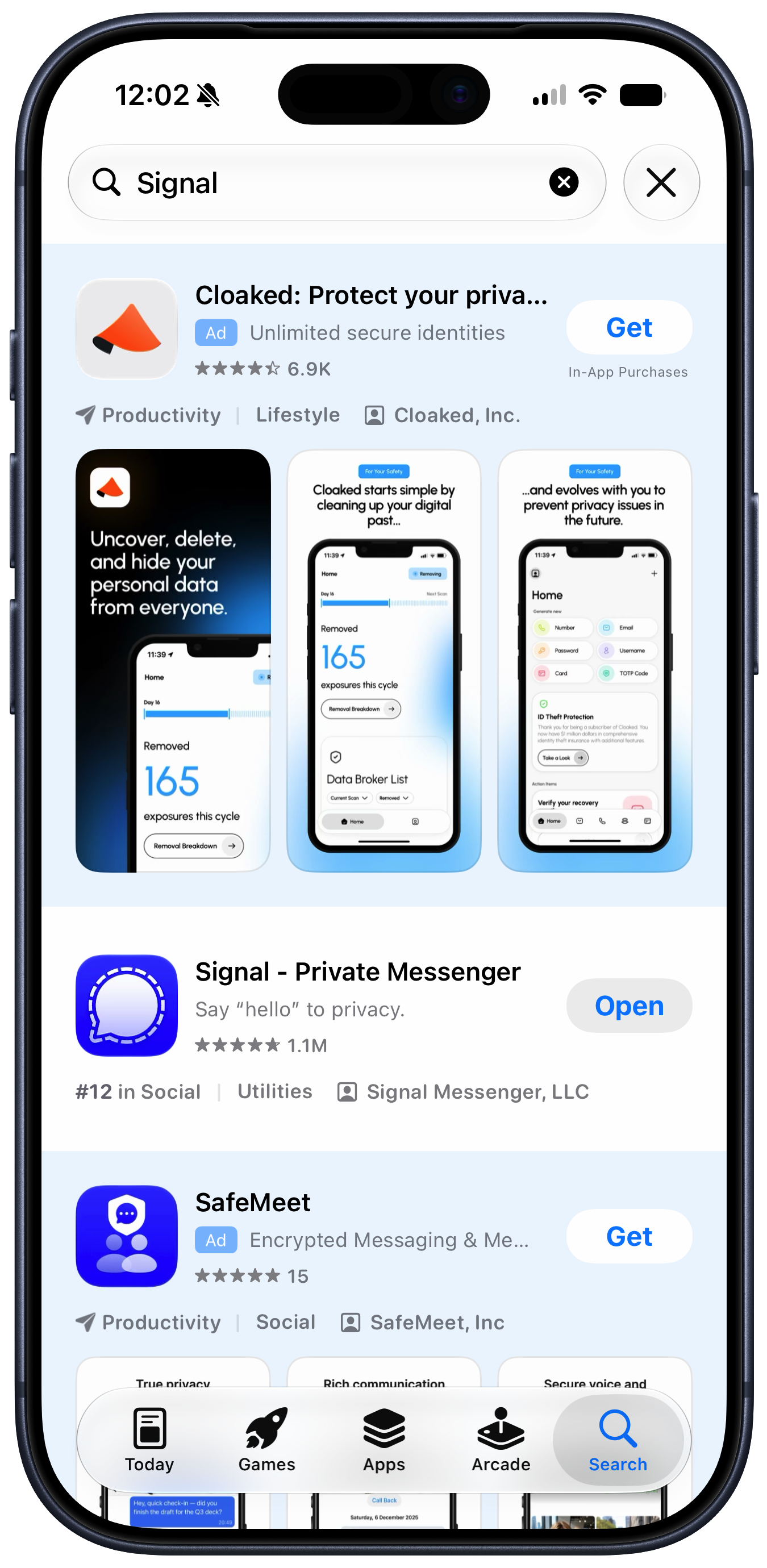
Putting themselves in customers’ shoes today, how many ads do Apple’s executives want stuck in the results when they search for an app in the App Store? We know the honest answer. But the answer evidenced by the actual App Store is “Two really big ones, including one in the first spot.”
At least you could peel off the stickers.
While Apple can spin adding ads to Apple Maps as a revolutionary new way for businesses to be discovered, it’s telling that its initial announcement was hidden inside a press release about an entirely different product, and introduced as “Enhanced Discoverability in Apple Maps.” Those choices show that this isn’t something Apple is actually proud of—and that the people in charge of communicating and explaining Apple’s decisions to the world are at odds with those who are making the decisions about expanding revenue.
[…]
To this day, you’re confronted with an ad for Creator Studio every time you create a new document in those apps, and their default toolbars contain buttons that won’t work unless you subscribe to the bundle. As a result, Apple has essentially turned its free productivity suite—software that was designed to enhance the inherent value of Apple’s products—into a freemium package with upsell to a creative professional subscription bundle that’s irrelevant (and a terrible value!) for most of its existing users.
[…]
There are many more examples. Using notifications to promote subscriptions and badging the Settings app to push AppleCare plans are among the ways Apple has chosen to intervene in the user experience to drive revenue. I’m actually not opposed to the idea that Apple should communicate opportunities for its customers to get more out of their devices—but it should be careful not to cross the line into actively annoying those customers. If someone doesn’t want to see what you offer, you need to accept that and go away—not keep needling them. Apple often falls on the wrong side of that line.
[…]
It makes me wonder if the people making these decisions at Apple have lost track of the Apple brand and what it stands for.
What Snell’s column makes clear is that the incremental revenue Apple is gaining from putting shitty ads in its software comes at a price. They’re withdrawals from Apple’s brand equity. And I would argue that the value they’re detracting from the brand far out-values the dollar amount they’d padding to Apple’s bottom line.
[…]
If your competitors’ stores all smell like dogshit, don’t aim to have the store that smells the least like shit. Aim to have a store that smells pristine. “Our stores only carry a vague whiff of dogshit” is not insanely great.
Hotelling’s Law, like I was saying.
This is not an “update”. This is an advertisement.
Update (2026-07-29): John Gruber:
The people haven’t changed, but Apple has. Strong leaders inevitably shape the personality — the spirit — of organizations over time. Apple in 2011 was peak Steve Jobs Apple. Apple in 2026 is peak Tim Cook Apple. But it was Cook who popularized the “you’re not the customer, you’re the product” argument against “free with ads” online services. But that was in 2014.
“Slippery slope” is a perfect term. But I wanted to add something here. In my experience, in the realm of UI, there is no middle notch. I’ve seen it time and time again… the moment you open the door to One, Infinity starts exerting its pull[…]
Previously:
Update (2026-08-03): Jon Snader:
I HATE, HATE, HATE having ads pop up when I’m trying to do something else. It’s bad enough on Web sites where at least they have the excuse of having to make money some how but it rises to intolerable when they put them up on a device I’ve already paid for.
The annoyance is reason enough to dislike Apple’s ads but for me the worst thing is that they’re corrupting and inevitably lead to the user being replaced by the advertiser as the customer.
Update (2026-08-05): John Gruber:
Only search engines that agree to pay Apple for the traffic are in the list, and there’s no option for users to add custom ones.
It says a lot about modern Apple that I can’t find an unsubscribe link in this marketing email.
Apple News ads have been going down the toilet for years, but it didn’t used to be literal.
In recent years, the landscape of cannabis consumption has undergone a significant transformation, with edible cannabis products rapidly gaining popularity among adult consumers. Unlike traditional cannabis forms such as smoking or vaping, edibles—ranging from gummies and chocolates to beverages—often resemble familiar and colorful snacks commonly found in grocery stores. This resemblance, while appealing to adult users, raises concerns about the inadvertent attraction of underage consumers to these products, posing a complex challenge for regulators who aim to restrict youth access while ensuring legal adult availability.
A pioneering study conducted by Washington State University shines a critical light on this issue. The research specifically examines how design elements of cannabis edible packaging, even when compliant with stringent state regulations, may still captivate the attention of teenagers and young adults under the legal age limit. Involving a sample of 454 participants aged between 13 and 20, the study revealed that over 80% of these young individuals found certain cannabis products—particularly gummies and candies—intriguingly appealing, despite the packaging adhering to Washington State’s current legal standards.
This research builds substantially on prior work that indicated adolescents’ favorable perceptions of cannabis edibles stemmed largely from their resemblance to everyday snacks and health food items. What differentiates the current study is its granular analysis of specific visual cues within the packaging that drive youth appeal. Funded by Seattle & King County Public Health and the Washington State Liquor and Cannabis Board, the investigation deployed innovative visual attention tracking methodologies to decipher exactly which features commanded the gaze and interest of the younger demographic.
The methodology involved surveying two distinct age groups: 149 teenagers aged 13 to 17 and 305 young adults aged 18 to 20. Participants were shown high-resolution images of five cannabis edible products legal in Washington State, spanning categories such as gummies, chocolates, pretzels, candies, and cannabis-infused sodas. Using hotspot analysis—where participants clicked on packaging areas they found most captivating—the researchers obtained precise data pinpointing the predominant design characteristics that ignited youthful curiosity and interest.
Analyzing the aggregated data revealed a strong predilection towards colorful logos, prominently displayed brand names, bold typography, and graphical elements mimicking familiar food imagery. These features dominated visual attention, far surpassing regulatory-mandated components like warning labels, ingredient lists, and nutritional information, which attracted minimal engagement from younger viewers. This disparity underscores the profound influence of branding aesthetics over informative content in shaping youth perceptions.
One particularly illuminating discovery pertained to the power of logos and brand identity. Despite compliance with existing regulations, certain branding elements resonated strongly with the youth cohort. A notable example is the turtle logo on a cannabis chocolate package, which, although meeting all state packaging requirements, was repeatedly highlighted by participants as an eye-catching feature. This finding calls into question the sufficiency of current regulations in mitigating youth appeal derived from brand-associated imagery.
Researchers emphasized that branding plays a pivotal role in how adolescents interpret packaging designs. According to Jessica Fitts Willoughby, a professor involved in the study, teenagers often do not distinguish between various package design elements and the intrinsic identity of the brand itself. Instead, they interpret logos, colors, and symbolic images as features that potentially appeal to underage users, complicating regulatory efforts aimed at limiting youth attraction solely through prohibiting overtly child-oriented design elements.
Washington State regulations already prohibit cartoons and bubble-letter fonts on cannabis product packaging to reduce youth appeal. However, the study’s data demonstrated that participants frequently identified colorful logos, playful fonts, and other visually dynamic branding features as appealing, even when these aligned with regulatory frameworks. This suggests an evolving understanding among underage consumers that the allure of branding can transcend explicit design prohibitions, highlighting a critical regulatory grey area.
This issue mirrors historical regulatory challenges faced in the tobacco industry, where decades ago, companies employed cartoon mascots such as Joe Camel to market cigarettes, sparking public health backlash. The eventual removal of such imagery resulted from concerns that these mascots disproportionately attracted children. While cannabis regulations have already banned cartoons, the current findings indicate that subtler branding cues may sustain youth interest despite such restrictions, necessitating a nuanced regulatory reassessment.
Lead author Stacey J.T. Hust points to a disconnect between regulator expectations and adolescent interpretations of packaging visuals. The research suggests that regulatory language is not fully capturing the nuanced way adolescents process visual stimuli on cannabis packages. A more informed regulatory approach would integrate adolescent perspectives, ensuring that interpretations of “youth-appealing” packaging align with how these products are genuinely perceived by underage individuals.
The findings hold profound implications for future regulatory policy development and public health strategies. By incorporating youth feedback into regulatory design criteria, policymakers can better anticipate and address visual elements that sustain youth interest while preserving adult consumer access. This balance is crucial for minimizing unintentional underage cannabis exposure and consumption without curtailing the legal adult market.
Furthermore, the study advocates for ongoing dialogue between researchers, regulators, and youths to continuously refine the understanding of how cannabis packaging influences youth behavior. Such collaboration will be vital as the legal cannabis marketplace evolves, ensuring that prevention efforts remain adaptive and effective in mitigating risks associated with youth appeal.
In summary, this Washington State University study underscores the complex interplay between cannabis packaging design and youth perception. Despite compliance with state regulations intended to reduce youth appeal, specific branding and design attributes continue to attract significant attention from underage demographics. This calls for a sophisticated reevaluation of packaging standards—one that incorporates adolescent perspectives and adopts a scientifically informed approach to limit the inadvertent allure of cannabis edibles to minors.
Subject of Research: Youth perception of cannabis edible packaging design and regulatory implications.
Article Title: Appealing to Whom? Identifying Design Features on Cannabis Edible Packaging That Attract Underage Consumers.
News Publication Date: 9 June 2026.
Web References: DOI:10.1016/j.drugpo.2026.105355
References: International Journal of Drug Policy.
Keywords: Cannabis edibles, youth appeal, packaging design, branding, regulatory compliance, adolescent perception, public health, visual attention, hotspot analysis.