❌

Normal view

The search for habitable worlds

15 October 2026 at 12:00

The NASA Exoplanet Exploration Program (ExEP) has a curated list of 164 nearest Sun-like stars that are easily visible from Earth. This list represents the first targets for a proposed large space telescope specially designed to find life in the universe, currently known as the Habitable Worlds Observatory (HWO). 

After the HWO is completed, likely sometime in the 2040s, scientists will use the specialized telescope to directly image planets in those star systems. The telescope will search around Sun-like stars for planets in a region known as the habitable zone, where temperatures allow liquid water to exist. Scientists hope to find Earth-like planets with liquid water in the habitable zones of other stars.

While the 164 stars on ExEP’s list have qualities that make them good candidates for study, it remains unknown how many actually have terrestrial planets within their habitable zones. A team of scientists at Arizona State University used simulated data for ExEP’s 164 stars and their hypothetical planetary systems to assess which are most likely to have habitable worlds. Their results would help the HWO prioritize which star systems to observe.

The team started with a subset of 134 stars on ExEP’s list with no known exoplanets, giving researchers the freedom to simulate potential worlds around them. They used a software model called the DYNAmical Multi-planet Injection TEster (DYNAMITE) to predict the possibility that an unseen planet exists around each star by generating 100,000 simulated planetary systems around it. The simulations use mathematical formulas based on observations of real exoplanets to determine the sizes and orbital characteristics of hypothetical gas giants and rocky exoplanets. DYNAMITE then determines whether these planetary systems would be stable and include a terrestrial exoplanet in the star’s habitable zone.

The other 30 stars in the ExEP’s list have known exoplanets, but none of them are rocky planets in habitable zones. To predict whether these stars have unseen terrestrial planets in their habitable zones, the team used the same DYNAMITE process as before with the additional requirement that each star must have an exoplanet matching the one already found.

The space around a Sun-like star can be divided into three regions. The region closest to the star is too hot for liquid water to persist on an exoplanet’s surface, while the region farthest from the star is so cold that any water on an exoplanet would be frozen solid. Between these lies the habitable zone, where temperatures would allow liquid water to exist. However, it’s also possible that a combination of light and gravity could create habitable temperatures on large enough moons orbiting gas giants even beyond a star’s main habitable zone. Illustration by <a href="https://www.linkedin.com/in/andrew-bizal-ab14401ab/">Andrew Bizal</a>.

The space around a Sun-like star can be divided into three regions. The region closest to the star is too hot for liquid water to persist on an exoplanet’s surface, while the region farthest from the star is so cold that any water on an exoplanet would be frozen solid. Between these lies the habitable zone, where temperatures would allow liquid water to exist. However, it’s also possible that a combination of light and gravity could create habitable temperatures on large enough moons orbiting gas giants even beyond a star’s main habitable zone. Illustration by Andrew Bizal.

To increase the chances of finding a terrestrial planet in a habitable zone, the team also investigated potentially habitable moons orbiting gas giants in these systems. For each simulation that included a gas giant, the team inserted between 2 and 23 moons, with masses between 10% of Earth’s Moon and 50% of Earth. Then they simulated the surface temperatures of these moons based on how much starlight they receive and how strongly their host planet pulls on them. They deemed the moons potentially habitable if they were large enough to retain an atmosphere and had a temperature ideal for liquid water, even if they were not technically in their stars’ habitable zones.

For each star, the team calculated a metric based on the probabilities that the star had a terrestrial planet in its habitable zone, that the planet would remain in a stable habitable zone for at least 2 billion years, and that the star had a potentially habitable moon. They called this probability statistic a ranking metric and used it to compare star systems. 

Based on the ranking metric, the team found that the dimmer and cooler stars on their list generally had better chances of hosting a habitable-zone terrestrial planet than the brighter, hotter stars. They also found that stars without known exoplanets ranked more favorably. Around 70% of the stars with known exoplanets had less than a 1% probability of hosting a terrestrial planet in their respective habitable zones. Additionally, fewer than 0.1% of their simulated moons were habitable.

Overall, the researchers concluded that the HWO should prioritize observing cooler, Sun-like stars with no known exoplanets. They claimed that the exoplanets with known characteristics in their sample set were of sizes and in positions that made it unlikely for other exoplanets to be in their systems’ habitable zones. Even with expanded habitability criteria for moons, it would be very unlikely for HWO to find another Earth orbiting a gas-giant exoplanet. They ranked 47 stars in the highest-priority category (A Tier), 51 stars in the middle category (B Tier), and 66 stars in the lowest category (C Tier) to observe with HWO. 

At the end of their study, the team remarked that the proposed HWO represents a potential next step in the search for other Earths, but scientists still need to identify the best targets for this future telescope. The HWO telescope should be able to image rocky exoplanets directly, so thorough research to prepare a list of high-priority targets will help avoid overlooking other Earths.

The post The search for habitable worlds appeared first on Sciworthy.
Dust Deal with It

15 September 2026 at 17:00

zodiacal light

Editor’s Note: Astrobites is a graduate-student-run organization that digests astrophysical literature for undergraduate students. As part of the partnership between the AAS and astrobites, we occasionally repost astrobites content here at AAS Nova. We hope you enjoy this post from astrobites; the original can be viewed at astrobites.org.

Title: The Exozodi Spectral Effect: Residual Habitable Zone Dust May Bias exoEarth Characterization
Authors: Miles H. Currie et al.
First Author’s Institution: NASA Goddard Space Flight Center
Status: Published in AJ

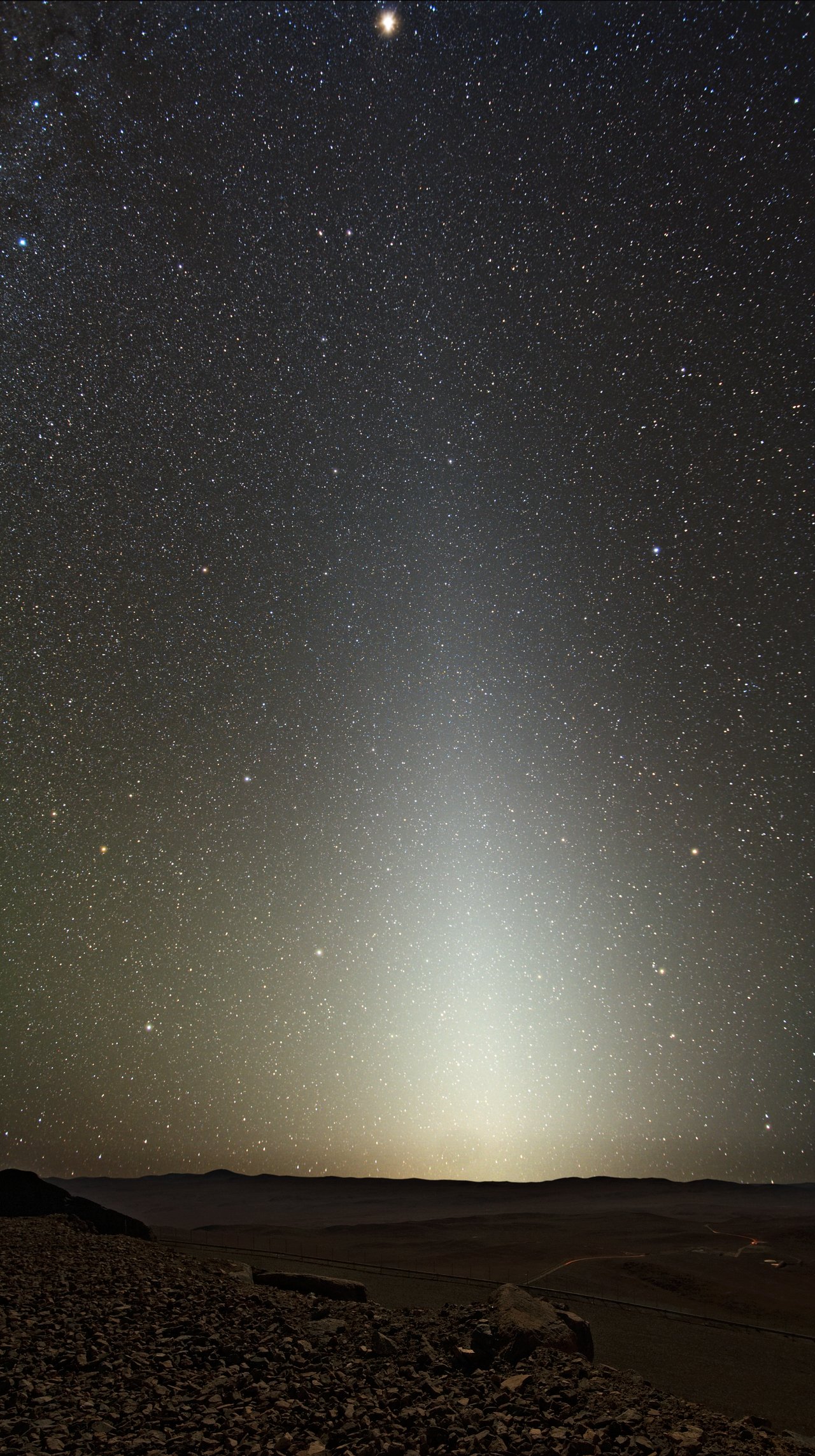
Figure 1: Zodiacal light as seen from Cerro Paranal. [ESO/Y. Beletsky; CC BY 4.0]

We have dust in our solar system — a huge cloud of it that permeates every corner. The dust itself is thought to be the product of many different processes including comet tails, collisions between asteroids, leftover debris from planetary formation, and gravitational collisions induced by planets. It’s small (on the order of 10–100 microns), made up of different silicates, and creates a noticeable triangle-shaped light that can be seen on the darkest nights (see Fig.1). This zodiacal dust is aptly named since the scattered light from the dust grains follows the line of the zodiac, or the ecliptic plane, across the sky. Its structure is quite complicated, with dust rings and trails and clumps near larger planetary bodies. For more information on the solar system’s zodiacal dust, you can read these bites here and here!

This zodiacal dust is not exclusive to the solar system. Other star systems, such as Tau Ceti and Vega, have been found to host similar clouds of interplanetary dust. This means planets imaged in these systems will also have emission from this dust mixed into the light that we observe from the planets. The Habitable Worlds Observatory (HWO) is a future space telescope mission under development by NASA. One of its primary science goals is to directly image 25 Earth-like planets in the habitable zones of nearby stars and look for signs of life (or biosignatures) in these planets’ atmospheres. Exozodiacal dust (aka exozodi) represents the biggest source of astrophysical noise that will need to be subtracted out from HWO observations of exoEarths. The authors of today’s article look at the potential impact of exozodi emission on the spectra of exoEarth atmospheres.

exozodiacal dust models

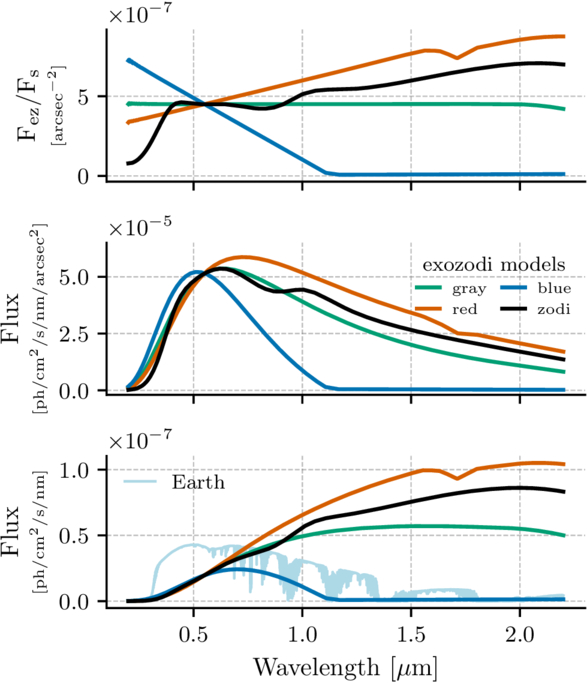
Figure 2: Different models of three “zodis” of dust observed at an inclination of 60 degrees plotted across HWO’s potential wavelength range. The gray scattering model is shown in green, the solar system’s model is shown in black, with the red and blue debris disk models shown in their respective colors. The top panel shows the flux contrast between the dust and the star. The middle panel shows the flux per area. The bottom panel shows the total flux captured with a 7.2-meter HWO with the thin blue line representing the spectrum of an Earth twin 10 parsecs (33 light-years) away for comparison. [Currie et al. 2026]

Show Me the Zodi

The authors first assume four different models of exozodi dust and how the dust’s emission changes with wavelength. The first model assumes a dust cloud that acts as a gray scatterer, meaning the particles scatter all wavelengths of light with no preference, and the second model’s dust acts just like the solar system’s does. However, it’s unknown whether the composition of exozodi will be the same as the solar system’s. Therefore, they adopt two more models of exozodi that act just like debris disks that have different compositions. One model is bluer in color because it is made up of smaller particles that preferentially scatter blue light, and the other model is redder in color because it is made up of bigger dust particles or different chemical compositions. Each of these models over HWO’s wavelength range can be seen in Figure 2. The authors then simulate a modern Earth atmosphere (both clear and 50% cloudy) as well as an Archean Earth atmosphere to understand how different exozodi models will affect observations of different exoplanet atmosphere conditions and compositions.

There’s Dust in My Spectra

In general, the effect that zodiacal dust has on the spectra of Earth-like planets can be broken down into two categories: its effect on the continuum and on the spectral features. The continuum is the object’s light emitted over all wavelengths and uninterrupted by spectral features. Spectral features are absorption and emission lines. These create either a dip or peak in the spectrum where atoms have either absorbed or emitted light at that particular wavelength. Lines at specific wavelengths tell us that a certain material is there, providing a list of possible chemicals that could be present in the planet’s atmosphere. For a brief summary of spectroscopy more generally, see here.

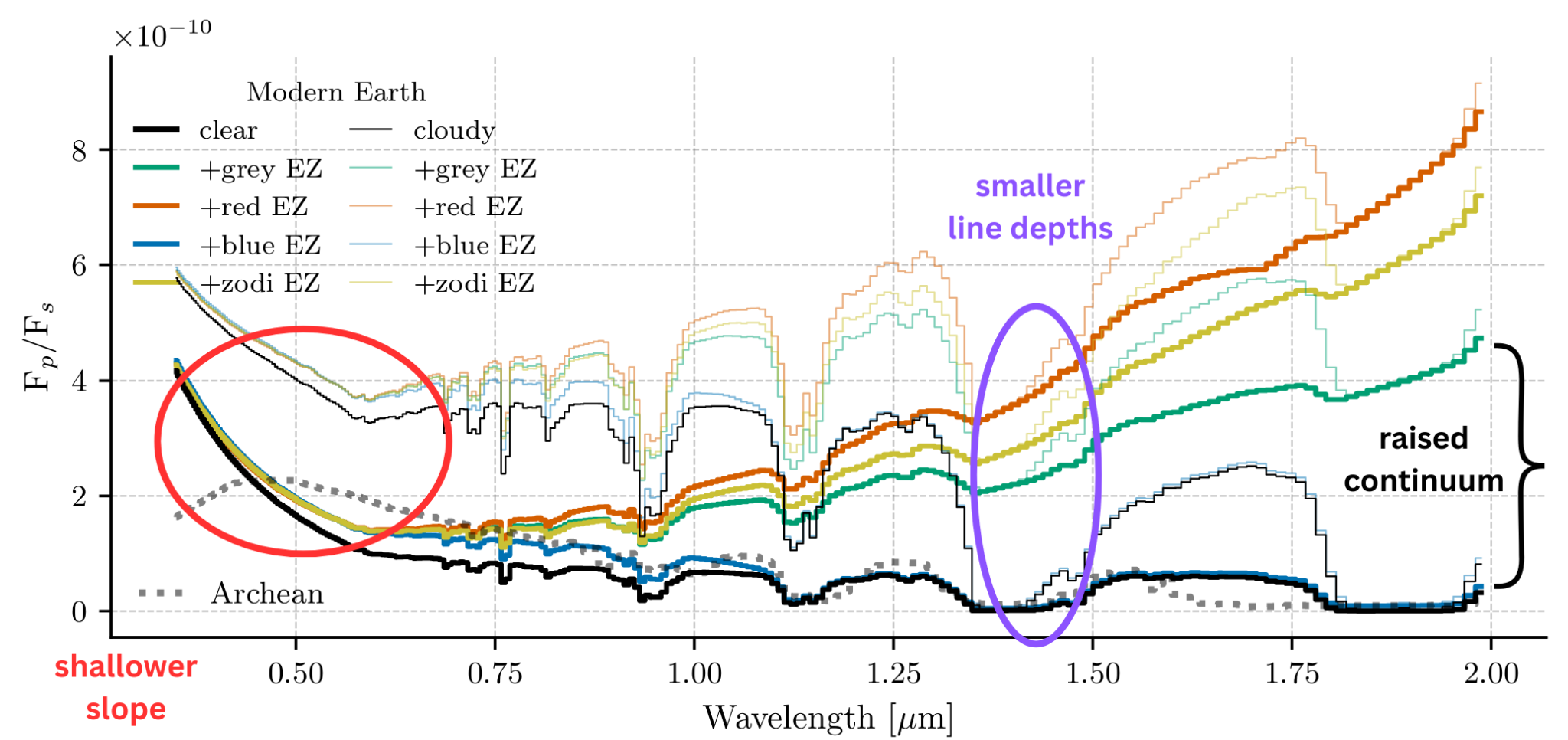
In the case of the continuum, exozodiacal emission raises the continuum, meaning the base flux of the planet is raised and absorption lines become more shallow. These effects can be seen in Figure 3, where the authors’ simulated spectra are plotted with and without zodiacal dust included. Not only is the continuum elevated for all models including zodiacal dust, notice how the dips become shallower at longer wavelengths. Because dust primarily radiates thermally, the red debris disk model nearly smooths out all dips beyond 1.25 microns! Molecules that absorb at these longer wavelengths, such as water or methane, may not be correctly identified with this type of exozodiacal emission.

simulated spectra of Earth-like planets with varying atmospheres and types of exozodiacal dust

Figure 3: Spectra of simulated modern-Earth atmospheres for clear (solid bright lines) and cloudy (solid dimmer lines) scenarios. The Archean Earth atmosphere is plotted in dotted gray. The redder exozodiacal spectrum has an elevated continuum and smoothed spectral features as opposed to the original, zodi-free spectrum plotted in black. [Currie et al. 2026, with annotations by Kaz Gary]

Additionally, the slope of the spectra between 0.25 and 0.75 microns (called the Rayleigh scattering slope) becomes shallower with zodiacal dust emission, which may bias our models toward lower-molecular-weight atmospheres. The slope at these wavelengths is dependent on the size distribution of molecules in the atmosphere, meaning it can tell us how much the average molecule in an atmosphere weighs.

From Figure 3, the effects of zodiacal dust are minimized with a bluer zodiacal dust model. This means systems with “bluer” zodiacal dust may be more optimal for HWO observations, as bluer dust does not scatter as much starlight as gray, solar system–like, or red dust. From their results, the authors recommend that the residual exozodi-to-planet flux ratio (in the V-band wavelengths) be kept to less than 10-2 in order to correctly understand the line depths (identify if a molecule is present or not) and 10-3 in order to accurately retrieve molecular abundances (understand how much of a molecule is present in the atmosphere). Dust is pesky enough here on Earth, but to find life on another planet like ours, we’ll dust have to deal with it.

Original astrobite edited by Anavi Uppal.

About the author, Kaz Gary:

I am a fourth-year PhD candidate at The Ohio State University with a passion for planets. My current work focuses on modeling exoplanet observations for the Habitable Worlds Observatory and understanding planetary atmospheres. Outside of research, I help develop planetarium shows and love all forms of science communication. In my free time, I enjoy playing tabletop RPGs, painting, watching terrible reality TV, and hanging out with my pet hedgehog.

The post Dust Deal with It appeared first on AAS Nova.

Earth May Not Be a Cosmic Fluke, New Simulations Suggest

9 September 2026 at 16:03
Exoplanet Ross 128 b Is Not Like EarthSolar system simulations starting from varied initial conditions suggest that Earth-like planets can emerge naturally from planet formation. Computer simulations of planetary systems can now begin from thousands of different starting conditions, allowing researchers to explore how worlds might emerge without assuming the final outcome. Over the past three decades, these models have advanced from [...]

The Search for a Second Earth Begins: NASA’s Nancy Grace Roman Space Telescope is Poised to Make History

1 September 2026 at 13:13

Now that NASA’s Nancy Grace Roman Space Telescope is on its way toward its Lagrange Point 2 (L2) destination, more of its mission goals are coming into focus, including the possibility that it could detect an Earth-like planet orbiting a star like our own Sun using gravitational microlensing.

The Roman team said such a detection could identify targets for the proposed Habitable Worlds Observatory project, including scanning their atmospheres for signs of extraterrestrial life.

Searching for Another Earth with the Nancy Grace Roman Space Telescope

In NASA’s mission fact sheet, Roman’s planners pose several questions. These include: 

  • How common are solar systems like our own?
  • What kinds of planets exist in the cold, outer regions of planetary systems?
  • What determines the habitability of Earth-like worlds?

Although scientists have used several methods to detect exoplanets, including Earth-like planets, Roman will employ three. These include the transit method, microlensing, and direct imaging. NASA said the combination of approaches will allow mission scientists to conduct a “sweeping search expected to uncover around 100,000 new exoplanets — a staggering leap compared to the nearly 6,200 currently known.”

“It is hoped that Roman will discover thousands of new exoplanets and significantly expand our knowledge of the diversity of planetary systems in our Galaxy,” explained Associate Professor Edita Stonkutė, an astrophysicist at Vilnius University unconnected to the Roman team, in a statement emailed to The Debrief.

Microlensing Can Reveal Earthlike Planets Orbiting Sunlike Stars

Most exoplanets have been detected by the dimming of their host star when they transit between it and Earth, giving the transit method its name. Roman plans to use that same method for most of its larger planetary detections. However, among the expected tens of thousands of transit-method detections, mission planners expect a small but sizeable percentage to come from microlensing.

NASA said the “light-bending” microlensing phenomenon occurs when two distant stars “align closely from our vantage point.” Due to the strength of the nearer star’s gravity, the light from the more distant one is “warped” around the nearer one, essentially focusing it very briefly for a distant observer.

“If the alignment is especially close, the nearer star acts like a cosmic lens, focusing and magnifying light from the background star.” Professor Stonkutė explained. “By analysing these changes, astronomers can determine that the planet exists and estimate its mass and orbital characteristics.”

Critically, Professor Stonkutė also noted that microlensing can occur with objects other than stars, including exoplanets.

“This is Precisely Where Roman Has the Edge”

Using its Wide-Field Array, Roman will monitor hundreds of millions of stars. NASA said the observatory will monitor these target stars for “tiny surges in starlight” that typically signal a microlensing event.

Although the transit method is employed to detect larger exoplanets, NASA noted that microlensing “specializes in finding planets like those in our solar system.” The space agency added that this includes “worlds as lightweight as Mars in their star’s habitable zone or farther out.”

A star’s habitable zone is typically defined as the orbital plane where an exoplanet could sustain liquid water on its surface, a key ingredient for life as we know it.

Professor Stonkutė described microlensing as “particularly valuable” since it can detect planets that are difficult to spot with other planet-hunting methods. The professor said this includes “small Earth-like planets located far from their star.” The Roman team hopes to find “more than 1,000 microlensing planets.”

The professor warned that “most microlensing events cannot be predicted in advance.” As a result, telescopes need to actively scan large areas of the sky to increase the chances of a microlensing detection

“This is precisely where Roman has the edge over other telescopes that have searched for exoplanets using different methods,” the professor added.

A “Stepping Stone” Toward NASA’s Habitable Worlds Observatory Concept

While Roman is tasked with directly imaging exoplanets, finding another Earth around a Sun-like star will still require an indirect detection, most likely from a microlensing event. However, the Roman team notes that their observatory “will provide a crucial stepping stone for NASA’s Habitable Worlds Observatory concept.”

According to the space agency, that “flagship” telescope, still awaiting final approval, “would be designed to photograph Earth-like planets for the first time ever.”

Roman may also be able to scan the atmospheres of planets detected with the transit method. The space agency said Roman “would also look for signs of life called biosignatures by measuring atmospheric gases like oxygen and ozone that could signal the presence of living things.” 

Christopher Plain is a Science Fiction and Fantasy novelist and has spent the last six years as Associate News Editor and Head Science Writer at The Debrief. Follow and connect with him on X, learn about his books at plainfiction.com, or email him at christopher@thedebrief.org.

Astronomers Detect an Atmosphere on a Potentially Earth-Like World

Artist’s Illustration of Exoplanet LHS 1140 BThis discovery marks a major milestone in the search for life on worlds beyond our solar system. A faint stream of helium escaping from a distant rocky world has revealed something astronomers had never clearly detected before: an atmosphere around an Earth-like planet in another star’s habitable zone. The result is the strongest evidence so [...]

“A Major Milestone in the Search for Life on Other Planets”: First Ever Detection of an Atmosphere Around an Earth-Like, Habitable Zone Rocky Exoplanet

18 July 2026 at 14:44

An international research team led by Harvard scientists has announced the first-ever detection of an atmosphere on an Earth-like rocky exoplanet, LHS 1140 b, orbiting within its star’s habitable zone, only 48 light-years away.

The researchers behind the historic discovery, which they are calling “a major milestone in the search for life on other planets,” said the detection of an atmosphere on an Earth-like rocky exoplanet offers the strongest evidence to date that worlds with similar compositions and temperatures to Earth that are also capable of supporting life could exist beyond our solar system.

Models Predicted First Earth-like Rocky Habitable Zone Exoplanet Atmosphere

In a statement announcing the detection of an atmosphere around a habitable-zone rocky exoplanet, the discovery was motivated by theoretical predictions suggesting that LHS 1140 b may contain an atmosphere. The planet was even more tantalizing because its orbit around its host red dwarf star allows for liquid water on its surface, a key ingredient for life as we know it.

Although thousands of exoplanets have been confirmed since 1995, including habitable-zone rocky worlds similar in size and composition to Earth, the team notes that determining whether any of these potential Earth analogs maintain an atmosphere. Like water, an atmosphere is considered a likely necessity for life to emerge.

“An atmosphere is essential for a planet to support life as we know it,” explained Collin Cherubim, the lead author of a study detailing the findings, who recently earned his Ph.D. in Earth and Planetary Sciences from Harvard University.

Robin Wordsworth, the Gordon McKay Professor of Environmental Science and Engineering and Professor of Earth and Planetary Sciences at Harvard, said that as recently as twenty years ago, astronomers still didn’t know if other, terrestrial-type planets “even existed.” However, he explained, they quickly found that this type of planet was common, including some orbiting within their star’s habitable zone.

“The next question was whether any of them had managed to keep an atmosphere,” the professor added.

Infrared Observations Confirm Historic First  

Before performing any direct observations, the team used computer models to predict what they might find on LHS 1140 b. As noted, those models predicted an upper atmosphere rich in helium. The models also suggested that the atmospheric helium was slowly escaping into space.

To test the model’s predictions, Cherubim and colleagues gained access to the Warm Infrared Echelle (WINERED) Spectrograph on the Magellan Observatory in Chile. The team noted that this powerful telescope allowed them to observe an alignment of LHS 1140 b and another planet transiting its star “on the same night.”

When analyzing the data, the team found that one of the planets appeared to lack any measurable atmosphere. However, as their models had predicted, helium was actively escaping from LHS 1140 b. The finding confirmed that this rocky exoplanet orbiting within its star’s habitable zone was actively maintaining an atmosphere.

David Charbonneau, the head of the Harvard Department of Astronomy and an astronomer at the Center for Astrophysics | Harvard & Smithsonian, and Cherubim’s co-advisor with Wordsworth, was initially skeptical because the entire concept was based on a mathematical prediction of a phenomenon astronomers had never witnessed directly. However, Professor Charbonneau ended up praising the student’s determination and follow-through, which led to the historic detection.

“Collin analyzed the planets we knew about and predicted that this one would have a helium atmosphere,” Charbonneau said. “Then he organized telescope time, got the data, and the detection was statistically rock solid.”

“Hopefully it’s just the First of Many More Observations to Come”

When discussing the implications of the findings, Cherubim noted that “this is the first time anyone has found an atmosphere on a rocky planet in the habitable zone of another star.” Professor Wordsworth agreed, once again noting that until now, planets in these categories with atmospheres had been purely theoretical.

“Now we know at least one has,” the professor said.

The data also suggest that LHS 1140 b’s atmosphere has likely survived for more than three billion years, roughly three-quarters of Earth’s existence. This durability makes LHS 1140 b an excellent candidate for future exoplanet atmosphere studies.

More broadly, the team said that using ground-based observatories to search for escaping gases, such as the helium detected leaving LHS 1140 b, “may become an important tool for studying atmospheres on rocky exoplanets.” They also note the potential value of atmospheric detection for astrobiologists searching for signs of life in the cosmos.

As for Cherubim, he plans on following up his historic discovery with a more detailed analysis of the planet’s atmospheric composition. He also said he would like to investigate the possible presence of surface oceans or other planetary characteristics typically associated with habitability and life. The entire team also said they would like to use Cherubim’s model to search for similar Earth-like, habitable-zone rocky exoplanets.

“This has been a model validation, and hopefully it’s just the first of many more observations to come,” Cherubim said.

The study, “Helium escaping from the atmosphere of a nearby rocky exoplanet orbiting in a habitable zone,” was published in Science.

Christopher Plain is a Science Fiction and Fantasy novelist and Head Science Writer at The Debrief. Follow and connect with him on X, learn about his books at plainfiction.com, or email him directly at christopher@thedebrief.org.

This Intriguing Exoplanet is Just 25 Light-Years from Earth—Is Its Too Dangerous to Be Home to Life?

2 July 2026 at 13:49

Researchers have discovered a potentially habitable exoplanet just 25 light-years from Earth—but is its precarious location on the cosmic shore too dangerous to make it a home for extraterrestrial life?

In a recent paper in The Astrophysical Journal, researchers at the University of California, Irvine, revealed their discovery of GJ 3378b, an exoplanet that resides in the habitable zone, sometimes referred to as the “Goldilocks zone,” a distance from the host star ideal for liquid surface water.

The habitable zone is a key focus in the search for extraterrestrial life, as planets any closer would have their atmospheres and surface waters burned off, while those any further from their host star would be completely frozen.

Finding Another Earth

“This one’s exciting,” said lead author Paul Robertson, a UC Irvine assistant professor of astronomy and lead author of the new study. “It’s one of our closest cosmic neighbors. 25 light-years sounds like a long way, but the Milky Way is about 100,000 light-years across, so in that respect it’s our next-door neighbor.”

Robertson led the team in the exoplanet discovery, using the Habitable-zone Planet Finder on the Hobby-Eberly Telescope at McDonald Observatory in Texas, and the NEID Spectrometer on the WIYN Telescope at Kitt Peak National Observatory in Arizona.

GJ 3378b is about twice the size of Earth, making it what astronomers call a “super-Earth” for its increased size. Additionally, this potentially habitable exoplanet likely receives a comparable amount of stellar radiation to our planet.

“This super-Earth gets about 90 percent of the radiation from its host star as Earth gets from its sun, so it’s right in the sweet spot,” said Robertson.

Exoplanet Atmosphere

While GJ 3378b resides within its star’s habitable zone, it does so only barely. This fringe area astronomers refer to as “the cosmic shoreline,” a distance just outside of which the stellar radiation would become so intense that its atmosphere would be ripped away, and any potential surface water along with it.

Straddling this shoreline, researchers are uncertain whether GJ 3378b has an atmosphere or is still a victim of excessive stellar radiation, as its larger size relative to Earth may make it more susceptible.

Our own solar system also offers an excellent example of this: the planet Mars, which researchers suspect once had an Earth-like atmosphere, and potentially even life. However, intense solar radiation bombardment destroyed that atmosphere, taking the surface water with it, leaving a desolate wasteland.

“If you scale the Earth down to the size of an apple, its atmosphere would be about as thick as the skin of the apple,” said Robertson. “That’s just enough to maintain the kinds of surface pressures where you can have liquid water. It’s enough that there’ll be breathable air, and it provides maybe a little bit of protection from the harsh radiation environment of space.”

Extraterrestrial Life on Exoplanets

Although GJ 3377b is relatively close to Earth on a cosmic scale, current equipment cannot determine whether the planet harbors an atmosphere. To do so, advanced future observation platforms will be required, and just such work is on the horizon.

“If a planet in the habitable zone has a proper atmosphere, we can justify further research looking for biosignatures, liquid water, or other signs of life that require both an atmosphere and the right amount of heating from the host star,” said co-author Gogod James, a UC Irvine student in Robertson’s group who worked to characterize the size of GJ 3378b.

NASA plans to take a closer look at these potentially habitable worlds in about two decades with its upcoming Habitable Worlds Observatory (HWO). Launching in the 2020s, HWO will be a large infrared/optical/ultraviolet space telescope designed to confirm whether exoplanets have atmospheres, and then seek biosignatures within those atmospheres, which could indicate the presence of extraterrestrial life.

The paper, “A Revised Mass and Period for the Habitable Zone Super-Earth GJ 3378 b: A Planet Straddling the Cosmic Shoreline,” appeared in The Astrophysical Journal on June 30, 2026.

Ryan Whalen covers science and technology for The Debrief. He holds an MA in History and a Master of Library and Information Science with a certificate in Data Science. He can be contacted at ryan@thedebrief.org, and follow him on Twitter @mdntwvlf.

❌