This episode of the Physics World Weekly podcast features Lin Ma, who is at the University of North Carolina at Chapel Hill. His research group tackles energy and environmental challenges using sustainable materials and electrochemical techniques.
In this episode I chat with Ma about the growing importance of energy storage in electricity grids. Much of this is driven by the growth of wind and solar generation, which can both be intermittent in nature.
Ma talks about the batteries that are currently used in grids and explains what improvements are needed as more renewable energy comes on line. We chat about the different battery technologies that can be used for grid storage and Lin explains why sodium-ion batteries offer advantages over lithium-based devices when it comes to large-scale deployment. Lin also talks about some of the safety issues surrounding large battery facilities and how artificial intelligence can be used to improve many aspects of battery technology.
This podcast is presented in partnership with the Electrochemical Society. The mission of the ECS is to advance theory and practice at the forefront of electrochemical and solid state science and technology, and allied subjects.
Researchers at the Karlsruhe Institute of Technology (KIT) in Germany and Stanford University in the US have developed an energy-collecting device that can simultaneously cool, produce electricity and generate heat. In their prototype, a radiative cooling layer reached 6.5 °C below ambient temperature while a solar collector generated electricity and reached nearly 111 °C.
“The new system could be installed on the roofs and facades of buildings to provide these three energy services at once,” says Gan Huang, who is head of the Hybrid Solar Technologies lab at KIT. “It could also be attractive for AI data centres that need both intensive power and cooling at the same time.”
As many of us have experienced, summer in the northern hemisphere has been particularly hot this year – a situation that is only likely to worsen in the future as the effects of climate change take hold. With this warming will come the increased need for air conditioning to cool down buildings. The problem is that current compression-based systems consume a lot of electricity and produce large amounts of CO2.
Passive daytime radiative cooling
A potential alternative is passive daytime radiative cooling (PDRC), in which heat is continuously exchanged between objects at different temperatures by absorbing and emitting thermal radiation. When the heat absorbed by the material is less than the energy radiated to outer space, it can cool down during the day – even without electricity.
Our planet naturally experiences this effect by radiating heat out to space. This allows it to cool down at night because its temperature (of around 300 K) is much higher than that of outer space (around 3 K) and there is no incident solar irradiation from the Sun at night.
A good PDRC material needs to satisfy several criteria. For one, it must reflect sunlight strongly at solar spectrum wavelengths (of 0.3 to 2.5 µm) to avoid it heating up. It also needs to emit heat strongly in the long-wave infrared (LWIR) wavelengths (of 8–13 µm) where the atmosphere is more transparent to infrared radiation, so that it can lose energy to the cold sky. Over the past decade, researchers have succeeded in developing a wide range of PDRC materials, including multilayer nanophotonic emitters, single-layer polymers on reflectors and porous ceramics. However, conventional PDRC systems cannot harvest the coldness of outer space and solar energy from the same surface at the same time.
A hybrid PDRC and photovoltaic-thermal collector
In the new work, which is detailed in Cell Reports Physical Science, the KIT researchers made a hybrid PDRC and photovoltaic-thermal collector. The emitting layer in the device, which is transparent, consists of a silica substrate coated with the silicone polymer polydimethylsiloxane. This layer allows sunlight to pass through while simultaneously emitting heat as LWIR radiation through the atmospheric window. Beneath the transparent emitter, a Fresnel lens concentrates the transmitted sunlight onto the (gallium arsenide-based) photovoltaic-thermal collector mounted on a two-axis solar tracker. This is where electricity is generated.
In outdoor experiments performed during the day, the prototype simultaneously achieved cooling of up to 6.5 °C below ambient temperature, an electrical power density of 60.6 W/m² and heating up to 110.8 °C. “This is exciting,” says Huang, “because it shows that the hot Sun and the cold universe can be harvested together, rather than treated as separate resources as has been the case until now.”
The main challenge was ensuring that the solar collector became hot while the radiative cooler stayed cool, he explains. “We achieved this by concentrating the transmitted sunlight onto a much smaller solar collector underneath the transparent cooling layer, so reducing thermal interference between the hot and cold parts in the device.”
The team is now busy improving the efficiency and practical design of its system. “We are already working on a better optical design, improved thermal management and more efficient solar cells,” reveals Huang.
“The Sun is not the only renewable energy resource in the sky, the coldness of outer space is another,” he says. “We believe there are many exciting possibilities for a new generation of energy systems if we learn how to manage both these together.”
If you’ve ever kept a drink cool on a hot summer day by placing it inside a frozen, gel-filled sleeve, you’ll understand the appeal of phase change materials (PCMs). The reason these sleeves work so well (and so much better than simply putting your drink in a cold bath or cool room) is that the solid inside them has a high latent heat, meaning it can absorb relatively large quantities of energy before melting and beginning to warm up.
But what if surrounding your drink with a frozen PCM isn’t enough? What if you want to cool your drink more quickly and evenly? One option would be to create a PCM sleeve with fin-shaped extensions that protrude into your drinking vessel. These fins would cool your drink – or, equivalently, allow your drink to melt the PCM – much more efficiently than a simple sleeve. But what should the fins look like? How far apart should they be? And how many of them do you need?
These are the questions that Paolo Proia, Mauro Sbragaglia and Giacomo Falcucci considered in a study published in EPL– though not with the aim of keeping their drinks cold. As researchers at the University Tor Vergata of Rome, Italy, Proia, Sbragaglia and Falcucci are interested in PCMs that store and release heat like a battery. Such materials are useful in fields such as electronics and refrigeration where heat is a common byproduct. Other applications include maintaining the efficiency of solar panels by preventing them from getting too hot and keeping buildings cool in the daytime via insulation.
Physics World spoke with them about their work.
What was your motivation for doing this research?
Our interest in PCMs stems, in part, from our interest in their many applications, especially in the ecological transition to less carbon-intensive fuels. PCMs are particularly good at managing heat in hydrogen storage with metal hydrides, for example, because storing hydrogen in these materials produces heat, while releasing the hydrogen requires it. Using a PCM to store the heat of the adsorption process and give it back during the release means that the produced heat doesn’t go to waste. Instead, it improves the efficiency of the process.
We’re also fascinated by the complexity of the equations involved. The coupling of fluid and temperature dynamics already causes interesting phenomena such as convection. By adding a phase transition to the mix, you introduce a moving boundary that complicates the system even more, both phenomenologically and analytically, since the describing equations must account for it.
We started this paper as a way of extending our previous work on the insertion of fins inside a PCM to three dimensions. PCMs are exceptionally good in latent heat but severely lacking in sensible heat; in other words, they store heat well, but they absorb and release it poorly. Fins are useful in relieving this flaw since they enhance the heat transfer surface and provide a horizontal heat source, which is instrumental for the development of convection, the main driver of heat transfer in this kind of system. By switching to a 3D system, we had more freedom to explore complex layouts of multiple fins and the importance of their relative position.
Phase change modellers: (left-right) Paolo Proia, Mauro Sbragaglia and Giacomo Falcucci. (Courtesy: Paolo Proia)
What is the most important advance in the paper?
The most important result is that naively inserting fins too close to each other can cause interference. If there are overlaps in the fins’ “influence zone”, the system will waste energy by, in effect, trying to melt something that was already molten from heating by a nearby fin. Moreover, by comparing a single fin and multiple fins with the same total surface, we found that the latter configuration benefits from the gaps between the fins. This is because the substance in these gaps melts early and starts acting as an extra heating surface, contributing to the development of bigger convective structures.
Why is it so challenging to model melting in phase change materials in 3D?
Beyond the analytical requirements we already mentioned, the success of this type of modelling depends on having a resolution that is high enough to capture correctly all the phenomena in the system. This means the number of computational sites N must be sufficiently large. In 2D, we “only” have N2 sites to model, but in 3D, this scales to N3. That creates a challenge because making N too large would severely slow down the simulation. Moreover, we must be sure to respect the restraints on the physical parameters for which the lattice Boltzmann method is a correct approximation of the equations involved. So, we underwent a thorough validation process to pinpoint the best parameters for the algorithm.
What do you plan to do next?
First, we’d like to further optimize the code. The main bottleneck is the speed of a single iteration. Ideally, we’d like to study a wider range of layouts and physical conditions, but with the code we have now, that would impact heavily on performance. For example, a slower-melting substance requires more iterations to completely melt, which translates into more real-life time to model, sometimes outside the limits of feasibility. This problem would obviously be solved if we can make a single iteration faster.
Another issue we have is that some ranges of physical parameters can make the simulation unstable. Fortunately, there exist some remedies to this, and we plan to eventually adopt them.
Finally, we would be happy to see other researchers use these findings in their own optimization studies on fin shapes and spatial layouts. It would also be very interesting to see someone study this problem from an analytical angle or to see some experimental validation. In the medium term, we are planning to conduct our own experiments to use as a benchmark for our computational results.
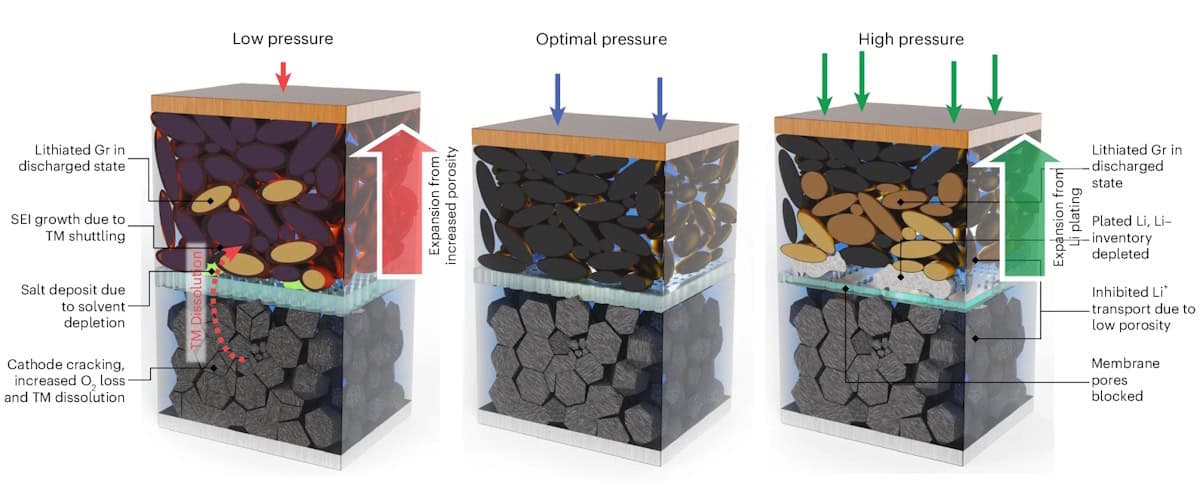
Pressure-dependent degradation mechanisms Low stack pressure accelerates cathode cracking, while high pressure promotes lithium plating. At the optimal pressure, balanced interparticle contact and porosity minimize mechanical degradation. (Courtesy: CC BY 4.0/Nat Energy 10.1038/s41560-026-02087-6)
Engineers are constantly striving to improve the safety and performance of electric vehicle (EV) batteries. Much effort has been put into developing new electrode materials over the years, but future improvements may not follow the same path and may just be as simple as utilizing physical pressure.
A recent study, led by researchers at the University of Cambridge, suggests that EV batteries could be made to last up to twice as long, by applying the right amount of pressure to the electrodes. It is, however, a fine balancing act, as too high or too low a pressure can cause the battery to fail. To employ this approach in real world systems, engineers will need to make sure that the process is easily repeatable without significant pressure error, but it’s an interesting avenue of battery engineering that has come to fruition.
“We carried this work out to improve the sustainability of batteries,” says Michael de Volder, one of the lead researchers on the study. “Given that we are not very good at recycling batteries, extending the lifetime of batteries reduces the need for mining critical minerals for making new batteries and therefore improves their sustainability.”
For their study, reported in Nature Energy, the researchers developed a dilatometer with pneumatic bellows to apply pressure to the electrodes. The bellows act like a clamp to maintain a uniform and constant pressure on the electrode, while a sensor detects small volume changes that occur as the battery charges and discharges.
The researchers tested their electrode pressurization approach on commercial nickel manganese cobalt (NMC) lithium-ion pouch batteries (which have a flexible packaging), without changing their electrolyte or electrode composition. By using commercial batteries with a standard setup, they could test them fairly under different pressures.
“In this work we optimized how hard battery anodes and cathodes should be pushed together to maximize the lifetime of batteries,” de Volder tells Physics World. “Importantly, we also unravel which degradation mechanisms kick in if you press too hard, or not hard enough.”
Doubling battery lifetime
The researchers found that increasing the stack pressure fourfold over typical initial values used in conventional coin cells – to an optimal pressure of 12.5 bar – doubled the lifetime of the NMC811 cells. They compared the results with NMC cells tested at an extra-low pressure of 1.5 bar, a low pressure of 3 bar, a medium pressure of 6.5 bar and a high pressure of 37.5 bar.
Different degradation mechanisms emerged at high and low pressures outside of the optimal pressure zone. Low stack pressure accelerated cathode cracking, causing an increase in transition metal dissolution and excessive formation of the solid electrolyte interphase (SEI) layer. The cracking is likely due to a small number of particles bearing most of the mechanical load, leading to localized high-stress concentrations that initiate crack propagation.
Higher stack pressures, meanwhile, caused increased lithium plating on the anode. The team observed that the electrode thickness reduced during initial cycling but then underwent rapid thickness growth. When the electrodes are at their thinnest, they have a lower porosity that limits lithium transport, leading to higher overpotentials and higher lithium plating. This increases the amount of “dead” lithium and reduces the usable lithium inventory in the battery, causing it to degrade faster.
“We found that when the pressure applied to battery cells is sub-optimal, certain dangerous degradation processes can be accelerated. So, in a way, pressure optimization might improve the safety of batteries. However, more research is needed before we can draw reliable conclusions on this front,” says de Volder.
The pressurization results in this study are still in the early stages, but if shown to be viable at scale in commercial systems, could help EV batteries to last longer. In theory, this could give second-hand EVs a higher market value as the vehicle will have a longer battery life when sold. Additionally, if EV batteries can last longer, it will reduce the pressure on lithium mining operations and reduce the amount of raw material required for battery manufacturing (assuming the same demand) – something that is becoming an issue due to the skyrocketing price of lithium.
Cambridge Enterprise, the university’s innovation arm, has filed a patent, so the research team and university obviously see commercial viability in the process. When asked about the team’s future plans, de Volder tells Physics World that “we studied pressure optimization for one specific battery chemistry, but we anticipate that gains can be made in the lifetime of other battery chemistries too”.

 Login