❌

Normal view

Monthly Roundup: The Fourth Catalog of Gravitational Wave Events from LIGO, Virgo, and KAGRA

29 July 2026 at 17:00

Illustration of gravitational waves emanating from a pair of black holes approaching a merger

A recent Focus Issue of the Astrophysical Journal Letters describes the fourth version of the catalog of gravitational wave events (GWTC-4.0) from the Laser Interferometer Gravitational Wave Observatory (LIGO), the Virgo interferometer, and the Kamioka Gravitational Wave Detector (KAGRA).

This catalog contains transient gravitational wave events recorded through January 2024, during the observatories’ fourth observing run, which concluded in November 2025. GWTC-4.0 displays the results of significant improvements to our suite of gravitational wave detectors, including higher-powered lasers and reduced quantum noise. A fifth catalog of gravitational wave events was released in Spring 2026, with the accompanying scientific articles being submitted to the Astrophysical Journal and the Astrophysical Journal Letters.

This Monthly Roundup consists of short descriptions of each of the currently published research articles in the LIGO–Virgo–KAGRA Gravitational Wave Transient Catalog (GWTC): Release 4 Focus Issue. Each snippet links to the corresponding research article, and the Focus Issue landing page is linked at the bottom of this post. Be sure to revisit the landing page to catch new articles as they’re published!

Introducing GWTC-4.0
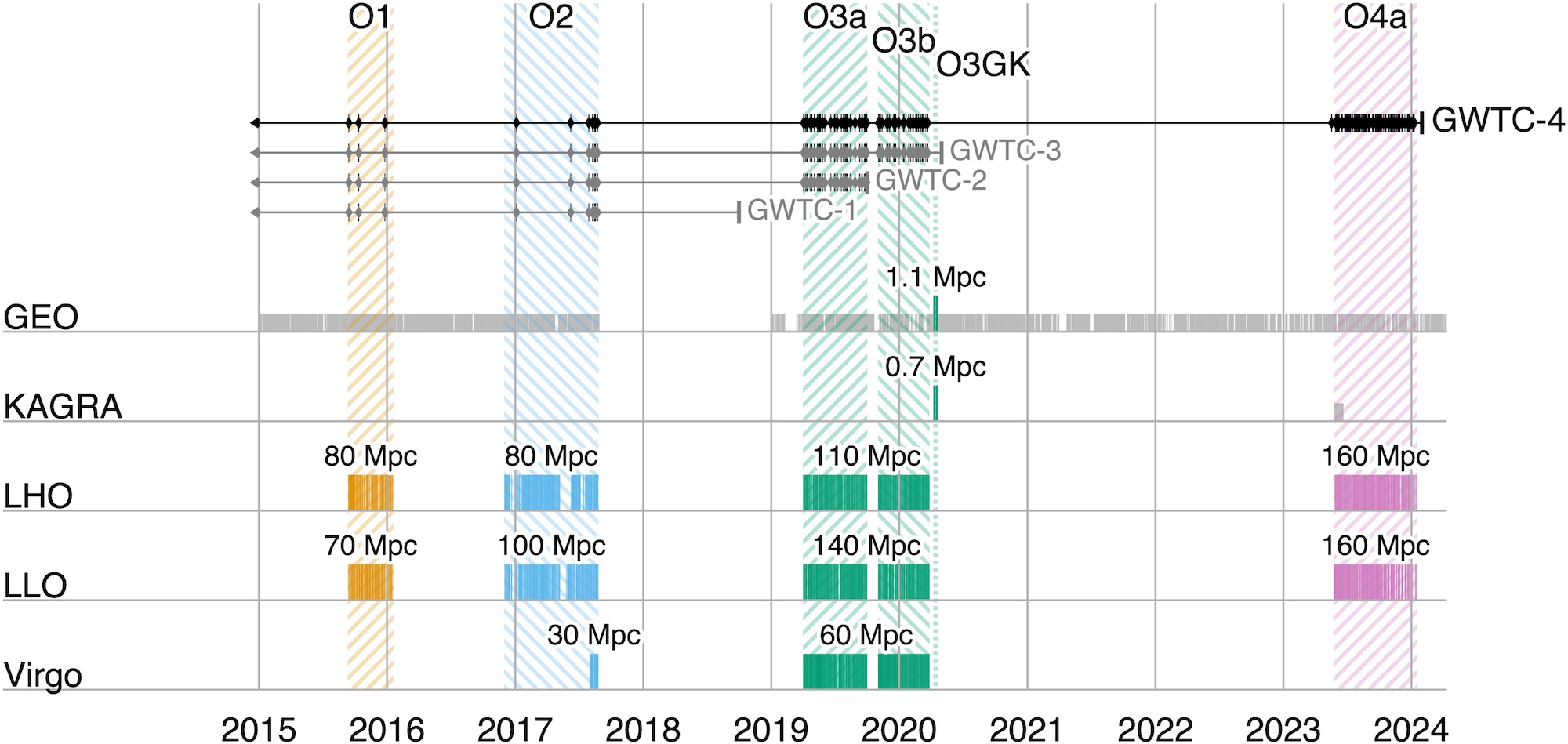
timeline of gravitational wave observatories' observing runs

A timeline showing observing runs between 2015 and 2024. Click to enlarge. [LVK Collaboration 2025]

First up, the collaboration orients the reader to many important aspects of the catalog and the articles contained in the Focus Issue. This article describes how four detectors, each with two arms 3–4 kilometers long, monitor gravitational waves from Hanford, Washington; Livingston, Louisiana; Santo Stefano a Macerata, Italy; and Hida, Japan. These detectors work in concert, ready to receive signals from the universe during coordinated observing runs separated by periods of downtime for construction and commissioning. During these pauses, a smaller instrument, the German–British GEO600 gravitational wave detector, has kept an ear out for signals and will continue to do so until the end of 2026.

After these detectors record subtle spacetime squiggles from compact objects colliding millions to billions of light-years away, the collaboration converts the raw signals into the data contained in catalogs like GWTC-4.0. This process involves modeling the gravitational wave signals, filtering them to identify candidate transients, and pinpointing the most significant events.

After collecting and cleaning the signals, the collaboration undertakes a critical step: making their data accessible to researchers and the public. The data are available through the Gravitational Wave Open Science Center, and the Focus Issue article on open data describes how to navigate the online portal, how the datasets archived online are structured, and how the data were calibrated.

Science Results

This fourth version of the gravitational wave transient catalog greatly expands the sample of gravitational wave transients recorded by detectors across the globe. Including events from previous catalogs, GWTC-4.0 brings us to 218 events for which the probability of the source being astrophysical in nature is more than 50% and for which there is little chance of the signal being an instrumental artifact. This represents a more than 100% increase in the number of recorded gravitational wave events fulfilling this criterion, broadening our understanding of colliding compact object pairs. This release also includes some superlative signals, such as the most massive black hole binary with a low false-alarm rate and the highest signal-to-noise ratio for a gravitational wave event thus far.

Detected in November 2023 by both LIGO Hanford and LIGO Livingston, GW231123 is in many ways an exceptional gravitational wave transient. The total mass of the merging components appears to be between 190 and 265 solar masses, and the false-alarm rate for this signal is less than one per year. This makes it the most massive merger event with such a low false-alarm probability. The two components also appear to have high spins, which complicates the interpretation of the signal with existing models. A binary black hole merger in which one or more components lies within the pair-instability mass gap is the likeliest explanation for this signal, but the authors also present alternative scenarios, such as a core-collapse supernova or a gravitationally lensed gravitational wave signal.
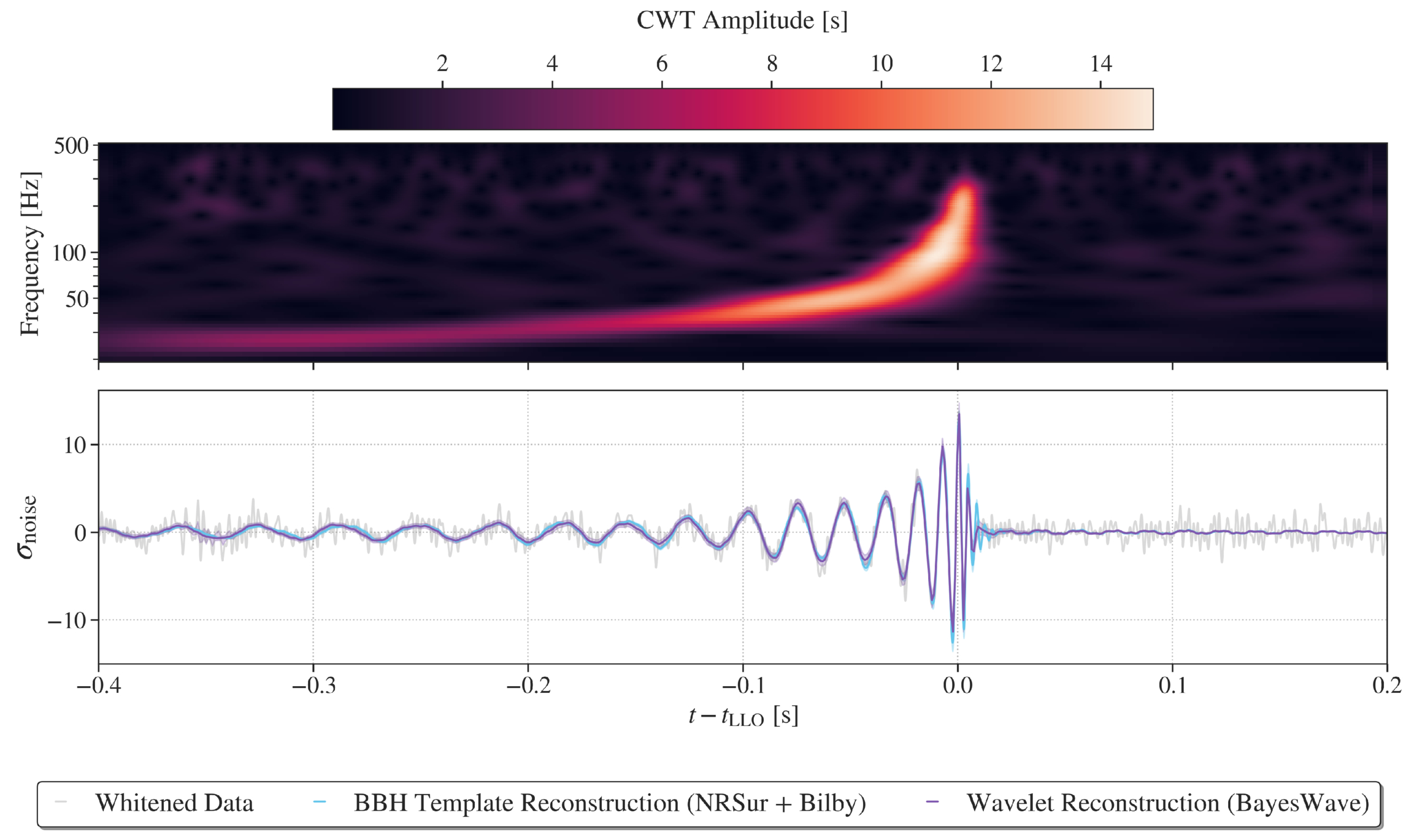
GW230814 gravitational wave signal

Representations of the GW230814 gravitational wave signal. Click to enlarge. [LVK Collaboration 2026]
GW230814, which was detected only by LIGO Livingston, is the loudest signal in the catalog. This signal is consistent with the collision of two black holes, each of roughly 30 solar masses. During the analysis of this signal, the team discovered potential deviations from the predictions of general relativity in the ringdown phase, when the remnant black hole settles into its final shape. Without a detection from another facility to corroborate this finding, it’s difficult to pinpoint the cause of the deviation, but the team could not rule out statistical noise fluctuations as the source.
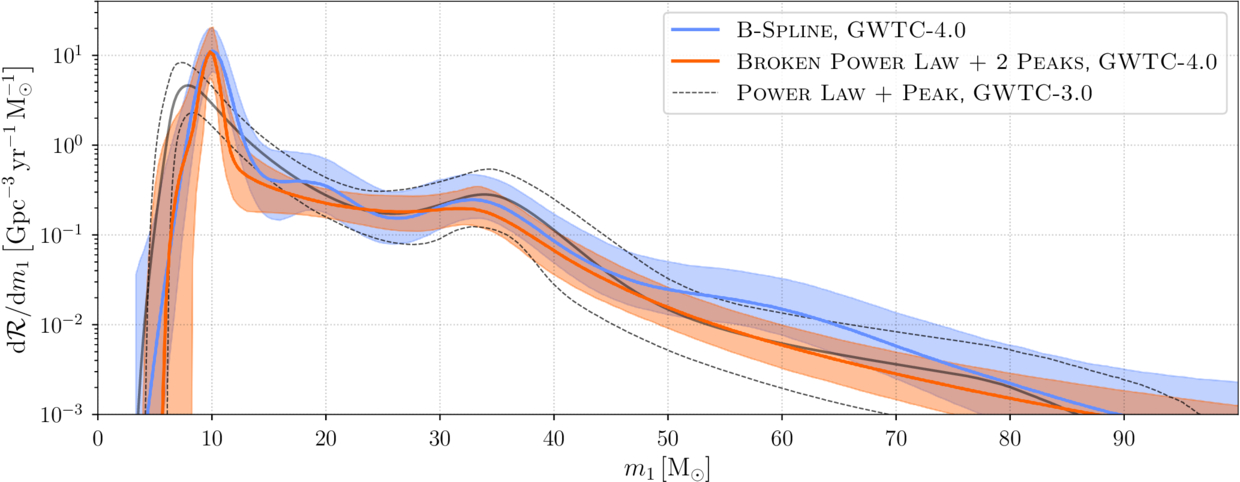
Plot of the differential merger rate

Plot of the differential merger rate as a function of the mass of the more massive of the two merger components. This shows overdensities at 10, 35, and possibly 20 solar masses. Click to enlarge. [LVK Collaboration 2026]

Surveying merging black holes and neutron stars on the population level, the team analyzed 158 gravitational wave signals from the current catalog. This analysis supported findings from previous transient catalogs, including multiple overdensities in the distribution of merging black hole masses, broadly distributed neutron star masses, and an increase in the merger rate with redshift. The new data strengthened certain previously identified trends, such as an increase in the width of the effective spin distribution with redshift, and weakened others.

The full list of articles in the GWTC-4.0 Focus Issue can be found here.

Citation

“GWTC-4.0: An Introduction to Version 4.0 of the Gravitational-Wave Transient Catalog,” A. G. Abac et al 2025 ApJL 995 L18. doi:10.3847/2041-8213/ae0c06

“GWTC-4.0: Methods for Identifying and Characterizing Gravitational-Wave Transients,” A. G. Abac et al 2026 ApJL 1004 L21. doi:10.3847/2041-8213/ae447b

“Open Data from LIGO, Virgo, and KAGRA Through the First Part of the Fourth Observing Run,” A. G. Abac et al 2026 ApJ 1004 232. doi:10.3847/1538-4357/ae211e

“GWTC-4.0: Updating the Gravitational-Wave Transient Catalog with Observations from the First Part of the Fourth LIGO–Virgo–KAGRA Observing Run,” A. G. Abac et al 2026 ApJL 1004 L22. doi:10.3847/2041-8213/ae2c74

“GW231123: A Binary Black Hole Merger with Total Mass 190–265 M⊙,” A. G. Abac et al 2025 ApJL993 L25. doi:10.3847/2041-8213/ae0c9c

“GW230814: Investigation of a Loud Gravitational-Wave Signal Observed with a Single Detector,” A. G. Abac et al 2026 ApJL 1004 L23. doi:10.3847/2041-8213/ae2ad3

“GWTC-4.0: Population Properties of Merging Compact Binaries,” A. G. Abac et al 2026 ApJL 1005 L51. doi:10.3847/2041-8213/ae771e

The post Monthly Roundup: The Fourth Catalog of Gravitational Wave Events from LIGO, Virgo, and KAGRA appeared first on AAS Nova.
Whirlpool in Spacetime Around a Black Hole Merger Provides First Detection of this General Relativity Prediction

26 June 2026 at 13:44

Hidden in the gravitational waves generated by the largest black hole collision ever detected, clues retrieved by Australian National University (ANU) researchers have helped them observe how black holes drag spacetime itself along with their spin.

As two black holes collide, they merge in a massive cosmic impact, forming a larger black hole and creating ripples in spacetime called gravitational waves. In the largest black hole merger observed, GW250114, the ANU team discovered a hidden direct wave for the first time, a feature expected by general relativity and revealed in a recent paper published in Nature.

Black Holes and Gravitational Waves

Some of the most intriguing objects in the universe, black holes have enormous power and effect on their surroundings, which scientists are still working to better understand. The gravitational waves produced by their collisions compress space as they travel, and highly sophisticated—and very precise—detectors are required to observe these waves, such as the United States’ Laser Interferometer Gravitational Wave Observatory (LIGO).

Since not even light can escape a black hole’s event horizon, gravitational waves’ ability to carry information about what lies just beyond the rim’s edge provides an important means of gaining perspective into one of a black hole’s most mysterious regions.

The most extreme black hole merger ever recorded, GW250114, came from a black hole perfectly positioned for Earth observers, allowing LIGO to capture faint signatures in the data. The team decoded the event’s direct wave, previously hidden in the data, revealing the black hole’s drag on spacetime.

Black Hole Frame Dragging

In his theory of relativity, Albert Einstein described black holes as producing a “frame dragging” effect in which they pull nearby spacetime with them as they rotate, like water circling a drain. Also, according to general relativity, the region where this frame-dragging occurs, just past the event horizon’s edge, should produce gravitational radiation that creates a direct wave, imprinting information about the cosmic whirlpool surrounding the black hole.

Event horizons have been essential to theoretical physics models for decades, but very little observational data on them has been collected due to the difficulty of observing light that close to a black hole. Although not a physical object and instead merely a boundary in spacetime, general relativity posits that the event horizon’s properties, such as gravitational strength and rotational speed, should be measurable. Therefore, having access to a data source so close to the black hole’s edge, as with a direct wave, is extremely valuable to understanding our universe.

Due to the extreme nature of the event and our prime viewing location on Earth, the extremely powerful gravitational wave produced by GW250114 was the perfect opportunity to hunt for a direct wave. Despite longstanding predictions of direct waves based on general relativity, this is the first time that one has ever been detected, providing new insight into how fast the black hole is spinning and the gravitational power of the event horizon.

Direct Wave Observation

The researchers employed a new technique to isolate the subtle direct wave in the data from the rest of the event. This first success proves the case for direct waves and how to detect them, opening an entirely new avenue for investigating black holes. By finally detecting these waves, the team provides future researchers with an essential technique for designing new tests of General Relativity, as direct waves, horizon rotations, and surface gravity should all be linked.

Scientists currently grapple with the apparent incompatibility between general relativity, which describes our universe at the macro scale, and quantum physics, which operates at the smallest scales of matter and energy.

Some of our most essential technologies, such as GPS, lasers, quantum computers, and semiconductors, are designed according to these theories and operate perfectly despite the seeming contradiction of how these two perspectives of our universe describe physical reality.

The difficulty of reconciling these ideas is one reason scientists are interested in distant black holes. The extreme conditions of spacetime at the edge of an event horizon may offer the best clues for finally reconciling these existing theories, or for upending them altogether in favor of something that more accurately describes the physical universe at all scales.

The paper, “GW250114 Reveals Signatures of Post-Merger Black-Hole Horizon,” appeared in Nature on June 24, 2026.

Ryan Whalen covers science and technology for The Debrief. He holds an MA in History and a Master of Library and Information Science with a certificate in Data Science. He can be contacted at ryan@thedebrief.org, and follow him on Twitter @mdntwvlf.

Astronomers Unveil Record-Breaking Haul of 161 New Black Hole Collisions

12 June 2026 at 19:57
Gravitational Waves IllustrationA new gravitational-wave catalogue reports 161 additional black hole mergers, bringing the total to 390 detections. Scientists at the University of Glasgow’s Institute for Gravitational Research are celebrating the release of a major new collection of gravitational wave discoveries, a milestone that highlights the rapid growth of gravitational astronomy. The latest Gravitational Wave Transient Catalogue [...]

Mysterious Cosmic Signal Could Be First Real Evidence of Primordial Black Holes

Illustration of Black Holes Orbiting Around One AnotherScientists believe an unusual LIGO detection may be evidence of a primordial black hole, potentially linking these long-theorized objects to the mystery of dark matter. Scientists at the University of Miami believe they may be closing in on evidence for one of the most elusive objects in the universe: primordial black holes. While definitive proof [...]

Selections from 2025: A Search for Gravitational Waves from SN 2023ixf

16 December 2025 at 17:00

Messier 101 and SN 2023ixf

Editor’s Note: For the remainder of 2025, we’ll be looking at a few selections that we haven’t yet discussed on AAS Nova from among the most-downloaded articles published in AAS journals this year. The usual posting schedule will resume January 2nd.

Search for Gravitational Waves Emitted from SN 2023ixf

Published May 2025

Main takeaway:

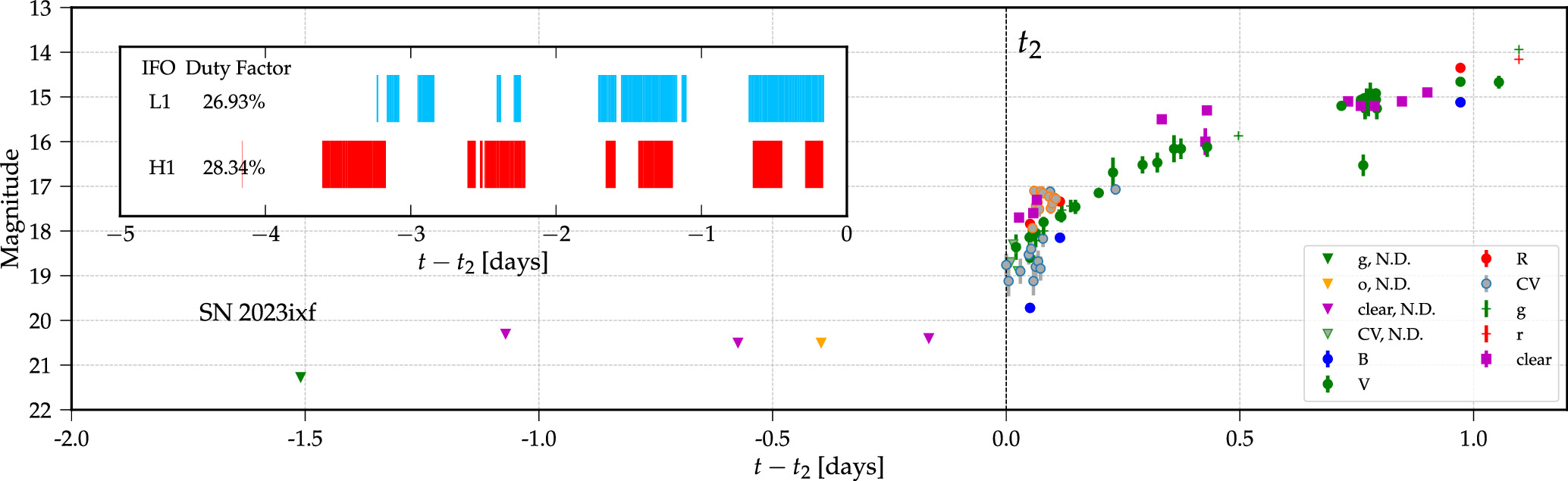
The LIGO, Virgo, and KAGRA collaborations searched for gravitational waves from the core-collapse supernova SN 2023ixf. Though no significant gravitational wave events were detected during times when two or more gravitational wave detectors were online, the non-detection of gravitational waves from this nearby supernova places constraints on the amount of energy emitted by the explosion in the form of gravitational waves, the shape of the proto-neutron star produced in the collapse, and more.

Why it’s interesting:

When a massive star expires in a core-collapse supernova, the collapse of the stellar core into a neutron star or black hole produces gravitational waves. These gravitational waves, along with a stream of neutrinos, should arrive at Earth before the light from the explosion does; gravitational waves and neutrinos can easily escape the dense, roiling ejecta from the explosion, but photons take some time to claw their way through the debris. Gravitational waves from a supernova have never been detected, but the nearby supernova SN 2023ixf, which occurred in a galaxy about 20 million light-years away, offered the best recent opportunity to detect these waves.

photometric evolution of SN 2023ixf and gravitational wave coverage of the event

Photometric evolution of SN 2023ixf in its early days and gravitational wave coverage leading up to the supernova’s discovery (inset image). [LIGO-Virgo-KAGRA Collaborations 2025]

What we learned from this non-detection:

Using the non-detection of SN 2023ixf, researchers placed stringent constraints on the gravitational wave energy and luminosity of a supernova explosion, but an even closer supernova is still needed to begin to rule out model predictions for these quantities. To estimate the distance out to which we can expect to detect gravitational waves from collapsing stars, the collaboration members injected synthetic supernova signals into their data. The majority of non-rotating explosions can be detected out to about 22,000 light-years — meaning events on the far side of our galaxy remain inaccessible to current detectors — while rapidly rotating explosions should be detectable out to nearly 100,000 light-years, pushing the detection horizon beyond the borders of the Milky Way.

Citation

A. G. Abac et al 2025 ApJ 985 183. doi:10.3847/1538-4357/adc681

The post Selections from 2025: A Search for Gravitational Waves from SN 2023ixf appeared first on AAS Nova.

A Black Hole Family Tree

31 October 2025 at 16:20

A rendering of two dark spheres surrounded by bright, misaligned disks drawing near to one another.

Black holes can have messy family histories, and a recent massive merger challenged astronomers to sort out just how many generations of black holes were involved in the event. Recent research, however, may have untangled the lineages of the two progenitors.

A Massive Collision

Earlier this year, the Laser Interferometer Gravitational-Wave Observatory (LIGO) detected the ripples in spacetime caused by the merger of two black holes somewhere in the distant universe. Though these detections have become increasingly common, this one in particular stood out among the more than 200 reported over the last decade. Named GW231123, this event must have caused more of a splash than a ripple since the two black holes that slammed together were unusually massive; both likely weighed more than 100 times the mass of the Sun. Not only that, each was also spinning unusually rapidly prior to the collision.

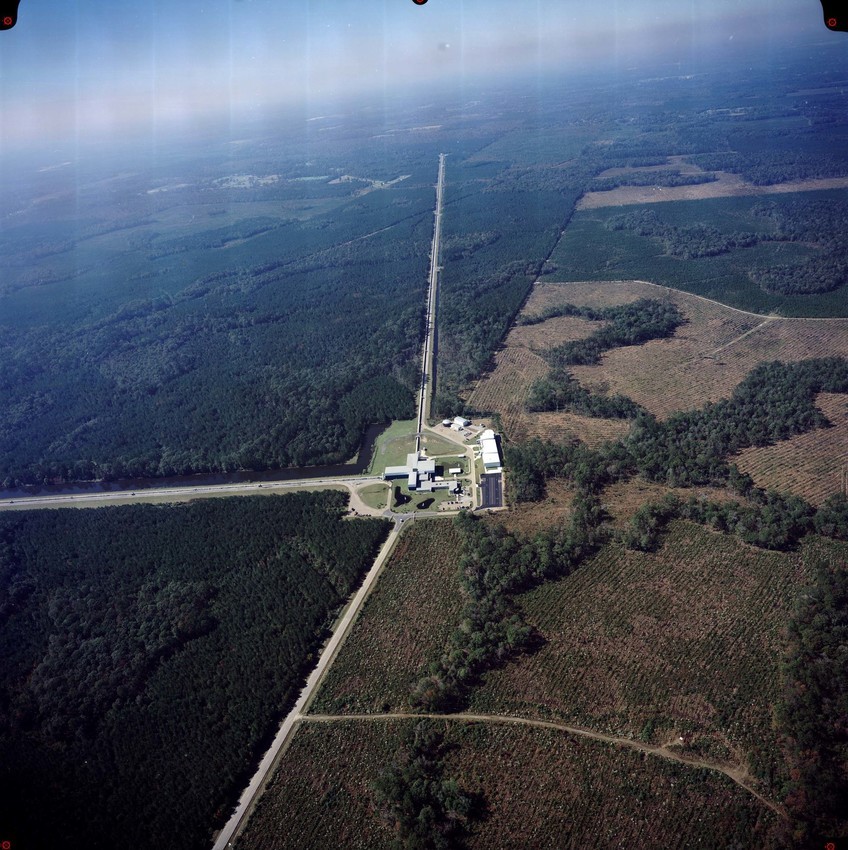
A photograph of two perpendicular straight lines that cut through a forest and meet at a complex of buildings in a clearing.

LIGO Livingston, one of the two LIGO detectors. [Caltech/MIT/LIGO Lab]

According to theory, black holes this large are not supposed to form on their own. When massive stars die, they can collapse into a black hole; but, when really massive stars die, the collapse is so violent that no material is left over to form the black hole. So, when researchers first measured the masses of the black holes involved in GW231123, they knew that the black holes involved couldn’t have formed directly from collapsed stars. Instead, they were likely second-generation black holes, meaning that they themselves formed from previous black hole–black hole mergers.

Merger Mystery

This result was celebrated as evidence of so-called “hierarchical formation,” in which black holes formed in dense environments swarm throughout their star clusters, merging with other black holes they encounter and growing ever larger.

However, there were a couple of complications with this picture. For one, theory predicts that it is challenging to form such rapidly spinning black holes from randomly oriented progenitors, since usually the spins wash out and leave the remnant rotating slowly. For another, the merging process tends to give the final black hole a “kick” that sends it flying rapidly away from the site of the impact, occasionally fast enough to leave the star cluster altogether, meaning second-generation black holes might not be able to merge into subsequent generations.

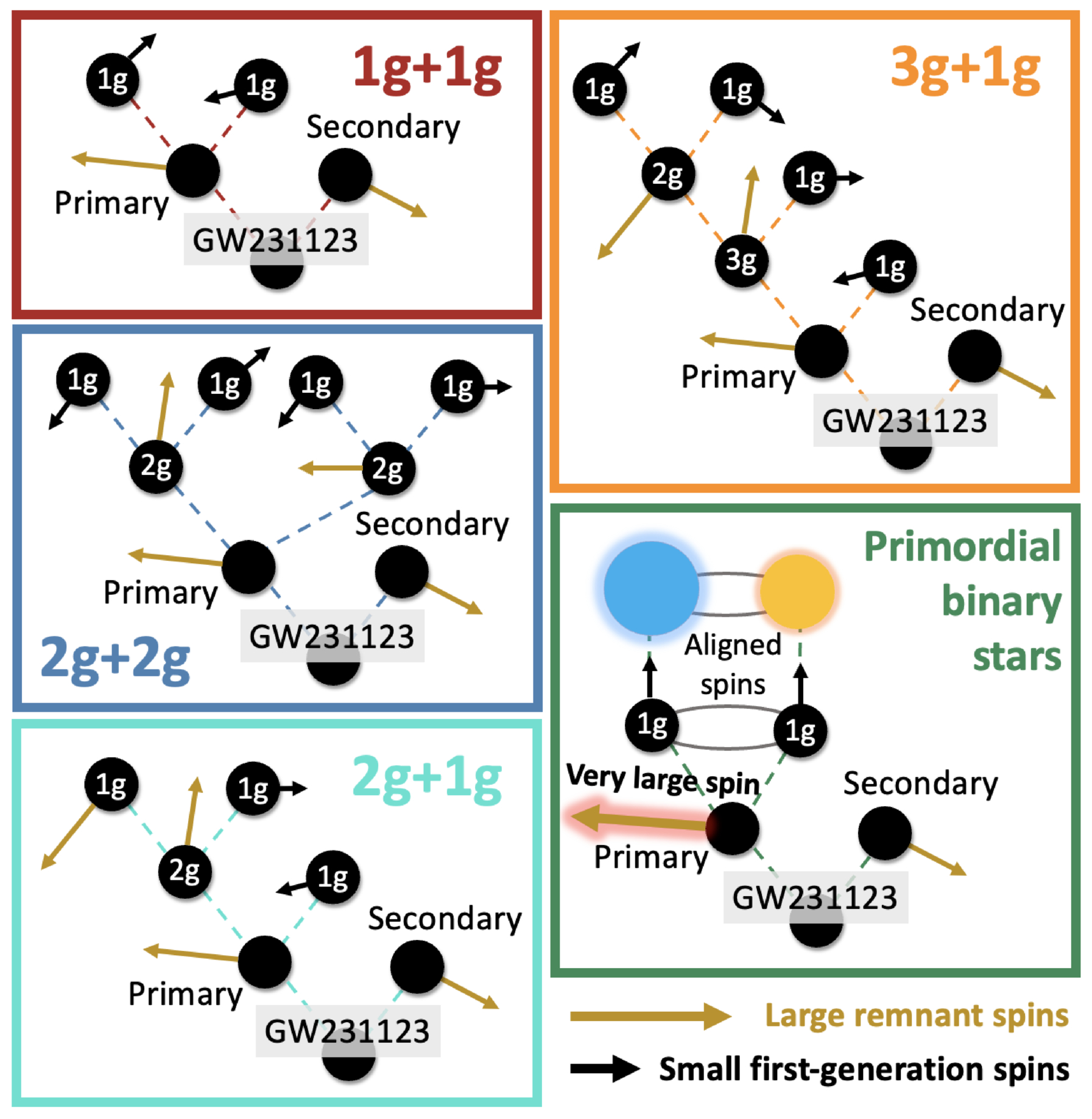
A multi-panel cartoon showing black holes merging through various combinations of 1st, 2nd, and 3rd generation black holes.

A schematic of various potential black hole family trees. The binary-star origin scenario is shown in the green box. Click to enlarge. [Stegmann et al. 2025]

Born as a Pair

New research led by Jakob Stegmann, Max Planck Institute for Astrophysics, suggests a way around each of these problems. In the team’s model, the two black holes involved in the GW231123 merger didn’t form from isolated black holes in a cluster, but rather from binary stars embedded within that cluster. In this picture, two massive stars were born bound together, orbiting one another within a larger cluster of stars. Crucially for this scenario, the massive primordial stars have aligned spins — an expected outcome of massive binary star evolution.

After both stars in the binary collapsed into black holes, these black holes merged to form a rapidly spinning second-generation black hole. This second-generation black hole eventually encountered another black hole within the cluster and merged to produce the ripples in spacetime we observed as GW231123.

Since black holes born within binary systems are expected to have smaller kicks and faster spins, this scenario neatly explains the properties observed in GW231123. As LIGO keeps listening for more black hole mergers, hopefully similar events will provide more chances to untangle their complex family trees.

Citation

“Resolving Black Hole Family Issues Among the Massive Ancestors of Very High-Spin Gravitational-Wave Events like GW231123,” Jakob Stegmann et al 2025 ApJL 992 L226. doi:10.3847/2041-8213/ae0e5f

The post A Black Hole Family Tree appeared first on AAS Nova.

Not Their First Rodeo: Gravitational Wave Detectors Spot Merging Black Holes That Have Merged Before

28 October 2025 at 16:00

gravitational wave illustration

Meet GW241011 and GW241101, two events from the fourth observing run of the LIGO, Virgo, and KAGRA (LVK) gravitational wave detectors. With rapid spins and mismatched black hole masses, both events provide strong evidence for black hole growth through hierarchical mergers.

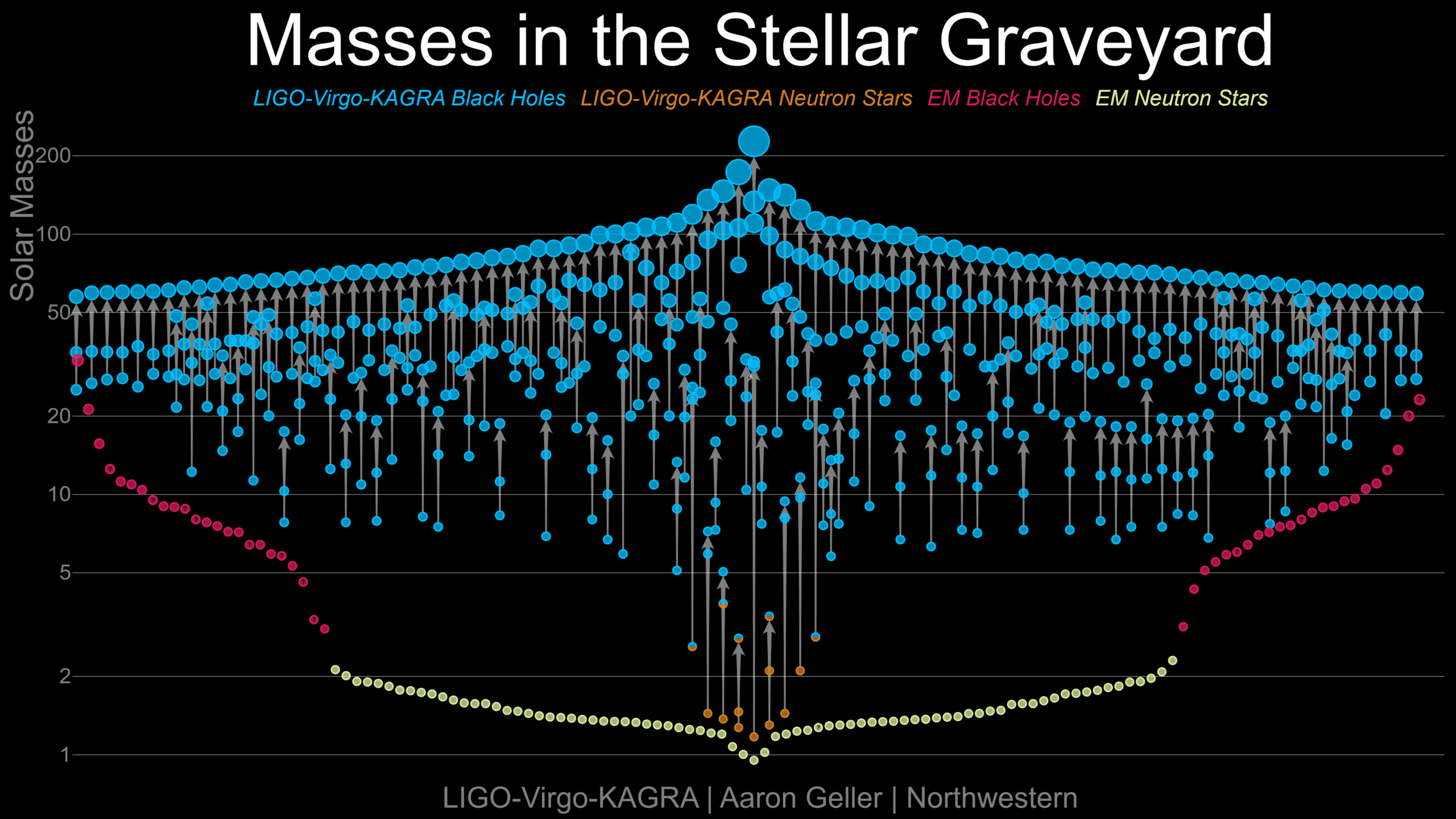
"masses in the stellar graveyard"

Masses of black holes and neutron stars discovered via gravitational waves (blue and orange circles). The red and yellow circles show the black holes and neutron stars detected through electromagnetic means. Click to enlarge. [LVK/A. Geller/Northwestern]

A Decade of Discovery

Humanity is 10 years into its study of the gravitational wave universe, and detectors across the globe are about to wrap up their fourth observing run. The recently released fourth catalog of gravitational wave transients, GWTC-4.0, more than doubles the number of recorded events.

Today, we’re taking a look at two of the fourth observing run’s gravitational wave events, both of which point to black holes born in dense environments.

Two Detections in the Spotlight

GW241011 and GW241101 are gravitational wave signals that reached Earth in late 2024. Using Bayesian parameter estimation, members of the LVK collaboration determined that each of these two signals arose from the merger of a pair of black holes.

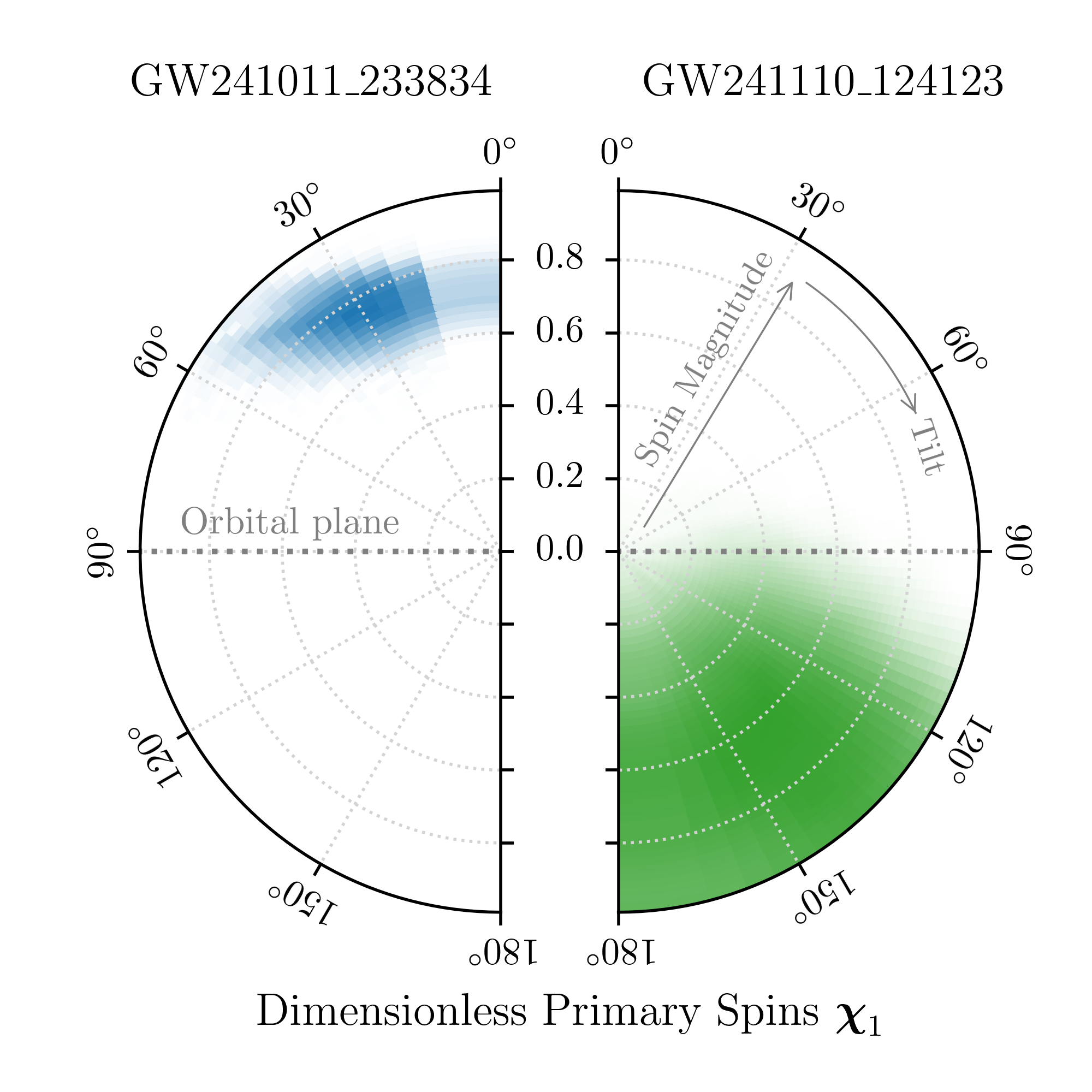
plot of posterior spin distributions

Posterior distributions for the primary black hole’s spin magnitude for GW241011 (left) and GW241101 (right). [LIGO, Virgo, and KAGRA Collaborations 2025]

Though the LVK detectors have by now spotted dozens of coalescing black hole pairs, these two detections stand out. GW241011 is the third-loudest gravitational wave signal ever detected, and its primary (i.e., more massive) black hole has one of the largest and most precisely measured spins among black holes detected via gravitational waves.

GW241101 flips the script: its primary black hole also spins rapidly, but it appears to do so in a direction opposite from the direction in which the black holes orbit. Though its spin isn’t measured as precisely as that of the primary black hole in GW241011, this event still provides the best evidence so far that the spins of some merging black holes are misaligned with their orbital motion.

In addition to their standout spin parameters, these events are also remarkable for the masses involved. In both cases, the larger black hole has a mass of 15–20 solar masses, and the smaller black hole is significantly smaller — about 6 solar masses for GW241011 and 8 solar masses for GW241101.

A Black Hole Genealogy Project

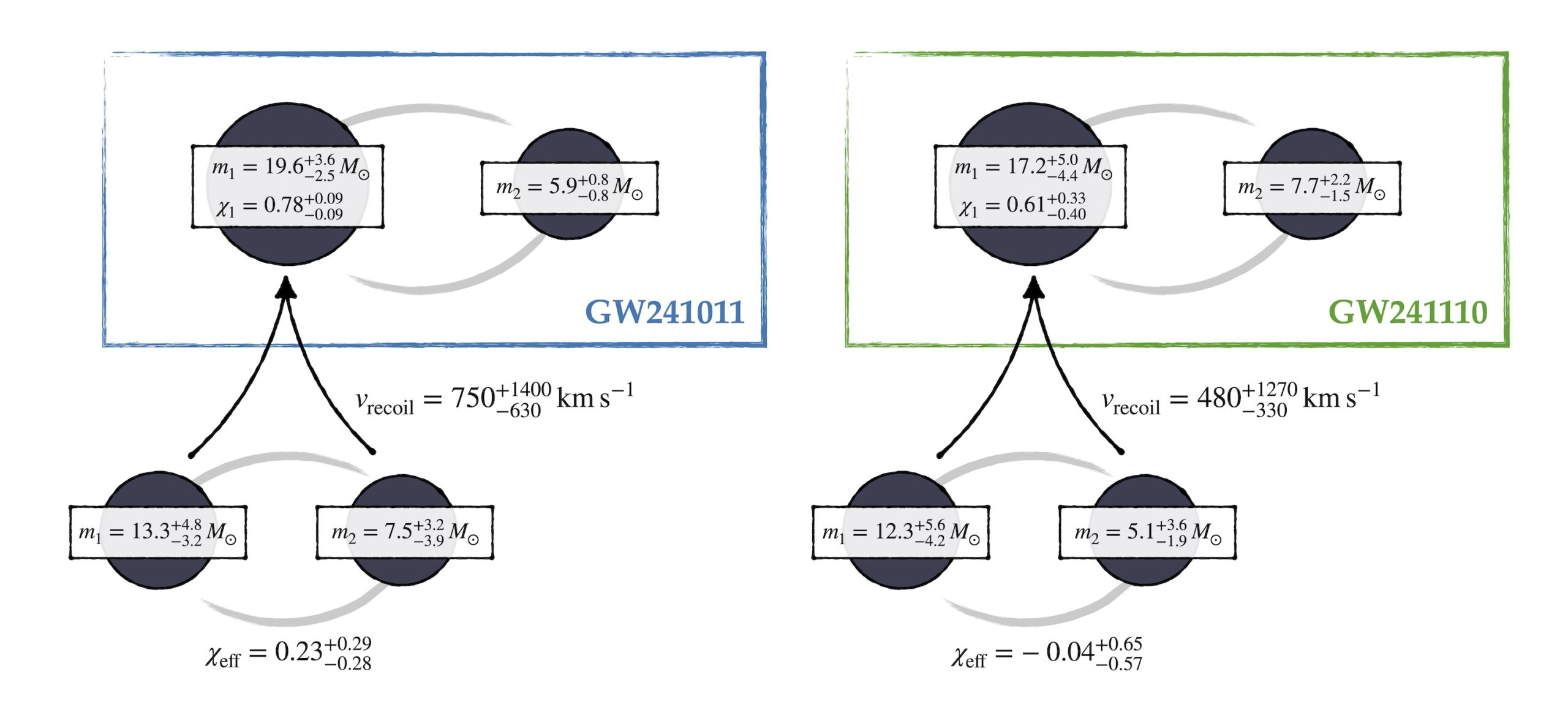
Inferred masses and spins of the ancestors of the primary black holes of GW241011 and GW241101

Inferred masses and spins of the ancestors of the primary black holes of GW241011 and GW241101. Click to enlarge. [LIGO, Virgo, and KAGRA Collaborations 2025]

The rapid spins and comparatively large masses of the primary black holes of GW241011 and GW241101 don’t line up with what’s expected for black holes arising in isolated binary systems, unsubjected to outside influences. But they do match expectations for hierarchical mergers, in which one or more of the black holes involved is itself the product of a merger.

If these signals arose from hierarchical mergers, that tells us something about the environment in which the black holes lived. When two black holes merge, the product is expected to spin rapidly and receive a “kick.” For a black hole pair in a loose grouping of stars, this kick would likely boot the merger product out of the group, preventing it from encountering other black holes and merging again.

But in dense environments like compact star clusters, even a good strong kick isn’t enough to overcome the cluster’s escape velocity and launch the resulting black hole on a lonely journey through space. Instead, these black holes are retained in the dense cluster environments of their birth, where they may dance and merge with another black hole partner. While it’s not possible to entirely rule out other origins, such as an isolated pair of massive binary stars, the data strongly support the hierarchical merger scenario.

This discovery yet again demonstrates the ability of our gravitational wave detectors to reveal the lives and histories of black holes throughout our universe. Stay tuned for even more black hole news from the current observing run!

Citation

GW241011 and GW241110: Exploring Binary Formation and Fundamental Physics with Asymmetric, High-Spin Black Hole Coalescences,” A. G. Abac et al 2025 ApJL 993 L21. doi:10.3847/2041-8213/ae0d54

The post Not Their First Rodeo: Gravitational Wave Detectors Spot Merging Black Holes That Have Merged Before appeared first on AAS Nova.

❌