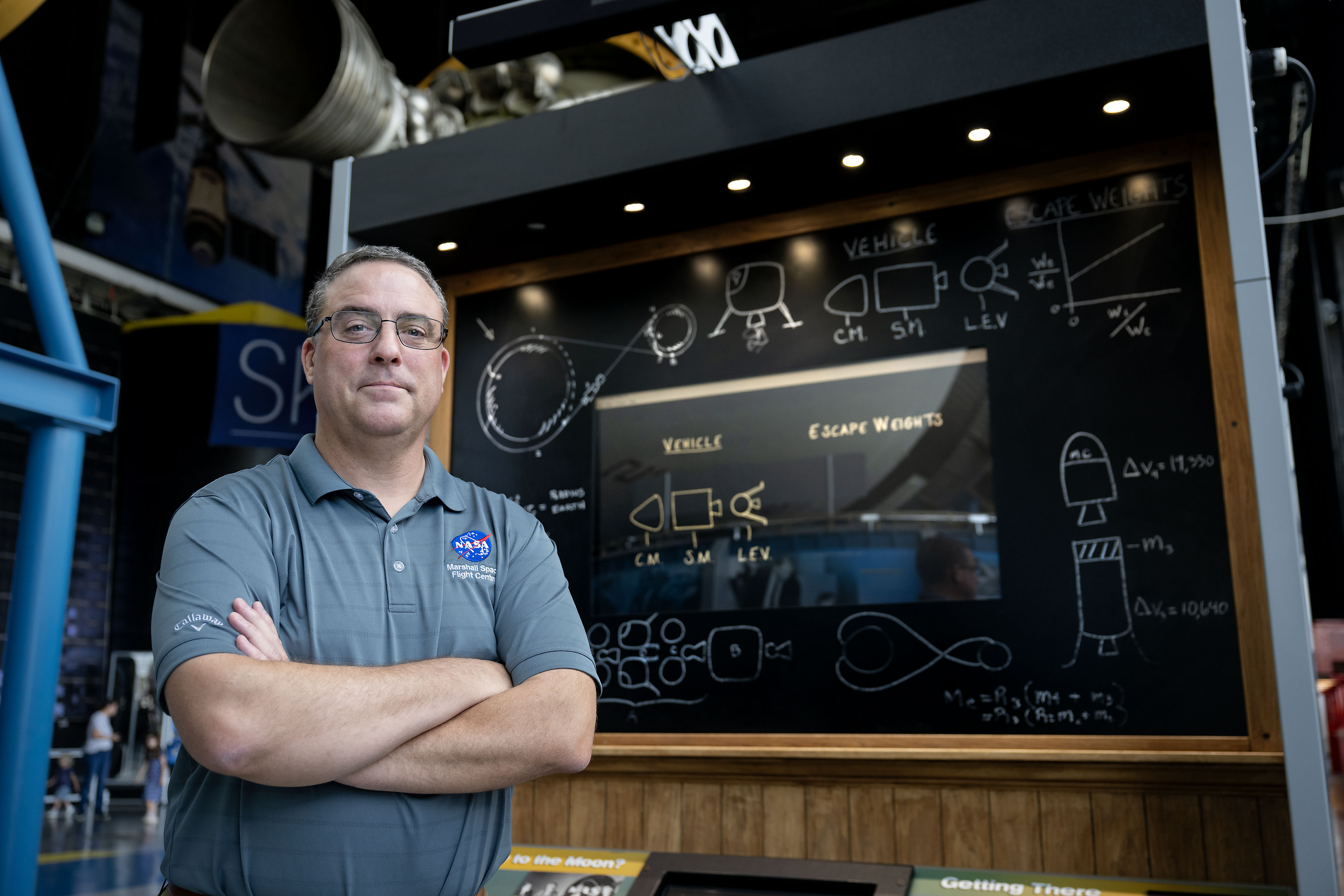
As NASA sets its sights on long-term exploration of the Moon and Mars, the agency is increasing the cadence of its Artemis missions. Helping bring these plans to fruition is Tom Percy, manager of systems engineering and integration for NASA’s Human Landing System Program.
Tom Percy, manager of systems engineering and integration for NASA’s Human Landing Systems Program, stands in front of an Apollo Program lander exhibit at the U.S. Space and Rocket Center in Huntsville near NASA’s Marshall Space Flight Center.
NASA/Charles Beason
Percy serves as a focal point in working with providers SpaceX and Blue Origin to accelerate and streamline systems designs, manufacturing, testing, and certification. He ensures the crewed landers that SpaceX and Blue Origin are developing for Artemis are designed, built, tested, and will operate with other NASA exploration assets safely and effectively.
“You might say that all human landing system integration work lands on my desk. And with the rest of my talented, hard-working systems engineering and integration team, we’re working to make it all happen,” Percy said.
A native of North Easton, Massachusetts, Percy earned a bachelor’s degree in mechanical engineering from the Rochester Institute of Technology in Rochester, New York, where he first got hands-on experience working on designs that could be applied to NASA’s sustainable lunar architecture.
“As an undergrad, I served as president of the Rochester Institute of Technology’s chapter of the American Society of Mechanical Engineers. To get some real-world engineering experience, we decided to participate in the Great Moonbuggy Race,” Percy said. “Now called the Human Exploration Rover Challenge, the competition is held annually at NASA’s Marshall Space Flight Center in Huntsville, Alabama.
“At the time, I had never heard of Marshall Space Flight Center,” said Percy. “But our student team designed and built a rover and traveled to Huntsville for the race. That’s when I learned about some of the projects in Marshall’s diverse portfolio that the center works for NASA. And that’s when I began planning to make my way to NASA Marshall for my career.”
Percy chose to move south and earn a master’s degree in aerospace engineering from the Georgia Institute of Technology in Atlanta. His research in the advanced propulsion lab and courses in space systems design culminated in a spacecraft design course and the chance to work directly with engineers at Marshall.
Since landing at Marshall in 2003, Percy has been involved in evaluating transportation architecture options for human deep space exploration, including missions to land astronauts on the Moon and Mars. He also has expertise in space transportation, including advanced propulsion technology development; trajectory analysis; and spacecraft and mission concept development. Percy earned a doctorate in aerospace systems engineering from the University of Alabama in Huntsville.
The range of experience comes together in his current role as manager of human landing systems engineering and integration.
“The world watched the amazing success of Artemis II. NASA and our commercial providers are looking forward to flying again soon and executing increasingly complex Artemis missions,” Percy said.
Through the Artemis program, NASA will send astronauts on increasingly complex missions to explore more of the Moon for scientific discovery, economic benefits, establish an enduring human presence on the lunar surface, and to build on our foundation for the first crewed missions to Mars.
NASA, SpaceX Advance Wind Tunnel Tests for Starship Rocket
Engineers at NASA Ames conduct transonic and supersonic wind testing on a 1.2% scale model of the Super Heavy Version 3 rocket that will launch the Starship human landing system.
Credits: NASA
NASA and its industry partners are preparing for next year’s Artemis III demonstration mission by completing new wind tunnel tests on SpaceX’s Super Heavy Version 3 rocket booster. The tests, conducted at NASA’s Ames Research Center in California’s Silicon Valley, focused on better understanding the extreme aerodynamic forces the rocket can experience during re-entry. The recent test series builds on previous testing completed at NASA Ames in 2024.
NASA is working with SpaceX to develop the company’s Starship Human Landing System (HLS) to safely carry astronauts from lunar orbit to the Moon’s surface and back. The upgraded Super Heavy rocket booster is part of SpaceX’s Starship launch system. Version 3 of Starship and Super Heavy is expected to be the basis for the Starship HLS for Artemis III in 2027 and a later crewed lunar landing in 2028.
Engineers at NASA Ames conduct transonic and supersonic wind testing on a 1.2% scale model of the Super Heavy Version 3 rocket that will launch the Starship human landing system.
NASA
Engineers at NASA Ames conduct transonic and supersonic wind testing on a 1.2% scale model of the Super Heavy Version 3 rocket that will launch the Starship human landing system.
NASA
Engineers at NASA Ames conduct transonic and supersonic wind testing on a 1.2% scale model of the Super Heavy Version 3 rocket that will launch the Starship human landing system.
NASA
Engineers at NASA Ames conduct transonic and supersonic wind testing on a 1.2% scale model of the Super Heavy Version 3 rocket that will launch the Starship human landing system.
NASA
Although Starship HLS is a lunar lander designed and built by SpaceX, NASA collaborates with commercial companies to provide access to specialized testing facilities, like the wind tunnels at NASA Ames, and technical expertise, such as the team that set up the wind tunnel testing and helped analyze the results.
“NASA has a lot of experience with unsteady aerodynamics,” said Manish Mehta, discipline lead engineer for the HLS Plume and Aero Environments team, NASA’s Marshall Space Flight Center in Huntsville, Alabama. “We used the agency’s broad experience base of conducting wind tunnel tests for the space shuttle, the SLS (Space Launch System) rocket, and Orion spacecraft to efficiently set up and analyze the wind tunnel testing for the Super Heavy Version 3. In fact, similar testing at the Ames Unitary Plan Wind Tunnel resulted in adding strakes to SLS for Artemis II, so what we learned for Artemis II is helping us get to Artemis III and beyond.”
Testing
SpaceX’s Starship consists of a 33-engine first-stage Super Heavy rocket, or booster, and the second-stage Starship. Version 3 of Super Heavy incorporates many new and upgraded systems, including:
New propulsion systems and new Raptor 3 rocket engines
No engine section skirt, individual engine shrouds, or integrated large-scale base heat shield
Three gridfins on the Super Heavy booster instead of four, with each fin now 50% larger
An integrated hot stage replacing the previous single-use protective interstage
With significant changes to Super Heavy, NASA and SpaceX engineers wanted more information about the steady and unsteady aerodynamic forces the rocket will experience during atmospheric re-entry as it returns to the launch site for refurbishment and re-use.
“When a rocket, or an airplane, flies through air at high speed, it’s subjected to steady aerodynamic forces and moments, and unsteady aerodynamic forces and moments,” explained Jayanta Panda, unsteady aerodynamics subject matter expert at NASA Ames and part of the Human Landing System Plume and Aero Environments team. “An example of a steady aerodynamic force would be when air smoothly flows over the surface of the rocket as it ascends. An unsteady aerodynamic force would be air ‘buffeting,’ or hitting, certain areas the rocket at less predictable times and potentially causing vibrations.”
Wind tunnels
NASA and SpaceX used a 1.2% scale model of the Super Heavy Version 3 in the transonic wind tunnel and the supersonic wind tunnel at NASA Ames for testing. The transonic tunnel blasts scale models of rockets or aircraft with air at speeds ranging from Mach 0.2 to Mach 1.4 (Mach 1 is the speed of sound, or about 761 miles per hour). The smaller supersonic tunnel fires winds at higher speeds, from Mach 1.55 to Mach 2.5. The wind tunnel tests on Super Heavy Version 3, conducted in late 2025, used both tunnels to measure steady and unsteady air flows on the surfaces of Super Heavy.
“Resulting wind tunnel data on steady forces and moments helps predict how the rocket will react to forces in the atmosphere during re-entry so the flight software can effectively guide the rocket during flight,” Mehta said. “The unsteady pressure data helps engineers understand the environment around the rocket as it re-enters Earth’s atmosphere. Engineers use that information as one input into software that analyzes loads on the rocket.”
Through the Artemis program, NASA is returning humans to the Moon for scientific discovery, economic opportunity, to establish an enduring human presence on the lunar surface, and build the foundation for the first crewed missions to Mars – for the benefit of all.
How NASA’s Artemis III Lander Test Will Pave Way for Moon Landings
Before Artemis astronauts land on the Moon’s surface in 2028, NASA will conduct the Artemis III demonstration mission in 2027, allowing teams on Earth and in orbit to practice rendezvous and docking operations between commercial human landing systems and the Orion spacecraft. Data from that mission, along with future uncrewed demonstration missions at the Moon, will support astronaut safety and mission success for crewed lunar landings.
NASA is working with two American companies to develop the human landing systems that will safely transport astronauts from lunar orbit to the Moon’s surface and back for future Artemis missions. For Artemis III, both SpaceX and Blue Origin will fly test versions, or test articles, of the crewed landers that will be used for future Moon landings. The lander test articles will launch by commercial rockets, while the Artemis III crew will launch to low Earth orbit in Orion atop the agency’s SLS (Space Launch System) rocket.
Stage setting for crewed flights
NASA and the human landing system providers have been working closely together to plan and determine capabilities for the Artemis III mission. With missions fast approaching, both SpaceX and Blue Origin are optimizing hardware availability and capability. SpaceX plans to use the company’s latest version of Starship and basis of the future Starship HLS, called Version 3, while Blue Origin will test their planned HLS crew cabin, allowing each company to apply lessons learned prior to uncrewed and crewed missions on the Moon.
“Each human landing system provider has taken a different approach to the Artemis III mission,” said Steve Creech, program manager, Human Landing System Program, NASA’s Marshall Space Flight Center in Huntsville, Alabama. “Ultimately, SpaceX and Blue Origin have put forward a list of aggressive objectives and goals intended to complement upcoming uncrewed demonstration missions at the Moon so that we can gain both understanding and confidence in the spacecraft and launch vehicles prior to a crewed landing. The lander prototype designs will inform future development efforts and will continue to mature over the next year.”
For the Artemis III mission, the Blue Moon test lander will be based on Blue Origin’s current architecture for its Mark 2 crew lander, incorporating all the major avionics and flight software and control systems to ensure flight operations from this demonstration mission can directly translate to crewed lunar flights. Up to two crew members, donning orange Orion crew survival system suits, will open the hatch to enter the Blue Origin test lander. The production hardware must incorporate many of the same systems and subsystems, including an Environmental Control and Life Support System (ECLSS), a crew cabin, and avionics.
These artist’s concepts depict Blue Origin’s Blue Moon Mark 2 human landing system test article in Earth orbit and docked with NASA’s Orion spacecraft as part of NASA’s upcoming Artemis III demonstration mission in low Earth orbit.
Blue Origin
These artist’s concepts depict Blue Origin’s Blue Moon Mark 2 human landing system test article in Earth orbit and docked with NASA’s Orion spacecraft as part of NASA’s upcoming Artemis III demonstration mission in low Earth orbit.
Blue Origin
The Blue Origin lander also will fly with an instrumented lunar surface spacesuit mass simulator. Like the suited “Moonikin” manikin that flew aboard Orion during the uncrewed Artemis I test flight, the low-fidelity spacesuit mass simulator will provide real-time feedback about the environment within the Blue Moon crew cabin.
SpaceX’s Starship lander test article will use a Starship Version 3, currently in production and testing, with an added docking system installed on the nose of the 171-foot (52-m) spacecraft, enabling NASA and SpaceX to evaluate how the entire integrated stack of Orion and the Starship test lander interact. NASA and SpaceX are identifying controllability and communications tests for the Artemis III mission. Astronauts will not enter the Starship test lander during Artemis III.
These artist’s concepts depict NASA’s Orion spacecraft and SpaceX’s Starship human landing system test article during docking operations as part of NASA’s upcoming Artemis III demonstration mission in low Earth orbit.
SpaceX
These artist’s concepts depict NASA’s Orion spacecraft and SpaceX’s Starship human landing system test article during docking operations as part of NASA’s upcoming Artemis III demonstration mission in low Earth orbit.
SpaceX
Launch cadence
NASA, SpaceX, and Blue Origin will launch three of the world’s most powerful rockets within a short timeframe of one another, exercising ground processing, launch crews, and facilities as well as control centers, networking, and data exchange at key sites across the country during two separate, back-to-back rendezvous and docking maneuvers between Orion and the lander test articles, before a safe splashdown of the Artemis III crew in Orion.
“Artemis III will be a highly choreographed dance with a demanding launch sequence across multiple launch pads and equally demanding mission operations for our ground and flight crews, making it one of the most complex and ambitious missions NASA has ever undertaken,” said Jeremy Parsons, Artemis program manager. “The demonstration mission will set the stage before our next giant leap. NASA’s expertise in systems engineering and integration, as well as launch and mission operations in low Earth orbit, will bring the mission together.”
For future crewed missions to the Moon, NASA and one of the commercial lander partners will execute a “dual launch campaign,” prepositioning the lander in orbit to await a crewed Orion, launched on SLS. Launching the three rockets in succession of one another for Artemis III offers a unique opportunity to practice launch processing and operations.
Blue Origin’s lander test article is planned to launch first and will be able to loiter in space for up to 30 days, allowing for checkouts in orbit prior to the launch of SLS and Orion from Launch Complex 39B at NASA’s Kennedy Space Center in Florida. The Blue Origin test article will launch at a set trajectory to meet a designated “parking” orbit for these systems checks.
Artemis III will be a highly choreographed dance with a demanding launch sequence across multiple launch pads and equally demanding mission operations for our ground and flight crews, making it one of the most complex and ambitious missions NASA has ever undertaken.
Jeremy Parsons
Artemis program manager
Following the completion of Blue Origin’s rendezvous and docking operations testing and the Artemis III crewed launch on SLS, SpaceX will launch its Starship lander test article to rendezvous with Orion and its crew for its phase of on-orbit testing.
Throughout the Artemis III mission, Orion will fly in a circular orbit. All three rockets will have more launch opportunities than are available for a lunar mission and will be able to reach the designated mission altitude in a single launch.
Docking operations
During docking and undocking operations, Orion and the Artemis III crew will use the lander test articles as the targets, while Orion will operate as the chaser spacecraft. This is the same configuration planned for future crew landing mission to the Moon.
NASA will ensure both test landers are mission ready and crew safe prior to Artemis III. These verifications will be based on functional and performance requirements for the test lander designs and hazard controls for hardware and software, ensuring the Artemis III astronauts inside Orion are safe throughout both docking phases of the mission.
SpaceX and Blue Origin have already tested their docking capabilities for their respective landers on the ground. SpaceX’s docking capability was qualified in 2023; Blue Origin conducted development ground testing on its pressurized docking system earlier this year.
A key difference between the docking capabilities of both lander test articles will be the location of docking. Orion will dock along the side of the Blue Moon test lander, adjacent to the crew cabin. Later, Orion will dock nose-to-nose with the giant SpaceX test lander.
Software testing between spacecrafts will help demonstrate that the commercial human landing system prototypes and Orion can meet at a precise time and location in space. When Orion docks with the Blue Moon test lander, the Orion spacecraft’s software will control the docked spacecraft. Meanwhile, the SpaceX test article will control the docked spacecraft for the second portion of the mission. During the docking phases, teams with NASA and the commercial partners will be able to test hardware and software interoperability, as well as dynamics of how the integrated lander-Orion spacecraft moves in space.
Through the Artemis program, NASA will send astronauts to explore the Moon for scientific discovery, economic benefits, and to build the foundation for the first crewed missions to Mars – for the benefit of all.

 Login