❌

Normal view

EU Antitrust Fines for Google Search and Play Store

23 July 2026 at 20:47

Tim Hardwick (Wired):

Google was today fined €890 million ($1 billion) by the European Union for breaching antitrust rules with regard to its search and Google Play store services.

The European Commission found that Google had broken the Digital Markets Act (DMA) by using its dominant position in the search market to favour its own services, like shopping and hotel deals, over those of rivals.

The Commission also said that the company had abused its position by preventing developers from directing users to cheaper ways to buy apps and app subscriptions on websites and alternative app stores.

Sergiu Gatlan:

The Commission noted that Google has begun testing changes to how its own services are placed in search results and rolled out changes to its steering terms, which the EU’s main executive body described as substantial progress towards compliance.

“Google has fallen short of effective compliance with the Digital Markets Act, and today we have taken decisive yet balanced enforcement action sanctioning these breaches,” said Teresa Ribera, Executive Vice-President for Clean, Just and Competitive Transition.

“The best products should succeed because they’re better, not because they’re owned by the company running the search engine. And European consumers have a right to be told by app developers where to sign up to the best offers, even when the app store owner does not get a cut.”

John Gruber (Mastodon):

With search, Google is required to share with competitors — search engines and AI chatbots alike — a massive amount of user data from Google Search user interactions. What terms people search for, what they click on in results, what languages and devices they use. It’s all ostensibly anonymized but that’s tricky when it comes to search terms. A lot of the terms people type into web search fields are to some degree personally identifying. The EC seems to be saying it’s Google’s problem to filter out things like passwords and usernames and omit them from the shared datasets. Google can charge money for this access, but only under “fair, reasonable, and non-discriminatory (FRAND)” prices, based on a Commission-defined methodology.

Previously:

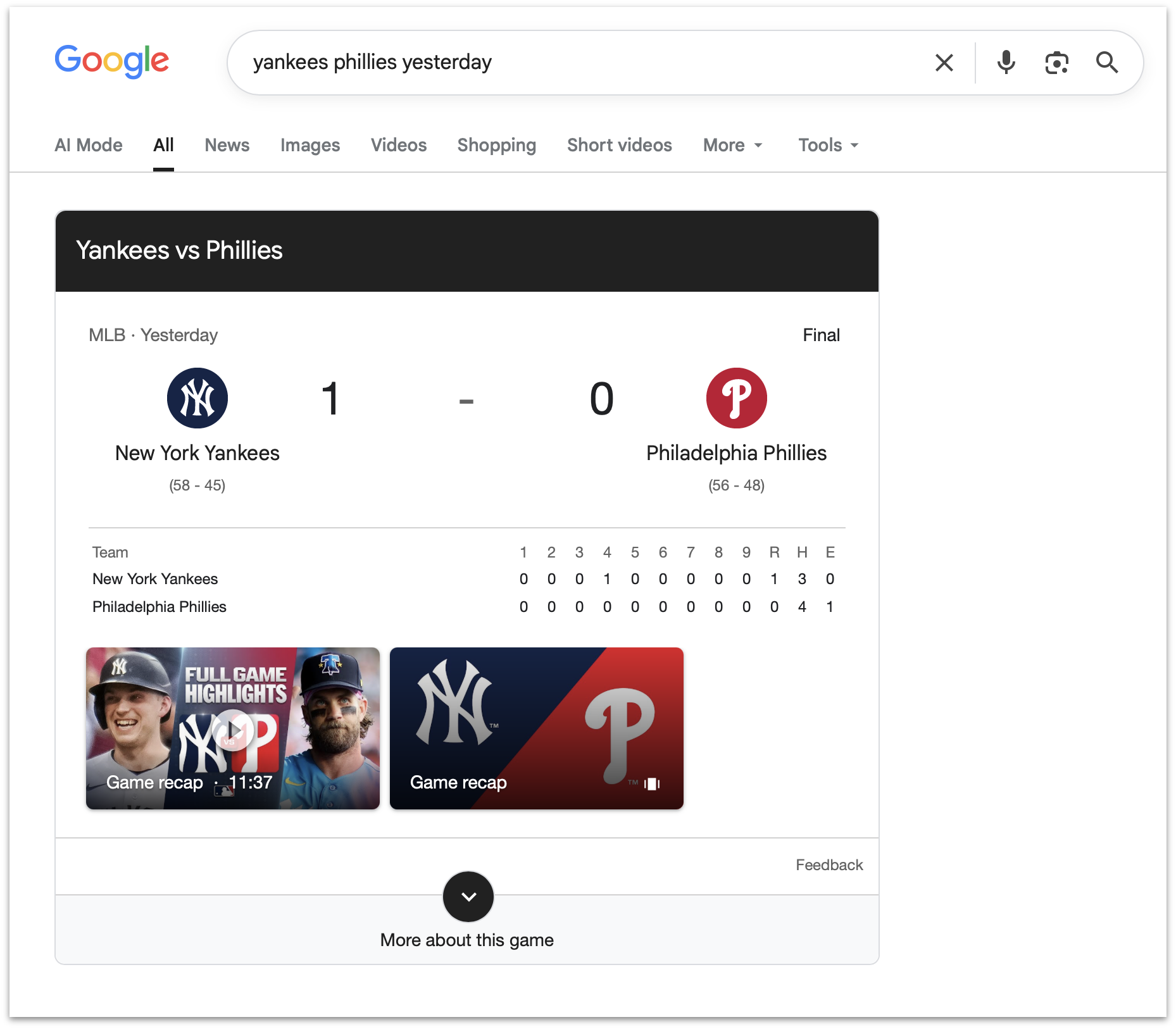
Update (2026-07-27): John Gruber:

So if you search for the score of a sporting event, it’s illegal in the EU for Google to show you the score, like this search I just tried. What the EC is saying is that because Google Search is so popular, it’s no longer allowed to improve.

plantain:

It drives me insane when in Europe the link between Google Search and Google Maps is broken and I often have to copy paste an address between the two. Thanks EU, what if I like Google’s integrations?

phiresky:

They could have simply added a selector when a user first clicks on the maps preview in the search result, and then remembered it on device or across that user’s account.

But of course, then the user could choose a competitor’s product and Google would have to honor it. That would be horrible, so instead they just made the user experience worse for everyone and elegantly made people blame the EU.

See also: Hacker News.

Google Loses Final EU Antitrust Appeal

23 July 2026 at 20:46

Ryan Whitwam (PDF, Reddit):

Back in 2018, Google was handed a record-setting 4.34 billion-euro ($4.9 billion) fine in Europe for abusing its monopoly on Android. The company has spent the intervening years challenging that decision, but the continent’s highest court has put a stop to that. The Court of Justice of the European Union has affirmed the penalty, meaning Google is out of options.

[…]

The EU took issue with Google search and Chrome being the default options on Android. Even devices made by other companies, such as Samsung and Xiaomi, include Google apps as the default per the Android licensing agreement, giving Google an unfair advantage, according to European antitrust regulators. This is not to be confused with a 2.95 billion euro ($3.45 billion) fine against Google’s advertising monopoly issued by the European Union last year.

Arjun Kharpal:

In 2022, a lower EU court reduced the fine to the current 4.1 billion euros from 4.34 billion euros previously.

Google has argued that the Android operating system provides choice for users and supports developers and businesses across Europe.

Via John Gruber:

Google last year booked $132 billion in profit; this fine is about 3 percent of that..

[…]

There’s never a reason not to string the appeal process out, but it’s especially true when your profits are growing at an exceptional rate. By growing their profits around 5×, they’ve reduced the relative sting of this fine by 5×

Previously:

Google is held liable for false information from its AI

11 June 2026 at 23:33

A German court has sparked a legal controversy by ruling that Google is responsible for defamatory comments generated by its own AI system. The search giant had argued that it couldn’t be blamed for the false results, but a Munich court has deemed that not to be the case and has ruled in favor of the two unnamed plaintiffs, both publishing companies, who the Google AI Overview inaccurately said engaged in shady business practices.

Google is required to remove the comments and ensure that they are not repeated. The case is certainly going to raise some questions globally. Will this mean that other courts are going to rule against AI vendors?

Bernhard Buchner, a partner at Lausen Rechtsanwälte, the legal firm that acted for the plaintiffs, said, “I believe it shows that online providers such as Google cannot hide behind the fact that a statement was generated by AI, but rather that they can be held liable for its output. It is an important step towards ensuring that providers of AI systems have to take responsibility for their outputs.”

So, does this mean that the decision could be replicated in the US or elsewhere? Alex Shahrestani, managing partner at Austin-based Promise Legal, said, “the short answer is ‘yes’:  the Munich ruling travels, because US courts are already making the same move.”

He explained that Section 230 of the US Communications Decency Act, which has been applied to protect online service providers like social media companies from lawsuits based on their decisions to transmit or take down user-generated content, was built for computer bulletin boards, “not for a model that writes its own answers. Once the AI is the author, the company is the publisher.”

This means, he said, “businesses now need named humans at accountability nodes, verification gates before AI output ships, and audit trails that survive discovery, because ‘the model recommended it’ is a legally empty sentence.”

Does the decision mean that other AI providers could find themselves in the same position? Buchner believes it’s possible, although, he said, the situation in this case is unusual; it does not involve a classic chatbot scenario, but one where the AI-generated statements are published as an ‘AI overview’ of a search query.

“Google’s liability here is based not so much on the fact that it operates the underlying AI, but rather on the publication of its output. However, it seems entirely conceivable to me that this could also be applied generally to inaccurate or defamatory AI,” he pointed out.

Nonetheless, said Carolyn Shelby, head of SEO at Yoast, the German ruling should ensure that companies will be more circumspect in how they handle AI in the future, to protect themselves from any legal action. The first thing they should do  is to separate low-risk use of AI from major decision-making.

“Using AI to summarize meeting notes, brainstorm campaign ideas, or create a first draft of something is very different from using it to make decisions about customers, employees, finance, compliance, health, legal claims, competitive positioning, or public communications,” she noted.

She pointed out that the effects of AI use could be devastating for companies. “The consequences could include customer complaints, reputational damage, regulatory attention, legal claims, correction costs, loss of trust, and internal disruption,” she said. “Even when a mistake does not become a lawsuit, the operational cost of correcting bad information can be significant.”

However, she noted, things may not change immediately.  “Many companies will wait until there is a high-profile court case, regulatory action, or major corporate embarrassment before they take this seriously. That is usually how governance catches up with technology. But the better-run organizations will start treating AI governance as part of normal business risk management now.”

And, said Shahrestani, after the Google decision, everything has changed. It will become more important to ensure that employees remain part of the process.

Why AI can’t match human creative work

29 May 2026 at 08:00

It’s hard for people to tell the difference between AI-generated advertising and writing. So why do they respond better to the human-made stuff?

AI vs. Mad Men

Ipsos, along with faculty members from Syracuse University’s S.I. Newhouse School of Public Communications, just published a unique advertising study. They took 20 real ads from major brands, including Cheerios, Chewy, Febreze, Fiat, H&M, Old Navy, Herbal Essences, Ray-Ban Meta, TurboTax and Visa. They fed the same creative briefs used by the human ad creatives into Google Gemini, then used OpenAI’s Sora to generate fully AI-produced counterparts with no human intervention. 

They showed the ads to 3,000 consumers. Only 25% of AI ad viewers were at least somewhat confident the spot was AI-made, and 40% of all viewers were uncertain either way — suggesting the public isn’t great at spotting ads that are AI generated. 

But here’s the interesting part: While most people didn’t register that ads were AI-generated, they also didn’t respond to them like they did with human-generated ads. They consistently rated human-made work as more eye-catching and more imaginative. 

In other words, people assumed AI ads were made by people, but didn’t particularly like them compared to human-generated ads. And that means human-generated ads performed much better. 

Ads made by people without AI were 14% stronger on short-term sales impact and 17% stronger on long-term brand health.

To me, the data here suggests that while people can’t easily discern the difference between AI- and human-generated content, the AI stuff hits wrong on a subconscious level. And I think that’s happening with AI social posts, AI blog posts and AI slop in general. 

In fact, I’ve noticed it strongly in my own response to AI-generated content. It often looks perfect but bothers me for reasons that aren’t immediately obvious. 

The researchers explained AI’s inability to match human ad creativity by pointing out that AI draws from what already exists, while great advertising breaks new ground. AI can replicate the conventions of advertising, but it can’t transcend them, make a creative leap or engender emotion like people can. 

A broad range of research beyond the Ipsos study suggests that skillful people working with AI tools will always outperform AI alone, and often outperform people not using AI tools. Ipsos’ advice? Ad agencies should keep people at the center of brand storytelling and emotive assets. 

Can AI write right?

Another recent study looked at written web content and compared how human-written articles “performed” on search engines compared to AI-generated content. Semrush analyzed 42,000 blog pages across 20,000 keywords, ran every single one through GPTZero’s AI detector, and cross-referenced the results with actual Google Search results. It also surveyed 224 search-engine optimization (SEO) professionals about their AI habits and beliefs.

They found a disconcerting disconnect between what SEO people believe and what is actually true. Some 72% of SEO professionals who use AI content say it performs just as well or better than human-written content in search rankings. But it turns out that human-generated posts strongly outperform AI-generated. 

Content classified as purely AI-generated appeared in the top spot in search result just 9% of the time. Content classified as human-written was there 80% of the time.” That’s a roughly 8-to-1 advantage. (Note that the coveted top link in search results typically gets around one-third of the clicks.)

For lower page-one positions — from the fifth position down (which get relatively few clicks) — AI- and human-generated posts perform more similarly. (The researchers also found that when people write posts with a little help from AI, their posts rank better much than AI-only content.)

Those Semrush results are consistent with previous research. 

  • NP Digital conducted an oft-cited study two years ago that found that human-written content ranked higher 94.12% of the time on Google than AI content. 
  • A Graphite/Common Crawl analysis found that 86% of articles ranking high on Google Search are human-written (only 14% AI-generated), and ChatGPT and Perplexity cite human-written articles 82% of the time (only 18% AI). 
  • On LinkedIn, more than half of site’s long-form content in 2025 was classified as “Likely AI” by Originality.ai. Engagement on verified human content was 61% higher than the AI-marked posts. 

Note that engagement performance varied by industry; that 61% result is an aggregate average across all industries. Ironically, in the category of “Leadership & Inspiration,” AI posts outperformed human posts by 75%. 

The absurd lesson here: If you want to be a thought leader on LinkedIn, don’t lead with your own thoughts. 

Quantity vs. quality

What all this research boils down to is that human-generated content (with or without help from AI) attracts far more traffic and higher engagement than AI-generated content. AI content is essentially invisible in high-value channels and while it might be high in quantity, it’s low in quality where it really matters — with reach and influence. 

As with the ad creative study by Ipsos, the conclusion of all this research is the same: People (and search engines) respond much better to creative content produced by people compared with AI-generated content. 

In short, AI is great at “flooding the zone” at high speed and low cost — and there’s a ton of AI-generated content out there. A quick check reveals that: 

  • More than half of all written content on websites is now AI-written.
  • Almost half of all music uploaded is now AI-generated.
  • Nearly one-quarter of all videos uploaded are AI-generated or manipulated.
  • Around 40% of all podcast episode uploads are AI-generated.
  • More than 70% of all images uploaded to social media may be AI-generated or manipulated.
  • And wll over half of all social posts are AI-generated

The specific numbers are my best estimates, and they’re changing fast each month. The takeaway is that AI-generated content is exploding in volume. 

But it isn’t reaching people the way human-generated content does. Take podcasts, for example. While roughly 40% of new podcast episode uploads are AI-generated, that 40% captures less than 1% of the listening hours. Of the top 100 podcasts, zero are AI-generated.

A clear picture is emerging about the use of AI for content generation. AI is great for churning out a lot of content at low cost. It can be good for some kinds of content — if a skillful person directs it. And AI can be a helpful tool for content creators. 

But when it comes to direct comparisons between people and AI, it’s clear that the winning content — the stuff with the best “performance” on search, best reception by people and the most engaging — is always human-generated. 

❌