
❌

Normal view

Titanium-polymer metamaterial floats in water

7 October 2026 at 09:00

Open-cell metallic structures are widely employed in the aerospace industry and in biomedical applications that require materials to be extremely light as well as strong. In marine infrastructure, however, their usefulness is limited because water quickly fills their interconnected open pores, preventing them from floating even though their bulk density is much lower than that of water.

Engineers in Australia and France have now developed a way around this problem. By combining so-called architected metals with a lightweight polymer foam, they created lightweight, strong, open-cell titanium structures that can float in water, overcoming the density limitation of previous materials while retaining structural performance.

“The innovation opens a new design space for marine structures, vehicles and rescue equipment where we need strength, low weight and buoyancy all at the same time,” says Ma Qian, a materials engineer at the RMIT University in Melbourne who co-led the research.

Beyond Archimedes

According to Archimedes’ principle, an object will float if its effective average density is lower than that of the fluid surrounding it. With open-cell materials, however, it’s more complicated. Because these interconnected frameworks of struts, thin plates or curved surfaces contain interconnected open voids that can fill with water as well as closed voids that cannot, they may fail to float even when their bulk densities (ρbulk) are well below that of water.

In the new work, which is detailed in Advanced Materials, Qian and colleagues at RMIT’s Centre for Additive Manufacturing and the Conservatoire National des Arts et Métiers in France developed an alternative measure of density that incorporates only the water-excluding parts of a structure. If the value of this “skeletal density” ρskeletal is lower than that of the surrounding liquid, then the structure will float even when water flows through all its interconnected open pores.

The team used this new measure to design a structure based on a recently-developed type of metallic open-lattice metamaterial called a hollow-strut lattice (HSL). Unlike conventional solid-strut designs, HSLs contain millimetre- or sub-millimetre-sized channels within their struts. These channels make them stronger than conventional solid-strut lattice materials of the same density, but that isn’t their only attraction. The presence of such channels also means that materials can be injected into them without compromising the HSL’s open-cell architecture – something that is impossible in traditional structures. Thanks to this feature, Qian explains, appropriately designed hybrid HSLs can float in water while remaining permeable.

Foam and titanium

The researchers made their open-cell hybrid lattice metamaterial by injecting expandable polyurethane (PU) foam, which has a density of 0.08–0.11 g/cm3, into a HSL structure made from a titanium alloy, Ti-6Al-4V.  At the macro level, Qian explains that the foam completely fills the hollow titanium struts, and microscopic analyses reveal continuous, defect-free interfacial bonding between the foam and the inner walls of the struts, while the foam’s own heterogeneous, closed-cell microstructure incorporates pores ranging from ∼10 µm to 200 µm in size. “The closed-cell PU foam limits water ingress into the internal strut channels while the external open-cell architecture remains permeable, so safeguarding marine buoyancy without notable density gain,” Qian says.
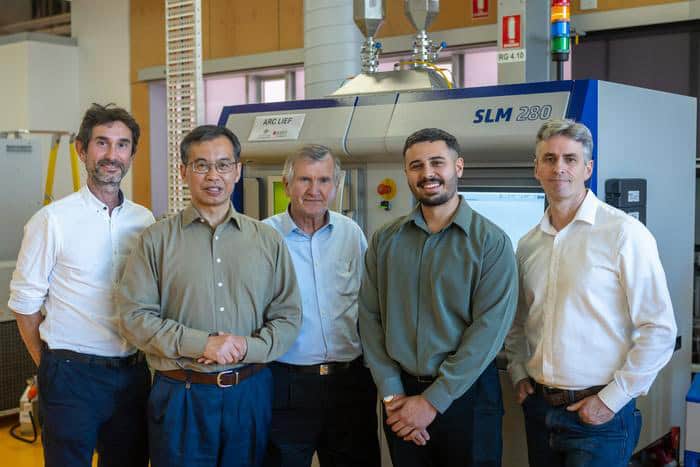
A team of researchers in front of equipment
The project team: Andrey Molotnikov, Ma Qian, Milan Brandt, Jordan Noronha and Martin Leary at RMIT’s Centre for Additive Manufacturing. (Courtesy: Sara Tan, RMIT)

The RMIT team submerged both unfilled and foam-filled titanium alloy HSLs in freshwater for more than two months. As expected, all the unfilled HSLs sank when immersed, regardless of strut diameter. The researchers then immersed the materials in natural seawater (which has a measured density of 1.03 g/cm3, slightly higher than the 0.997 g/cm3 they measured for freshwater) over a period of two weeks. They found that the hybrid structures stayed afloat over the experimental period and lost only about 0.15 % of their mass, suggesting they are resistant to corrosion. They also found that the foam-filled HSLs have a higher specific strength than commonly employed marine materials such as high‑density polyethylene and 316L stainless steel.

While the most immediate uses for these new materials will be in seafaring vehicles, lightweight floating structures and rescue equipment, Qian thinks they could have wider applications. “The open-cell architecture allows different materials to be integrated within the same structure,” he tells Physics World. “For example, a biodegradable magnesium scaffold could potentially be combined with a hydrogel containing growth factors for controlled therapeutic delivery during bone regeneration. And in aerospace applications, a hollow-strut titanium lattice might be integrated with a carbon-fibre-reinforced polymer to create lightweight, stiff hybrid structures.”

The researchers now plan to further develop their technology and are seeking collaborations with potential commercial partners. “We want to assess its viability for larger marine applications, including autonomous underwater vehicles and floating platforms and investigate long-term performance under realistic marine conditions,” Qian says. “We also plan to introduce our concepts into our advanced manufacturing and design courses at RMIT to help engineering students and researchers develop new ideas in this emerging field.”

The post Titanium-polymer metamaterial floats in water appeared first on Physics World.

How Low Gravity and Pressure Affect Space Manufacturing of Carbon-Fiber Structures

9 August 2026 at 04:58

A new study is challenging one of the most persistent assumptions in space manufacturing: that building advanced composite structures beyond Earth is simply a matter of moving terrestrial production methods into orbit. Research published in npj Advanced Manufacturing examines how two defining features of the space environment—reduced gravity and reduced atmospheric pressure—can alter the manufacture of carbon-fiber-reinforced structures, materials widely regarded as essential for future spacecraft, habitats and large orbital infrastructure.

Carbon-fiber-reinforced polymers, commonly known as CFRPs, combine strong, lightweight carbon fibers with a polymer resin that binds the fibers into a rigid composite. Their exceptional strength-to-weight ratio makes them attractive for launch vehicles and spacecraft, where every kilogram matters. Yet manufacturing these materials is a delicate process. Fibers must be positioned accurately, resin must penetrate the reinforcement evenly, and gases or trapped voids must be removed before the material cures. On Earth, gravity and atmospheric pressure quietly assist—or complicate—each of these steps.

In space, those familiar forces change dramatically. Reduced gravity can alter how liquid resin flows through a carbon-fiber structure, while low pressure can encourage dissolved gases and volatile compounds to expand or escape. Together, these effects may influence impregnation, consolidation, curing and the final mechanical performance of a composite part. The new work by R. Strecker, T. Rieger, A. Tabelander and colleagues focuses on understanding these interactions before manufacturers attempt to produce increasingly complex structures in orbit.

The central issue is void formation. A composite that appears solid can contain microscopic pockets of air or vapor between its fibers. These voids interrupt the transfer of stress through the material and can reduce strength, stiffness and fatigue resistance. During conventional manufacturing on Earth, pressure is often applied to compress the layers and drive out unwanted gases while resin fills the spaces between fibers. In a reduced-gravity environment, however, buoyancy-driven movement is weakened, and the pathways through which bubbles travel may change. A bubble that would rise and escape during terrestrial processing could remain trapped inside the structure.

Pressure reduction introduces another layer of complexity. Lower ambient pressure can help remove volatile substances and trapped gases, but it can also cause dissolved gases in the resin to expand. If the resin is not sufficiently mobile, expanding bubbles may become locked in place as the material cures. The balance between degassing and bubble growth therefore becomes a critical manufacturing parameter. The study’s importance lies in treating pressure and gravity not as isolated variables, but as environmental conditions that can interact throughout the production cycle.

Resin flow is equally important. Carbon-fiber reinforcements are made from tightly packed filaments, creating narrow channels through which resin must travel. On Earth, gravity can influence resin distribution, especially in vertically oriented or large components. In reduced gravity, capillary forces and surface tension become relatively more significant. These forces can help draw resin into small spaces, but they may also create uneven wetting patterns depending on the fiber architecture, resin viscosity and processing orientation. Such changes could affect whether a component cures uniformly from its surface to its interior.

The findings carry implications far beyond laboratory samples. Future space manufacturers may seek to fabricate beams, pressure-vessel elements, antenna supports, solar-array components and repair patches directly in orbit. Producing these parts where they are needed could reduce the need to launch bulky finished structures from Earth. It could also enable designs too large to fit inside a rocket fairing, including trusses and habitation modules assembled gradually in space. But the economic and engineering promise of this approach depends on reliable quality control. A component that looks flawless may still fail if its internal fiber alignment, resin distribution or void content is inconsistent.

The research also highlights why manufacturing hardware designed for Earth cannot automatically be considered space-ready. Pumps, heaters, vacuum systems, molds and curing chambers must all operate under conditions in which heat transfer, fluid movement and gas removal behave differently. Temperature control is particularly important because resin viscosity changes strongly with temperature. A resin that flows readily during terrestrial processing might move more slowly or unevenly in orbit, while excessive heating could accelerate curing before impregnation is complete. Space-based production systems will therefore need carefully coordinated control of pressure, temperature, resin chemistry and processing time.

For engineers, the study provides a foundation for developing manufacturing protocols tailored to reduced-gravity environments. Instead of copying Earth-based workflows, future systems may need staged pressure changes, specialized fiber preforms, modified resin formulations or active bubble-management techniques. Sensors could monitor pressure, temperature and resin flow in real time, allowing automated systems to detect defects before a part is finished. Non-destructive inspection, including imaging and ultrasonic testing, will also be essential for verifying the integrity of components that cannot easily be returned to Earth for analysis.

The broader message is that space manufacturing is not merely an extension of industrial production—it is a new manufacturing regime governed by different physics. Understanding how gravity and pressure reshape the behavior of fluids, gases and composite materials could determine whether orbital fabrication remains a promising experiment or becomes a practical industrial capability. By examining the production of carbon-fiber-reinforced structures under space-relevant conditions, Strecker, Rieger, Tabelander and their colleagues are helping identify the hidden variables that will decide how safely and efficiently humanity can build beyond Earth.

Subject of Research: Effects of reduced gravity and reduced atmospheric pressure on the in-space manufacturing of carbon-fiber-reinforced structures

Article Title: Effects of reduced gravity and reduced atmospheric pressure on in-space manufacturing of carbon-fiber-reinforced structures

Article References: Strecker, R., Rieger, T., Tabelander, A. et al. Effects of reduced gravity and reduced atmospheric pressure on in-space manufacturing of carbon-fiber-reinforced structures. npj Adv. Manuf. 3, 26 (2026). https://doi.org/10.1038/s44334-026-00104-w

Image Credits: AI Generated

DOI: https://doi.org/10.1038/s44334-026-00104-w

Keywords: in-space manufacturing, carbon-fiber-reinforced polymers, reduced gravity, reduced atmospheric pressure, composite materials, resin flow, void formation, space technology

❌