❌

Normal view

Received — 11 August 2026 ⏭ The Conversation

Why do some people feel life is so unfair? Understanding this may help explain conspiracy beliefs

HimelVector/Shutterstock

Most people set out in life wanting to believe the world is fair. They expect people to wait their turn in queues, to be treated equally in their job, and to be rewarded for hard work. These expectations influence how they understand the world around them, and shape their responses to it.

But what happens when life repeatedly challenges those assumptions? Psychologists have long been interested in this question. Our new research, published in the British Journal of Psychology, suggests adverse experiences shape both how fair people believe the world is, and how they view their place in society.

Over the course of a lifetime, personal setbacks – from illness and bereavement to being a victim of crime – may have a cumulative effect, leading to a growing sense that the world is unfair. We think this is important in the context of today’s increasingly polarised societies, in which trust in institutions has declined severely in the UK and many other countries.

Video: TEDxTalks.

Adversity and unfairness

Our research set out to answer two key questions: do experiences of adversity influence whether people see the world as fundamentally unfair – and if so, what are the societal consequences? We conducted three surveys involving more than 1,200 British participants with an equal gender split and average age of 39.

In one study, we found that people who reported experiencing more lifetime adversity – including illness, bereavement, financial hardship and violence – were more likely to believe the world was unfair.

In another, we compared people who had experienced violent victimisation with those who had not. After accounting for demographic factors, people who had experienced violent crime reported stronger perceptions of injustice.

Our final study found that greater lifetime adversity was associated with lower trust in institutions through perceptions of injustice. This is important because trust underpins many aspects of society, from confidence in public institutions to democratic participation.

Together, these findings suggest that people don’t simply interpret information based on the facts available to them. They also interpret it through the lens of their previous experiences.

Two people can read the same news story, watch the same political debate or hear the same public health advice, yet come away with very different conclusions that may not simply reflect differences in knowledge or politics. It may also reflect differences in how they have come to see the world as a result of the hardships they have faced.

Furthermore, if someone increasingly believes that the world is unfair, they may be more likely to notice fresh examples of perceived injustice, corruption or hidden motives – and interpret new events through that lens.

Belief in conspiracy theories

Previous research has shown that people who feel uncertain, powerless or threatened are often more likely to endorse conspiracy theories. Most of this work, however, has focused on their identities, traits and beliefs.

In our investigation of the impact of adverse life experiences on people, we found a remarkably consistent pattern. When these hardships are associated with stronger perceptions of injustice in the world, the same people more strongly endorse conspiracy beliefs.

Conspiracy theories rarely describe events as random. Instead, they tend to suggest that powerful individuals or organisations are secretly responsible for what happens. They offer explanations that identify intentional causes behind events that might otherwise seem confusing or unjust.

Research suggests that across societies, the level of belief in conspiracy theories is relatively stable over time. But once these beliefs become part of how someone understands the world, they can be difficult to shift.

This makes it all the more important to understand the experiences and psychological processes that may contribute to these worldviews developing in the first place. Our findings suggest that perceptions of injustice are one such pathway.

For someone who increasingly feels the world is unfair, conspiracy theories may become more psychologically appealing – providing a way of making sense of experiences that otherwise feel difficult to understand.

Our research does not suggest that adversity inevitably leads to conspiracy beliefs; nor that conspiracy theories are an inevitable consequence of trauma. Rather, it highlights a long-term psychological process that may help explain why some people become more receptive to these ideas.

In an increasingly polarised world, the media and political focus is often concentrated on what information people consume. But our research suggests we should pay more attention to the experiences that shape the lens through which people interpret information. This could help explain why people can look at the same events and reach very different conclusions.

Ultimately, people’s experiences don’t just affect them in the moment. They shape their worldview – which can influence how they interpret and respond to events and other people’s behaviour far into the future.

So, we believe any effort to reach greater consensus in society may require a deeper understanding of the hardships people have lived through over the course of their lives – and how these can affect their sense of injustice.

The Conversation

Daniel Jolley has received funding from the Leverhulme Trust, the British Academy, and the Engineering and Physical Sciences Research Council (EPSRC). The studies mentioned in this piece were funded by the British Academy/Leverhulme Small Research Grants Scheme (SRG23/230720) and carried out in collaboration between Daniel Jolley, Laura Blackie, and research assistant Anna Maughan.

Laura Blackie has received funding from the British Academy.

How a cosmic coincidence gives Earth its ‘perfect’ solar eclipses

A solar eclipse is a rare, visually striking phenomenon. The Moon passes between Earth and the Sun, temporarily hiding our star – a geometrical alignment spanning millions of miles.

A partial solar eclipse occurs when the Moon doesn’t fully block the Sun, resulting in a gentle dimming of the sky. A total solar eclipse, however, dramatically plunges a daytime sky into blackness.

Everything has to be perfect for this to happen. An astonishing cosmic coincidence means that solar eclipses as viewed from Earth are spectacular – and unlike those anywhere else in the solar system.

For a given place on Earth, a total solar eclipse will only occur once in a few hundred years. The next total solar eclipse takes place on Wednesday, August 12 2026. The path of totality (the area where a full eclipse can be seen) will pass through parts of Greenland, Iceland, northern Russia, Spain, and a small portion of Portugal.

In Britain and Ireland, between 90% and 97.5% of the Sun will be obscured by the Moon, depending on where a person is.

The eclipse starts at 6.08pm (BST) in Glasgow and Edinburgh, 6.12pm in Galway and Dublin, 6.13pm in Manchester and Liverpool, 6.15pm in Norwich and Birmingham, 6.17pm in London, Bristol and Cardiff and 6.18pm in Truro.

The UK Health Security Agency warned that looking directly at an eclipse can cause permanent eye damage. There are two safe ways to view an eclipse: specialist eclipse glasses (or handheld solar viewers) and indirect methods.

A map of the August 12, 2026 total solar eclipse, showing where it is visible. Nasa

Eclipse glasses or solar viewers must be genuine and sold by a reputable retailer. They should have specially designed filters that meet the international safety standard ISO 12312-2:2015(E). Indirect methods include projecting the Sun’s image onto a sheet of paper using a simple pinhole projector.

A solar eclipse’s appearance is wrapped up in the geometry of the bodies involved; it depends on the apparent sizes. This apparent size depends on the sizes and distances involved. The total solar eclipse we see from Earth is particularly special.

The Sun is around 400 times wider than the Moon, but also about 400 times further away, hence they appear approximately the same size in our sky. During totality, the Moon fits over the Sun like a puzzle piece slotting into place.

People are incredibly fortunate to be able to fly around our planet chasing such events, allowing eclipse watchers to gather under the Moon’s shadow. So how would solar eclipses look if we were able to travel to other planets?

How a solar eclipse takes place. Designua

Mars has two moons; the larger is Phobos, at around 14 miles across, and the smaller, Deimos, is only about 7.5 miles in diameter. Both moons are rather lumpy and irregularly shaped.

Neither moon has an apparent size large enough to produce a total solar eclipse on Mars. Phobos, being closer and larger, produces an eclipse that lasts only around 30 seconds. It’s very different from what we’re used to. Phobos appears as an oddly shaped silhouette that can cover just over one-third of the Sun.

Deimos, being smaller, and further away from Mars, appears as a small dot crossing the Sun. The eclipses of Phobos and Deimos are events we’ve seen, thanks to Nasa’s Perseverance and Curiosity rovers allowing us to see eclipses on another planet.

Nasa’s Perseverance rover sees a solar eclipse on Mars (Nasa JPL).

A view from Jupiter

Jupiter has 101 moons, which includes the four large Galilean satellites. These moons can completely obscure the Sun from Jupiter, casting vast shadows across its cloud tops.

Jupiter, unfortunately, doesn’t have a solid surface, hence an observer would need to float on top of its clouds. From there, the moons would appear much larger than the Sun.

Although dramatic, this lacks the satisfying alignment we see from Earth of the Moon and Sun almost matching each other in size. The Galilean moons orbit so fast around Jupiter that such eclipses happen almost every day.

Jupiter’s volcanic moon Io casts its shadow on the planet. As with solar eclipses on Earth, within the dark circle, one would witness a full solar eclipse. Nasa

Their shadows are visible from Earth through amateur telescopes as small, distinct black dots moving across the colour bands of Jupiter. The orbits of the moons can even sometimes align such that double, or even triple, solar eclipses are visible.

Saturn has even more moons, with 274 confirmed. Similar vast shadows are seen on Saturn’s clouds during eclipses, with larger moons such as Titan causing the most dramatic displays. Saturn itself has seasons, similar to the Earth. Depending on the season, solar eclipses can happen daily on Saturn.

The limits of solar eclipses

There are parts of the solar system that will never, or very rarely, see a solar eclipse. Mercury and Venus have no moons, so unfortunately miss out on the spectacle entirely. As we go farther from the Sun, it appears smaller in the sky.

Comparatively small moons can therefore completely obscure it. From Pluto, the Sun would look like a very bright point in the sky. Pluto’s largest moon, Charon, would appear far larger and completely cover it up.

These would definitely class as total solar eclipses, but would be very different from the exquisitely balanced spectacle we see from Earth. Far out in the solar system, the moons don’t delicately fit over the Sun. Instead, they would utterly swallow it.

Throughout the solar system, solar eclipses are possible and, from some planets, frequent. From Earth, the occasional alignment of size, distance and time allows for total solar eclipses that make the Moon look as if it was made to fit perfectly over the Sun.

For a few transcendent moments, we are cast into a shadow that allows us to glimpse the solar corona peeking out from behind the Moon. There are many small, chance events that have made our planet habitable. This fleeting geometrical balance that produces our solar eclipses is a chance alignment that isn’t something functional. It’s just beautiful.

The Conversation

Alix Violet Freckelton does not work for, consult, own shares in or receive funding from any company or organisation that would benefit from this article, and has disclosed no relevant affiliations beyond their academic appointment.

Can DNA from cave paintings tell us who the artists were?

Ancient painting of a bison from Altamira cave in Spain. luisrphoto

Perhaps the most evocative windows into the minds of our ancient ancestors are the images they painted on the walls of caves – renderings known simply as rock art or cave paintings.

Rock art, which is found across the world, offers snapshots of human history, preserving representations of cultural traditions, symbolic communication and social identity. Common subjects include animals, hunting scenes and hand stencils – thought to have been made by blowing pigment over the artist’s hand.

Scientists have wrestled with basic questions about the origins of rock art such as: what was used to produce it, when was it made, and who made it?

Now, a recent study of cave art from Spain and Portugal has shown that ancient human DNA can be recovered directly from the cave walls. We may therefore be edging closer to answering “who made it?”

Using this technique to link a specific painting to an ancient artist may be a step too far. But there are still important things it can tell us about the past.

Previously, researchers had made considerable progress in answering the “what” and “when” questions. Scientists can analyse what pigments are preserved in rock art using techniques such as X-ray fluorescence spectroscopy, which allows them to identify materials such as red ochre and charcoal.

Scientists can also estimate the age of the art using techniques such as carbon-14 dating, carried out on minute quantities of organic material, to determine when rock art was created.

For example, in 2026, researchers reported that a stencil of a human hand had been found in Southeast Sulawesi, Indonesia. The researchers used a laser to bore a microscopic hole and collect samples from a fine layer of calcium carbonate that had formed over the painting.

The research team then measured the degradation of radioactive uranium contained in these mineral deposits to assign a minimum age to the painting of 67,800 years – making it the world’s oldest known minimum date for cave art.

The age of this art fits within a period when modern humans (Homo sapiens) are thought to have migrated through the area. But the wider Indonesian archipelago was previously home to other human species, such as Homo erectus and Homo floresiensis (nicknamed “the Hobbits”), which complicates matters significantly.

While the stylistic and technical complexity of the art suggests authorship by Homo sapiens, we have no way to be certain who made it.

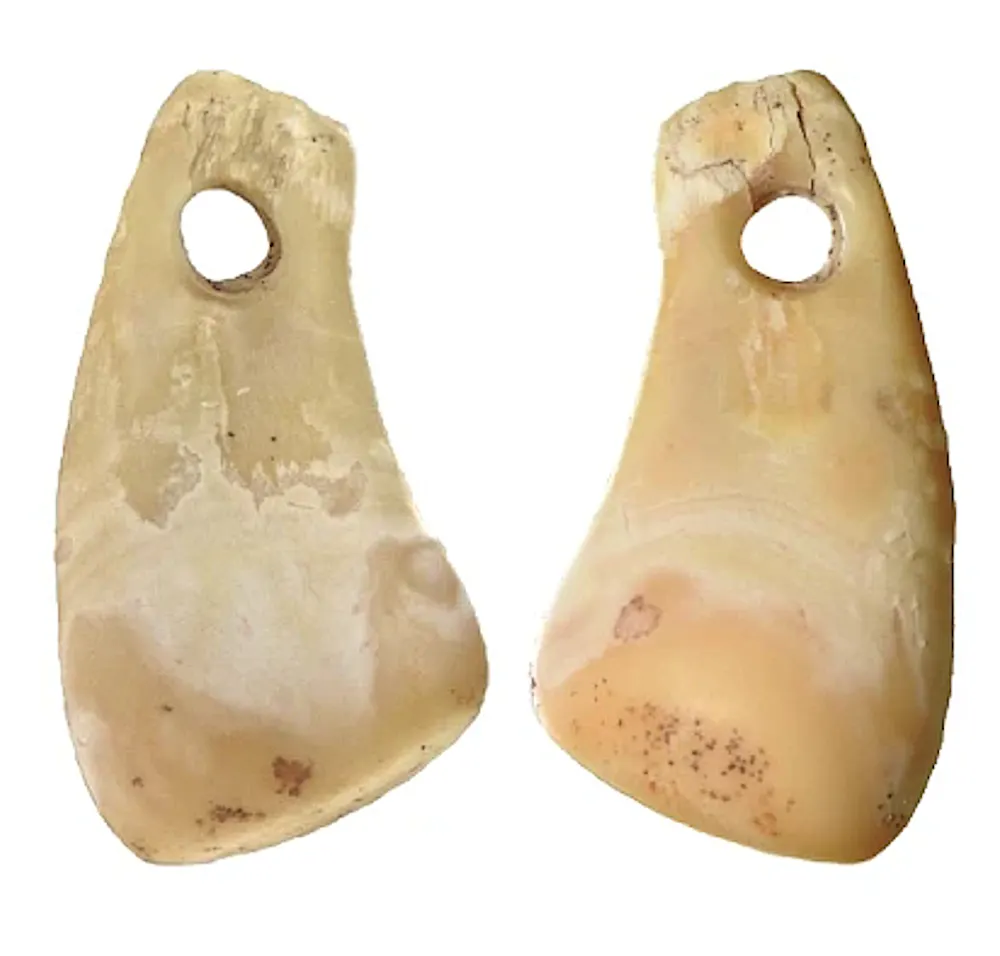
Identifying a human linked to a prehistoric item has an established methodology. For example, in 2023, researchers recovered ancient DNA from a deer-tooth pendant found in Denisova cave, southern Siberia.

Analysis of the genetic sequence showed that the pendant was probably worn by a 25,000-year-old woman belonging to an ancient population known as Ancient North Eurasians, who lived across Siberia in Palaeolithic times.

Such discoveries transform otherwise anonymous objects into evidence of real people, giving us an intriguing glimpse into the lives of our prehistoric ancestors.

New genetic reservoirs

A deer-tooth pendant from Denisova Cave in Russia
This deer-tooth pendant from Denisova Cave in Russia yielded DNA from its ancient wearer. Essel, et al. Nature (2023), CC BY-NC-SA

In the latest cave art study, scientists systematically sampled both painted and unpainted surfaces of cave walls at 11 sites across Spain and Portugal. Remarkably, they recovered ancient human DNA directly from the walls, demonstrating for the first time that these surfaces can act as reservoirs for genetic information.

Some of these cave wall samples were shown, through both genetic analysis and the archaeological context, to be at least 4,000 years old.

In two of the samples from Covarón cave in northern Spain, human DNA was sufficiently preserved to be identified as belonging to ancient western hunter-gatherers. These were populations that lived across much of Europe during Late Palaeolithic and Mesolithic times.

One of the samples from a pigmented part of a cave wall, in Escoural cave, Portugal, also yielded traces of ancient DNA, but it was not as well preserved as other samples.

Nevertheless, the research establishes a powerful new methodological framework and proof of concept. It raises the tantalising prospect of studying not only the images left behind, but also the communities of people who made them.

However, applying this technique successfully to identify the artist of specific ancient rock art is incredibly unlikely.

Only one of the pigmented samples from the Spanish and Portuguese cave sites yielded ancient DNA. It was retrieved from Escoural cave in Portugal. Bossoms Mesa, et al. (2026), CC BY-NC-SA

This research could, though, potentially resolve one of the most contentious debates in archaeology. This concerns a 66,700-year-old hand stencil discovered within Maltravieso cave in Extremadura, western Spain.

This controversial stencil appears to predate the arrival of modern humans in Europe. Some researchers have therefore argued that Neanderthals, not Homo sapiens, made the art.

Finding DNA from either species in this location, at similar times to the creation of the rock art, could offer a potential route for resolving the debate. But this too is much more difficult than it might seem.

Easy transfer

The presence of human DNA does not prove who created the rock art. DNA is easily transferred – actions as simple as breathing can transfer someone’s genetic material to a location or object. This is why DNA recovered from a knife cannot definitively conclude who committed a stabbing in a forensic case.

DNA establishes the association of someone with an item or location, not the actions they carried out during the deposition of their genetic material. Environmental activities such as rain can also transfer human DNA to these spaces, making it extremely difficult to identify a single person at a location.

Additional DNA can be deposited at very different times to when the painting was produced – by both modern and ancient humans. The potential for contamination is incredibly high, making it difficult to establish who may have been at a given location at a specific time.

Nonetheless, scientists can use this new research to explore important prehistoric questions such as the hominin species, population groups and sexes of those who entered specific cave systems, and their migration routes across landscapes.

In the general sense, we can also begin to connect prehistoric art with the people who created and lived with it.

Behind each rock-art hand stencil or hunting scene is evidence of a real person who, while separated from us by tens of thousands of years, felt the need to communicate their creativity – as we do today. Techniques such as this offer a vital opportunity to understand more thoroughly the human experience via our similarities with ancient people.

The Conversation

The authors do not work for, consult, own shares in or receive funding from any company or organisation that would benefit from this article, and have disclosed no relevant affiliations beyond their academic appointment.

❌