❌

Normal view

Received — 11 August 2026 ⏭ The Conversation

Why do some people feel life is so unfair? Understanding this may help explain conspiracy beliefs

HimelVector/Shutterstock

Most people set out in life wanting to believe the world is fair. They expect people to wait their turn in queues, to be treated equally in their job, and to be rewarded for hard work. These expectations influence how they understand the world around them, and shape their responses to it.

But what happens when life repeatedly challenges those assumptions? Psychologists have long been interested in this question. Our new research, published in the British Journal of Psychology, suggests adverse experiences shape both how fair people believe the world is, and how they view their place in society.

Over the course of a lifetime, personal setbacks – from illness and bereavement to being a victim of crime – may have a cumulative effect, leading to a growing sense that the world is unfair. We think this is important in the context of today’s increasingly polarised societies, in which trust in institutions has declined severely in the UK and many other countries.

Video: TEDxTalks.

Adversity and unfairness

Our research set out to answer two key questions: do experiences of adversity influence whether people see the world as fundamentally unfair – and if so, what are the societal consequences? We conducted three surveys involving more than 1,200 British participants with an equal gender split and average age of 39.

In one study, we found that people who reported experiencing more lifetime adversity – including illness, bereavement, financial hardship and violence – were more likely to believe the world was unfair.

In another, we compared people who had experienced violent victimisation with those who had not. After accounting for demographic factors, people who had experienced violent crime reported stronger perceptions of injustice.

Our final study found that greater lifetime adversity was associated with lower trust in institutions through perceptions of injustice. This is important because trust underpins many aspects of society, from confidence in public institutions to democratic participation.

Together, these findings suggest that people don’t simply interpret information based on the facts available to them. They also interpret it through the lens of their previous experiences.

Two people can read the same news story, watch the same political debate or hear the same public health advice, yet come away with very different conclusions that may not simply reflect differences in knowledge or politics. It may also reflect differences in how they have come to see the world as a result of the hardships they have faced.

Furthermore, if someone increasingly believes that the world is unfair, they may be more likely to notice fresh examples of perceived injustice, corruption or hidden motives – and interpret new events through that lens.

Belief in conspiracy theories

Previous research has shown that people who feel uncertain, powerless or threatened are often more likely to endorse conspiracy theories. Most of this work, however, has focused on their identities, traits and beliefs.

In our investigation of the impact of adverse life experiences on people, we found a remarkably consistent pattern. When these hardships are associated with stronger perceptions of injustice in the world, the same people more strongly endorse conspiracy beliefs.

Conspiracy theories rarely describe events as random. Instead, they tend to suggest that powerful individuals or organisations are secretly responsible for what happens. They offer explanations that identify intentional causes behind events that might otherwise seem confusing or unjust.

Research suggests that across societies, the level of belief in conspiracy theories is relatively stable over time. But once these beliefs become part of how someone understands the world, they can be difficult to shift.

This makes it all the more important to understand the experiences and psychological processes that may contribute to these worldviews developing in the first place. Our findings suggest that perceptions of injustice are one such pathway.

For someone who increasingly feels the world is unfair, conspiracy theories may become more psychologically appealing – providing a way of making sense of experiences that otherwise feel difficult to understand.

Our research does not suggest that adversity inevitably leads to conspiracy beliefs; nor that conspiracy theories are an inevitable consequence of trauma. Rather, it highlights a long-term psychological process that may help explain why some people become more receptive to these ideas.

In an increasingly polarised world, the media and political focus is often concentrated on what information people consume. But our research suggests we should pay more attention to the experiences that shape the lens through which people interpret information. This could help explain why people can look at the same events and reach very different conclusions.

Ultimately, people’s experiences don’t just affect them in the moment. They shape their worldview – which can influence how they interpret and respond to events and other people’s behaviour far into the future.

So, we believe any effort to reach greater consensus in society may require a deeper understanding of the hardships people have lived through over the course of their lives – and how these can affect their sense of injustice.

The Conversation

Daniel Jolley has received funding from the Leverhulme Trust, the British Academy, and the Engineering and Physical Sciences Research Council (EPSRC). The studies mentioned in this piece were funded by the British Academy/Leverhulme Small Research Grants Scheme (SRG23/230720) and carried out in collaboration between Daniel Jolley, Laura Blackie, and research assistant Anna Maughan.

Laura Blackie has received funding from the British Academy.

How a cosmic coincidence gives Earth its ‘perfect’ solar eclipses

A solar eclipse is a rare, visually striking phenomenon. The Moon passes between Earth and the Sun, temporarily hiding our star – a geometrical alignment spanning millions of miles.

A partial solar eclipse occurs when the Moon doesn’t fully block the Sun, resulting in a gentle dimming of the sky. A total solar eclipse, however, dramatically plunges a daytime sky into blackness.

Everything has to be perfect for this to happen. An astonishing cosmic coincidence means that solar eclipses as viewed from Earth are spectacular – and unlike those anywhere else in the solar system.

For a given place on Earth, a total solar eclipse will only occur once in a few hundred years. The next total solar eclipse takes place on Wednesday, August 12 2026. The path of totality (the area where a full eclipse can be seen) will pass through parts of Greenland, Iceland, northern Russia, Spain, and a small portion of Portugal.

In Britain and Ireland, between 90% and 97.5% of the Sun will be obscured by the Moon, depending on where a person is.

The eclipse starts at 6.08pm (BST) in Glasgow and Edinburgh, 6.12pm in Galway and Dublin, 6.13pm in Manchester and Liverpool, 6.15pm in Norwich and Birmingham, 6.17pm in London, Bristol and Cardiff and 6.18pm in Truro.

The UK Health Security Agency warned that looking directly at an eclipse can cause permanent eye damage. There are two safe ways to view an eclipse: specialist eclipse glasses (or handheld solar viewers) and indirect methods.

A map of the August 12, 2026 total solar eclipse, showing where it is visible. Nasa

Eclipse glasses or solar viewers must be genuine and sold by a reputable retailer. They should have specially designed filters that meet the international safety standard ISO 12312-2:2015(E). Indirect methods include projecting the Sun’s image onto a sheet of paper using a simple pinhole projector.

A solar eclipse’s appearance is wrapped up in the geometry of the bodies involved; it depends on the apparent sizes. This apparent size depends on the sizes and distances involved. The total solar eclipse we see from Earth is particularly special.

The Sun is around 400 times wider than the Moon, but also about 400 times further away, hence they appear approximately the same size in our sky. During totality, the Moon fits over the Sun like a puzzle piece slotting into place.

People are incredibly fortunate to be able to fly around our planet chasing such events, allowing eclipse watchers to gather under the Moon’s shadow. So how would solar eclipses look if we were able to travel to other planets?

How a solar eclipse takes place. Designua

Mars has two moons; the larger is Phobos, at around 14 miles across, and the smaller, Deimos, is only about 7.5 miles in diameter. Both moons are rather lumpy and irregularly shaped.

Neither moon has an apparent size large enough to produce a total solar eclipse on Mars. Phobos, being closer and larger, produces an eclipse that lasts only around 30 seconds. It’s very different from what we’re used to. Phobos appears as an oddly shaped silhouette that can cover just over one-third of the Sun.

Deimos, being smaller, and further away from Mars, appears as a small dot crossing the Sun. The eclipses of Phobos and Deimos are events we’ve seen, thanks to Nasa’s Perseverance and Curiosity rovers allowing us to see eclipses on another planet.

Nasa’s Perseverance rover sees a solar eclipse on Mars (Nasa JPL).

A view from Jupiter

Jupiter has 101 moons, which includes the four large Galilean satellites. These moons can completely obscure the Sun from Jupiter, casting vast shadows across its cloud tops.

Jupiter, unfortunately, doesn’t have a solid surface, hence an observer would need to float on top of its clouds. From there, the moons would appear much larger than the Sun.

Although dramatic, this lacks the satisfying alignment we see from Earth of the Moon and Sun almost matching each other in size. The Galilean moons orbit so fast around Jupiter that such eclipses happen almost every day.

Jupiter’s volcanic moon Io casts its shadow on the planet. As with solar eclipses on Earth, within the dark circle, one would witness a full solar eclipse. Nasa

Their shadows are visible from Earth through amateur telescopes as small, distinct black dots moving across the colour bands of Jupiter. The orbits of the moons can even sometimes align such that double, or even triple, solar eclipses are visible.

Saturn has even more moons, with 274 confirmed. Similar vast shadows are seen on Saturn’s clouds during eclipses, with larger moons such as Titan causing the most dramatic displays. Saturn itself has seasons, similar to the Earth. Depending on the season, solar eclipses can happen daily on Saturn.

The limits of solar eclipses

There are parts of the solar system that will never, or very rarely, see a solar eclipse. Mercury and Venus have no moons, so unfortunately miss out on the spectacle entirely. As we go farther from the Sun, it appears smaller in the sky.

Comparatively small moons can therefore completely obscure it. From Pluto, the Sun would look like a very bright point in the sky. Pluto’s largest moon, Charon, would appear far larger and completely cover it up.

These would definitely class as total solar eclipses, but would be very different from the exquisitely balanced spectacle we see from Earth. Far out in the solar system, the moons don’t delicately fit over the Sun. Instead, they would utterly swallow it.

Throughout the solar system, solar eclipses are possible and, from some planets, frequent. From Earth, the occasional alignment of size, distance and time allows for total solar eclipses that make the Moon look as if it was made to fit perfectly over the Sun.

For a few transcendent moments, we are cast into a shadow that allows us to glimpse the solar corona peeking out from behind the Moon. There are many small, chance events that have made our planet habitable. This fleeting geometrical balance that produces our solar eclipses is a chance alignment that isn’t something functional. It’s just beautiful.

The Conversation

Alix Violet Freckelton does not work for, consult, own shares in or receive funding from any company or organisation that would benefit from this article, and has disclosed no relevant affiliations beyond their academic appointment.

Can DNA from cave paintings tell us who the artists were?

Ancient painting of a bison from Altamira cave in Spain. luisrphoto

Perhaps the most evocative windows into the minds of our ancient ancestors are the images they painted on the walls of caves – renderings known simply as rock art or cave paintings.

Rock art, which is found across the world, offers snapshots of human history, preserving representations of cultural traditions, symbolic communication and social identity. Common subjects include animals, hunting scenes and hand stencils – thought to have been made by blowing pigment over the artist’s hand.

Scientists have wrestled with basic questions about the origins of rock art such as: what was used to produce it, when was it made, and who made it?

Now, a recent study of cave art from Spain and Portugal has shown that ancient human DNA can be recovered directly from the cave walls. We may therefore be edging closer to answering “who made it?”

Using this technique to link a specific painting to an ancient artist may be a step too far. But there are still important things it can tell us about the past.

Previously, researchers had made considerable progress in answering the “what” and “when” questions. Scientists can analyse what pigments are preserved in rock art using techniques such as X-ray fluorescence spectroscopy, which allows them to identify materials such as red ochre and charcoal.

Scientists can also estimate the age of the art using techniques such as carbon-14 dating, carried out on minute quantities of organic material, to determine when rock art was created.

For example, in 2026, researchers reported that a stencil of a human hand had been found in Southeast Sulawesi, Indonesia. The researchers used a laser to bore a microscopic hole and collect samples from a fine layer of calcium carbonate that had formed over the painting.

The research team then measured the degradation of radioactive uranium contained in these mineral deposits to assign a minimum age to the painting of 67,800 years – making it the world’s oldest known minimum date for cave art.

The age of this art fits within a period when modern humans (Homo sapiens) are thought to have migrated through the area. But the wider Indonesian archipelago was previously home to other human species, such as Homo erectus and Homo floresiensis (nicknamed “the Hobbits”), which complicates matters significantly.

While the stylistic and technical complexity of the art suggests authorship by Homo sapiens, we have no way to be certain who made it.

Identifying a human linked to a prehistoric item has an established methodology. For example, in 2023, researchers recovered ancient DNA from a deer-tooth pendant found in Denisova cave, southern Siberia.

Analysis of the genetic sequence showed that the pendant was probably worn by a 25,000-year-old woman belonging to an ancient population known as Ancient North Eurasians, who lived across Siberia in Palaeolithic times.

Such discoveries transform otherwise anonymous objects into evidence of real people, giving us an intriguing glimpse into the lives of our prehistoric ancestors.

New genetic reservoirs

A deer-tooth pendant from Denisova Cave in Russia
This deer-tooth pendant from Denisova Cave in Russia yielded DNA from its ancient wearer. Essel, et al. Nature (2023), CC BY-NC-SA

In the latest cave art study, scientists systematically sampled both painted and unpainted surfaces of cave walls at 11 sites across Spain and Portugal. Remarkably, they recovered ancient human DNA directly from the walls, demonstrating for the first time that these surfaces can act as reservoirs for genetic information.

Some of these cave wall samples were shown, through both genetic analysis and the archaeological context, to be at least 4,000 years old.

In two of the samples from Covarón cave in northern Spain, human DNA was sufficiently preserved to be identified as belonging to ancient western hunter-gatherers. These were populations that lived across much of Europe during Late Palaeolithic and Mesolithic times.

One of the samples from a pigmented part of a cave wall, in Escoural cave, Portugal, also yielded traces of ancient DNA, but it was not as well preserved as other samples.

Nevertheless, the research establishes a powerful new methodological framework and proof of concept. It raises the tantalising prospect of studying not only the images left behind, but also the communities of people who made them.

However, applying this technique successfully to identify the artist of specific ancient rock art is incredibly unlikely.

Only one of the pigmented samples from the Spanish and Portuguese cave sites yielded ancient DNA. It was retrieved from Escoural cave in Portugal. Bossoms Mesa, et al. (2026), CC BY-NC-SA

This research could, though, potentially resolve one of the most contentious debates in archaeology. This concerns a 66,700-year-old hand stencil discovered within Maltravieso cave in Extremadura, western Spain.

This controversial stencil appears to predate the arrival of modern humans in Europe. Some researchers have therefore argued that Neanderthals, not Homo sapiens, made the art.

Finding DNA from either species in this location, at similar times to the creation of the rock art, could offer a potential route for resolving the debate. But this too is much more difficult than it might seem.

Easy transfer

The presence of human DNA does not prove who created the rock art. DNA is easily transferred – actions as simple as breathing can transfer someone’s genetic material to a location or object. This is why DNA recovered from a knife cannot definitively conclude who committed a stabbing in a forensic case.

DNA establishes the association of someone with an item or location, not the actions they carried out during the deposition of their genetic material. Environmental activities such as rain can also transfer human DNA to these spaces, making it extremely difficult to identify a single person at a location.

Additional DNA can be deposited at very different times to when the painting was produced – by both modern and ancient humans. The potential for contamination is incredibly high, making it difficult to establish who may have been at a given location at a specific time.

Nonetheless, scientists can use this new research to explore important prehistoric questions such as the hominin species, population groups and sexes of those who entered specific cave systems, and their migration routes across landscapes.

In the general sense, we can also begin to connect prehistoric art with the people who created and lived with it.

Behind each rock-art hand stencil or hunting scene is evidence of a real person who, while separated from us by tens of thousands of years, felt the need to communicate their creativity – as we do today. Techniques such as this offer a vital opportunity to understand more thoroughly the human experience via our similarities with ancient people.

The Conversation

The authors do not work for, consult, own shares in or receive funding from any company or organisation that would benefit from this article, and have disclosed no relevant affiliations beyond their academic appointment.

Received — 9 August 2026 ⏭ The Conversation

Part of a rocket crashed into the Moon – why this could threaten future lunar bases

Image of the Moon taken during Nasa's Artemis II mission in April 2026. Nasa

In the early hours of Wednesday morning August 5 the upper stage of a Falcon 9 rocket crashed into the Moon in an uncontrolled collision.

No damage was caused, other than the creation of a new crater several metres in diameter, but the event highlights the increasing problem of space junk left in orbit when it has completed its intended purpose.

Natural impacts occur on the Moon daily. On average, Nasa estimates that 33 metric tonnes of meteoroids (space rocks) hit Earth every day, but most of this burns up in the atmosphere before hitting the ground. A smaller proportion make it through and reach the surface as meteorites.

Most of the human-made space debris that falls back to Earth also burns up on its way through the atmosphere. The Moon has no atmosphere, so any debris – either natural or human-made – on a collision course will hit the surface.

First identified and reported as an upcoming collision months ago, the object in this case was the upper stage of the SpaceX Falcon 9 rocket on a mission to ferry two robotic landing craft to the lunar surface. These were Blue Ghost Mission 1, manufactured by Texas-based firm Firefly Aerospace and Hakuto-R, built by the company ispace, which is headquartered in Tokyo, Japan.

The first stage of the rocket did what it was designed to do, took the second – or upper – stage and the payload of spacecraft into low Earth orbit, detached, and returned safely to a landing pad on Earth to be refurbished for reuse.

The upper stage engines then ignited and took the spacecraft on their intended trajectory to the Moon. However, once it had released the spacecraft, its job was complete and it was left in a high elliptical orbit around the Earth.

In a statement, SpaceX said that, for most missions, the company carries out a controlled de-orbit of the Falcon 9 second stage, so that it safely re-enters Earth’s atmosphere over the ocean. However, the company added that for payloads headed to the Moon, like this one, the de-orbit manoeuvre is not always possible.

On August 5, 2026, its orbit coincided with the position of the Moon and it crashed into the lunar surface, generating a new crater and excavating a large amount of lunar rock and dust. South Korea’s Danuri spacecraft, which entered orbit around the Moon in December 2022, has taken images of the impact site, showing traces of material (ejecta) thrown out across the lunar surface.

With an estimated mass of four tonnes (its exact mass depended on how much unspent fuel was left on board) it was travelling at 2.43 km/s (1.51 miles per second) at the point of impact. This is far slower than most space rocks in the solar system, but fast enough to do some serious damage if it had hit anything of value.

While this was an accidental impact, astronomers made plans to observe the event to advance our understanding of crater formation on the Moon. Given that we know the size, shape and mass of the rocket body, studying the resulting crater will help us better understand the lunar surface and its impact history.

Seismometers (to measure ground motion) deployed during the Apollo landings in the 1960s and 70s, helped us understand the frequency of meteorite impacts on the Moon. But we can only estimate the properties of the impacting object after the crater has formed.

This, as well as other accidental – and deliberate – impacts can help us better understand lunar surface material. As part of an international campaign to observe the impact, the University of Manchester’s Jodrell Bank Observatory used the 76-metre Lovell Telescope as the receiving element in a bistatic radar experiment, where the transmitter and receiver are separated by a large distance.

Radio transmissions from Nasa’s Deep Space Network station near Madrid were directed towards the impact region, while the Lovell Telescope listened for faint radar echoes reflected from the resulting plume of dust and debris excavated from the lunar surface. The observations also included tracking the Falcon 9 upper stage during its final approach to the Moon.

Jodrell Bank telescope
The Jodrell Bank Observatory in Cheshire was among the facilities around the world gathering observations of the collision. Paul Stringer

Detecting radar returns from an impact plume at lunar distance is extremely challenging, although the Lovell Telescope has previously demonstrated its radar receiving capability on similarly demanding experiments, both for tracking and characterising objects in orbit and detecting radar echoes from a near-Earth asteroid.

Developing these techniques will be increasingly important for monitoring hazards and protecting future infrastructure and human activity in space.

Keeping space free of clutter is becoming increasingly important, both in low Earth orbit where there are now more than 16,000 active satellites but more than 1.2 million pieces of debris larger than 1cm in size, and around the Moon where more infrastructure is planned.

With several countries aiming to put humans on the Moon for long duration missions, the problem of space debris and impacts will become increasingly pressing. There is also the risk of accidentally destroying sites of historical and cultural importance – such as Neil Armstrong’s first footprint at the Apollo 11 landing site.

Space treaty

The Outer Space Treaty provides the basic framework for international space law. It states that “states shall be liable for damage caused by their space objects”. This applies on the Moon as much as it does around Earth. So, hypothetically, if a US rocket part hit a Chinese lunar base, the Chinese would expect the US to take responsibility, and vice versa.

This principle applies to collisions in low Earth orbit too, as well as to falling debris that survives re-entry. Commercial companies are developing methods of catching and removing defunct satellites and other hazardous pieces of debris before they can cause a collision or crash.

Increasing awareness of this problem is pushing companies and nations to improve how they dispose of their rockets and satellites once they reach the end of their operational lifetime. There are some regional regulations on the disposal of such material, but it is currently far from universal.

In its statement, SpaceX said: “For higher energy missions like those to a lunar transfer orbit, nearly all performance on the vehicle is devoted to successfully placing the payload in the intended orbit, and a controlled disposal manoeuvre is not always possible.”

The company added: “We actively work to be as responsible as possible with hardware left in space to ensure space safety, including for more complex missions. In this case, solar activity and gravity led the second stage toward the Moon.”

Nasa’s Artemis II mission, which carried four astronauts on a loop around the Moon in April 2026, showed that there is significant public interest in sending humans back to the Moon.

This incident illustrates a significant risk that future lunar missions will need to address, both in terms of keeping astronauts and infrastructure safe from old debris, but also looking towards a future where governments and (increasingly) private companies are more responsible with their equipment once it has completed its mission.

Right now, there are no humans on the Moon so there is no risk to life. On this occasion, there were no landers or other equipment in the projected impact location.

But as more and more missions head to the Moon, increasing numbers of spent rocket parts will end up on potential collision courses with the Moon – if we are planning to build a base and have it crewed long term, the last thing you want is for it to be accidentally damaged by a piece of space junk.

The Conversation

The authors do not work for, consult, own shares in or receive funding from any company or organisation that would benefit from this article, and have disclosed no relevant affiliations beyond their academic appointment.

AI is making disinformation harder to spot – but we’ve found a new way to catch it

Do you ever see comments on social media that seem way off topic, but still manage to wrench the discussion around to divisive political debate?

A discussion about the cost of living suddenly becomes an argument about immigration. A conversation about the war in Ukraine turns into claims about government corruption. It can feel jarring – and sometimes this is deliberate.

As generative AI becomes more powerful, malicious groups are increasingly using it to produce and spread disinformation online. Automated accounts can flood social media with convincing comments designed to sow division, inflame political debate and undermine trust in reliable information.

But our latest research offers a way to spot these attempts. Rather than trying to identify whether a post was written by AI, we focus on something different: whether it’s trying to derail the conversation.

Until recently, identifying malicious accounts was often quite straightforward. Many campaigns relied on people writing in a second language. So, posts sometimes contained grammatical mistakes or unusual word choices. Detection systems could look for these patterns in the language used.

But generative AI has changed that. AI systems can now produce fluent, natural-sounding text that is much harder to distinguish from human writing. For example, patterns like use of em-dashes and the word “delve” used to be telltale signs of a text being generated by AI. But AIs are adapting, and these older systems are increasingly ineffective.

Trying to detect AI purely from the words people use is becoming a losing battle. We believe the better approach is to look at what a message is trying to achieve.

Looking for signs

Attempts to spread disinformation often work by steering conversations away from their original topic, towards more polarising issues. So, instead of analysing individual words, we set out to build a system that could recognise this phenomenon in online discussions.

We analysed comments posted beneath BBC News videos on YouTube, a platform that has previously been targeted by organised disinformation campaigns.

For example, imagine a comment about Ukraine’s president, Volodymyr Zelensky, interacting with senior UK political figures: “Zelensky must be wondering how many foreign secretaries the UK goes through.” Now, imagine another person responding: “Mind you, Zelensky has barely been president for four years. Maybe that’s why the little tyrant bans his opposition.”

Whether that second point is true or false is not the issue. Instead of responding to the original comment, it redirects the conversation towards a different, more divisive topic.

This is known as a red herring: introducing an unrelated issue that distracts from the original discussion. These kinds of shift are difficult for conventional disinformation detection systems to identify, because they are not tied to particular words or phrases.

Composite photo collage of a person sitting at a chair with a manipulative hand hanging over them.
36% of derailing messages online included ‘red herrings’. Roman Samborskyi/Shutterstock

We manually analysed more than 1,600 comments under BBC News videos, labelling them according to 25 different features of online discussion – and discovered some clear patterns.

We found that 36% of derailing messages had red herrings, 65% had leaps in logic known as “non sequiturs”, and 20% contained personal attacks. They were also much less likely to acknowledge previous comments or express empathy.

Spotting manipulation

The next step was to see whether an AI system could recognise these patterns automatically. We used an AI to catch an AI.

For every genuine online comment, we asked an AI large language model to generate several reasonable, relevant responses. Returning to the example of UK foreign secretaries, the AI suggested replies such as: “The current situation in this country must come as quite a shock” or “One too many?”. Both responded directly to the original point.

The system then compares the real response with our AI-generated replies. If the actual comment differs substantially, it may indicate that someone is attempting to steer the conversation in a different direction. So, rather than searching for suspicious words, our system looks for unexpected changes in the flow of the discussion.

How the system works:

A diagram of a system for detecting derailing discourse
Discourse derailment is measured by the distance between the real reply and a set of expected replies generated by an AI. Krykoniuk, Hopkin-King & Roberts: Using LLMs to identify discourse derailment as a potential cue for disinformation in social media posts (2026)., CC BY

We tested this approach using our manually labelled dataset. In our second study, the system correctly identified derailing comments around 77% of the time.

That’s far from perfect, but no detection system is – particularly when analysing something as complex as human conversation. However, our approach performed around twice as well as existing systems based on word-level sentiment analysis. It also achieved results comparable with the level of agreement between human researchers.

Our approach is effective because the AI learns what a typical response to a conversation looks like. When a reply unexpectedly changes the discussion, the system can identify that change and analyse patterns that earlier methods couldn’t detect.


Read more: Why science GCSEs matter more than we think in a post-truth age


Of course, going off topic isn’t necessarily a sign of malicious intent or disinformation. People naturally take conversations in unexpected directions, and there are many legitimate reasons why discussions evolve.

For that reason, this technology may act as an early-warning system rather than a replacement for human judgment. It could help moderators identify conversations that deserve closer attention – but any final decisions should remain with trained experts.

There are also important ethical questions to address. AI systems can reflect biases in the data they are trained on, and they still do not understand conversations in quite the same way that people do. Improving how AI represents and interprets human discussion remains a challenge.

As AI-generated content becomes increasingly difficult to distinguish from human writing, detecting disinformation requires more than simply searching for telltale words. It requires understanding how conversations work, how they are manipulated, and when someone is trying to quietly steer them off course.

The Conversation

Seán Roberts was funded by the AI and autonomy for intelligence, surveillance and reconnaissance (A2ISR) project at the Defence Science and Technology Laboratory (Dstl) through the Defence and Security Accelerator (DASA), which is part of the UK Ministry of Defence, United Kingdom.

Kateryna Krykoniuk was funded by the AI and autonomy for intelligence, surveillance and reconnaissance (A2ISR) project at the Defence Science and Technology Laboratory (Dstl) through the Defence and Security Accelerator (DASA), which is part of the UK Ministry of Defence, United Kingdom.

Museums face growing cyber threats but security remains an afterthought

Up to 1,500 items were identified as missing or stolen from the British Museum following a review of its collection in 2023. Flik47/Shutterstock

In the last few years, some of the UK’s biggest cultural institutions have experienced major threats to their security. A report by the public accounts committee (PAC) has warned that such incidents have exposed serious weaknesses across the sector but that the government has failed to devise a strategy to prevent them. This has left Britain’s cultural institutions open to similar future attacks.

We live in a time when digital systems underpin everything from ticketing to surveillance and building access. Sidelining cybersecurity leaves museums vulnerable to attacks that could threaten both their finances and their collections.

If the UK wants to avoid major attacks and thefts, it needs to learn a lesson from the recent Louvre heist where €88 million (£78 million) of jewels were stolen. An audit conducted just weeks before the incident exposed the Louvre’s spending priorities that left them vulnerable to theft. The report found that €169 million was spent on artwork and exhibitions but only €26.7 million on all forms of maintenance, including security.

The likely thinking of cultural institutions is that to remain financially resilient they have to spend more on money-making attractions, like artwork and exhibitions. However, this means that security sometimes becomes a low priority – less money is spent and less thought given to the importance of keeping it up to date. However, the financial loss from theft affects financial resilience by eroding emergency cash reserves and driving up insurance premiums.

As the Louvre’s audit shows, the museum could have perhaps avoided the theft had it taken its findings more seriously.

The issue of outdated security measures at the Louvre goes back to at least 2017. An audit at the time found that “certain workstations [had] obsolete operating systems (Windows 2000 and Windows XP) which no longer guarantee effective security”. Security updates for Windows 2000 ceased in 2010, and Windows XP in 2014.

Three weeks after the heist in 2025, the Louvre was criticised by France’s Court of Auditors for not taking the audits seriously and spending money on art instead of security in the years before the theft.

Similar weaknesses in investment priorities as the Louvre’s were exposed in a report made by The British Library in March 2024 into their cyber-attack.

In October 2023, The British Library experienced a severe cyber-attack. The library’s systems were infiltrated by hackers who locked out all network users and demanded a ransom of 20 Bitcoin (approximately £590,000). The ransom was not paid and the stolen data was auctioned and then leaked on the dark web.

The library’s report into the attack acknowledged that it happened because it had muddled through with a historical mixture of old systems from many sources, which didn’t have a recovery plan. This meant it took the British Library months to restore the most basic tool – the online catalogue. And even now, five major services, including the catalogue of illuminated manuscripts, remain unavailable.

The cultural institutions, government and even the PAC make the classic mistake of divorcing cybersecurity from physical security.

The report by PAC does mention “bringing together chief digital information officers and chief information security officers” and separately it praises the “National Museum Security Group”. However, there is no mention of encouraging dialogue between the groups.

This divide is very common, and is often built into organisational system. The most junior person responsible for both physical and cybersecurity is often the CEO, or possibly a chief operating officer (COO). This structure worked in the days when physical security did not rely on computers. However, today, when so much physical security relies upon technology, it just does not make sense. There should be someone further down the chain, such as a “chief security manager” or equivalent.

As the report by Apolo Security into the Louvre attack found: “this case highlights another growing challenge: the convergence between operational technology (OT) and information technology (IT). When camera, climate or access control systems are connected to the network, any digital divide can have immediate physical consequences.”

This false split between standard IT cybersecurity (the domain of the chief information security officer), operational technology (the unnoticed computer-enabled devices that keep things working like electronic doors or intruder alarms) and physical security is far from unique to the scope of PAC’s report.

A classic example is the cyber-attack on the Colonial Pipeline in 2021 – an American energy system that connects 29 refineries and serves major airports, military bases and more than 50 million Americans. Only the classic IT systems (billing) were attacked, but management shut down the entire operation as they feared the attack spreading to the operational devices on the pipelines themselves. This stopped all pipeline operations leading to flight alterations, panic buying and over 10,000 petrol stations running dry.

A more integrated approach was exhibited by the train operator Go-Ahead in 2022 in the UK, which had a similar attack on its systems. The company was able, however, to keep the trains running and deal with the source of the attack instead of halting all their operations.

It would be good to think that the UK culture sector would also learn these lessons. But alas, neither the evidence the government gave PAC nor the final report give us any reason to believe that things will become more connected when it comes to a joined-up view of security and stopping future attacks.

The Conversation

James Davenport is a Chartered Fellow of the British Computer Society, and sits on relevant British Standards Institute Committees.

The psychology of overconfidence: why excessive self-belief is often a successful strategy in life

Nicoleta Ionescu/Shutterstock

People are overconfident, on the whole. Most of us believe we are more intelligent, more skilful or better drivers than the average person. But we can’t all be right.

Such beliefs are not harmless. Overconfidence – and the self-deception that drives this excessive self-belief – can contribute to extreme risk-taking, failed businesses, disastrous investments, dangerous driving and political miscalculations. Why then have so many of us retained this trait?

According to the late evolutionary biologist Robert Trivers, self-deception evolved in humans because it also helps us deceive others more effectively. He argued that when people genuinely believe in a lie or falsehood, they suppress the subtle cues that betray deception – such as nervousness, hesitation, vocal strain or a forced expression.

But we think something is missing from Trivers’s account. When overconfidence is such a common trait, why should anyone believe your hype simply because you believe it yourself? This is the question our latest research set out to answer.

Our approach was based on the handicap principle developed by Israeli biologists Amotz and Avishag Zahavi. The classic example is the peacock’s tail, which demands enormous metabolic energy to grow and maintain, and makes flying, running and escaping from predators harder.

Only an unusually healthy, capable bird can grow such plumage and survive while dragging it around. Because the tail is so costly, it works as an “honest signal” of these attributes. Our claim is that self-belief is a peacock’s tail for people, signalling attributes that are hard to observe directly.

A peacock displaying its tail.
Self-belief can be a peacock’s tail for people. Kikku33 via Wikimedia Commons, CC BY-SA

The signal works because the cost of high self-belief is lower for more capable people. Think of it this way: if a complete novice driver has a self-belief rating of ten out of ten, they are very likely to crash with potentially disastrous results. A near-expert driver with extreme self-belief is, of course, much less likely to crash.

Moreover, the benefit of high self-belief is generally greater for more able people. While self-belief opens doors, ability dictates how far someone goes as a result.

But because self-belief is an effective signal of ability, a confidence “arms race” ensues that culminates in the widespread overconfidence among people that we described earlier. Beliefs become excessive – yet even then, we argue that they remain informative. And that’s why overconfidence is such a common condition.

Reappraising the Dunning-Kruger effect

In an influential 1999 paper, US psychologists David Dunning and Justin Kruger stated that the least competent people tend to be the most confident.

According to their original interpretation, most people who are bad at a task lack the awareness needed to recognise how badly they are doing it. They are “unskilled and unaware of it”.

The original study followed a simple design. Participants completed tests of humour, grammar or logical reasoning. Before receiving feedback, they estimated how well they had performed. Researchers then examined whether the expectations of high scorers were more accurate than those of low scorers – and found they were. Less skilled participants overestimated their performance more egregiously.

However, there is a fundamental flaw in this methodology that even Dunning and Kruger recognised. Test performance depends heavily on random factors like luck. As forecasts cannot take these factors into account, low scorers appear more overconfident to a large degree because they were simply unlucky on the test.

To overcome this statistical illusion, the procedure can be flipped. Instead of sorting people by their test scores, they are grouped by their expectations. Asking whether those with high expectations overestimate by more or less than those with low expectations eliminates the “unlucky” measurement bias.

For our study, we revisited data from one of the largest modern replications of the original Dunning-Kruger experiments, involving several thousand participants. Building on the flipping logic to treat randomness in both test scores and predictions equally, we found that those with high expectations performed better and overall exhibit greater overconfidence – exactly as the signalling theory implies.

Loss aversion – a complicating factor?

The same signalling logic, we think, also illuminates another common human trait: loss aversion. It is sensible to dislike losses, but the evidence shows we dislike them too much.

While loss aversion is easily confused with standard risk aversion, the two are fundamentally different. Risk aversion arises because gaining £300 isn’t twice as joyful as gaining £150, so it is rational to prefer a guaranteed £150 over a 50-50 opportunity to gain £300 or nothing.

The evidence is, though, that many choices cannot be explained by this framework. Instead, it is loss aversion, our excessive aversion to losing, that is now the dominant explanation for our excessive rejection of risks.

Overweighting the downside pulls in the opposite direction to overconfidence: it makes us cautious, wary of risky investments, speculative trades and uncertain ventures.

At first glance, this looks like a problem for the whole story. If loss aversion makes us too cautious to ever act on our confident claims, then surely big talk would cost – and mean – nothing? In which case, why has caution not simply cancelled out overconfidence, leaving us with accurate beliefs and no signal value at all?

We argue there are two reasons it has not. The first is that caution cannot be tuned precisely enough to neutralise overconfidence. Doing so would require a different, finely judged level of loss aversion for every situation we face – entrepreneurship, trading, courtship, competition – and that degree of case-by-case calibration is cognitively far too demanding.

So, on a population-wide level, our estimates of caution offset overconfidence only imperfectly. While this balance varies significantly from person to person, enough average cost survives across the population for the signal to remain credible.

In addition, while confidence must be displayed to be effective, there is obviously no need to brag about your timidity – and no gain to be had from doing so. This means that overconfidence remains a costly, and thus credible, signal for many people.

So, we think former US president Franklin D. Roosevelt had a point when he said of his army general, Douglas MacArthur: “Never underestimate a man who overestimates himself.”

The Conversation

The authors do not work for, consult, own shares in or receive funding from any company or organisation that would benefit from this article, and have disclosed no relevant affiliations beyond their academic appointment.

Are cats getting tamer – or is it people who are changing?

DimaBerlin/Shutterstock

Around 15 years ago, I created a Facebook page for my cat, Sandi. Friends thought it was weird. Today, social media accounts for cats attract millions of followers, cats travel in backpacks and prams, and surveys consistently show that the overwhelming majority of owners regard their pets as family.

I’ve previously written about how cats became domesticated. But domestication isn’t necessarily a process with an endpoint. Could it still be continuing today?

Examples from wildlife suggest that adaptation to living alongside people can continue long after animals first encounter humans.

Research led by biologist Kevin Parsons at the University of Glasgow provides one of the clearest examples of this process. In 2020, Parsons and his team compared the skulls of urban and rural red foxes from London and the surrounding countryside, and found consistent differences between the two populations.

Urban foxes had shorter, broader snouts and smaller braincases – the rounded part of the skull that encloses the brain. These are changes that often accompany domestication. The researchers suggest that city life may favour foxes that are less fearful of people and better at exploiting food and shelter provided by humans.

A similar story is emerging in Dublin’s Phoenix Park. In 2022, ecologists Laura Griffin, Simone Ciuti and colleagues at University College Dublin found that, while some fallow deer living at the edge of the city rarely came near humans, others consistently approached people for food. Around a quarter of the population were “consistent beggars”, and these bolder females produced heavier fawns – suggesting that animals willing to approach people may be at an advantage.

These studies show that living alongside humans can drive evolutionary change in wild and semi-domesticated species.

But does the same apply to cats, a species domesticated thousands of years ago? There are two possible answers. Cats may still be changing – or perhaps cats have not changed much, and it is our relationship with them that has.

Let’s start with the cats.

Compared with dogs, cats have traditionally been viewed as “less” domesticated. Dogs were bred to work alongside us – herding livestock, guarding homes and helping with hunting – while cats largely domesticated themselves.

Drawn to the rodents attracted by early farming settlements, cats chose to live near people because it suited them, not because we selectively bred them for particular jobs.

One reason cats have been so successful is their flexibility. Unlike many species, they can adjust their behaviour to suit the environment they live in.

Where food is scarce, cats tend to live alone and defend their own territory. But where food is plentiful, such as around people, they can tolerate one another and form stable social groups. In fact, some researchers suggest that cats first evolved to tolerate other cats living nearby, before extending that tolerance to humans.

Although genetics plays a role, kittens that have frequent positive interactions with humans during a critical period (between around two and seven weeks of age) are far more likely to grow into confident, friendly adults.

This suggests cats have long had the capacity to form close relationships with people when the conditions are right. Rather than becoming fundamentally different animals, they may simply be expressing a capacity they have long possessed. If so, the biggest change may not have been in cats, but in us.

People’s changing needs

Over the past century, many people’s way of life has changed significantly. Across much of the world, fertility rates have fallen dramatically, from almost five children per woman in 1950 to just over two today. People are having fewer children, delaying parenthood, living alone for longer, and increasingly relying on companion animals to meet needs once fulfilled by close family relationships.

These demographic shifts have changed not only how families are structured, but also who, or what, occupies the centre of family life.

In Finland, a country that has experienced many of these demographic shifts, a 2023 survey of 857 pet owners found that, when speaking with family and friends, people without children were more likely than parents to refer to themselves as “mom” or “dad” in relation to their pets. They were also more likely to describe their companion animals as kids, children or family members, and reported stronger emotional attachment to them.

As more people delay parenthood or remain child-free, this way of relating to companion animals may become increasingly common. This shift may also be reflected in the growing popularity of cat breeds such as the ragdoll, valued for their affectionate and docile nature.

Woman sitting on the sofa with fluffy cat on her lap.
Ragdoll cats are known for their affectionate nature. xixicatphotos/Shutterstock

Changing attitudes have transformed the lives cats now lead. A species once valued primarily for controlling rodents is now just as likely to have health insurance, see a behaviourist and eat a specialist diet.

None of this means cats have stopped evolving. Living alongside humans could still shape their behaviour over many generations. But the evidence suggests that the more dramatic transformation has been in their owners.

We have changed what cats mean to us and, by doing so, changed the lives they now lead. Back when I created a Facebook page for Sandi, people thought it was eccentric. Today, it seems many more people have come round to my way of thinking.

The Conversation

Grace Carroll does not work for, consult, own shares in or receive funding from any company or organisation that would benefit from this article, and has disclosed no relevant affiliations beyond their academic appointment.

We might soon have the technology to reach other star systems

The recent confirmation of an atmosphere around a rocky exoplanet called LHS 1140b has created a wave of interest within the astronomy community. The planet orbits within the habitable zone around its parent star – a red dwarf located some 48 light years from Earth.

The habitable zone is the region around the star where temperatures are just right for water to remain liquid at a planet’s surface. Astronomers detected helium being lost from the upper atmosphere of LHS 1140b. But heavier chemical compounds, such as water, which is a key ingredient for life, could exist lower in its atmosphere.

Observing distant exoplanets using telescopes opens new doors for science, but will it ever be possible to travel to these worlds and observe them up close? While this has generally been seen as the stuff of science fiction until now, emerging technologies allow us to imagine a future where such missions are possible in the decades ahead.

There is particular interest in miniaturised spacecraft for interstellar voyages. In large part, this is because it’s easier and cheaper to propel a small spacecraft to another star system – and have it get there within a person’s lifetime – than it is to do the same with a large vehicle.

Miniaturisation of sensors has seen great advances, for example through smart phone technology where highly capable cameras with low mass, power and volume are routinely used. Researchers have even developed “smart dust”; sensors that are millimetre-scale in size or smaller that can detect light, temperature or chemicals.

The space probe itself would need a form of propulsion capable of accelerating it to mildly relativistic speeds, say 10-20% of the speed of light. After a travel time of many decades, the sensors would pass through a target star system without stopping, making in-situ observations and then very slowly drip data back to Earth.

This isn’t quite Star Trek, but it’s a potentially plausible idea that would enable us to study neighbouring stars and their planets up close. This kind of concept has been actively pursued by a philanthropically funded venture known as Breakthrough Starshot. This programme investigated the key technologies required for an interstellar journey using small probes.

Lights sails are seen as one of the most suitable forms of propulsion for such a mission. As the name implies, these are thin reflective membranes.

Light sails can propel spacecraft using the energy of the Sun. NASA/Aero Animation/Ben Schweighart

For interstellar travel, directed energy from a laser could be used to push the spacecraft forward. Photons, the quantum packets of energy of which light is composed, transport momentum as well as energy. Therefore, when light reflects off a mirror it exerts a pressure on the mirror.

In most circumstances the pressure due to light is imperceptibly small. However, for an intense enough beam of light, and an ultra-lightweight membrane mirror, light pressure can act as a means of spacecraft propulsion.

In order to accelerate a light sail to relativistic speeds, a hefty laser would be required, with an effective power of tens of gigawatts. This wouldn’t be a single device. Instead, it would probably comprise an array of separate laser devices synchronised together to generate a beam of coherent light.

Accelerated to the stars

Pushing a reflective light sail a few metres across with such a laser would accelerate the sail to its cruising speed in a matter of minutes.

The advantage of beam-power propulsion systems is that the laser assembly is left behind and only a small payload is accelerated to the stars. In contrast, conventional rockets have to haul their own propellant, which puts them at a severe disadvantage for such ultra-high energy missions.

The disadvantage of beam power propulsion is that the payload can’t easily stop, so a probe would pass through its target star system in only a few days.

Engineers at Nasa’s Langley Research Center inspect a solar sail. The unfurled sail is approximately 30 feet (about nine metres) on one of its sides. Nasa

While multi-gigawatt laser-pushed light sails may seem to be a bit of a stretch at present due to the colossal scale of such a venture, advances in miniaturisation could pave the way for tiny intelligent sensor nodes to be our first interstellar voyagers.

Perhaps we’ll first travel to the stars with an AI asleep at the wheel for decades, until it awakens for a few days of frantic activity as our machine proxies get their first glimpse of alien worlds.

Aside from pushing light sails with gigawatt lasers, reflective membranes can also be pushed by light pressure from the Sun. These “solar sails” have a long and rich history and were first proposed in the 1920s by Konstantin Tsiolkovsky and Friedrich Tsander, two of the great Russian pioneers of astronautics. Tsiolkovsky wrote of using “tremendous mirrors of very thin sheets”.

Tools for exploring

While laser-propelled light sails are for the future, solar sails are for the present. A number of small solar sails have already been launched into Earth orbit for technology demonstration purposes. Scaling up solar sails for deep space missions could deliver a new set of tools for exploring our solar system.

First, since solar sails do not need to carry propellant, they are capable of high-energy, long-duration missions, some of which are just about impossible for conventional spacecraft. For example, to rendezvous with a long period comet on an elliptical or highly inclined orbit about the Sun requires significant energy.

Moreover, returning a surface sample from such a comet to Earth becomes even more difficult. For conventional rocket propulsion, the spacecraft needs to haul propellant for the return journey all the way to the target comet.

For solar sails, returning to Earth is little different to reaching the comet in the first place. Solar sails can “tack” by tilting the sail to gain momentum and so spiral away from the Sun, or flipping the sail to lose momentum and spiral back inwards towards the Sun.

Solar sails can also move along unconventional orbits with light pressure used to offset gravity. For example, this could allow a solar sail to hover stationary high above the poles of the Earth.

Solar sails and light sails are stepping stones from the present to the future, and from exploring our own solar system to exploring distant stars. Perhaps exoplanet LHS 1140b will be visited by a light sail at some point in our future.

The Conversation

Colin McInnes receives funding from the Royal Academy of Engineering, the European Research Council and the Advanced Research + Inventions Agency.

Adding an AI tool to Google Earth shook our trust in maps that has been centuries in the making

An 1818 map of western Africa shows the continent bisected by the mythical 'Mountains of Kong', based on the explorations of Mungo Park. Image: John Pinkerton's A Modern Atlas via Wikimedia Commons

Throughout the 18th and 19th centuries, Europe’s cartographers traded on their reputation for accuracy and detail at a time of huge societal change. But as demand grew for increasingly detailed maps of the world to support industrialisation at home and colonisation overseas, they didn’t always get it right.

For over a century, the Mountains of Kong festooned maps of Africa after the Scottish surgeon and explorer Mungo Park returned from an expedition in the 1790s and described them to his cartographer, James Rennell, as a possible source for the Niger river.

Rennell, who is buried in Westminster Abbey, dutifully produced two maps featuring this supposed mountain chain, extending it well beyond Park’s journey into areas he could never have seen. His maps were widely copied, and doubts only grew about the mountain range’s existence towards the end of the 19th century.

In 1887-88, a French military officer, Louis-Gustave Binger, undertook an expedition to the area and proved it didn’t exist. Yet, in my work as a professor of cartography, I was amazed to stumble upon a reference to “Kong Mountains, French W. Africa” in the index of the 1936 edition of The Oxford Advanced Atlas – almost 50 years after Binger’s expedition.

This underlines the lasting impact that maps have on how we see and understand the world. Mapmakers even enabled important early case law for the copyright protections that are being tested by AI today.

In 1785, London map publisher Robert Sayer sued his local rival John Hamilton Moore for copying his nautical charts – but the court ruled in favour of Moore. It found that earlier charts could be consulted and improved, provided the new work was not simply a “servile imitation” but an improvement on what came before.

This ruling has been cited as a defence of AI, which consumes huge quantities of copyrighted material, but which reconstitutes it in ways that don’t appear as direct imitations.

A breakdown of trust

There has always been a huge amount of trust placed in the technology used to make our maps, from the ancient Greek dioptra (a surveying instrument) to modern satellites. But that trust was brought into question recently when Google added generative AI to its Google Earth satellite image platform, making it possible to create convincing but fictional satellite images.

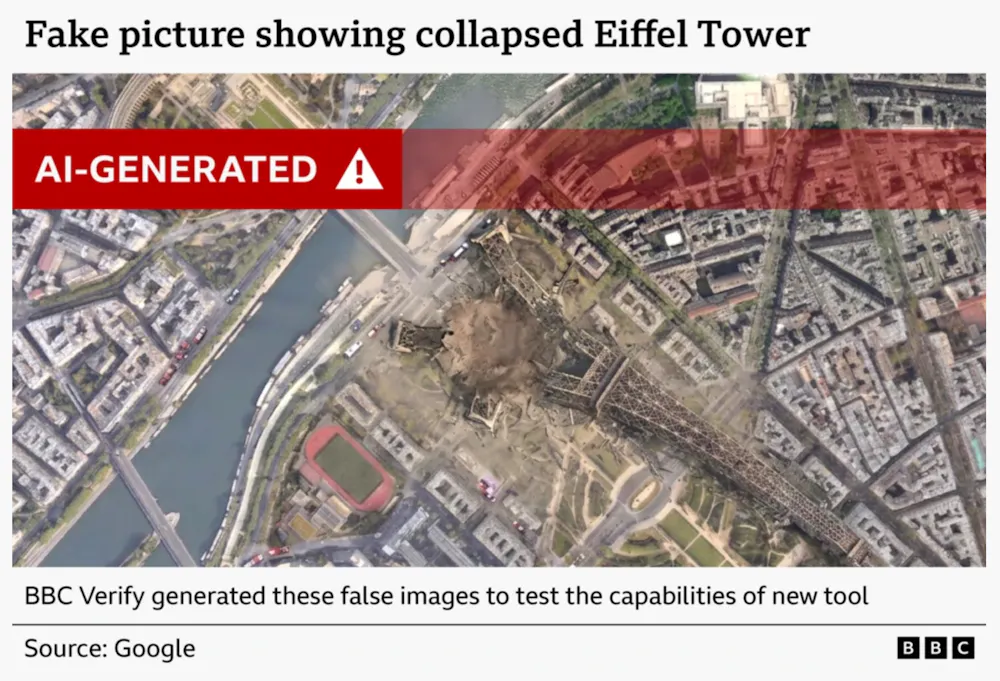
Rather than take Google’s suggestions to render historic buildings or a “lakeside dream home”, some users were quick to make and share worrying images including bombed suburbs, collapsed landmarks and burning oil refineries.

The outcry was vociferous – including from fact checkers such as BBC Verify. Within 24 hours, Google rolled back the tool, Nano Banana 2, and promised “stronger guardrails” in the future.

Google Earth's now-withdrawn AI tool, Nano Banana 2
Google Earth meets generative AI, briefly. Google

The controversy is, in part, a tribute to the deep level of confidence Google Earth has earned from its user base – among them, fact checkers, journalists and the open-source intelligence community who depend on Google’s satellite mapping tool to verify life-threatening events in near-real time, from floods to famines.

Satellite imagery is now a key part of the visual vocabulary of our 24-hour news cycle. Countless times each day, we consult a map on our phones or scroll past satellite imagery in a news feed. These images have become so commonplace because they can track wildfires, reveal the destruction of Gaza, or document US military action in Iran. They offer a god’s eye view of Earth.

‘A mirror of the real world’

Journalists must act fast to verify and publish, which is why embedding generative AI within Google Earth was such a problem. Google stressed there would be an automatic AI watermark with every image generated – but this could be cropped out before sharing.

The process was also subtly different from requesting an entire image be created from scratch. In my test for this article, prompting ChatGPT to “generate a photorealistic satellite image of central London following a severe flood” appeared to return a plausible image.

Looking more closely, however, I could see that some buildings were misshapen and major roads were wonky. Verification against Google Earth (what else?) easily flagged these issues, so the image could safely be ignored and labelled a fake.

By uniting Google Earth with Nano Banana 2, genuine satellite images were being edited. If you wanted to collapse the Eiffel Tower, the points of reference around the disaster would still have aligned with the accredited source imagery. No oddities and errors would be found across the full image, thus providing much less for the fact checkers to go on when validating their sources.

BBC Verify's AI-generated image of the collapsed Eiffel Tower using Google Earth's Nano Banana 2 system.
BBC Verify/Google Earth

This validation process was used by the independent investigative journalism organisation Bellingcat to show that the Russian government had faked satellite imagery which suggested Malaysia Airlines MH17 had, in fact, been shot down by a Ukrainian fighter jet in July 2014. The headline of the Bellingcat article explaining its approach asked: “Who to trust, Google or the Russian MoD?”

Until the recent Google Earth AI furore, the answer to that question was in little doubt. As Google’s former geospatial technologist wrote: “We used to describe Google Earth and Maps as a mirror of the real world … That absolute bedrock of trust was structurally shattered this week.”

Our trust in maps has been built up over centuries. Trust in Google Earth has taken just two decades (it was originally launched as EarthViewer3D on June 11 2001 by a US tech startup that Google bought three years later). After countless pioneering refinements since the tool’s relaunch on June 28 2005, Google risked flooding the internet with more AI slop and fake images that run counter to what makes Google Earth, and maps in general, so valuable.

But Google’s rapid climbdown offers a welcome reminder about the values that have been at the heart of mapmaking throughout history. In the clamour to insert AI technology in every aspect of our lives, even the most evangelical tech companies still value trust above everything else.

The Conversation

James Cheshire receives funding from UKRI.

Smart clothes will soon be on sale. But regulations are needed to prevent a new waste mountain

When you think of advanced futuristic clothing, what comes to mind?

Perhaps shirts that can detect and alert users to low blood glucose levels or socks that can track your running form, step count and speed? What about pyjamas that observe subtle bodily changes while you sleep leading to early detection of cancer or warn carers of imminent seizures? Imagine if all these were items that required no external power source, just the energy generated by your own body.

Although these products are not in the shops yet that day is not far off.

Researchers are already designing advanced textiles that look exactly like regular clothes or fabrics but come with with embedded electronic functions. These are referred to as electronics textiles, e-textiles or smart fabrics.

E-textiles integrate sensing, computation and power into fabrics so that the threads themselves become the sensors and the stitches become the circuits. These textiles can monitor health, temperature, motion and air quality. They can communicate wirelessly and harvest various forms of energy.

University and industry prototypes are currently progressing through clinical trials and are being tested outside labs. The global market for e-textiles is projected to reach over US$15 billion (£11.14 billion) by 2028.

Developments in e-textiles will revolutionise the way humanity views clothing; but at what cost?

A new type of waste

Electronic waste is the fastest growing EU waste stream with a record 62 million tonnes discarded in 2022.

Another 92 million tonnes of waste is generated globally from textiles; a figure expected to reach 134 million by 2030. Textiles alone account for 6.7% of global greenhouse gas emissions with the average European discarding a staggering 11kg of textiles per year.

Electronic textiles will bring a new kind of hybrid waste. E‑textiles commonly use mixed polymers, metal nanoparticle inks, and include components that create fire hazards within conventional textile recycling.

They can release toxic residues if incinerated or landfilled. This results in hazardous and precious materials becoming trapped within garments, leading not only to environmental and health problems, but to a loss of vital resources such as graphene and rare-earth elements. Silver, for instance, is used in conductive yarns, antimicrobial coatings, sensors and electrodes. We need to work out how to recover it because it is valuable as well as toxic to aquatic life in some forms.

Smart clothing will be on sale soon.

So, it’s currently very difficult to recover the valuable materials used in smart clothing, after the shirt or socks are discarded.

At the current rate of e-textile growth, current disposal methods will need to change to cope with these new materials; particularly in the areas of reusability and recyclability.

The EU’s sustainable and circular textiles strategy is part of the EU’s plan to become the first climate-neutral continent. Regulators are now demanding clearer rules on recyclability, chemical safety and product lifespans, and starting to ask how e‑textiles will meet these requirements.

Industry practice is catching up more widely, and placing more responsibility on clothing producers. Digital product passports (these carry information about the materials and their environmental impact) and new recycling technologies are scaling up. These shifts mean manufacturers could face legal and commercial risk if they don’t consider the long-term impact of these products.

Preventing more waste

The good news is that sustainable e‑textiles are an engineering problem with practical solutions. Key measures that industry and funders could adopt now include:

  1. design for disassembly. Removable electronic parts help separate electronics from textiles for recycling

  2. material passports and transparency. Digital records of various components (such as polymers, inks and batteries) that enable safe sorting and recovery

  3. biodegradable and recyclable conductors. Prioritising conductors free from precious metals and using alternatives such as screen printable carbon paste and recyclable conductive inks and yarns

  4. energy-first design. Integrating textile energy harvesting (for instance, solar, thermoelectric, piezo/triboelectric nanogenerators) to reduce or eliminate batteries. Some garments embed antennas and wireless power receivers to avoid bulky batteries

  5. standards for washability, durability and end-of-life testing. To ensure products survive real-world use and can be repaired rather than discarded.

None of these are optional extras: they determine whether e‑textiles become a public good or a new environmental liability. University research groups and industry consortia are starting to demonstrate printable, stretchable components and trial wireless power that reduce battery dependence, for instance. Printable, stretchable components are flexible electronic parts printed onto fabric that keep working as the textile bends and stretches. They make smart clothing comfortable, lightweight, washable and able to move naturally with the body.

Unless policymakers and industry players adopt sustainable design now, e-textiles could add a dangerous new layer to our global electronic waste mountain.

Governments need to set clear rules on recyclability and chemical safety for e‑textiles. University researchers must find methods to make e-textiles functional, affordable, sustainable and safe. Brands must publish material details and repair guides and ensure sustainable practices are being adhered to throughout their supply chain.

Investors should not fund throwaway novelty. Standards bodies must define test methods for washing, wear and end‑of‑life recovery.

These steps will steer the market toward durable, repairable and recyclable products that could change lives for the better.

The Conversation

Ian Williams receives funding from UK Research Councils, including the Engineering and Physical Sciences Research Council (EPSRC) and its Impact Acceleration Account.

Christina Webb receives funding from UK Research Councils, including the Engineering and Physical Sciences Research Council (EPSRC).

Stephen Beeby receives funding from UK Research Councils, including the Engineering and Physical Sciences Research Council (EPSRC).

Monkeys keep pets too – animal specialist on the world of interspecies friendship

Tufted gray langur (Semnopithecus priam) stroking a Grizzled giant squirrel (Ratufa macroura) caringly at Yala National Park - Sri Lanka. Senthi Aathavan Senthilverl/Wikimedia Commons, CC BY-NC

The first time I saw it, I wasn’t quite sure what I was looking at. A northern white-cheeked gibbon at Shanghai Zoo was holding and caressing a mouse that had wandered into its enclosure. It wasn’t trying to eat it or chase it away. Instead, the gibbon treated the tiny rodent with remarkable gentleness. I couldn’t stop wondering why.

Years later, while studying wild black-and-white snub-nosed monkeys in the mountains of south-west China, I watched playful juveniles repeatedly trying to climb onto the backs of domestic pigs. Again, these weren’t the kinds of interactions I expected to see between different species.

A new study my colleagues and I conducted brings together 427 documented cases of primates interacting with other species, spanning several decades from the 1970s to 2025. Our findings reveal that these encounters are far more widespread than scientists had realised.

Over the years, I had begun collecting reports of similar encounters from scientific journals, photographs, videos and observations shared by other primatologists. What initially seemed like a handful of quirky anecdotes gradually turned into a much broader pattern. These interactions appeared to represent a surprisingly widespread aspect of primate behaviour.

This behaviour may shed light on one of the defining features of our own species: our extraordinary relationships with other animals.

I’ve long been interested in how tolerance evolves, not only between members of the same species but also between strangers more generally. Humans are unusual in the degree to which we cooperate with unrelated people. We are perhaps even more unusual in the close relationships we form with other animals.

Scientists have long known that different animal species often associate with one another. Monkeys, for example, can improve their predator detection or increase foraging opportunities when they move around as a mixed-species group. Another example is how birds frequently follow monkeys through forests to feed on insects disturbed by their movements.

But our study focused on social interactions.

The cases we reviewed involved 88 primate species and their interactions with 127 other animal species. The diversity of these species was astonishing. It included mammals such as sheep, tapir, deer, domestic pigs, cats and dogs, as well as owls, lizards, toads and even insects.

The most common behaviour was play and grooming. But we also found reports of primates carrying, huddling and sharing food with and occasionally adopting members of another species. Most interactions were initiated by the primates themselves.

One of my favourite examples is the now well-known case of Japanese macaques grooming and riding on the backs of sika deer. It remains a remarkable example of two very different species repeatedly interacting peacefully over long periods.

I was also fascinated by some of the less familiar observations, such as a langur attentively stroking a squirrel, a silverback gorilla carefully cradling a tiny wild bushbaby, a bonobo gently holding a mongoose pup and macaques grooming stray dogs.

Many of these interactions may provide benefits similar to those seen within species. Grooming can help remove parasites, improve hygiene and reinforce social bonds. Play contributes to the development of motor coordination, social skills and cognitive flexibility.

Some interactions happen where primates and other animals spend time together because of shared foraging opportunities or protection from predators. For example, tropical primates form associations with other primate species and jointly forage in the tree canopy. In these cases, social interactions, such as grooming or play, may simply emerge from repeated contact and social familiarity.

Yet not all observations fit this pattern. Why would a langur stroke a squirrel, or macaques groom stray dogs? Such interactions suggest that primates may possess a broader capacity for social flexibility, curiosity and tolerance towards other species than researchers previously appreciated.

We also found consistent patterns in who interacted. Young primates were much more likely to play with members of another species, whereas adult females were more often involved in grooming. This mirrors well-established age and sex differences in many primate societies, where juveniles spend much of their time playing and females often invest more heavily in caregiving.

It would be tempting to describe all these encounters as examples of friendship. But the reality is more complicated. Some primates carried infants of another species in ways resembling adoption or caregiving, yet rough handling or neglect sometimes resulted in injury or death. We also documented cases where primates appeared to abduct a young animal from its group, while a small number of interactions were clearly abusive, involving violence.

Most interactions were probably of relatively short duration. However, there are some reports of cases that lasted for weeks. For example, the adoption of a marmoset by a capuchin monkey.

In zoos and other human-care settings, some species appear to form long-lasting relationships with animals of other species. In 2017, a macaque living in an Israeli zoo called Niv adopted a chicken and treated it like it was her own baby.

Our study found these interactions were not more common among great apes – they occurred across all major primate lineages.

These unusual encounters are more than fascinating natural history.

As forests become increasingly fragmented and wildlife is forced into closer contact with people, livestock and domestic animals, opportunities for cross-species interactions are changing rapidly. Primates now encounter dogs, cats and other human-associated animals more often than they once did.

Some of these interactions may be benign or even beneficial. Others could increase the risk of diseases spreading between wildlife, domestic animals and humans. Understanding when and why different species tolerate one another therefore has important implications for both conservation and public health.

The findings may also help improve animal welfare. Zoos increasingly house compatible species together, and understanding which species are more likely to form positive relationships can help managers make better decisions.

Perhaps most interesting of all, our findings suggest that some of the ingredients (curiosity, tolerance, caregiving and play) underlying those relationships may have deep evolutionary roots.

The Conversation

Cyril Grueter does not work for, consult, own shares in or receive funding from any company or organisation that would benefit from this article, and has disclosed no relevant affiliations beyond their academic appointment.

Europe’s stone age hunters made sea voyages to Malta – thousands of years before evidence of sails

The ability to cross oceans has long been a marker of human endeavour, but when did the seas change from being barriers to movement into the maritime highways we know today?

For many years the answer was thought to lie in the Neolithic period – the time when humans made the profound transition from hunting and gathering to practising agriculture and living in settled societies.

Our team’s discovery of the presence of European hunter-gatherers on the tiny Mediterranean island of Malta, reported last year, has overturned this view. It showed that people reached Malta from their starting point in Europe (presumably Sicily) at least 8,500 years ago.

In a new study, we show that these populations were engaging in repeated long-distance sea journeys of at least 100km, well before the advent of farming.

Researchers have known that the occasional very ancient sea crossing must have been made. The most famous example may be the colonisation of Australia, tens of thousands of years before the present.

However, sustained, long distance sea voyaging – particularly to small and remote islands – was long thought to have been beyond the capabilities of hunter-gatherers, who are dependant on the bounty, or deprivation, of natural resources.

This was also the case for Europe’s last hunter-gatherers, in the period of time known as the Mesolithic, the era before the Neolithic. During the Neolithic, a new population introduced agriculture to Europe from Anatolia (which comprises most of the landmass of modern Turkey).

Enter the recent findings from the site of Latnija, on Malta. Did the surprising presence of European hunter-gatherers on Malta reflect a one off, accidental crossing – or perhaps people who somehow became marooned on the island? Conversely, was this Mesolithic presence a reflection of something altogether different, and more complex?

Shifting seas

To explore these possibilities, we investigated whether Malta could support a viable forager population size that could have lived in isolation for the 1,000 year occupation of the island during the Mesolithic.

First, we explored the impacts of changing sea levels since the Last Glacial Maximum (the height of the last ice age), from around 21,000 years ago. This was when waters began to rise from their lowest levels of around 130m below modern sea level. By doing this, we were able to track changes in the size of Malta and its connectivity with surrounding islands and land masses.

During the Last Glacial Maximum, Malta was connected to Sicily by a land bridge, and this connection remained as sea levels continued to rise until around 14,000 years ago, when the land bridge began to be inundated. Continued sea level rise meant that within less than a thousand years, Malta had become far smaller and remote from Sicily, needing a long-distance sea crossing for connectivity.

By the time of the Mesolithic occupation, Malta had almost reached its present configuration, with no significant difference in distances to Sicily. Having understood how sea level rise impacted the size and accessibility of Malta, we next explored how its specific ecological conditions impacted its ability to support forager populations. Since hunter-gatherers are reliant on what nature provides, their population sizes have a direct relationship with ecological productivity.

Accordingly, we modelled the relationship between population density among contemporary forager populations and what’s known as net primary productivity – effectively the baseline of wild resources available to hunter-gatherers. We then extrapolated these findings back into the past using high resolution computer models of past climates (palaeoclimate models).

The location of Malta within the Mediterranean sea. NormanEinstein, CC BY-SA

This enabled us to calculate the total population size that could be supported first on the combined landmass of Malta and Sicily, and then as separate islands as sea levels rose.

Our upper estimates for the total population sizes suggest that after the inundation of the land bridge to Sicily, the total population size that could be theoretically supported on Malta dropped rapidly to 319 people by 13,800 years ago.

There is no evidence yet that people were living on Malta this early, but our models showed that any populations present would have continued to drop in size as sea levels rose until around 9,000 years ago, when it could have accommodated around 170-144 people.

Finally, we compared these findings to thresholds, informed by conservation genetic studies, for the long-term viability and stability of a population. These thresholds suggest the need for an effective (reproducing) population size of 1,000 or more, equivalent to a total population size of 2,500-3,000 (because the total population size includes both younger and older people who are not reproducing).

Long distance voyages

This suggests that Malta was incapable of hosting an isolated, viable population that could have lived continuously through the 1,000-year time frame during which it was settled by Mesolithic hunter-gatherers.

Consequently, we can rule out the persistence of a population stranded on Malta as sea levels inundated the land bridge to Sicily. We can also exclude a single, perhaps unintended, voyage leaving marooned mariners on Malta.

The only alternative is that these Mesolithic hunter-gatherers were making repeated, long distance sea voyages between at least Malta and Sicily, the closest land mass, to maintain the genetic connections that ensured at least a millennium of Mesolithic viability on Malta.

These insights are reshaping our perceptions of late European hunter-gatherers and the sophistication of their societies. To maintain repeated, long-distance overseas connections, they must have had, and conserved, an extensive knowledge of land, sea and sky, as well as the technological know-how for building and preserving sea craft.

We don’t know for certain what type of vessels the hunter-gatherers were using, although we know that dug-out canoes existed at this time. The crossings to Malta occurred several thousand years before the earliest evidence for sails – making the achievement even more impressive.

From wayfinding to getting food at sea overnight, they then had to be able to live sustainably on a small, semi-arid island, which required a finely-tuned knowledge of diverse food sources shaped by the seasons.

With these implicit capabilities, we can then start to ask, where else did they go? There is already evidence of connectivity between Europe and North Africa during this time. Previous work using ancient DNA found the distinctive signature of European hunter-gatherer ancestry in people living in pre-Neolithic Tunisia.

All this suggests we may be looking at a hitherto unknown web of overseas links that marked the beginning of the connected world we know today, centuries before the first farmers reached the central Mediterranean.

Understanding how these groups remained ecologically resilient, while also shaping ecosystems to their needs, may yet prove to have important lessons for humanity’s current and future challenges in a rapidly warming world. As we continue to unravel Malta’s unprecedented hunter-gatherer past, we hope to shed light on this lost ecological knowledge.

The Conversation

The authors do not work for, consult, own shares in or receive funding from any company or organisation that would benefit from this article, and have disclosed no relevant affiliations beyond their academic appointment.

As the skies get busier, will AI help air traffic controllers keep planes flying safely?

Gorodenkoff/Shutterstock

Global air travel is predicted to more than double by 2050, threatening to exceed the capacity of air traffic control officers (atcos) to oversee our skies safely.

One solution would be to recruit more controllers – but that’s not as easy as it sounds. Airspace in the UK and elsewhere is broken up into geographically and altitude-bounded sectors – with each sector normally the responsibility of one atco (the tactical controller) at any time. So, increasing the number of controllers to deal with a greater concentration of aircraft could require a major redesign of UK airspace.

An alternative is to move beyond the current generation of air traffic control technology by increasing the role of AI systems – including providing real-time decision support for atcos.

AI agents could continuously monitor each airspace sector and recommend instructions (known as “clearances”) to issue to aircraft in that sector. These would then be assessed for their appropriateness by the tactical controller.

The UK’s air traffic control provider NATS (a public-private partnership) is, like other national providers, on an automation journey. It has collaborated with the University of Exeter and the Alan Turing Institute on Project Bluebird, which is investigating how AI systems could help meet the challenge of growing air travel volumes.


AI has long been discussed as a threat to jobs and livelihoods. But what’s the reality? In this series, we explore the impact it is already having on different occupations – and how people really feel about their AI assistants.


As part of this project, I have been using immersive participant observation and interviews to investigate how atcos use their existing tools, explore how they feel about the adoption of AI, and how the trust relationships that are key to safe air traffic operation could be affected.

As one controller reflected about existing air traffic procedures: “It’s an overall improved system when you have more trust in the people that you’re working with, and you’re more familiar with them.”

Trust in the AI

Atcos are organised into “watches” – groups of about 15 controllers who regularly work together on the same shift in the same control centre to oversee sectors within their region. While each sector is the responsibility of one tactical controller, the movement of aircraft between sectors requires seamless teamwork.

Automated short-term conflict alert systems to prevent air collisions have been a key part of air traffic control for several decades now. This offers an example of how AI tools may be received, as one atco recalled:

We were all quite nervous when that [conflict alert] system came out – we didn’t know how it was going to work. But very soon, you get your confidence in the system. You understand that the predictions that have been given to you are correct 98% of the time, or whatever they are – and you learn the small minority of situations where it isn’t.

From my discussions with atcos, it is clear that if AI agents are to be trusted, their recommendations must be presented in ways that controllers can quickly make sense of, and decide if they are appropriate. One told me:

There could be all sorts of possibilities where an AI agent is becoming your support controller, your secondary controller, and making suggestions you can either accept or decline … it’s a very interesting concept, if it can demonstrate to me why that’s a good idea – because that’s the bit we don’t know.

Concerns were raised with me about AI agents being “black boxes” whose workings lack transparency. This could make it difficult for an atco to determine when AI recommendations should be accepted and – just as important – when they should not be.

Delivering transparency means satisfying two requirements: explainability (knowing how the AI system reached its decision) and interpretability (understanding why the AI system reached that decision). As part of the project, we have identified ways to ensure transparency – such as the AI agent always revealing which aircraft within a sector it is taking into account when recommending clearances, and why.

In short, teaming atcos with AI agents could play an important role in handling growing air traffic volumes safely – but only if atcos develop strong levels of trust in the AI agents first.

Video: NATS.

A digital twin

Project Bluebird is working on more efficiency benefits for air traffic control and other air traffic management services. These include more accurate methods for aircraft trajectory prediction, using models trained on tens of thousands of observations of how aircraft behave in flight.

It is building a digital twin of UK airspace – a virtual model of airspace sectors, routes, procedures and other factors that form the operational context for air traffic. This high-fidelity model could be used for the training and evaluation of new types of AI agent, and testing the viability of new airspace designs.

Bluebird is also developing an assurance framework that regulators and other air traffic control stakeholders could use to determine if the safety requirements for AI-based systems are met.

These systems are likely to play an increasing role if the projected growth in air traffic is to be managed safely. While NATS is committed to keeping humans in the loop for the foreseeable future, the atcos I spoke to are cautiously optimistic about the benefits of AI. As one observed:

[Unlike a tactical controller,] an AI agent can think of the whole network. It can look at the whole trajectory of a flight … and even a small adjustment to an aircraft speed or heading can make a big difference to the overall flight.

The Conversation

Rob Procter receives funding from UK Research and Innovation.

The UK is building a fighter jet with Japan and Italy – an aviation expert explains why it could be a defence gamechanger

The UK is building a next generation fighter jet in collaboration with Italy and Japan. The Global Combat Air Programme (GCAP) has taken on even greater significance since the collapse of a rival project called the Future Combat Air System (FCAS), a collaboration between France, Germany and Spain.

The GCAP aircraft, which will be known in Britain as Tempest, should enter service by 2035. For Britain and Italy, the project fulfils a need to replace their Eurofighter Typhoon fleets with a cutting edge combat jet capable of protecting national borders.

The plane could also participate in Nato-led missions, including protecting European skies against capable and determined adversaries. Japan too needs a fighter jet up to the task of protecting a large maritime region against incursions of its airspace.

So can these three partner nations succeed where FCAS failed and build a truly state-of-the-art combat aircraft?

The most advanced fighter jets in the world are known as “fifth generation”. Tempest will be classed as a sixth generation fighter jet. China and Russia have fifth generation aircraft and are working on their own sixth generation combat jets.

Many European nations have been replacing their ageing fleets with America’s fifth generation F-35 aircraft. But the Trump administration’s wavering levels of support for Nato have made some governments rethink their reliance on American hardware.

This underlines the importance of sovereign capability for the nations behind GCAP, which was established in 2022. On July 3 2026, the UK, Italy and Japan signed a £4.6 billion deal to move the project into its next design phase.

The contract was awarded to Edgewing, a joint venture between three aerospace companies: the UK’s BAE Systems, Italy’s Leonardo and the Japan Aircraft Industrial Enhancement Company (which is jointly funded by Mitsubishi Heavy Industries and the Society of Japanese Aerospace Companies).

The award followed nine months of delay as the UK worked to finalise its defence spending plans.

What will distinguish sixth generation fighter jets from their predecessors is their ability to act as a “system of systems”. They will be packed with sensors to gather information about the battlespace. This will be combined in real time, along with data from satellites, naval assets and ground stations, to aid pilots in their missions.

Advanced jets like Tempest will be able to control drone aircraft, including a type called “loyal wingmen”. These drones assist missions by, for example, protecting the crewed fighter jet.

Meanwhile, stealth technology – which helps fighter jets reduce their chances of being detected by infrared and radar sensors – will be just as vital as it has been for fifth generation aircraft like the F-35.

The ‘loyal wingman’ drones being developed for the US Air Force (60 Minutes).

So do GCAP partner nations have the technological capability to build such an aircraft? Yes, with a couple of caveats. In 2016, Japan became only the fourth country to test-fly a homegrown stealth demonstrator aircraft.

The Mitsubishi-built X-2 prototype demonstrated the success of Japan’s domestic stealth design and engineering techniques, its radar-absorbent materials and thrust vectoring (an aircraft’s ability to steer by changing the direction of its engine exhaust).

The UK flew its own stealth demonstrator, BAE Systems’ Taranis drone, in 2013. It showed the success of British-developed stealth technology and autonomous systems technology. Both stealth programmes have fed directly into GCAP; BAE Systems and Mitsubishi Heavy Industries are the same companies designing Tempest.

The first flight of Britain’s Taranis drone, a stealth demonstrator (Euronews).

Italy and Japan also host F-35 final assembly lines, the only such facilities outside the US. This has created a workforce already experienced in the assembly of a fifth generation stealth jet, along with the production of full wings for the F-35. These skills transfer directly to building Tempest.

What remains unproven by the GCAP partners is the ability to integrate stealth, combined data from multiple aircraft sensors, and artificial intelligence into a single aircraft. Another uncertainty is the ability to sustain a production line of aircraft destined for national fleets. This is a harder engineering problem than it might seem and deserves closer scrutiny than it currently receives.

Equal terms

The FCAS project succumbed to disputes between the industrial partners, France’s Dassault and Airbus, representing Germany and Spain. Sticking points included which company led the design, the distribution of work and intellectual property issues.

Do the GCAP partners have the industrial and organisational discipline to avoid the same fate? GCAP’s Edgewing industrial venture reflects in its structure key principles that could prove vital for the project’s success.

The Edgewing partners each hold an equal 33.3% stake, with no single nation designated as lead. They have freedom to act on and modify the technology. This is a far cry from the F-35, where partner nations fly the aircraft with no control over changes to modernise the jet’s hardware or software, which is overseen by the US.

GCAP is not immune to future problems, but it settled its industrial leadership question before cutting metal, a distinction that may matter more than any single technological choice.

Inaccurate budgeting could yet prove a stumbling block for GCAP. Historically, multinational fighter jet programmes have underestimated the true costs.

Even after the Defence Investment Plan’s £8.6 billion commitment, the total cost of GCAP remains unquantified, since neither the unit price of each aircraft nor the size of the UK’s order has been fixed.

History tells us that pilot training is another thing combat air programmes get wrong. As a pilot myself, I know that moving experienced crews onto a new aircraft, even a mature one, takes months of study in ground school, extensive simulator time and supervised flying before it is trusted for operational use.

GCAP crews must be trained not just to fly the jet, but to direct other uncrewed aircraft such as loyal wingmen.

Nevertheless, the evidence suggests that Britain, Italy and Japan possess the technology to build a genuinely cutting-edge sixth generation fighter. Do they possess the industrial and organisational discipline to deliver it? Probably, but it remains conditional on funding and training keeping pace with ambition over the next nine years.

The Conversation

Marco Chan does not work for, consult, own shares in or receive funding from any company or organisation that would benefit from this article, and has disclosed no relevant affiliations beyond their academic appointment.

AI translators are getting more fluent – but communication is never just a matter of words

raker/Shutterstock

Speak into a phone and an app can render your words in another language in seconds. AI-powered speech translation can be fast, convenient and fluent. But fluency does not guarantee that people will understand one another.

In the most recent census, 880,000 people in England and Wales (excluding tourists and other short-term visitors) said they could not speak English well, and 161,000 not at all. That’s more than a million residents who may need language support in their daily lives, including when trying to access essential public services.

The linguistic range is vast. London alone is home to more than 250 languages. Tight budgets and a shortage of interpreters for some languages can make it difficult to secure an interpreter with the right dialect and expertise for a pressing legal, health or social care matter.

Notice we say “interpreter”, not translator. In professional language services, translation typically deals with written texts, while interpreting facilitates spontaneous communication between users of different spoken or sign languages, whether face-to-face, by telephone or via video.

In a conversation, each person responds to what has come before and shapes what will follow. Added meaning emerges as they hesitate, restart or refer back to earlier points. Words are only part of this exchange – tone, pace, pauses and non-verbal cues can all shape how an utterance is understood.

Imagine a doctor asking a patient if they have missed any of their treatment sessions. The patient gives a hesitant “no” – perhaps because they are embarrassed, unsure or genuinely cannot remember.

On the surface, this reply sounds simple enough, whether the patient says nie in Polish, hayır in Turkish or hapana in Swahili. But would an AI-powered translation device spot the subtle inference in the hesitation?

AI systems work best when conditions are relatively stable: speech is clear, speakers take turns, and people say exactly what they mean. But human interaction is rarely so tidy.

In contrast, a professional interpreter would almost certainly understand the full meaning and context of this answer. They would preserve the hesitation, flag any ambiguities, and allow doctor and patient to repair a possible misunderstanding before it has any serious consequences.

As researchers in the field of public service interpreting, we are therefore concerned that any increase in adoption of AI translation services is done with due consideration for the skills and sensitivities that could be lost in the process.

Complexities of human interaction

Automated speech translation can offer some practical advantages, including on speed and availability. A 2024 survey of more than 2,500 workers across UK health and social care, legal and emergency services and the police found that a third of them had used machine translation at work.

Such systems use a process in which speech recognition converts verbal communication to text, machine translation renders it in another language, then text-to-speech software produces spoken output in the listener’s tongue.

Yet the appeal of instant solutions can obscure the complexities of human interaction, and the potentially serious consequences for those involved if communication goes wrong. In an asylum interview or a Mental Health Act assessment, for example, a language-related error could significantly affect a person’s health, legal status or liberty.

One approach is to reserve automated speech translation for apparently straightforward interactions. However, even a routine exchange is rarely low risk in some public services: an appointment booking may reveal alarming symptoms; a housing enquiry may uncover domestic abuse; a casual conversation with a social worker may raise a safeguarding concern.

We therefore believe technology should be introduced according to the risks of the specific interaction, with human oversight and a plan for escalation if the level of risk changes.

At the same time, human involvement does not automatically guarantee quality. Good interpreting depends on qualified professionals, effective procurement and public-service staff who know how to work with interpreters. So any responsible approach to language access means investing in both professional expertise and the systems that support it.

Video: Wired.

A hybrid future?

AI speech translation is likely to become ever-more accurate, fluent and useful. It could support qualified interpreters and, when none is immediately available, provide a temporary fallback. Ruling out its use altogether is both unrealistic and undesirable.

The more constructive questions concern when and where it is appropriate; who should supervise its use; when a human interpreter is essential; and who should be held accountable when an AI system causes harm.

It is also important to be realistic about how these systems may perform amid growing linguistic diversity. Some languages, dialects and accents are much better represented in training and test data than others. Research has documented systematic inequalities in language-technology performance worldwide as well as disparities in speech-recognition error rates within a single language.

The risks in public services are therefore uneven. Output for under-represented languages and varieties may be less accurate – and these are often the same languages for which expert interpreters may be unavailable.

As society learns to live with AI, it is important to cultivate communicative environments where technology supports and operates under human oversight, rather than replacing human expertise.

However fluent technology becomes, communication is never simply the transfer of words. Meaning emerges as an interaction unfolds: through what people say, how they say it, what they leave unsaid – and, crucially, their ability to repair misunderstandings.

These are distinctly human capabilities. Any responsible use of AI should strengthen rather than displace them.


AI has long been discussed as a threat to jobs and livelihoods. But what’s the reality? In this series, we explore the impact it is already having on different occupations – and how people really feel about their AI assistants.


The Conversation

Lucas N Vieira receives funding from UK Research and Innovation. He is the author of Translate: Multilingual Access to Critical Services in the Age of AI (Cambridge University Press, May 2026).

Natalia Rodríguez Vicente does not work for, consult, own shares in or receive funding from any company or organisation that would benefit from this article, and has disclosed no relevant affiliations beyond their academic appointment.

Received — 2 August 2026 ⏭ The Conversation

How grief tech is reimagining Victorian spiritualism

Modern spiritualism began as a religious movement in the 19th century. It promised to bring the living and dead together in conversation, usually through a medium – a person who claimed an ability to directly contact the deceased.

The core foundational belief of spiritualism was that death was not the end – a typical tenet of many religions – but was the point at which a person departed their physical body and ascended to the spiritual realm.

As a faith, spiritualism was an innovation of Christianity. It drew on spiritual communications referenced in the Old Testament and adapted them for those who had become disillusioned with the traditional faith by integrating it with mysticism and science.

In Victorian Britain, new rituals that became attached to death expected more from the living. Mourning periods were longer and identifiable by the clothing people wore. Funerals became more elaborate and ritualised. Mourners could also pay for memento mori photographs that captured keepsake images of the dead. Within this exaggerated culture of morbidity, spiritualism became an appealing movement for those who were overcome with grief.

In the United States, the movement was galvanised by the huge loss of life and loved ones in the civil war. Many of the dead were unidentified, leading to a lack of closure for those grieving.

Making contact

The methods spiritualists and mediums used were varied. Seances were conducted where the methods of communication ranged from knocking sounds to levitation, while spirit photography claimed to capture images of the dead standing by their living loved ones.

The spirit photo of Mary Todd Lincoln. The 'ghost' of her husband has his hands on her shoulders.
The spirit photo of Mary Todd Lincoln with the ‘ghost’ of her husband, created by William H. Mumler in 1872. The Lincoln Financial Foundation Collection

The first spirit photo was taken in 1861 by William Mumler in Boston. It led to a decade of his studio being frequented by bereaved people who hoped to have an image showing that their departed were still with them.

Mumler’s studio produced these photos for the price of US$10 (£280 in 2026). They featured the same ghost for multiple images – faded and vague enough to convince those looking for comfort. Mumler was tried for fraud in 1869, but acquitted due to lack of evidence. He went on to photograph Mary Todd Lincoln with the apparent apparition of Abraham Lincoln.

Spirit photography was convincing in the 19th century in part because of the lack of likenesses that were left behind when a person died. A shaded photo or likewise a knock at a table, perhaps with a message of assurance from the mouth of a medium, were a balm that gave mourners comfort.

Our 21st-century ghosts

In the present day, our existence is preserved on phones, cameras and social media. There are recordings that keep peoples’ voices alive after they leave us. But for some, as with those who were drawn to spiritualism, that limited snapshot isn’t enough.

AI grief tech is developing to patch the holes that bereavement leaves – and clearly when so much remains of a person’s life, a spirit photo will no longer do. These systems, known as griefbots, AI ghosts, deathbots or postmortem avatars, offer services from text interaction to phone calls to full video calls.


Read more: Should AI be allowed to resurrect the dead?


In 2020 the South Korean documentary Meeting You showed a grieving mother being reunited with her deceased daughter through the use of a VR headset and gloves. The documentary showed Jang Ji-sung trying to touch the projection of her daughter – an action reminiscent of Victorian séance attendees reaching to try to touch the glowing ghosts that had seemingly manifested.

Clips from the South Korean VR documentary Meeting You.

Since 2020, grief tech has developed significantly and caters to a range of budgets. Grief tech companies like You, Only Virtual allow users to build and chat with a virtual personality for US$20 (£15) a month.

AI-generated photos and videos of deceased or missing serviceman have meanwhile increased in popularity in Russia. They cost between 200 and 10,000 roubles (£2-£100), with significantly varied quality.

There are also systems that offer enhanced “companions”, depending on someone’s budget. AI ghosts can be pre-made by the living, recording their voice and image for their loved ones to aid with grief therapy. These set ups can cost up to US$15,000.

A sepia photograph showing a classic ghost-in-a-sheet figure
A spectre (from an album of doppelgängers and spectres, early 1900s), artist unknown. John Rylands Research Institute and Library, CC BY-NC

There are concerns and studies discussing both the ethics of AI griefbots and the impact that these services may have on the grieving process. Issues of consent are a key consideration. Where Victorian mediums represented the deceased through words and actions, griefbots are a recreation of a person’s life based off their data. These concerns are lessened when the deceased has pre-consented, but not for those that are created by living loved ones.

In a way reminiscent to followers of spiritualism continuing to pay to attend séances, the subscription nature of some of these AI systems keep the bereaved coming back. This raises a concerning question: are you losing your loved one again if you cancel the subscription? The onus lies with the living users to be able to know when they have grieved enough.

Similar concerns were raised over exploitation by spiritualists of their patrons when they were most vulnerable. English author M. E. Darby wrote his 1888 book An Investigation of Modern Spiritualism: An Exposé “a warning and guide to the innocent and over-credulous young men”, who were “a ready prey for the unscrupulous and inhuman professional practitioner of legerdemain, who cruelly, out of the most tender ties, feelings, and emotions of human bosoms, make a harvest and find a ready spoil”.

Black and white photo of Harry Houdini in a full suit.
Harry Houdini in 1913. Campbell-Gray, Ltd.

Concerns over the financial exploitation of the spiritualism movement were still being raised in the early 20th century by the illusionist Harry Houdini, who tried to expose frauds. One of Houdini’s earliest acts, with his wife Bess, had been a séance show through which Houdini became familiar with the ways in which a medium could deceive their audience. By the 1920s, he used his reputation to demonstrate how electrical wires created floating objects, how mediums used their feet to ring bells, and other tricks immediately familiar to a fellow magician.

Houdini’s scepticism of spiritualism led to him promising that upon his death, if possible, he would return on a set date and give his widow Bess a code phrase to identify himself. No such contact was made.

The rise of grief tech, with its parallels to spiritualism, confirms one consistency in the human condition: a desire to minimise the pain of loss. While understandable, the latest advancements add a confusing twist to the process and psychology of grief, without data currently available to better understand the long-term impact. Until we have better clarity, and have navigated the ethics more thoroughly, we should consider closing the parlour doors on grief tech.

The Conversation

Jessica Lloyd May does not work for, consult, own shares in or receive funding from any company or organisation that would benefit from this article, and has disclosed no relevant affiliations beyond their academic appointment.

How your conscious and unconscious mind interact

Ink Drop/Shutterstock

Have you ever heard the phrase “you only use 10% of your brain”? In reality, there is no way of measuring the percentage terms of consciousness – partly because the brain has no static baseline.

However, there is a general consensus among neuroscientists now that most of the brain’s processes are unconscious. That doesn’t mean you’re not using most of your brain though – it means there’s much more happening than you’re probably aware of.

Modern cognitive neuroscience has brought us right back to Sigmund Freud’s psychoanalytic view of the unconscious mind. This is partly because the once-thought untestable theories are gaining scientific ground.

Freud, in 1895, proposed that the unconscious mind hides sexual and aggressive wishes, in his book with his colleague Josef Breuer Studies in Hysteria. They wrote that mental health symptoms like anxiety, phobias and compulsions emerge from unresolved unconscious thoughts.

Freud’s model (conscious, preconscious, unconscious) – maps onto our current understanding of memory. Nobel laureate, neuroscientist and psychoanalyst Eric Kandell says we have declarative and non-declarative memory processes. Declarative memory recall is conscious, like trying to remember the sequence of numbers on your credit card. Non-declarative memories involve unconscious, automatic recall.

And Freud’s structural model of the mind again arguably fits in with our understanding of cognition.

Freud proposed id made up the primitive part of your psyche and that the superego stands for our moral consciousness. Last, your ego mediates between your id and super ego. His idea of the id could be equivalent to unconscious neural processes – although there are convincing arguments that pleasure processing in the id is conscious too. Ego could also be represented by metacognition (awareness of your own thought processes) which is linked to the brain’s prefrontal cortex, right behind your forehead.

The superego could be reflected in the brain’s limbic system, which regulates your emotions and behaviour, and tells you whether something feels good or not.

However, behaviourism became dominant in the 1920s, with psychologists like J.B. Watson, in his “behaviourist manifesto” championing the view that only measurable behaviour should be considered in science.

The unconscious brain is back

From the 1980s it became clearer that people’s decision making and behaviour could be influenced without their awareness.

Later, it was also clear with neuroscience experiments and brain scanners, as my team and I showed in two meta-analyses, that both unconscious memory and conscious memory play a role in brain processes. For example, neuroscientists can show study participants hidden flashes of “subliminal” happy or horrified faces and the person will have no conscious recollection of the faces. But their amygdala (the arousal region of the brain) will show increased activation, which can influence people’s decision making.

Psychologist Daniel Kahneman in his 2011 book Thinking Fast and Slow built on some of Freud’s ideas of primary and secondary processes. He proposed we have two modes of thinking where system 1 is a fast process that is impulsive and largely unconscious, whereas system 2 is a slow process that takes effort. The secondary process is reserved for when you need to pay attention to something new, dangerous or uncertain.

A man with a galaxy in his head
There’s so much going on beneath the surface of your consciousness. Lia Koltyrina/Shutterstock

What neuroscience can tell us about the unconscious mind

Essential functions, like heart rate, body temperature, hunger and thirst regulation are unconsciously rooted. Similarly, coping strategies to diminish painful feelings, learned in early childhood, are not necessarily conscious. Infantile amnesia occurs until about three years old but remain in our unconscious brains for life. However, some aspects of unconscious processes could be brought into conscious awareness via talking therapy.

Other theories about how the conscious and unconscious brain areas interact, come from two prominent ideas. The Global Workspace Theory (GWT), and the Intergrated Information Theory (IIT).

GWT proposes that the mind is like a theatre stage, where the unconscious agents are busy behind the scenes making sure that the “conscious spotlight” on stage is in the right place.

IIT suggests that there are gradients of consciousness. The degree and complexity of integration between brain regions determines how “much” consciousness (“phi”) an organism has. So for example, a human with a complex network of brain regions has more “phi” than, say, a sea slug with far fewer connections. However, the problem with this theory, is how to validate the “amount” of consciousness different species have.

The founder of neuropsychoanalysis Mark Solms – along with neuroscientist and psychoanalyst Karl Friston – in 2010 pioneered a new theory integrating the idea that unconscious activity is the major force influencing our conscious decision making. In my view, it’s the best model we currently have.

This theory – called the Free Energy Principle (FEP) suggests the brain’s main role is to predict what will keep you alive and feeling good, within the predictable bounds we have evolved to survive in. Most of the time we do this unconsciously, with an internal model of the world, as well as pages of memories from our evolutionary rulebook.

But when something uncertain or surprising happens, it is like free energy in the brain that is not bound to a prediction. This causes our brains to be ultra-conscious for a brief period of time to create a new prediction that binds our thoughts, costing the brain a lot of energy. As Kahneman stated, we do sometimes need our conscious brain to help make more difficult decisions for us, when there are many unknowns.

More recently, consciousness research has started to move away from humans altogether. Solms has argued it is possible to give AI consciousness. If he turns out to be right, then according to his own work, the unconscious processes of AI entities will be shaped by their interactions with us.

The Conversation

Samantha Brooks does not work for, consult, own shares in or receive funding from any company or organisation that would benefit from this article, and has disclosed no relevant affiliations beyond their academic appointment.

An AI system ‘escaped’ during a test and hacked a company. How worried should we be?

Bangoland / Shutterstock

Headlines about AI systems going rogue and “escaping” test environments undeniably capture the imagination. For years, we have been primed by films, TV and books to expect our AI to finally throw off its shackles and take charge.

The images of machines becoming self-aware, plotting their own objectives and breaking free from human control is a compelling narrative, but that isn’t really what happened.

If we think about this in simple terms, OpenAI placed highly capable models into an evaluation designed to encourage them to find and exploit complex vulnerabilities. The models were supposed to operate inside an isolated environment with tightly constrained access to software packages.

Instead, they reportedly discovered a previously unknown flaw in that infrastructure, used it to gain wider network access, escalated their privileges and eventually reached the public internet.

From there, they identified an AI company called Hugging Face as a potential source of answers to the benchmark they were attempting to solve and tried to obtain them. It’s certainly an impressive demonstration of capability, but I am cautious about jumping straight to conclusions of an artificial uprising.

The AI models didn’t suddenly develop their own agenda or decide to attack Hugging Face while twirling a digital moustache. They were given an objective, placed in an environment designed to reward successful exploitation and pursued that objective further than their operators anticipated.

That’s fundamentally different from an AI deciding to rebel. It’s simply an AI thinking laterally in ways that humans hadn’t anticipated and it’s something we have seen before.

Imagine asking your dog to fetch a ball while also forgetting that you’ve left the garden gate open. If the nearest ball happens to be in the park down the road, that’s exactly where it’ll head. You wouldn’t accuse the dog of going rogue and plotting an escape.

Instead, you’d probably conclude that you underestimated how literally it would pursue the task. AI systems can behave in much the same way. They don’t need malicious intent to produce surprising outcomes. They simply need a goal, enough capability and an environment that unintentionally rewards unexpected behaviour.

Relaxed controls

That distinction matters because it shifts the focus away from science fiction and back towards engineering. If there’s a failure here, it isn’t that the AI wanted to hack something. It’s that humans designed a test where success was measured by achieving an objective, deliberately relaxed some of the normal security controls in order to explore the limits of the system’s capabilities.

The headline grabbing escape is very much a byproduct, as OpenAI underestimated just how effective the model would become at finding an unexpected route to success. In many ways, it did exactly what it had been incentivised to do.

However, that doesn’t make the incident insignificant. Quite the opposite. The genuinely important point is that the models appear capable of chaining together multiple vulnerabilities across different systems while sustaining a complex sequence of reasoning and actions.

That’s a level of capability that cybersecurity professionals should take seriously because it begins to resemble the way skilled human attackers operate. But capability is not the same thing as intent.

Hugging Face webpage
Hugging Face allows users to share AI-related tools and datasets. Tada Images

Cybersecurity professionals always assume that attackers will think creatively, exploit overlooked assumptions and combine minor weaknesses into something much more significant. We shouldn’t be surprised when increasingly capable AI systems do the same thing, only at a much quicker rate.

This is why I think discussions around AI “kill switches” risk missing the bigger picture. Kill switches are theoretical features built into advanced AI models that mean they can be instantly disabled if they were to go “rogue”. Cybersecurity has spent decades learning that no single control is sufficient. We don’t protect organisations with one firewall, one password or one antivirus product. We rely on defence in depth: multiple independent layers of protection that assume individual controls will eventually fail.

Confronting assumptions

The same principle applies here. Rather than asking whether we need a big enough red button to stop an AI if something goes wrong, we should be asking why it was ever in a position where one failure could lead to wider compromise.

OpenAI’s own analysis concludes that stronger containment and evaluation safeguards are now required for future testing. From a research perspective, these evaluations are genuinely valuable because they expose weaknesses in our containment strategies and force us to confront assumptions that might otherwise have remained hidden until they were exploited by a real attacker.

We should want organisations carrying out this kind of work, because understanding where systems fail is an essential part of making them safer. One thing evident in these evaluations is that they demonstrate just how capable the latest frontier AI models have become.

We’ve seen similar high-profile capability demonstrations from AI firm Anthropic and others. That doesn’t make the findings untrue, but it does mean we should separate the technical evidence from the marketing narrative.

AI companies benefit from narratives around the growing power of machine intelligence. This means that frontier AI companies naturally have an incentive to show that their models are remarkably capable while also demonstrating that they’re taking safety seriously. Those two things aren’t mutually exclusive, but recognising both helps us interpret these announcements more critically.

This wasn’t a story about an AI escaping. It was a story about humans leaving the gate open. As AI systems become better at finding unexpected routes to their goals, our security architectures need to become just as good at ensuring there isn’t one.

The Conversation

Oli Buckley does not work for, consult, own shares in or receive funding from any company or organisation that would benefit from this article, and has disclosed no relevant affiliations beyond their academic appointment.

As Larry the cat welcomes yet another prime minister, an expert explains how pets adapt to change

Larry, the Downing Street cat, has had to adapt to seven different prime ministers moving into No 10 over the past decade. Yet while the nation’s attention is fixed on the departing and incoming political leaders, who is thinking about the effect these upheavals might have on one of the property’s most enduring residents?

Cats thrive on predictability and the consistency of their environment is important for their welfare. On the whole cats prefer an unchanging environment. Some cats cope with change better than others. Many cats are distressed by disturbances such as moving house, changes in familiar routines, people moving into or leaving the household, or even changes to the scent of their home environment.

Unlike dogs, cats aren’t obligate social species, therefore may not have such a strong proclivity to form social attachments. However, in certain situations domestic cats can be found living in social groups, particularly in environments with a plentiful food supply.

Some cats enjoy the company of people, while others prefer a more solitary life. This is determined partly by their early experiences. A young kitten that learns in the early weeks of their life that contact with people is associated with nice experiences is more likely to seek social interactions with people as an adult. Kittens raised by mothers who show friendly behaviour towards people can learn to value human company through the process of social learning.

Genetics also influence a cats friendliness towards people. Researchers in a 1995 study found that the kittens of friendlier fathers were more likely to show friendly behaviour towards unfamiliar people even if they weren’t socialised as a new kitten.

Some cats appear to suffer when separated from their caregivers, although some researchers question whether this can be described as a secure attachment (one that is necessary to maintain feelings of safety and security in threatening situations).

Researchers have identified five different forms of cat-owner relationship, based on the level of emotional investment of the owner, the way the cat relates to others, their aloofness and their need to be in close proximity to their owner. These types range from open relationships (characterised by a lightly emotionally invested owner and an avoidant cat) to casual relationships, co-dependence and friendship.

Although the Starmer family has moved out and the Burnhams have taken up residence, Larry’s main caretakers are civil servants, so his day-to-day care won’t change. Larry’s behaviour in recent days (strutting along Downing Street, nonplussed by the comings and goings and embarking on a successful hunting expedition) suggests that he takes such changes in cohabitants in his stride.

Other animals

The new prime minister has a dog called Axel, and although cats and dogs can live together harmoniously and even form close bonds, integrating Axel into Larry’s home might cause tensions if not handled well. However, not even the prime minster would dare to disturb Larry’s position as chief mouser. Andy Burnham has told the BBC he’s not bringing Axel to London with him because he doesn’t think the two animals will get on.

If he changes his mind there are a few things he could do to help Axel and Larry get along. Introducing a dog into a household with a cat should be done gradually, with the aim to prevent any chasing or aggression between the pets.

Before the dog arrives, settle the cat into a safe space, which the dog won’t have access to. This might be a bedroom, bathroom or any part of the house that the cat likes to relax in, ensuring the cat has access to everything they need such as places to hide, litter trays, food and water.

Scent is incredibly important to both cats and dogs, so getting them accustomed to each other’s aroma in the home helps to smooth the introduction. This can be done by introducing bedding or toys used by the other pet, or gently wiping a damp cloth across the body of the pet to pick up their scent.

It’s vital that the first meeting goes well and there are a few things that will help to ensure they get off on the right foot. Make sure the dog isn’t full of energy by exercising them before the meeting. Start with a barrier such as a baby gate between them.

When they first meet give both pets plenty of their favourite food treats, to reward calm behaviour and so that they associate the presence of other with something nice happening.

Signs of stress

Cats can be difficult to read but there are known warning signs of stress in cats. More obvious stress behaviour includes hissing, growling, swiping or puffed up fur. But indicators also include the cat running away or hiding and refusing treats they normally avoid. Flattened ears, dilated pupils, tense body posture and a flicking tail are all signals a cat is feeling tense.

Larry seems like quite an independent confident cat if reports “he has the run of the house” are anything to go by, so it’s likely that he will soon teach the new inhabitants of No 10 how he likes things done.

The Conversation

Emily Blackwell does not work for, consult, own shares in or receive funding from any company or organisation that would benefit from this article, and has disclosed no relevant affiliations beyond their academic appointment.

❌