
❌

Normal view

Received — 9 August 2026 ⏭ The Conversation

Smart clothes will soon be on sale. But regulations are needed to prevent a new waste mountain

When you think of advanced futuristic clothing, what comes to mind?

Perhaps shirts that can detect and alert users to low blood glucose levels or socks that can track your running form, step count and speed? What about pyjamas that observe subtle bodily changes while you sleep leading to early detection of cancer or warn carers of imminent seizures? Imagine if all these were items that required no external power source, just the energy generated by your own body.

Although these products are not in the shops yet that day is not far off.

Researchers are already designing advanced textiles that look exactly like regular clothes or fabrics but come with with embedded electronic functions. These are referred to as electronics textiles, e-textiles or smart fabrics.

E-textiles integrate sensing, computation and power into fabrics so that the threads themselves become the sensors and the stitches become the circuits. These textiles can monitor health, temperature, motion and air quality. They can communicate wirelessly and harvest various forms of energy.

University and industry prototypes are currently progressing through clinical trials and are being tested outside labs. The global market for e-textiles is projected to reach over US$15 billion (£11.14 billion) by 2028.

Developments in e-textiles will revolutionise the way humanity views clothing; but at what cost?

A new type of waste

Electronic waste is the fastest growing EU waste stream with a record 62 million tonnes discarded in 2022.

Another 92 million tonnes of waste is generated globally from textiles; a figure expected to reach 134 million by 2030. Textiles alone account for 6.7% of global greenhouse gas emissions with the average European discarding a staggering 11kg of textiles per year.

Electronic textiles will bring a new kind of hybrid waste. E‑textiles commonly use mixed polymers, metal nanoparticle inks, and include components that create fire hazards within conventional textile recycling.

They can release toxic residues if incinerated or landfilled. This results in hazardous and precious materials becoming trapped within garments, leading not only to environmental and health problems, but to a loss of vital resources such as graphene and rare-earth elements. Silver, for instance, is used in conductive yarns, antimicrobial coatings, sensors and electrodes. We need to work out how to recover it because it is valuable as well as toxic to aquatic life in some forms.

Smart clothing will be on sale soon.

So, it’s currently very difficult to recover the valuable materials used in smart clothing, after the shirt or socks are discarded.

At the current rate of e-textile growth, current disposal methods will need to change to cope with these new materials; particularly in the areas of reusability and recyclability.

The EU’s sustainable and circular textiles strategy is part of the EU’s plan to become the first climate-neutral continent. Regulators are now demanding clearer rules on recyclability, chemical safety and product lifespans, and starting to ask how e‑textiles will meet these requirements.

Industry practice is catching up more widely, and placing more responsibility on clothing producers. Digital product passports (these carry information about the materials and their environmental impact) and new recycling technologies are scaling up. These shifts mean manufacturers could face legal and commercial risk if they don’t consider the long-term impact of these products.

Preventing more waste

The good news is that sustainable e‑textiles are an engineering problem with practical solutions. Key measures that industry and funders could adopt now include:

  1. design for disassembly. Removable electronic parts help separate electronics from textiles for recycling

  2. material passports and transparency. Digital records of various components (such as polymers, inks and batteries) that enable safe sorting and recovery

  3. biodegradable and recyclable conductors. Prioritising conductors free from precious metals and using alternatives such as screen printable carbon paste and recyclable conductive inks and yarns

  4. energy-first design. Integrating textile energy harvesting (for instance, solar, thermoelectric, piezo/triboelectric nanogenerators) to reduce or eliminate batteries. Some garments embed antennas and wireless power receivers to avoid bulky batteries

  5. standards for washability, durability and end-of-life testing. To ensure products survive real-world use and can be repaired rather than discarded.

None of these are optional extras: they determine whether e‑textiles become a public good or a new environmental liability. University research groups and industry consortia are starting to demonstrate printable, stretchable components and trial wireless power that reduce battery dependence, for instance. Printable, stretchable components are flexible electronic parts printed onto fabric that keep working as the textile bends and stretches. They make smart clothing comfortable, lightweight, washable and able to move naturally with the body.

Unless policymakers and industry players adopt sustainable design now, e-textiles could add a dangerous new layer to our global electronic waste mountain.

Governments need to set clear rules on recyclability and chemical safety for e‑textiles. University researchers must find methods to make e-textiles functional, affordable, sustainable and safe. Brands must publish material details and repair guides and ensure sustainable practices are being adhered to throughout their supply chain.

Investors should not fund throwaway novelty. Standards bodies must define test methods for washing, wear and end‑of‑life recovery.

These steps will steer the market toward durable, repairable and recyclable products that could change lives for the better.

The Conversation

Ian Williams receives funding from UK Research Councils, including the Engineering and Physical Sciences Research Council (EPSRC) and its Impact Acceleration Account.

Christina Webb receives funding from UK Research Councils, including the Engineering and Physical Sciences Research Council (EPSRC).

Stephen Beeby receives funding from UK Research Councils, including the Engineering and Physical Sciences Research Council (EPSRC).
Europe’s stone age hunters made sea voyages to Malta – thousands of years before evidence of sails

The ability to cross oceans has long been a marker of human endeavour, but when did the seas change from being barriers to movement into the maritime highways we know today?

For many years the answer was thought to lie in the Neolithic period – the time when humans made the profound transition from hunting and gathering to practising agriculture and living in settled societies.

Our team’s discovery of the presence of European hunter-gatherers on the tiny Mediterranean island of Malta, reported last year, has overturned this view. It showed that people reached Malta from their starting point in Europe (presumably Sicily) at least 8,500 years ago.

In a new study, we show that these populations were engaging in repeated long-distance sea journeys of at least 100km, well before the advent of farming.

Researchers have known that the occasional very ancient sea crossing must have been made. The most famous example may be the colonisation of Australia, tens of thousands of years before the present.

However, sustained, long distance sea voyaging – particularly to small and remote islands – was long thought to have been beyond the capabilities of hunter-gatherers, who are dependant on the bounty, or deprivation, of natural resources.

This was also the case for Europe’s last hunter-gatherers, in the period of time known as the Mesolithic, the era before the Neolithic. During the Neolithic, a new population introduced agriculture to Europe from Anatolia (which comprises most of the landmass of modern Turkey).

Enter the recent findings from the site of Latnija, on Malta. Did the surprising presence of European hunter-gatherers on Malta reflect a one off, accidental crossing – or perhaps people who somehow became marooned on the island? Conversely, was this Mesolithic presence a reflection of something altogether different, and more complex?

Shifting seas

To explore these possibilities, we investigated whether Malta could support a viable forager population size that could have lived in isolation for the 1,000 year occupation of the island during the Mesolithic.

First, we explored the impacts of changing sea levels since the Last Glacial Maximum (the height of the last ice age), from around 21,000 years ago. This was when waters began to rise from their lowest levels of around 130m below modern sea level. By doing this, we were able to track changes in the size of Malta and its connectivity with surrounding islands and land masses.

During the Last Glacial Maximum, Malta was connected to Sicily by a land bridge, and this connection remained as sea levels continued to rise until around 14,000 years ago, when the land bridge began to be inundated. Continued sea level rise meant that within less than a thousand years, Malta had become far smaller and remote from Sicily, needing a long-distance sea crossing for connectivity.

By the time of the Mesolithic occupation, Malta had almost reached its present configuration, with no significant difference in distances to Sicily. Having understood how sea level rise impacted the size and accessibility of Malta, we next explored how its specific ecological conditions impacted its ability to support forager populations. Since hunter-gatherers are reliant on what nature provides, their population sizes have a direct relationship with ecological productivity.

Accordingly, we modelled the relationship between population density among contemporary forager populations and what’s known as net primary productivity – effectively the baseline of wild resources available to hunter-gatherers. We then extrapolated these findings back into the past using high resolution computer models of past climates (palaeoclimate models).

The location of Malta within the Mediterranean sea. NormanEinstein, CC BY-SA

This enabled us to calculate the total population size that could be supported first on the combined landmass of Malta and Sicily, and then as separate islands as sea levels rose.

Our upper estimates for the total population sizes suggest that after the inundation of the land bridge to Sicily, the total population size that could be theoretically supported on Malta dropped rapidly to 319 people by 13,800 years ago.

There is no evidence yet that people were living on Malta this early, but our models showed that any populations present would have continued to drop in size as sea levels rose until around 9,000 years ago, when it could have accommodated around 170-144 people.

Finally, we compared these findings to thresholds, informed by conservation genetic studies, for the long-term viability and stability of a population. These thresholds suggest the need for an effective (reproducing) population size of 1,000 or more, equivalent to a total population size of 2,500-3,000 (because the total population size includes both younger and older people who are not reproducing).

Long distance voyages

This suggests that Malta was incapable of hosting an isolated, viable population that could have lived continuously through the 1,000-year time frame during which it was settled by Mesolithic hunter-gatherers.

Consequently, we can rule out the persistence of a population stranded on Malta as sea levels inundated the land bridge to Sicily. We can also exclude a single, perhaps unintended, voyage leaving marooned mariners on Malta.

The only alternative is that these Mesolithic hunter-gatherers were making repeated, long distance sea voyages between at least Malta and Sicily, the closest land mass, to maintain the genetic connections that ensured at least a millennium of Mesolithic viability on Malta.

These insights are reshaping our perceptions of late European hunter-gatherers and the sophistication of their societies. To maintain repeated, long-distance overseas connections, they must have had, and conserved, an extensive knowledge of land, sea and sky, as well as the technological know-how for building and preserving sea craft.

We don’t know for certain what type of vessels the hunter-gatherers were using, although we know that dug-out canoes existed at this time. The crossings to Malta occurred several thousand years before the earliest evidence for sails – making the achievement even more impressive.

From wayfinding to getting food at sea overnight, they then had to be able to live sustainably on a small, semi-arid island, which required a finely-tuned knowledge of diverse food sources shaped by the seasons.

With these implicit capabilities, we can then start to ask, where else did they go? There is already evidence of connectivity between Europe and North Africa during this time. Previous work using ancient DNA found the distinctive signature of European hunter-gatherer ancestry in people living in pre-Neolithic Tunisia.

All this suggests we may be looking at a hitherto unknown web of overseas links that marked the beginning of the connected world we know today, centuries before the first farmers reached the central Mediterranean.

Understanding how these groups remained ecologically resilient, while also shaping ecosystems to their needs, may yet prove to have important lessons for humanity’s current and future challenges in a rapidly warming world. As we continue to unravel Malta’s unprecedented hunter-gatherer past, we hope to shed light on this lost ecological knowledge.

The Conversation

The authors do not work for, consult, own shares in or receive funding from any company or organisation that would benefit from this article, and have disclosed no relevant affiliations beyond their academic appointment.

Received — 25 July 2026 ⏭ The Conversation

Differences in human and great ape laughter reveal clues to the origin of speech

Bonobos in the water in the Democratic Republic of Congo. Sergey Uryadnikov/Shutterstock

Humans are not the only animals that communicate. Birds sing to attract mates, dolphins use signature whistles that identify individuals, and many primates produce complex vocalisations that help them coordinate their social lives.

By studying these communication systems, researchers can reconstruct some of the evolutionary steps that eventually led to one of our defining traits: language.

Language doesn’t just mean making sounds – it requires an extraordinary ability to control them. Human speech demands precise coordination between breathing, the vocal folds across the larynx, and our tongue, lips and jaw.

Humans’ closest living relatives – chimpanzees and bonobos – possess vocal tracts that are more similar to ours than scientists once believed. Yet they do not seem to have the same fine voluntary control over the structures – starting with our lips and tongue – that allow us to produce rapid sequences of speech and such diverse sounds.

This raises an intriguing question: when did our ancient ancestors begin to acquire this remarkable vocal control? One possible clue comes from an unexpected source: laughter.

The evolution of laughter

For several years, I have studied the rhythmic structure of vocalisations in non-human primates. Rather than focusing on what calls mean, I have been interested in how they are produced.

The timing of vocalisations can reveal how breathing and vocal movements are coordinated, offering a window into the mechanisms that generate them. Whether analysing the songs of Madagascar’s indris lemur or the calls of orangutans, I kept coming back to the same question: how much control do different primates have over the rhythm of their voices?

Laughter turned out to be an ideal system for exploring this question.

Chimpanzees playing and laughing. Video: Apes Like Us.

Unlike speech, our ability to laugh is shared with all the great apes. Chimpanzees, bonobos, gorillas and orangutans all produce laughter-like vocalisations during play. Although these sound quite different from our familiar “ha ha ha”, they serve similar social functions, signalling playful intentions and strengthening social bonds.

Human laughter is much more diverse, however. We can produce loud belly laughs, quiet chuckles, giggles, snorts or almost silent laughter. We laugh when we are amused but also when we are embarrassed, nervous or trying to ease social tension. This flexibility makes laughter much more than a simple emotional reflex for us.

Human laughter is highly context-dependent. We laugh differently when we are genuinely amused, when we engage in polite social interactions, when we feel awkward, or when we share an inside joke.

Together with colleagues, I analysed 140 laughter bouts from humans and the four other great ape species. Instead of asking whether laughter sounded similar across species, we examined its rhythm: how quickly each laugh element followed the previous one, and how consistent that timing was. Our results revealed a clear evolutionary pattern.

When laughing, humans show greater temporal variability than our closest relatives. Chimpanzees and bonobos produce laughter at a slower rhythm than humans, while gorillas and orangutans laugh at an even slower pace.

In contrast, human laughter consists of more rapidly repeated elements – successive vocal bursts that together form a laugh. This increased flexibility may be one of the evolutionary changes associated with the emergence of finer voluntary control over vocal production.

In other words, humans’ ability to “laugh fast” may reflect one of the key innovations that eventually made speech possible.

The link between laughter and speech

The evolution of speech may not simply have involved producing new sounds, but changing the very tempo at which vocal actions are organised. Our findings suggest traces of this key evolutionary transition are still preserved in one of our most familiar activities: laughing.

While humans and chimpanzees share a common evolutionary history, we will never hear how our ancient ancestors laughed. Fossils preserve bones not vocalisations, so the only way to reconstruct the evolution of laughter is by comparing living species and inferring the changes that occurred along the hominin lineage.

Because we found that chimpanzee and bonobo laughter differs from human laughter in rhythmic structure and temporal variability, we can use these living species to infer that early hominins may have exhibited laughter patterns which were already distinct from those of other great apes during the evolutionary transition towards modern human laughter.

Three-to-four million years ago, early hominins may already have shown some of the foundations of the flexible laughter patterns seen in humans today. Our findings suggest that increased temporal variability in laughter evolved along the hominin lineage. This may have enabled laughter to become increasingly adapted to different social contexts, from playful interactions to maintaining social bonds and signalling affiliation.

Every time we compare ourselves with our closest great ape relatives, we discover that the gap between humans and other apes is smaller than was once imagined. Yet we also uncover subtle differences that may have had profound evolutionary consequences.

Laughter is one of them. It may seem like a simple expression of joy, but hidden within its rhythm is a record of millions of years of evolution – and, perhaps, one of the clues to how our human ancestors eventually found their voice.

The Conversation

Chiara De Gregorio does not work for, consult, own shares in or receive funding from any company or organisation that would benefit from this article, and has disclosed no relevant affiliations beyond their academic appointment.

How turning front gardens into driveways has added to night-time heat

Thousands of front gardens have been paved over. 1000 Words/Shutterstock

Warm sticky nights are becoming more and more common in the UK.

Climate change is raising temperatures, but one factor that adds to that is often ignored. Walk down a city street and you see what would have been front gardens a decade or so ago have now been tarmacked over and turned into driveways.

Individually these changes might seem small, but as more and more gardens disappear this increase in hard driveways can alter the way neighbourhoods heat up during the day and cool down at night. It’s an issue that is suddenly on more people’s minds this summer as they struggle to sleep.

According to a UK’s Royal Horticultural Society (RHS) report in 2025, 42% of domestic garden space is now paved over, including 55% of front garden space.

In 2005, only about 8% of UK front gardens were fully paved. By 2015, that figure had tripled to roughly 24%.

Estimates from the RHS suggest there are 20.6 million domestic gardens (front and back) in the UK, covering around 502,757 hectares. The UK’s domestic gardens together cover an area around three times larger than all national nature reserves combined, giving them enormous potential to support wildlife.

Replacing vegetation with hard surfaces also shrinks habitat for plants and wildlife while increasing surface runoff and the risk of flooding.

The desire for more off-street parking may have contributed to this trend. The shift to electric vehicles could have created another incentive to pave front gardens, as goverment grants helped households finance home-charging points.

How paving stokes heat

Impervious surfaces including asphalt (which many driveways are made of) absorbs heat, raising ground and air temperatures. They both absorb up to 95% of incoming solar radiation during the day, reaching surface temperatures of 50-55°C, compared to 27-32°C for grass or tree-covered areas.

During the day, this heat is stored and slowly released after sunset. This is known as the urban heat island effect. The result is warmer night-time air temperatures, particularly during heatwaves. Unlike vegetation, these hard materials have little capacity to cool themselves through evaporation, and are making cities hotter.

This heat island effect can raise cities’ temperatures by 1-3°C compared to surrounding countryside. That’s why it always feels hotter in the city on summer nights.


Read more: Heatwaves: how to close the UK’s cooling divide


And the result can also cause health problems. The 2018 summer heatwave saw an estimated 399 (of 785) heat-related deaths in the Greater London area attributable to this night-time effect.

Paved front gardens eliminate evaporative cooling (the process by which plants release water vapour), which lowers air temperatures. Plants and trees provide cooling through shading and evapotranspiration (defined as the combined loss of water to the atmosphere through two processes: evaporation and transpiration). In urban environments, green spaces release moisture into the air, which humidifies the atmosphere and significantly reduces air temperature, a mechanism entirely absent in paved areas.

What needs to change?

Changing front driveways back to grass can reduce daytime surface temperatures by 1.5-2.0°C and nighttime temperatures by 0.3-0.5°C. Adding trees doubles the benefit: daytime cooling of 2.0-3.0°C and nighttime reductions of 0.5-1.0°C. Therefore, increasing urban greenery by 10% – particularly planting trees – can lower average air temperatures by around 0.5°C.

Front gardens with plants rather than driveways can also reduce flood risk by absorbing rain, filter air pollutants, support biodiversity and improve mental wellbeing. The RHS estimates that restoring plant cover in one million front gardens could save millions of litres of stormwater run-off annually.

But there are ways to have a driveway that doesn’t create so much heat. London’s De-pave Your Garden campaign offers guidance on replacing concrete with permeable paving, gravel or planting strips, an approach that has since been promoted by London boroughs including Lambeth and Ealing.

Leeds City Council’s front garden design guide encourages householders to retain at least 30% green space.

Other things could help change people’s attitudes to front gardens and their value. Financial incentives, such as council tax rebates for depaving or grants for rain gardens, could accelerate change.

In the future, public policy must recognise private gardens as green infrastructure, not merely private amenities. Updating planning permission rules to encourage a mix of plants and gravel, for instance, would help.

The United Nations identifies urban greenery as a key way to reduce heat in cities. The benefits extend beyond gardens: green roofs and balcony gardens can lower indoor temperatures by up to 11°C.

No single garden will transform a city’s climate, but when thousands of gardens are protected and restored across neighbourhoods, the combined cooling effect would become significant.

As climate projections show more frequent, longer and hotter summers, every square metre of restored vegetation matters. Domestic gardens are frontline defences against intensifying heatwaves.

By not opting for a tarmacked driveway or replanting the existing one, households can help cool their streets, protect vulnerable neighbours and reclaim a piece of Britain’s vanishing green heritage.

The Conversation

Karina Corada-Pérez does not work for, consult, own shares in or receive funding from any company or organisation that would benefit from this article, and has disclosed no relevant affiliations beyond their academic appointment.

Received — 16 July 2026 ⏭ The Conversation

Flow batteries that store energy in liquid could accelerate the green transition

nano-stocker/Shutterstock

Harnessing renewable resources such as wind and solar energy is vital for the green transition. But these renewables are intermittent and unpredictable. It’s impossible to control when the wind blows and when the sun shines.

Currently, we don’t have to rely on the weather to boil a kettle. That’s largely thanks to our use of fossil fuels. To break our reliance on this finite and polluting source of power, we need to be able to store vast amounts of renewable energy cheaply and safely, but unfortunately, no technologies yet tick all the boxes.

Lithium-ion batteries are used in our phones, laptops, and electric vehicles. But lithium-ion technology depends on costly, geographically concentrated materials such as lithium and cobalt.

Cobalt mining can be a dangerous and polluting process. The organic lithium-ion-containing electrolyte (the liquid chemical between the positive and negative terminals inside a battery) is flammable. Because it poses a fire hazard, it’s risky to deploy these batteries at a large enough scale to power our homes, cities, and industries.

But there is an alternative solution: flow batteries.

In a flow battery, energy is stored in liquid electrolytes which are held in large external tanks. To charge or discharge the liquid, it is pumped through a stack of cells where electrochemical reactions generate or consume electrons. This has several advantages.


Read more: What will batteries of the future be made of? Four scientists discuss the options – podcast


In most batteries, two properties (energy and power) are intrinsically linked. Energy refers to how much electricity is actually stored by the battery and therefore how long that supply can run at a given rate. Power is the rate at which the energy is delivered and how much can be supplied within a given time.

Usually, it’s impossible to change one without changing the other. To store more, you add cells, and that adds power you may not need (and cost you don’t want).

However in flow batteries, this is not the case. Need to store more energy? Simply use larger tanks with more liquid. Need more power? Simply use a bigger cell stack. This ability to independently control power and energy makes the technology cheaper to scale up. Additionally, unlike lithium-ion batteries, flow batteries can’t catch fire (as they are mostly water) and are extremely durable. Some flow batteries have been in operation for more than 20 years.

Several large-scale flow battery systems have already been deployed. In China, the largest systems that connect to the grid reach gigawatt-hour scale (equivalent to powering 100,000 homes for a full day). In Switzerland, what will be the world’s largest flow battery, at 2.1 gigawatt-hours (equivalent to powering over 200,000 homes for a full day) is being constructed to power an AI data centre. Nevertheless, flow batteries are still an emerging technology, with several challenges still to solve.

Test cells

Worldwide, researchers like us are developing new electrolyte chemistries and materials to reduce the cost of flow battery systems and drive wider adoption. But getting started in flow battery research can be quite daunting. Test cells can often cost thousands of pounds and testing a new cell requires lots of ancillary equipment.

Through our research, we have developed a low-cost 3D-printed test cell. This makes flow battery research much easier and has enabled our research group to test dozens of these cells. But our team struggled to get repeatable test results. It was also difficult to replicate results from previous flow battery studies by other groups in our own labs at Queen’s University Belfast. This resulted in several months of frustration as we scrutinised every aspect of our testing protocols.

lab set up with batteries
Lab-scale development of all-iron flow battery electrolytes at Queen’s University Belfast. Josh Bailey/Queen's University Belfast, CC BY-NC-ND

As it turned out, our research group was not alone. At a conference in early 2024, we attended a talk by Fikile Brushett, a chemical engineering professor from the Massachusetts Institute of Technology in the US. He described the lack of protocols in this field. Together, we have led a series of studies to investigate and work out how to tackle the issue of reliably replicating data from reported scientific studies.

In one study, published in April 2026, we sent our low-cost 3D-printed test cell to several leading research groups around the world. We were struck by the extent of performance variability between different groups all nominally testing the same battery. Since then, we have identified several potential causes for this variability and have suggested improvements to testing protocols.

Our latest study has involved more than 30 research groups assessing our test cells. Our testing data is now publicly available online. We are using this to pin down why performance varies across the cohort. Our findings will help the community to develop testing protocols that all researchers can use.

Eventually, this work could make it easier for newcomers to make a start in flow battery research. It could also give established groups a reliable foundation to compare results and accelerate their work. This all helps chemical engineers innovate more quickly towards storing renewable energy cheaply, safely and at scale.

The Conversation

Joshua James Bailey receives funding from UKRI's EPSRC.

Hugh O'Connor received funding from UKRI's EPSRC and PSDI.

Received — 31 May 2026 ⏭ The Conversation

My unsung hero of science: William Adams, the Bombay bureaucrat whose vision of a solar future was dashed by colonial conservatism

William Adams was entranced by energy. As a young man, his interest was nursed by working as a clerk in a London patent office in the 1860s. This gave him an early look at some of the first British designs for exploiting solar energy using mirrors, water or both.

Adams would later recount his excitement at reading about the French mathematician Augustin Mouchot’s invention of the first machine ever to run on energy from the Sun. The device, which connected a solar boiler to a specifically designed steam engine, was warmly received by Napoleon III when it was presented to the emperor in 1866.

Inspired, Adams soon designed and patented his own rudimentary solar boiler. The only problem was, he needed more sun.


Frank Malina beside a rocket

This series is dedicated to lesser-known, highly influential scientists who have had a powerful influence on the careers and research paths of many others, including the authors of these articles.


When offered the chance to become deputy registrar of Bombay by the Indian city’s governor, Sir Philip Edmond Wodehouse, Adams jumped at the opportunity. There, he became the first Briton to design, build and test a fully-functioning solar steam engine fit for industrial purpose.

But he also came up against the conservatism of India’s colonial rulers, who did not see this Bombay bureaucrat for the energy visionary that he undoubtedly was.

‘The rays beat like missiles’

Adams arrived in Bombay in 1873 to find it in the middle of a cotton boom, with mills popping up like mushrooms across the city. The population was growing so quickly that firewood was depleted for miles around. The landscape grew “bald as a billiard ball”, as Adams put it.

Every morning before setting off for work near Bombay’s central fort, Adams would set up his outdoor laboratory at his home in the southernmost Colaba district, near the open sea. He instructed an Indian fundhi (skilled carpenter) to build a set of three-tiered wooden shelves to hold 18 looking glasses.

“Each glass was moveable on a swivel in the same manner as an ordinary toilet glass”, Adams explained, meaning he could pivot each glass by “the touch of the finger”.

Later, for open-air experiments, Adams used two banks of mirrors (36 in total) which made “the mercury in the thermometer boil, leaping up to over 670 degrees fahrenheit”. He then placed a copper cylinder containing three gallons of water in the focus of all 36 mirrors, making it boil in exactly 20 minutes.

But Adams’s ambition did not end there. To reach sufficient pressure in the boiler to drive a steam engine, this bureaucrat-cum-engineer built a giant concave mirror, 24 feet in diameter. He then sent for his London solar boiler, which was delivered by ship to Bombay in 1876.

One fine morning, Adams – wearing dark glasses for safety – turned his giant concave mirror on the copper cylinder filled with water. “The rays beat like missiles in a continuous and incessant storm of solar fire,” he wrote.

An hour later, the cylinder registered 55 pounds of pressure per square inch. He hired a steam engine of 3 horsepower and connected it to the boiler: the pressure moved the pistons. Adams had built the first working, British-designed solar steam engine.

For a fortnight, he kept the pump going near his bungalow in Colaba – proudly and sweatily displaying his innovation to government officials, newspaper reporters, mill owners and the local Indian communities. Members of the public were invited to witness his experiments too, via a notification in a Bombay newspaper.

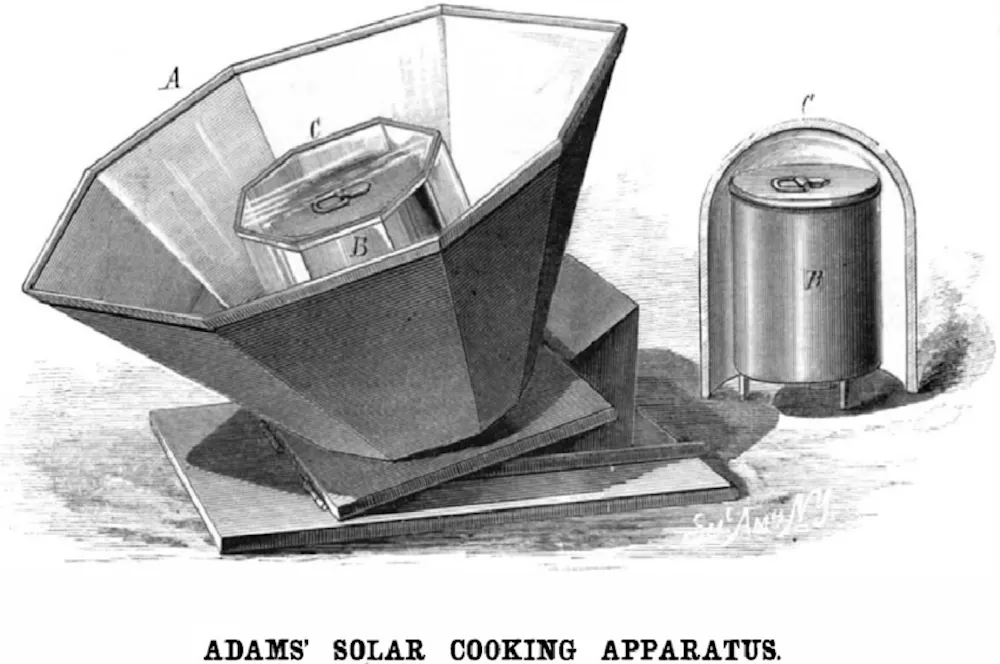
Engraving showing William Adams's design for a portable solar cooking stove.
Adams’s design for a portable solar cooking stove. Illustration from Cooking by Solar Heat by William Adams in Scientific American (1878), CC BY-NC-ND

‘An inexhaustible source of wealth’

In 1877, Adams wrote a letter to the editor of the Times of India arguing that the application of his solar steam engine would “make India the seat of the principal manufacturing industries of the world”.

Later, in his wildly ahead-of-its-time treatise Solar Heat: A Substitute for Fuel in Tropical Countries (1878), Adams argued that countries near the equator “possess, in their clear skies, a gratuitous and inexhaustible source of wealth, equal to that which western nations have to dig, with infinite labour and toil, from the bowels of the Earth”.

Adams sketched out plans to use solar heat for everything from cotton gins (engines to separate cotton fibres from seeds) to Hindu crematoria. He called upon the colonial British government to invest in this promising substitute for coal, which was then being imported to India at great expense.

Adams envisioned solar energy transforming the Raj. Just like the coal-combusting steam engine had replaced the waterwheel in England, he argued that thermal heat could now replace fossil fuels in India. But his colonial bosses were not persuaded.

‘Too subversive’

Adams was part of a 19th-century wave of global research into solar steam engines, as I explore in my postdoctoral project and upcoming book. But in contrast to fellow pioneers including Frenchman Mouchot, Adams built his solar steam engine to stimulate local Indian industry, not to benefit the colonial government.

The locals shared Adams’s belief in this technology. One even wrote to Scientific American magazine to express their desire for the rapid adoption of solar power:

My residence is in a tropical part of India … where fuel is scarce and dear … In this part of the country (about 300 miles north of Bombay), there is a great opening for cheap power in small units.

Bombay’s new governor Sir Richard Temple concluded, however, that solar heat “could not be used for commercial purposes on a large scale”. He argued that local factory owners would not like giving “the workmen a holiday on days when the sky is not clear”.

In truth, Adams’s invention was too subversive for Britain’s colonial officials and capitalists. In less sunny climes, solar energy – tethered to the seasonal rhythms of nature – might negate their commercial ambition for timeless industrial production. But they also saw India as an important market for British coal exports.

A huge solar power plant in western India.
AMPIN Energy’s solar power plant in Bhadla, western India. India is now the world’s third biggest generator of solar power. Sarvajanik Puralekh/Wikimedia Commons, CC BY-SA

While a few mill owners adopted Adams’s auxiliary solar heater for their steam engines, most regarded it as a primitive contraption unfit to satisfy the demands of modern civilisation.

Increasingly frustrated that neither the industrial capitalists nor the colonial government supported his vision, Adams abandoned further experiments. His dream of India switching away from coal to solar power, from combustion to concentration, would not happen for at least another century.

Now, however, India is a world leader in the global energy transition. It heads the International Solar Alliance, and is the third largest solar power generator in the world.

Which begs the question: how much further advanced would this technology be had Adams’s 19th-century solar experiments been embraced by India’s colonial rulers at the time?

The Conversation

Sebastian Egholm Lund receives funding from the Carlsberg Foundation. His upcoming book, Changing the Climate at the Fin de Siècle, is published by Cambridge University Press (September 2026).

❌