
❌

Normal view

Received — 17 June 2026 ⏭ The Conversation

What makes the ideal digital icon? A psychologist explains

wavebreakmedia/Shutterstock

Digital icons are everywhere – and usually, we interpret these visual symbols in the blink of an eye. Who today doesn’t know that a wastebasket means “delete” and a magnifying glass means “search”?

Yet icons’ meanings can be deeply shaped by culture, experience and technological history. So what seems obvious to one person may be confusing to another.

They were originally designed to make computers look friendlier and less intimidating to the few people who had access to them. For example, the icons below first appeared in 1975 in the Pygmalion visual programming system.

Years later, they attained much wider visibility thanks to the Xerox Star 8010, a pioneering office computer that introduced many graphic interface concepts that are still used today.

Alt text
The Xerox 8010 Star’s icons. stardock.com

Research my colleagues and I conducted examines how people perceive, understand and evaluate digital icons – including which visual characteristics make icons easier to learn and use. Pygmalion’s pioneering icons worked because they relied on existing knowledge of the office world.

This meant they reduced cognitive effort by relying on recognition rather than recall. The icons looked like the physical objects they were representing – and critically, objects the computer’s users were already familiar with.

Five secrets of a good icon

The designer Susan Kare, creator of many of the original Macintosh icons, said a good icon should either be instantly recognisable or so easy to remember that a user only needs to learn it once.

To Kare, designing icons was about solving “the little puzzle of making an image fit a metaphor”. More than 40 years later, that challenge remains.

Research, including work by my colleagues and me, suggests the most successful icons tend to share key characteristics that guide us from seeing to understanding almost instantaneously. Here are five of them.

1. They depict things we already know

Early computer icons worked because they borrowed from the office world that people already knew: folders, bins, documents, calculators, floppy disks. Psychologists refer to those as “concrete” icons because people to use their knowledge of the everyday world to interpret them.

However, only a limited number of functions can be represented as identifiable objects, and getting a close fit between pictures and functions is not always easy. The more complex the meaning becomes, the harder it is to design concrete icons.

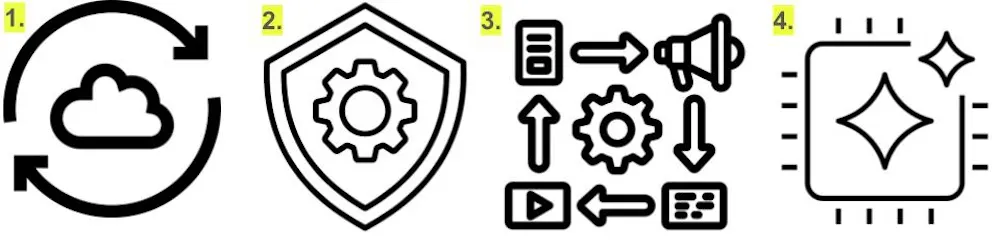
To test this, can you guess the meaning of these four icons? (Answers at the end of the article.)
Alt text
Icon credits: Freepik/Flaticon; Kartini 1/The Noun Project; Elzicon/Flaticon; IconPai/The Noun Project.

2. They mean what we think they mean

Psychologists talk about “semantic distance” – how closely an image matches its intended meaning. An abstract symbol for “privacy settings” or “cloud syncing” has a much larger semantic distance than using a bin to mean “delete”.

As digital functions become more complex, designing icons that communicate their meaning quickly becomes increasingly difficult.

3. They feel familiar

Another important feature of successful icons is consistency of use over time – which leads to familiarity. The icons shown below are widely used even though the objects depicted are no longer so widely in use. This highlights the point that icons are partly informative signs and partly shared learned conventions, whose success is based on collective familiarity.

Take the floppy disk “save” icon (below left). Younger users recognise the meaning without ever having seen the physical object that the icon originally represented. The same is true of traditional telephone handsets and perhaps even envelopes (now widely used to denote “email”). While the objects have been superseded, the icons remain.

Alt text
Icon credits: Yogi Aprelliyanto/Flaticon

4. They look good

A well-designed object can have a positive effect on our behaviour – and the digital world is no different. Well-designed icons are more likely to attract downloads, help us perform tasks more efficiently, and learn better and faster. They even make digital environments feel more pleasant to use.

Think of the difference between an app icon that feels cluttered and amateurish and one that looks clean, balanced and professional. Even before we know what the app does, the icon’s design can influence expectations of how well the app will work.

5. They are tested with real users

Although icons and symbols are on the rise as a global visual language, it’s important not simply to assume that icons work globally – and to understand what makes a good digital icon across languages, cultures, ages and digital experiences.

This is why the International Standards Organisation (ISO 9186) demands comprehensibility testing – because symbols should be understood without explanatory text whenever possible.

A bridge between perception and meaning

As we spend more of our lives in digitally mediated environments, icons do two jobs simultaneously. They help us interact with technology more efficiently, and shape how we feel about the experience.

A digital icon is not simply a small picture. It is a bridge between perception and meaning. The best icons make interfaces feel less intimidating, more intuitive and more approachable – creating a global visual language that crosses barriers of language and culture.

In other words, good icons do more than help us find our way around a digital world. They help make that world feel understandable, welcoming and human.

Icon quiz answers: 1. cloud syncing; 2. privacy settings; 3. algorithmic recommendations; 4. generative AI.

The Conversation

Irene Reppa does not work for, consult, own shares in or receive funding from any company or organisation that would benefit from this article, and has disclosed no relevant affiliations beyond their academic appointment.

Received — 3 June 2026 ⏭ The Conversation

Great apes: what we know about their cognition, cooperation and curiosity after two decades of research

A chimpanzee sits in the Pongoland enclosure at Leipzig Zoo, where a huge amount of research has been conducted since 2004. Marco Warm/Shutterstock

Leipzig Zoo in central Germany is a world-leading centre of great ape research. Recent studies have seen chimpanzees there using touchscreen controls to navigate virtual forests and locate food rewards – applying similar techniques to what they would use in the wild.

Other research (of which I was part) has investigated chimpanzees’ social curiosity. We discovered they actively seek out information about others’ interactions, even if it means forgoing food rewards. Keeping track of their peers’ latest social developments appears central to these great apes’ social wellbeing.

But in my decade working with Leipzig Zoo’s chimpanzees and bonobos, one question came up repeatedly. Were differences in how each great ape would cooperate and resolve conflicts simply down to its mood on a particular day? Or were there longer-term explanations – deep-rooted personality traits, for example, or their relationship history with other apes?

Long-term questions like this are very difficult to tackle in single studies, which often draw on just a handful of participants. So, my colleagues and I have developed EVApeCognition: a standardised database of 18 years’ worth of great ape experiences, decisions and relationships.

This lays the groundwork for answering many more questions about these extraordinary creatures’ cognition, intelligence and social behaviour. If a bonobo showed striking generosity towards a partner in 2008, for example, we can piece together whether that behaviour was linked with their stable disposition, a particular relationship, or some other factor.

Changing how we study great apes

In all, EVApeCognition comprises 262 experimental datasets from 150 scientific publications between 2004 and 2021. These were all overseen by the Wolfgang Köhler Primate Research Centre, headquartered at Leipzig Zoo. Eighty-one great apes participated in these studies, with the vast majority (78) taking part in more than one.

These wide-ranging social cognition studies have assessed how great apes think about other apes, how they cooperate, and to what extent they are motivated to help their peers. But there have been limitations to this research.

A group of chimpanzees in Leipzig Zoo.
Larger-group studies of chimpanzees and other great apes may prove more relevant to their behaviour in the wild. The Otters/Wikimedia Commons, CC BY-NC-SA

In the wild, great apes are social animals who live in stable groups with histories, hierarchies and relationships that change over time. In contrast, a large majority of the studies in our database were with apes in pairs that imposed strict control conditions.

So, moving to larger-group studies could offer a more ecologically relevant window on their cognition and social behaviour. Group settings can present apes with different problems that map more closely on to the social challenges they face every day in the wild.

Our most recent study, led by Kirsten Sutherland at the Max Planck Institute for Evolutionary Anthropology, found that great ape quartets maintained access to a pool of yoghurt for significantly longer than pairs did. Social tolerance played a key role, with more tolerant quartets maintaining access to the yoghurt for longer periods.

We found that cooperation was strongest when the highest-ranking individual showed restraint, emphasising the importance of tolerant leadership.

The new database also highlights an imbalance running through captive great ape research: chimpanzees dominate the record, while bonobos, gorillas and orangutans remain comparatively underrepresented.

Bonobos – which, unlike chimpanzees, are known to cooperate in the wild outside the limits of their group’s territory – would be particularly compelling subjects for this research shift towards studying larger groups.

Closing the gap with wild settings

Experimental performance does not occur in a social vacuum. A great ape’s willingness to cooperate on a task on a given Tuesday may not only reflect its intelligence, but whether it groomed its partner that morning, or if its status had changed within the group.

Providing this context is essential to understanding how everyday experience and social relations shape their cognitive development. Fortunately, the field is moving in promising directions, with the EVApeCognition database one piece of a larger picture.

The global ManyPrimates project, established in 2017, has already produced the most comprehensive overview of primate short-term memory. This shows that genetic lineage has played a larger role than ecology or sociality in the evolution of their short-term memory.

At the level of higher-order reasoning, we now know that chimpanzees update their beliefs by considering all sources of information before making a choice. A 2025 study showed they remained committed to an initial belief when counter-evidence was weaker, but revised this when the supporting evidence became stronger – a pattern long thought to be distinctly human.

Perhaps most ambitiously, the divide between captive and wild settings is also beginning to close. Research led by Sofie Forss at the University of Zurich, for example, has found a systematic “captivity effect” when presenting the same new stimuli to both wild and captive orangutans. The wild individuals responded far more cautiously to novelty than their zoo-housed counterparts.

Taken together, these efforts point in a common direction: toward an understanding of great ape cognition that is at once broader in scope, richer in context, and more faithful to the complexity of their social lives.

The Conversation

Alejandro Sánchez-Amaro does not work for, consult, own shares in or receive funding from any company or organisation that would benefit from this article, and has disclosed no relevant affiliations beyond their academic appointment.

❌