
❌

Normal view

Your brain runs on 20 watts. Could brain-inspired computing do the same?

Blue Andy/Shutterstock

Right now, your brain is recognising the shapes of these letters, analysing their meaning, and holding a stream of thought together – all on about 20 watts of power. That’s roughly what it takes to run a lightbulb.

Yet reproducing even a small fraction of the brain’s capabilities using today’s AI systems can require vast computing infrastructure and energy.

Neuromorphic computing – also known as “brain-inspired computing” – is an attempt to close that gap. Not by making today’s computers slightly more efficient, but by fundamentally rethinking how they should work.

The human brain holds roughly 86 billion neurons, wired to each other through junctions called synapses. A neuron receives signals from its neighbours; when their combined effect crosses a threshold, it will fire a brief electrical pulse known as a spike.

Two things make this process efficient. First, energy is spent only where it’s needed, not everywhere constantly. Second, memory and processing are intertwined in the strength of each synapse’s response. The brain doesn’t have to pause and go find information, saving both time and energy.

In contrast, in an ordinary computer chip, the processor and memory are physically separate, so every calculation entails transferring data between them. This can account for a substantial share of energy use – known as the Von Neumann bottleneck, a term first used by US computer scientist John Backus in 1978 to describe this computing inefficiency.

Introduction to neuromorphic computing. Video: UCL Electronic and Electrical Engineering.

Neuromorphic computing tackles this inefficiency in several ways: bringing memory and processing closer together, using “sparse representations” (data models where most values are zero), and performing computation only when events occur.

This is known as event-driven computing – and we are already seeing some exciting applications.

Sensors modelled on human retina

Event cameras are sensors modelled on the human retina. Their pixels respond individually and only when they detect a change in the scene – rather than capturing a full frame dozens of times a second, like a smartphone or video camera.

The result is a neuromorphic sensor that uses a fraction of the power, handles fast motion without blur, and works equally well in bright sunlight and near-total darkness.

In autonomous vehicles, this combination of low latency and reliable performance in glare or darkness could be the difference between detecting a pedestrian in time, or not. And in space, where power is scarce and lighting extremes are common, event cameras have already been deployed for object and debris tracking.

An event-based vision sensor explained. Video: Sony.

It might be tempting to ask if neuromorphic hardware could do for computing what Nvidia’s graphics processing units (GPUs) have done for AI. But these are fundamentally different kinds of chip.

Nvidia’s GPUs are exceptionally good at the dense, repetitive maths behind deep learning, which has made them the default choice for almost any AI task. In contrast, neuromorphic computing’s event-driven approach looks likely to spawn a wide range of specialised chips, rather than a single winner-takes-all design that everyone adopts at once.

Australia’s BrainChip already sells a commercial neuromorphic processor for powering cameras and sensors that need to run at very low power. Expect neuromorphic hardware to sit alongside conventional processors and GPUs rather than replacing them, taking on the jobs where its efficiency edge is decisive.

Sensitive information

But there is another advantage to neuromorphic computer technology beyond energy saving.

Because neuromorphic chips can process data right where it’s generated, sensitive information from wearables, smart cameras, and medical sensors can stay on the device instead of travelling to the cloud, potentially reducing privacy and cybersecurity risks associated with data transmission.

Devices can also work offline, without needing to send data to a distant server and wait for a reply. Cutting out that round trip matters wherever split-second decisions are required, such as in autonomous vehicles, drones, and robots operating beyond reliable signal.

This won’t make data centres redundant. But fewer tasks may need one in future, and those that remain could become dramatically more efficient. IBM has already demonstrated energy savings of up to 10,000-fold on event-driven tasks, compared with conventional digital architectures, with its TrueNorth chip.

Interview with Tony Kenyon, director of the Neuroware Innovation and Knowledge Centre. Video: Curious with Ezra Chapman.

Rethinking how computing works

Computing has been through a transition like this before. The first computers filled entire rooms and drew as much power as a small factory. Today, however, a chip smaller than a fingernail in the phone in your pocket is far more capable.

Neuromorphic computing raises the possibility of a similar shift – driven less by cramming in more transistors (the tiny switches that make up a chip’s circuitry) than by rethinking how computing should work in the first place.

But turning this promise into everyday infrastructure will take sustained effort. At NeuroWare, the UK’s leading multi-university innovation hub for neuromorphic computing, I have led the development of a UK roadmap for this technology up to 2050, working with colleagues across academia, industry and government.

With the global market for neuromorphic technology forecast to nearly quadruple to US$20 billion (£14.8 billion) by 2030, the UK needs open-access facilities to prototype new chips, coordinated investment, common standards – and a workforce trained to bridge neuroscience, electronics and computer science.

The foundations are already here. What’s missing is the infrastructure to take neuromorphic computing from supercomputers such as the University of Manchester’s brain simulator, SpiNNaker, to the billions of ordinary devices that could one day use brain-inspired hardware for themselves.

Your brain solved this problem millions of years ago. It’s taken science a long time to appreciate just how well it works.

The Conversation

Aysha Asif Riaz works for NeuroWare Innovation Knowledge Centre as a Research Fellow. NeuroWare is funded by the Engineering and Physical Sciences Research Council under grant UKRI2784.

Received — 9 August 2026 ⏭ The Conversation

Adding an AI tool to Google Earth shook our trust in maps that has been centuries in the making

An 1818 map of western Africa shows the continent bisected by the mythical 'Mountains of Kong', based on the explorations of Mungo Park. Image: John Pinkerton's A Modern Atlas via Wikimedia Commons

Throughout the 18th and 19th centuries, Europe’s cartographers traded on their reputation for accuracy and detail at a time of huge societal change. But as demand grew for increasingly detailed maps of the world to support industrialisation at home and colonisation overseas, they didn’t always get it right.

For over a century, the Mountains of Kong festooned maps of Africa after the Scottish surgeon and explorer Mungo Park returned from an expedition in the 1790s and described them to his cartographer, James Rennell, as a possible source for the Niger river.

Rennell, who is buried in Westminster Abbey, dutifully produced two maps featuring this supposed mountain chain, extending it well beyond Park’s journey into areas he could never have seen. His maps were widely copied, and doubts only grew about the mountain range’s existence towards the end of the 19th century.

In 1887-88, a French military officer, Louis-Gustave Binger, undertook an expedition to the area and proved it didn’t exist. Yet, in my work as a professor of cartography, I was amazed to stumble upon a reference to “Kong Mountains, French W. Africa” in the index of the 1936 edition of The Oxford Advanced Atlas – almost 50 years after Binger’s expedition.

This underlines the lasting impact that maps have on how we see and understand the world. Mapmakers even enabled important early case law for the copyright protections that are being tested by AI today.

In 1785, London map publisher Robert Sayer sued his local rival John Hamilton Moore for copying his nautical charts – but the court ruled in favour of Moore. It found that earlier charts could be consulted and improved, provided the new work was not simply a “servile imitation” but an improvement on what came before.

This ruling has been cited as a defence of AI, which consumes huge quantities of copyrighted material, but which reconstitutes it in ways that don’t appear as direct imitations.

A breakdown of trust

There has always been a huge amount of trust placed in the technology used to make our maps, from the ancient Greek dioptra (a surveying instrument) to modern satellites. But that trust was brought into question recently when Google added generative AI to its Google Earth satellite image platform, making it possible to create convincing but fictional satellite images.

Rather than take Google’s suggestions to render historic buildings or a “lakeside dream home”, some users were quick to make and share worrying images including bombed suburbs, collapsed landmarks and burning oil refineries.

The outcry was vociferous – including from fact checkers such as BBC Verify. Within 24 hours, Google rolled back the tool, Nano Banana 2, and promised “stronger guardrails” in the future.

Google Earth's now-withdrawn AI tool, Nano Banana 2
Google Earth meets generative AI, briefly. Google

The controversy is, in part, a tribute to the deep level of confidence Google Earth has earned from its user base – among them, fact checkers, journalists and the open-source intelligence community who depend on Google’s satellite mapping tool to verify life-threatening events in near-real time, from floods to famines.

Satellite imagery is now a key part of the visual vocabulary of our 24-hour news cycle. Countless times each day, we consult a map on our phones or scroll past satellite imagery in a news feed. These images have become so commonplace because they can track wildfires, reveal the destruction of Gaza, or document US military action in Iran. They offer a god’s eye view of Earth.

‘A mirror of the real world’

Journalists must act fast to verify and publish, which is why embedding generative AI within Google Earth was such a problem. Google stressed there would be an automatic AI watermark with every image generated – but this could be cropped out before sharing.

The process was also subtly different from requesting an entire image be created from scratch. In my test for this article, prompting ChatGPT to “generate a photorealistic satellite image of central London following a severe flood” appeared to return a plausible image.

Looking more closely, however, I could see that some buildings were misshapen and major roads were wonky. Verification against Google Earth (what else?) easily flagged these issues, so the image could safely be ignored and labelled a fake.

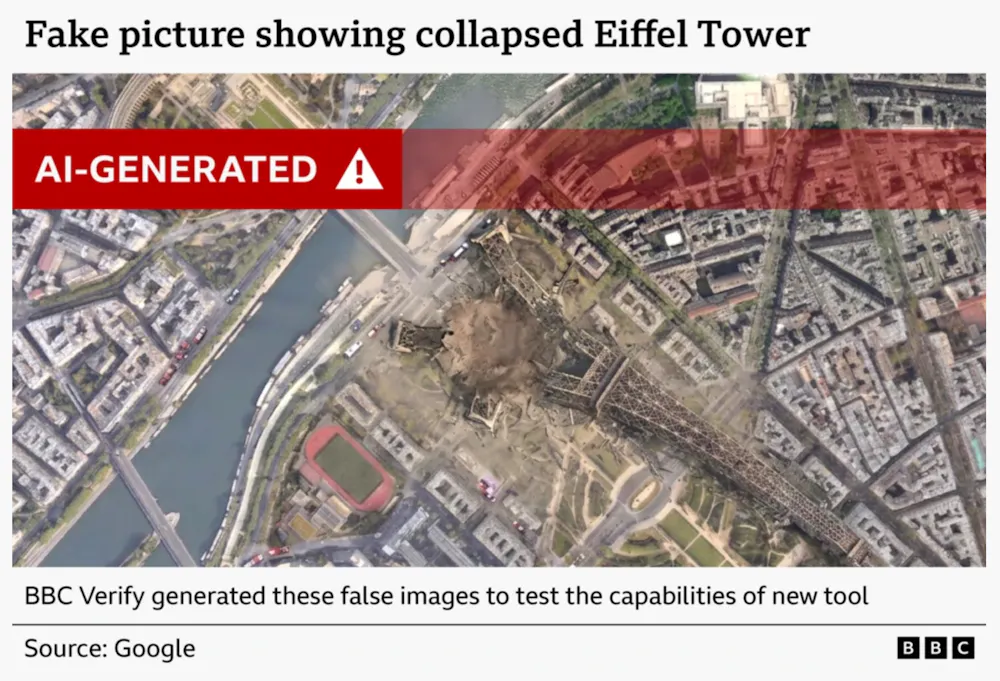
By uniting Google Earth with Nano Banana 2, genuine satellite images were being edited. If you wanted to collapse the Eiffel Tower, the points of reference around the disaster would still have aligned with the accredited source imagery. No oddities and errors would be found across the full image, thus providing much less for the fact checkers to go on when validating their sources.

BBC Verify's AI-generated image of the collapsed Eiffel Tower using Google Earth's Nano Banana 2 system.
BBC Verify/Google Earth

This validation process was used by the independent investigative journalism organisation Bellingcat to show that the Russian government had faked satellite imagery which suggested Malaysia Airlines MH17 had, in fact, been shot down by a Ukrainian fighter jet in July 2014. The headline of the Bellingcat article explaining its approach asked: “Who to trust, Google or the Russian MoD?”

Until the recent Google Earth AI furore, the answer to that question was in little doubt. As Google’s former geospatial technologist wrote: “We used to describe Google Earth and Maps as a mirror of the real world … That absolute bedrock of trust was structurally shattered this week.”

Our trust in maps has been built up over centuries. Trust in Google Earth has taken just two decades (it was originally launched as EarthViewer3D on June 11 2001 by a US tech startup that Google bought three years later). After countless pioneering refinements since the tool’s relaunch on June 28 2005, Google risked flooding the internet with more AI slop and fake images that run counter to what makes Google Earth, and maps in general, so valuable.

But Google’s rapid climbdown offers a welcome reminder about the values that have been at the heart of mapmaking throughout history. In the clamour to insert AI technology in every aspect of our lives, even the most evangelical tech companies still value trust above everything else.

The Conversation

James Cheshire receives funding from UKRI.

Received — 2 August 2026 ⏭ The Conversation

Where have all the wasps gone this summer?

Dabuch/Shutterstock

Summer can be lovely – until a wasp turns up. Whether they present as an irritating picnic visitor or an uninvited loft guest, common social wasps are as much a part of our summer as festivals, sun cream and the growing despair of how to entertain children who’ve forgotten how to be bored.

But summer 2026 is breaking the norm, and there don’t seem to be many wasps about. As a wasp biologist, I’ve noticed it acutely, because my students need wasps for their experiments, and we simply can’t find them.

A second sign that something is wrong is the absence of wasp stories in the media. Wasps tend to be more active in warmer weather. Their colonies grow faster and bigger, and they end up making news headlines by bothering humans. This time last year – also a warm spring and hot summer – the media airwaves were filled with “plagues of wasps” stories. Now, even professional pest-controllers tell me it’s a quiet year with very few requests to remove wasp nests.

Admittedly, these are anecdotes not data: the Big Wasp Survey – the only national wasp monitoring survey – is yet to start sampling this summer. But the signs are not good.

If data back this up, their absence worries me greatly because – love them or hate them – wasps are important in ecosystems as pest-controllers, pollinators and decomposers.

So what’s happening?

Spring started well for wasps. In the warm, dry spring a glut of glorious foundresses – new queens – emerged from hibernation to start their nests alone, carrying out all the nest building, egg laying, foraging and brood rearing. This nest-founding period is a risky time. If a new queen survives until her first brood emerges as adult workers, though, then the odds are in her favour as she no longer needs to undertake risky foraging.

But spring 2026 was strange: the warm, dry start should have been good. Warm, dry spring weather improves a nest’s chance of survival as it ensures a good nectar supply for the queen to develop her ovaries and good prey populations for her to feed the brood. But we experienced unprecedented heat for the time of year, punctuated by cold, damp days and followed by unexpectedly chilly nights.

Such weather extremes may have caused queens to abandon their nests or die, reducing the initial spring queen bounty to a more modest population.

Temperature tolerance

And then came the heatwave. And another. And another. Some insects may benefit from this. Wildlife charity Butterfly Conservation is hoping 2026 could be a “bumper summer of butterflies” because warm, dry days mean uninterrupted foraging, mating and egg-laying.

But all insects have a thermal tolerance called critical thermal maximum (CTmax). If their CTmax is exceeded, insects succumb to desiccation, muscle spasms and eventual stupor.

For honeybees, this is around 49°C – which might sound high, yet ground surfaces exceeded 50°C in the UK heatwaves this summer. But the temperature doesn’t need to reach an animal’s CTmax to affect their productivity and behaviour. For example, bumblebee cognition and foraging efficiency are impaired by heatwaves of 32°C.

Bumblebee Conservation Trust raised concerns that 2026 may exacerbate a declining trend in bumblebee populations as flowers wither and bees fail to forage effectively.

Wasps are thought to be quite resilient to extreme weather. They are one of the most successful invasive species around the globe. And as a social insect, their thermoregulation behaviour (such as wing fanning to cool the larvae) and nest architecture (which has insulating envelopes surrounding the brood combs) may help buffer any environmental perturbations.

Insects also have waxy molecules called cuticular hydrocarbons that coat their exoskeletons protecting them from desiccation. Social wasp cuticular hydrocarbons change structure in response to heat, better protecting them from desiccation in excessive heat.

Their varied diets should also buffer them from imbalances in prey populations. However, their CTmax may be lower than other social insects – at around 45°C – which may have made them especially vulnerable to the high ground temperatures of the 2026 heatwaves.

Why are the wasps so small?

There’s something else that I’ve noticed: the few wasps I’ve seen are rather small. The adult size of many insects is fixed during their development, depending on the quality and quantity of food they receive as larvae. Wasps don’t get bigger once they’ve pupated.

The first workers to emerge in spring are usually small because the queen is limited in how much food she can provide for them alone. But by early August, the foraging capacity of the colony has increased exponentially, brood are better fed and the emerging workers are substantially larger.

So why are we still seeing “spring-sized” wasps? It’s possible that limited diversity and abundance of prey may mean their nutrition is restricted. The problem may also be more directly linked to heat. Insect larvae reared at higher temperatures will develop faster and reach pupation at a smaller size.

Global warming is thought to explain the trend in social wasps shrinking in size over the last 100 years. We could be seeing this in real-time this year.

How can you help wasps?

Share your alfresco meal with a wasp. When it approaches, don’t flap it away. Watch to see what it wants. In the absence of wild prey, it might be desperate for some protein (your picnic ham) to feed her brood. In the absence of flowers for nectar, it might be in need of something sugary (some jam) for her own nutrition.

My research team would also like you to share your wasp observations with us, so that we can better understand these important insects. Snap a photo of her eating and submit your data to the Wasp Picnic Survey 2026: Ham or Jam?. Keep the observations coming all summer. The wasps (and wasp scientists) will thank you.

The Conversation

Seirian Sumner receives funding from the UK government's Natural Environment Research Council (NERC) and the Biotechnology and Biological Sciences Research Council (BBSRC). She is a Trustee and Fellow of the Royal Entomological Society, and author of the book 'Endless Forms: Why We Should Love Wasps'

Received — 25 July 2026 ⏭ The Conversation

Storms that built a graveyard: ancient monsoons created a spectacular dinosaur fossil site

Around 80 million years ago, a stretch of tropical coastline in what is now north-eastern Italy was lashed by monsoon rains and tropical cyclones. Those storms swept dinosaur carcasses, crocodiles, plants and river mud onto a tidal flat, where the tides and a film of microbes sealed everything away with extraordinary preservation.

My colleagues and I have published a new study that reconstructs the violent tropical climate behind the Villaggio del Pescatore Lagerstätte near Trieste and reveals it preserves just four decades of life, recorded almost day by day.

The Villaggio del Pescatore site near Trieste is one of the most important Late Cretaceous fossil localities in the Mediterranean. It is the only known site in the region to preserve large land animals, including dinosaurs such as Tethyshadros insularis, from the final 15 million years or so of the age of dinosaurs.

Tethyshadros insularis was a plant-eating, duck-billed dinosaur that lived in what is now north-eastern Italy around 80 million years ago. It was initially interpreted as a dwarf island species, shaped by the “island rule” – that large animals evolve smaller bodies in environments with limited space and resources.

However, the discovery of larger specimens challenged this idea. Up to 11 individuals are potentially preserved in this succession of rocks, with at least three other fairly complete skeletons still waiting to be extracted from the hard (and expensive to cut) limestone rock. Geological evidence has also revealed that the site was about 10 million years older than previously thought and was not part of a tiny, isolated island. Instead, it lay near a larger landmass connected through the ancient Mediterranean region.

Photo of a dinosaur skeleton encased in rock
Reconstruction of a Tethyshadros insularis skeleton, nicknamed Antonio, near his finding site. Tiziana Brazzatti, CC BY-ND

The fossils of tiny crocodilians named Acynodon (with shorter muzzles than modern crocodilians) have also been found at this site.

After years of research, Professor Federico Fanti of the University of Bologna and I led a multidisciplinary team of palaeontologists, physicists and geologists to determine exactly how this fossil treasure trove formed. Our findings overturn decades of competing interpretations.

In a study published in Global and Planetary Change, we show that the site was not a quiet, isolated lake or sinkhole, as previously suggested. Our results suggest it was a storm-battered tidal flatland at the edge of a tropical sea.

Villaggio del Pescatore is not simply a place where fossils happen to be beautifully preserved. It is also a record of the weather that shaped the site. We can identify individual storms and floods in the rocks, almost day by day. Very few fossil sites on Earth allow us to do that.

Reading the rock like a calendar

The fossils at Villaggio del Pescatore are concentrated in a finely layered carbonate rock, marked by thousands of paper-thin light and dark bands. For years these were interpreted as annual layers (like tree rings) laid down season by season.

Our new analysis tells a different story. Using high-resolution X-ray scans at the Elettra Synchrotron in Trieste, alongside detailed geochemical and microscopic analyses, we showed that the bands were not annual but daily. A synchrotron accelerates electrons (particles with a negative charge) to almost the speed of light. This produces powerful X-rays that can penetrate dense materials such as rock. This allowed us to examine structures inside the rocks and bones at a resolution of fractions of a millimetre.

The scans revealed that the layers were deposited by ocean tides, two pairs each day. These tides varied according to the familiar fortnightly cycle of stronger and weaker tides that still happen today. We could count these tidal layers, thanks to this unparalleled resolution.

The entire fossil-bearing rock pile, our results calculate, accumulated in only about 40 years, a single human lifetime, frozen in stone. Most fossil deposits containing several individuals average together thousands or millions of years. Here, we’re looking at a few decades.

Monsoons, cyclones and microbes

To explain why storms were so central to the preservation of the fossils, the team ran climate simulations. The models consistently placed the site at around 29° north, inside a powerful, summer-dominated monsoon belt. This was a tropical regime of intensely wet summers and recurring tropical cyclones, sustained by the greenhouse climate of the age.

Monsoon-driven floods and cyclone surges created pulses of sediment, nutrients, plant debris and animal carcasses onto the tidal flat. The tides trapped this material, and mats of microbes rapidly stabilised it. This encouraged the sediment to harden right after the carcass was deposited, before it started rotting or predators could scavenge its dead tissues. These storms were the main agents behind this preservation.

The site’s three most important Tethyshadros insularis dinosaurs show a range of fates: one buried so quickly that soft-tissue outlines survive, another bearing the cracked, sun-dried bones of a carcass that lay exposed inland before being washed in by a flood. Crocodilians such as Acynodon adriaticus, fish and shrimps were also local residents, entombed close to where they lived and died.

We propose that this combination of “ingredients”, monsoon floods, tidal trapping and microbial sealing, represents a recipe for creating exceptionally preserved fossil sites in hot, tropical greenhouse climates – precisely the kind of setting in which rapid decay would normally destroy organic remains.

The study also offers an ancient perspective on how intensifying monsoons and cyclones can reshape coastlines, ecosystems and what becomes preserved along tropical shores.

Villaggio del Pescatore has been studied for more than four decades, yet it still has new stories to tell. Understanding how extreme storms transformed this ancient coastline may also help us think about how modern coasts could respond to a warmer and more turbulent climate fuelled by high levels of CO₂.

The Conversation

Alfio Alessandro Chiarenza works for University College London, Department of Earth Sciences. He receives funding from The Royal Society as a Newton International Research Fellow.

What the sudden demise of the UK’s department of science means for the future of research

The obituaries were being written before the body was cold. Within hours of Prime Minister Andy Burnham confirming that Whitehall’s responsibilities for science and technology would be absorbed into a new Department for Business, Innovation, Science and Trade (DBIST), Sir Paul Nurse, president of the Royal Society, was on Radio 4 warning that “science isn’t a slave to business”. The trade association TechUK declared it “the wrong change at the wrong time”.

You might imagine that something ancient, ineffable and essential to British science had been ripped away. In fact, the Department for Science, Innovation and Technology (DSIT) was only born in February 2023 – a surprise late tweak to the machinery of government under Rishi Sunak’s faltering premiership.

Science has never enjoyed a settled home in Whitehall. For most of the period from 1995 to 2023, it sat precisely where Burnham has put it now: inside a business super-department. Notably, the single most important protection UK science secured in that era – a ring-fenced budget through the George Osborne austerity years – was won from inside the Business, Innovation and Science department, under then-business secretary Vince Cable.

The historian David Edgerton has long argued that Britain’s fondness for tinkering with the machinery of government is a form of displacement activity. What actually shapes the fortunes of research is money, people and demand for what they produce, not the nameplates on London’s Victoria Street.

On that test, the outlook for science is far calmer than some reactions to this latest move would suggest. Under plans published last October, the UK’s total research and development budget is locked in at £58.5 billion over the four-year spending review to 2030 – a real-terms increase.

Machinery changes move budget lines across departments; they don’t unravel them. As yet, nothing we’ve heard from the Burnham government suggests the settlement for UK Research and Innovation (UKRI) is at risk.

A US wrecking ball

If we want to be reminded what real damage to a science system looks like, we only need to glance across the Atlantic. While London rearranges the departmental furniture and dishes out new email addresses, Washington is taking a wrecking ball to the foundations of its public science system.

A 2027 budget request will halve the size of the US National Science Foundation, if passed. A draft White House rule, due to take effect in October, will hand political appointees the power to vet federal research grants against “the president’s priorities” and terminate awards mid-stream.

A predictable exodus has begun. The Nobel laureate Omar Yaghi has just left the University of California, Berkeley for Tsinghua University in China.

Top researchers consider leaving US amid funding cuts. Report: PBS NewsHour.

Set against political commissars patrolling the borders of knowledge, the UK’s science soap opera feels deeply provincial – a debate about which secretary of state sponsors oversight of a gradually swelling budget.

And the institutional layer beneath this is in better shape than doomsayers allow. UKRI’s new strategy has set a clear five-year path: priority programmes in AI, quantum and clean energy, faster funding decisions, and a welcome seriousness about experimentation with the modes and means by which we manage public investment in research.

Not everyone is happy with UKRI’s approach to prioritisation. But a funder with a published strategy, agreed budget and hard targets is a more durable asset than a three-year-old ministry. The research councils have outlasted every department that ruled over them, and UKRI will outlast this too.

Nor should the science community be spooked by closer proximity to business. When I leave my office at UCL and stroll down the Euston Road through London’s Knowledge Quarter – dubbed “the new square mile” – I pass by the Wellcome Trust, the Crick and Turing institutes, the British Library, Anthropic and Google DeepMind. Day in, day out, this dense weave of labs, firms and cultural institutions delivers what the triple helix of government, industry and academia is all about.

And we can find versions of the same story unfolding in Manchester, Sheffield, Cambridge and Glasgow. Rather than science being subordinate or “enslaved”, the UK’s world-leading universities have spent the past decade aligning themselves with agendas for regional growth and frontier technologies.

But there’s a harder truth lurking here too. Public money accounts for less than a third of UK research and development investment. The rest is financed and largely performed by the private sector.

UK science’s chronic weakness has never been the quality of publicly funded research. It is the R&D intensity of UK firms, and their ability to convert discoveries into products, services and revenue streams generated and owned in the UK.

If yoking science to industrial strategy in a single department reminds Whitehall to treat these as a single problem, some good may come of Burnham’s reorganisation.

AI policy concerns

With DSIT’s disappearance, a particular source of concern has been the future of AI policy. This at a time when the radical possibilities and risks of AI frontier models, fluctuating US export controls, and the latest “Sputnik moment” jolt from China’s Kimi K-3 demand sustained and technically fluent policy attention.

We are also seeing a sharp acceleration in the ways AI is transforming science itself – whether by cracking mathematical problems that stumped humans for the past 87 years, or collapsing decades-old models of grant writing and peer review.

Splitting AI from science just as they converge in practice would have been the least defensible element of this reorganisation. So it is reassuring that cross-government oversight of AI, including the AI Security Institute and AI public sector adoption, is moving to a new “AI taskforce” in the Cabinet Office – alongside the promotion of Kanishka Narayan to the status of AI minister attending Cabinet. Much now rests on his shoulders.

Government departments come and go. Those of us who have long advocated for research policies built on evidence rather than gut can allow ourselves a wry smile at the fuss created by this latest reorganisation – and then get back to work.

DSIT is dead, but UK science will be fine. Keep your eyes on the AI prize – and be thankful we are arguing about organograms, not survival.

The Conversation

James Wilsdon receives funding from UKRI and the Wellcome Trust, and a wider consortium of international research funders who partner in the Research on Research Institute (RoRI).

Received — 16 July 2026 ⏭ The Conversation

Why some primates have even tougher births than humans

Having a baby is no joke for tamarins. Martin Leber/Shutterstock

Scientists have long thought humans have a uniquely difficult birth compared to other primates.

And it’s true that from an evolutionary perspective, we face an obstetrical dilemma. As we evolved to walk on two feet, our pelvis changed shape and size and our birth canal became smaller and oddly twisted. Meanwhile, the evolution of our enormous brain meant that a large-headed baby needed to fit through it.

But our new study found that some primates have to give birth to babies that are squashed even more tightly in the birth canal.

Primate births usually happen at night which makes them difficult to study, especially in the wild. Because of this, we do not know much about them. Rare observations suggest a more solitary, shorter and less noisy labour compared to humans.

To get around this lack of direct observations, in 1949, the Swiss anthropologist Adolph H. Schultz looked for clues in anatomy instead. He measured the size of the pelvic birth canal and of the neonatal head in humans and seven other primates. He wanted to find out how tightly the baby’s head fitted through the birth canal. His results suggested that humans were unique in having a rounder birth canal, one in which the baby’s head only just fitted through. Other great apes seemed to have an oval canal with plenty of space for the baby’s head. Schultz’s influential study shaped how we think about human birth as unusual and harder than other primates.

However, the way he measured the birth canal was based on human anatomy. And the human standard measure Schultz used did not actually reflect how much space there was. He used the distance between the top of the sacrum (a large triangular bone at the base of the spine) and the top of the pubis bone to represent the diameter of the canal (a standard obstetric measurement in humans). Since the sacrum sits higher in the pelvis in other primates, only its lower part forms part of their birth canal. This is why their birth canals appeared so elongated in his diagram.

Our study instead used 3D scans of the pelvis and measurements of the newborn head from 29 primate species, including humans, to revisit Schultz’s study using more appropriate measurements. We found that, in reality, many primates experience a much tighter fit than humans do.

Some of the most striking examples were squirrel monkeys and tamarins, small primates from Central and South America that live high in the tree canopy. Their babies are born with heads that are about double the size of the maternal pelvic canal.

Small monkey with black snout carry a baby on their back
Squirrel monkeys have a tight fit at birth. dangdumrong/Shutterstock

Birth for squirrel monkeys and tamarins might seem impossible with such a head-to-pelvis disproportion, but a 1995 study provides an explanation. After many sleepless nights spent observing squirrel monkeys giving birth in a primate centre, doctoral researcher Melissa Stoller managed to take X-ray images of the labour, revealing that the monkey’s pelvic bones temporarily dislocate, creating extra space for the baby to pass through. We think a similar strategy may help bushbabies, whose newborns also have unusually large heads relative to the mother’s birth canal. As we showed in a 2025 study, the pelvis of female bushbabies (but not males) is open at the front, where their pubic bones do not meet and elastic connective tissue between them can stretch and expand during labour.

Another adaptation concerns the way the baby moves through the birth canal. In these species, babies usually enter the canal face-first rather than with the top of the head (the orientation assumed by Schultz in his diagrams). This reduces the amount of space needed during birth. Stoller’s X-ray study showed this in squirrel monkeys and baboons, and it may be common in other monkey species too.

Neither of these adaptations could be easily adopted by humans. Because we walk upright, our pelvis must provide stable support to our body and cannot easily stretch during labour. In fact, when the pelvic ring dilates too much during birth, this can lead to severe pelvic pain, and difficulty in walking after the birth. Instead, our babies have evolved a highly plastic head that can mould to the shape of the maternal birth canal as it passes through it.

The dangers of giving birth

Giving birth is neither easy nor risk free. Despite huge medical advances, we still see three maternal deaths per 1,000 live births worldwide, and more in low-income or war-torn countries. Birth is even riskier for babies, with 17 deaths per 1,000 live births in sub-saharan Africa. Maternal mortality rates were much higher a hundred years ago, before antibiotics and advances in obstetric care.

Golden lion tamarin mother rests with baby nestled against her, surrounded by foliage
Spare a thought for tamarin mothers. Martens Coyotes/Shutterstock

While these adaptations make birth possible, they do not necessarily make it easy. Going back to squirrel monkeys, despite their flexible pelvis they have high maternal and foetal mortality.

Looking even more widely across mammals, there are many examples of unique adaptations for apparently impossible births; from female bats having evolved a pelvic girdle fully open at the front so the pelvis is more of a horseshoe structure to accommodate enormous babies, to spotted hyenas having to give birth through their extremely large clitoris.

Primates, and mammals at large, show a diversity of obstetrical dilemmas, each solved in different ways depending on their anatomy, ecology and movement. If we are unique, so are all other species.

The Conversation

Lia Betti received funding from the Leverhulme Trust and the Great Britain Sasakawa Foundation.

Nicole Torres Tamayo is currently working as a researcher at the Institut Català de Paleontologia Miquel Crusafont (ICP-CERCA). She is affiliated with the Department of Anthropology of University College London and the Institute of Evolutionary Medicine od the University of Zurich.

Received — 31 May 2026 ⏭ The Conversation

Keep calm and carry on: lessons from wasps on how societies survive power struggles

What happens when a leader suddenly disappears? In politics, business and other human organisations, leadership transitions can trigger intense power struggles. Rivals compete for control, alliances shift and institutions can become unstable.

Similar dynamics occur throughout the animal kingdom. Our new research on tropical paper wasps, published in the journal Animal Behaviour, shows just how chaotic leadership struggles can be – but also how societies can remain stable even while conflict rages.

Many animal societies revolve around a single dominant breeder. In cooperative paper wasps, as in many other social wasp species, dozens or even hundreds of females live together in a colony. But reproduction is usually controlled by one dominant individual: the queen. The other females help raise her offspring by foraging for food, feeding larvae and defending the nest.

Unlike in honeybee, yellowjacket wasp or ant colonies, however, these helpers are not sterile. If the queen disappears, any of them could potentially take over and become the next breeder. Often there is a queue – ladies-in-waiting, hoping to be queen. But succession isn’t always predetermined, and in some cases, it can become a contest.

How is the contest settled?

It was in a derelict building in Panama that we found the answer to this question. We experimentally removed queens from 19 wild colonies of the tropical paper wasp, Polistes canadensis, and watched to see what happened next.

The effects were immediate. Aggressive interactions between females increased sharply as several of them competed for dominance. The colony’s usual patterns of behaviour broke down and its dominance hierarchies rapidly became unstable. Rather than a smooth transfer of power, succession turned into a period of widespread conflict involving many members of the colony.

At first glance, this kind of turmoil looks risky. Fighting takes time and energy, and wasps distracted by conflict might neglect essential tasks such as foraging for prey, feeding larvae and maintaining nest structure and hygiene. Violent fights over leadership have been reported in other paper wasps, resulting in societal collapse.

But that wasn’t what we observed.

Despite the chaos, the colonies continued functioning. While some wasps fought to be queen, others avoided the conflict and instead stepped up their investment in foraging and brood care. They ignored the conflict and kept the colony running.

Cooperation didn’t disappear – it was redistributed.

One surprising finding was that the peaceful wasps didn’t appear biologically different from the fighters. In many animal societies, traits such as body size, age or position in the hierarchy help predict who will compete for leadership. For example, in meerkats the largest and oldest females are most likely to inherit the dominant breeding role. In naked mole rats, females already high in the hierarchy fight hardest when the queen dies.

Rodent with large teeth in tunnel
Naked mole rats live in underground matriarchies. Goskova Tatiana/Shutterstock

Read more: Of mice and matriarchs: the female-led societies of the animal kingdom


But in our wasp colonies we found no clear differences in body size, age or previous status between individuals that fought and those that stepped back.

This suggests the behaviour may reflect strategic decisions rather than fixed roles. Some wasps may judge that competing for dominance offers them a good chance of producing their own young, while others may gain more by assuring the survival of the brood, which are typically the wasps’ siblings. Investing in the survival of your close relatives is an alternative reproductive strategy and explains the evolution of helping behaviour in animal societies.

Cooperation during conflict

Social insects are often portrayed as perfectly organised societies with rigid rules. Honeybee and ant colonies, for example, typically have sterile workers, leaving little competition over who becomes the next queen. But paper wasps are different. Workers retain the ability to reproduce, and in the tropical species we studied there appears to be no “next in line” when the queen disappears.

Aggression-driven succession might seem too costly for a society to tolerate. Yet our results show it can work, so long as some animals compensate for the disruption by maintaining essential tasks. Even during intense leadership battles, cooperation can persist if some members adjust their behaviour to keep the system functioning.

The balance the wasps in our study maintained may be a common feature of social systems more broadly. When power struggles intensify, stability depends upon those who keep crucial work going in the background.

It’s easy to get distracted when political rivals are fighting it out, but, perhaps we should be shining a light on the unsung heroes who quietly keep things ticking over.

The Conversation

Seirian Sumner receives funding from UK government's Natural Environment Research Council (NERC) and the Biotechnology and Biological Sciences Research Council (BBSRC). She is a Trustee and Fellow of the Royal Entomological Society, and author of the book 'Endless Forms: Why We Should Love Wasps'.

Owen Corbett receives funding from the UK government's Natural Environment Research Council (NERC).

❌