❌

Normal view

SpaceX wants to put 1 million AI satellites in orbit. What would that do to Earth's climate?

Concentrations of dangerous pollutants from rocket launches and satellite reentries in Earth's upper atmosphere might reach treacherous tipping points if constellations of hundreds of thousands of orbiting data centers get deployed in the next decade, experts say.

There's no question that Earth has an AI data center problem. By 2030, AI data centers may be responsible for up to 17% of electricity consumption in the U.S., according to a forecast by the Electric Power Research Institute. New fossil fuel power plants are being built to feed the growing demand for electricity, and aging ones are kept online despite decarbonization plans. On top of that, huge amounts of water are taken from already strained reservoirs to cool the computers.

Companies such as SpaceX, Amazon and Blue Origin say they have a solution: moving the power-hungry data crunching infrastructure into space, where solar power is easy to produce, and heat can be radiated out into the frigid vacuum. Combined, those companies have filed applications to the U.S. Federal Communications Commission to launch more than a million orbiting data centers in the next 10 years. Most of those will belong to SpaceX, if all goes to plan; Elon Musk has said the company wants to operate a million-satellite AI constellation all by itself.

The plans are making atmospheric scientists tear their hair out. If all these projects come to fruition, the number of satellites being launched to space and reentering the atmosphere will increase 100 times compared to today's numbers.

Moreover, the data center satellites will be much larger than the spacecraft orbiting Earth today. This large mass will translate into higher quantities of polluting propellant needed to loft these systems off Earth and a much larger amount of metals vaporizing in Earth's atmosphere during reentry. Neither is good news for our planet's air.

Pristine upper atmosphere

"Launches and the reentries are really the only things that humans do that deposit material directly into the upper atmosphere," Aaron Boley, an astronomy professor and space sustainability researcher at the University of British Columbia, told Space.com. "And the way things mix in the upper atmosphere means that the launch and reentry emissions are by far more impactful."

Most rockets emit black carbon, which could worsen global warming. Satellite bodies are mostly made of aluminum, which likely turns into aluminum oxide when burned in the presence of oxygen. Aluminum oxide is known for its ability to trigger ozone depletion, a hazardous process that was successfully thwarted by the Montreal Protocol of 1987.

Currently, scientists don't have a precise understanding of the chemical reactions that occur between the pollutants and the atmospheric gases at high altitudes. They also don't understand the tipping points, which may mean the difference between minor and major impacts on the climate. What is worse, pollutants in the upper atmosphere remain much longer than those emitted by cars and factory chimneys close to the ground.

"Close to the ground, we have rain and wind that removes pollution from the atmosphere within weeks," Eloise Marais, a professor of atmospheric chemistry at University College London, told Space.com. "If we put it into the higher layers of the atmosphere, we rely on very slow atmospheric processes to bring this pollution back down."

Too many launches

Black carbon from rockets, for example, can stay in the atmosphere for three years, scientists think, meaning its concentrations could dangerously rise in the near future.

SpaceX's Starship megarocket is likely to play a key role in the deployment of data center constellations. Unlike SpaceX's current workhorse launcher Falcon 9, which burns a form of the aviation fuel kerosene, Starship combusts the much cleaner combination of methane and liquid oxygen. But Marais cautions that Starship's size and the much more frequent launches that will be needed to deploy the vast constellations would result in an overall increase in the pollution injected into the upper atmosphere.

"Starship is a bigger rocket burning more propellant," Marais said. "So, in terms of each rocket launch, the difference almost offsets. It has potential per launch to produce quite similar amounts of black carbon."

Andrew Wilson, a space sustainability researcher at Glasgow Caledonia University in the U.K., told Space.com that every single Starship launch produces around 76,000 metric tons of carbon dioxide equivalent. That's about as much as 17,727 gasoline-powered passenger cars emit in a year.

And up to 77,000 Starship launches β€” some 15,300 per year β€” might be needed, according to estimates by Ars Technica, to deploy SpaceX's planned million-data-center constellation. That's a lot of rocket pollution added into the atmosphere. For comparison, there were just 324 orbital rocket liftoffs globally in 2025, according to Space News.

aerial view of a huge black and white rocket launching with wetlands beneath it

SpaceX's Starship megarocket launches on its 13th test flight, on July 24, 2026. (Image credit: SpaceX)

The space junk rain

Then there is the toxic ash from reentering satellites. Today, nearly 19,000 operational and defunct satellites orbit Earth, according to the European Space Agency. Currently, the most numerous type of satellite in Earth orbit is SpaceX's Starlink V2 Mini, each of which weighs about 1,760 pounds (800 kilograms). But SpaceX's orbital data centers are likely to be much more massive. Featuring solar arrays 246 feet (75 m) wide, every data center satellite might weigh up to 7.5 metric tonnes, according to available estimates.

Industry insiders expect that SpaceX and other providers would want to replace their AI satellites every five years with newer technology, as they do with existing communications satellites. As a result, tens or even hundreds of tons of metal may be reentering the atmosphere every year in the future, exceeding the amount of natural space rock that hits the planet.

The materials that satellites are made of are not naturally present in Earth's atmosphere, which means the consequences of such reentries can be unpredictable.

"Only 10 years ago, the reentries were not really a concern, because there were much more natural meteorites entering the atmosphere per year," Wilson said. "But if you have hundreds of thousands or millions of satellites in space at any one time, you are essentially going to create a rain of man-made materials, electronic equipment and metals that otherwise wouldn't be coming into the atmosphere."

He added that the situation is akin to ongoing climate change, which shows no signs of slowing down as humanity has so far failed to reduce carbon emissions.

"This is the most objects we've ever had in space, and we're continuing to propose more and more and more and more and more," Wilson said. "And there seems, in my opinion, to be very little consideration for the environment."

Not enough funding is currently flowing into research to answer the unknowns, Marais added.

"We need way more observations and way more time to be able to look into that," she said.

Boley concurred: "We absolutely have to understand, and we have to understand that before we actually launch a million satellites. Not that we launch them and wait [to see] what happens."

The plans of the satellite companies are stirring protests also among astronomers, who fear that the light pollution the constellations create will impact astronomical observations. A recent study by the European Southern Observatory concluded that, if all currently planned satellite constellation projects were to be built, astronomical research from the surface of Earth would no longer be possible.

Will Perseid shooting stars be visible during the Aug. 12 total solar eclipse?

11 August 2026 at 13:00

A spectacular total solar eclipse will coincide with the peak of the Perseid meteor shower on Aug. 12-13. But will you be able to spot shooting stars in the false twilight of totality?

Perseids appear as Earth plows through the stream of debris shed by comet Swift-Tuttle. Up to 100 shooting stars may be seen each hour around its peak under ideal dark skies, as particles from the ancient comet collide with our atmosphere at speeds of 133,200 mph (214,365 km/h) to etch a fiery path through the summer night sky.

It's an unmissable highlight of the skywatching calendar, supercharged in 2026 by the spectacle of a total solar eclipse, which will plunge millions across Greenland, Iceland and Spain into the darkness of an eerie twilight, as the moon crosses the face of the sun.

Is it possible to see shooting stars during totality?

Yes. The most brilliant Perseid shooting stars can shine bright enough to be spotted in the brief twilight of totality. But it's all a question of timing.

"It would have to be a fireball that passed through the darkest portion of the sky," Robert Lunsford of the American Meteor Society told Space.com in an email. "The Perseids usually produce about one fireball per three hours at night. That's asking a lot for one of these bright meteors to appear during a 2-3 minute window. If anyone does see one, they had better go play the lottery asap!"

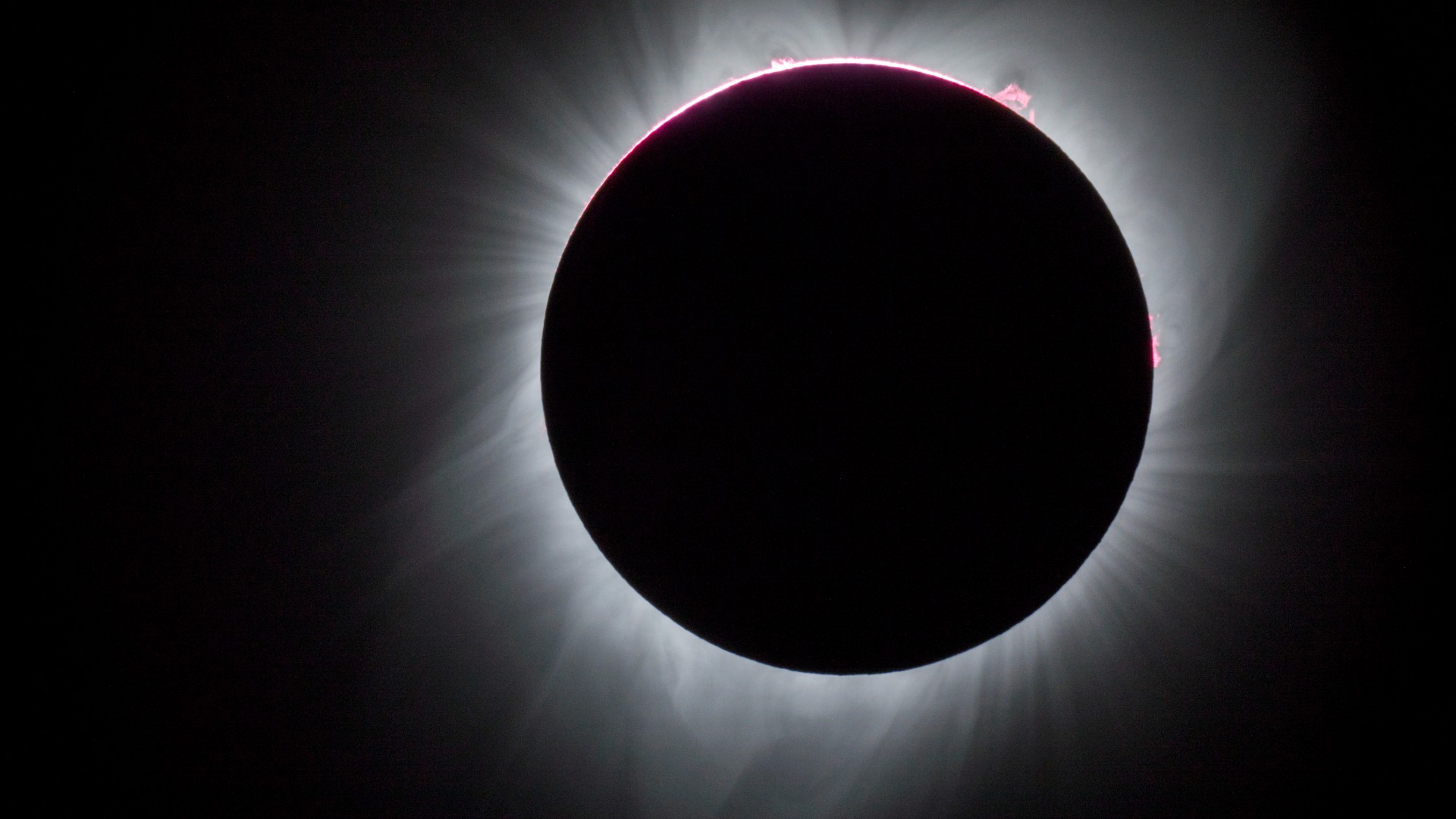
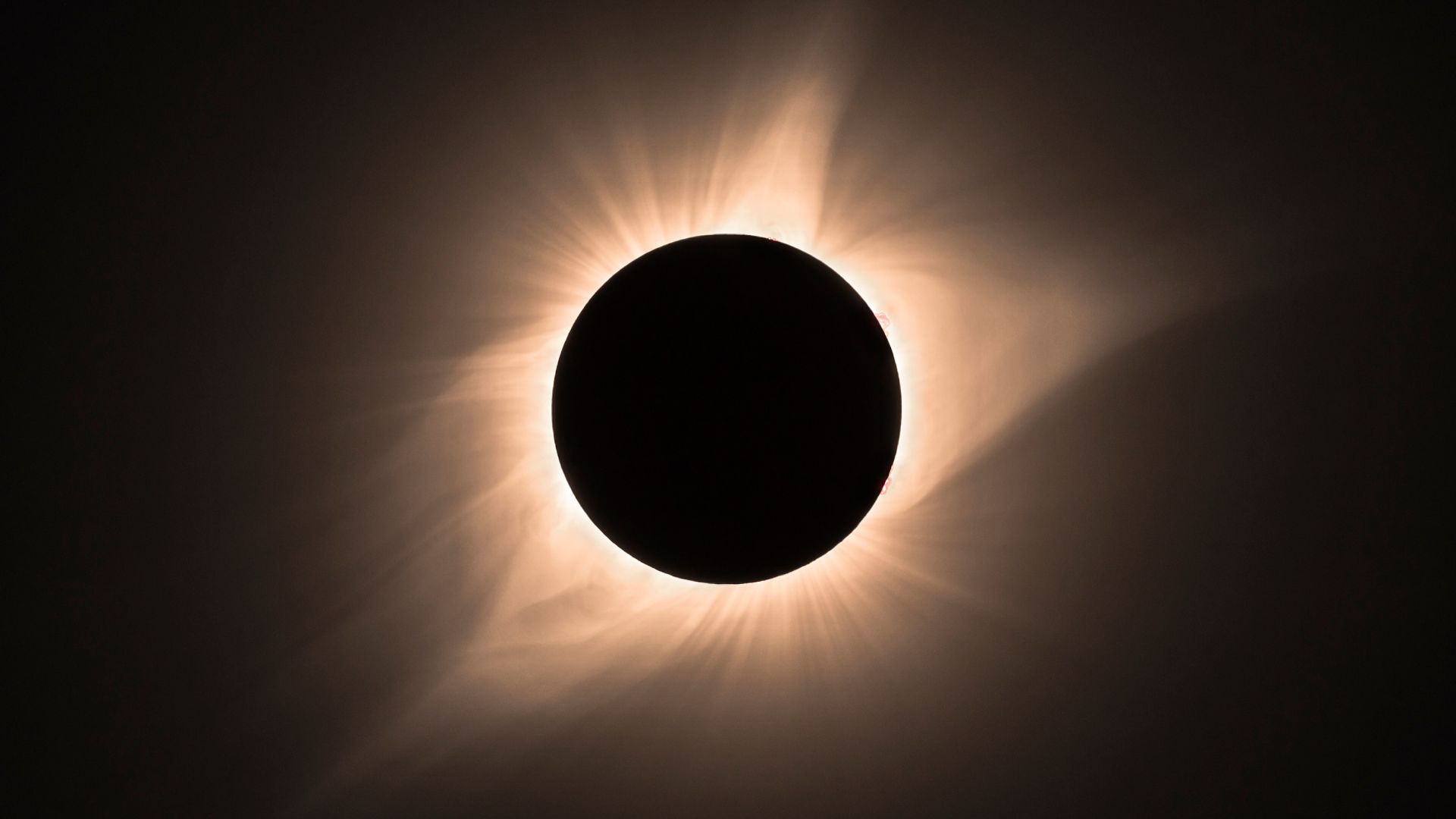
A fully eclipsed sun is photographed at the height of a total eclipse in a black sky, with its golden atmosphere streaming away from the lunar disk.

The sky will take on the appearance of dusk as totality falls. (Image credit: John Finney Photography via Getty Images)

NASA Meteoroid Environments Office head Bill Cooke added his own word of caution, noting that the relatively bright sky during totality will likely hide all but the most brilliant Perseids from sight.

"Only Perseid fireballs will be visible," Cooke told Space.com in an email. "Given the brightness and duration of the eclipse, you might see one if you're extremely, extremely lucky. [The] most likely scenario is that you will see no meteors whatsoever."

The odds are definitely stacked against you. But you never know. A piece of comet Swift-Tuttle could've broken away at just the right time, at just the right point in its orbit to meet a fiery end in Earth's atmosphere, just as the sun slips from view. As for our advice? Keep your eyes locked firmly on the eclipse as it unfolds in the skies above you. There'll be plenty of time for hunting Perseids later.

Want to capture gorgeous photos of the Aug. 12 cosmic doubleheader? Then be sure to read our expert guides to imaging a total solar eclipse, along with tips on photographing fast-moving meteors. You can also stay up to date with all the latest news and reports for the field with our total solar eclipse live blog!

Editor's Note: If you would like to share your astrophotography with Space.com's readers, then please send your photo(s), comments, and your name and location to spacephotos@space.com.

Watch the total solar eclipse online Aug. 12 with these free livestreams

11 August 2026 at 07:00

The Aug. 12 total solar eclipse is just one day away! Here's how you can watch the entire show live online from the comfort of your home

Millions of people across Spain, Iceland and Greenland will see the moon completely hide the sun during the climactic phase of totality on Aug. 12. Countless more skywatchers across Europe will witness a deep partial solar eclipse, as the moon's curved silhouette covers a swathe of the sun's surface, while failing to cover it entirely.

Thankfully, we live in modern times. So there's no need for you to miss out on the solar spectacle if you find yourself outside of the path of totality, or if clouds conspire to ruin your view. Here's where to watch every phase of the 2026 total solar eclipse live online.

NASA

NASA will be hosting its own livestream of the event starting at 1:15 p.m. EDT on Aug. 12, featuring live views of totality from cameras spread throughout the path of the eclipse. The visuals will be accompanied by information on the science of the incredible event and details on how the agency is working to learn more about our sun.

The NASA coverage will be hosted here on Space.com, but can also be streamed through YouTube, Twitch, NASA+, Facebook, Instagram and Amazon Prime.

Time and Date

Time and Date's YouTube livestream kicks off at 12 p.m. EDT (1700 GMT) on Aug. 12, bringing live views of the eclipse from Leon in northwestern Spain and the island of Mallorca, along with live commentary from journalist Anne Buckle and astrophysicist Graham Jones.

The European Space Agency

An official European Space Agency (ESA) livestream will begin at 1:30 p.m. EDT (1730 GMT) on Aug. 12. The stream will feature expert commentary on the science of the eclipse along with live views from telescopes at the Observatorio Astrofisco de Javalambre, which is located close to the Spanish city of Teruel directly in the path of totality.

Royal Observatory Greenwich

London's historic Royal Observatory Greenwich will host two simultaneous YouTube streams featuring live views of the partial solar eclipse starting at 1:15 p.m EDT (1815 GMT) on Aug. 12. The first livestream will be presented by Royal Observatory astronomer Greg Brown, who will discuss the science of the sun while providing expert commentary on the eclipse, while the second will offer a silent livestream, featuring visuals of the eclipse with no accompanying audio.

The Virtual Telescope Project

The Virtual Telescope Project livestream begins at 1:20 p.m. EDT (1720 GMT) on Aug. 12, bringing real-time views from the organization's robotic telescopes in Manciano, Italy, where a partial eclipse will be visible and from the path of totality in Spain. The Virtual Telescope Project will host a separate livestream a few hours later featuring views of the Perseid meteor shower peak, which occurs overnight on Aug. 12-13.

Be sure to check out our live blog for all of the latest news on the Aug. 12 total solar eclipse. We'll also have reports from Skywatching Writer Anthony Wood as he watches the eclipse unfold low in the horizon in central Spain, and also from Skywatching Editor Daisy Dobrijevic as she witnesses the spectacle during a voyage with HX Expeditions to Greenland!

Editor's Note: If you would like to share your eclipse photos with Space.com's readers, then please send your photo(s), comments, and your name and location to spacephotos@space.com.

'Launching anywhere, anytime and without compromise': Rocket Lab unveils new 'GHOST' portable spaceport system

10 August 2026 at 23:43

Rocket Lab plans to start launching even more frequently and flexibly, thanks to a new portable spaceport system called "GHOST."

GHOST β€” short for "Global Hypersonic & Orbital Spaceport Technology" β€” turns the company's "Electron and HASTE rockets into a launch-anywhere, launch-anytime capability for multi-launch flight campaigns and critical national security missions," Rocket Lab representatives said in a statement today (Aug. 10).

"Packaged entirely within standard shipping containers, GHOST deploys complete rockets, launch infrastructure, ground support and range control systems anywhere in the world," they added.

Electron is Rocket Lab's workhorse orbital rocket, giving small satellites dedicated rides to the final frontier. The expendable 59-foot-tall (18-meter-tall) launcher debuted with a test flight in 2017 and has 83 missions under its belt to date.

As its full name suggests, HASTE ("Hypersonic Accelerator Suborbital Test Electron") is a suborbital version of Electron that customers use to test various technologies in the hypersonic flight environment. HASTE first flew in June 2023 and has flown nine times to date, most recently in June of this year.

Rocket Lab currently flies from two different launch sites β€” one on the North Island of company founder and CEO Peter Beck's native New Zealand and one at Wallops Island in Virginia. But the company recently announced plans to fly out of Alaska's Pacific Spaceport Complex as well, and GHOST will expand its launch footprint even further.

"Electron and HASTE revolutionized small orbital launch and hypersonic testing. Now we're making it easier to deploy them wherever they're needed most, whether that's for missile defense testing or sovereign orbital launch capability," Beck said this afternoon during Rocket Lab's second-quarter 2026 earnings call.

"We've mastered the art of building launch sites," he added. "Now we're making them deployable worldwide."

Rocket Lab intends to deploy its two planned pads at the Pacific Spaceport Complex using GHOST, Beck said during the call. The company was inspired to develop the portable spaceport system, he added, to meet the needs of a HASTE customer, who expressed a desire for Rocket Lab to be "a little bit more mobile than we are."

Rocket Lab currently flies out of two pads at its New Zealand site and one at Wallops, though it has built a second pad at the Virginia facility to accommodate launches of its coming Neutron rocket.

Neutron will be bigger and more powerful than Electron, and partially reusable as well; its first stage is designed to come back to Earth for recovery and reflight, like SpaceX's Falcon 9.

Rocket Lab originally wanted to fly Neutron for the first time in 2024, but the new launcher has yet to leave the ground. Such delays aren't uncommon in the case of new rockets, and the company is making considerable progress with Neutron, according to Beck.

"Every part of the vehicle has now seen significant testing," he said during today's call. "As with any complex development program, we've had to tweak a few things along the way, but we're moving now into final checkout and assembly of all of our flight hardware before integrating them at the pad."

The company is on target to deliver the first Neutron to that Wallops pad in the fourth quarter of this year, Beck added.

The Andromeda galaxy may be getting bullied by a smaller galactic neighbor, scientists find

10 August 2026 at 19:00

Thanks to the Hubble Space Telescope, astronomers have shed light on a recent chapter in the history of our Milky Way's neighboring galaxy, Andromeda.

Using Hubble Space Telescope observations of Andromeda's stars, a research team showed that the spiral galaxy's rate of making new stars has dramatically slowed down in the last 40 million years. And they've found more evidence that one of Andromeda's own neighbors β€” a smaller galaxy called M32 β€” may be to blame.

"We can't explicitly say that we are seeing a decrease in star formation because of M32. But it's right there, and it's definitely the most likely suspect," said Tobin Wainer, a graduate student at the University of Washington and one of the astronomers, in a statement.

Astronomers like Wainer knew from prior research that Andromeda saw a burst of star formation about 2 billion years ago (possibly as a result of a collision with an unknown galaxy). They also knew that star formation had slowed down since then. What they did not know was how quickly that deceleration had been. If they could find out, they could fill in some of the gaps in Andromeda's history.

At 2.5 million light-years' distance, Andromeda is near enough to Earth that Hubble can measure its stars. In the past several years, Hubble has conducted two surveys of Andromeda. While Hubble can only make out stars in Andromeda that are brighter than our sun, these two surveys still gave Wainer and colleagues a compendium of 200 million stars, covering two-thirds of Andromeda's disk.

Wainer and colleagues parceled out this vast space into a grid of squares, 300 light-years to a side. They reconstructed the history of each square by examining the colors of its stars.

A square with many bright blue stars, for example, probably saw a lot of star formation recently, since blue stars tend to be younger. On the other hand, if a square only contains smaller, redder stars, we know those stars are longer-lived and older, and that square probably hasn't seen a lot of newborn stars.

The astronomers mapped out a story of slowing star formation. Around 500 million years ago, on average, Andromeda turned the equivalent of our sun's mass in gas and dust into newborn stars each year. As millions of years passed, that rate declined. About 40 million years ago, it was about one-half the sun's mass each year. Then, it tilted into a dramatic deceleration. Today, it stands at about one-fifth the sun's mass each year.

A spiral galaxy with lots of stars in the background. A bright haze is seen coming from the center of the galaxy. Toward the center left there is a glowing dot. And on the center right another glowing dot mostly offscreen.

The Andromeda galaxy, M31, with satellite galaxies M32 (center left) and M110 (lower right). (Image credit: S. Ozime)

Curiously, they found that Andromeda's starmaking slowdown is especially pronounced on one particular side of the galaxy, starting about 60 million years ago. Astronomers know this side of Andromeda is closest to another galaxy: M32.

Astronomers have eyed M32 with suspicion for some time now. M32 is only located about 16,000 light-years from Andromeda (Andromeda is formally called M31) and it looks like the rump core of a spiral galaxy that lost its arms. It's possible that this is actually the aftermath of a collision between M32 and its larger neighbor. It's possible, though not confirmed, that Andromeda's slowing bears the fingerprints of this collision.

We may not need to wait long for more answers. Just as Hubble can see Andromeda's stars, so too will the Nancy Grace Roman Space Telescope, set to launch in late August. In the coming years, Roman will be able to measure even more of Andromeda than Hubble has.

Lego Project Hail Mary review: Amaze, amaze, amaze!

10 August 2026 at 18:00

Given how much I enjoyed the Project Hail Mary movie, I was beyond hyped to get my hands on the Lego Project Hail Mary set. And now that I've built it, I'm thrilled to say it does not disappoint. You could even say that it's amaze, amaze, amaze!

The titular Hail Mary is the spaceship from "Project Hail Mary", the Andy Weir novel-turned-Hollywood blockbuster that carries Ryland Grace (Ryan Gosling) across the stars to save humanity. While the design of the ship is certainly described in the book, this is definitely a Lego rendition of the movie version. So, if you're an Andy Weir fan who imagined it looking a little different, you can blame the studio.

Coming in at $99.99 with just under 900 pieces, it's a lot smaller than we expected (and hoped for). If you're after something comparable to the hefty NASA Artemis Space Launch System or gargantuan Venator-Class Republic Attack Cruiser sets, then you'll be disappointed. However, the Lego Project Hail Mary has a heck of a party trick to make up for its diminutive size: A spinning mechanism that simulates the centrifugal gravity system of the ship.

Price: $99.99/Β£99.99

Model number: 11389

Number of pieces: 830

Dimensions: 12 x 9.5 x 8.5 inches / 30 x 25 x 22 cm

Recommended age: 18+

Lego Project Hail Mary review: Build

Build process for Lego Project Hail Mary set
Partway through building the Lego Project Hail Mary set.Future (Ian Stokes)
Build process for Lego Project Hail Mary set
Future (Ian Stokes)
Build process for Lego Project Hail Mary set
Future (Ian Stokes)
Build process for Lego Project Hail Mary set
Future (Ian Stokes)

The Lego Project Hail Mary is constructed from 830 pieces, split across six numbered paper bags, with a few large pieces in a separate plastic bag. I built the kit over the course of two nights, but you could easily smash it out in a single evening if you wanted to.

The build starts with a little diorama, showcasing the Ryland and Rocky minifigures on either side of a window (the barrier that separates them when they first meet and learn to communicate in the movie). It's a cool little display that can work well on its own or can be attached to the stand of the ship itself.

From there on, four out of the six bags are almost entirely dedicated to the display stand and the incorporated spinning mechanism, with the final section of bag four attaching the ship’s crew module to the spinning mechanism. Thanks to the intricate mechanism inside it, the stand not only spins, but also retracts and extends the crew section of the ship, simulating the centrifugal gravity system from the movie. While it's a complicated mechanism that means a lot of Technic pieces, but the build itself is straightforward thanks to the clear instructions.

At last, the final two bags will see you constructing the ship itself. This consists of the main body where the thruster is housed, the three fuselage sections, and the solar panel array that provides power to the ship. Some builders might be disappointed that the actual spacecraft is a remarkably small part of the build process, but I think the spinning display stand is cool enough to offset that. Also, there are no stickers, which is always a huge win for me.

Lego Project Hail Mary review: Design

Lego Project Hail Mary set
Though the ship is beautiful, the hefty stand somewhat draws the eye away from it.Future (Ian Stokes)
Lego Project Hail Mary set
Future (Ian Stokes)
Lego Project Hail Mary set
Future (Ian Stokes)
Lego Project Hail Mary set
Future (Ian Stokes)
Lego Project Hail Mary set
Future (Ian Stokes)
Lego Project Hail Mary set
Future (Ian Stokes)
Lego Project Hail Mary set
Future (Ian Stokes)
Lego Project Hail Mary set
Future (Ian Stokes)
Lego Project Hail Mary set
Future (Ian Stokes)

As I mentioned earlier, the display stand is surprisingly hefty and draws the eye away from the beautiful ship – a bit more than you might want from a display piece. That's the downside, but the upside is that it's an awesome party piece. Turning the handle on the front of the stand in either direction rotates the entire ship, simulating its spin in the movie. If you turn the handle clockwise, the crew module extends outward, while turning it counterclockwise retracts it.

The ship itself is a great recreation of Grace's eponymous craft, the Hail Mary. It's quite small, as Lego spaceships go, so there are no interior details or easter eggs hiding within the construction. Despite that, it captures the distinctive silhouette of the craft well, and includes all the major details, like the astrophage-powered engines that make the whole mission possible. From the three main pillars of the ship, which are the fuel tanks that store the astrophage, to the solar panel arrays that stick out from the main body, it all looks great.

I really love the little mini-diorama scene that you can create between Grace and Rocky, recreating their tentative first contact. It's a clever bit of design too, as you can attach their individual plinths to the main display and tuck the glass divider away in the stand. The minifigures themselves are great too. Grace has a custom red NASA flight suit, while Rocky is barely a minifigure β€” he's an eccentric collection of pieces mashed together, but I can't deny the end result is unmistakable Rocky.

Should you buy the Lego Project Hail Mary?

Lego Project Hail Mary set

(Image credit: Future (Ian Stokes))

Overall, the Lego Project Hail Mary is a wonderful set that should thrill fans of the movie (more so than fans of the book, although I’m sure they’ll enjoy it too). The ship looks fantastic, and the spinning mechanism is wonderful to see in motion. There are actually some enterprising companies out there selling motorized mod kits for it, which is something I'm seriously considering checking out myself.

With that said, the prominent nature of the stand and somewhat gimmicky spinning feature does limit its appeal as a display model. Plus, those who aren’t big into technic-like builds may want to pass on this one and just admire it from afar.

Finally, while the build itself is only suitable for older teens and adults due to the complex nature of the internal workings, the finished model will definitely delight younger kids thanks to the interactivity it offers.

Chinese rocket explodes less than 90 seconds after liftoff (photos)

10 August 2026 at 17:03

China's latest rocket launch ended in failure this morning, lighting up the skies with some unwanted fireworks.

The state-owned China Aerospace Science and Technology Corporation (CASC) launched a Long March 7A rocket today (Aug. 10) from the Wenchang Space Launch Site, in the country's Hainan province, just after 8:00 a.m. EDT (1200 GMT; 8:02 p.m. local time). Around 85 seconds into the launch, the rocket exploded, generating a massive fireball and a cloud of smoke and debris while still soaring through Earth's atmosphere.

CASC had not yet released a statement about the incident by the time of this story's publication, but video reposted to social media captured the shock of onlookers the moment that the rocket burst into flames. Based on such views, the mission will almost certainly be deemed a complete failure, with total loss of vehicle and payload.

Today's launch was the 18th Long March 7A mission since the rocket's debut in 2020, which, subsequently, also ended with the vehicle's explosion. China traced that mishap to an engine malfunction that occurred shortly after first-stage separation. This morning's launch, however, didn't get that far.

The Long March 7A's four side boosters and core stage detach as a full cluster during first stage separation, which typically occurs just under three minutes after liftoff. As today's incident occurred just 85 seconds into flight, the rocket was still engaged in the main stage's initial engine burn to escape Earth's atmosphere.

The 7A β€” a variant of China's Long March 7 rocket family β€” stands just over 197 feet (60 meters) tall and combines the first two Long March 7 stages with a hydrolox (liquid hydrogen and liquid oxygen)-powered third stage capable of launching up to 7 tons to geostationary transfer orbit (GTO).

long-distance photo of a rocket launching at night

A Long March 7A rocket carrying the ChinaSat 4B satellite launches from the Wenchang Spacecraft Launch Site on Aug. 10, 2026. The launch was not successful. (Image credit: Meng Zhongde/VCG via Getty Images)

According to China National Radio, today's launch carried China's Zhongxing-4B spacecraft,, a communications satellite presumably bound for GTO. China's Zhongxing satellites provide telecommunications and broadband internet services and are also thought to provide services for China's military.

It is unclear what repercussions today's explosion may have on upcoming launches, including a Chinese Zhuque-3 rocket liftoff scheduled for Monday evening. That mission is scheduled to fly from China's Jiuquan Satellite Launch Center, more than 1,500 miles (2,415 kilometers) from Wenchang, at 7:45 p.m. EDT (2345 GMT; 7:45 a.m. local time), and is expected to feature a first-stage landing attempt.

CASC uses the standard Long March 7 rocket, which shares its core stage with the 7A, as its launch vehicle for delivering cargo to the Tiangong space station in low Earth orbit about every eight months. The most recent of those missions launched in May, putting the next resupply launch sometime around January 2027. Depending on the cause of this morning's explosion, that mission and others could face delays as China investigates the incident.

Editor's note: This story was updated at 4:20 p.m. ET on Aug. 10 with new photos of the launch.

This ZWO astronomy camera is perfect for solar and lunar imaging

10 August 2026 at 15:11

Originally launched a decade ago, the ZWO ASI174MM is a planetary astrophotography camera β€” something you insert into the eyepiece of a telescope to take images and video of deep-sky objects, planets, the moon and the sun. This one is very much geared towards the latter, with solar and lunar imaging its goal.

Specifications

Product type: Monochrome astronomy camera

Sensor: 1/1.2-inch Sony Exmor IMX174LLJ / IMX174LQJ CMOS

Resolution: 2.3MP, 1936x1216

Pixel size: 5.86Β΅m

Shutter: Pregius global shutter

Maximum frame rate: 164.5fps at full resolution in 10-bit mode; 128.2fps at full resolution in 12-bit mode

Interface: USB 3.0 / USB 2.0

Guide port: ST4

Adapters: 2-inch / 1.25-inch / M42 x 0.75

Dimensions: 62 x 36 mm

Weight: 140g / 4.2 oz

Accessories: M42-to-1.25-inch nosepiece adapter, 1.25-inch cap, 2m USB 3.0 cable, 2m ST4 cable

At first glance, the specification looks simple: a 2.3MP monochrome Sony IMX174 sensor, 5.86Β΅m pixels, USB 3.0 connectivity and a compact red aluminum body. The important details are the sensor size, speed and global shutter. For lunar and solar imaging, where you often want to capture large areas in high frame rate videos and freeze split-seconds of steady β€œseeing” β€” when turbulence in Earth’s atmosphere doesn’t degrade an image of an astronomical object β€” those traits matter more than headline megapixels.

The ASI174MM is especially attractive for solar imaging with an H-alpha telescope β€” a filter that blocks all wavelengths of light other than H-alpha, which is emitted by hydrogen atoms. That’s because its 5.86 ΞΌm pixels match the focal ratios typical of solar telescopes, yielding sharp, efficient detail. Its relatively large sensor can cover more of the solar disc than many small planetary cameras, while its high frame rate supports the usual lucky-imaging workflow of capturing video, selecting the best frames and stacking them for sharper images.

ZWO ASI174MM astronomy camera: Design

A close-up of the ZWO ASI174mm Mono camera on the Sky-Watcher Heliostar 76Ha solar telescope.

Large 5.86Β΅m pixels help with solar and lunar capture. (Image credit: Jamie Carter)
  • Compact aluminum camera body
  • USB 3.0 and ST4 guide port included
  • Useful adapter bundle

The ZWO ASI174MM has a compact, lightweight and practical design that’s ideal for use as a camera attached to a telescope. Its small cylindrical aluminum body adds very little strain to a focuser, solar diagonal or off-axis guider, which is particularly useful when working with solar telescopes.

The ZWO ASI174mm mono camera attached to the bottom of the Sky-Watcher Heliostar 76Ha solar telescope.

The compact aluminum body weighs just 140g. (Image credit: Jamie Carter)

Usefully, the camera includes a high-speed USB 3.0 connection, which is important because the ASI174MM’s main strength is capturing and transferring many video frames very quickly. It can also be used over USB 2.0, but doing so gives up much of the performance that makes the camera appealing in the first place.

A close-up of the ZWO ASI174mm Mono camera attached to the Sky-Watcher Heliostar 76Ha solar telescope.
The 2.3MP resolution is modest, but well suited to bright solar system targets. Jamie Carter
ZWO ASI174mm mono camera connected to the bottom of the Sky-Watcher Heliostar 76Ha solar telescope Sky-Watcher SolarQuest mount.
It’s a tough, practical performer for imaging the sun and moon. Jamie Carter

An ST4 guide port adds extra flexibility. Although the ASI174MM is primarily sold as a planetary camera, it can also be used as a guide camera (mounted on top of a main imaging scope to capture a wide field of view), especially with off-axis guiders (a device that sits between a main camera and the telescope to precisely track stars), where the larger sensor helps find guide stars more easily than smaller-chip models.

ZWO ASI174MM astronomy camera: Performance

The solar disk in wrinkled grey colour, surrounded by black background, as imaged by the ZWO ASI174mm mono camera.

A mono image of the sun using data captured by the ZWO ASI174MM. (Image credit: Jamie Carter)
  • Excellent for solar and lunar video capture
  • Global shutter is a real advantage
  • Large pixels favor longer focal lengths

A portion of the solar disk in wrinkled gold and black bacground, as imaged by the ZWO ASI174mm mono camera.

A prominence on the sun captured using the ZWO ASI174MM. (Image credit: Jamie Carter)

The ASI174MM’s combination of a relatively large 1/1.2-inch sensor, 5.86Β΅m pixels, and fast video capture makes it particularly well-suited to imaging the sun and moon. Compared with planetary cameras built around smaller sensors, it records a considerably larger area of the telescope’s field of view, reducing the number of panels needed for mosaics and making it easier to locate and frame a target.

The back of the ZWO ASI174mm Mono camera .

At full resolution, the ASI174MM can capture over 100 frames per second. (Image credit: Jamie Carter)

That larger sensor is especially useful for solar imaging, which is what we tested it with. The exact field of view depends on the telescope’s focal length, but the ASI174MM can capture larger active regions β€” and, with some setups, most or all of the solar disc β€” without immediately requiring a mosaic. For example, we tested it with the Sky-Watcher Heliostar 76Ha solar telescope, for which it is a natural match, where prominences, filaments, sunspots and rapidly changing structures on the solar surface need to be recorded at high speed.

The solar disk in deep orange with wrinkles, surrounded by a black background, as imaged by the ZWO ASI174mm mono camera.

A mono image of the sun using data captured by the ZWO ASI174MM. (Image credit: Jamie Carter)

The camera’s global shutter is another advantage for solar imagers. A rolling shutter (the standard choice for deep-sky imaging) records an image progressively, one row of pixels at a time, to produce a low-noise, high-dynamic-range image. However, atmospheric turbulence, which slightly shifts the image, can cause distortion. A global shutter exposes the entire sensor simultaneously, helping the ASI174MM preserve the shape of solar and lunar features more accurately from frame to frame.

A close-up of the back of the ZWO ASI174mm mono camera with a wire connected to it.

The ASI174MM works well with solar telescopes, lunar rigs and longer focal-length scopes. (Image credit: Jamie Carter)

High-speed capture also supports lucky imaging. Instead of trying to produce one perfect exposure, the camera records thousands of short exposures in rapid succession. Software then identifies and stacks the sharpest frames β€” the brief instants when Earth’s turbulent atmosphere becomes relatively steady.

The entire solar disk in wrinkled gold colour surrounded by black background, as imaged by the ZWO ASI174mm mono camera.

A colorized image of the sun via the ASIStudio software. (Image credit: Jamie Carter)

While it’s ideal for solar imaging, the ASI174MM is much less convincing as a conventional deep-sky camera. Long exposures can reveal pronounced amp glow towards one side of the frame, while the uncooled sensor becomes increasingly noisy as exposure times increase. Calibration with dark frames can reduce these effects, but it adds complexity and cannot turn the ASI174MM into a modern cooled deep-sky camera. It can be used for short-exposure imaging, guiding and some specialist applications, but solar, lunar and planetary video remain its natural strengths.

ZWO ASI174MM astronomy camera: Functionality

Screenshot of stacking software on a Macbook showing entry tables, graphs and a detailed image of the sun.

The sun through the ASICap software. (Image credit: Jamie Carter)
  • Captures good data
  • ZWO software works well
  • Little guidance available

The ASI174MM fits neatly into the established workflow for solar, lunar and planetary imaging: capture a high-speed video, identify the sharpest frames, align and stack them, then sharpen and process the image. Its fast USB 3.0 connection enables high data transfer rates, while region-of-interest controls allow the user to record only a selected portion of the sensor. Reducing the size of the recorded area can substantially increase the frame rate, which is particularly useful when imaging an individual sunspot.

The ZWO ASI174mm mono camera connected to the Sky-Watcher Heliostar 76Ha solar telescope and Sky-Watcher SolarQuest mount.

USB 3.0 connectivity allows fast frame rates for lucky imaging. (Image credit: Jamie Carter)

Several free applications can control the camera and record these videos, including SharpCap and FireCapture. AutoStakkert! is widely used to analyze, align and stack solar, lunar and planetary frames, while programs such as ImPPG, RegiStax, Siril, Adobe Photoshop and GIMP can be used for sharpening, contrast adjustment and final processing. Windows users have the widest choice of third-party astronomy software.

However, ZWO also provides its own free ASIStudio software suite. For the ASI174MM, the most relevant applications are ASICap, which controls the camera and records lossless SER or AVI video, and ASIVideoStack, which analyses and stacks the resulting frames (and can also be used for post-processing). ASIStudio is available for both Windows and macOS.

A screenshot of stacking software and a zoomed in solar photograph.

A sunspot on the sun through the ASICap software. (Image credit: Jamie Carter)

The basic capture process is straightforward. After connecting the ASI174MM to ASICap, exposure time and gain are adjusted until the brightest areas of the sun or moon remain below saturation. Because this is a monochrome camera, the live view can be shown either in grayscale or with false color applied for easier viewing. A video containing around 1,000 to 3,000 frames is then recorded, though the ideal number depends on the target, seeing conditions and available storage.

Storage requirements are significant. Uncompressed high-frame-rate video from the full sensor can consume several gigabytes in a matter of seconds, so a fast computer, a USB 3.0 connection and plenty of free drive space are essential.

A screenshot of image stacking software on a Macbook.

Stacking using the ASIVideoStack software. (Image credit: Jamie Carter)

Once a video is loaded into ASIVideoStack, the software can assess frame quality, align the image and combine a chosen percentage of the sharpest frames. The finished stack can be exported in formats including JPEG and FITS. JPEG is convenient for immediate sharing, but FITS preserves more of the original image data and is better suited to serious post-processing.

A screenshot of editing software with a solar photograph and exposure adjustments sliders.

Image editing using the ASIVideoStack software. (Image credit: Jamie Carter)

The workflow is functional rather than polished. There is relatively little guidance for beginners and obtaining the best results requires experimentation with exposure, gain, frame rate, focus, stacking percentages and sharpening settings. It can take many attempts to determine which combination works best with a particular telescope and observing conditions. For that reason, it’s wise to archive the video files, which can be revisited and processed later as processing skills/software improves.

How we tested the ZWO ASI174MM

The Sky-Watcher Heliostar 76Ha solar telescope pointing at the sun, connected to the Sky-Watcher SolarQuest mount and ZWO ASI174mm mono camera.

Its Sony IMX174 sensor gives a wider field than many smaller planetary cameras. (Image credit: Jamie Carter)

We tested the ZWO ASI174MM planetary camera for two weeks and used it in conjunction with the Skywatcher HelioStar 76mm solar telescope and Solar Quest mount to image the sun in H-Alpha (HΞ±).

Should I buy the ZWO ASI174MM?

Buy it if:

βœ… You mainly image the sun or moon: The ZWO ASI174MM astro cam excels in solar, planetary and lunar imaging, so if these are your main astrophotography targets, it's the perfect choice.

βœ… You have an H-Alpha telescope: If you have a solar telescope and want to move on from observation to start imaging the sun with it, you will need a monochrome astrocam like the ZWO ASI174MM.

Don't buy it if:

❌You want a dedicated deep-sky imaging camera: This model exhibits severe amp glow for exposures longer than a few seconds and lacks thermoelectric cooling (TEC) needed for noise reduction.

❌You need high megapixel resolution: The low resolution is another reason it fails as a deep-sky imaging camera as you would want a higher resolution model for detail in star clusters and galaxies.

Buy the ZWO ASI174MM if your main targets are the sun and moon, especially if you want a monochrome camera with a larger-than-average sensor, fast frame rates and a global shutter. It remains particularly suited for H-alpha solar imaging, where monochrome capture, speed and sensor area matter.

If this product isn’t for you

If you want a cheaper first planetary camera, a smaller-sensor ZWO ASI120-series-style camera may be enough for basic lunar, planetary and guiding use, though it will not offer the same field of view.

If you want a more modern planetary camera, look at newer monochrome planetary models like the ZWO ASI585MM with lower read noise, smaller pixels or higher resolution, depending on your telescope’s focal length.

If your goal is deep-sky imaging, a cooled astronomy camera is a better choice than the ASI174MM. We have reviewed the ZWO ASI533MC Pro and the ASI183MC Pro and gave both of them nothing less than four and a half stars for beautiful deep-sky astrophotography.

Sharpest image of the sun ever captured! | Space photo of the day for Aug. 10, 2026

10 August 2026 at 15:00

Yellow and orange swirls show the sun in sharp detail.

This image of the sun β€”Β the sharpest ever snapped β€” was captured by the NSF Inouye solar telescope. (Image credit: NSF,Β NSO,Β AURA,Β MPS,Β Inouye Tel)

Scientists have captured the sharpest image ever of our sun's surface. This view has revealed incredible new details about the inner mechanisms driving stellar activity.

What is it?

An international team of researchers using the U.S. National Science Foundation's Inouye Solar Telescope has captured the highest-resolution view of the sun's surface.

In analyzing observations from this telescope, the team, made up of researchers from the National Solar Observatory, the NSF NCR High Altitude Observatory and the German Max Planck Institut fΓΌr Sonnensystemforschung, discovered strange patterns on the sun's surface. The whirling patterns, they found, are actually evidence of what's called Kelvin-Helmholtz instability (KHI), or instability that happens when there is a change in velocity of fluids.

Why is it incredible?

This image is groundbreaking. Capturing the highest-resolution view of the sun's surface is a massive accomplishment, and in the time-lapse video above, you can even see the fluid dynamics on the surface of the sun in motion.

But this view is much more than a beautiful, high-resolution image. These observations have revealed swirls on the sun's surface at the edges of the magnetic areas, allowing the team to identify KHI on the sun's surface. This fluid instability has long been suspected on the sun, but these observations are the first time they have ever been directly seen like this.

β€œWe believe that the discovery of Kelvin-Helmholtz Instability in the solar photosphere, backed up by analysis of numerical simulations, is a major step forward in our understanding of the dynamics and evolution of solar and stellar plasma, and will serve as a basis for future discoveries," David Boboltz, the deputy director at the National Solar Observatory, said in a statement.

A paper describing these findings was published recently in the journal Nature.

On this day in space! Aug. 10, 1972: A 'Great Daylight Fireball' lights up the sky over North America

10 August 2026 at 15:00

On Aug. 10, 1972, an Earth-grazing fireball burst through the sky over North America. It didn't hit the ground, but instead it passed straight through the sky.

The fireball entered the atmosphere somewhere over Utah and passed northwards, leaving the atmosphere over Alberta, Canada about 100 seconds later.

Analysis of its trajectory showed the object was about 10 to 45 feet in diameter, depending on whether it was an icy comet or a denser, rocky asteroid.

a meteorite is seen falling to Earth during a bright sunny day over a mountain range and lake.

(Image credit: NASA/Astronomy Photo of the Day/James Baker)

Why it mattered

When we think of fireballs, we typically think of "shooting stars" during a meteor shower: a night sky spectacle that's brief but brilliant. But a daytime fireball is something else altogether.

Nighttime meteors are typically tiny particles of space dust or rocks that burn up as they streak through Earth's atmosphere. While they look impressive in the night sky, they're relatively dim. City streetlights or even a bright full moon can outshine them.

But a daytime fireball is caused by something large enough to be visible in the sky in broad daylight, something large and fast enought to light up a sky brighter than a sunlit day. That's what happened today in 1972.

Today, an event like the "Great Daylight Fireball" of 1972 (as it came to be named) would be visible to potentially millions of witnesses as it streaked over the United States and Canada, and we'd likely see social media flooded with images and video. There is at least one reported video of the 1972 event you YouTube, but nothing compared to what we'd see if it happened today.

Japanese H3 rocket launches 10,800-pound navigation satellite to high Earth orbit (video)

10 August 2026 at 14:00

Japan's H3 rocket flew for the ninth time ever this afternoon (Aug. 10).

The H3 lifted off from Tanegashima Space Center today at 3:23 p.m. EDT (1923 GMT; 4:23 a.m. on Aug. 11 local time), carrying the Michibiki 7 navigation satellite aloft.

The H3's upper stage deployed Michibiki 7 into its target orbit 29 minutes later, eliciting cheers from the folks in mission control.

closeup of the bottom third of a rocket in flight at night, riding into a dark sky atop a pillar of bright yellow-orange exhaust

A closeup of the H3's first stage powering the rocket to orbit on Aug. 10, 2026. (Image credit: JAXA)

The two-stage H3 is the successor to Japan's workhorse H-2A rocket, which retired last year after a total of 50 flights.

The H3 β€” which stands 187 feet or 207 feet (57 or 63 meters) tall, depending on what type of payload fairing it employs β€” debuted in March 2023 and had eight liftoffs under its belt before today.

Two of those eight were failures β€” the debut flight and the launch of Michibiki 5 in December of last year. But the H3 bounced back from that latter anomaly two months ago, successfully delivering six satellites to orbit on June 11.

Michibiki 7 will be part of Japan's Quasi-Zenith Satellite System (QZSS), a homegrown navigation system that operates high above Earth in geosynchronous orbit.

"This system is compatible with GPS satellites and can be utilized with them in an integrated fashion," Japanese officials wrote in a description of the QZSS project. "QZSS can be used even in the Asia-Oceania regions with longitudes close to Japan, so its usage will be expanded to other countries in these regions as well."

The QZSS network will eventually consist of 11 satellites, if all goes according to plan. There are five such spacecraft operating in orbit at the moment.

Michibiki 7 is carrying a payload for the United States as well — the Situational Awareness Camera Hosted Instrument (SÃCHI), which was developed for the U.S. Space Force by the MIT Lincoln Laboratory. This is the second of two SACHIs to go up on a QZSS satellite; Michibiki 6, which launched atop an H3 in February 2025, hosts the other one. (Yes, Michibiki 6 launched before Michibiki 5.)

"This program will allow the United States to monitor satellite behavior within the GEO belt over a very interesting part of the world," Mark Huber, a technical staff member in the Lincoln Laboratory's Space Systems and Technology Division, said in a statement in December 2020.

"It is also a pathfinder in several ways," he added. "The U.S. team is blueprinting methods to allow sensitive data sharing between the United States and Japan."

Editor's note: This story was updated at 3:55 p.m. ET on Aug. 10 with news of successful launch and satellite deployment.

Pluto's atmosphere is collapsing as it drifts away from the sun into a deep freeze

10 August 2026 at 13:00

Pluto's atmosphere appears to be freezing out as the dwarf planet moves ever further away from the sun, according to careful observations of Pluto astronomers made as it was seen passing in front of stars in the sky.

Pluto is already cold. Its surface temperature is about –382 degrees Fahrenheit (–230 degrees Celsius), while its upper atmosphere is a little warmer at –333 degrees Fahrenheit (–203 degrees Celsius). As Pluto moves away from the sun it will grow even colder and its nitrogen-rich atmosphere should start to collapse and freeze out, condensing as frost on the frigid surface.

Now, a team led by Amanda Sickafoose of Arizona's Planetary Science Institute believe they have seen the onset of this process. "We're at a particularly interesting point for Pluto," said Sickafoose in a statement. "Our work suggests that the atmosphere has recently started decreasing in pressure."

Pluto's orbit is highly elliptical and very oblique to the ecliptic plane of the solar system. In fact, so eccentric is Pluto's orbit that for ten years either side of its perihelion in 1989 (when Pluto was closest to the sun), it was actually closer to the sun than Neptune was.

However, ever since 1989 Pluto has been moving away from the sun on its 248-year-long orbit – we've not even seen Pluto complete half of its orbit yet since its discovery in 1930. Pluto will reach its furthest point from the sun – called aphelion – in the year 2114 when it will be about 49 astronomical units (7.3 billion kilometers/4.6 billion miles) distant.

When NASA's New Horizons mission flew past Pluto in July 2015, it measured Pluto's atmospheric pressure to be 10 microbars. This is a tiny amount, millions of times lower than the atmospheric pressure on Earth, resulting from Pluto's thin nitrogen atmosphere that also contains hazes made from organic molecules including methane and carbon monoxide.

a hazy blue ring of light on a black background

An image taken by NASA's New Horizons spacecraft that offered scientists the first look at Pluto's atmosphere in infrared wavelengths when it was taken in July 2015. (Image credit: NASA/JHUAPL/SwRI)

With New Horizons now having flown past Pluto and deeper into the Kuiper Belt, astronomers have to instead rely on more distant and less direct means of keeping tabs on Pluto's atmosphere. From our point of view on Earth, Pluto is sometimes seen to pass in front of a distant star. This is called a stellar occultation. When an airless body, such as an asteroid, occults (or hides) a background star the star's light winks out in an instant, before suddenly reappearing. When there is an atmosphere involved, however, the light of the star doesn't go out all at once when blocked by Pluto, but steadily fades as the atmosphere scatters and refracts the starlight before the star vanishes behind the dwarf planet's solid body.

Between 2017 and 2023, Sickafoose's team probed Pluto's atmosphere during ten occultations of stars ranging in brightness from about magnitude 12 to magnitude 18, far below naked-eye visibility.

Observing stellar occultations is not always a simple matter. They are not visible from everywhere on Earth, but only along narrow tracks, often in difficult to reach areas. The tracks, which are just a few kilometers wide, are effectively Pluto's shadow falling on the Earth. By spacing observers across the width of the track, it is possible to measure the extent of Pluto's atmosphere (there usually also has to be an unlucky observer just outside the track to confirm that is indeed the edge of the shadow track).

"I'm constantly amazed at how the simple technique of watching starlight dim and reappear allows us to study a thin atmosphere – a few millionths of the Earth's – on a world two-thirds the size of our moon and 30 times farther from the sun," said Sickafoose.

Of the ten occultations, four could be seen from observatories in multiple locations, which meant that the different observatories could confirm each other's results.

"We often prefer to observe predicted occultations that have shadow paths over large observatories because that equipment and data have proven successful," said Sickafoose. "Then, we try to improve those datasets by collaborating with local observers in the shadow paths."

a U-shaped graph of dots with labels that read, from left to right, star+Pluto system, atmosphere, Pluto system, atmosphere, star+Pluto system

Light curve from the June 1, 2026 occultation, observed from Savannah Skies Observatory in Chillagoe, Queensland, Australia. The gray vertical lines indicate different stages of the occultation. The baseline flux level contains combined light from the star and the Pluto system (Pluto plus all of its moons). The flux drops gradually as the starlight bends and scatters in Pluto's atmosphere, reaching nearly zero flux as defined by only light coming from the Pluto system. As the star appears on the other side of Pluto, the light gradually reappears in the atmosphere before returning to full strength. (Image credit: A. Sickafoose/Planetary Science Institute)

Previous work had suggested that Pluto's atmosphere began freezing out in 2018, but Sickafoose's team found that actually, Pluto's atmosphere remained constant from 2015 to midway through 2021. However, between mid-2021 and the last occultation that Sickafoose's team observed in 2023, Pluto's atmospheric pressure dropped by 16 per cent.

The pressure drop was deduced from the light curves, which show how the star's brightness changed with time during an occultation. The light curves revealed that while the structure of Pluto's upper atmosphere remained fixed, the lower atmosphere changed.

Sickafoose's team interprets this as being the haze particles settling towards lower latitudes. This is what is expected to happen when the atmospheric pressure drops.

"I am hopeful that we'll be able to get more data in the next years to decades to specifically confirm or refute this trend," said Sickafoose.

It is thought that Pluto's atmosphere won't have completely frozen onto the dwarf planet's surface by the time it reaches aphelion, and then as Pluto begins moving in towards the sun once more the feeble solar heating that Pluto receives will slowly begin to increase, causing nitrogen frost to sublimate from the surface and thicken the atmosphere once more.

The findings were published on July 31 in the Planetary Science Journal.

Could the northern lights be visible during the total solar eclipse on Aug. 12? Maybe.

On Aug. 12, 2026, a total solar eclipse will sweep across Earth, giving skywatchers across Greenland, Iceland and northern Spain an incredible view of totality. As the moon completely covers the sun, day will briefly turn to twilight, revealing the sun's faint outer atmosphere, the corona. But could totality reveal something else too?

Although totality never produces true nighttime darkness, it does briefly dim the sky to roughly the brightness of twilight. Since eclipse chasers in Greenland and Iceland will be in the auroral zone β€” the geographic zone around Earth's magnetic pole where auroras are most frequently seen β€” it's natural to wonder whether the two phenomena could appear together.

The answer is yes β€” but only if everything falls perfectly into place.

"During totality, the sky brightness is comparable to civil twilight (the first period of darkness after sunset, until the sun reaches six degrees below the observer's horizon). It's uncommon to see auroras during this time, but by no means impossible," Tom Kerss, independent astronomer and Chief Aurora Chaser for tour company Hurtigruten, told Space.com in an email.

Kerss knows this from experience. Last year, he photographed the northern lights in Norway at twilight, demonstrating that sufficiently bright auroras can remain visible even before the sky becomes fully dark.

aurora visible in the sky as ribbon of green light during twilight hours with the glow of the sunset on the horizon.

Twilight aurora captured by Tom Kerss in Norway, 2025. (Image credit: Tom Kerss)

However, the aurora's position in the sky would impact its visibility.

"During totality in August, the surface brightness of the sun's corona would almost certainly outshine auroras in its vicinity, but other parts of the sky away from the eclipse could host visible auroral structures," said Kerss.

So while it's physically possible, how likely is it?

Not very.

"If the auroral activity stays quiet, we wouldn't expect to see it during totality even though we know some energy is probably being emitted in the dayside portion of the oval," Kerss said.

To have any realistic chance of seeing the northern lights during the eclipse, Earth would need to be in the grip of a severe geomagnetic storm. These storms occur when eruptions from the sun, such as coronal mass ejections (CMEs), slam into Earth's magnetic field. During such conditions, auroras can get a dramatic boost, appearing brighter and more widespread than usual.

Kerss explained that observers would almost certainly need a G4 or G5 geomagnetic storm (G5 is the most powerful category) to overlap with the eclipse to have any realistic chance of seeing an aurora show because they will be on Earth's dayside.

"Bright, nightside aurora can be driven by powerful substorm activity, in which energy is stored and released," Kerss explained. "The dayside aurora is driven by a combination of favorably aligned solar wind (which opens the field lines around the Earth's polar cusps) and strong precipitation directly into the auroral oval. This latter requirement is contingent on very strong or extreme geomagnetic activity."

Kerss' thoughts are echoed by PΓ₯l Brekke, a solar physicist and northern lights expert working as Lead of Space Science at the Norwegian Space Agency.

Brekke knows just how difficult this is. He attempted to spot auroras during the 2015 total solar eclipse over Svalbard but found the sky never got dark enough.

"The sky never got that dark β€” we could hardly see any planets and no stars," Brekke told Space.com in an email. "Most probably because the snow-covered valley and mountains reflecting lights leaking in from the side of the moon's shadow. Making the sky too bright even during the eclipse."

Brekke also pointed out that the timings work against eclipse chasers. Totality occurs in the afternoon over Greenland and Iceland, meaning observers will be beneath the daytime portion of the auroral oval. Unlike the nighttime aurora oval, which expands dramatically during geomagnetic storms, the dayside auroral oval changes much less, making displays harder to see even during active space weather.

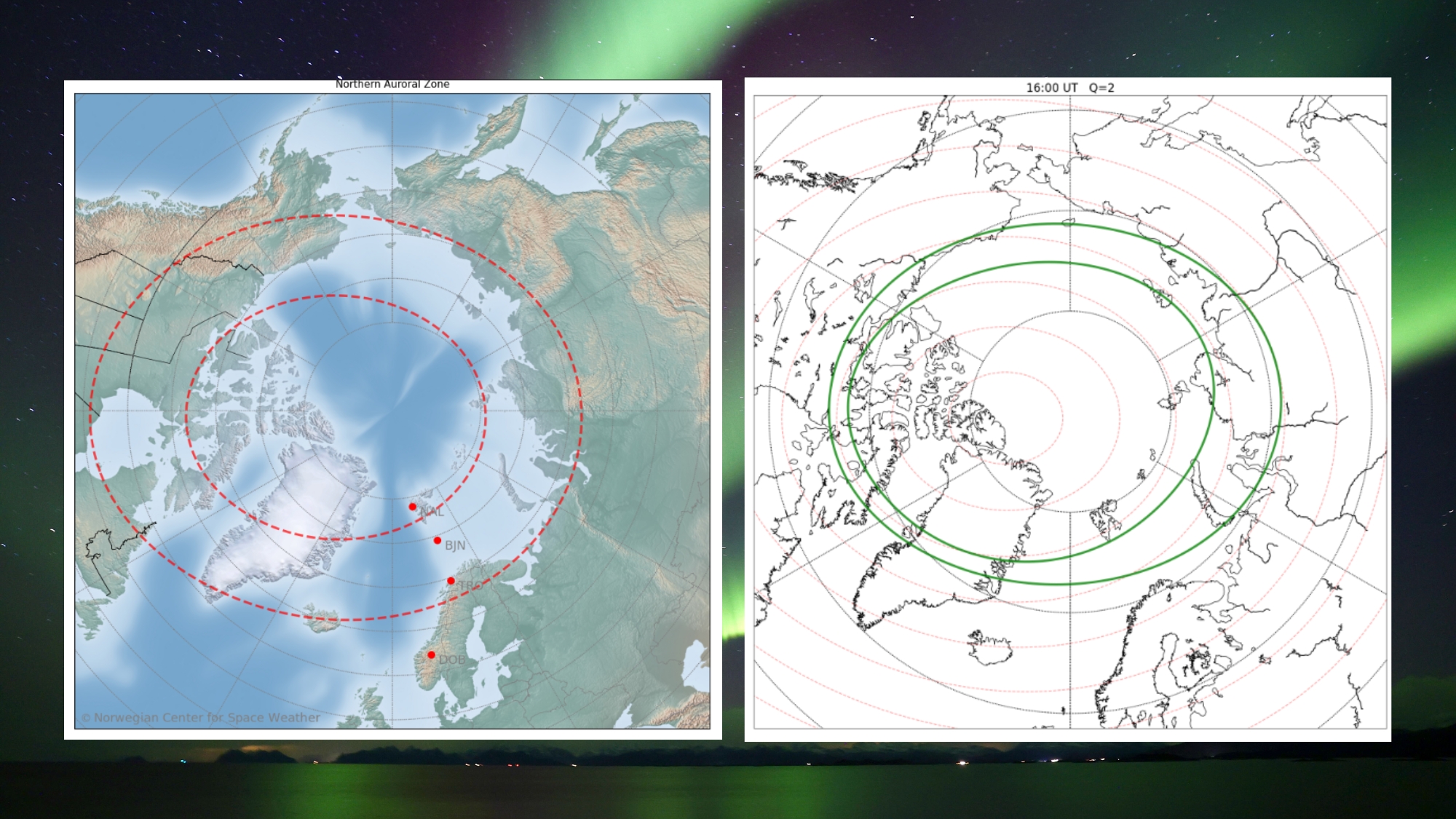
two panel image on the left is a map showing the auroral zone and on the right is the approximate position of the auroral oval at 1600 UTC

Left: The auroral zone β€” a geographic band on Earth that passes under the oval. Right: The approximate location of the daytime auroral oval at 1600 UTC (around the time of totality for observers in Greenland and Iceland) showing the instantaneous, ring-shaped region where auroras are most likely to occur at that time. (Image credit: Magnar Gullikstad Johnsen, Background added in Canva Pro by Daisy Dobrijevic)

"The chance for aurora over Spain is very low β€” that would need a KP=9 or so β€” and 20:00 [UTC] is still very early so the fattest part of the oval is still not over Spain at that time. So our guess is it will not be very likely," said Brekke.

There is one scenario, however, that could make eclipse day even more extraordinary.

"If the sun launches CMEs in the days before the eclipse, it'll be very exciting for anyone going to Iceland or Greenland, and since the exceptional Perseid Meteor Shower will also peak on that date, there's a rare opportunity to see three of the sky's greatest wonders together if conditions line up," said Kerss.

The odds may be slim, but they're not zero.

If the sun happens to unleash a powerful geomagnetic storm in the days leading up to Aug. 12, eclipse chasers in Greenland or Iceland could witness something truly remarkable.

If not, don't be too disappointed. During totality, the sun itself puts on one of nature's greatest spectacles β€” and that's where your attention should be.

What time is the total solar eclipse on Aug. 12, 2026?

If you're planning to watch the total solar eclipse on Aug. 12, knowing exactly when to look up is crucial.

While totality will be visible from parts of Greenland, Iceland and Spain, millions more people across Europe will experience a dramatic partial solar eclipse. Whether you're chasing the moon's shadow in Reykjavik or watching the moon take a 'bite' out of the sun from London, Paris, or Berlin, timing is everything.

You can keep up with the latest total solar eclipse news and coverage with our total solar eclipse live blog.

Total solar eclipse timings

Location

Totality begins (local time)

Duration

Scoresby Sund, Greenland

4:35 p.m.

1m 46s

Reykjavik, Iceland

5:48 p.m.

1m 1s

Snæfellsjâkull, Iceland

5:45 p.m.

2m 10s

GijΓ³n, Spain

8:26 p.m.

1m 46s

A CoruΓ±a, Spain

8:27 p.m.

1m 15s

Burgos, Spain

8:28 p.m.

1m 44s

Mallorca, Spain

8:31 p.m.

1m 36s

Partial solar eclipse timings for major cities

Location

Local time (maximum coverage)

% of sun's disk covered

New York City

1:54 p.m.

9%

St. John's, Newfoundland, Canada

3:35 p.m.

53%

Nuuk, Greenland

4:35 p.m.

79%

Oslo, Norway

7:57 p.m.

83%

Berlin, Germany

8:08 p.m.

84%

London, U.K.

7:13 p.m.

91%

Paris, France

8:17 p.m.

92%

Tangier, Morocco

7:40 p.m.

92%

Dublin, Ireland

7:10p.m.

94%

Lisbon, Portugal

7:36 p.m.

94%

Nice, France

8:24 p.m.

95%

Madrid, Spain

8:32 p.m.

99.96%

Barcelona, Spain

8:29 p.m.

99.82%

Looking for your own eclipse time? The interactive map and resources from Time and Date let you search by city and view detailed timing information for every stage of the eclipse.

What is a total solar eclipse?

a total solar eclipse seen against a black sky

A total solar eclipse occurs when the moon moves in front of the sun and blocks it from view. (Image credit: Paul Souders/Getty Images)

A total solar eclipse occurs when the moon moves directly between Earth and the sun, completely blocking the sun's disk from view.

During totality, the sky darkens significantly, temperatures drop and bright stars and planets can even become visible. Observers can also catch a glimpse of the sun's outer atmosphere, known as the corona, glowing around the silhouetted moon.

Totality β€” when the sun is completely obscured β€” is only visible within the narrow path of the moon's shadow. Outside that path, observers may see a partial solar eclipse, whereby only a portion of the sun is covered.

REMEMBER to NEVER look directly at the sun. To view this solar eclipse safely, you must use solar filters. Only during the brief period of totality when the moon completely covers the sun, is it safe to look at the sun without protection. Observers will need to wear solar eclipse glasses, and cameras, telescopes and binoculars must have solar filters placed in front of their lenses at all other times.

Our how to observe the sun safely guide tells you everything you need to know about safe solar observations.

After this, when is the next solar eclipse?

After the total solar eclipse on Aug. 12, 2026, the next solar eclipse will be an annular solar eclipse on Feb. 6, 2027 visible across parts of Africa and South America. The next total solar eclipse will be a spectacular event on Aug. 2, 2027. Visible across North Africa, it will be the longest totality on land since 1991.

❌