Microsoft and Xbox are currently facing all sorts of troubles (many of their own doing) in the shape of sweeping layoffs, studio cuts, and calls to boycott their products, to name a few. Extremely talented developers (who deserve much better) still put out exciting video games regardless, and with the remake of Halo: Combat Evolved out now, we look to Gears of War: E-Day, the series' first mainline entry since 2019.
While there are plenty of upcoming space games worth keeping tabs on, Gears of War's return feels special for a number of reasons. Although Gears 5 was not a flop – quite the opposite – there was a growing sentiment among the fanbase that Gears of War needed to reevaluate its future by revisiting its past. After a solid remaster of the original game last year, this next chapter is taking us back to where it all started: Emergence Day.
With gameplay systems, mechanics, controls, and visuals fully rebuilt on Unreal Engine 5, The Coalition aims to deliver the ultimate Gears of War experience with E-Day, and at least the atmosphere and tone seem pitch-perfect. But with nostalgia taking so many beloved franchises a few steps back in recent times, we must wonder if there's more to E-Day than reliving the series' glory days? Here's everything you should know about Gears of War: E-Day ahead of its launch.
When is Gears of War: E-Day coming out?
(Image credit: Xbox Game Studios)
Gears of War: E-Day launches on October 6, 2026.
After a gameplay-less reveal in summer 2024, The Coalition went silent to continue work on the prequel. It was finally during the Xbox Games Showcase 2026 that we received confirmation Gears of War: E-Day would arrive before the year's end.
Is Gears of War: E-Day coming to PlayStation 5?
(Image credit: Xbox Game Studios)
No, Gears of War: E-Day won't be releasing on PS5 despite last year's remaster of the first game marking the series' debut on Sony consoles.
Though rumors and leaked materials pointed to Gears of War: E-Day launching on Sony's console alongside Xbox, the full reveal in summer 2026 underlined it was an Xbox Series X/S console exclusive. It will, however, also launch on Windows via the Xbox app and Steam. As usual, Game Pass Ultimate subscribers will also get access to it day one.
Three editions will be available at launch, and you can pre-order them already:
Premium ($99.99 / £89.99 / €99.99) – Base game with up to five days of early access, Bravo Squad Signature Weapon Pack, Emergence Customization Pack, Four Seasonal Customization Packs (released post-launch), and 1,000 iron (the game's premium in-game currency). A separate upgrade for Standard will also be sold.
Collector's ($299.99 / variable regional pricing) – Everything in the Premium Edition plus physical items, including a collector's display box, a 15" statue, replica COG tags, an exclusive steelbook case, an art piece, and an art print & thank-you note from the studio.
All editions also benefit from pre-order bonuses that include open beta early access (on August 6), the Exfil weapon set, and Exfil Dom legendary character skin.
Gears of War: E-Day trailers
Xbox and The Coalition are sharing all sorts of short videos in the lead-up to launch, but if you want to only watch the trailers and gameplay demos, we have them right here:
Is Gears of War: E-Day the first game in the timeline?
(Image credit: Xbox Game Studios)
Gears of War: E-Day is the first chapter in the Gears timeline. It tells the story of how the humans on the Earth-like planet of Sera came in contact with the bloodthirsty and relentless Locust Horde on what would later be called Emergence Day.
If you're planning to play the Gears of War games in order, this would be the perfect place to start moving forward. Though the original game and Judgment (a spinoff that was released for Xbox 360) gave us information on what happened during E-Day, we never really had a Rogue One-like prequel similar to Halo: Reach. Now, both veterans and newcomers will be able to experience the struggle humanity faced as a new conflict erupted.
Alongside a supporting cast of new and familiar faces, the story follows original trilogy protagonists Marcus Fenix and Dominic 'Dom' Santiago as they battle through the chaos of E-Day and push back against the subterranean invaders. For additional context, the war against the Locust kicks off only a few weeks after the 79-year conflict between human factions known as the Pendulum Wars, which explains why the COG wasn't in the best of conditions when the monsters attacked.
Will Gears of War: E-Day have co-op and competitive multiplayer?
(Image credit: Xbox Game Studios)
Gears of War: E-Day is a third-person, cover-based shooter in the style of the previous games and, as such, both co-op and competitive multiplayer are back alongside the single-player experience.
The main story campaign can be played in single-player, or with up to four players online or two players locally via split screen. It must be noted the PC version of the game won't feature local co-op. These player counts also apply to the series' famous Horde Siege PvE survival mode, which pits players against waves of enemies as they select different classes and loadouts.
Versus PvP multiplayer for online competition also returns with all-new maps and both Social and Ranked matches. While the post-launch support hasn't been fully detailed, it feels likely more maps will be added in the future at no extra cost.
Is there a Gears of War: E-Day demo?
(Image credit: Xbox Game Studios)
There's no Gears of War: E-Day demo announced at the time of writing. However, players can look forward to a multiplayer open beta happening in the coming weeks. More specifically, those who pre-order or have active Game Pass Ultimate subs can access the test early, from August 6 to 10. The second – and fully open – weekend will happen at a later date, probably the following week.
A cutting-edge hypersonic vehicle just hit a big flight milestone.
Stratolaunch's reusable, autonomous Talon-A craft now has more than 10 successful flights under its belt, the California-based company announced late last month.
"Reaching more than 10 successful hypersonic flights with Talon-A is a testament to our team's dedication and the robustness of our technology," Stratolaunch President and CEO Zachary Krevor said in a July 22 statement. "We are transforming hypersonic testing from a rare event into a routine service, empowering our customers to innovate at unprecedented speed."
Stratolaunch has two Talon-A vehicles, each of which is about 28 feet (8.5 meters) long with a wingspan of 11.3 feet (3.4 m). The craft can travel through Earth's atmosphere at more than five times the speed of sound (Mach 5) — the definition of hypersonic flight.
Talon-A missions start beneath the belly of a carrier plane, which hauls the robotic vehicle into the sky and drops it down. Stratolaunch has two such carriers — a modified Boeing 747 called Spirit of Mojave and Roc, a custom-built vehicle that measures a whopping 385 feet (117 m) from wingtip to wingtip, the biggest wingspan in aviation history.
Roc and Spirit of Mojave lift off from Mojave Air and Space Port in southeastern California and tend to drop Talon-A over the Pacific Ocean. After completing its hypersonic flight, the vehicle comes back for a runway landing in California, generally at Vandenberg Space Force Base, on the state's scenic central coast.
These jaunts test sensors and advanced new materials in the hypersonic flight environment, among other tasks. Details about Talon-A's payloads tend to be sparse, likely because many Stratolaunch customers — the U.S. Missile Defense Agency, for example — are tight-lipped by nature.
Indeed, military agencies around the world are increasingly interested in hypersonic tech. Superfast, maneuverable vehicles like Talon-A are tougher to track and intercept than ballistic missiles, which follow predictable trajectories despite moving fast. (To be clear: Talon-A itself is not a weapon or weapon-delivery system; it's a technology testbed.)
Stratolaunch's giant carrier plane, Roc, with a Talon prototype aircraft tucked under its wing. (Image credit: Stratolaunch)
Stratolaunch isn't the only company that gives customer payloads hypersonic rides. Rocket Lab provides this service with HASTE, a suborbital version of its workhorse Electron rocket.
HASTE debuted in June 2023 and now has nine flights under its belt. But the vehicle's cadence will likely increase soon; in March, Rocket Lab signed a $190 million contract to conduct 20 HASTE missions for the U.S. military.
On Aug. 2, 1971, a lunar liftoff was televised for the first time. Apollo 15 astronauts David Scott and James Irwin spent three days on the moon before departing in the lunar module, named "Falcon."
An RCA TV camera was mounted onto their lunar rover, which Scott parked about 300 feet away with the camera pointed at Falcon. Flight controllers in Mission Control Houston had the option to move the camera, but because of some technical difficulties, they opted to leave the camera pointed in the same direction during liftoff. from the moon. Following a quick pop and a bunch of sparks, Falcon quickly disappeared from sight. Shortly afterward, Falcon joined the command module "Endeavour," and Apollo 15 began its journey back to Earth.
This video still shows just one moment from the live TV broadcast of NASA's Apollo 15 lunar lander blasting off from the moon on Aug. 2, 1971. (Image credit: NASA)
The Apollo 15 mission launched to the moon on July 26, 1971. The mission was commanded by David Scott, with James Irwin as lunar module pilot. Astronaut Al Worden served as command module pilot and remained aboard Endeavour as Scott and Irwin explored the moon's surface. The Apollo 15's Falcon lunar lander touched down on the moon on July 30. Orwin and Scott performed three moonwalks and test drove NASA's new lunar rover before lifting off on Aug. 2.
The Apollo 15 crew remained in lunar orbit until Aug. 4, when they departed for Earth. The mission ended with a splashdown landing in the Pacific Ocean on Aug. 7.
Why it mattered
When Apollo 11 astronauts Neil Armstrong and Buzz Aldrin first walked on the moon, their first lunar steps were broadcast to the world live. But their liftoff, not so much.
But capturing a liftoff live from the moon was the next logical step to chronicle NASA's lunar exploration in real-time. The TV camera mounted on Apollo 15 Lunar Roving Vehicle, which also made a moon debut on this mission, and was remote controlled by flight controllers on Earth, pioneering a process that is commonplace today on the International Space Station. It also allowed engineers to see how a lunar module actually behaved during liftoff in the moon's one-sixth gravity.
That legacy of live video from the moon took center stage in April 2026 during NASA's Artemis II mission, which sent the first astronaut to visit the moon since the Apollo 17 mission in 1972. The Artemis II Orion spacecraft was covered in cameras, both inside and out, allowing NASA to livestream the entire voyage to the moon and back, nonstop.
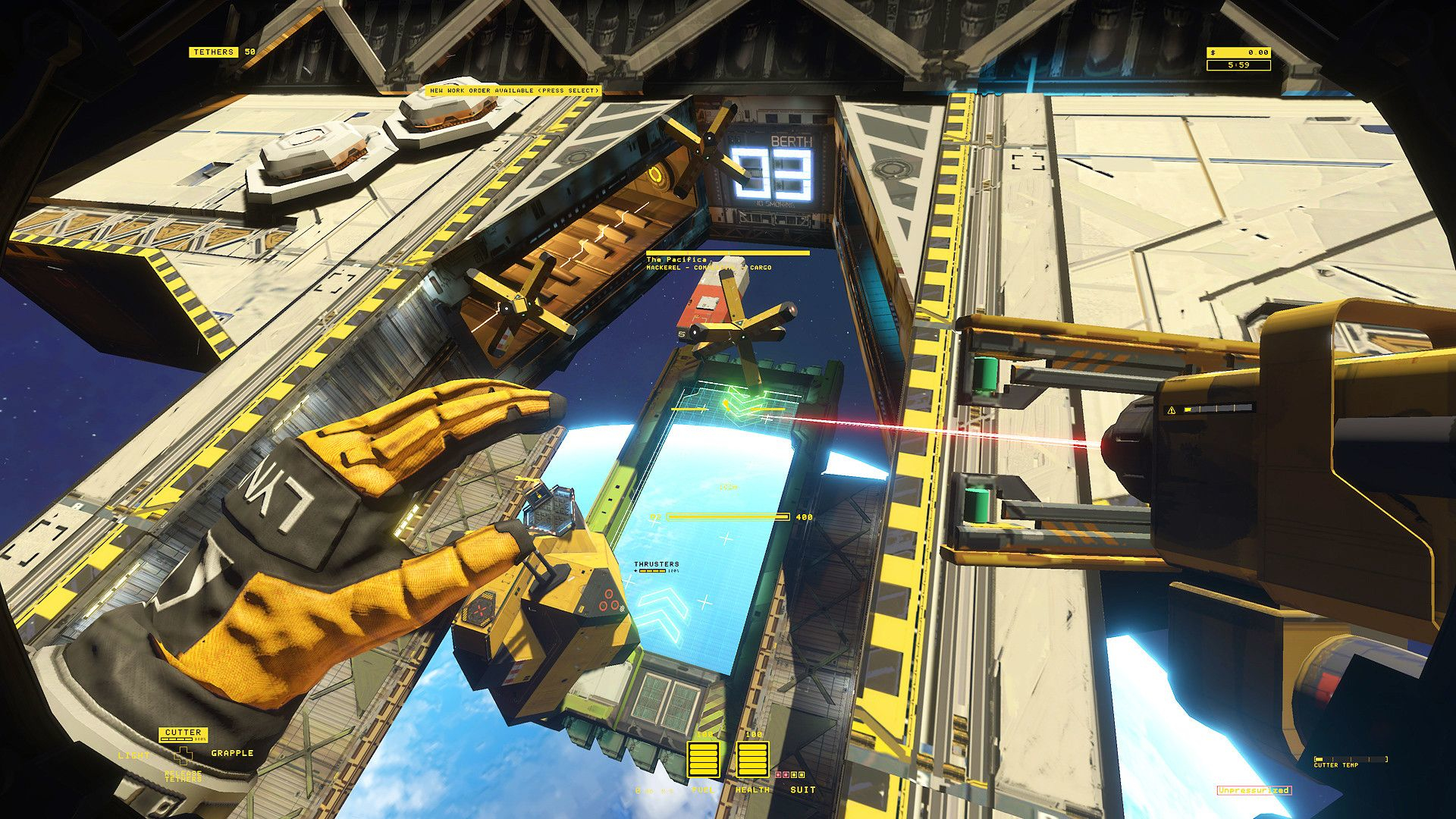
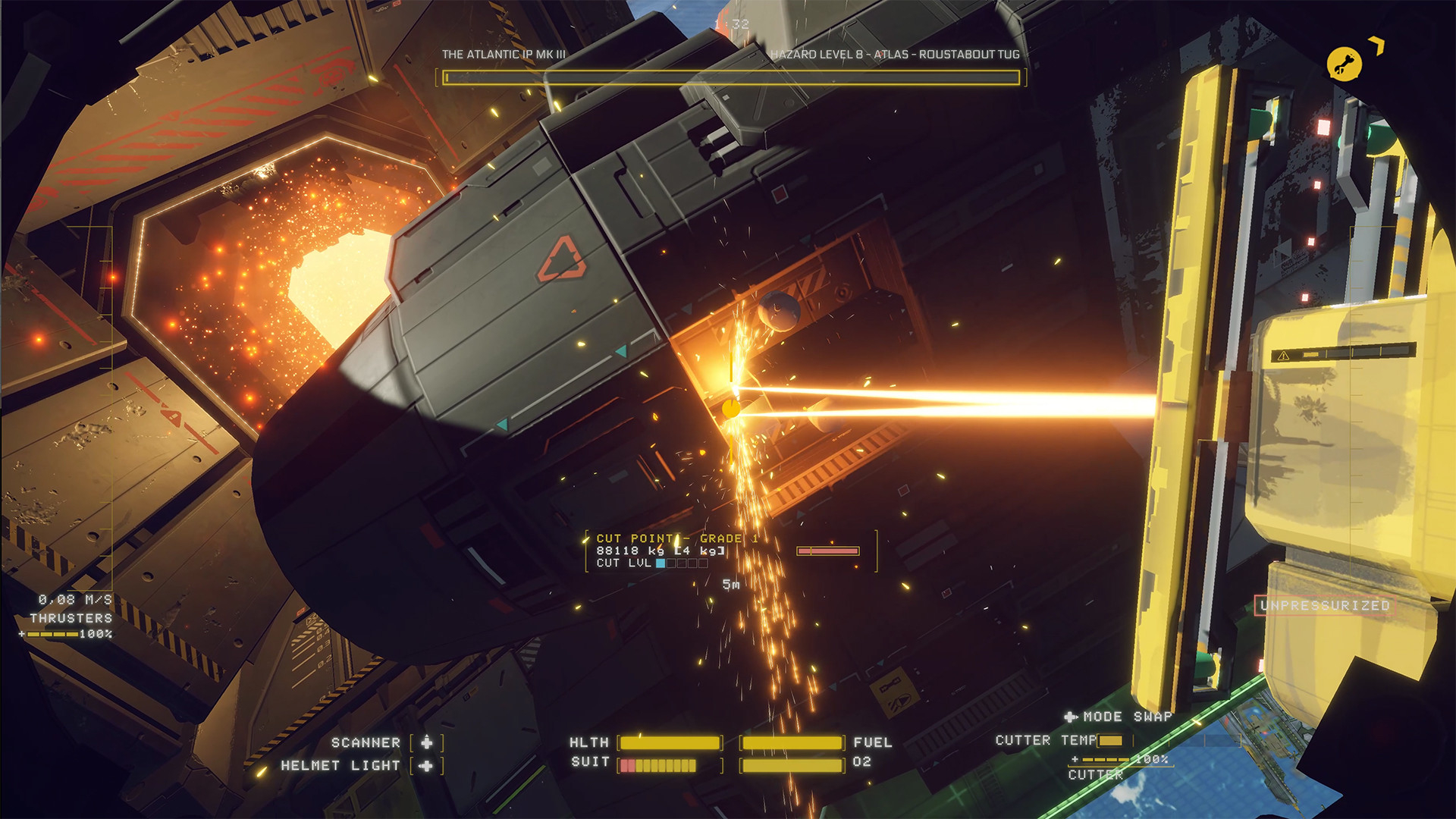
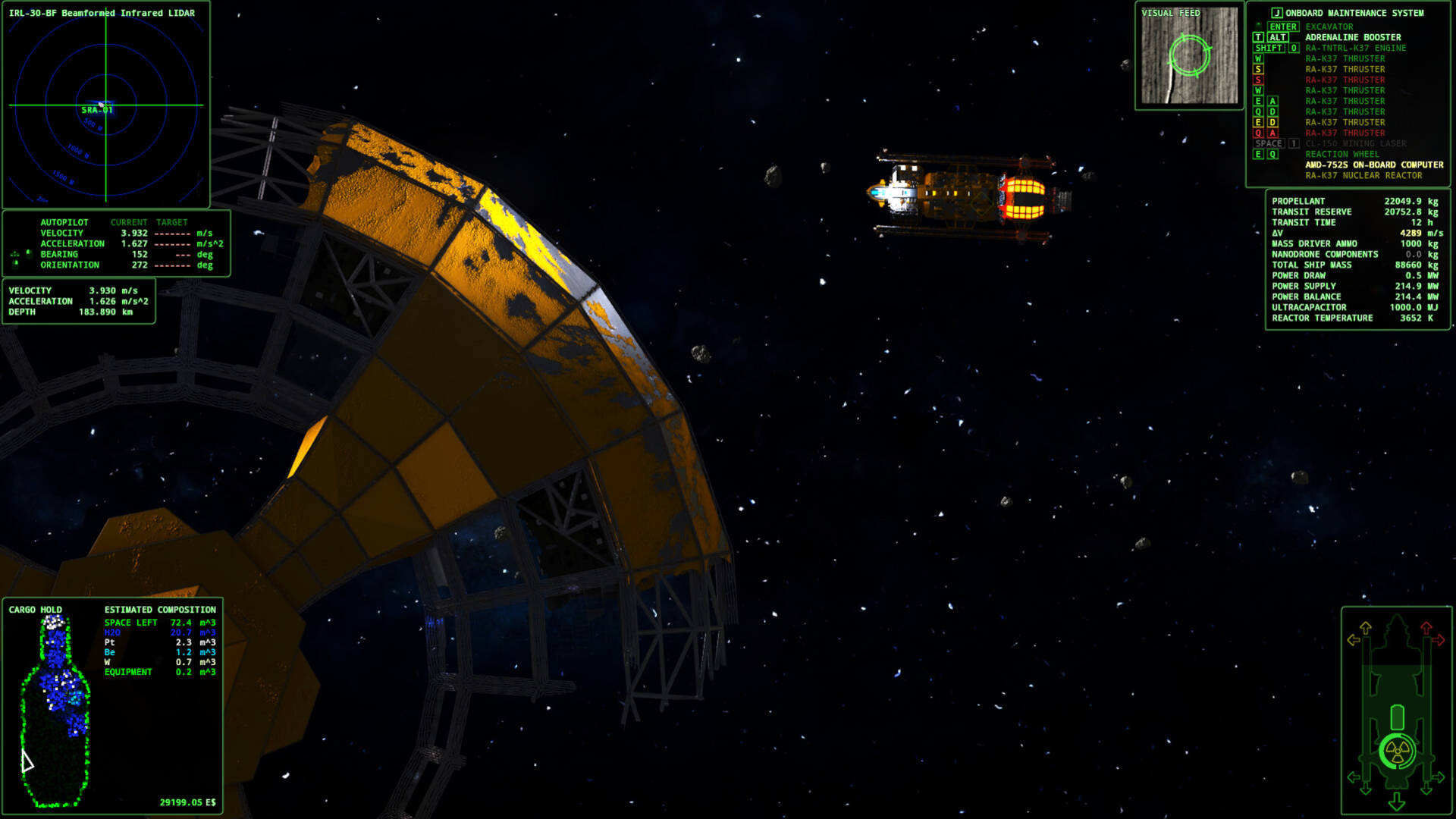
While Hardspace: Shipbreaker does an excellent job of capturing the dystopian perils of unchecked hypercapitalism, the real fun in thisspace game comes from carving up massive capital ships with space lasers and explosives.
Floating in zero gravity, players slice derelict spacecraft into salvageable chunks, while also contending with unruly physics, pressure, and profit margins. It's a compelling fantasy: orbital blue-collar labor, where yesterday's spacecraft become tomorrow's raw materials.
As satisfying as the simulation is, the real-world challenge of space debris removal is both more constrained and more urgent.
(Image credit: Blackbird Interactive)
Christian Steimle is the Project Manager of the European Space Agency's (ESA) ClearSpace-1 mission, the first ever aimed at removing a piece of debris (in this case, a satellite called PROBA-1) from low-Earth orbit.
We spoke to him to get a sense of how actual space junk removal will happen in the future, and how it stacks up to the representations we see in sci-fi games like Shipbreaker.
The fantasy of orbital demolition
(Image credit: Blackbird Interactive)
Games like Hardspace: Shipbreaker, ΔV: Rings of Saturn, and other space cleanup simulators tend to emphasize three core ideas: that debris can be dismantled piece by piece, that tools can safely cut or break apart structures in orbit, and that salvage is economically driven and scalable.
While they may be necessary assumptions to make for engaging gameplay, they diverge pretty significantly from current realities.
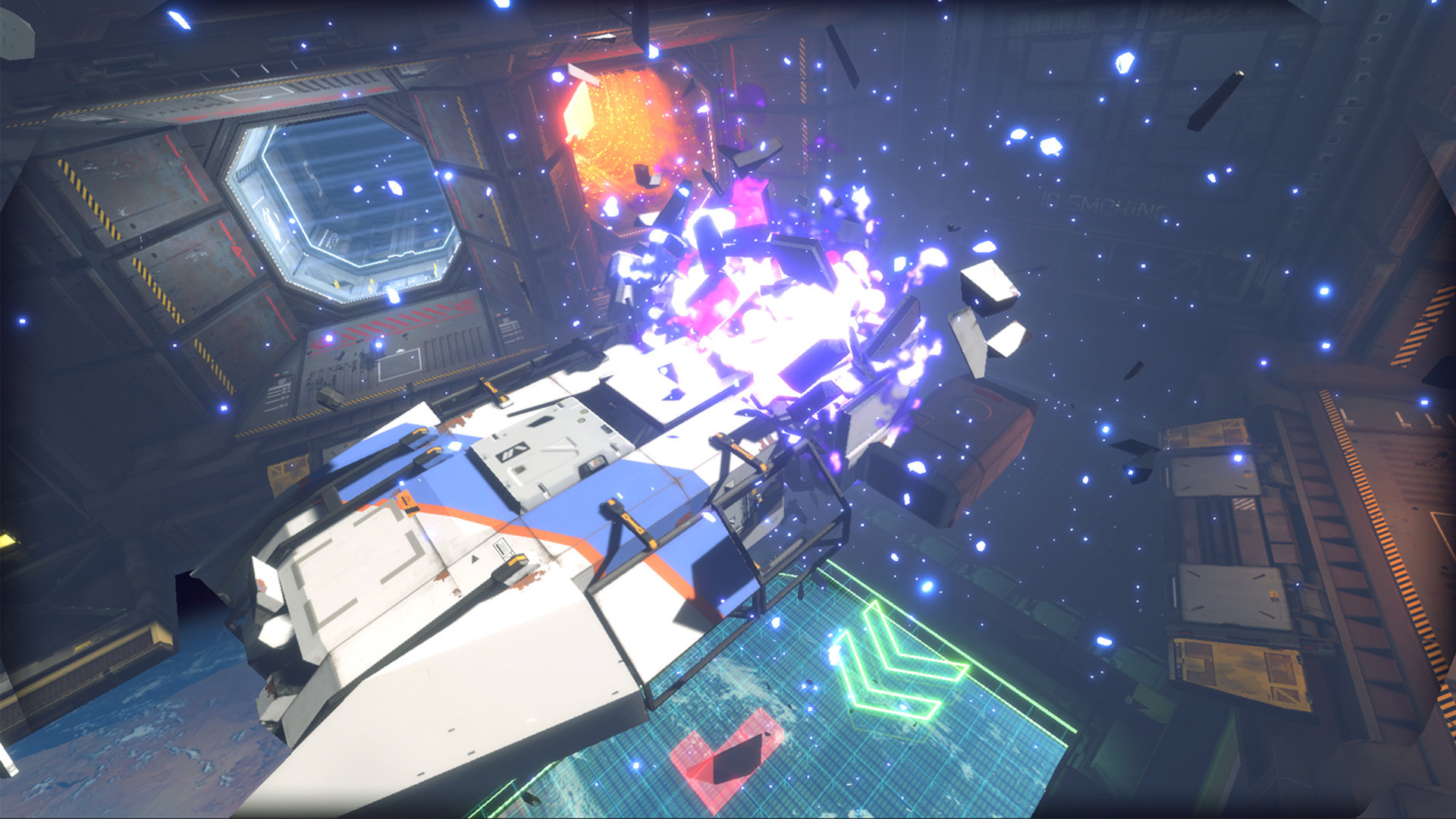
The main issue is fragmentation. Breaking apart a defunct satellite, even under the most carefully controlled and monitored conditions, risks generating thousands of high-velocity fragments. Some of those generated would be too small to feasibly track, yet large enough to destroy operational spacecraft, satellites, or stations. This is the nightmare scenario behind the Kessler syndrome, a cascading chain of collisions that could render entire orbital pathways unusable.
(Image credit: Blackbird Interactive)
As Christian Steimle, Project Manager for the European Space Agency's ClearSpace-1 mission, explains, "The common agreement between all of these missions is that objects to be removed shall not be broken up or damaged… especially to avoid creating smaller debris which is more difficult to track."
That means that the core mechanic of many space salvage games (cutting or exploding things into smaller bits) is precisely what real missions are designed to avoid.
How real debris removal works
(Image credit: Clearspace)
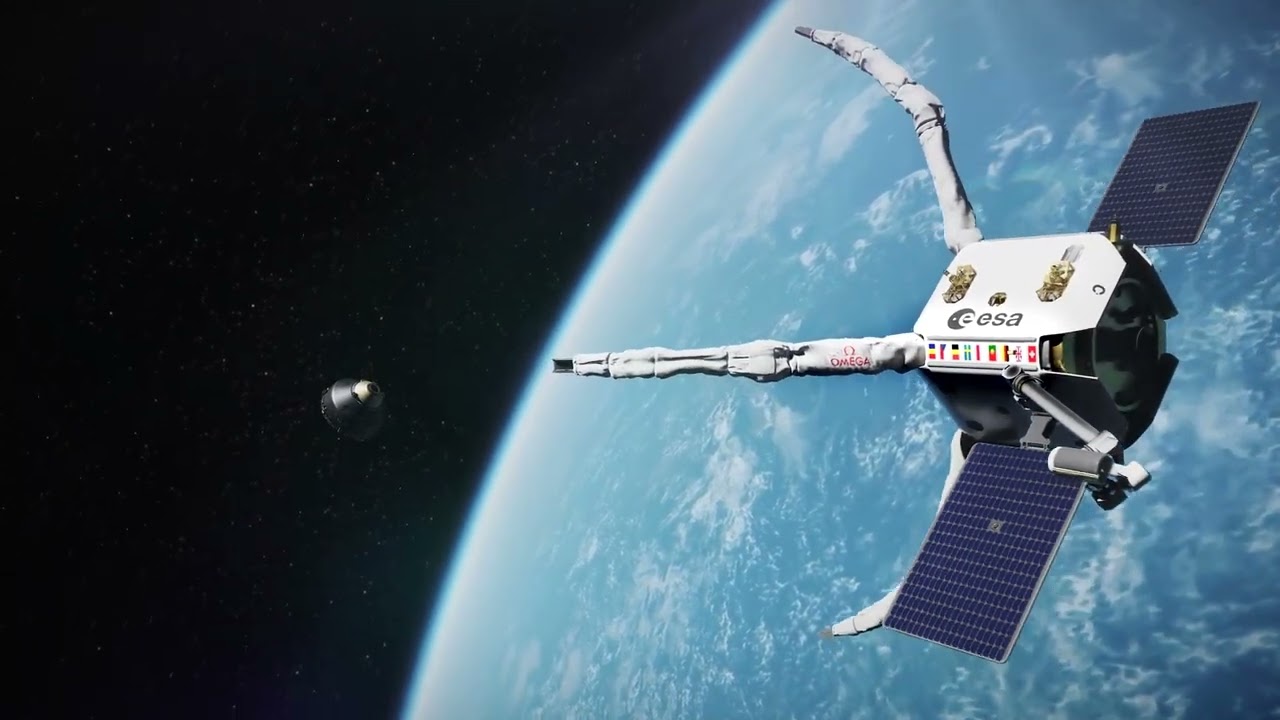
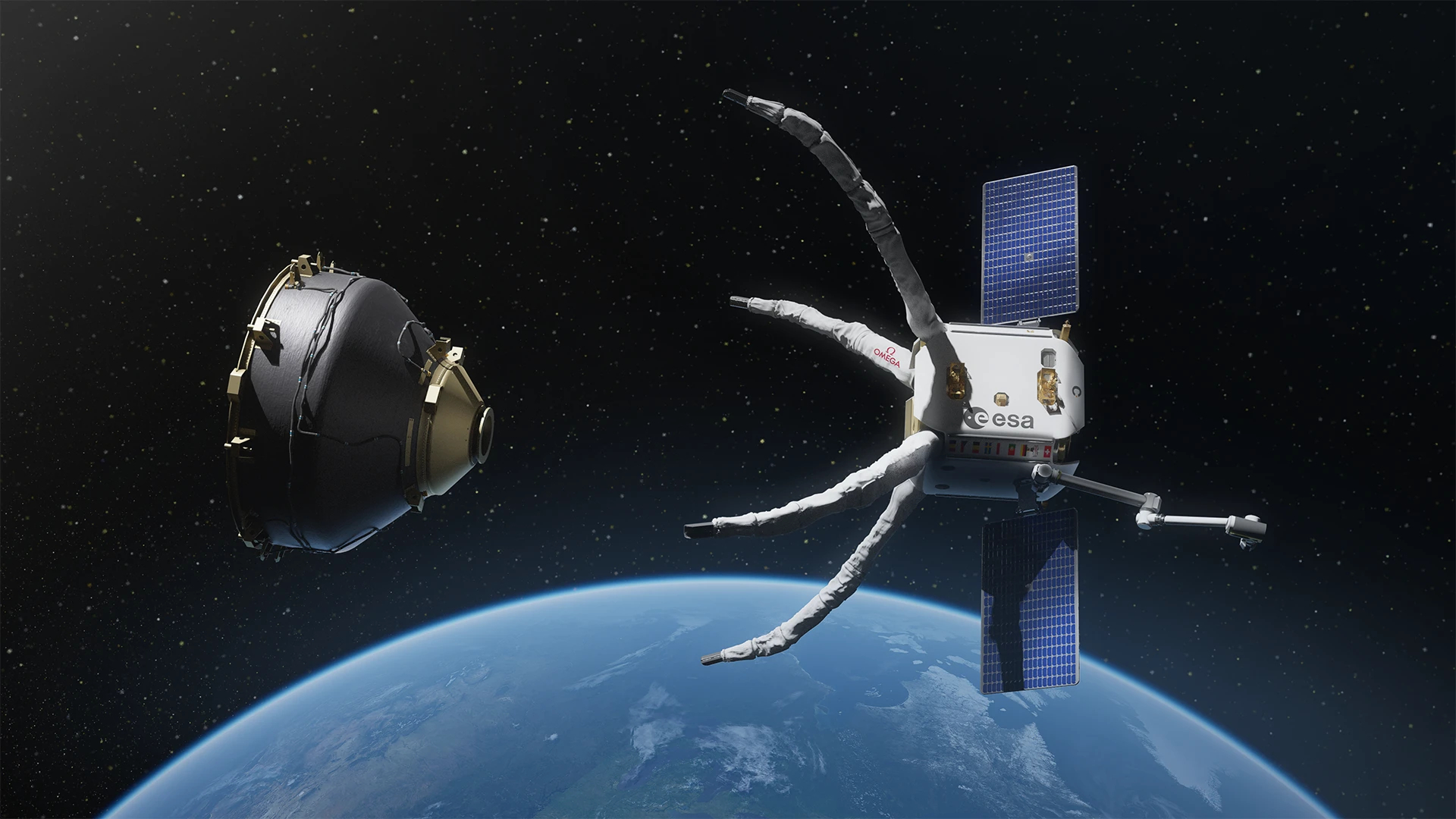
ClearSpace-1 takes a more holistic approach. Instead of dismantling debris, the mission aims to capture PROBA-1 with as little initial damage as possible, then guide it to destruction in Earth's atmosphere.
"ClearSpace-1 will be launched into a position slightly below PROBA-1 by a dedicated launch," Steimle says. "After successful commissioning, the ClearSpace-1 servicer will inspect PROBA-1 in a number of fly-around manoeuvres."
These inspection passes are not just reconnaissance. They validate visual navigation systems and analyze how the target object is tumbling so the capture vehicle can respond appropriately.
The capture itself is a delicate operation. "The ClearSpace-developed capture system will encompass the client satellite, first forming a cage around PROBA-1, then closing the cage carefully to avoid damaging the client," Steimle explains.
Once secured, the combined spacecraft must be stabilized before any orbital change. Only then can the system lower its orbit, ensuring both objects burn up safely during re-entry. "ClearSpace-1 is designed to demise during re-entry, ensuring on-ground safety and disposal at the same time."
The process more closely resembles a surgical extraction of potentially hazardous material than scrapyard demolition.
What games get right
(Image credit: Kodera Software)
Despite their liberties, space cleanup games do hit the mark in a number of areas. One is the importance of orbital mechanics. Many games emphasize inertia, momentum, and the difficulty of stopping or redirecting large masses. Real active debris removal (ADR) missions face similar constraints, where even small velocity mismatches can lead to mission failure or damage to the capture vehicle or target.
The danger of uncontrolled motion is also well represented. Tumbling objects are among the hardest targets in space operations. Synchronizing with them requires precise, multi-axis propulsion and control systems. As Steimle notes, future vehicles must "synchronise [their] motion with a potentially tumbling space object and apply the proper control to detumble." One of the main challenges in games like Shipbreaker is avoiding being clobbered by moving debris, especially after you've detonated some explosives, or matching the speed of a rotating component long enough to cut it apart.
Third, specialization is key. Your toolkit and how you use it in games like Shipbreaker is key, and real missions rely on highly tailored capture systems. Each target may require a different approach, from robotic arms to nets, harpoons, or enclosure systems like ClearSpace's.
Where the simulations fall short
(Image credit: Clearspace)
The biggest gap between games and reality isn't the tech, it's risk tolerance.
In games, mistakes are recoverable. In orbit, a single error can generate long-lived debris fields traveling at roughly 7–8 kilometers per second, turning tiny fragments into deadly kinetic weapons.
Games also tend to assume an eventual salvage economy, where materials are recovered and reused in space. While in-orbit manufacturing and recycling are active areas of research, current debris removal efforts aren't about profit. They're about mitigation.
"The overarching requirement is to preserve the space environment around the Earth for use by future generations," Steimle says. "Removing large objects before first collisions occur is key."
There are also orbital regime differences that games rarely address. In geostationary orbit (GEO), for instance, debris is not deorbited but moved to a higher "graveyard orbit" due to the prohibitive energy cost of re-entry. This kind of orbital zoning has no real analogue in most gameplay systems.
The future of orbital cleanup
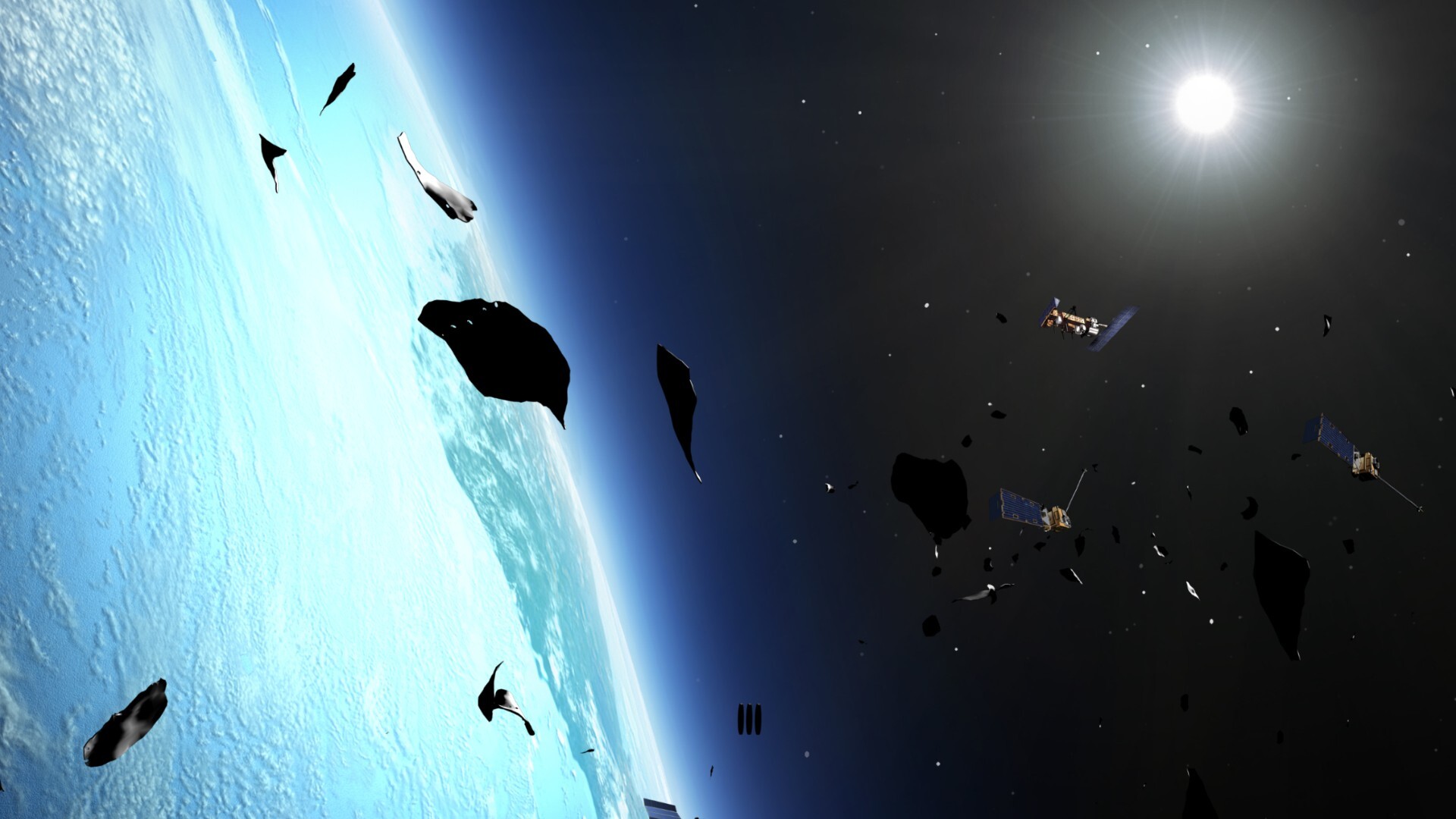
Illustration of space junk around Earth. Space junk consist of debris left in orbit from space missions: abandoned or broken satellites, satellite pieces, tools dropped by astronauts, or even space rocks captured into Earth orbit. (Image credit: Mark Garlick/Science Photo Library/Getty Images)
Looking ahead, the field of in-orbit servicing and debris removal is diversifying rapidly. Steimle says agencies and private companies across Europe, the United States and Japan are developing competing capture technologies and mission architectures.
Low-Earth orbit operations will likely favor agile, highly maneuverable vehicles capable of complex rendezvous and stabilization tasks. GEO missions, by contrast, will involve larger, less dynamic spacecraft performing long-duration servicing and relocation.
What remains consistent is the guiding principle: do no harm to the orbital environment. There's little room for the improvisational cutting and explosive decompression you see in most space salvage games. Instead, the future of orbital cleanup will depend on autonomy, precision guidance, and tightly controlled interactions with fragile, often unpredictable objects.
Fiction vs. necessity
An artist's illustration of space junk orbiting Earth. (Image credit: NASA)
Perhaps tellingly, most space cleanup games focus on the economy of salvage. You're tasked with generating profit, or feeding it into a progression system to purchase new tools or more efficient methods of destruction. In reality, the immediate challenge is more conservative and more urgent: preventing a runaway cascade of collisions that could close off access to space altogether.
If anything, the contrast highlights just how precarious Earth's orbital environment has become. The fantasy is not that we can break things apart in space; it's that we can continue to use space safely without cleaning up the vast constellations of trash we've already left behind.
German startup Rocket Factory Augsburg (RFA) just put the brakes on its first launch.
While testing its RFA One rocket on the launch pad at the U.K.'s SaxaVord Spaceport on the Shetland Islands in Scotland, the company found "an issue with the vehicle that requires further investigation," RFA wrote on X on Wednesday (July 28). Previously, the launch had been expected to happen in August or September, but RFA did not disclose a new launch date.
RFA did not disclose the nature of the issue, but said it would de-stack the staged rocket and that it would provide more details as the investigation continues. The situation means that the U.K. will need to wait at least a few more weeks to attempt its first-ever vertical launch from the region, amid global constraints in launch capacity and calls for increased European spaceflight autonomy.
RFA One, a smaller rocket designed to launch smaller satellites, is a three-stage rocket that will eventually include a reusable first stage in an effort to push down cost and to increase launch cadence. It will target a range of orbits, with examples including geosynchronous (where a satellite can constantly look at one area of the Earth), polar (allowing satellites to scan the whole Earth, as the planet orbits underneath) or sun-synchronous (which gives consistent lighting conditions.)
It's common for new rockets to encounter issues during development, including in later stages such as integrated pad testing or even during the first launch, because spaceflight is inherently hard. That said, there is more pressure on startup launching companies than ever to achieve their goals quickly, for commercial and defense reasons.
Rocket Factory Augsburg conducts a hot fire test of their RFA One launcher stage at Saxavord Spaceport in November 2024. (Image credit: RFA)
Rockets are in high global demand in large part due to constantly launching satellite batches for large satellite constellations, most especially SpaceX Starlink, and planned orbital data centers. Simultaneously, the U.S. Department of Defense is asking companies to launch more often for security missions, such as the quick-turnaround VICTUS HAZE mission that Rocket Lab launched in June only 16 hours and 42 minutes after receiving the military's request.
Conflicts in Ukraine and Iran and other defense activities, meanwhile, have pushed other countries into more sovereign launch work that is accelerating already ongoing spaceport construction, in jurisdictions such as the U.K., Europe and Canada.
RFA has been trying to position itself as one of the leading new companies in Europe, on the back of receiving a spaceflight operator license in January, from the UK Civil Aviation Authority, for the SaxaVord spaceport launch. Meanwhile, SaxaVord is working to become an alternative to older, busier launch ports (especially Kourou's Guiana Space Centre, a popular location for high-profile launches such as the James Webb Space Telescope.)
"This is a groundbreaking moment for RFA and for Europe's space industry," Jörn Spurmann, RFA chief commercial officer, said in a statement released shortly after his company obtained the license. "Securing the first-ever launch license outside the European Space Agency's established site in Kourou is not just a regulatory milestone—it's a powerful endorsement of our technical excellence and a turning point for European space innovation."
Rumors are also abounding in the industry that the popular SpaceX Falcon 9 rocket, which companies worldwide use for rideshare missions, might not be accepting slots for its popular Transporter series beyond 2028 or 2029. If this happens, the demand in launch capacity transferring from SpaceX might lead to more opportunities for companies such as Rocket Lab and RFA One, assuming more rockets are ready in time.
The excitement of the new moon mission has potentially helped create a new generation of stargazers, just like the Apollo program did 60 years ago. These new observers will be looking for a beginner’s telescope that is easy to use and which can show them the craters on the moon in particular. The Celestron Moon Mission 100mm Tabletop Dobsonian could be the perfect entry point for them. It has a superb price-point for its aperture, and is capable of bringing not only the moon, but double stars, the brighter galaxies and nebulas and the moons of Jupiter to your backyard.
The Celestron Moon Mission 100mm Tabletop Dobsonian comes equipped with 8mm and 20mm eyepieces, one of which is intended specifically for the moon, as well as a red-dot finderscope, a moon filter, a moon-map poster and free access to download the Starry Night planetarium software and Celestron’s SkyPortal app, which is powered by SkySafari.
All in all, it will make an excellent package for someone to get started enjoying the night sky. Though the optics and accessories are not perfect, for the price their drawbacks can be overlooked, and as an entry-level telescope it paves the way for the user to graduate to increasingly more sophisticated telescopes at a later date.
The lack of a tripod means this telescope does have its limitations but any stable, flat surface will suffice. (Image credit: Gemma Lavender)
Quick and simple set-up
Portable
The Celestron Moon Mission 100mm Tabletop Dobsonian comes out of its box complete, other than its eyepieces and red-dot finderscope in plastic bags. Set-up takes literally minutes — remove the plastic cap over the aperture and the cap on the focuser, insert your eyepiece of choice, screw on the finderscope and you are ready to go. No tools such as screwdrivers or Allen keys are needed— it is just a matter of unscrewing thumbscrews.
We found the finderscope went on easily — more about that later. However, the tiny thumbscrews that lock in the eyepiece were incredibly tight. Pliers didn’t help much and risked damaging the screw. In the end, we found elbow grease was just about enough to unscrew them, but if our review model is typical, then children will definitely need the help of an adult to unscrew these. Once they are unscrewed, they can be tightened to more forgiving tolerances.
Adults may be needed to help smaller children install the thumbscrews that hold the eyepiece in place. (Image credit: Gemma Lavender)
Specifications
Optical design: Newtonian reflector
Aperture: 3.9 in (100 mm)
Focal length: 15.75 in (400 mm)
Focal ratio: f/4
Eyepiece focal lengths & magnification: 20mm (20x) and 8mm (50x)
Weight: 2.4 lbs (1.08 kg)
Mount type: Dobsonian
Overall we can recommend the build quality of the Celestron Moon Mission 100mm Tabletop Dobsonian. Everything is sturdily made, from the Dobsonian base, the optical tube, the easily adjustable tilt and focuser knobs. The mount has a single arm and rotates on a ‘lazy Susan’ turntable.
The Moon Mission's focuser can be a little finicky, as we discovered. (Image credit: Gemma Lavender)
Three
Bullet
Points
This is where we thought that the Celestron Moon Mission 100mm Tabletop Dobsonian excelled. For such a small telescope, it was decently versatile.
For example, on the night of April 5, our first target was Jupiter, which was bright in Gemini, and unmistakable as it lay not far from the constellation’s twin stars Castor and Pollux. Jupiter appeared as a bright disk, with perhaps the merest hint of its banding — or was that our imagination? What certainly were real were the four Galilean moons: Io and Europa on one side, Ganymede and Callisto on the other. It was a sight sure to impress beginners and casual observers.
We moved the Celestron Moon Mission’s view towards the multiple star Castor, and the telescope capably split the main binary pair as two close, white stars using the 20mm eyepiece. Another popular multiple star is Mizar and Alcor in Ursa Major. Of course, Mizar and Alcor can be split with the naked eye, but the third visible star in the system is for telescopes only, and again the Celestron Moon Mission showed the three stars clearly.
Slewing east, Arcturus — the second brightest star visible from the U.K., and fourth brightest in the entire sky — appeared a glorious red, evoking its nature as a red giant.
While waiting for the moon to rise (and before taking some time out to watch the Artemis II coverage), we decided to track down some faint fuzzies. The box that the Celestron Moon Mission comes in highlights the Orion Nebula and the Andromeda Galaxy as two deep sky objects that the telescope can see. At the time of testing, the Orion Nebula was too low in the west, while the Andromeda Galaxy was not visible. Instead, we hunted down two other nearby galaxies, M81 and M82, in Ursa Major.
Searching for these two galaxies, which are located next to each other in the same field of view, is where the real challenge of using the finderscope, as we described in the Functionality section, really reared its head. In the end, we decided to star hop to the galaxies and struck out in roughly the right direction. Soon the telescope alighted on the two galaxies, visible as two fuzzy patches of light. Looking at them straight on, we found it difficult to discern their shape, but by using averted vision as we looked through the 20mm eyepiece of the Celestron Moon Mission, we could make out the broad disk-shape of the spiral M81, and the elongated cigar shape of M82, and even caught hints of mottling with brighter spots in the edge-on M82 that are better seen in images.
You'll likely use the eyepiece more frequently than the finderscope. (Image credit: Gemma Lavender)
After we watched the live NASA feed of Artemis II going around the far side of the moon, the moon finally rose from our location after midnight. Its phase was a waning gibbous three days after full. As such, the moon appeared bright and reddish, being low to the horizon. Through the 20mm we could see the whole disk, though the phase meant that for most of the lunar surface there was no contrast, making it harder to distinguish craters except for at the terminator.
Adding the 1.25-inch moon filter — more properly known as a neutral density filter that dims the incoming light — helped to limit the contrast and make the details stand out more. Switching to the 8mm eyepiece, with a magnification of 50x, the view jumped closer to the moon and the lunar surface filled the field of view, with bright crater rays visible on dark lunar mares.
As a Newtonian reflector, the Celestron Moon Mission 100mm Tabletop Dobsonian provides an inverted image. (Image credit: Gemma Lavender)
Finderscope is awkward to use when pointed at the zenith
Focusing is adequate
Simple to use
The tabletop nature of the telescope poses some challenges for adults using it. As its name suggests, the telescope is designed to go on the top of a table. Usually when we think of Dobsonian telescopes, we think of very large instruments with very large apertures, and eyepieces close to standing height. This Dobsonian, on the other hand, is very small, and without a very tall table we found that we spent a lot of our time bent double looking through the eyepiece. Of course, this also means it is the perfect height for a child.
We found it did pose a problem when using the finderscope. For objects at low elevations, such as Jupiter in Gemini during spring 2026, we found it wasn’t too bad. However, when we wanted to direct the telescope towards Ursa Major at the zenith, the only way we could look through the finderscope was by literally getting on the floor to look through it. This is a problem with all tabletop telescopes, not just the Celestron Moon Mission, and it would be unfair to suggest otherwise — but it is a problem nonetheless.
Once we addressed the tightness of the focuser thumbscrews, we could switch the eyepieces in and out with ease. We found the focuser to be perfunctory. It provides only coarse focusing, with no careful fine-tuning, and sometimes it was tricky to find the sweet spot. Additionally, Newtonian reflectors like this one require collimating for perfect pin-sharp images. Collimating refers to adjusting the secondary mirror (the primary mirror is fixed at the base of the optical tube) so that it aligns and focuses light reflected from the primary just so. It’s also a fact that astronomers hate collimating, as it is a finicky procedure.
The scope comes with 8mm and 20mm eyepieces, and can handle most 1.25-inch eyepieces. (Image credit: Gemma Lavender)
Out of the box, the collimation wasn’t bad, and we felt it was also unreasonable to expect beginners and children, whom this telescope is undoubtedly aimed at, to collimate the instrument with no guidance or tools included. Therefore, we reviewed the telescope as it came out of the box, to replicate the experience that beginners and children would receive. Had we collimated the telescope, then it probably would have improved the image a tad.
We found that actually using the telescope, in terms of positioning and pointing, was very simple. It’s worth remembering that Newtonian reflectors reverse their image (up becomes down), and after using smart telescopes, GoTo telescopes and Celestron’s StarSense telescopes with directions provided by a smartphone for so long, that took a little getting used to again! It may confuse beginners and children, but before the days of smart telescopes and GoTo, everybody had to get used to navigating across the sky using a reversed image, so it’s no bad thing.
Should you buy the Celestron Moon Mission 100mm Tabletop Dobsonian
Buy it if:
✅ You are a beginner
✅ You are a parent wanting to introduce your child to the night sky
✅ You are looking for ease of use
✅ You are working on a budget
✅ You need portability
Don't buy it if:
❌ You are a serious observer and need larger apertures
❌ You are an astrophotographer and need a driven mount
❌ You want a high-tech instrument with smart capabilities
❌ You don’t want to have to star-hop and would prefer a GoTo
If you want to introduce your children to astronomy, then the Celestron Moon Mission 100mm Tabletop Dobsonian is the perfect instrument. It is safe to use, with no risk of knocking something heavy over, as it weighs about the same as a bag of sugar, which is amazing really. It is simple to use, in the sense that it is just a matter of pushing and turning, although children might need assistance in pinpointing the location of targets. It’s also a fair all-rounder, as all Dobsonians are – it excels at showing the moon, displays the planets very well, and shows deep-sky objects as best it can for a 100mm-aperture telescope
If you want to see fainter galaxies and nebulae, then you will need a telescope with a larger aperture. If you want to do imaging, then you will need a telescope with a motorized equatorial drive to enable you to track the objects while imaging.
And if you want assistance in finding celestial objects without having to star-hop, then a GoTo or smart telescope might be best for you.
If the Celestron Moon Mission 100mm Tabletop Dobsonian isn't for you
How we tested the Celestron Moon Mission 100mm Tabletop Dobsonian
We put the Celestron Moon Mission 100mm through its paces, gazing both at deep space and objects in our own solar system. (Image credit: Gemma Lavender)
We used the Celestron Moon Mission 100mm Tabletop Dobsonian during the occasional clear nights in the first two weeks of April 2026 from our south-facing garden in the United Kingdom. The temperature was clement, about 50 degrees Fahrenheit (10 degrees Celsius), with some modest light pollution to the north and dark skies to the south looking towards a more rural area.
We began observing after 10 pm, with the skies completely dark. The moon was near full at the time of testing — in fact, quite fittingly, one of the nights was the same night that the Artemis II mission went around the moon. However, the moon remained low the entire night, meaning it could only be viewed near moonrise after midnight, close to the horizon, before it became hidden behind a nearby bank of trees for the rest of the night.
Related articles
Want help choosing the right stargazing equipment? We have guides to the:
As evidenced by Paramount's live-action "Transformers" movies and the recent "Masters of the Universe" film released by Amazon MGM Studios, nostalgic toy lines can serve as fertile grounds for a variety of engaging Hollywood projects leaning into vintage intellectual properties.
With Mattel ramping up their own film production efforts and toy-to-screen endeavors after enormous success with "The Barbie Movie" and hi-octane plans for Hot Wheels movies rolling into theaters, the toys-to-silver screen craze shows no sign of slowing down. What could be next? We think there's a perfect choice hiding in the Mattel goldmine that might just become the next big thing.
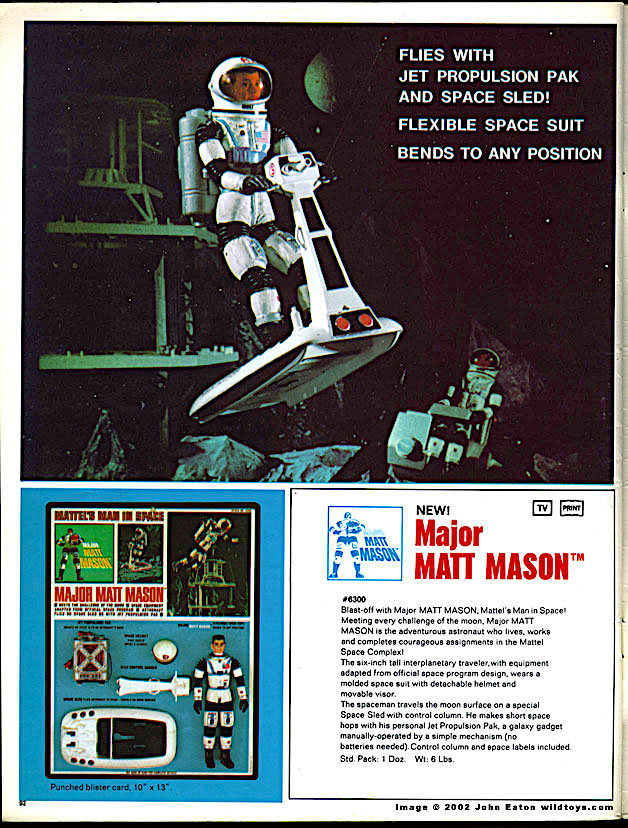
We're of course talking about Major Matt Mason, that Plastisol astronaut action figure and kids' playset product line from the 1960s, which is celebrating its 60th anniversary this year.
Born in the 1960s, during the heat of America's space race with NASA's Apollo program aiming for the lunar landing by the end of the decade, Mattel's design mastermind's found inspiration in visionary space concept artists' wild dreams of futuristic moon bases, lunar buggies, and space vehicles.
Major Matt Mason was one of the first serious space toys to exist in the marketplace, first hitting the shelves of toy shops and department stores across the country in 1966.
Capitalizing on the daily news stories of Gemini missions and Apollo moon-walking dreams, this spacefaring fellow and his astronaut pals let kids everywhere imagine colorful cosmic adventures.
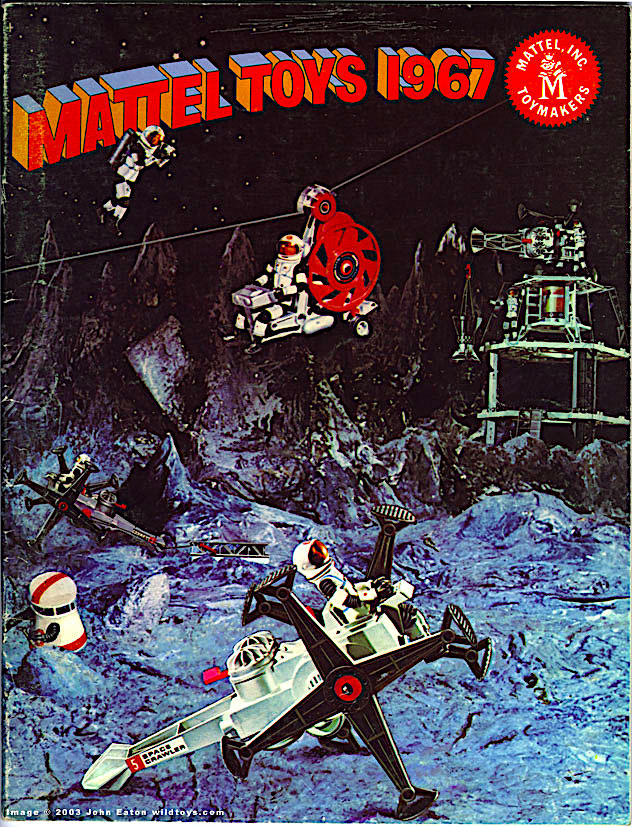
The expanded line of Major Matt Mason's vehicles and playsets shown in a 1967 catalog. (Image credit: Mattel)
Back in 2019, Variety reported that Tom Hanks was attached to star in a Major Matt Mason live-action film being set up at Paramount Pictures with Akiva Goldsman ("A Beautiful Mind," "The Da Vinci Code") hired to write the screenplay.
Hanks is an enthusiastic advocate of NASA history after starring in Apollo 13 and co-executive producing the Emmy Award-winning HBO docuseries "From The Earth To The Moon" alongside "Band of Brothers" super producer Graham Yost. Despite the heavy hitters attached, momentum has since stalled on the sci-fi project and it's sadly been shelved for the immediate future.
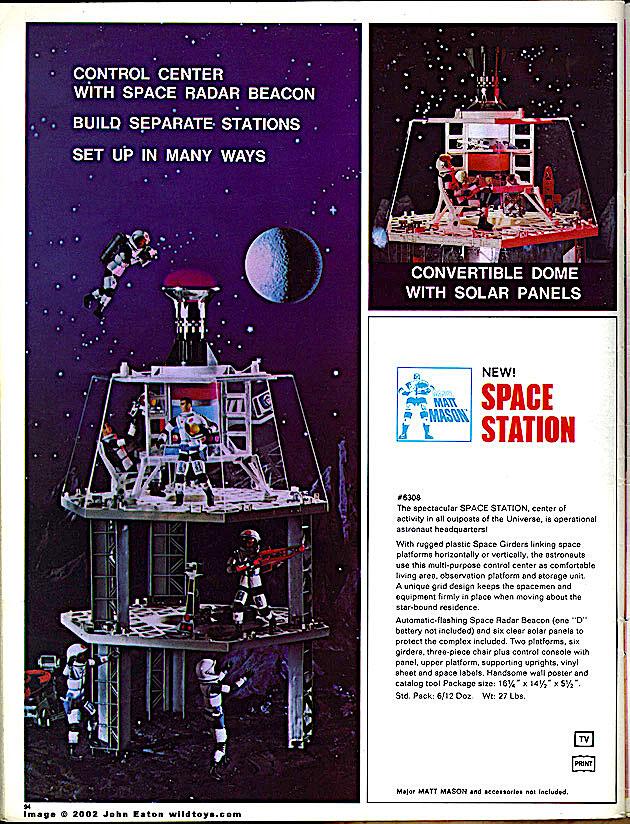
Matt Mason and his astronaut buddies score their own space station. (Image credit: Mattel)
Matt Mason's line-up of bendy 6-inch astronaut action figures was developed as a competitor to Hasbro's 12-inch G.I. Joe toys that ruled the marketplace in the mid-60s.
Along with Matt's fellow rubberized space buddies — available in a variety of color-accented spacesuits — Mattel also offered a complete universe to create your own space outpost and ramped lunar headquarters, alongside accessory vehicles, moon gear, expansive playsets, and Matt's "allies from the stars": A purple-and-pink creature called Scorpio, and a green-skinned friendly Jovian alien called Callisto.
Some of Major Matt Mason's retro-cool lunar accessories included a jet propulsion pak and space sled. (Image credit: Mattel)
With the Vietnam War raging in Southeast Asia and televised on the nightly news, Major Matt Mason blasted into Sears and JCPenney catalogs when soldier action figures were losing their appeal.
He wasn't a gun-toting commando but a heroic explorer "ready and able to cope with any space task or fierce danger." In addition to the action figures and peripheral playsets, Matt Mason became a pop culture phenomenon with his own board game, coloring books, lunch boxes, and puzzles.
Named after Mattel's co-founder Harold "Matt" Matson, the Matt Mason line carried a certain air of authenticity as many of its designers happened to be former aerospace engineers. Some of the toys' far-out designs were taken straight out of NASA conceptual art and prototypes seen in the pages of Popular Mechanics, Life, and National Geographic magazines.
Matt Mason's space station could be built in many different ways. (Image credit: Mattel)
But, the general public is difficult to please for any extended period of time and following the Apollo 11 moon landing in July of 1969, space toys faded in interest. Just one year later, Major Matt Mason was no more, destined only to be coveted decades later as collectors items .
As NASA ramps up their Artemis program with 2027's Artemis 3 mission, before an Artemis 4 moon landing set for 2028, and the space agency doubling down on plans for a recently announced permanent lunar base, can there be any better time for Hollywood moguls to resurrect this cool project for a fantastic, retro-styled Major Matt Mason movie or TV series?
On Episode 221 of This Week In Space, Tariq Malik and guest host Rick Jenet of the National Space Society talk about SpaceX's Starship Flight 13, which deployed new Starlink V3 satellites and stunned viewers when the ship survived reentry intact enough to float in the ocean for days afterward.
They also discuss NASA's Roman Space Telescope, now just a month from launch, and an in-progress emergency effort to save the ailing Swift Space Observatory using a servicing spacecraft that is itself now experiencing technical trouble. Finally, they look into Boeing's continued Starliner delays and India's first successful private orbital launch via Skyroot Aerospace's Vikram-1 rocket. Tune in!
This Week in Space covers the new space age. Every Friday we take a deep dive into a fascinating topic. What's happening with the new race to the moon and other planets? When will SpaceX really send people to Mars?
Join Rod Pyle and Tariq Malik from Space.com as they tackle those questions and more each week on Friday afternoons. You can subscribe today on your favorite podcatcher.
Scientists once suspected that a brutal, years-long winter starved the dinosaurs following an asteroid impact 66 million years ago. New evidence suggests a more violent end: widespread firestorms that may have burned even thick-skinned dinosaurs to a crisp within hours.
The roughly six-mile-wide (10-kilometer-wide) asteroid struck Mexico's Yucatán Peninsula, excavating the Chicxulub crater and vaporizing enormous quantities of rock. Some of that material condensed into tiny droplets called spherules, which spread around the planet before falling back through Earth's atmosphere at several miles per second.
As the spherules slowed, their kinetic energy became heat, producing an intense pulse of thermal radiation. Earlier models suggested the effect would have resembled a worldwide broiler that was potentially deadly to exposed, thin-skinned animals, but not powerful enough to ignite vegetation across the globe.
A new study argues that those calculations overlooked a crucial ingredient: a thick layer of fine silicate dust formed from rock vapor that did not initially condense into spherules. Evidence for that dust emerged in 2023 from the Tanis fossil site in North Dakota, where researchers identified a layer of extremely fine, impact-derived material deposited above the spherules. A similar dust layer has since been documented at the K–Pg boundary (which divides the "age of reptiles" and the "age of mammals") in Raton Basin across the Colorado–New Mexico border.
"It reinvigorated my interest in what happened to the leftover vapor — that's where this work started," lead author Brandon Johnson, a planetary scientist at Purdue University, said in a statement.
The dust would have acted like an insulating blanket, preventing thermal radiation from escaping into space and redirecting more heat toward Earth’s surface. The researchers estimated that the surface heat pulse could have been about 3.5 times more intense than what was suggested by models considering the falling spherules alone. "We're in the realm where we might be essentially killing off everything within that first hour or two," Johnson said.
The radiation may not have directly ignited thick pieces of wood, but it exceeded ignition thresholds for grass, lichen, and pine needles, which could have fueled larger fires. The study also found that exposed terrestrial animals may have received about 17 times the thermal dose considered lethal to humans.
Animals sheltering underground or in water would have had a better chance of surviving the initial heat pulse. Afterward, the same dust may have blocked sunlight for years, triggering the prolonged "impact winter" more typically blamed for the dinosaurs' extinction.
There is, however, a missing element: the wildfire evidence that supports this dust-caused inferno theory has only been found in North America. "It could be that we will eventually find the record of completely global wildfires," said Alfio Alessandro Chiarenza, a paleontologist at University College London who was not involved in the study. "We just don't have it so far."
The study was published on July 28 in the journal JGR Biogeosciences.
On Aug. 1, 1968, NASA canceled the production of its Saturn V moon rocket. At the time, the giant rocket was the only launch vehicle to have ever carried astronauts beyond low-Earth orbit, and it was then the largest, most powerful rocket ever.
NASA built 15 of these rockets but only flew 13 of them. When NASA made the decision to stop building the Saturn V, it was almost a year before Apollo 11 astronauts would walk on the moon for the first time.
Giant rocket stages for NASA's Saturn V moon rocket are assembled at the Michoud Assembly Facility in this undated NASA photo. (Image credit: NASA)
A federal budget deficit and the rising costs of the Vietnam War led Congress to slash nearly three-quarters of the funding that President Lyndon Johnson had allotted for the Apollo program.
The last Saturn V launched in 1973, and it was originally supposed to send Apollo 18 to the moon. However, that mission was canceled, and that Saturn V launched the Skylab space station instead.
Why it mattered
From start to finish, NASA spent a reported $9.4 billion on the Saturn family of rockets (which would be an estimated $118 billion in today's dollars) to develop the Saturn V. That includes the Saturn I and Saturn IB blocks. But the decision to shut production down in 1968 over those costs spelled the end of NASA's Apollo program to send astronauts to the moon a year before the Apollo 11 astronauts even walked on the moon in 1969.
Without a steady supply of heavy-lift rockets (the Saturn V was the most powerful of its day), NASA only had a limited number of moonshots left. The final Saturn V rocket to carry astronauts sent the Apollo 17 astronauts to the moon in 1972. The Skylab mission flew a year later, with the final Saturn IB rocket launching an Apollo command module on the Apollo-Soyuz flight in 1975.
It would not be until 2022, when NASA launched the first Space Launch System on the Artemis I mission, that the space agency had another megarocket to rival the Saturn V. In April 2026, that new rocket launched NASA's Artemis II astronauts around the moon.
Despite Han Solo's protestations to the contrary, travelling faster than light on screen is usually just as straightforward as dusting crops. So whether you're in "Star Wars", "Star Trek" or "Battlestar Galactica", jumping to hyperspace, going to warp or spooling up the FTL really is as simple as popping out to the store.
In fact, Albert Einstein's time-dilating general theory of relativity tends to be little more than an afterthought, with films highlighting the inconveniences of interstellar travel definitely in the minority. For this reason, the very existence of "Flight of the Navigator" is even more improbable than its premise.
The Disney family movie — which celebrates its 40th anniversary this weekend — sends an ordinary kid on an unlikely journey that's part "Interstellar", part "Back to the Future".
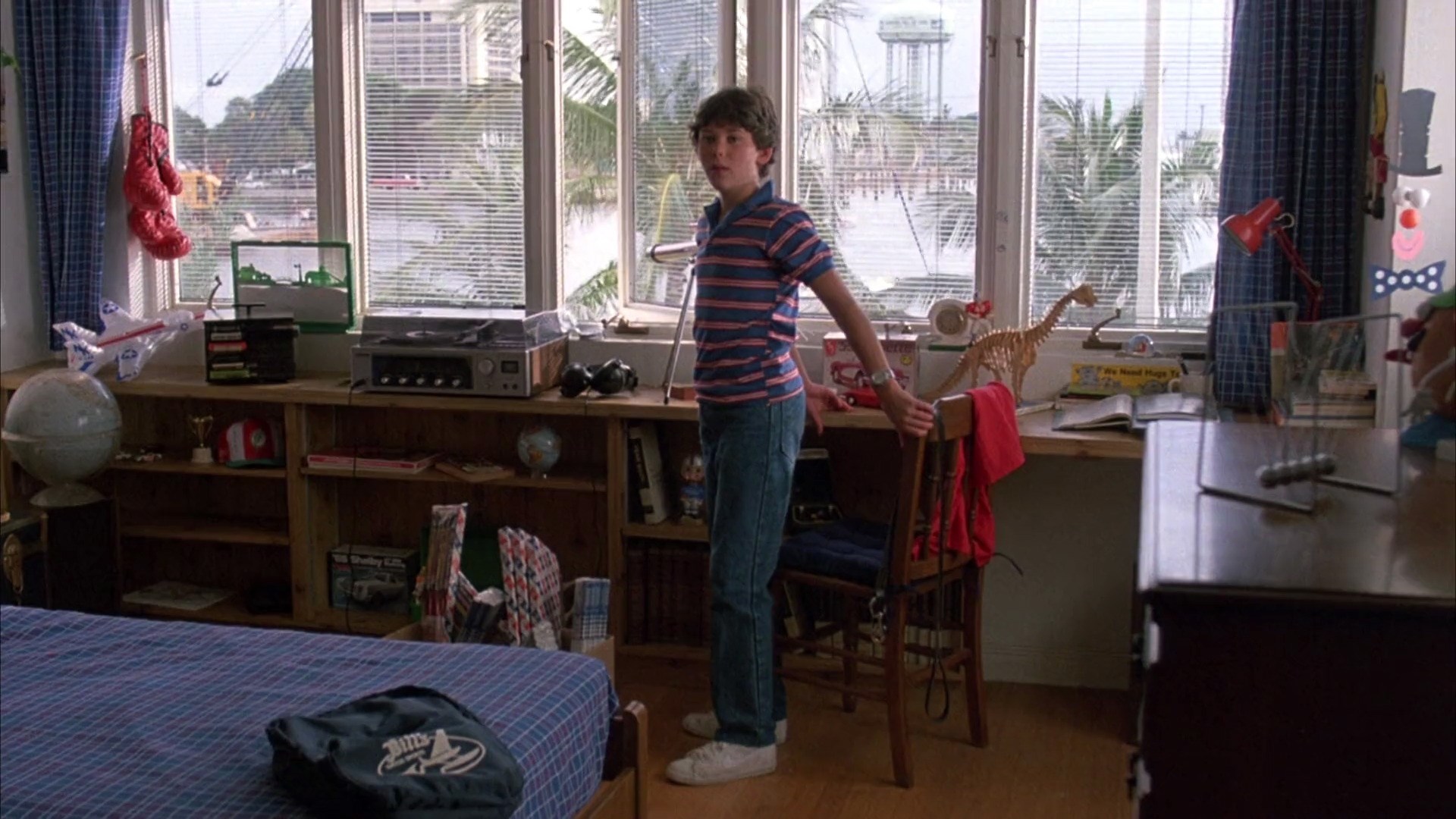
On July 4, 1978, 12-year-old David Scott Freeman is briefly knocked unconscious after he falls into a ditch near his Florida home. When he wakes up — seemingly moments later — he finds strangers living in his house, and gradually comes to realize that eight years have passed for everybody else. In the meantime, David has been declared dead, his little brother is now his big brother, and — perhaps weirdest of all — music videos are now a very big thing on MTV.
NASA scientists explain away the eight-year time slip as a consequence of "light speed theory", the idea that "time slows down as you approach the speed of light". And if that sounds like a big concept for "Flight of the Navigator"'s target audience to grasp, the filmmakers weren't particularly worried.
"I think kids can understand it," director Randal Kleiser said back in 2020. "'Back to the Future' was sort of like that, and kids are smarter than most people think. You just tell them that you’re going at the speed of light and time slows down, and they get it."
Kleiser was best known for the musical smash hit "Grease", the highest-grossing movie of 1978, when he got the "Flight of the Navigator" gig. When he came on board, the film's paymasters were already disagreeing about the direction they wanted to take Mark H Baker's story.
(Image credit: Disney)
Disney, unsurprisingly, were shooting for a family movie "with dancing little animals", while their production partners at Producers Sales Organization (PSO) were looking for something a little edgier. "They wanted to have the army come in and shoot down the spaceship," Kleiser recalled.
Eventually, a gun-free compromise was found, though the opening act of the movie would remain surprisingly bleak and emotionally complex. Now living in 1986, David has to come to terms with his new reality as a human guinea pig in a world where his family looks familiar, but he no longer really knows them. Also, how did his brain come to be filled with weird alien languages and complex star maps?
The role was always going to ask a lot of its actor, and Kleiser ultimately selected a young Vancouver native named Joey Cramer. Cramer beat hundreds of other kids to the role, including future Hollywood stars Chris O'Donnell and Joaquin Phoenix, who appeared in "Space Camp" the same year.
(Image credit: Disney)
"Joey was so easy to get to cry," Kleiser said of his casting decision. "For him to be able to do it in the audition — and be also so personable and likeable — was the thing that put him over the top."
Cramer's main co-star would prove even more difficult to find, however, seeing as faster-than-light spacecraft from distant worlds called Phaelon don't — as far as we know — exist.
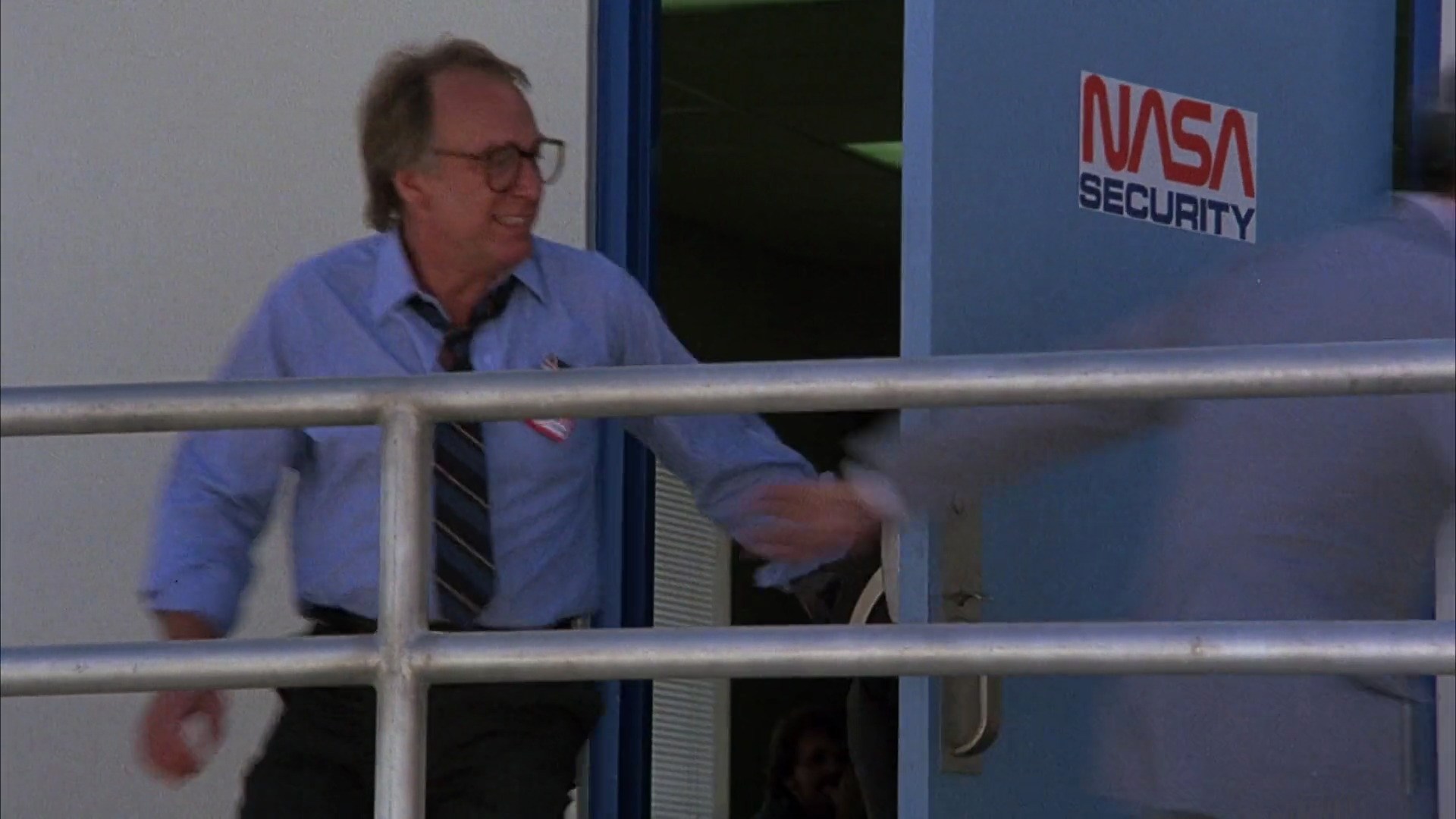
In the second half of "Flight of the Navigator", David makes a credibility-stretching escape from a top-secret NASA facility — seriously, where did they find such a negligent bunch of security guards? — to hitch a ride on board the aforementioned Trimaxion ship.
(Image credit: Disney)
Nicknamed Max and voiced by Pee-wee Herman star Paul Reubens (credited here as Paul Mall), the spacecraft reveals that David is one of several alien species taken to Phaelon for study; we also meet a menagerie of puppets on board, including a hungry little guy who eats David's hat, and the pocket-sized, implausibly cute Puckmaren.
Max would usually return the test subjects back to the time and place he found them, but says that David's human physiology is too fragile to make the journey back to 1978. In the meantime, he also needs to access the maps he uploaded to the human kid's brain, seeing as a collision with some electricity pylons has damaged his navigational databanks. It's here that the movie evolves into childhood wish-fulfilment fantasy, as David and the fast-learning AI become BFFs on the run from the authorities.
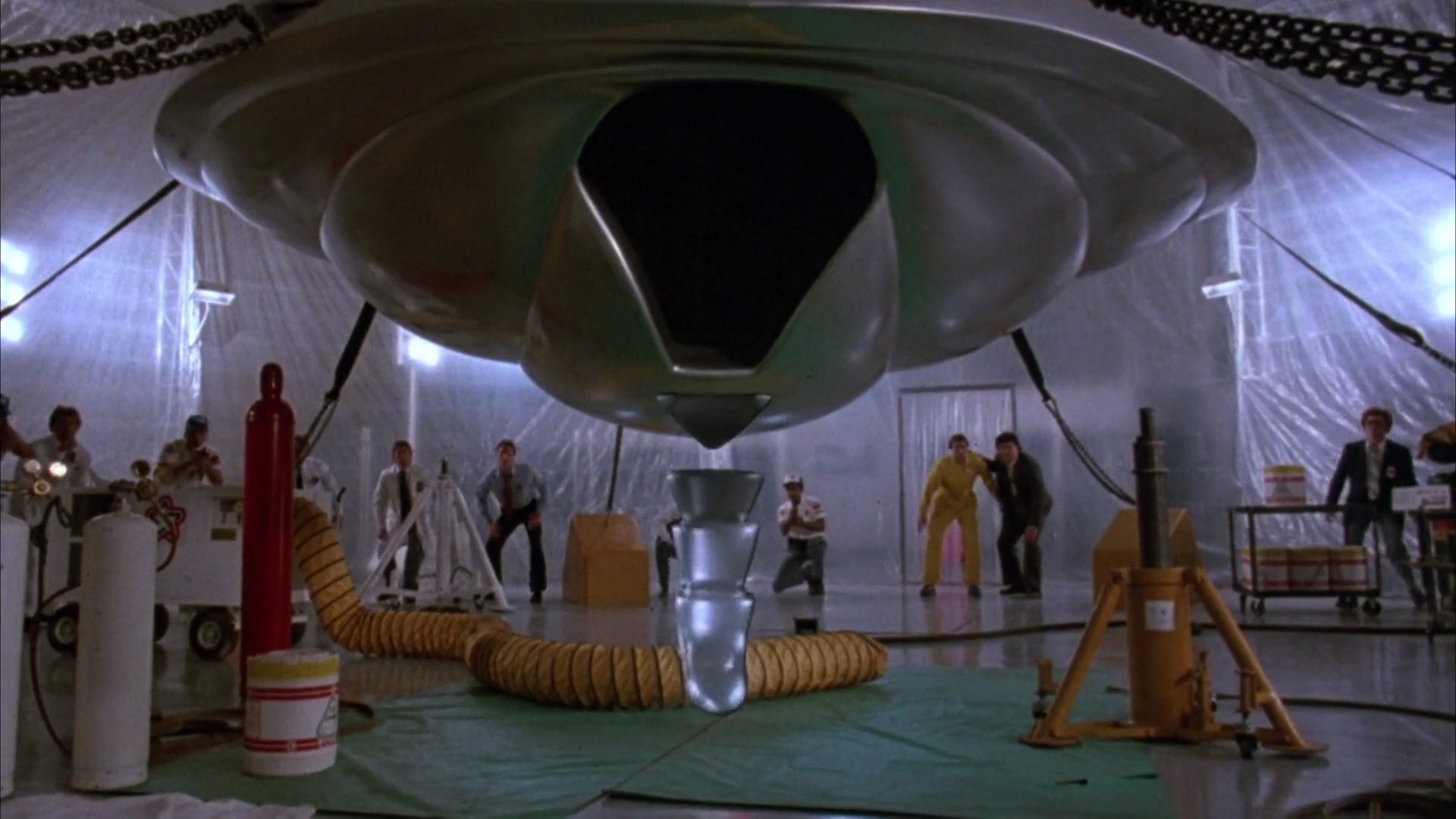
The spaceship exterior, meanwhile, is arguably the most groundbreaking thing about the film, a mirrored, shapeshifting update of the classic flying saucer design popularized by "The Day the Earth Stood Still".
(Image credit: Disney)
Kleiser persisted with that shiny surface, despite the advice of a former University of Southern California classmate (a certain George Lucas) who told him that all those reflective surfaces would make the ship "more trouble than it's worth". (By the time "The Phantom Menace" was released 13 years later, Lucas had clearly changed his mind, so maybe "Flight of the Navigator" had a tiny bit of influence on a galaxy far, far away.)
"I wanted to find something different that hadn’t been done before," Kleiser explained. "I was driving down the freeway behind a big silver truck, and I could see my car reflected behind it. And I thought, 'Wow, I've never seen a spaceship like that.' It took a while till we figured out how to do it!"
After several unsuccessful experiments involving silver paint and mylar glued to paper plates, salvation came courtesy of Kleiser's brother Jeff, who'd worked on the VFX for "Tron" and was a pioneer in the nascent field of computer graphics. And while the liquid metal effects aren't quite as, ahem, polished as James Cameron's genre-defining efforts in 1991's "Terminator 2: Judgment Day", "Flight of the Navigator" deserves to be mentioned in the same breath.
(Image credit: Disney)
Despite having an innovative spaceship and a considerably happier ending than "Interstellar" (spoiler: David does eventually make it home), "Flight of the Navigator" struggled at the box office. It eventually found its audience on home video, however, and deservedly so, seeing as it's an inventive, witty, and surprisingly sophisticated family movie that refuses to talk down to its audience.
"When it first came out, I think maybe it just wasn’t marketed properly," said Kleiser, "but the fact that it’s become kind of a cult classic is nice. I run into people all the time who say that it's their favourite movie. [Lots of them] really like the fact that it explored how time travel could change a sibling relationship."
As we said, "Flight of the Navigator" really is "Back to the Future" and "Interstellar" rolled into one.
'Flight of the Navigator' is available to stream on Disney+ in the US and Prime Video in the UK.'Life After the Navigator', a documentary about the film, is also available on Prime Video in the UK.
SpaceX has sent yet another batch of its Starlink internet satellites into orbit.
A Falcon 9 rocket carrying 24 of the broadband spacecraft lifted off from California's Vandenberg Space Force Base on Friday (July 31) at 11:08p.m. EDT (8:08 p.m. local time; 0308 GMT on Aug. 1).
The rocket's first stage came back to Earth as planned 8.5 minutes later, touching down in the Pacific Ocean atop the SpaceX droneship "Of Course I Still Love You." It was the 26th mission for this particular booster, which is designated B1081.
The 24 Starlink satellites were deployed into low Earth orbit (LEO) 61.5 minutes after liftoff as planned, SpaceX confirmed via X.
They're joining more than 10,800 other spacecraft in the Starlink megaconstellation, by far the largest satellite network ever assembled.
A batch of SpaceX's Starlink satellites is seen high above Earth before deployment from their Falcon 9 rocket on July 31, 2026. (Image credit: SpaceX)
SpaceX has now launched 89 Falcon 9 missions in 2026, 69 of which have been dedicated Starlink flights.
The company also has three other liftoffs under its belt this year — one launch of its powerful Falcon Heavy vehicle and two test flights of Starship, the fully reusable megarocket SpaceX is developing to help humanity settle the moon and Mars, among other tasks.
We just got an amazing new view of SpaceX's Starship vehicle, thanks to one of the company's next-gen Starlink satellites.
Starship, the biggest and most powerful rocket ever built, launched on its 13th test flight from South Texas last Friday (July 24). The suborbital jaunt was similar in many respects to past Starship test missions, with one big exception: This time, the vehicle deployed a batch of functional, next-gen Starlink internet satellites into space.
Six of those "Starlink V3" spacecraft carried cameras, so that SpaceX could get good views of the heat shield on Starship's upper stage, which is known as Starship, or simply Ship. The satellites did that job and more, capturing amazing views of Ship as it cruised away from them high above Earth.
View of Starship in space from a Starlink V3 satellite on Flight 13.This composite is made of imagery from four separate cameras on a single satellite. Six of the satellites were equipped with cameras to scan Starship’s heat shield and transmit imagery down to operators to… pic.twitter.com/sNTHHz5vLrJuly 31, 2026
SpaceX shared one such view on X Friday evening (July 31) — a 65-second video that stitches together imagery taken by four different cameras on a single Starlink V3 satellite.
The video starts with an up-close view of the shiny, 171-foot-tall (52 meters) Ship. We see more of the vehicle as the footage rolls and the two spacecraft get farther and farther apart. Toward the end, we see Ship in its entirety, and we get a sense of its activity; three of its six Raptor engines are firing, and small puffs of white vapor indicate that the vehicle is engaging its fine-tuning reaction control thrusters.
Like all Starship test missions to date, Flight 13 targeted a suborbital trajectory. So the 20 Starlink V3 satellites, the first ever to reach space, did not stay up for long; they came back down to Earth about 20 minutes after deploying into the final frontier.
Their successors will get higher — and there will be many of them. According to a filing with the U.S. Federal Communications Commission, SpaceX wants to operate a megaconstellation of 100,000 Starlink V3 satellites.
Starship will be key to building and maintaining this constellation, which will require many launches of the brawny, fully reusable rocket. (SpaceX currently operates a constellation of nearly 11,000 Starlink satellites, but those V2 craft are considerably smaller than the 4,400-pound V3 iteration.)
SpaceX's Starship upper stage splashes down in the Indian Ocean to wrap up its 13th test flight on July 24, 2026. (Image credit: SpaceX)
Ship seems to have checked all of its boxes on Flight 13. After deploying the satellites and successfully reigniting one of its Raptors in space, it splashed down on target in the Indian Ocean off the coast of Western Australia about 65 minutes after liftoff.
The vehicle survived its harrowing return trip through Earth's atmosphere in one piece and remains intact today, as far as we know; SpaceX recently shared a photo of the vehicle bobbing in the Indian Ocean five days after splashdown.
But Starship's giant first-stage booster, known as Super Heavy, had a few issues on Flight 13. Its landing burn employed only five of a planned 13 Raptor engines, for example, and the booster hit the waters of the Gulf of Mexico at a higher velocity than intended. (Super Heavy has a total of 33 Raptors, all of which fire at liftoff.)
Starship remains in the development phase, but SpaceX wants to get the megarocket operational soon. It's slated to fly on NASA's Artemis III astronaut mission to low Earth orbit in mid-2027 and to land a crew near the moon's south pole on Artemis IV in late 2028.
Some of the brightest objects in the universe may also hold the key to understanding how galaxies evolve — especially when gravity transforms them into giant cosmic magnifying glasses.
Using artificial intelligence to search through data from the Dark Energy Spectroscopic Instrument (DESI), astronomers have identified seven promising candidates for quasars acting as gravitational lenses — natural cosmic magnifying glasses created when a massive object's gravity bends and magnifies light from a more distant object.
These unusual systems could help researchers better understand how actively growing supermassive black holes evolve, according to a statement from Ohio State University.
"Quasars are like the baby pictures of a supermassive black hole," Everett McArthur, lead author of the study and a graduate student in astronomy at The Ohio State University, said in the statement. "So exploring how we get from quasars to those black holes is really important."
Quasars are the intensely bright centers of galaxies powered by actively feeding supermassive black holes. Studying these objects can help researchers understand how black holes evolve into the enormous ones found throughout the modern universe. But as these black holes pull in gas and dust, they release so much energy that they can outshine their entire host galaxies, making those galaxies difficult to study.
Rare cases where a quasar acts as a gravitational lens offer a way around that problem, giving astronomers a unique opportunity to observe both the quasar and the distant galaxy whose light is magnified by its gravity.
Gravitational lensing can be seen in this cosmic deep field. Notice how some glowing spots are dots while others are lines. (Image credit: Image: NASA, ESA, CSA, STScI, Jose Diego (IFCA), Jordan D'Silva (UWA), Anton Koekemoer (STScI), Jake Summers (ASU), Rogier Windhorst (ASU), Haojing Yan (University of Missouri); Image Processing: Joseph DePasquale (STScI))
However, finding these rare alignments can be exceptionally challenging. To uncover them, the research team began with a catalog of roughly 800,000 quasars identified by DESI and used a machine-learning model to search for subtle signatures of gravitational lensing.
Because so few quasars acting as gravitational lenses are known, researchers had little real-world data to train their AI model. Instead, they generated simulated examples of these cosmic alignments, allowing the algorithm to learn what to look for before searching the DESI catalog. The algorithm narrowed the search to about 200 candidates, which researchers then reviewed manually. That process resulted in seven new quasar lens candidates.
Two "fans" representing DESI observations above and below the plane of the Milky Way. (Image credit: DESI Collaboration/DOE/KPNO/NOIRLab/NSF/AURA/R. Proctor/ Robert Lea (created with Canva))
The discoveries roughly double the number of known systems found through similar survey searches, according to the statement.
While artificial intelligence played a key role in finding the candidates, the discoveries highlight the scientific potential hidden within the massive datasets produced by modern astronomy. DESI is mapping millions of galaxies and quasars, creating an enormous archive that would be nearly impossible to search by hand.
Follow-up observations will be needed to confirm the newly identified quasar lenses and study their properties in greater detail. If verified, they could offer astronomers a powerful new way to investigate how supermassive black holes shaped the galaxies around them while demonstrating how AI can uncover rare cosmic phenomena hidden within the enormous datasets produced by modern sky surveys.
The summer is slowly waning as we soon turn the calendar page to August and back to school supplies are already cluttering store shelves, but Hollywood still has a pocketful of of possible surprises hitting the silver screen. My prediction for "Masters of the Universe" as a summertime sleeper hit did not come to pass, though it was a totally enjoyable nostalgic romp, if not about 20 minutes or so too long.
Recent teasers and trailers starring Ewan McGregor and Anne Hathaway and their suburban family have them sprinting for their lives after a strange cosmic event whisks their placid American neighborhood seemingly back to prehistoric times when dinosaurs roamed the Earth. Think "The Twilight Zone" meets "Jurassic Park" with a dash of "A Quiet Place" and you’ll be pretty close to the wild narrative that will unfold when the "running and screaming" begins.
This all seems like the perfect recipe for a fun cocktail of primeval creatures rampaging across driveways and lawns while residents fight back with guns and garden tools. "I think our house, our neighborhood, our whole street, has moved," Hathaway's Denise Platt explains to her children in the first teaser that dropped in March and racked up a hefty 30 million views.
While "Spider-Man: Brand New Day" is surely destined to become a global sensation, we’d like you to redirect your cinematic radar to "The End of Oak Street," a cool little sci-fi fantasy film brought to life by executive producer J.J. Abrams and Bad Robot ("Lost," "Cloverfield," "Star Trek," "Star Wars: The Force Awakens").
Stomping into theaters on Aug. 14, 2026, it's written, produced, and directed by David Robert Mitchell ("It Follows") who brings his twisted sensibilities to the surreal survival material.
Could "The End of Oak Street" become a certified summer sleeper hit? (Image credit: Warner Bros.)
Fans of "The Outer Limits" might recall a similar theme, minus the feathered dinos of course, playing out in the 1964 episode, "A Feasibility Study," where aliens abduct a 6-block suburban neighborhood to their planet Luminos to study them as candidates for enslavement. Whether or not aliens are involved in this plot is unclear and Warner Bros. is now keeping that tightly under wraps.
Also starring Maisy Stella and Christian Convery and produced by Hannah Minghella, Jon Cohen, Matt Jackson and Tommy Harper, "The End of Oak Street" thunders into multiplexes on Aug. 14, 2026 and is our best bet for a late summer smash before the kiddies return to school!
If you've not seen the Milky Way this year from the Northern Hemisphere, it's time to make a plan. August's dark sky window opens around Aug. 6, when the moon begins to rise late at night as a waning crescent, meaning dark moonless skies for about 10 nights. That's when to see the Milky Way (and if you can time it for Aug. 12/13's Perseid meteor shower peak, all the better).
Five things are required to successfully see the Milky Way:
the correct time of year (The brightest part is visible March-October)
the correct moon phase (last-quarter moon through slim crescent moon)
a dark sky away from light pollution
dark-adapted eyes (stand in total darkness for 25 minutes)
an idea of what you're going to see
The best way to dark-adapt your eyes is to start stargazing. Look south and begin picking out stars you know, paying special attention to the Summer Triangle. These three stars — Vega, Deneb and Altair — are your major signpost for finding the dense arc of starlight that will gradually emerge. Specifically, focus on the sky from Deneb through Altair — the left-hand side of the Summer Triangle — and you'll slowly see not only the Milky Way, but something else in front of it that few stargazers properly appreciate.
Sure, you can see the bright halo of gas and stars that indicate the center of the Milky Way galaxy, which is particularly bright below the Summer Triangle in the Sagittarius constellation. The closer you are to the equator, the higher in the sky, and the brighter, this region — known as the Galactic Center — will be.
Now look again. See those dark patches within the arc winding from Deneb to Altair? That's the Great Rift, so named because it appears to tear the Milky Way in half. It's an interstellar cloud of gas and dust (dark nebulas) between the solar system and the bright center of the Milky Way, which blocks and scatters visible light, essentially covering up bright stars and nebulas from our point of view. It looks like someone has spilled black ink across the Milky Way.
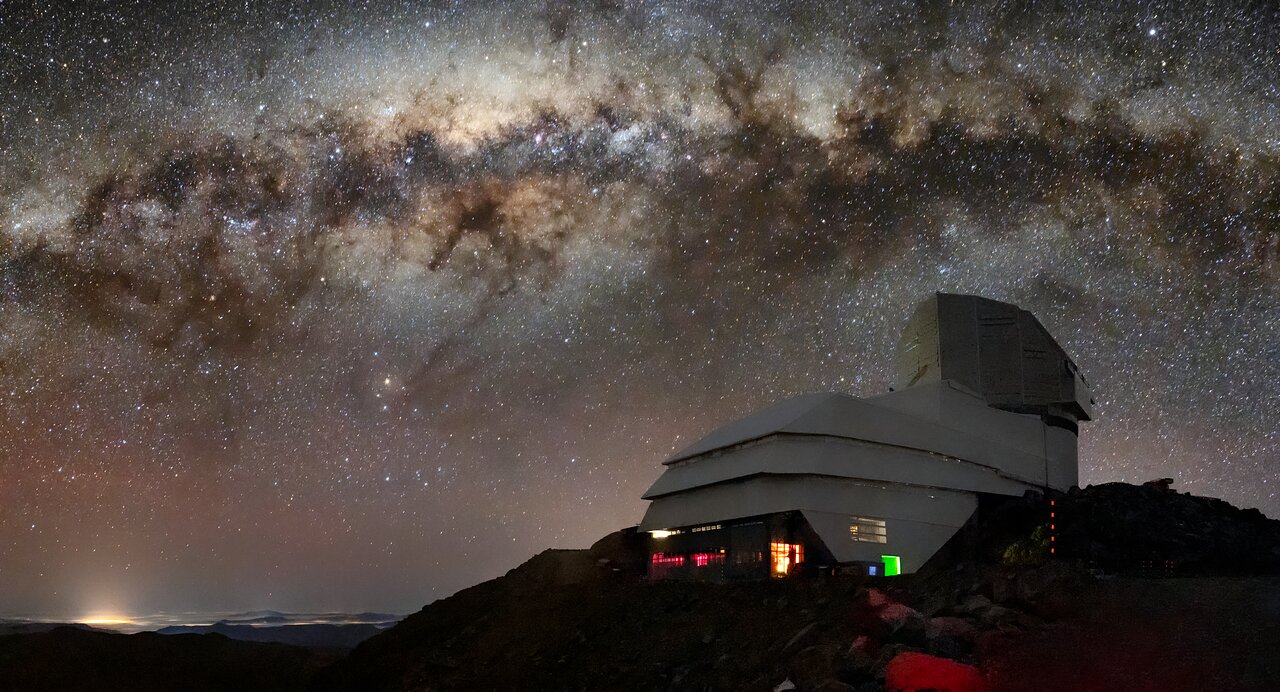
There are two ways of seeing the Great Rift. The most modern way is to observe it in infrared and radio light, which passes through the dust without being absorbed. This is exactly what some observatories are built to do, from radio dishes to the James Webb Space Telescope, which can probe the inner Milky Way — including the billions of stars in the center of our galaxy — which are on the other side of the Great Rift. Meanwhile, the new Vera C. Rubin Observatory has begun observing the entire visible southern sky every few nights over the course of a decade, mapping the Milky Way (including the Great Rift) to answer questions about its structure and formation.
The second way to see the Great Rift is to see it for what it is. Astronomers call the section we're looking at the Cygnus Rift, also called the Northern Coalsack, 1,000-3,000 light-years away in the constellation Cygnus. It's just below Deneb (which is 1,500 light-years distant), slightly outside of the Summer Triangle over an otherwise bright, dense region of stars called the Cygnus Star Cloud (around 2,600 light-years away). About six degrees in diameter, the Northern Coalsack blocks the light of background stars. However, it's just the northern tip of the Great Rift, which stargazers also call The Dark River or Dark Cloud.
Beyond the Northern Coalsack, however, the Great Rift is something to travel to see more of. It stretches across about 120 degrees of the night sky from Cygnus and Sagittarius in the Northern Hemisphere to Centaurus in the Southern Hemisphere. The latter is home to the famous Southern Cross and, besides its star Acrux, the original Coalsack Nebula. Another reason to travel to see more of the Milky Way is to appreciate how Southern Hemisphere cultures view the Great Rift. While modern astronomers see it as a dark cloud that needs to be peered through, indigenous cultures see its shapes. The Wiradjuri in Australia see the silhouette of an emu (its head is the Coalsack Nebula) and use its position in the night sky as a seasonal calendar. Meanwhile, the Inca in South America saw a llama (and, beside it, a baby llama).
The Great Rift is one of my favorite things to see, because it reveals what we're doing when we see that arc of light stretch across a summer night sky — we're looking at a galaxy from the inside, with all of its depth and complexity.
How and when I'm watching it
The Great Rift in the Southern Hemisphere above the Vera C. Rubin Observatory. (Image credit: RubinObs/NOIRLab/SLAC/NSF/DOE/AURA/B. Quint)
You do need perfect darkness and excellent timing. With that in mind, I'm trying out a new app called Milky Way Tonight, which is built around a useful question: is tonight actually worth the effort? It checks when the Milky Way core is above the horizon, then weighs that against moon phase, moonrise and moonset times, the local cloud forecast and the Bortle rating for your location. That last part matters. A technically clear night in a bright suburb is still a bad Milky Way night. The app also has a dark-sky finder, which is the feature I suspect I will use most.
Although the Milky Way has to be enjoyed as a naked-eye sight, it's also worth bringing along some binoculars to let you sweep across the dense star fields right up to the edges of the Great Rift.
Stargazer's corner: July 31-August 7, 2026
This is a good week to plan a trip to see the Milky Way and the Great Rift, but not to actually take that trip. Since the moon was recently full, our galaxy will be badly washed out for much of the night. That will make it difficult to see much of the Southern Delta Aquariids peak around July 30-31, as well as the now-active Perseids building toward their August peak. Saturn is worth a pre-dawn look, and Venus remains bright low in the evening sky if the horizon is clear, but if you're an astrophotographer or you have a smart telescope, you can use light-pollution filters to take advantage of nebula season — with key deep-sky sights being the Lagoon and Trifid Nebula (M8 and M20), the Little Sagittarius Star Cloud (M24) and the Wild Duck star cluster (M11).
Asterism of the week: The Coathanger/Brocchi's Cluster
The Coathanger/Brocchi's Cluster is within the Summer Triangle. (Image credit: Alan Dyer/VW Pics/Universal Images Group via Getty Images)
The Coathanger looks exactly like its name. Also known as Brocchi's Cluster, it's a pattern of 10 stars in the small constellation Vulpecula, with six forming a straight bar and four making a curved hook. First find the Summer Triangle — Vega, Altair and Deneb — then scan roughly halfway between Vega and Altair. The small constellation Sagitta, the Arrow, points nearby, with the Coathanger just to its north. Dark skies may reveal it to keen naked eyes, but binoculars are the best way because they show the whole shape at once. One last thing: it's not a real coathanger! Once thought to be a cluster of stars born together, the shape is now known to be a chance alignment of unrelated stars at different distances — yet another cosmic illusion.
The script is flipped in Prime Video's upcoming "Blade Runner 2099" series where replicants have rebelled and seized power from human beings in a massive uprising. An arresting new trailer was unleashed during the annual San Diego Comic-Con pop culture pageant and it's an atmospheric return to the futuristic realm of Ridley Scott's "Blade Runner" universe 80 years later.
"The old world forever fights to come back," Olwen tells Cora in this interesting first peek at the limited series that arrives Nov. 25, 2026. "Humans want what was taken from them. But it's our time now."
Michelle Yeoh as Olwen in "Prime Video's" Blade Runner 2099" (Image credit: Prime Video)
"Blade Runner 2099" stars Academy Award winner Michelle Yeoh ("Everything Everywhere All At Once") as an aging replicant Blade Runner named Olwen and Hunter Schafer ("Euphoria") playing Cora, a fugitive human trying to escape pursuing Blade Runners. It's more or less a tangential sequel to director Denis Villeneuve’s "Blade Runner 2049" set in the same neon-drenched dystopian world with a team-up element between natural and artificial beings, we're also going into outer space!
We first heard word of series executive producer Ridley Scott developing a "Blade Runner" TV showback in early 2022and we're finally on the threshold of its 8-episode release this fall, which is helmed by showrunner and executive producer Silka Louisa ("Shining Girls").
"Fifty years after the events of 'Blade Runner 2049,' Los Angeles has been reborn, just not by humanity," states the official synopsis. "Cora, a fugitive in a final bid to stop running, takes on one last identity: a Blade Runner. Forced to partner with Olwen, a Replicant days from dying, she hunts down a runaway hiding a truth that could collapse their fragile city."
Yeoh and Schafer share cyberpunk cityscapes with Dimitri Abold ("The Hunger Games: The Ballad of Songbirds & Snakes") and Lewis Gribben ("Somewhere Boy"). Guest stars include Katelyn Rose Downey ("The Nun II"), Daniel Rigby ('Renegade Nell"), Johnny Harris ("A Gentleman In Moscow"), Amy Lennox ("Only Child"), Sheila Atim ("The Woman King") and Matthew Needham ("House of the Dragon").
Hunter Schafer as Cora in Prime Video's "Blade Runner 2099" (Image credit: Prime Video)
"I am so excited for people to see it," Louisa told EW last week. "There is so much legacy with 'Blade Runner.' Every person who touched the show in any way is a huge fan. Everyone was very well aware of the weight of what we were doing, and we did it with great care. And when you're taking on something like this, you're very thoughtful and deliberate about each step. That is why it has taken so long, because we wanted to make sure we got it right.
"We stayed very true to the noir principles of 'Blade Runner.' And there's a mystery at the heart of the show that looks both forwards and backwards in terms of mythology that fans are gonna be very excited about."
Also executive produced in collaboration with David W. Zucker and Clayton Krueger of Scott Free Productions. "Blade Runner 2099" will appear on Prime Video Nov. 25, 2026.
NASA is planning to send two maneuverable probes to lunar orbit in order to learn how spacecraft are affected by the complex gravitational environment near the moon.
The mission, known as CAPSTONE 02, is currently aiming to launch in 2027. It will see the two probes maneuver in close proximity to one another and fly in "formation" so mission operators can better understand the gravitational effects spacecraft experience in cislunar space. This area of space is under the influence of both Earth's gravity and the moon's, meaning spacecraft operating there will have to navigate what are known as "three-body orbits."
While testing spacecraft maneuverability in these complex orbits, CAPSTONE 02 will also study communication and navigation systems that will be used in NASA's planned Artemis missions of lunar exploration and moon base construction. "This mission represents an important step in the maturation of cislunar capabilities," said NASA's Sean Fuller, Moon Base CAPSTONE manager, in an agency statement. "CAPSTONE 02 lays the foundation for lunar infrastructure and commercial services that support Artemis, Moon Base, and future missions to deep space."
The two CAPSTONE 02 probes are being built by Terran Orbital Systems, Inc. Once in space, they will alternate jobs while flying in formation, switching between what NASA calls "chaser" and "target" roles.
The spacecraft pair will use celestial navigation, optical sensors and data collected by telescopes on the ground during these maneuvers. This is similar to how NASA will use a variety of data to help its Orion spacecraft meet up with a lunar lander en route to the moon.
"Transporting crew to the lunar surface from cislunar orbit depends on knowing how well navigation systems will perform during these operations. Since these conditions can't be fully recreated on Earth, they must be tested in space," NASA wrote in its statement outlining the CAPSTONE 02 mission.
An artist's rendering of NASA's Orion spacecraft meeting up with SpaceX's Starship on the planned Artemis III mission. (Image credit: SpaceX)
As its name implies, this will be the second mission under NASA's CAPSTONE program, or Cislunar Autonomous Positioning System Technology Operations and Navigation Experiment. The first CAPSTONE probe launched in 2022 and operated for four years before NASA officially concluded its mission in June 2026.
That microwave-oven-sized CAPSTONE spacecraft tested communications tech and became the first spacecraft to test three-body orbits around the moon, according to a NASA statement.
CAPSTONE was tested in what is known as a near rectilinear halo orbit. This is a fairly gravitationally stable orbit, thanks to the nearly equal pulls of both Earth's gravity and the moon's.
It was Lucky 13 for SpaceX, as new videos show just how much work came into getting the latest flight of Starship’s upper stage softly down into the ocean.
After Starship made its 13th launch on Friday (July 24) from SpaceX's Starbase site in South Texas, the upper stage achieved all major milestones: putting 20 next-gen Starlink satellites aloft to watch it go, reigniting a Raptor engine in space, and then the soft splashdown off the coast of Western Australia.
While the lower stage of Starship faced engine issues, fresh video shows some incredible views of the successful upper stage. Starlink satellites, ferrying signal from a buoy in the Indian Ocean, helped create a video on X showing the 171-foot (52-meter) upper stage roaring above the water, then generating steam as the engines swiveled to make a gentle splashdown.
SpaceX's Starship upper stage fires its engines to slow down before splashing down on the Indian Ocean after its 13th test flight on July 24, 2026. (Image credit: SpaceX)
Getting down that way was no easy feat, as SpaceX posted another video on Tuesday (July 28) showing Starship swaying dramatically in midair to achieve a near-vertical orientation above the water. If you don’t mind a bit of vertigo, SpaceX also provided an on-ship view of the splashdown, complete with dramatic swings and ocean steam.
The upper stage's ocean arrival was so soft, in fact, that days after launch on July 28 the 171-foot (52-meter) stage was reported as still afloat in the Indian Ocean, SpaceX said on X, adding that its Starship recovery team is continuing to gather imagery of the vehicle at sea.
SpaceX's Starship Recovery Team poses for a portrait in front of the company's Starship V3 rocket afloat in the Indian Ocean on July 28, 2026. (Image credit: SpaceX)
Starship's Version 3 (which flew on Friday) is a 408-foot-tall stacked system including the Super Heavy booster and the upper stage, also known as Starship (or Ship). SpaceX aims to make this system rapidly reusable for applications ranging from astronaut moon missions to launching even more powerful and larger Starlinks.
That said, SpaceX still needs to notch some goals ahead of its expected participation for docking during the Artemis III astronaut mission scheduled for next year, and to possibly bring astronauts to the moon's surface during Artemis IV.
And Ars Technica (quoting experts) recently raised concerns about the Starship heatshield, noting more changes will be required for reusability.
On July 31, 1971, Apollo 15 astronauts drove on the moon for the first time.
David Scott, the commander of Apollo 15, and James Irwin, the lunar module pilot explored the moon for three days by driving around in the Lunar Roving Vehicle. Apollo 15 command module pilot Al Worden remained in orbit around the moon. This moon buggy was folded up and stowed inside the lunar module and deployed after landing. Unpacked, it measured about 10 feet long, 7 feet wide and 45 inches high.
The lunar rover could travel up to 8.6 miles per hour and allowed the astronauts to venture farther from their landing site than previous Apollo astronauts could. For their first drive, Scott and Irwin went to Elbow Crater to gather samples and take photos. Throughout their stay on the moon, they drove more than 17 miles.
The Lunar Roving Vehicle is seen on the moon during the Apollo 15 mission, the first to use the LRV, in 1971. (Image credit: NASA)
The Apollo 15 mission launched to the moon on July 26, 1971. The mission landed on July 30, with Scott and Irwin ultimately performing three moonwalks in addition to their lunar rover test drive. The Apollo 15 crew left the moon's surface on Aug. 2 and left lunar orbit on Aug. 4. They returned to Earth on Aug. 7, splashing down in the Pacific Ocean.
Why it mattered
Apollo 15's moon rover made space history as the first human-driven rover on the moon, let alone another world entirely.
While developing the rover, NASA had to wrangle many issues at once. How do you build a rover light enough to land on the moon with the Apollo 15 lunar lander? How do you make it compact as well?
The result was an aluminum, foldable moon car built by Boeing and powered by batteries that could carry up to 1,080 pounds (490 kg) of cargo — about twice its own weight — while carrying two astronauts. The rover design flew on Apollo 15, Apollo 16 and Apollo 17. Those three rovers are still on the lunar surface awaiting fresh batteries.

 Login