❌

Normal view

'We knew we had a lot to live up to': As 'Aliens' turns 40, we chat to the legendary VFX masters who created the Alien Queen (interview)

18 July 2026 at 14:00

It's almost inconceivable that 40 years have passed since what's been called the greatest sci-fi action film of all time (and not just by us) assaulted theaters with the juiced-up sequel to Ridley Scott's 1979 classic, "Alien."

Director James Cameron's propulsive vision for a gung-ho military-style movie would call upon Stan Winston Studio's elite creature effects crew from 1984's "The Terminator" β€” a team that would later work on "Predator," "Terminator 2: Judgment Day," "Jurassic Park," and "Predator 2."

Cameron's "Aliens" greatly expands upon the xenomorph life cycle with the inclusion of a matriarchal beast that his screenplay described as "a massive silhouette in the mist, the ALIEN QUEEN glowers over her eggs like a great, glistening black insect-Buddha. Her fanged head is an unimaginable horror. Her six limbs, the four arms and two powerful legs, are folded grotesquely over her distended abdomen."

The brilliant filmmaker and Winston's energetic gang would craft and operate this 14-foot-tall articulated hydraulic puppet fabricated from fiberglass, foam rubber, and plastic. It contained two stunt performers in the torso and puppeteers on the ground manipulating legs and limbs.

Production was led by Stan Winston, Shane Mahan, Alec Gillis, John Rosengrant, Tom Woodruff Jr., and Lindsay MacGowan, the core wizards who’d later found the acclaimed Legacy Effects firm with J. Alan Scott following Stan Winston’s unfortunate death in 2008. Gillis and Woodruff would eventually split off to form Amalgamated Dynamics in 1988.

We caught up with Mahan and MacGowan to have them offer memories of working on "Aliens" at Pinewood Studios and specifically constructing this magnificent drooling, hissing monster that's spawned countless nightmares since the blockbuster landed on July 18, 1986.

"It was 1983 when I started at Stan's on the first 'Terminator,'” Mahan tells Space. "I’d worked with Jim on a Roger Corman movie that Makeup Effects Lab was doing, 'Battle Beyond the Stars.' [...] During 'Terminator,' Jim had drawings of Sigourney and the Power Loader he'd brought into the shop. I'd see them out of the corner of my eye and knew exactly what it was supposed to be. It was clearly an alien of that world with Sigourney Weaver.

"I was intrigued by it all because four years before, when 'Alien' had come out, it was so amazing cinematically. The lifecycle of the creature, and the organic nature of it. I had no idea that seven years later we'd be in England doing a sequel."

Mahan and posse began working on the Queen's preliminary designs in Southern California at Stan Winston's shop, where they conducted the infamous 'garbage bag test' out in the back parking lot, so named due to the flailing puppet being wrapped in black plastic trash bags.

"It was a proof of concept of how that was going to work," he explains. "Moving to Windsor, England, and setting up shop at Pinewood Studios was extraordinarily exciting. We then started making the full-size process of making the Queen and all the other effects, and we met the English crew, and Lindsay was one of them."

MacGowan fondly remembers his experience on the ambitious project and being recruited to join Stan Winston and the rest of the guys.

"They were legends at that point for us. We were also young and goofy, and it's amazing they actually let us do what we did when we were that young," MacGowan notes. "I was at college at the time, and I’d skip off college and make my way to Pinewood. It was like here’s the rock β€˜n' roll Americans, and then we have our more reserved English team that got influenced by the American team. It was a lot of fun and some of my favorite memories of starting in the business.

"I remember it being incredibly cold at Pinewood at the time. There was no insulation in the warehouse, and we had these giant propane jet heaters, and they kept going out. We’d be nice and warm, then suddenly the flame would be out. It was a great time to get to know Shane, John, Alec, and Tom. I look at them as my American brothers."

Having everything under one roof, being created pre-shooting, was a great asset as it allowed Cameron to constantly oversee the process and monitor the progress being made.

"We were life-casting all the actors, various teams were doing the xenomorph warriors and the eggs and the facehuggers," Mahan adds. "It was a pretty big build list, and we had four or five months to get everything done. John Richardson was a great special effects man from the Bond films, and we all thought that was cool to work with guys that had done James Bond movies.

"That was my first time in England, so the setting was very new and exciting. Of course, we blew off a lot of steam occasionally, but we were very serious about just getting it all done. We knew we had a lot to live up to because of the first film. Very few people, if any, had come back from working on that first film. You don’t know how it's going to turn out. We all thought the 'Aliens' script was great. Jim had a lot of turmoil there and didn’t have a good time on his own for various reasons, but we weren't really privy to that."

a man standing between two armored robot suits

Legacy Effects' Lindsay MacGowan between two armored supersuits created for 2008's "Ironman" (Image credit: Legacy Effects)

Before hopping across the pond to the UK, Mahan and his ace crew did molds and castings using a quarter-scale maquette of the Alien Queen sculpted at Stan Winston's shop for their design master.

"Back then, everything had to be done by measurements, by plotting out, and by eye. Today, it's so simple to have a computer generate and mill out a perfectly formed section. You had to use a really focused artistic eye to get exactly where we were supposed to be.

"We also had to make action suits, and there were a lot of them. I think there were 13 or 14, and then there were like eight eight-foot-tall puppets that were more spindly and long that were going to be used on wires and get hit and blow up and get shot. Then there was one articulated half-animatronic that would play in various scenes. You have to imagine an era that was pre-CGI. There was no reliance on rod removal or performer puppeteer removal. You had to hide everything and everybody in the frame. So in the dropship fight, it’s an enormous amount of people making the Queen operate, and you don’t see them.

"That all comes down to Jim Cameron and his magnificent eye for framing this action scene without seeing the crane or any of the support devices. Directors today, most of them don't even have any idea how to do that. And that was the magic of Jim Cameron and still is. He had the designing thought of shot composition and action that played off the best attributes of that hydraulic/actor-driven Queen. Because there were two guys inside and nine of us on her tail, her head, the cable, her hands, the feet. We were everywhere."

MacGowan took his role very seriously to get the fit and finishing perfect for this elegant egg-laying beast that would end up being the seething, android-ripping superstar of the popular 1986 sequel. -

"It was really just to honor what Giger had done in the past, but also to give Jim what he was looking for in his vision for the Queen," he recalls. "The Queen is really Jim's design and entire look. Our focus was making sure that we got what Jim wanted, but still make sure that fans of the original movie, which was all of us, could really appreciate."

As a mentor to his dedicated young crew of VFX creators, Winston schooled them in the subtle art of injecting personality and emotion into their creature performances.

"It's something they always reinforced, but if you’re a student of horror and science fiction films, you know all the great creatures and monsters have got some sympathetic or some interesting personality," adds Mahan. "Even the xenomorph in the first film, the personality is that it does not care. It's just going to kill you. But that’s still a personality trait.

"We were always taught by Stan that these are not effects; these are characters that we’re making; these are actors in the film. It just happens to be a creature from space, or a robot from the future, or a dinosaur. Whatever it is, it has to be believed, and we’ve always carried that philosophy through."

As to the mystery of exactly where the original Alien Queen screen-used puppet ended up, Mahan has a few clues, but sadly admits that most of it has unfortunately been lost to time.

a VFX master at work on an alien creature

Legacy Effects' Shane Mahan working on a xenomorph design for "Alien: Romulus" (Image credit: Legacy Effects)

"Jim has one in his museum, and I think collector Bob Burns did have a head," Mahan shares. "The rest of it might be that it's fallen into disrepair. I know when we left, a lot of it was put into containers at Pinewood, and it sat and rotted for years. We always wanted to get that back, but I’ve not seen a real Queen in a while.

While the classic design hasn't changed much over the years, Mahan notes that the materials used to make creatures like the Alien Queen have.

"The head was fiberglass and had other foam rubber parts. The materials back then were not very sophisticated," explains Mahan. "The materials we have today, like what we did on 'Alien: Romulus', are like from outer space. They're translucent silicones, and they stretch well, and there’s lightweight plastic 3D-grown parts."

"Back then, the only thing we had was clear urethane that I got the cowl of her head to kind of move around. The original idea was that the skin on her face was supposed to be translucent. It ended up being foam rubber painted to look translucent. A lot of those materials have just fallen apart. On screen, it's pretty impressive.

"When we did 'Alien: Romulus,' Lindsay and I had not done an 'Alien' film since 'Aliens.' When that opportunity came up to revisit that world, the sensory memories came flooding back. It's one of those movies where I think I remember every day that I was on set for that film.”

"Aliens" is available to stream on Disney+ in the UK, and to rent and buy on various platforms in the US.

An animated sci-fi rom-com wasn't on our wish list, but we'll be damned if 'Not Alone' doesn't look sweet, stylish, and hilarious

16 July 2026 at 18:00

After cracking into the animation world with family-friendly animated features from the "Despicable Me " and "Minions" franchise, "The Lorax," and the musical menagerie of "Sing," Illumination is finally setting their sights on outer space with next year's "Not Alone."

"Not Alone" isn’t due to arrive in theaters until Apr. 16, 2027 but this sneak peek β€” accompanied by David Bowie's somber 1969 anthem "Space Oddity" β€” sets a sweet tone telling the lively tale of an introverted rocket mechanic name Joe, and Fran, his astro-botanist colleague who has engineered the planet's first plant-based rocket, when alien fugitives toss their lives into chaos.

Xenomorph monstrosities and spaceship laser battles can often dominate sci-fi, so it's great to see something different on the horizon, and while a space rom-com starring TimothΓ©e Chalamet and Selena Gomez wasn't on our bingo card, the trailer has us really hyped for this one.

It's a wholly original story that's a definite departure for Illumination, but one that could strongly connect with audiences via the project’s colorful Euro style and humor. Vocal duties include the talents of TimothΓ©e Chalamet, Selena Gomez, Brett Goldstein, Rob Brydon, Jamie Demetriou, Diane Morgan, Allison Janney, and Lamorne Morris.

"When Joe and Fran are brought together to prepare for the inaugural launch of this revolutionary rocket, there are immediate sparks, but neither is particularly adept at romance," states the official synopsis.

two cartoon scientists working on a yellow robot

Illumination's "Not Alone" lands in theaters on April 16, 2027. (Image credit: Illumination)

"Life becomes more complicated when three aliensβ€”tiny, unruly, and adorableβ€”take refuge in Joe's home. Dunk, Welly, and Shirm are on the interplanetary run from a zealous-yet-inept officer of the law named Zandro. The aliens determine that Fran’s rocket could provide their means of getting back home to safety."

The French animation factory recently launched an early trailer for this charming romantic comedy directed by Eric Guillon, Claire Dodgson, and Jonathan Del Val.

Four colorful alien blobs from a sci-fi movie

(Image credit: Illumination)

Guillon is an Illumination veteran whose career includes serving as lead designer for "Despicable Me" and "Minions," as well as co-directing "Despicable Me 3." Here he's joined by seasoned editor Claire Dodgson ("The Lorax,"β€―"Minions," Despicable Me 3," "Minions: The Rise of Gru") and Jonathan Del Val (co-director ofβ€―"Minions: The Rise of Gru"β€―and "The Secret Life of Pets 2").

This fun animated rom-com is produced by Illumination founder and CEO Chris Meledandri and executive produced by Joy Poirel, Richard Curtis, and David Distenfeld.

"Not Alone" rockets into theaters Apr. 16, 2027.

'Once Upon a Time in Space': How to watch PBS's out-of-this-world astronaut documentary

14 July 2026 at 20:00

As our planet revels in the recent achievements of this spring’s Artemis 2 mission and its four astronaut crew members, a new four-part PBS documentary series takes a scrutinizing look at space exploration and its inherent perils and promises. "Once Upon a Time in Space" will be available to watch on PBS (and the PBS app) starting on July 14, 2026 (9pm ET).

Directed by James Bluemel and his filmmaking team β€” the crew behind the award-winning "Once Upon a Time in Northern Ireland" and "Once Upon a Time in Iraq" β€” "Once Upon a Time in Space" explores the connections between those venturing beyond Earth's gravity and the support staff remaining behind while pioneering souls venture into hostile outer space territory.

"'Once Upon a Time in Space' tells the human stories behind one of our most extraordinary endeavors: the exploration of space," states the official synopsis. "Moving beyond scientific achievement, the series examines the personal experiences of astronauts, cosmonauts, ground-based participants, and the loved ones left on Earth. Across four episodes, it traces significant landmarks in spacefaring history, from the birth of the Shuttle and the pioneering Space Station Mir to the rise of commercial spaceflight."

a promo poster for a space documentary series

"Once Upon a Time in Space" launches on PBS on July 14 (Image credit: PBS/BBC)

"Through powerful firsthand testimony and intimate, unseen archival footage, a complex portrait of humanity emerges: one that lays bare both our fragility and boundless curiosity. Accounts of bravery, friendship, and tragedy are told against the backdrop of a rapidly changing world, connecting technical and geopolitical developments to those who experienced them."

Here’s a schedule of the docuseries’ chapters and their slated air dates:

  • Episode 1 "America First" – Tuesday, July 14 – 9:00 p.m. ET
  • Episode 2 "The Russian Thing" – Tuesday, July 21
  • Episode 3 "Politics Always Wins" – Tuesday, July 28
  • Episode 4 "Friends Forever" – Tuesday, August 4

This remarkable show features NASA astronauts Charlie Bolden, Anna Lee Fisher, Bill Fisher, Michael Foale, Jerry Linenger, Mike Mullane, Dan Tani, and Terry Virts. They’re joined by cosmonauts Sergei Zalyotin and Alexander β€˜Sasha’ Lazutkin, NASA officials, aerospace engineers, and numerous family members.

Produced in collaboration with the BBC, "Once Upon a Time in Space" was first broadcast last fall in the UK, but now makes its U.S. premiere at 9:00 p.m. ET on PBS, PBS.org and the PBS app.

"The Ninth Jedi" is a bold new Star Wars anime project hitting Disney+ next month, and it looks sick!

13 July 2026 at 16:00

Disney+’s imaginative anime anthology series, "Star Wars: Visions", is getting a standalone expansion next month with "Star Wars: Visions Presents –The Ninth Jedi".

This 8-episode limited series is a continuation of the saga of Lah Kara, Margrave Juro, and their ragtag crew in the search for her kidnapped father. "Star Wars: Visions Presents – The Ninth Jedi" debuts on Disney+ on Aug. 5, 2026.

Fans were first introduced to the intriguing story in "Star Wars: Visions" Volume 1’s chapter titled "The Ninth Jedi", and now writer/director Kenji Kamiyama and his animation studio Production IG will revisit Kara’s world to elaborate more on the mythology behind lightsabers of different hues.

In the original 2021 episode, viewers met a bright Force-sensitive girl named Kara and her sabersmith father, Zhima, as they harvest Kyber Crystals to forge new lightsabers for Margrave Juro, the leader of an outer rim planet called Hy Izlan.

Juro is collecting worthy Jedi to help repopulate the Jedi Order, but evil Sith mercenaries are hiding within his candidates’ ranks. Kamiyama’s short initially presented the cool notion of lightsabers changing colors to reflect their users’ true links to the Force.

A direct sequel to Kamiyama's episode, "The Ninth Jedi: Child of Hope," was delivered by anime master Naoyoshi Shiotani and premiered on Oct. 29, 2025, for "Star Wars: Visions" Volume 3. Lucasfilm's new show takes place shortly after the events seen in the two "Star Wars: Visions" shorts as Kara advances her training and searches for her father.

a poster for an anime series with a girl holding a green lightsaber

(Image credit: Disney+)

"Every time we finished one of the anthologies, the first conversation would be, 'God, I’d love to expand that story,'" James Waugh, Lucasfilm Senior V.P. and "Star Wars: Visions" executive producer, told TechRadar last year after the project was announced at Star Wars Celebration Japan.

"We love the shorts, but Kathy [Kennedy] heard that, and there was a moment to say, 'Let’s see what could happen if we expanded this.' That’s really where 'Visions Presents' comes from. If we could give a bigger canvas to paint on, what would we get? We’ve been so impressed with what Kamiyama and his Production IG team has delivered so far."

Directed by Shunsuke Tada and with Kenji Kamiyama acting as supervising director, "Star Wars: Visions Presents - The Ninth Jedi" arrives Aug. 5 on Disney+ and Hulu.

Watch The Ninth Jedi on Disney+:
Disney+ (With Ads): $11.99/month
Disney+ Premium (No Ads): $18.99/month or $189.99/year

Watch The Ninth Jedi on Hulu:
Hulu with Ads: $11.99/month or $119.99/year
Premium (No Ads): $18.99/month

'Rick and Morty' cast talk vocal health, hot viscous liquids, and their favorite season 9 moments (interview)

23 June 2026 at 16:00

Adult Swim's smash animated series "Rick and Morty" recently unleashed its ninth season, and it's already shaping up to be one of the best seasons so far, with plenty of interdimensional shenanigans, existential excursions, evolutionary entanglements, hostile living room furniture, a potential trip to Boob World, and Pool Time!

We chatted to the creators Dan Harmon and Scott Marder earlier this month, but now we're catching up with the main cast to hear from Ian Cardoni (Rick), Sarah Chalke (Beth), Harry Belden (Morty), and Spencer Grammer (Summer) on the rigors of voice acting, playing in the multiverse, and watching all your plosives.

"We've got what we would consider classic adventures, balanced by a lot of fresh and new directions for these characters and for these stories," Cardoni tells Space.

Rick Sanchez from Rick and Morty, pictured alongside his voice actor Ian Cardoni

Rick Sanchez from Rick and Morty, pictured alongside his voice actor Ian Cardoni (Image credit: Getty Images / Adult Swim)

"I can honestly say that some of my favorite moments of episodes of the whole series run are coming in season 9, and I'm excited for fans to see that. Sci-fi in its best form is human stories. It may be our future, and I think we get glimpses of that by tapping into the human elements. With all the wacky hijinks that take place, we're in for a really amazing season and some real good science fiction."

Those hijinks call for some suitably animated vocal performances from the vast though. "These are voices that take a toll, even when it’s not a session, when it requires the intense gravel or yelling of Rick," explains Cardoni.

"It requires your full instrument. I like to prep with a full cardio workout because oxygen support is what you need. Then I go on vocal rest before and after sessions. I have all kinds of warm, hot, viscous liquids to soothe. I use a vocal steamer. Harry [Belden] is really religious about his regimen, but I’ve got my own way to get myself into the voice, but not burn out. Voice acting is acting. And the show doesn’t pull any punches emotionally."

Beth and Space Beth from Rick and Morty, pictured alongside their voice actor Sarah Chalke

Beth and Space Beth from Rick and Morty, pictured alongside their voice actor Sarah Chalke (Image credit: Getty Images / Adult Swim)

Chalke relishes her time playing Beth and Space Beth and adamantly declares season 9 as her favorite season they’ve ever done.

"There's a couple of specific episodes, 'Salute Your Morts' and 'Jer Bud' where you really get to go deeper into the relationships," she notes. "The fun part of 'Rick and Morty' as an actor is all the unique challenges because there's no limits and because it's a multiverse and because the show can go anywhere, you’re always doing things with your voice you've never done before.

"None of us have to do the voice intensity Ian does with Rick. You're working those vocal chords so hard with the burping and all of that," Chalke remarks to Cardoni. "For me, Space Beth is more in that direction than Beth. So I always record all of that first and Space Beth second because she has more of a gravelly, raspy quality to it. It's whatever you need to do to make it grounded and as real as you can."

Morty from Rick and Morty, pictured alongside his voice actor Harry Belden

Morty from Rick and Morty, pictured alongside his voice actor Harry Belden (Image credit: Getty Images / Adult Swim)

For Belden, it was gratifying for Morty to experience a great deal of personal growth this season.

"There are a lot of intense situations that he finds himself in, and I’m excited for fans to see him go through that and come out the other side," he adds. "For me, my favorite episode is going to be the finale ["Field of Dreams"] for sure, and the journey that Morty goes on. There's so much good stuff in there."

Regarding his own regimen of keeping his vocal health tip-top, Belden explains:

"I like to run a couple of miles before I start, stretch out the entire body, do the actual vocal warmups. Morty being such a particular voice, I need a lot of breath support, so I have a wide stance and create a powerful base. I’m expanding my ribcage to support myself. And that’s not without even getting into tongue placement, spreading your lips wide to get the sound out, watching your plosives on the letter 'p.' It's all this stuff you would never ever think about."

Grammer is thrilled to see some fan favorite characters make return cameos in season 9, as we get to watch Summer and Morty just being terrible teenagers, and loves the fact that the Smith family gets a swimming pool.

Summer from Rick and Morty, pictured alongside her voice actor Spencer Grammer

Summer from Rick and Morty, pictured alongside her voice actor Spencer Grammer (Image credit: Getty Images / Adult Swim)

"I kind of learned on the job about 14 years ago," she reveals. "I was trained as an actor though, so I have a pretty good vocal ability. But it's very demanding, especially as you get older. There’s these tiny muscles and tiny folds. The last few years, I’ve really devoted to vocal health and got to a place where I can comfortably do the Summer role really well."

Grammer has really embraced the role of Summer, but it's also led to some major lifestyle changes for her. "You have to choose where you want to live. I don’t see a lot of people now. I just work a lot", explains Grammer.

"I can’t go to a party that’s going to be loud and talk to people. And that's fine. Alcohol is really bad for hydration, so I don’t really drink anymore. I’m constantly drinking water or something really slimy all the time. I have a whole kit of just things for your voice that I always take with me."

Executive produced by Dan Harmon and showrunner Scott Marder, "Rick and Morty season 9" airs Sundays at 11 p.m. on Cartoon Network's Adult Swim, and will also begin streaming weekly on Hulu and HBO Max starting June 15, 2026.

Watch Rick & Morty Seasons 1-8 on HBO Max:

Basic (Ads): $10.99/month or $109.99/year
Standard (No Ads): $18.49/month or $184.99/year
Premium (4K): $22.99/month or $229.99/year

'Project Hail Mary' is streaming now on MGM+, and you can watch for just $0.99 for a limited time

22 June 2026 at 20:00

'Project Hail Mary' has finally landed on a streaming service, though maybe not the one you were expecting.

Amazon MGM Studios' "Project Hail Mary" recently launched (June 18) first on the MGM+ streaming platform, which is a sister site to Prime Video, after its 90-day theatrical window was up. As a bonus, there is a summer deal that lets you snag the Amazon Prime Video MGM+ channel for $0.99/month for 2 months. Be quick, though; this offer ends June 26.

Watch Project Hail Mary on MGM+ (via Amazon Prime Video): $0.99/mo for 2 months ($7.99/month thereafter)

This is a limited-time offer that ends on June 26, 2026.

"Project Hail Mary" sees reluctant astronaut Ryland Grace embarking on a cosmic rescue mission to save Earth, aided by a stone-skinned alien named Rocky. Fans looking for the Ryan Gosling space epic to show up on Prime Video out of the gate might be a little surprised, but as they say, That’s Hollywood, Baby.

Why MGM+ and not Amazon Prime Video?

Since Amazon MGM Studios is both a theatrical and streaming studio, deals are often shifted depending on the different monetization models involved.

In "Project Hail Mary's" case, MGM+ becomes the initial outlet for streaming and PVOD, with Prime Video as the secondary streaming destination. Movies making their first streaming stop on Prime Video, like "Red One," are handled differently within the corporation, especially if their costs were paid by Prime Video.

Directed by Phil Lord and Chris Miller, "Project Hail Mary" was a certified crowd-pleaser after a juggernaut marketing campaign that saw waves of teasers, trailers, clips, and interview videos anywhere and everywhere, which helped to catapult the popular sci-fi film adapted from Andy Weir's bestselling novel to a decent $678 million global haul.

Amazon, the behemoth parent company of both Prime Video and MGM+, possibly also made a decision to deliver the spring blockbuster initially to MGM+ as an enticement to lure prospective customers to the much smaller platform as a way to drive up subscription numbers. Prime Video's sweet MGM+ deal is further evidence of this plan's logic.

For now, "Project Hail Mary"'s interstellar odyssey is available exclusively on MGM+, but we’ll keep you updated when its official Prime Video date arrives.

'This is not like life that we’ve experienced' 'Star City' cast on struggling to relate to the brutality of Soviet existence in Apple TV's For All Mankind' spin-off

19 June 2026 at 21:00

Apple TV’s "For All Mankind" spinoff series, "Star City," places viewers directly behind the scenes of the hush-hush Soviet space program community in the late β€˜60s and early β€˜70s to witness all the harrowing missions, love triangles, espionage, sabotage, interrogation, and torture of those turbulent times. And believe us, there’s more than a little truth behind this alternative-history re-enactment.

Priya Kansara (who also voiced Ryan Gosling's AI spaceship in "Project Hail Mary") portrays Lakshmi Chadha in the absorbing new series. A gifted Indian aerospace scientist, Chadma, is recruited to Star City for a special, under-the-radar project by Rhys Ifans’ Chief Designer for the risky Venera-7 mission to Venus.

Josef Davies plays a younger version of Sergei Nikulov, a rocket engineer working at Soviet Ground Control, a character previously portrayed by Piotr Adamczyk in "For All Mankind." In that series, Nikulov becomes the director of Roscosmos and develops a relationship with Margo Madison (Wrenn Schmidt) during the Apollo-Soyuz program that leads to costly secrets shared and a very bad outcome.

Both Kansara and Davies both play pivotal roles in the show’s experimental Venera-7 deep space expedition and we spoke to them about crafting their roles. "I was very excited to play a much-loved character which people already know," Davies tells Space.

"But also to dive into it because this show has its own completely different identity. To be able to play that character that feels familiar but tells a lot more of the story to people who are interested in him and the world he came from.

"The whole experience has been incredible and something I hope continues for a very long time. I loved it deeply. Finding every moment of that character and really being able to have the reins to take control of it and play with it is my favorite part of the whole thing."

a spaceflight engineer in a control room

Josef Davies as a younger version of Sergei Nikulov in" Star City" (Image credit: Apple TV)

Kansara considered it a supreme privilege to play Lakshmi and to conjure up the character’s confident demeanor and innate determinism.

"She never questions her own ability even if the situation is not what was expected or somebody else doesn't believe in her," she reveals. "She really believes in herself. And when presented with a challenge she takes it head on even if it's terrifying."

"I really respect that strength that she has," continues Kansara. "It was so much fun to play and to explore that journey with her. The circumstances are so intense. Just some of the scenarios that are thrown at you, you’re like, 'I don’t have a relatable thing. This is not like life that we’ve experienced.' But it was fun to play with that as well."

Both Davies and Kansara had specific costumes touches that allowed them to create layered performances in their "Star City" episodes.

"The watch was a big one for me because it felt like it was mechanical," Davies mentions. "Everything was about precision and timing and all that. So that helped and it felt like an anchoring. Also my tie. I always liked for it to be a little bit too tight so I could feel it. That helped me get into that space. Honestly the whole thing was an amazing six months."

a young woman in a patterned dress on a lawn

Priya Kansara portrays engineer Lakshmi Chadha in "Star City" (Image credit: Apple TV)

To stand out amid the drab colorless environment of Star City, costumers thankfully brightened things up for Lakshmi’s wardrobe.

"Lakshmi naturally had a little bit more color in her clothing because we wanted her to feel and look like an outsider," Kansara adds. "That was really important in terms of me walking into these bleak spaces. That physical reminder of me being someone who’s from the outside. The other thing was the Sindoor that I wear on my head, which is the red powder that symbolizes a married woman for Hindu and South Asian women. I wanted a piece of her that she can’t let go of. That’s hugely important. To put that on every day was a real grounding for me.

"We laughed a lot on set, we had so much fun filming together. It was amazing."

"Star City" season 1 is streaming now exclusively on Apple TV.

Watch XXXXXXXXX on Apple TV+:
Apple TV+: $12.99/month (7-day free trial)
Apple TV & Peacock Premium: $14.99/month

Jared Leto's unreal Skeletor transformation for 'Masters of the Universe' only took '15 minutes' (interview)

18 June 2026 at 19:00

Emmy Award-winner Barrie Gower has helped created some of the most memorable beasts and creatures in the entertainment sphere, including "Stranger Things"' Vecna, "Game of Thrones"' chilling White Walker, the Night King, and the freaky fungus mutants of HBO's "The Last of Us."

For director Travis Knight’s sci-fi fantasy film, "Masters of the Universe," Gower called upon all of his veteran skills to provide special makeup and prosthetic applications for Jared Leto's Skeletor and his entire band of weird henchmen, plus He-Man's gang of crazy companions. From iconic characters like Spikor and Moss Man to Goat Man and Trap Jaw, Gower’s ace crew was tasked with bringing these monsters to the big screen.

"We got contacted a few years ago about 'Masters of the Universe' in 2018 or 2019," Gower tells Space.

"It was with a different director at the time and a different studio. It was two writer/directors, the Nee Brothers, who co-wrote the screenplay for this latest integration."

"The project changed studios two or three times and eventually they came back to us and the timing was bang on," explains Gower. "They’d enlisted Travis Knight and his vision was quite different to the original take, which was very high tech, very clean, very Marvelesque. Travis was a huge fan of He-Man and the '80s cartoon, the toy line, and the whole IP and franchise. His passion and love was really trying to do this film project justice and make it as true as possible."

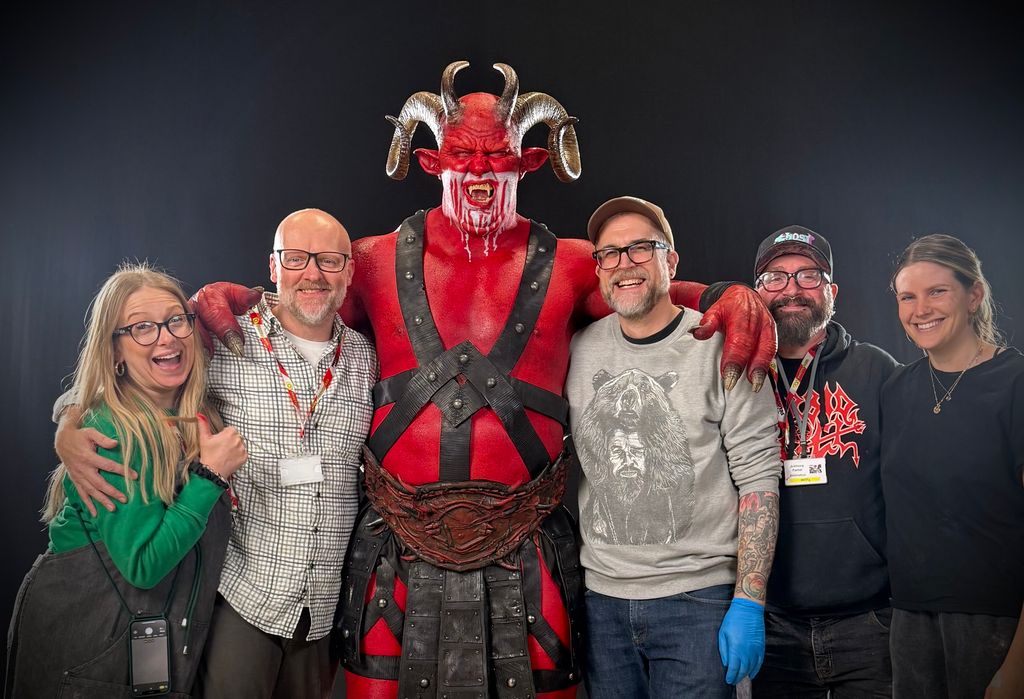
a horned red goat man with five makeup artists

Team Goatman. (L to R) Sarah Downes, Barrie Gower, Hapthor Bjornson, Duncan Jarman, Anthony Parker and Gillian Jarvis (Image credit: Amazon MGM Studios)

The master plan was to still give the $200 million feature a fun modern spin, but Knight was interested from a character perspective of creating full-sized human equivalent action figures.

"He wanted the world to be ultra colorful, ultra bright, and have this sense of awe and eye candy. We went through the characters to decide what would be practical, what would be purely digital, and what would be a combination of the two. Because of Travis’s background with Laika Studios he was very much into the practical techniques."

That was all music to Gower's ears and his BGFX team began the process of bringing the menacing egomaniacal antagonist called Skeletor to life.

"Originally Skeletor was going to have some sort of decorative golden mask in the shape of a skull with possibly some kind of disfigured makeup underneath," he notes. "But Travis said we’re doing Skeletor properly. He’s going to have a skull for a talking face and a blue muscular body. And this is the prefect example of a combination between practical and digital effects.

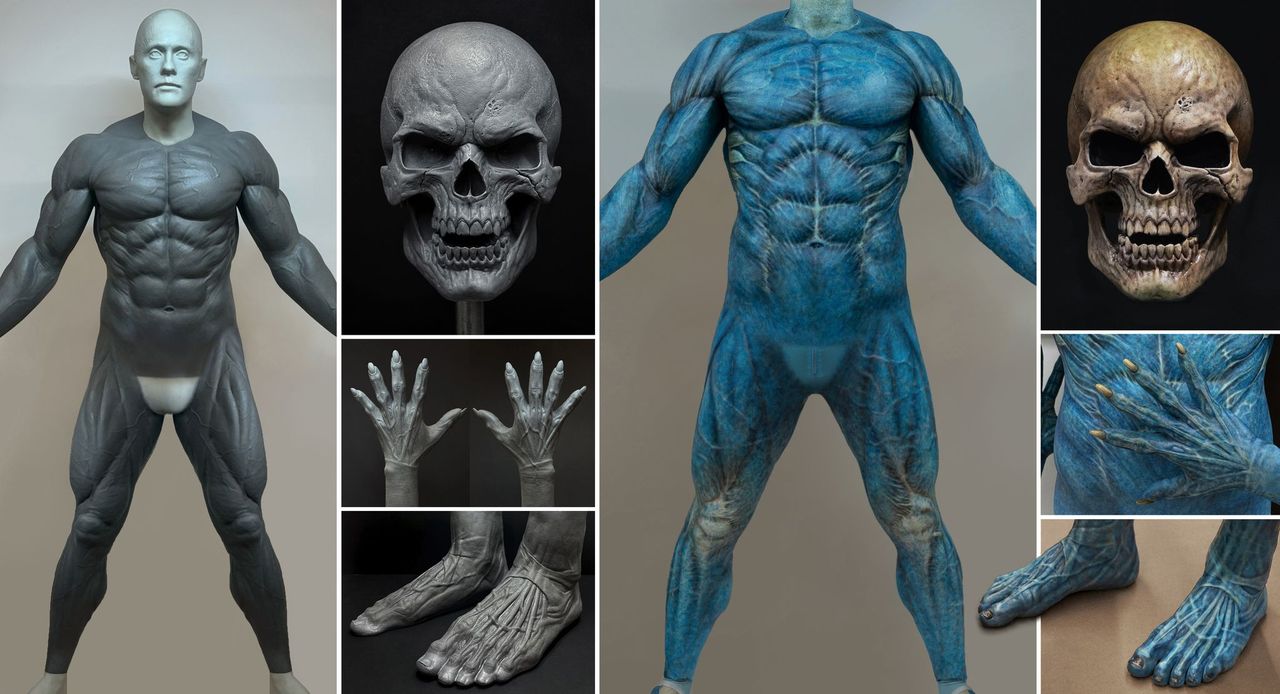
"He was set on the idea of creating a practical muscle suit for Jared, and his head would be animated digitally. We had a scan of Jared's head that we reduced and classically sculpted the skull based on the concept art, then we 3D scanned that for a digital file which we shared with the visual effects department for them to use as an asset to animate."

blue latex skeleton man concept art

Gower's Skeletor build page for "Masters of the Universe" (Image credit: Amazon MGM Studios)

Creating this blue-hued Skeletor muscle suit was quite a complex job that included upper and lower body appliances crafted out of foam latex.

"It was using a lot of Jared’s muscle tones that we over-exaggerated and sculpted in more muscle sets and tones, but kept everything relatively anatomically accurate," adds Gower. "Then we went through a lot of testing and paint schemes. We originally did some silicone work, which is one of the most commonly used products in the prosthetics industry now because you get a beautiful translucency with it. But it’s very dense and non-porous and very heavy. So Jared would have been walking around with pounds and pounds of rubber on him. We did R&D and it was going in the right direction but we were running out of time, so we reverted to foam latex."

Jared's otherworldly outfit consisted of a foam suit, skeletal silicone gloves that fit over his hands, a foam latex collar, and then a hood fabricated by the costume department.

makeup artists touching up a spiked monster

Prosthetic artists Jon Moore and Ashley Powell with James Apps as Spikor (Image credit: Amazon MGM Studios)

"We'd actually built two suits based on Jared. It was on a January morning and we met him at a hotel near the London airport," Gower recalls. "We had a very small window of time before filming so we were praying we weren’t going to have many adjustments to make. Jared came in, we got the stuff on him, and he was really lovely with us. Very funny, very jovial. He had just stepped off a plane!

"It went really well, just a couple tiny adjustments. We had a small team looking after him with his suit every day. Usually with prosthetics if you’re gluing it over the entire body you’re looking at seven or eight hours to do an application each day. Apart from times where we had to glue a few things on him here or there, we actually got him into his suit in about 15 minutes. He was a joy to work with. He was a lot of fun on set and there was this charismatic presence every day."

"Masters of the Universe" is currently in theaters everywhere.

❌