❌

Normal view

Received β€” 11 September 2026 ⏭ Latest from Android Central

Galaxy Tab S12 prices leak, and we might have higher costs on our plate

What you need to know

  • A report from an overseas publication claims that the prices for the Galaxy Tab S12 Plus and Ultra might go up this year.
  • It's suggested that the prices for Samsung's next tablets have shot up by ~€200, and there's a chance the U.S. could see a similar trend.
  • Recent Galaxy Tab S12 Ultra rumors suggested there could be a 16/1TB variant; however, the current rumors do away with that theory, and the ongoing memory issues could be the cause (much like the higher pricing

Rumors continue late this week about Samsung's next tablets. Whether it's to be expected or not, it's been alleged that a price hike is on the way.

A WinFuture report highlighted allegations about the Galaxy Tab S12 series' price. The Galaxy Tab S12 Ultra will reportedly feature two storage configurations for each variant (Wi-Fi and 5G). The publication cites its "retail sources" in stating the Tab S12 Ultra could cost €1,539 and €1,739 for its 12/256GB and 12/512GB versions. When it comes to the 5G variant of this tablet, rumors claim €1,689 and €1,889 price tags.

On the other hand, there's the Galaxy Tab S12 Plus. The publication claims it will feature the same storage configs as the Ultra. Its prices are rumored to be €1,299 and €1,499. As usual, Samsung will rework the pricing to "better suit" the region; however, we still might be in for a price hike in the U.S.

WinFuture mentions that the alleged prices in Europe are roughly €200 higher than the Tab S11 series. There's a chance Samsung could raise the cost of its next tablets similarly in the U.S. and other regions. For context, the Tab S11 is $699, while the Tab S11 Ultra is $949. If we're to see similar hikes, we might see a Tab S12 Plus closer to $900, while an Ultra could just cross $1,100. But, as always, this is speculative for now.

The trail continues

The Samsung Galaxy Tab S11 and S11 Ultra.

(Image credit: Brady Snyder / Android Central)

Galaxy Tab S12 series leaks have been sporadic this year. These rumors have continued to claim that Samsung is opting for two models: a Plus and an Ultra. The Tab S12 Ultra had its details leaked in July, suggesting a tablet that's largely similar to its S11 counterpart. A similar thin build, camera notch, and a 14.6-inch display were mentioned. What's more, the Ultra model could feature an 11,600mAh battery.

One thing has changed with these rumors. The publication today (Sept 10) did not mention a 16/1TB configuration for the Ultra. Previous rumors suggested it could reach these attractive heights; however, we know the ongoing RAM situation that's affecting all of tech. That could be a major cause for the no-show, as well as these purported price hikes.

When the Galaxy Tab S12 Plus' "live images" surfaced, that model also looked pretty much the same. The device was spotted with rather thick bezels around its display.

Android Central's Take

I'd imagine the U.S. market would follow suit if these price hike rumors are to be believed. If anything, I'd say a $100 to $200 increase is in the cards. We are expecting these tablets to appear any week now. We've crossed into September, and that's usually when we start expecting the next tablets from Samsung.

Dbrand's newest minimalist cases stray far from the company's usual vibes

11 September 2026 at 10:36

When Dbrand told me it was launching a new minimalist case sub-brand, I was immediately interested. I've loved the company's products for years, and they often come out with new and interesting design ideas, but MNML immediately felt different from Dbrand's usual vibes.

It's such a departure from the company's usual designs that you won't even find the name Dbrand on the case. It's just MNML on the corner, and there's no support for Dbrand skins or any of the usual snarky flair most of us are used to.

Three different colors of Dbrand MNML case and the retail boxes
Nicholas Sutrich / Android Central
Looking at the blue Dbrand MNML case
Nicholas Sutrich / Android Central
Looking at the blue Dbrand MNML case
Nicholas Sutrich / Android Central
Looking at the blue Dbrand MNML case
Nicholas Sutrich / Android Central
Looking at the blue Dbrand MNML case
Nicholas Sutrich / Android Central
Looking at the blue Dbrand MNML case
Nicholas Sutrich / Android Central

You'll also find the prices to be much more minimalist than Dbrand's usual afair. At just $39, these are a bit more palatable than the $50 Ghost cases or the $60+ Grip cases, and they come in four simple colors. The burgundy is my favorite of the four, although I think it looks terrible on an orange iPhone. Better stick to black or tan for a bolder color like that.

Dbrand sent me cases for the Pixel 11 Pro and the iPhone Pro Max 17/18 (since they're the same phone anyway). The "sandstone" texture on these isn't at all like OnePlus's sandstone phones or cases β€” meaning they're textured but not rough like sandstone usually is β€” which gives it a nice grip without sanding your fingerprints off by accident.

A burgundy Dbrand MNML case on an orange Apple iPhone 17 Pro Max
Nicholas Sutrich / Android Central
A burgundy Dbrand MNML case on an orange Apple iPhone 17 Pro Max
Nicholas Sutrich / Android Central
A burgundy Dbrand MNML case on an orange Apple iPhone 17 Pro Max
Nicholas Sutrich / Android Central
A burgundy Dbrand MNML case on an orange Apple iPhone 17 Pro Max
Nicholas Sutrich / Android Central
A burgundy Dbrand MNML case on an orange Apple iPhone 17 Pro Max
Nicholas Sutrich / Android Central
A burgundy Dbrand MNML case on an orange Apple iPhone 17 Pro Max
Nicholas Sutrich / Android Central
A burgundy Dbrand MNML case on an orange Apple iPhone 17 Pro Max
Nicholas Sutrich / Android Central
A burgundy Dbrand MNML case on an orange Apple iPhone 17 Pro Max
Nicholas Sutrich / Android Central
A burgundy Dbrand MNML case on an orange Apple iPhone 17 Pro Max
Nicholas Sutrich / Android Central
A burgundy Dbrand MNML case on an orange Apple iPhone 17 Pro Max
Nicholas Sutrich / Android Central

I also love the clicky covered buttons on the case. It's got all the port cutouts you'd hope to find on a case, plus a perfectly sized lip around the front glass to protect it. I didn't have trouble using gestures with these cases, unlike some rugged cases that have too large a lip and usually get in the way.

A blue Dbrand MNML case on a Google Pixel 11 Pro
Nicholas Sutrich / Android Central
A blue Dbrand MNML case on a Google Pixel 11 Pro
Nicholas Sutrich / Android Central
A blue Dbrand MNML case on a Google Pixel 11 Pro
Nicholas Sutrich / Android Central
A blue Dbrand MNML case on a Google Pixel 11 Pro
Nicholas Sutrich / Android Central
A blue Dbrand MNML case on a Google Pixel 11 Pro
Nicholas Sutrich / Android Central
A blue Dbrand MNML case on a Google Pixel 11 Pro
Nicholas Sutrich / Android Central
A blue Dbrand MNML case on a Google Pixel 11 Pro
Nicholas Sutrich / Android Central
A blue Dbrand MNML case on a Google Pixel 11 Pro
Nicholas Sutrich / Android Central

These also aren't minimalist in the way Thinborne cases are. They're not super rugged like Dbrand's Tank cases are, but they still add a little bit of bulk to the phone. They're cushy and a few millimeters thin, but they weigh around 40-50g, depending on the phone, which is roughly twice the weight of an aramid fiber case (like Thinborne).

The bright side to the extra "bulk" is that these are more drop-resistant than aramid fiber cases. I purposefully dropped the Pixel 11 Pro on the concrete from about 3ft up a few times to see what would happen. The phone looked untouched, and the MNML case just had a few minor dings on the corners.

Weighing a Thinborne case for the Pixel 11 Pro Fold
Nicholas Sutrich / Android Central
Weighing a Dbrand MNML case for the Pixel 11 Pro
Nicholas Sutrich / Android Central
Weighing a Dbrand MNML case for the iPhone 17 Pro Max
Nicholas Sutrich / Android Central

Seems to me that these will generally hold up nicely to wear and tear over the life of your phone, making them a great option to grab the next time you're in a Best Buy (so long as you don't care about Dbrand skins).

Dbrand makes MNML cases for 24 phone models across Apple, Samsung, and Google Pixel phone lines. That MNML sub-brand also includes a handful of MagSafe accessories, like a kickstand wallet, slim wallet, and an AirPods case (I guess that's a thing?).

Here's your first look at the upcoming Samsung Galaxy open-ear earbuds

What you need to know

  • Samsung is reportedly working on Galaxy Buds On, a new pair of open-ear earbuds with a clip-on design.
  • Leaked renders show two rounded sections connected by a silicone loop, with black and white color options expected.
  • Galaxy Buds On could offer Auto Volume, head gestures for controls, and automatic pausing when you fall asleep.

It looks like Samsung is cooking up a pair of open-ear Galaxy Buds, and they could launch fairly soon.

While the best wireless earbuds still offer features like ANC and superior sound quality, open-ear earbuds have suddenly started taking over. We recently checked out the Huawei FreeClip 2, which we called one of the most comfortable open-ear earbuds we've tried, and now it looks like Samsung is preparing to challenge the throne.

As reported by SammyGuru, Samsung appears to be working on a pair of open-ear earbuds called the Galaxy Buds On. The publication has shared what appear to be product renders of the device, giving us an early look at the earbuds.

Leaked images of the Galaxy Buds On

(Image credit: SammyGuru)

According to the leak, the Galaxy Buds On will feature a fairly standard open-ear design, with two rounded sections connected by a flexible silicone loop. One side will presumably sit closer to the user's ear, while the flatter section will remain on the outside and likely provide an area for touch controls and gestures.

The leaked renders show the Galaxy Buds On in black, although a white color option also appears to be in the works.

The publication was also able to extract illustrations showing how the Galaxy Buds On will clip around the user's ears. The report claims the earbuds will feature Auto Volume, which will automatically adjust the volume depending on your surroundings, alongside head gestures like nodding and shaking.

Leaked images of the Galaxy Buds On

(Image credit: SammyGuru)

Another interesting feature will reportedly detect when the wearer has fallen asleep and automatically pause whatever is playing.

There's still no word on exactly when Samsung plans to launch the Galaxy Buds On. However, the company now has several products rumored to be waiting in the pipeline, including the long-awaited Galaxy Glasses and Galaxy Tab S12 Ultra, so we could be hearing much more about Samsung's upcoming hardware fairly soon.

3 reasons the UGREEN Nexode Pro 160W is now my go-to GaN charger

I've been using UGREEN's Nexode Pro chargers while traveling for well over two years now. These charges don't take up much room thanks to GaN tech, and they have all the ports I need. The latest iteration of the product β€” the UGREEN Nexode Pro 160W Charger with Retractable Cable β€” adds a retractable cable, built-in panel, and foldable pins, and while it is a little bigger than its predecessor, it the new features provide much better convenience in daily use.

The Nexode Pro 160W charger is now available for $99 on Amazon, and I think that's a reasonable price when you look at everything on offer. I the Nexode Pro 160W for the better part of three months, and I'm outlining three reasons why it is now my go-to GaN charger.

The built-in LCD panel takes guesswork out of charging

UGREEN Nexode Pro 160W GaN Charger with Retractable Cable

(Image credit: Apoorva Bhardwaj / Android Central)

While the Nexode Pro 160W isn't the only charger to come with a built-in LCD screen, it makes a big difference in my usage. I connected a lot of accessories and phones to the charger in the last three months, and knowing just how long it takes to fully charge these devices takes all the guesswork out of charging.

UGREEN Nexode Pro 160W GaN Charger with Retractable Cable
Apoorva Bhardwaj / Android Central
UGREEN Nexode Pro 160W GaN Charger with Retractable Cable
Apoorva Bhardwaj / Android Central

The screen also shows real-time charging speeds, including wattage, voltage, and which charging protocol is being used. This is particularly useful for me, as I tend to use phones like the Find X9 Ultra and Vivo X300 Ultra that use their own charging standards. Thankfully, these phones rely on USB PD at up to 50W, and that's what I ended up using. The screen rotates based on the orientation of the charger, which is a nice addition.

The retractable cable is an added bonus

UGREEN Nexode Pro 160W GaN Charger with Retractable Cable

(Image credit: Apoorva Bhardwaj / Android Central)

Retractable cables in charging products became a thing around two years ago, and since then, I didn't use a power bank that didn't have it. They're just so useful, and I'm excited to see brands adding these cables to chargers. The retractable cable on the Nexode Pro 160W goes up to 140W, and is ideal for charging phones, notebooks, and power banks.

UGREEN Nexode Pro 160W GaN Charger with Retractable Cable

(Image credit: Apoorva Bhardwaj / Android Central)

The cable has four preset lengths, and goes up to 70cm with a full extension. The USB-C connector has a built-in magnet that ensures the cable is attached to the GaN charger when not in use, and after three months of extensive use, I didn't see any issues with the retractable motor.

It has all the ports I need

UGREEN Nexode Pro 160W GaN Charger with Retractable Cable

(Image credit: Apoorva Bhardwaj / Android Central)

With three USB-C ports (including the retractable cable) and a USB-A connector, the Nexode Pro 160W has all the ports I need in daily use. The USB-C1 and retractable ports go up to 140W over the USB PD 3.1 protocol, the USB-C2 port hits 100W, and the USB-A port goes up to 22.5W, which is ideal to use with accessories.

It has a total power budget of 160W when using all three USB-C ports β€” 65W + 65W + 30W β€” and it's a decent choice if you're like me and need to charge several devices at once. I also like that the plug is foldable; that's the case with U.S.-style blade plugs anyway, but I'm using the EU model, and it's just easier to have a plug that folds β€” it makes the Nexode Pro 160W just that little bit better as a travel charger.

UGREEN Nexode Pro 160W GaN Charger with Retractable Cable

(Image credit: Apoorva Bhardwaj / Android Central)

Overall, the Nexode Pro 160W has all the features I need in a GaN charger, and the build quality combined with the extras make it a good choice if you need a new charger to use at home or on the road.

UGREEN Nexode Pro 160W 4-Port Charger

UGREEN
Nexode Pro 160W 4-Port Charger

The Nexode Pro 160W GaN charger has all the ports you need, goes up to 140W via USB PD 3.1, and the built-in cable adds a lot of convenience. The LCD panel makes it easier to know just how long it takes to charge a connected device, and the overall build quality is among the best. If you need a new 160W GaN charger, this is the one to get.

RIP Pixel Tablet: Google has officially pulled the plug

What you need to know

  • Google has officially removed the Pixel Tablet from its online store after listing it as out of stock.
  • The Pixel Tablet has also disappeared from major retailers including Amazon and Best Buy.
  • Google reportedly canceled plans for second- and third-generation Pixel Tablets due to sales and profitability concerns.
  • Existing Pixel Tablet owners will continue receiving software updates until mid-2028 despite the lineup's end.

The Pixel Tablet is finally dead. Like, properly dead dead.

Google launched the Pixel Tablet back in 2023 as a hybrid device that could work as both a traditional Android tablet and a smart home display when placed on its charging dock. At $499, the Pixel Tablet offered a pretty interesting combination on paper, but reactions to the device were mixed after launch.

Google reportedly had plans for a second-generation Pixel Tablet in 2025 and even a third-generation model in 2027. But amid poor sales and profitability concerns, the company reportedly pulled the plug on those plans back in 2024. Despite that, the original Pixel Tablet remained available through the Google Store and retailers for quite some time. Until now.

The Google Pixel Tablet showing a picture of a deep blue hydrangea, pulled from Google Photos while docked

(Image credit: Nicholas Sutrich / Android Central)

As spotted by Jetstream, Google has officially removed the Pixel Tablet from the Google Store. The tablet was listed as "out of stock" until a few days ago, but the product page has now been removed altogether, effectively confirming that Google is done selling the device. The Pixel Tablet has also disappeared from retailers, including Amazon and Best Buy.

That means there's now no official way to buy a new Pixel Tablet. You may still be able to find remaining stock through smaller online retailers or pick one up from a reseller, but Google's own inventory is officially gone.

The good news for existing Pixel Tablet owners is that software support isn't ending anytime soon. Google is expected to continue supporting the device with updates until mid-2028. But unless Google decides to resurrect its tablet ambitions again, there won't be another Pixel Tablet waiting to replace it.

The Pixel Tablet was an interesting idea. Having one device that could work as both an Android tablet and a smart home display made plenty of sense, especially inside Google's ecosystem. Unfortunately, the idea never really took off.

So, RIP Pixel Tablet. This time, it looks like it's actually over.

Samsung might've started racing ahead to Android XR glasses with a color display

What you need to know

  • Rumors claim Samsung is developing a new pair of smart glasses, and has tapped Samsung Display for an in-lens color display.
  • The glasses would allegedly focus on displaying "text, notifications, icons, and more" on an extremely thin panel.
  • Samsung has its Intelligent Eyewear, which is supposedly coming out this fall, but those are mostly voice-focused with Google's Gemini and a camera.

Samsung has barely dipped a toe into the world of smart glasses, and there's already a rumor that it wants to go bigger next time.

This report from The Elec (Korean) claims Samsung might've started developing smart glasses with a color display (via 9to5Google). The publication cites its "industry sources" in saying Samsung has tapped Samsung Display to "create microdisplays" for a future pair of AI smart glasses. These rumors claim Samsung has a lot on its plate to prepare this product.

Specifically, the post claims Samsung has a "technical challenge" to overcome: its FOV (field of view). The company is purportedly chasing a wide FOV for these glasses to accommodate the information users would see. What's more, Samsung is leaning on its Display side to create "ultra-small panels" of ~0.2 inches or smaller for the lenses. Samsung is allegedly focusing on displaying "text, notifications, icons, and navigation arrows" (machine-translated).

It's still incredibly early to know for sure how Samsung's first color display smart glasses will arrive. However, the publication suggests the glasses could see a launch in the second half of 2027 or "early" in 2028.

Got lenses?

Hands-on with Samsung Glasses with Warby Parker and Gentle Monster styles

(Image credit: Derrek Lee / Android Central)
Android Central's Take

Samsung's getting serious. I don't think its Intelligent Eyewear are a bad start, though. It's starting simple. Useful, even. Everything is based on your voice. You still have a camera to take photos, and Gemini is there to help with hands-free assistance. To put a color displayβ€”a proper screenβ€”would definitely take things up a notch. To me, I think this rumor is probably a little more eye-catching.

We can't help but think about the Ray-Ban Display glasses from Meta. In fact, that's probably the kind of competition Samsung wants to get itself involved in. These glasses also feature the neural band. It makes it easier to control the display and content on your lenses with hand gestures. There's plenty of time still to see how Samsung manages this.

Right now, we have (kind of) Samsung's "Intelligent Eyewear." These glasses are in partnership with Google, alongside designs from Warby Parker and Gentle Monster. These are Samsung's first smart glasses, but they lean more on the user's voice. Users can communicate with Gemini for navigation, order pickups, and photos. The glasses feature a camera and a microphone to get all of this done. Google reiterated its Samsung partnership during this summer's Unpacked.

These glasses aren't out yet. During the original announcement this past spring, Samsung said we shouldn't expect to see them until "later this fall."

Galaxy Watch 4, 4 Classic are no more: these Samsung watches lose support

What you need to know

  • It's been reported that Samsung has cut support for the Galaxy Watch 4 and Watch 4 Classic.
  • The watches have reached the end of their five-year software support cycle and will no longer receive any updates from Samsung.
  • The Galaxy Watch 4 series made headlines years ago since Samsung swapped its in-house Tizen OS for Wear OS 3; however, there was a lot we weren't satisfied with.

Samsung's made a change this week regarding currently supported devices, and two old smartwatches are no longer on the list.

Samsung amended its Security Updates page, and it no longer lists the Galaxy Watch 4 and Galaxy Watch 4 Classic (via Android Police). The company's smartwatches receive "Quarterly" security patches, and that's where the change resides. According to Samsung, the Watch 4 and Watch 4 Classic have reached the end of their update lifecycles.

As it stands, Samsung's "oldest" supported watches are the Galaxy Watch 5 (40mm, 44mm) and the Galaxy Watch 5 Pro. Users with a Galaxy Watch 4 series device have reached the end of their allotted five years of updates. It also makes sense that Samsung is writing in this change now, in September. The watches' final update rolled out early in August.

That update was pretty minimal, which you'd expect for a device so old. Samsung only rolled out the essential fixes to ensure your Galaxy Watch 4/4 Classic would remain protected against malicious attacks, but that's it.

They've been cut

Samsung Galaxy Watch 4 and 4 Classic

(Image credit: Android Central)

There's a lot we can sit here and talk about concerning the Galaxy Watch 4 and 4 Classic. But we don't have that kind of time. One of the main highlights was Samsung's software change for the Watch 4. The device launched with Google's Wear OS, not the brand's in-house wearable OS, Tizen. In fact, Samsung co-developed Wear OS 3 for its Galaxy watches.

However, despite some of the "good" Samsung did with the watch, there was a lot we weren't happy with. The UI on the watches mirrored Tizen quite closely, despite being Wear OS 3. What's more, the Galaxy Watch 4 and 4 Classic were missing some classic Wear OS features. That was a strange pill to swallow, considering you'd find those features readily available on a TicWatch.

Fast-forward to 2026, and you'll find Samsung's latest Galaxy Watch 9 series. Samsung is using Qualcomm's Snapdragon Wear Elite (a great move). The company has also continued to enhance the available health features on the watch, as well, for your heart health and more.

Metro by T-Mobile is giving away the Samsung Galaxy A37 for FREE β€” here's how to claim yours

It's not unusual for Big Three providers to run free phone deals, but when an affordable prepaid carrier like Metro by T-Mobile does it, one should take note. Bring your number and add a line with any of Metro's plans (starting at $40/month) and you'll get the Samsung Galaxy A37 for completely free. No trade-in required, no hidden taxes or fees to worry about.

That's a $450 value, and the T-Mobile-owned carrier will even waive the activation fee. $40 per month for unlimited talk, text, and data AND one of the best cheap Android phones on the market? Sign me up.

Sign up for cheap wireless through Metro by T-Mobile and the free Samsung phone is yours

Samsung Galaxy A37 5G 128GB: $449.99 FREE with phone plan at Metro by T-Mobile

Join Metro by T-Mobile with its $40/month unlimited plan and you'll get enough promo credits to make the Galaxy A37 5G completely free. There's no device activation fee to worry about, and there are no hidden taxes or charges applied at checkout. It's just a single payment of $40 today, period. View Deal

Completely owned and operated by T-Mobile, Metro by T-Mobile is an affordable prepaid carrier that harnesses the power of its parent company to deliver comprehensive wireless for cheap. The $40/month Unlimited 5G Data plan gives you unlimited talk, text, and data on T-Mo's vast 5G network, plus you get access to Scam Shield protection and exclusive offers through T-Mobile Tuesdays.

It may lack a lot of the bells and whistles included in some unlimited plans (particularly those offered by Big Three providers), but if you just want simple, affordable wireless with no hidden fees or regular price increases, Metro by T-Mobile has you covered.

The only catch is that, since it's a prepaid provider, it is possible for your Metro service to get deprioritized when T-Mobile's network is busy. This can only occur after 35GB of data is used in one billing cycle, however, so it's really only an issue if you're a particularly heavy data user.

Samsung Galaxy A37 5G

(Image credit: Samsung)

What about the phone?

Starting at $449.99, the Galaxy A37 is a budget phone that punches well above its weight class, with a stunning 6.7-inch AMOLED display, snappy Exynos 1480 chipset, and a bunch of AI-powered camera features. The device also boasts an efficient 5,000mAh battery that lasts longer than some flagships, plus you get six years of guaranteed OS and security upgrades, which is a rarity in this price range.

Android makes switching password managers much easier

What you need to know

  • You can now move passwords and passkeys directly between supported apps on Android without exporting sensitive data to an unencrypted file.
  • Your new password manager hands the process to Android, which detects compatible managers installed on your phone and coordinates the transfer.
  • Once authorized, Android moves the credentials between apps without requiring manual file handling.

Android has always made it a pain to switch password managers. Moving passwords usually involved exporting your data into an unencrypted text file, and passkeys were pretty much stuck in place. Android is tackling both of those issues with a new transfer experience that makes moving your credentials much more secure and simple.

In a blog post, Google said the new system lets you transfer passwords and passkeys directly between password managers, without first having to download a file.

That eliminates one of the biggest security hassles of the old process, which was that sensitive credentials were sitting unprotected on your device for a while. Furthermore, passkeys weren’t transferable, so you had to manually recreate them across websites and apps.

The process is built to be mostly out of your way. Start in your new password manager and select the option to import or copy credentials from another provider. The app then hands the job to Android, which knows which compatible password managers you have already installed on your phone and shows you where the data can come from.

You are then sent back to the password manager you already use to select, review, and approve the transfer. Once approved, the passwords and passkeys move between the apps in just a few seconds.

password import flow within Google's password manager

(Image credit: Google)

The feature is already available with Google Password Manager, 1Password, Bitwarden Password Manager, and Dashlane. Dashlane notes that CXP is compatible with devices running Android 10 or newer with the latest Play Services update. Bitwarden needs Android 14+ with Play services 26.21+.

It is not merely a matter of convenience. Passkeys are more secure than passwords and resistant to phishing. Adoption has been stalled in part due to user concerns around vendor lock-in. CXP removes that barrier.

Bitwarden says the creation of passkeys peaked this summer at over 500% compared to early 2024, with nearly half of all passkeys created in the past three months alone.

Google says more partners are on the way. If you’ve been waiting to change password managers because of the hassle, that excuse just went out the window.

The best foldable phone deals of September 2026 β€” major savings on Samsung Z Fold, Motorola Razr, and beyond

Foldable phones are all the rage right now, but these innovative devices can get pretty expensive without a good deal attached. Fortunately, I've tracked down all of the best foldable phone deals on the web so you don't have to go looking.

We've reached the point where pretty much every OEM is selling a clamshell or book-style foldable phone, and each manufacturer is racing to build the thinnest, most powerful, and most creaseless device on the market. Even Apple has entered the fray with the upcoming iPhone Duo.

This spells good news for you as a consumer, as stiff competition generally means a wider variety of tempting deals to choose from. These manufacturers want you to use their foldable phones and no one else's, which gives you all of the buying power you need. From straight discounts on Motorola flip phones to trade-in offers on the latest Galaxy Z Fold, keep reading for my favorite offers of September 2026.

Samsung

Samsung Galaxy Z Fold 8 256GB: $1,899.99 FREE with eligible trade-in, new line at T-Mobile

Samsung's first passport-style foldable phone has landed, and you can already get the Z Fold 8 for free by trading in an old device and adding a line with the Experience Beyond plan at T-Mobile.

πŸ’²Alternative deal: Amazon is carving a straight $250 off the Galaxy Z Fold 8 when you buy the phone unlocked on its site. View Deal

Samsung Galaxy Z Fold 8 Ultra 256GB: $2,099.99 $1,799.99 at Amazon

Buy the powerful Galaxy Z Fold 8 Ultra unlocked from Amazon and you'll get a straight $400 off your purchase. No strings attached! The retailer is also offering up to $815 back (in the form of an Amazon gift card) when you trade in an old or broken phone.

πŸ’²Alternative deal: buy the Z Fold 8 Ultra directly from Samsung and you'll be eligible for up to $800 off when you trade in. Skip the trade-in process and you'll still score a $300 discount, plus access to additional discounts when you bundle the phone with Samsung accessories. View Deal

Samsung Galaxy Z Flip 8 256GB: $1,199.99 $99.99 with new line at T-Mobile

Purchase the new Samsung Galaxy Z Flip 8 and T-Mobile will give you $1,100 of promo credits over 36 months when you add a line with the Experience More or Experience Beyond plan. That knocks the price of the clamshell device down to just $99 (or $2.78 per month), no trade-in required!View Deal

Motorola

Motorola Razr Fold 512GB: $1,699.99 $599.99 with new line at T-Mobile

Similar to other deals on this list, you can get a straight $1,100 off the powerful Motorola Razr Fold when you add a line with the Experience Beyond plan at T-Mobile. No trade-in required!View Deal

Motorola Razr (2026) 256GB: $799.99, plus free smartwatch and earbuds at Motorola

The Motorola Razr (2026) is easily the most budget-friendly device on this list, and now you can get a free Moto Watch AND some free wireless earbuds when you buy the clamshell device directly from Motorola.com. You can also claim up to $150 of trade-in credit.

πŸ’²Alternative deal: Add a line with the Experience More or Experience Beyond plan and T-Mobile will give you enough promo credit to make the Razr (2026) completely free.View Deal

Motorola Razr Plus (2026) 256GB: $999.99 FREE with eligible line at T-Mobile

Another T-Mobile deal for the books. Add a line with the Experience Beyond plan and the Big Three carrier will give you $1,000 in promo credits, effectively making the Motorola Razr Plus (2026) free. You'll also get same day delivery at no additional cost!View Deal

Motorola Razr Ultra (2026): $1,499.99, plus free smartwatch and earbuds at Motorola

The Motorola Razr Ultra (2026) might be the best flip phone ever built, but it's not exactly cheap. Fortunately, if you buy the device directly from Motorola.com, you'll get a free smartwatch, a pair of earbuds, and up to $250 back when you trade in. View Deal

Google Pixel

Google Pixel 11 Pro Fold 256GB: $1,899.99 $999.99 with most plans at T-Mobile

Most folks don't really think of Google when they think of foldable phones, but that's a shame, as the new Pixel 11 Pro Fold really holds its own against the other phones on this list. Now you can try the powerful device yourself and score $900 off your purchase when you add a line with most unlimited plans at T-Mobile.View Deal

Magic Capture is the best camera feature in a decade, and Pixel 11 owners need to use it ASAP

10 September 2026 at 15:49

If I had to pick just one reason to recommend Google's Pixel 11 series of phones, it would be for Magic Capture. This Pixel 11-exclusive Gemini feature uses AI smarts to automatically capture photos while you're recording a video with your smartphone.

It ensures the best moments are delivered in picture-perfect HDR+ detail, so you can stay in the moment instead of trying to strike the right pose. Better yet, it retains the video you captured, so you get a top-notch video recording and effortless photos from every moment.

We've seen similar auto-capture features from companies like Honor, but Google's implementation goes further than any of them have, and it does it all in an impressively simple way, too. If you've got a Pixel 11 series phone, here's what you need to know about Magic Capture (and why you need to use it immediately).

What is Magic Capture and how does it work?

Magic Capture on a Google Pixel 11 Pro Fold

(Image credit: Nicholas Sutrich / Android Central)

Magic Capture is a new main camera mode on the Google Pixel 11 series. Google puts it alongside the main photo and video modes, which makes sense since it combines both. Once you start a Magic Capture recording, you can just focus on capturing the moment instead of worrying about getting the right photo.

After you hit stop, the Pixel 11's special version of Gemini will analyze the video locally, so it won't go to the cloud for processing. Gemini mainly captures photos based on expressions, movement, and composition. This means that if someone smiles during a Magic Capture session, for example, you can expect Gemini to create a photo of that moment.

If you tap the thumbnail in the viewfinder, you can watch this happen in real-time. Here's a video example from our hands-on time with the Pixel 11 Pro back in early August 2026.

Gemini will pick out several moments from the video and save them as a photo, but this isn't just a simple frame export of the video. During the Magic Capture session, the Pixel 11 captures several additional frames of data that are used to create a full HDR+ quality photo, which is a substantial step-up in quality versus a simple frame export.

Plus, since Gemini can take multiple video frames and combine them into one excellent photo, moving subjects (like kids and pets) come out crystal clear. I've been calling Pixels the best phones for parents for years, and this levels up that expectation in ways even I didn't foresee.

I've constantly been blown away by using Magic Capture over the past month on my Pixel 11 Pro Fold because of its ability to save those moments I absolutely would have missed if I were just taking regular photos. It's the kind of AI-powered technology that I've been dreaming about, and it's dead simple to use, at that!

What are the downsides of Magic Capture?

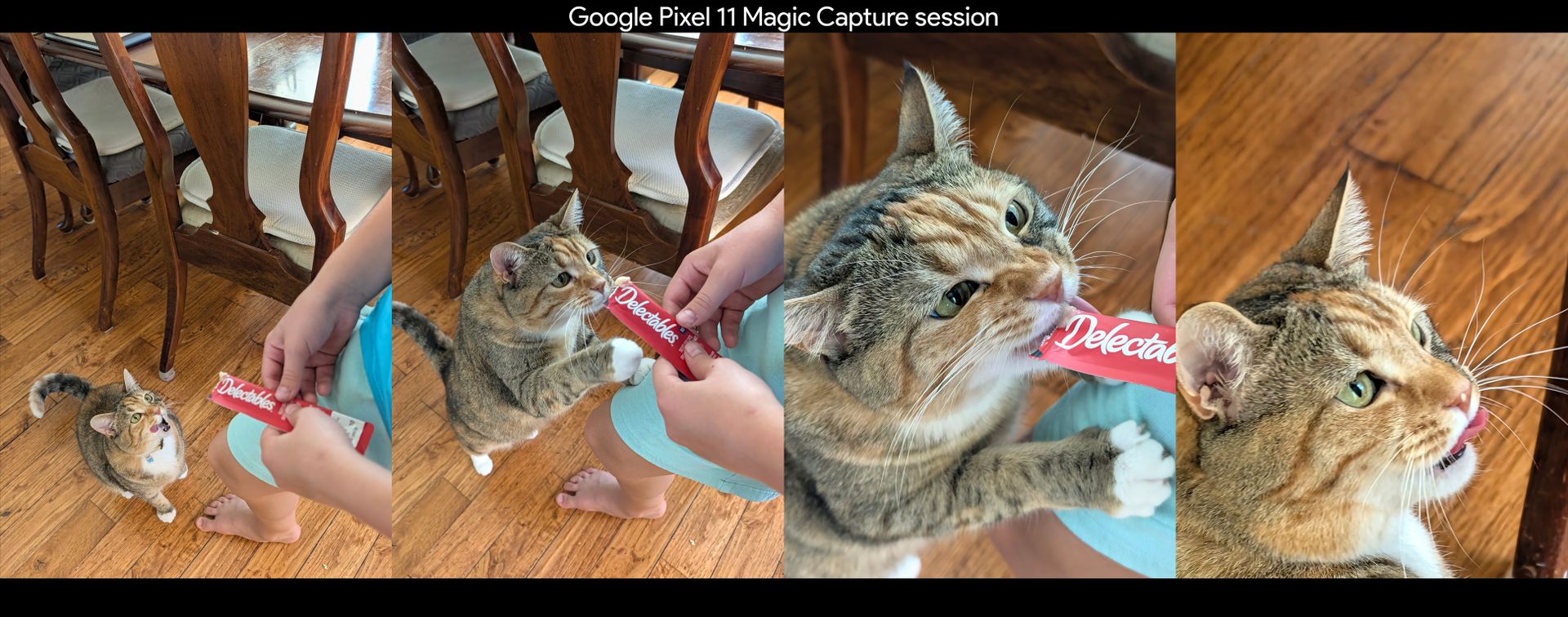
Four photos of a cat eating a snack taken via Magic Capture on a Google Pixel 11 Pro

(Image credit: Android Central)

While Magic Capture is truly amazing, it does have a few downsides. Namely, you won't get full-resolution video or photos from the captures. That doesn't mean they look bad, but it's worth noting that you'll lose a little quality when you use the feature. Here's how the numbers run:

Google Pixel 11 camera maximum resolution

Photo mode

Video mode

Magic Capture

Video capture

N/A

4K (3840 x 2160) resolution, 60 FPS

1080p+ (1440 x 1080) resolution, 30 FPS

Photo capture

4000 x 3000 resolution

N/A

3820 x 2865 resolution

As you can see, the photos are nearly full quality, but the resolution will vary. By default, Magic Capture automatically crops and rotates captured images to make them look better. This results in a slightly lower-resolution photo, but only because it's cropped and/or rotated. If you wish, you can disable this option in Magic Capture settings to get the full-resolution frame.

Magic Capture only records in 1080p+ quality at 30FPS, so if you're used to 4K60 video, you'll be disappointed with the results. The aspect ratio is also a little funky for a video β€” it's much closer to 4:3 than 16:9 β€” but it's not the end of the world. Just expect that videos won't take up the whole screen on your phone or a TV, and you'll be fine.

How to use Magic Capture on a Pixel 11

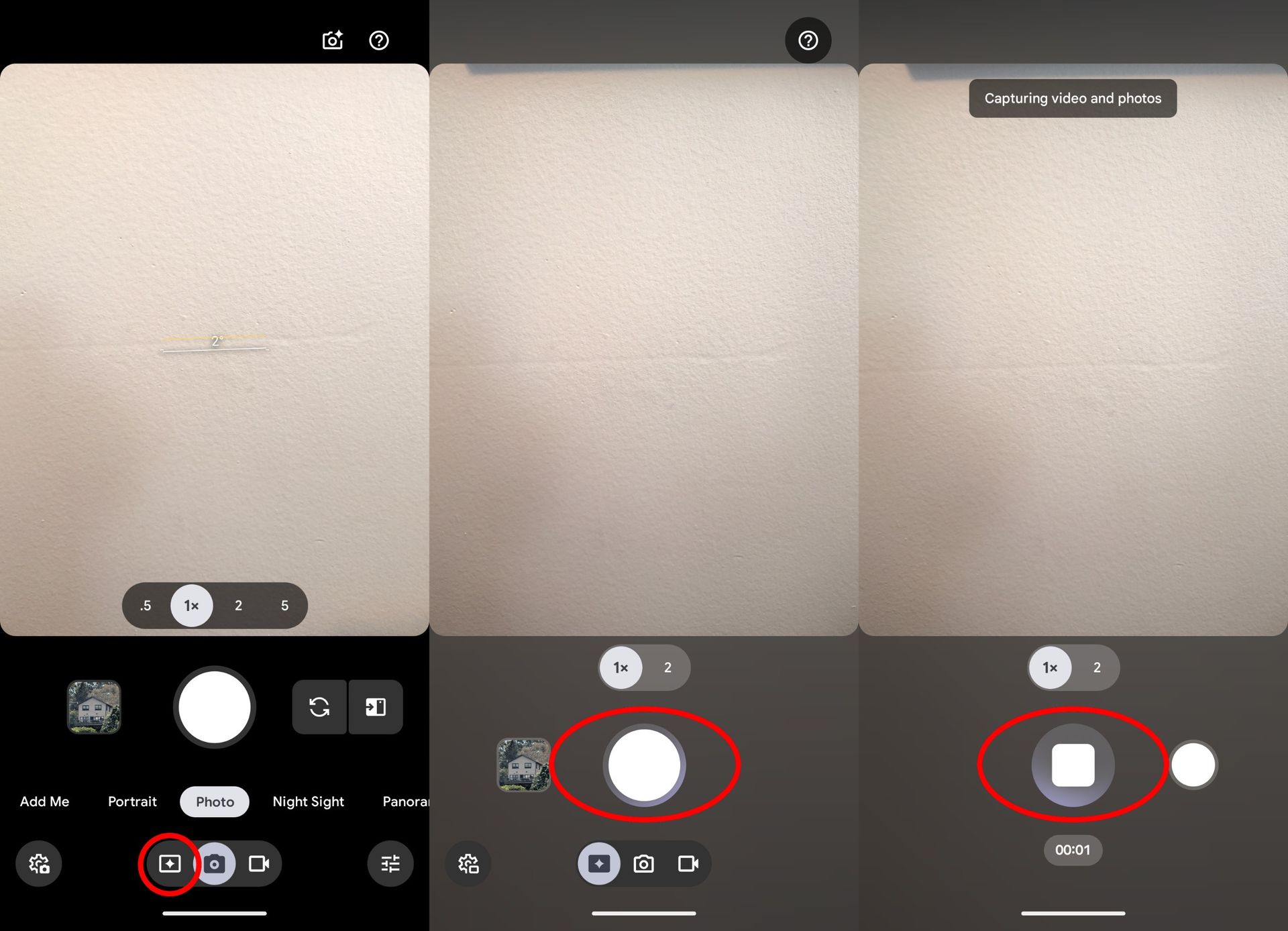
While some camera modes require you to select a main mode and then swipe over to a sub-mode, Magic Capture is one tap away at all times. Here's how to use it:

1. Open the Camera app on your Pixel 11.

2. Tap the Magic Capture button at the bottom of the viewfinder. It's the button to the left of the camera icon at the very bottom of the camera viewfinder.

3. Tap the white shutter button to start a Magic Capture session.

4. Film anything you'd like to capture, and Gemini will automatically identify moments to turn into photos.

5. Tap the red stop button when you're done filming.

How to begin and end a Magic Capture session on a Google Pixel 11 series phone

(Image credit: Android Central)

And that's all there is to it! Tap the photo thumbnail in the viewfinder or open your Google Photos app to view the results of the Magic Capture session. Since Magic Capture relies on a local Gemini agent to process the photos, it may take a few seconds to begin generating photos from each session.

The simplicity and overall quality are why Magic Capture is so amazing to me, and it's exactly why Pixel 11 owners should start integrating Magic Capture into their daily routines. Happy capturing!

Rokid wants anyone to build AI agents for its smart glasses

What you need to know

  • Rokid's AIUI Studio is a browser-based platform that lets anyone build spatial AI apps for Rokid Glasses, with no coding experience or dev kit required.
  • Developers can describe an idea, while the AI-native workflow helps turn it into a working app.
  • The built-in smart glasses simulator lets developers create and test projects before getting physical hardware involved.

Rokid is making it easier to build apps for its AI glasses, and you won't need a coding background or even to own a pair of the glasses.

The company has launched AIUI Studio globally at IFA Berlin 2026, giving developers a browser-based platform for creating and publishing spatial AI applications.

Much of the development process takes place via an AI-native workflow in AIUI Studio. You can say what you want to build in plain language, and the platform can take that idea and build an app without the traditional coding skills.

It also offers a simulation of Rokid’s smart glasses, enabling developers to work on their projects without having to purchase the hardware.

There’s still a reason to get the real hardware involved eventually, though. Rokid’s developer documentation advises testing agents in its Interactive Inview simulator before performing a final check on the actual glasses.

Rokid booth at IFA 2026

(Image credit: Rokid)

For developers who want to have more control, Rokid pairs its AIUI Skills Library framework with AIUI Code assistance. The company says this helps creators make better use of the glasses’ hardware while also optimizing apps for less latency, less memory use, and less power consumption.

The move is the latest as Rokid’s developer ecosystem continues to grow. The company says it now has some 35,000 registered developers and more than 500 agents available through its Agent Store.

AIUI Studio is now available worldwide. If Rokid can take advantage of that growing developer base to create a steady stream of useful agents, its glasses might just become a platform that people actively build around.

Arm's upcoming GPU for Android claims it can deliver 'desktop-class' graphicsβ€”I hope it's true

What you need to know

  • Arm revealed the work put into empowering its new Mali G2-Ultra NX GPU, which is said to bring "desktop-class" graphics to phones.
  • Arm states it's leaning on an AI-native Mali GPU with a Neural Accelerator and more to handle demanding graphics, while maintaining smooth frame rates for mobile gamers.
  • Qualcomm also teased its upcoming Adreno GPU for the next Snapdragon chips, stating it will also lean on AI to help with graphics rendering and frame rate generation.

Arm is highlighting what mobile users can expect from its next GPU. It states everything it's worked to implement is due to growing user demands for "richer visuals" and better frame rates.

Arm revealed the Mali G2-Ultra NX GPU in a newsroom post this week. According to its data, Arm says mobile users want a few things: "They want richer visuals, smoother frame rates, and increasingly immersive experiences." However, there are certain challenges it reportedly needs to overcome to help consumers (and developers, too). The Mali G2-Ultra NX is purportedly the answer to everyone's problems.

Arm states it built the GPU for "neural graphics." This is an AI-native Mali GPUβ€”its first-everβ€”which brings the Neural Accelerator into shader cores. This reportedly aids better teamwork between the graphics and computing workloads. What's more, performance is said to increase. Arm states its Neural Accelerator helps the GPU "handle increasingly demanding scenes more efficiently." This would give developers creating more pleasing visuals more room without the cost of reduced frame rates.

Arm's third-generation ray tracing technology will also assist the graphics department. The Mali G2-Ultra NX support for this ray tracing software will facilitate advancements in shadows, complex lighting, reflections, and more. At a hardware level, Arm states devices with Opacity Micromaps support can produce "richer foliage, more detailed fabrics, layered surfaces, and more."

Better graphics are nothing without smooth frame rates. Arm says "architectural improvements" in the GPU can support longer gaming sessions at "up to" 120FPS.

AI comes to the aid of mobile graphics?

We've been hearing about AI's involvement with mobile phone graphics since earlier this month. Qualcomm highlighted its Adreno "Neural Fusion" GPU, stating that it will lean on AI to upgrade mobile gaming graphics. The chip reportedly utilizes AI-driven rendering tech. This new tech will put better gaming resolution and frame generation in the graphics pipeline.

Console-like graphics were a major detail for Qualcomm in that announcement. The company claims its new chip, coupled with AI, will reduce the work the chip needs to do to produce the graphics mobile users have been asking for. All of this is en route to the Dual 8 Elites from Qualcomm during the Snapdragon Summit from September 22-24.

The Galaxy Watch Ultra 2 is one of the best Android smartwatches you can buy... if you own a Samsung phone

10 September 2026 at 09:02

As I prepped for my day this morning, I opened the YouTube Music app on my Samsung Galaxy Watch Ultra 2 and queued up the latest episode of my favorite podcast. Everything felt great until I actually went out on my run, when the watch lost connection to my phone and stopped playing the podcast. Turns out, auto-downloading isn't enabled by default. Why? I asked the same question.

I'd love to say this was the only annoyance I've faced in the past month since I started using the Galaxy Watch Ultra 2, but that's only a half truth. That's not to say this is a bad watch by any means β€” far from it β€” but several aspects of the experience have been irritating until I tweak something to work the way I expect. This is one reason I stopped using Wear OS watches over the past two years, and while some aspects have improved, others have gotten worse.

That feeling extends across the entire Galaxy Watch Ultra 2 experience. The hardware is faster, but the battery life is worse, and the charging is much slower. Samsung has finally addressed some of the weakest points of the workout experience (like the missing rep count feature on previous watches), but some things are still too obtuse for their own good.

Plus, many of the best features are arbitrarily locked to Android owners who happen to use Samsung phones. I wanted to say I loved the Galaxy Watch Ultra 2, but that would also be a lie. Here's my full review.

What's good

Running with a Samsung Galaxy Watch Ultra 2

(Image credit: Nicholas Sutrich / Android Central)

Right off the bat, I was impressed with Samsung's design and build quality. The circle-within-a-squircle design looked better than I initially imagined, and I appreciate that this watch uses buttons instead of a crown that gets in the way when working out.

I also loved how well apps worked on the phone. This watch is a multitasking beast, both thanks to the Snapdragon Wear Elite processor inside and Wear OS's generally excellent OS design. It's so nice to easily juggle messaging apps, check my calendar, and log my workouts without losing any progress.

Getting turn-by-turn navigation with the trail running feature on a Samsung Galaxy Watch Ultra 2

(Image credit: Nicholas Sutrich / Android Central)

The new trail run workout mode is absolutely superb. This one differs from outdoor running because it provides turn-by-turn navigation (which is paramount for not getting lost on a mountain trail, trust me) and an easy way to load up routes from apps like AllTrails. The voice guidance was more attentive than my favorite Amazfit watch, which I appreciated.

While I rarely ever use Gemini on a watch, it's a great feature to have when you want to do something hands-free. Samsung also loads this watch with great gesture support, furthering the idea that you don't need to get your grubby fingerprints on the screen.

Using the Running Coach feature on a Samsung Galaxy Watch Ultra 2

(Image credit: Nicholas Sutrich / Android Central)

I was also elated to see that several workouts support rep counts and weight measurements, something that's been missing from most Wear OS watches since their inception.

I've also loved using the Running Coach feature, which has been helping me train for a half marathon I've scheduled in November. I've never run a half marathon before, and setting this up on the watch was as easy as opening Running Coach and following the prompts in the Samsung Health app.

Not just annoyances. Real problems.

Samsung heart health features on a Samsung Galaxy Watch Ultra 2

(Image credit: Nicholas Sutrich / Android Central)

Samsung's Running Coach is excellent, but I found that the watch doesn't measure pacing correctly. This was especially prominent during my half marathon training, as the watch wants me to run at a specific slow pace to build endurance, but it's hard to do that when it constantly thinks I'm going too fast. I found this to be the case even during the Spartan Race I wrote about last month, so it's not limited to slow paces.

The Samsung Galaxy Watch Ultra 2's best health features are only supported when using a Samsung phone

(Image credit: Nicholas Sutrich / Android Central)

While I appreciate all the cool new heart health features Samsung added to this watch, they're only for people using Galaxy phones. This makes no sense at all and, quite frankly, is embarrassing for an Android device. Android thrives on interoperability between brands, and Samsung feels like it is making a mockery of that.

I was also extremely unimpressed with the blood pressure and food logging features. Blood pressure monitoring was far too difficult to set up (you have to use a blood pressure machine to create a baseline), and food logging in the Samsung Health app is extremely archaic. In the age of Galaxy AI, I still have to search and scroll through lists of items instead of just asking AI to do it. Competitors like Amazfit have had that feature for years, and it's time Samsung got with it.

Enabling always-on heart rate measurement on a Samsung Galaxy Watch Ultra 2

(Image credit: Nicholas Sutrich / Android Central)

Lastly, I can't express how disappointed I was with this watch's battery life. With an 800mAh battery, this thing should last a week. As it stands, I could barely get through 2 days, and it takes around 2 hours to charge it from empty. If I paid $700 for this watch, I would be pretty disappointed in how mid the overall experience has been.

You could buy the Galaxy watch Ultra 2, or...

If I were recommending new Wear OS watches this year, the Pixel Watch 5 would be my choice. If you're deeply entrenched in Samsung's ecosystem or have a specific feature you love (like diving or trail running), this is a great second-place option, but it's hard to recommend something so expensive when it simply doesn't excel in all the areas it should.

6 iPhone Duo and iPhone 18 Pro features Apple copied from Samsung, Motorola, and Google

The new iPhones are finally here. After months of leaks and rumors, Apple officially unveiled the iPhone 18 Pro series alongside its first-ever foldable smartphone, called the iPhone Duo, at its September 9, 2026, launch event.

The iPhone Duo marks Apple's first entry into the foldable phone market, though Android manufacturers have been selling foldable phones for nearly a decade.

And as is usually the case with a new iPhone launch, Apple has brought a bunch of features to its ecosystem that Android users might find pretty familiar. Here are some of the biggest iPhone Duo and iPhone 18 Pro features that Samsung or Google did first.

The iPhone Duo's passport-style design

Apple iPhone Duo official renders

(Image credit: Apple)

The iPhone Duo isn't the first foldable phone we've seen, of course. Samsung has been experimenting with book-style foldables for years, while Apple is only just jumping on the bandwagon.

And if you think Apple's shorter and wider passport-style form factor is something new, that's not the case either. Google's first-generation Pixel Fold used a very similar approach, with a shorter and wider cover display that unfolded into a more tablet-like inner screen.

More recently, Samsung has adopted a similar form factor with the Galaxy Z Fold 8, while the Xiaomi 18 Fold we saw at IFA 2026 also follows the same wider design. So while the iPhone Duo might be Apple's first foldable, the form factor itself is anything but new.

Stylus support and hidden cameras

Using the AI doodle feature on the Samsung Galaxy Z Fold 6

(Image credit: Nicholas Sutrich / Android Central)

The iPhone Duo supports Apple Pencil on both the outer and inner displays, so you can use the stylus to jot down notes, draw, or mark things up on either screen. But this isn't the first time we've seen stylus support on a foldable phone.

Samsung offered S Pen support on its Galaxy Z Fold phones for years before eventually dropping it from its newer models. And even today, you can find other foldables with stylus support, including the Motorola Razr Fold.

Another feature Apple seems to have borrowed from Android foldables is the under-display camera on the inner screen. Samsung used an under-display camera on several generations of Galaxy Z Fold phones before finally dropping it with last year's Galaxy Z Fold 7. However, we're curious to see if Apple's implementation is any better.

Samsung beat Apple to the anti-reflective inner display

iPhone Duo's anti-reflective inner display

(Image credit: Apple)

Apple's iPhone Duo comes with a 7.6-inch inner display, and one thing Apple talked at length about is its specialized matte nano-texture finish, which, in simpler terms, is an anti-reflective coating.

The inner display on any foldable phone can be quite reflective because of the materials used to make the screen flexible. Adding an anti-reflective coating should reduce those reflections and make things like watching videos or reading content much easier in bright light.

But again, we're not seeing this for the first time. Samsung's Galaxy Z Fold 8, which launched earlier this year, also features an anti-reflective coating on its inner display. Apple's implementation may turn out to be better or more advanced, and we'll have to put both phones side by side to know for sure. But the idea of reducing reflections on a foldable's inner display is great, though certainly isn't new.

Samsung has been doing Flex Mode for years

iPhone Duo's flex mode

(Image credit: Apple)

Unlike the regular Galaxy Z Fold 8, which either stays fully open or snaps shut, the iPhone Duo's hinge can hold the phone open at different angles. This means you can partially fold the iPhone Duo and prop it up to take photos with the rear cameras or just watch videos on one half of the display.

It sounds great, but again, Apple isn't the first to do this. Samsung offers similar functionality on the Galaxy Z Fold 8 Ultra with Flex Mode and has offered it on previous generations of Galaxy Z Fold phones as well. Samsung has even optimized several apps to take advantage of the partially folded position, so this is another area where Apple is following an idea we've already seen on Android foldables.

The iPhone finally gets proper manual camera controls

Taking a picture of flowers at 5x zoom using a Samsung Galaxy S26 Ultra

(Image credit: Nicholas Sutrich / Android Central)

Switching our focus (pun intended) to the iPhone 18 Pro models, another new feature this year is what Apple calls "Pro Controls," which essentially brings proper manual camera controls to the iPhone for the first time.

You can now manually adjust things like aperture, shutter speed, white balance, and other camera settings instead of relying entirely on Apple's automatic processing. It shifts the iPhone from being primarily a point-and-shoot camera to giving serious photographers much more control over the final image.

But again, this isn't exactly new. Pro and manual camera modes have been available on Android flagships for years, with phones from Samsung and other manufacturers already letting users manually adjust these settings.

Split screen, App Pairs, Dual View, and more

Dual view photo capture on iPhone Duo

(Image credit: Apple)

Finally, the iPhone Duo and iPhone 18 Pro offer plenty of software features we've previously seen on Android smartphones.

The iPhone Duo, for example, finally brings proper split-screen multitasking, letting you run two apps side by side on the larger inner display. You can also save two apps together as an App Pair and quickly relaunch them in split screen later.

There's also Dual View, where the cover display can act as a viewfinder for the person you're photographing while you're using the rear cameras. Again, these are useful additions, but they're features Motorola and other Android foldable makers have offered in some form for years.

So while Apple's implementation might be different or more polished in certain areas, quite a few of the iPhone Duo's headline software features will feel very familiar if you've used an Android foldable before.

And if you haven't used one before, we have a handy guide on why you should buy a foldable and what you can expect.

New iPhone Duo foldable gets wild, cheeky responses from Samsung and... Duolingo???

What you need to know

  • Duolingo was incredibly cheeky on social media over Apple's iPhone Duo announcement, stating, "They named a phone after me and made it bend over."
  • Samsung followed up in "solidarity" with the app; however, it continued to post throughout Apple's event, stating, "Making us wait? Fine. We'll be over here, folding 3 ways."
  • The iPhone Duo is Apple's first foldable with a 7.6-inch inner screen and a 5.4-inch cover display with a whopping $1,999 price tag (to start).

The iPhone Duo is Apple's first foldable phone. The company has finally entered the foldable game, and it's drawn the attention of two notable brands in humorous (and cheeky) ways.

Apple's event wrapped up this afternoon, but Duolingo was first on the ball with the response. No other way to say it: Duolingo was as cheeky as cheeky could be on X today (Sept 9) as word about Apple's iPhone Duo made its rounds. Duolingo said, "They named a phone after me and made it bend over." As unhinged as this post was, Duolingo quickly followed it up with positivity: there's more screen space for your language lessons.

As the event wound down, Samsung got involved. Samsung has been in the foldable game for years now, and this is Apple's first one. The Korean OEM posted in solidarity with Duolingo this afternoon. Samsung said, "I'm so sorry, Duolingo. They copied us too." The friendly banter between the two companies continued, with the language learning app posting a photo that read, "We infringed upon."

However, Samsung was posting the entire time Apple's event was running. The company said, "So far, so same" at one point, then followed it up with "Accessories? It’s giving condiments and no food. #ItsTimeToSwitch." And what could be seen as its most... um, interesting post was "Making us wait? Fine. We'll be over here, folding 3 ways." Let's also not forget Samsung said the iPhone Duo's bedside clock mode was "giving groundhog day."

You could say this was coming. People have been wondering (and waiting) for a foldable from Apple for years. There have been post upon post of speculation. Renders upon renders of its purported design, too. Now, we finally have it, and it'll be up to the consumers to determine if it's worth it.

Welcome the iPhone Duo

Duolingo got incredibly cheeky on X, poking fun at Apple's iPhone Duo, saying it named a phone after them.

(Image credit: Duolingo / X)
Android Central's Take

Unhinged and cheeky from Duolingoβ€”I approve. The iPhone Duo is a decent looking device. It's certainly something new that Apple iPhone consumers might enjoy. This is nothing new for Android users, though. What's more, I dare say Android foldables are a little bit beyond Apple. Not sure how long that'll last, though. This is Apple's first one, there are kinks it can work on ironing out. Let's see how things go from here, especially after we get it in our hands.

The iPhone Duo was the "one last thing" from Apple this afternoon. Everyone was waiting for it, and it confirmed the foldable will feature a 7.6-inch inner screen and a 5.4-inch cover display. When unfolded, the device is 5.3mm thick; however, it is 254g, roughly 53g heavier than the Galaxy Z Fold 8. Apple's foldable is also a bit heavier than Google's Pixel 11 Pro Fold.

Apple had to rework its software a bit for the foldable. Your key navigational buttons and the like are consistently positioned vertically on the right side. What's more, as you'd expect with a device like this, your apps will adapt depending on its orientation. Apple announced the phone in two colorways: Star White and Night Sky.

The iPhone Duo starts at $1,999, with pre-orders beginning on October 16 before an October 23 market release. We're breaking down everything you need to know in full detail.

Following iPhone Duo foldable launch, Motorola teases its next big move: a midsize Razr Fold

What you need to know

  • Apple wrapped up its iPhone 18 event, where it debuted the iPhone Duo (its first foldable), but Motorola wasn't interested in staying quiet.
  • The company talked about its "iconic" Razr line on Instagram, then teased a shorter, wide Razr Fold right at the end.
  • Recent rumors claim this wider Razr Fold could feature a "bezel-less" cover display, a dual horizontal camera array, and an "easy-op

Motorola had something to say following Apple's event this afternoon, where it showcased its first foldable, the iPhone Duo. Shorter foldables are taking the market by storm, and Motorola is making sure it's in the picture.

We're slowly settling down after Apple's iPhone event, where it showed off its first foldable, the iPhone Duo ($1,999 price tag, btw). Shortly after, Motorola went on Instagram to talk about why we should wait for its "next move." Moto takes us through its "iconic" lineup of Razr phones. These phones have folded for as long as memory serves.

The company takes us all the way through its Razr lineup from past to future. Yesβ€”future. Motorola ended its short Razr homage video with a look at what seems to be its rumored wide Razr Fold. Before the shorter foldable appears, we get a good look at the Razr Foldβ€”the taller book-style phone. Immediately after, we're taken to a blacked-out device that's shorter, like a passport.

Since Moto remained mysterious, it's hard to get a good look at the phone. What's evident from the blacked-out tease is its horizontal camera array. It rises off the back panel, giving that camera bump we've become accustomed to. Also, the phone's rounded corners, a choice Moto likely made for comfort, are on full display.

Watch the moves

Motorola seemingly teased its upcoming wide/short Razr Fold in a Razr homage video on Instagram following the Apple iPhone Duo foldable debut.
Motorola / Instagram
Motorola seemingly teased its upcoming wide/short Razr Fold in a Razr homage video on Instagram following the Apple iPhone Duo foldable debut.
Motorola / Instagram

A wide Motorola Razr Fold started bouncing around our brains earlier this week when a rumor surfaced about its design.

Alleged sketches for the phone's design surfaced, suggesting Motorola would give it an "easy-open" profile and a "bezel-less" cover display. When fully opened, this wider, shorter Razr Fold would have a punch-hole selfie camera at the top right corner of the screen. The cover display would have its lens centered at the top. The camera bar was another highlight in these rumors. They claim Motorola could equip it with a dual-lens array; however, specific specifications are unknown at this time.

It's not evident when Motorola could debut this shorter Razr Fold. Recent rumors claim Motorola is preparing for a debut "in the coming months."

The iPhone Duo is here, and it will convince you to buy a foldable

The iPhone Duo is finally official, and there's plenty of cool features in the wider-style foldable. Apple says it combined a "thoughtful design with breakthrough engineering," and that the name signifies how the foldable is basically two products in one β€” a phone and a tablet. The naming makes that patently clear, but it isn't the most original β€” Microsoft may have something to say about that.

Anyway, the iPhone Duo isn't like the usual book-style foldables, instead following a wider and shorter design that Apple says is intuitive to use. This is essentially identical to the Galaxy Z Fold 8 and the Xiaomi 18 Fold, and now that the iPhone Duo is official, I'd wager we get a lot of similar Android-based foldables that follow a similar style.

There's a 5.4-inch outer panel and a 7.6-inch inner panel, and the chassis is made out of titanium. At 5.3mm unfolded and a weight of 254g, it isn't quite as thin or light as the latest generation of Android foldables β€” even the Pixel 11 Pro Fold is lighter by 15g β€” but the iPhone Duo has IP68 dust and water resistance, and that in itself is a big deal.

Apple iPhone Duo official renders

(Image credit: Apple)

What's unique with the inner panel is that Apple is using two layers of glass sandwiched together, and this ensures that the panel doesn't deform with long-term use. This is a big enough problem on foldables, and it's good to see Apple coming up with a novel solution immediately; we should see a similar system used by at least Google on the Pixel 12 Pro Fold next year. There's also a nano-texture coating on the inner panel to reduce glare, and this is bound to make a difference.

The iPhone Duo will be available in Star White and Night Sky colors, with the latter delivering a blue hue that looks great. The hinge itself is touted to have a smooth articulation and a custom torque profile, and it is designed to fold fully flat β€” something that took Samsung six years to get right.

The hinge stays open at various angles, and that's good to see as well as it unlocks new use cases while taking photos or viewing content on the go. You can even use the iPhone Duo as a glorified bedside clock, and I like that it has a new StandBy mode that's usable even when it isn't being charged.

Apple iPhone Duo official renders

(Image credit: Apple)

There's no Face ID; instead, you get Touch ID that's baked into the power button, similar to the iPad Mini and most Android foldables. Another thing that's good is the camera on the inner panel; it's visible when you're making calls, but otherwise hidden away.

What I like is the ability to use the Apple Pencil with the iPhone Duo; that feature will come later in the year, and as someone who uses the stylus constantly, I'm excited about this.

The software in general looks great; the Liquid Glass interface switches effortlessly between the outer and inner panels, and Apple moved UI elements to a vertical position to accommodate the unique size of the iPhone Duo. The dock is located vertically, giving you better real estate when using the inner panel, and there's good multitasking features β€” you get split-screen multitasking similar to the iPad.

Apple iPhone Duo official renders

(Image credit: Apple)

Coming to the internals, the iPhone Duo is powered by the latest A20 Pro silicon, which is built on a new 2nm node that delivers much better efficiency. It starts with 256GB of storage, going up to 2TB.

What isn't so great is the camera system; you get a 48MP main camera and a 48MP wide-angle lens, but there's no dedicated telephoto camera on the device. This was the case on the Z Fold 8 as well, and it's annoying that the lens that most of use regularly is missing on the device.

The iPhone Duo will go on pre-order starting October 16 for $1,999. Thankfully, it is getting a global launch and will be available in more than 70 countries on launch day, and heading to 28 additional regions by the end of October. What isn't great is the pricing; the iPhone Duo costs a lot more in other regions β€” it starts at closer to $2,700.

Why wait for the iPhone Duo? The Samsung Galaxy Z Fold 8 is still FREE with this T-Mobile deal

It's official: Apple's first ever iPhone foldable has been unveiled, but why wait for that October release date when you can still get the Galaxy Z Fold 8 for FREE with T-Mobile's latest deal? Process a trade-in and add a line with the Experience Beyond plan and T-Mo will give you the passport-style Samsung Galaxy Z Fold 8 for free, weeks before the iPhone Duo even goes on sale.

Don't have anything to trade in? Skip that part of the process and you can still score $1,100 off the Galaxy Z Fold 8 when you add a line with the Experience More or Experience Beyond plans on T-Mobile's website.

Sure, T-Mobile's Experience plans aren't exactly cheap, but when I'm looking at grabbing a $1,900 smartphone, I'll take just about any deal I can get. It doesn't hurt that they are also two of the best unlimited plans in the business. If you're interested in one of the most innovative phones of 2026 and you were planning to update your wireless service anyway, this deal is worth grabbing ASAP.

Forget the iPhone Duo: grab a FREE Galaxy Z Fold 8 with trade at T-Mobile

Samsung Galaxy Z Fold 8 256GB: $1,899.99 FREE with eligible trade-in and new line at T-Mobile

Trade in an old or broken phone and add a line with the Experience Beyond plan and T-Mobile will give you up to $1,900 off the new Samsung Galaxy Z Fold 8, enough to make the innovative foldable phone completely free!

Don't have anything to trade in? Skip that part of the process altogether and you'll still enjoy $1,100 off the phone with any Experience plan, or you can save $900 by adding a line with "most plans" on T-Mobile's site. View Deal

Samsung just unveiled the Galaxy Z Fold 8 (alongside the Z Fold 8 Ultra and Z Flip 8) during a Galaxy Unpacked event a few months back, and the phones are already turning heads. For starters, it's hard to describe the Z Fold 8 as a true successor to last year's Galaxy Z Fold 7, as Samsung has given the phone a shorter and wider, "passport-style" design.

This new look makes the phone easy to pocket and use with one hand while folded, while unfolding the device gives you an experience akin to an Android tablet. And as usual, the foldable phone's two AMOLED display are absolutely stunning and smooth as butter.

Under the hood, you still get the powerful Z Fold experience that we've all come to know and love, with a Snapdragon 8 Elite Gen 5 chipset, 12GB of RAM, and all of the latest AI-boosted software tricks. The phone does clock in at $1,899, however, so deals like the T-Mobile promotion above are essential.

Received β€” 9 September 2026 ⏭ Latest from Android Central

Honor's Magic 9 Pro Max debuts at Venice Film Festival: ARRI partnership will continue

What you need to know

  • Honor was featured at the 83rd Venice International Film Festival, and it brought the Robot Phone with it to highlight its cinematic capabilities with ARRI.
  • What truly captivated users was another appearance: the Magic 9 Pro Max in moss green, which consumers saw for the first time.
  • Honor announced that it will continue its huge ARRI partnership with the Magic 9 Pro Max, bringing many features you'd find on the Robot Phone.
  • The Magic 9 Pro Max will debut in China on September 28.

Honor paraded at the 83rd Venice International Film Festival with its cinematic devices. However, the Robot Phone's presence at the festival wasn't the only big thing Honor had in store.

Earlier this morning (Sept 9), Honor revealed that it brought the Robot Phone's cinematic videography capabilities to the 83rd Venice International Film Festival. The company recognizes the attention the phone has received for its "innovative mechanical gimbal design and professional-grade cinematic imaging capabilities." The Robot Phone was crafted in collaboration with ARRI for professional camera-grade features.

While this has captivated consumers, Honor says it plans to extend its partnership with ARRI for its next flagships.

At the festival, Honor revealed its upcoming Magic 9 Pro Max in moss greenβ€”the first time consumers have witnessed it. Another exciting tidbit is that the phone features ARRI's logo on the back by its cameras. Honor states the device even features "the lens layout follows the design language of one of the most iconic ARRI cinema cameras." Creators will find ARRI's LogC3 to help preserve highlights and shadows for post-production. Additionally, ARRI Wide Gamut 3 delivers a broader, more distinct color space, with ARRI Looks handling controlled cinematic color styles.

The Honor Magic 9 Pro Max will debut on September 28 in China.

Honor and ARRI continue

The Honor Magic 9 Pro Max in moss green, shown off for the first time at the 83rd Venice International Film Festival.

(Image credit: Honor)
Android Central's Take

I'm a big fan of photography and, more recently, recording better videos. Bringing that sort of "professional-grade" software and tech into a phone is huge. To have the ability right in your pocket makes it easier for people who care about that kind of thing. For creators, I'm sure it's a major win. They can streamline their devices and purchases a little moreβ€”if they prefer, of course. I still love photography on a traditional, more powerful camera, but a phone is up there.

Cinematic styles and vibes played a key role in Honor's Robot Phone debut in August. The phone features an automatic gimbal that is just as curious as a little robot. Honor states it combined its technology with ARRI Image Science and professional cinema workflows. The Robot Phone is equipped with two 200MP lenses. The gimbal hosts one of these 200MP cameras with an f/1.6 aperture on a 1/1.28-inch sensor. The periscope telephoto lens arrives at 200MP with 2.7x optical zoom.

Several features such as ARRI LogC3, ARRI Wide Gamut 3, and ARRI Looks with its in-house H1 Image Chip help solidify Honor's "cinematography" position with the Robot Phone. AI is woven in to help reduce strenuous noises and to optimize your video's high dynamic range.

The Honor Magic 9 Pro Max launch is a few weeks away. It'll be interesting to see if Honor takes any of these features up a notch for the traditional slab phone form factor.

❌