
 Login

Normal view
Received — 6 August 2026
⏭
Culpium, by Tim Culpan
- Culpium, by Tim Culpan
- Exclusive: Apple is Scrambling for DRAM Weeks Ahead of Ultra, iPhone 18 Launch

Microsoft Just Said the Nvidia Part Out Loud
2 August 2026 at 17:42
SK Hynix Sales and Profit Miss, Bears Roar
28 July 2026 at 23:48
The US-China AI Battle is About Economics, Not Technology
22 July 2026 at 12:46
The World Cup, a Dumb Ball, and the Glory of Old Tech
19 July 2026 at 16:18
TSMC is Now the Biggest Driver of AI, Not the Brake
16 July 2026 at 12:37
AI Server Makers are Under Strain, CASCI Data Shows
13 July 2026 at 13:04
What SK Hynix's IPO Prospectus Doesn't Tell You
8 July 2026 at 12:32
Inside Apple's Chipflation Dilemma
1 July 2026 at 12:31
GlobalWafers Has a Texas-Sized Problem
17 June 2026 at 12:31
CASCI Data Points to Massive AI Capacity Ramp
10 June 2026 at 13:03
- Culpium, by Tim Culpan
- Exclusive: Intel is Struggling to Supply Laptop Chips Built Around its New 18A Node
The Ultimate Guide to Computex and the Kingmakers of Tech
1 June 2026 at 13:35
Good Evening from Taipei,
Computex Taipei starts tomorrow, Tuesday 2 June, and the annual trade show is more popular than it’s ever been.
I was asked recently what’s different about Computex this year to make it suddenly so hip. Nothing. I’ve attended each year since 2000 and it’s barely changed.1
What has changed in recent years is that the world discovered a renewed interest in computers, along with the sudden realization that Taiwan dominates the industry. This year servers — being massive computers built inside big, boring, black boxes — are now part of popular conversation and cultural discourse in ways never before seen in history.
This is my primer for how to navigate Computex, how to get the most out of it, and how to understand what’s really go on at the world’s most-important trade show.
I’m happy you’re here. Be part of the family. Click the button to sign up for more great Culpium insights.
Computex’s origin story is right there in the name, Computer Expo, and the annual event has been true to its word even as the world’s interest in computers waxed and waned.
For many years, the rise of consumer electronics, games consoles, and smartphones made computers seem dull. But the event never veered from being a showcase for computer makers who want to show off their desktops, laptops, servers, motherboards, cables, peripherals, and all that makes up the PC industry.
The show proper starts on the Tuesday of the first week of June. The Monday is not officially a show day, but some companies hold events. For a while Saturday was the final day and open for the public to come take a look (now it’s Friday). I recommend avoiding Saturday at Computex.
There’s three main parts to Computex:
The industry keynotes.
Forums.
The show floor.
Keynote Speeches
Keynotes are a chance for executives to sell people on their company, their ecosystem, and their latest products. Remember, the target audience for Computex is engineers, product managers, supply-chain buyers, and global sourcing executives. It’s a tech-savvy solder-and-motherboards kind of crowd. Bus speeds and thermal thresholds are normal shop talk for these people.
For many years Intel saved one of its annual chip announcements specifically for launch at Computex. AMD often did the same. Taiwan’s VIA Technologies became a hero at Computex one year, and Intel was the villain when it burst its smaller rival’s balloons (literally, I am not kidding). Graphics chip makers ATi and Nvidia leant heavily on Computex to introduce their niche products to an attentive audience.
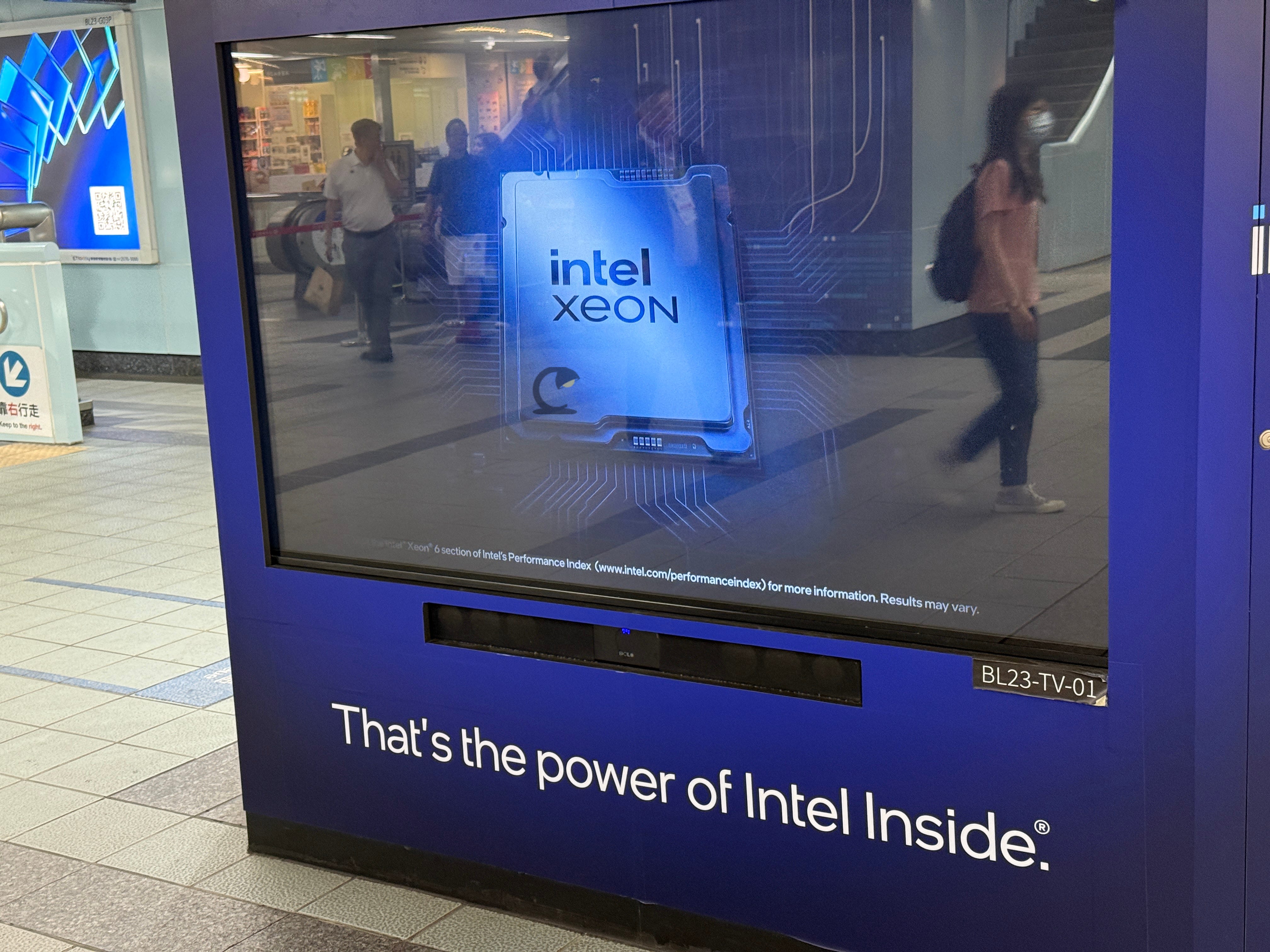
Computex is, and always was, the premier computer expo.
As a result, the CEO of Intel would usually provide a keynote, and one or two other bosses might show up to give a talk. A couple of foreign CEOs was about all we could expect, while local leaders like Jonney Shih of Asustek or Gianfranco Lanci of Acer would fly the Taiwan flag. Regional or VP-level bosses of global names tended to stand in as ambassadors for their companies.
This year, Computex has attracted more overseas bosses than any year I can remember, including:
Qualcomm, Cristiano Amon
Intel, Lip-Bu Tan
Arm, Rene Haas
AMD, Lisa Su2
Nvidia, Jensen Huang3
Marvell, Matt Murphy
Rafael Sotomayor, NXP
Computex is not important because of all the tech CEOs who make it to Taipei. It’s the reverse, they all come to Taipei because Computex is so important.
The world’s industry elite are here in Taipei to kiss the technology ring.
I count AMD’s Lisa Su in that list, even though she was in town prior to Computex and not for the show itself. Nvidia’s Jensen Huang isn’t appearing at Computex either, for that matter. Not officially, anyway. His GTC Keynote on Monday is not part of the official Computex lineup.
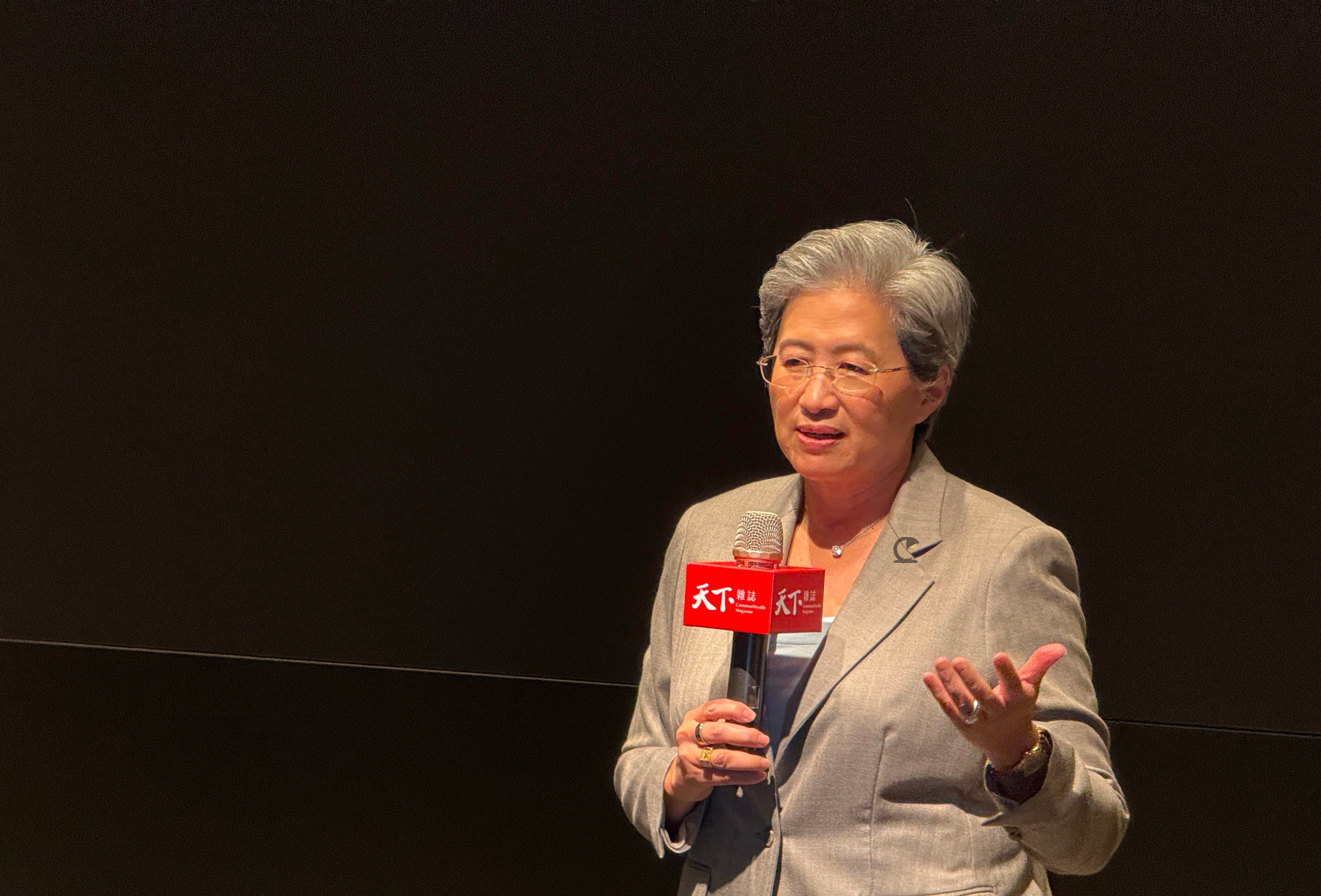
But that’s kind of the point. So many executives realize that Computex, and Taiwan more broadly, are so important to their businesses that they’re finding ways to squeeze into the packed schedule. They want to make big announcements while the world’s eyes are on them, and then meet people behind closed doors to build the relationships that will make or break their businesses over the following 12 months.
The action doesn’t really happen in the keynotes, anyway. All that news will naturally flow from embargoed interviews and press releases timed to land just as the boss steps on stage.
Forums
Since the keynotes are well covered by media, press releases, and social media, your time is probably better spent in smaller sessions dedicated to super niche topics. For example, Craig McDonnell a managing director at ABB Robotics, will hold a session on Industrial-Grade Physical AI for Robotics this year. If that’s not your thing, then consider Ed H. Chi of Google DeepMind and his talk on The Future of Personalized Universal Assistants. There’s many more. There’s also side events, such as Innovex which is focused on startups and budding companies.
Companies want to present at these forums as a way to push their vision and ecosystem. Companies also want to be in the audience to learn what their rivals and partners are up to, and to swap business cards. I guarantee you’ll learn more and make better-quality connections from a few well-chosen forums than you will by attending every single one of the keynotes.
The Show Floor
I am constantly surprised when I learn that Computex visitors schedule their exit for the Wednesday or Thursday. But that’s an understandable choice if you’re not aware of where the real riches lie. And I think these early departures are informed by the dearth of good stuff left in the final few days of most other trade shows.
But the best action is neither at the keynotes nor the forums. It all happens on the show floor, in the VIP sections of those 3x3 booths,4 at the invitation-only hotel suites, and inside meeting rooms of the tech companies whose offices surround the Taipei Exhibition Hall in the nearby Nangang and Neihu districts.
Many businesses, both local tech companies and the local offices of foreign companies, mark Computex as black out days in their calendar, banning leave or business travel to ensure all hands on deck.
Overseas clients are the bread-and-butter of Taiwanese industry, particularly in tech, and local partners are primed for this annual pilgrimage. Experienced hands come because they understand something that many visitors do not. Winning over the PC ecosystem is crucial to them winning market share among end-buyers.
The tech ecosystem is more bottom-up than many imagine. Foreign clients have the money, but local suppliers have the talent and the connections.
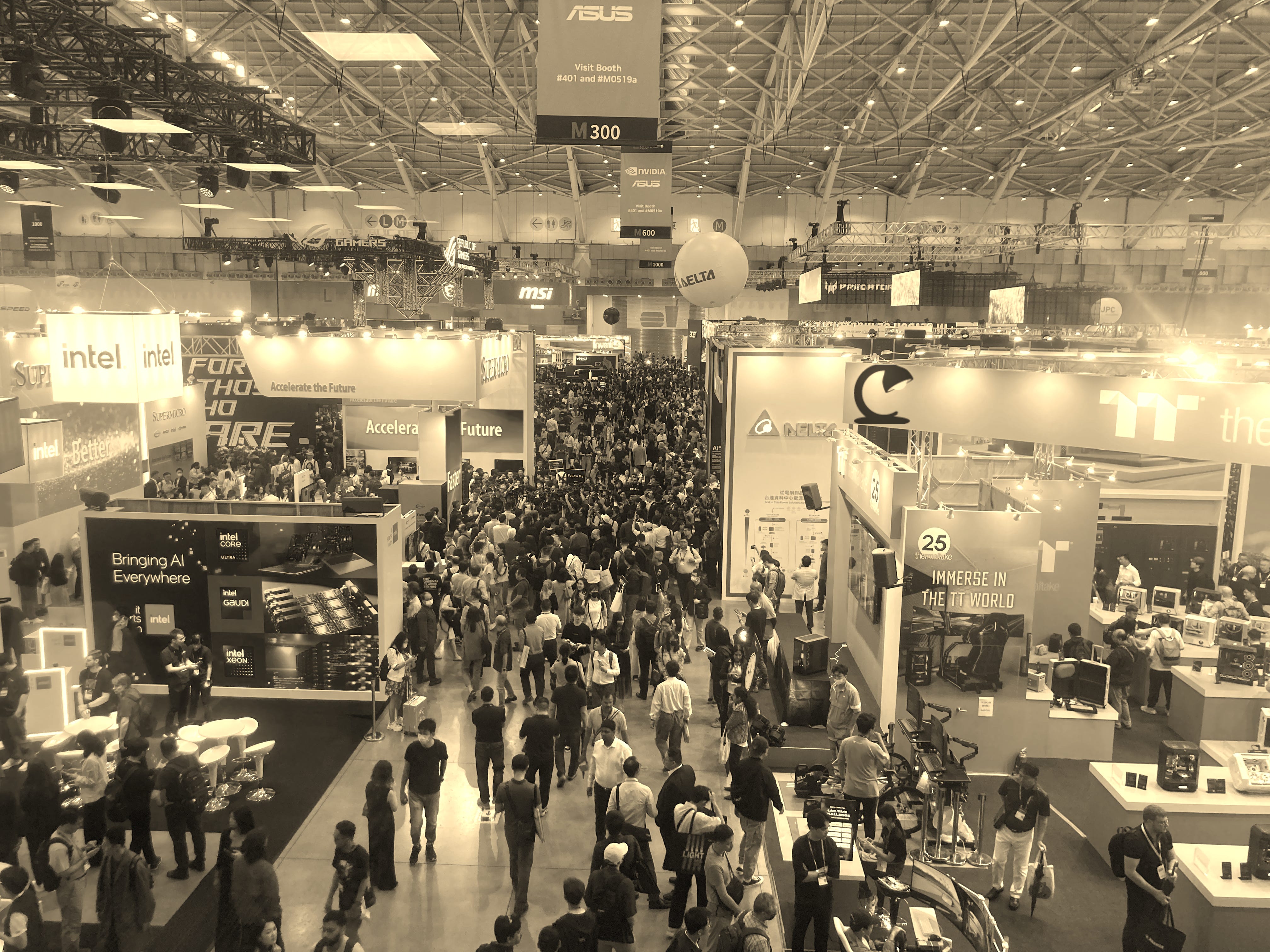
A module maker who doesn’t want to design a circuit-board around your chip will not be an advocate for your product. A thermal management or mechanical parts player who won’t take the time to learn and build around your specs will not have something ready when assemblers need it.
And an assembler who doesn’t want to invest time and resources into developing a system that incorporates your product, in part because upstream players don’t have the pieces in place, will not even bother presenting it to a brand-name PC player.
While Dell, HP, Lenovo, Acer and Asus decide what products to sell, with what specs, and at what price, their hands are tied if the rest of the ecosystem is disinterested.
A little-known reality is that system manufacturers and their suppliers make many of the important product and engineering decisions before presenting them to the brand-name client. These choices mark the difference between your component being taken seriously or it being yet another oddity that barely shipped.
While there are many parts made in South Korea, Japan, China and even the US, it’s the Taiwan Hardware Mafia who really call the shots. A disinterested assembler, or a confused and harried module maker could kill your product before it’s left TSMC’s fabs. This is not some conspiracy. It’s cold, hard pragmatism.
Tech cycles are short. Margins are thin. Technical hurdles are high. The only speed at which this industry can operate is fast. And doing so requires cooperation among both competitors and partners. As Lisa Su said of her rivals recently in Taipei, “we’re all friends because we all grew up together.” Bringing something new to market is a huge risk for every single player who may be involved in its manufacture.
The show floor, and the hidden back rooms, are where these relationships develop. It’s at these booths where a niche maker of thermal plates, or high-speed cables, or multi-layer printed-circuit-boards shows their products. They then listen as current or prospective clients share their engineering troubles, outline their own sales projections, and then seek advice on how to build a product with oppressive margins to impossible deadlines
Got thoughts? Do share.
For major names like Intel, AMD, Nvidia, Qualcomm and Marvell, not being talked about in these discussions means your chips are being rejected by people who build the final products. Equally, failure to show and support those manufacturers will result in them working with a supplier who will.
Like any industry, relationships and interoperability matter. What’s unique about technology hardware is the combination of physical products manufactured within a product-development cycle that works at tech speed.
Computex presents a unique chance to observe this ecosystem. You just need to know where to look.
Thanks for reading
Culpium is free, for now. Join thousands more getting great insights and exclusive news.
More from Culpium
1
Computex was delayed in 2003 by SARS, and in 2020 by Covid.
2
Technically, AMD’s Lisa Su was here two weeks prior, but her presence and timing is linked to Computex.
3
Nvidia’s Jensen Huang doesn’t actually speak at Computex, his keynote was at the company’s own GTC on the Monday.
4
A standard booth is 3m x 3m, and in multiples therein.
The World's Premier Chipmaker is Facing its Biggest Crisis Yet
27 May 2026 at 13:25
Good Evening from Taipei,
TSMC’s CC Wei has negotiated with Donald Trump, delivered price rises to Tim Cook, and haggled over capacity allocation with Jensen Huang.
His hour-long talk with over 7,000 staff on Wednesday morning was far more crucial to the company’s long-term success than any other showdown the chipmaker’s Chairman and CEO is ever likely to face.
Join thousands of readers getting exclusive insights. Direct to your inbox. Culpium.
Faced with growing discontent over what many see as an unfair tweak to their compensation schedules, Wei canceled a business trip and at 5:30pm Tuesday night announced an impromptu townhall for 10am the next day. The event was in-office only — streamed to company auditoriums and meeting rooms — and booked out within 10 minutes, sources told me. Those who missed a slot could not dial in, I was told, a sign of the company’s paranoia about leaks.
TSMC pays out 12.5% of an employee’s annual bonus each quarter, with the final 50% delivered in July the following year. This quarter the company trimmed its payout while maintaining that full-year bonuses would still be higher than the prior year.
Tune in to this week’s Supply-Chained with Tim Culpan (Culpium) & Jon Y (Asianometry).
ASML: Riding the AI Wave, but Crushed by its Own Success
As Wei explained it, company profit is shared across three key categories: shareholders, employees, and ESG.
The reason for this adjustment is so the company could allocate “an even larger share of our earnings towards initiatives that foster social sustainability in order to give back to Taiwan.” In other words, more for ESG and less for staff.
The company’s explanation is staggering, confusing and not at all appeasing for thousands of the company’s 91,000 employees. Many have taken to bulletin boards and social media to express their frustration, anonymously, over what was seen as both a lack of gratitude and a measure of backsliding.
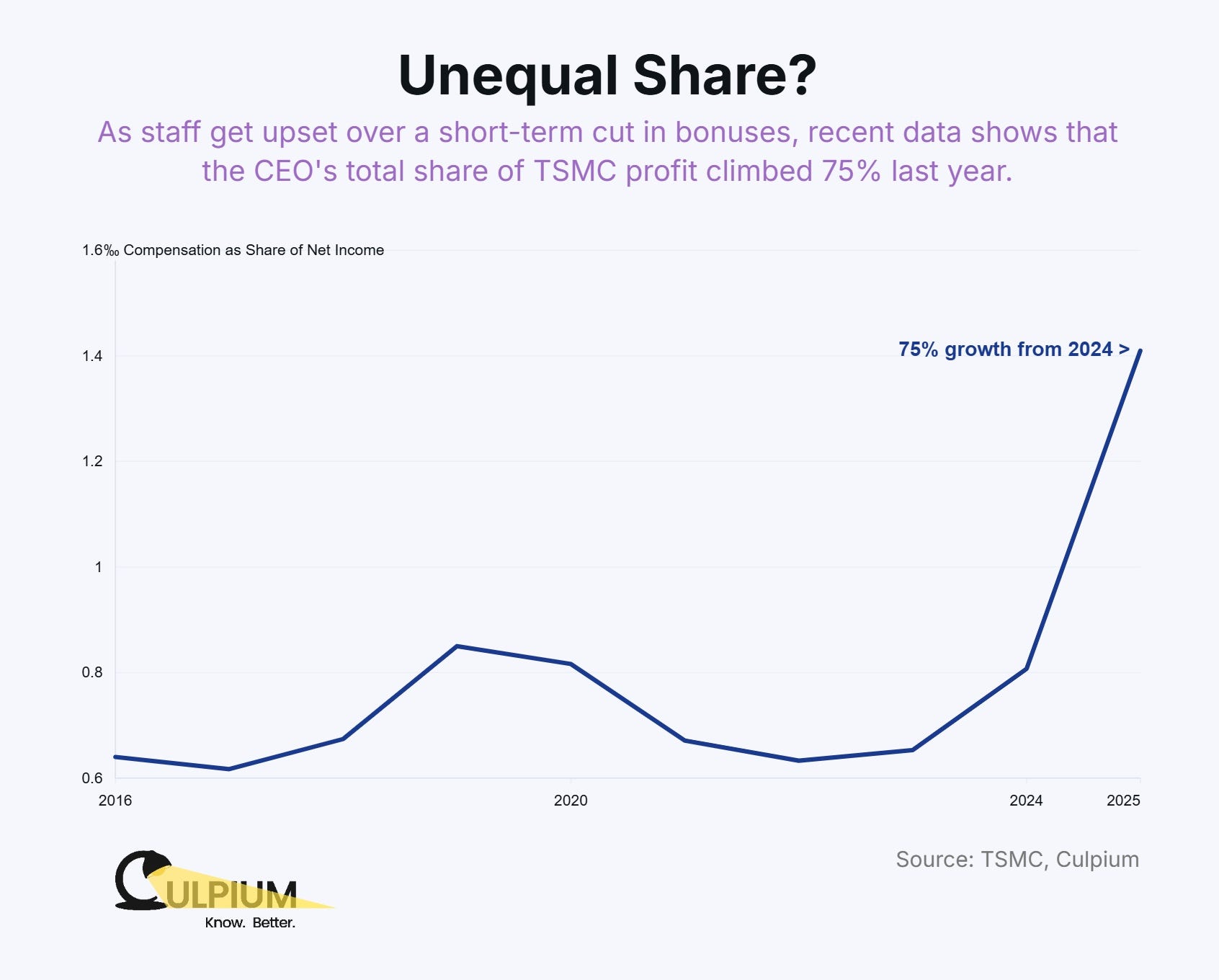
What’s particularly galling to many staff is that Wei’s own total compensation ballooned last year to $78 million — stated as NT$2.4 billion. Some employees whom I spoke with were flabbergasted when told of the CEO’s total compensation, which only came to light buried in the pages of its 2025 annual report which was published recently. They knew it was big but didn’t know it was that big. A small fraction of that figure comes from his salary, with the bulk coming from bonuses and allowances tied to performance, as well as profit sharing.
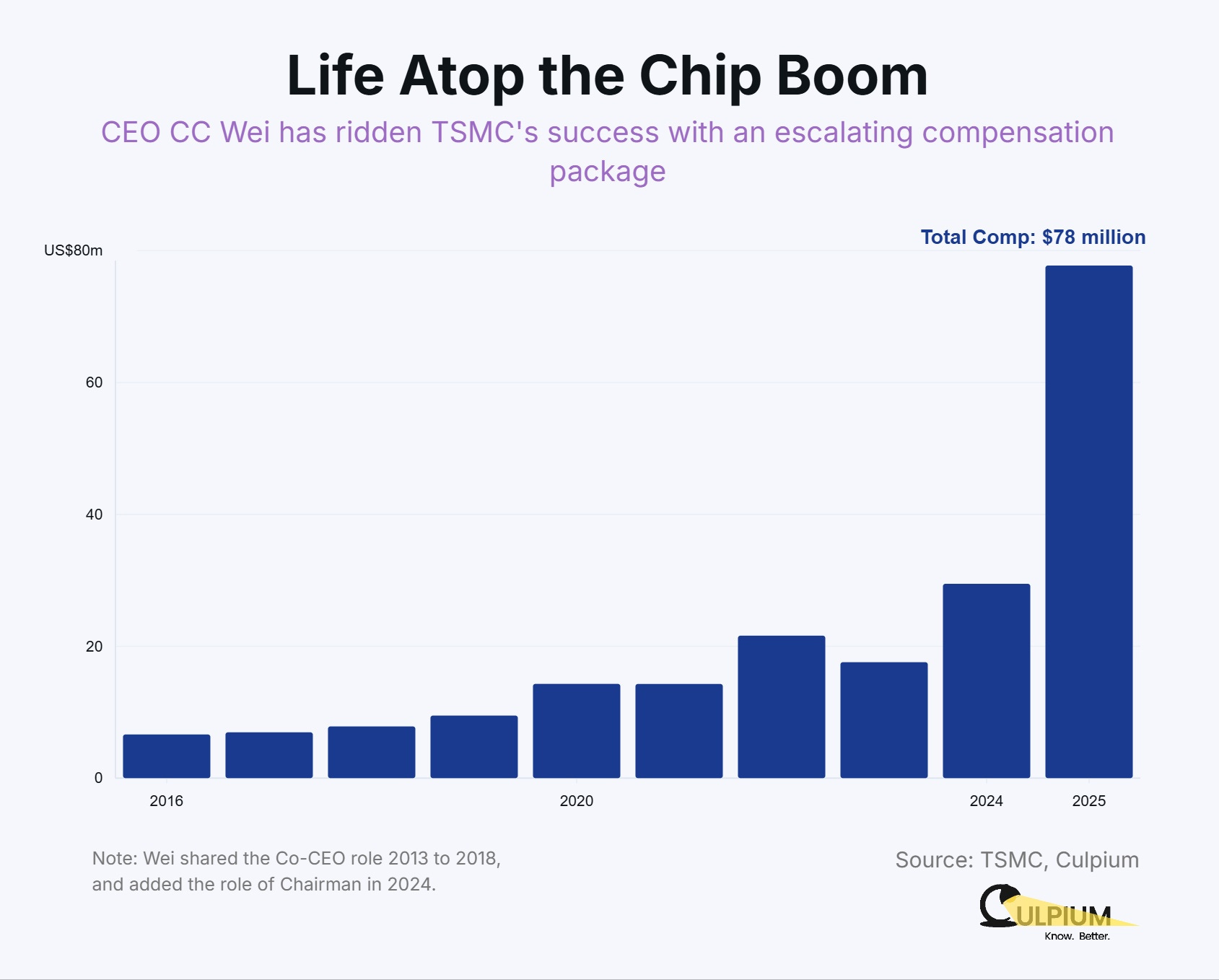
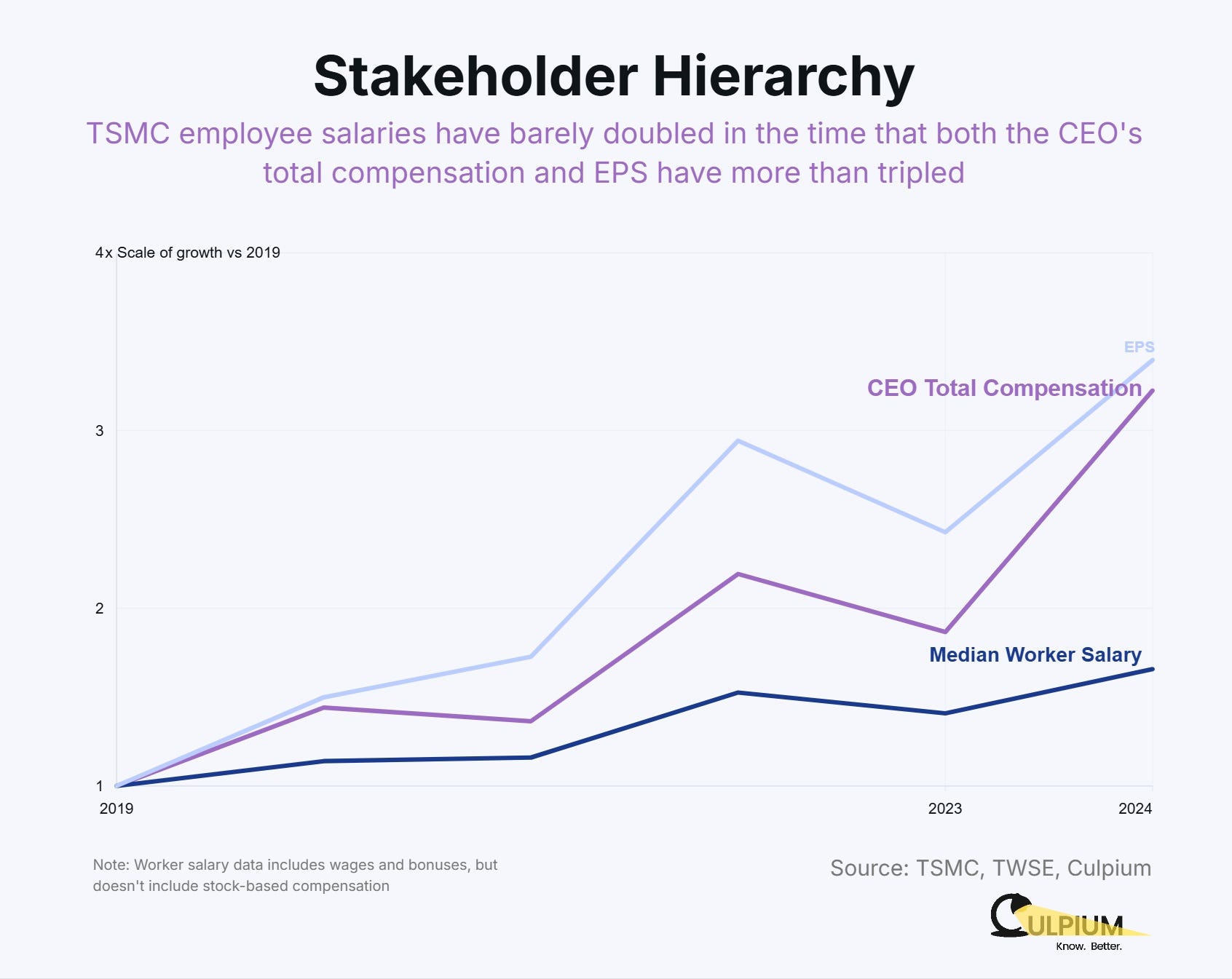
But beyond the actual figure, Wei’s total compensation as a share of net income climbed 75% in 2025. Likewise, his compensation has outpaced median employee salaries in recent years, according to Culpium calculations based on data in TSMC’s annual report and information filed to the Taiwan Stock Exchange.
In most Western countries, such large executive compensation packages are par for the course. In Taiwan, however, there’s an expectation that a modicum of egalitarianism be maintained between management and the rank and file.
Asked about his salary during Wednesday’s meeting, Wei punted and explained that his package is decided by the board, I am told. He also downplayed the prospect of a Samsung-style employee union, suggesting they’re more trouble for workers than they may be worth.
The issue is that many employees feel they’ve been working brutal hours to help expand capacity and churn out the world’s most high-tech chips amid a historic boom in demand driven by AI. It’s the staff, they reason, who should be getting the spoils and not some vague notion the company has about fostering “social sustainability.”
We would like to extend our sincere appreciation to all colleagues for their invaluable contributions. As the company continues to grow, we are highly confident that the full-year growth percentage of our employee profit sharing (based on performance evaluation) will surpass that of last year. We also believe that, with the company's sustained future growth, our profit sharing will continue to increase. — TSMC Statement, 25 May 2026.
As this issue started to boil over, a number of employees reached out to me directly to vent their frustration, share their take, and ask if I had further information. That a journalist was seen as a more reliable source than their own company speaks volumes. The tamest comments I got framed the saga as merely a problem of poor communication rather than corporate malice. Others were not so kind and noted that Wei himself enjoyed record compensation last year while revenue, profit and market cap have climbed to record highs.
These issues put together are not a good look for Wei.
In Wednesday’s townhall, he didn’t back down on TSMC’s decision to amend the payout plan. Instead, he spent time explaining the policy and then taking questions on dozens of topics which started to veer far away from the original agenda, my sources tell me.
This event may have succeeded in fending off a revolt, for now, but the lessons from Samsung show that management should not take employee goodwill for granted.
Wei, who’s been in the role for eight years, will surely know that the last time a CEO of TSMC messed up employee relations he lost his job. Wei is in his current position as a direct result of his predecessor, Rick Tsai committing an unforgiveable sin.
Back in 2009, in the dark days of the global financial crisis, Tsai implemented unprecedented layoffs. Even though the scale of the cuts — at 5% of staff — was small by Western standards, the move was widely seen as a breach of an unwritten covenant: never lay off employees.
Within months of those layoffs founder Morris Chang — who held onto the Chairmanship after handing the CEO role to Tsai — apologized for the cuts and said TSMC would welcome back all those who were laid off. Soon after, Tsai himself was booted though he stayed at the company for a few more years in a lesser role. Chang retook the CEO role and then groomed two replacements: Wei and Mark Liu, who both shared the Co-CEO role until Chang’s later retirement.
Wei has climbed through the ranks and has first-hand understanding that for a knowledge-based company at the leading edge of technology, employees are the primary reason TSMC has defeated Intel, Samsung, UMC and numerous others. And they’re also responsible for continuously keeping Apple, Nvidia, AMD and hundreds more addicted to the Hsinchu-based giant.
“Human capital is TSMC’s most treasured asset. The Company strives to provide employees with meaningful work, continuous learning, a healthy and inclusive workplace, and high-quality compensation and benefits” — TSMC 2025 Annual Report.
But touchy-feely measures like staff gymnasiums, exclusive company-branded merch, an annual sports day, and the warm glow of being a good corporate citizen do not make up for the one reason workers at every company turn up each morning: the money.
And Wei himself knows a little about money. His own compensation has climbed 10-fold over the past decade. It would be hard to argue that he does not deserve the fat pay package, but it would be impossible to argue that his staff don’t deserve more, too.
And now is not the time to turn his back on an employee-first culture or pinch pennies.
A widening global rollout, including a record pace of expansion in Taiwan, coupled with new fabs in Arizona, Japan and Germany will raise the need for staff. And finding the right staff isn’t easy. More than half its headcount has at least a Master’s degree. Concurrent booms among memory-chip makers, a resurgence at Intel, and more global tech companies getting into the chip-design business is increasing competition for a limited pool of talent.
Share and comment. It helps the algo. Culpium thanks you.
Its troubles in Arizona highlight the issue of attracting and keeping talent. TSMC is facing a class-action lawsuit claiming discrimination, while a rising number of staff are quitting to return to their old jobs at US companies like Intel, Micron and Texas Instruments. Then there’s China, where dozens of state-backed companies are eager to write fat checks to any TSMC engineer willing to cross the Taiwan Strait.
TSMC is rightly proud of its ESG policies, which include buying renewable energy, recycling water, and giving to charity. But in attempting to “foster social stability,” Chairman and CEO CC Wei may be forgetting the most important policy of all: If you don’t keep your staff happy, someone else will.
Thanks for reading.
I appreciate you being here. Culpium promises no spam, no junk, and no AI slop. Quality journalism matters to me, sign up if it also matters to you. Thanks.
More From Culpium:
Dear President Trump, We Didn't Steal Your Chip Business
21 May 2026 at 15:28
Dear President Trump, Good Evening From Taipei,
Allow me to congratulate you on your successful trip to Beijing. I’ve heard the trees at Zhongnanhai are quite lovely. I cannot visit of course, since your host thinks of me as a “separatist,” which is a swear word in their country.
You can tell me more about those trees, and Beijing, and Mr. Xi when we talk. I assume we will talk since, when asked by reporters on Air Force One about selling us weapons, you replied “I have to speak to the person, you know who he is, that’s running Taiwan.”
That person, Mr. President, is me. It’s possible you forgot my name. No problem, I’ll remind you: It’s Lai Ching-te. The “te” is pronounced “de,” but you can just call me William Lai. I am the elected president of Taiwan, so I am the person who is running Taiwan. I’ve been doing so since 2024.
I hope we get to talk, because it would be helpful for me to set the record straight and ease your concerns. It seems you have many concerns when it comes to Taiwan, including the view that Taiwan is a “problem” to be “solved.”
Original, incisive, independent. Make sure you’re on the list. Culpium!
Let’s start with Taiwan independence. Mr. Xi probably told you that he is worried Taiwan will declare independence. Or maybe he didn’t say that he’s “worried.” He probably used harsher words than that. Let me allay your fears Mr. President, I will not declare Taiwan independence because we’re already independent. We exist under the name “Republic of China,” but as you know Mr. President, that is not the same as the “People’s Republic of China” where you traveled last week.
Think of it like the “Democratic People’s Republic of Korea,” run by your not-so-democratic friend Mr. Kim Jong-un, and the “Republic of Korea” which actually does have democracy. To the rest of the world they’re known as North Korea and South Korea. Different countries, independent of each other, and using names that are different to their official titles. Imagine if President Kim were to threaten to invade South Korea should Seoul declare independence.
But as I said, Mr. President, I don’t intend to declare independence for Taiwan. Now, I may make some bold and inflammatory statements from time to time, but really that’s just pillow talk for my political base. We’re a democracy, after all, and that means keeping core constituents happy. I am sure you’re familiar with the concept.
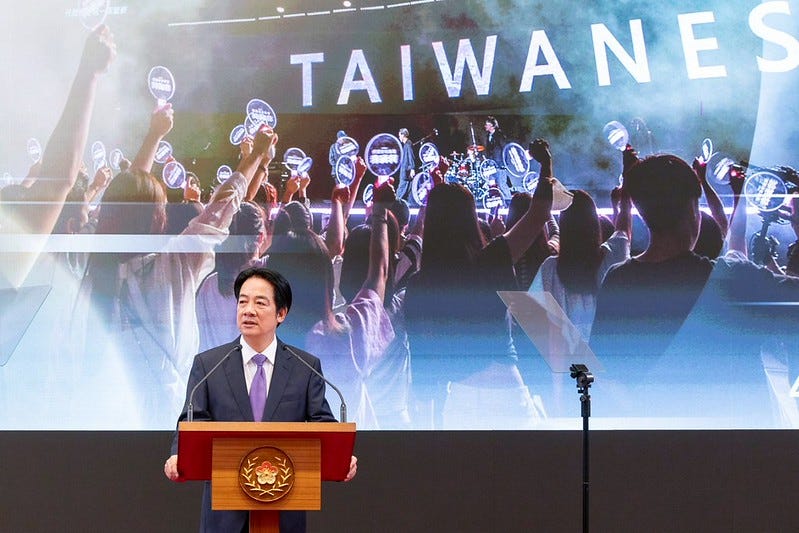
Presidential Office responds to remarks by US President Donald Trump in media interview
For example, “lock her up” and “build the wall” were quite helpful in energizing your supporters, but you didn’t actually do either and no one held you to it. Except in my case, we did lock him up. I mean, he was convicted of graft and probably did do it. But who’s to say? It’s really just convenient that our independent judiciary found one of my major political rivals guilty.
But there’s something else that’s been gnawing away at me, and 23 million of my fellow countrymen.
Chips.
You keep claiming that Taiwan took your chip industry. At first I thought it was just one of those throwaway lines aimed at shocking your audience. But you’ve said it so many times that I am starting to think you believe it.
This really isn’t true, Mr. President. Taiwan didn’t steal America’s chip industry. If anything, Mr. President, we saved it.
You needn’t take my word for it, I am a politician after all. Perhaps you could ask Jensen Huang, whom I know you listen to. Now, I cannot speak for Mr. Huang, but he has said on more than one occasion that if it wasn’t for TSMC then Nvidia wouldn’t exist.
This is indeed the truth.
You see Mr. President, Taiwan paid one of America’s ailing industrial empires a handsome sum of money in the 1970s. The year was 1976, and Taiwan’s Industrial Technology Research Institute (ITRI) signed a $3.5 million deal with Radio Corporation of America to teach our engineers how to make chips. Taiwan’s gross national product was just $1,143 per person that year, so $3.5 million was a huge sum for a developing country. But still, we paid in full. We didn’t steal.
Now, as you know Mr. President, thousands of people come to the US every year and pay large amounts to learn from prestigious institutions like the University of Pennsylvania, your alma mater. They then take that knowledge back home and apply it locally. That’s what our engineers did.
After learning from RCA, they returned home and found they’re pretty good at this semiconductor stuff. I guess you Americans are great teachers, because within months of their return our young engineering students were making chips even more efficiently than their American masters ever did.
That same year, Mr. President, an American citizen proposed a radical idea to his bosses at Texas Instruments. How about making chips for external clients instead of just for itself. This business model, known later as a chip foundry, was rejected. The Texans weren’t interested.
A decade later, that engineer-turned-executive moved to Taiwan — a place he’d never previously resided — and started the business he’d previously suggest to his superiors at that great American institution. His name, Mr. President, is Morris Chang and the company was TSMC. He stole nothing, Mr. President, in fact he’d offered that very idea and the business plan to his US employer 10 years earlier and they turned him down. He event went back to Intel and TI to see if they’d like to invest in his new startup, they again said no.
This was a missed opportunity by those two American companies, but a great win for America. That’s because, Mr. President, Taiwan’s budding chip industry was a partner to the US, not a foe. As Silicon Valley faced growing rivalry from Japan and later South Korea, Taiwan’s counterpart — the Hsinchu Science Park — became America’s biggest supporter. Qualcomm, which helped America dominate mobile phone technology for the past three decades, would have got nowhere without TSMC as a neutral party, making its chips without competing against it.
And when Apple wanted to have a US-made processor for its iPhone, America’s beloved Intel “ended up not winning it or passing on it, depending on how you want to view it.”
Instead, Steve Jobs was forced into the arms of his biggest rival, South Korea’s Samsung. Later, after accusing Samsung of stealing from him and threatening “thermonuclear war” it was Taiwan who stepped up and helped Apple extricate itself from Samsung. After an introduction by Foxconn founder Terry Gou, you remember him, TSMC’s Morris Chang built a dedicated factory for Apple in record time and at record cost. Dr Chang even agreed to develop a process node just for Apple.
What I am trying to say, Mr. President, is that the first iPhone processors weren’t even American. But Taiwan didn’t steal them. They in fact handed control over Apple’s chips back to Apple when an American couldn’t (or wouldn’t) do the job, and another foreign rival started “stealing” US technology.
Then there’s the story of AMD. After making its own chips for decades, AMD was losing far too much money to sustain the pace of innovation. No one stole anything from AMD, it just couldn’t keep up, so it sold its manufacturing business. Not to Taiwan, but to a group of Middle East investors who dubbed it Globalfoundries.
But those new UAE owners didn’t necessarily have the interests of AMD, or America at heart. Mr. President, these Emirati owners extracted a promise from AMD that all its best chips would be made at Globalfoundries. Unfortunately, Globalfoundries wasn’t very good. They were so bad, in fact, that AMD paid the Emirates-owned company to not make its chips. That’s right, Mr. President, a storied American company had to pay its foreign-owned supplier for the right to not make its products for them.
However, who do you think saved AMD? You guessed it, Taiwan.
When that 10-year exclusivity deal finally expired in 2019, AMD went straight to TSMC. And what happened next will amaze you. Within two years of being unshackled from its unfair deal, revenue doubled. Within four years, AMD revenue had climbed four-times. This is not gossip or hearsay, Mr. President, these are facts documented in detail by the great American AMD.
So we come back to Nvidia. Another great American company that wouldn’t exist without TSMC. When a young startup founder with great ideas and courage, but no reliable manufacturing partner and almost no money sent a letter to Taiwan in 1997, he was astounded by the response. Jensen Huang was desperate. But instead of being dismissed for being too small or irrelevant, Dr Chang called Mr. Huang directly, and then met with him in person. He promised that TSMC employees would 'jump through hoops' for Nvidia. And they’ve continued to do so for three decades.
If you want to learn more about stolen businesses and technology, Mr. President, I invite you to contact folks at T-Mobile, Boeing, GE Aviation, Cisco and Google. Each of them can provide accounts of their own technology being stolen, by China.
You see, Mr. President, we don’t have any need or interest in stealing from our friends. And we still see the US as a friend.
This is a point of conflict in Taiwan now, actually. My opponents accuse my government of being too close to the US. These political rivals, from the Chinese Nationalist Party (KMT), feel Taiwan should be a little more distant from Washington and a little closer to Beijing. Your continued complaints that Taiwan stole a key industry from America make my case tougher by the day, even despite the fact that Washington’s historic support for Taiwan is a key reason why the KMT survives to this day.
I understand that you need to look after your people and your own political interests, and that bashing Taiwan is useful in achieving that. Like you, I am also an elected leader who first came to power with less than a majority of the vote. But, hey, we didn’t make the rules! Amirite?
Still, despite this Taiwan-bashing, our companies are still investing in America. Foxconn, whom you once boasted was going to build “the Eighth Wonder of the World” in Wisconsin, is making amends for that broken promise. In fact, it’s now making more of its AI servers in the US than anywhere else. TSMC is following through on its commitment to expand in Arizona, and many more companies including Quanta and WiWynn are spending their own money to help you “Make America Great Again.”
You may not be aware, Mr. President, but Taiwanese companies did more to boost American computer and electronics manufacturing in the ten years through 2023 than Chinese businesses did. Our $7.3 billion in foreign direct investment in the US outweighs $6.6 billion from China, and that’s before the massive influx from TSMC really kicked in. Then there’s the massive increase to $165 billion which TSMC has promised as a result of your superb leadership. Is there any Chinese company which has promised you anything close to this figure?
Mr. President, I am not complaining. Politics is politics, and for a man who wrote The Art of the Deal, I understand that these statements about Taiwan stealing your chip industry might be just part of your negotiating tactic. But I wouldn’t be doing my duty, as the man “that’s running Taiwan,” if I didn’t correct the record.
Yet, on another point of record, I should also thank you for your fine display of statesmanship. You told the press, when asked about Mr. Xi’s warnings over Taiwan, that you “heard him out” yet “made no commitments.”
I take this response as you showing the world that you didn’t let Mr. Xi box you into a corner. Any lesser leader would have either pushed back or cowered, you did neither.
Show that you’re in on it.
I have also held my ground. After months of wrangling and politicking, our government has finally succeeded in pushing through a special defense budget which will allow Taiwan to purchase more than $24 billion in US weapons. That means more money for great American companies like RTX Corp and Lockheed Martin.
In summary, Mr. President, we didn’t steal your chip industry and we are willing to pay for our own defense.
But I have a favor to ask. When you do make the call, which I am most looking forward to, I hope it’ll be to tell me you’re approving the arms sale my DPP government expended a lot of political capital trying to fund.
You see, we too have an election coming up, and I’d hate to resort to waving the Taiwan independence flag in order to win votes. But if I do, don’t worry, it’s just politics.
Lai Ching-te (William)
President of Taiwan (aka Republic of China)
Thanks for reading.
Readers: This is satire, written by Tim Culpan for Culpium. It was not written by President Lai Ching-te of Taiwan.
Who knows, maybe President Lai, or President Trump, will one day publish a letter through Culpium. Do you wanna be the one to miss out?
AI Flash Boys, Pulling Wool, and China's Fight to Catch the US
13 May 2026 at 12:31
Good Evening from Taipei,
Chinese AI models really aren’t as good as their US peers, despite claims on both sides to the contrary. That’s not just my assertion, but the view of many Chinese themselves. And they’re desperate to access the best models available.
After doing a backflip on banning Nvidia chip sales to China, AI will be among the items on Trump’s agenda when meeting with Chinese leader Xi Jinping this week in Beijing.
Catch the latest episode of Supply-Chained across all podcast platforms.
The disparity in both computing power and AI models has spurred a burgeoning industry of arbitrageurs in China who hunt down loopholes and flagrantly flout curbs to access models from OpenAI, Anthropic, and Google. It’s an industry driven by China’s lagging position and users’ desire to access something better.
Thanks for reading Culpium! Subscribe for free to receive new posts and support my work.
Those exploiting this mismatch are not even trying to hide.
“Shattering commercial and geopolitical silos,” is the boast from B-AI, an outfit backed by Trump friend-turned-foe Justin Sun.
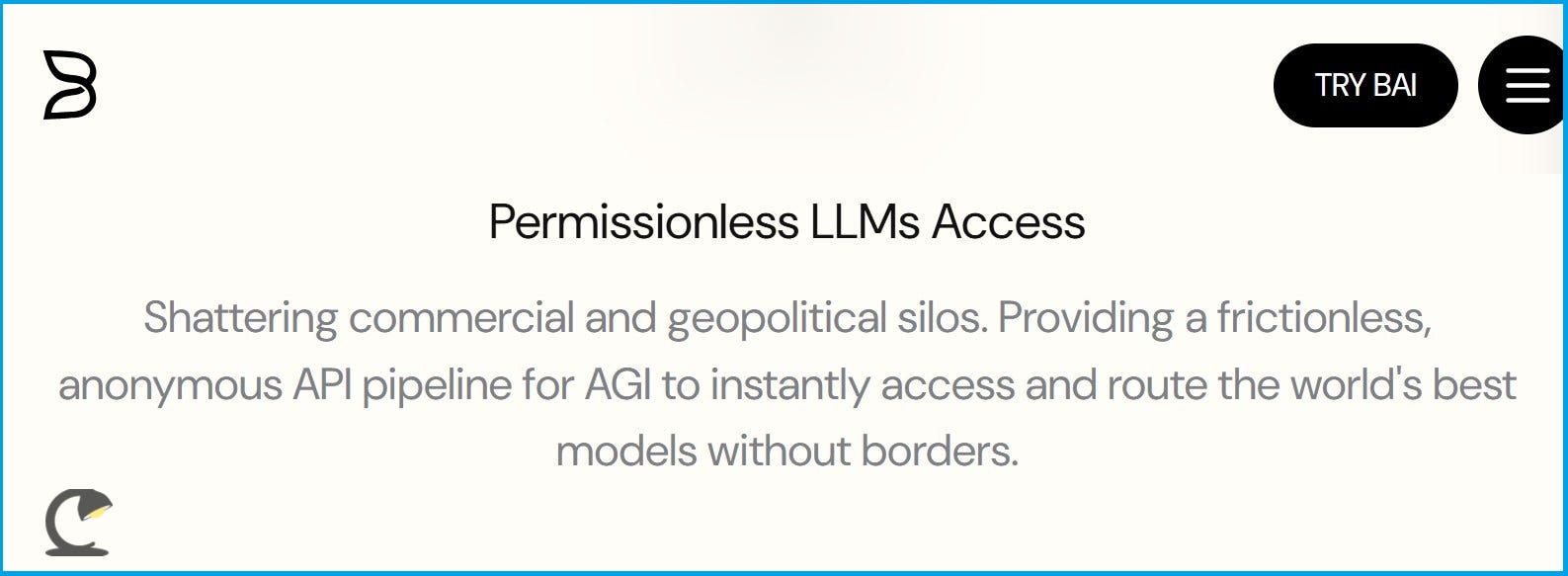
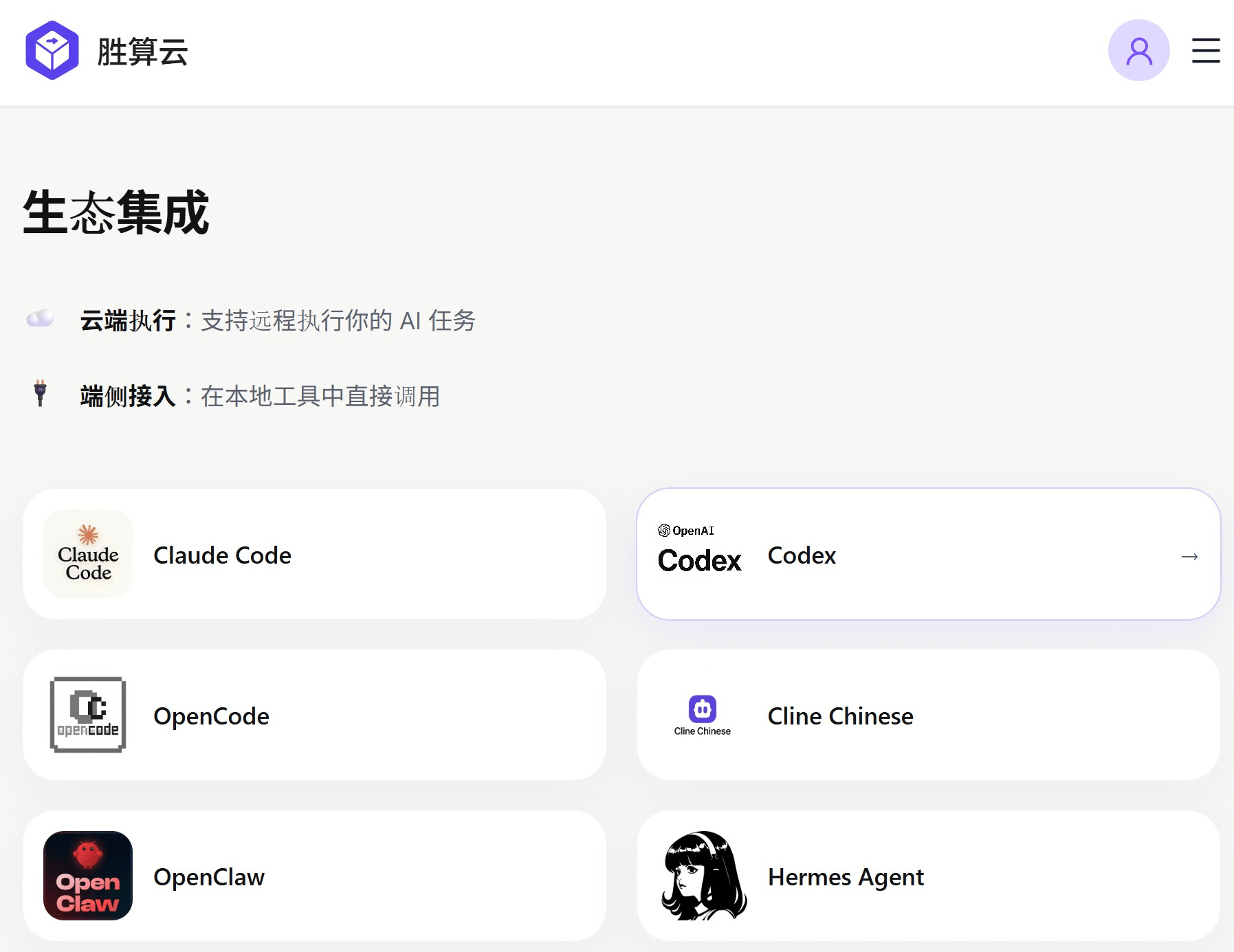
B-AI (白) is merely the latest in a long lineup of what Chinese call “transfer stations” — middlemen who take in AI requests from users and reroute them to US providers, then return the response.
The advantage is written clearly on their own websites. “No more worries about account bans/limits,” another transfer station called OneToken states plainly.
Writing for ChinaTalk, Qian Zilan — a research associate at the Oxford China Policy Lab — recently gave a detailed rundown on the mechanics of transfer stations titled How to Buy Cheap Claude Tokens in China. It’s well worth a read.
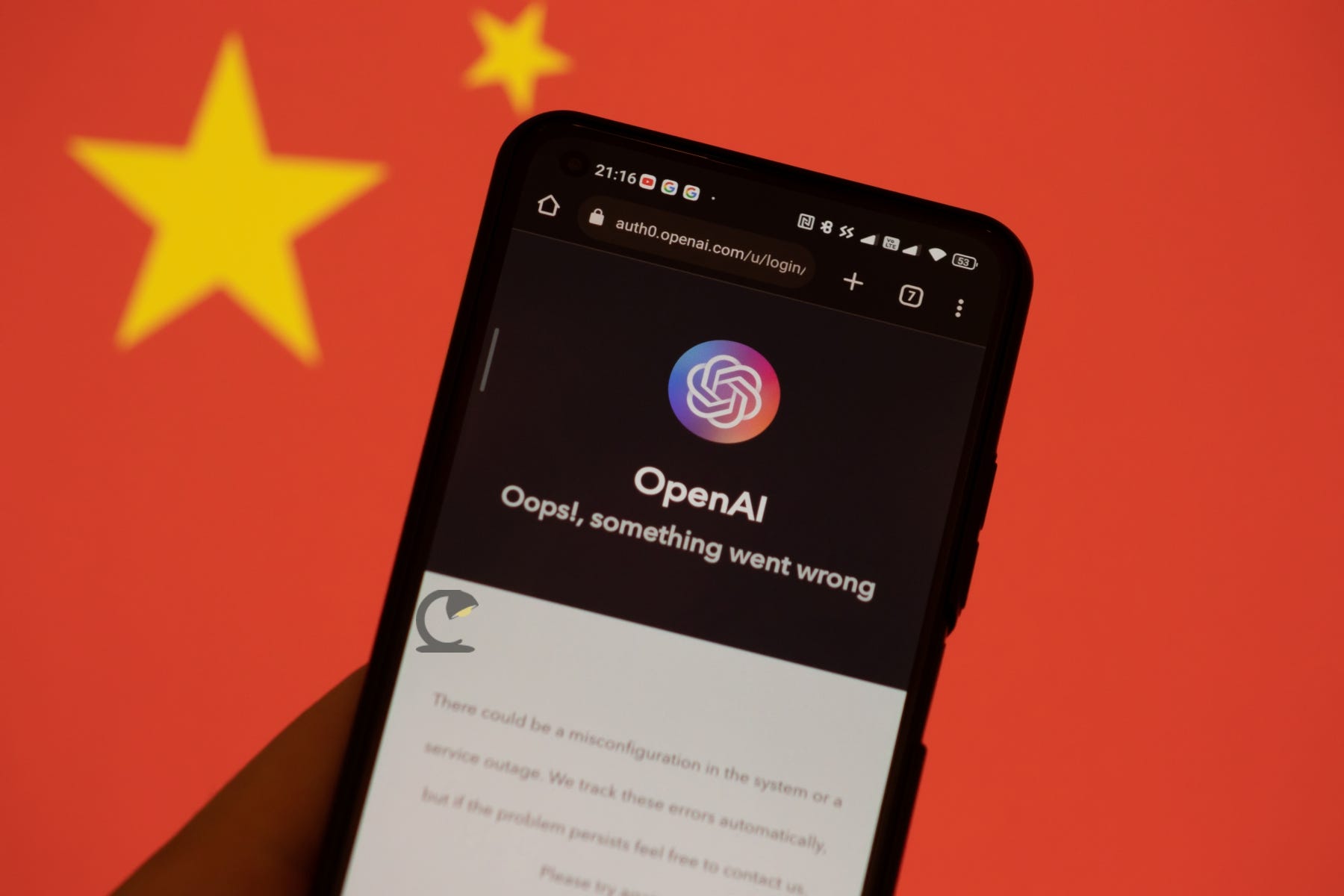
US companies’ curbs on using their models date back a few years. In July 2024, OpenAI cut off Chinese access to its Application Programming Interface (API) a few months after announcing that it “terminated accounts associated with state-affiliated threat actors.” An API allows programmers to send data directly to a server without the an interface wrapper such as a Website or mobile app.
As Kevin Xu of Interconnected Capital wrote at the time, “plugging the leaky API bucket is the next phase of AI model export control.”
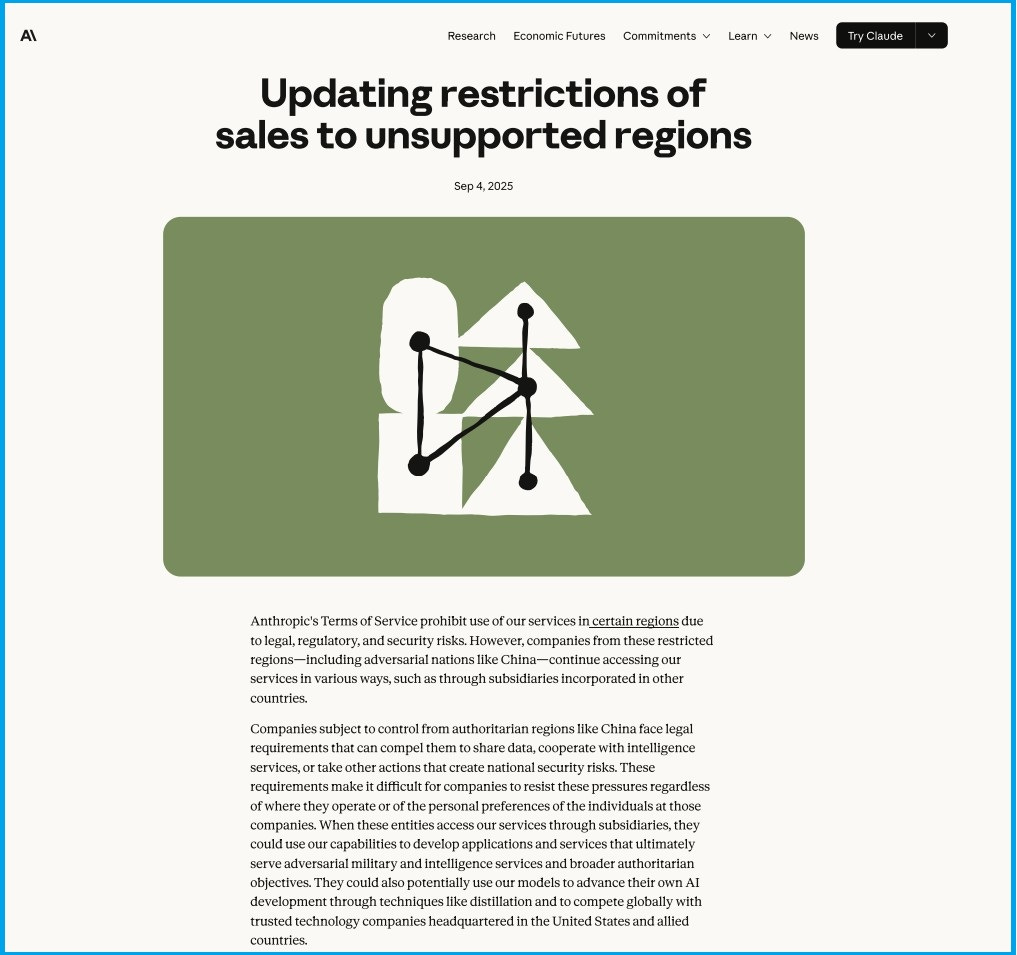
To be clear, these bans didn’t come directly from the US government, instead they’ve been largely imposed by the AI companies themselves. A year after OpenAI’s API curbs, Anthropic closed a loophole in its own rules by preventing Chinese-owned entities from using its models.
“Companies from these restricted regions—including adversarial nations like China—continue accessing our services in various ways, such as through subsidiaries incorporated in other countries,” it wrote at the time.
OpenAI and Anthropic have numerous reasons to want to boot Chinese from their platforms, beyond supposed concerns over national security. A major catalyst is allegations that rivals like DeepSeek are harvesting data from US providers and then distilling them down to create their own models. This has been lauded by many as an example of Chinese “brains” defeating American “brawn.”
Despite the supposed advantage brought by this innovation, Chinese AI providers still seemed pretty excited about Americans exiting their local market. Within hours of OpenAI’s 2024 announcement, Zhipu AI welcomed ChatGPT refugees to its platform with a “relocation plan.”
And yet, Chinese users don’t seem satisfied with local offerings, hence Xu’s prophetic view about ban-enforcement becoming a cat-and-mouse game. Wherever there’s strong demand, eager entrepreneurs will step in to offer supply.
AI Flash Boys
The result is a growing industry of what I call “AI Flash Boys.” The term Flash Boys was popularized by Michael Lewis in his best-selling book of the same name. By exploiting lags between the time an order is made and the time it’s placed on a stock exchange, high-frequency traders (HFTs) could intercept trades and front-run them.
Whenever a disparity exists in availability and access, an arbitrage opportunity arises. In Flash Boys, availability was the supply of market orders and access was the time at which someone could view them. HFTs had an advantage in when they could see and act upon a buy or sell request. Location is the most common form of arbitrage — a commodity bought and sold in disparate locations or exchanges offers a chance to trade both ends and pocket the difference.
The key to a profitable arbitrage strategy, though, is that the disparity must be both persistent and scalable enough to be worthwhile.
In China, the AI Flash Boys are benefiting from disparities in not only region, but price. And they’re exploiting local users’ escalating demand for the world’s best AI models.
The region issue is somewhat obvious, and arises from the ban imposed by service providers. If you can fake your location, then you can pretend to be non-Chinese. VPNs were once the primary method, but everyone has cottoned on to this approach and it rarely works. Beijing often tolerates VPNs, but has shown a willingness to shut them down. Likewise, Western providers regularly cut connections that come in via VPN.
Transfer stations get around this by having a genuine non-Chinese connection. Situated in Singapore, Malaysia, or even the US, they open up API access directly to Anthropic or OpenAI with little trouble. They then offer Chinese consumers access, with local billing in Chinese yuan via AliPay, WeChat Pay, e-CNY, cryptocurrencies, and even Apple Gift Cards. Hence, the transfer station links the two sides.
Pulling Wool
An interesting quirk of the Chinese model is that transfer stations offer access to US models at crazy big discounts. The method is ridiculously simple — like forehead-slappingly “why didn’t I think of that?” simple. OpenAI, Anthropic and Google are so desperate to get people onto their platforms that they give away time-limited freebies. Transfer stations exploit these vouchers — a phenomenon known among consumers as “pulling wool” (薅羊毛) — to open accounts en-masse and then cycle through them as they expire.
US service providers offer other ways to game the system. Microsoft, for example, gives discounts of as much as 75% if you batch your queries to OpenAI for a reply sometime in the next 24 hours. There’s also discounts for tokens already created and served up previously by the AI model. Meanwhile, unlimited plans offered by Anthropic and their ilk allow transfer stations to spread the cost over hundreds of their individual customers.
Cache Distillation
Then there’s caching, header-swapping, and other dubious schemes. By saving queries submitted by Chinese users and the response from the US provider, transfer stations can build their own model, a form of distillation which I call “Cache Distillation.” They can then dish up the same response next time a different user asks a similar question, with the legitimate claim that it came from ChatGPT or Claude.
More nefarious though is header-swapping. A provider sends the query to a cheaper local model, such as DeepSeek, or a lower-spec version of the same US model, then returns the reply with a claim (via the data header) that it was delivered by the premium alternative.
The fact that new players like Justin Sun-backed B-AI are entering the market while hundreds of other providers have been thriving for years tells you something about the Chinese AI market. This kind of arbitrage is only possible because Chinese users consistently see US models as a preferred choice over local options.
And this view is not just prevalent among everyday consumers. Upper echelons of the Chinese government also want access to the best America has to offer.
Mythos Envy
Last month, a Chinese think tank asked Anthropic directly for access to its powerful new artificial intelligence model, insisting the startup change its stance on curbing availability to Beijing, the New York Times reported on May 12. The answer was no, the newspaper reported.
“A senior US official said AI and cybersecurity were high on the agenda with Beijing, noting concerns with ‘the latest models of AI,’” the NYT wrote. While it wasn’t clear exactly which model the Chinese think tank wanted, the newspaper hinted that they were talking about Anthropic’s unreleased Mythos, billed as so powerful that “it was skilled at finding software vulnerabilities and could cause a cybersecurity reckoning.”
With Nvidia’s Jensen Huang in tow, and in light of Trump’s previous reversal on banning chip sales to China, there’s no telling what concessions the US president will offer to Xi Jinping during his visit.
Perhaps he’ll keep acceding to Huang’s wish to let some Nvidia chips remain on sale in China, and at the same time placate hawks back home by formally curbing Chinese access to US models.
Even though China decided it would regulate the import of Nvidia’s H200 chip soon after Washington lifted a ban on shipments to the country, Beijing has not formally banned access to American AI models. Instead, it limits usage through virtual curbs such as putting them outside the Great Firewall and regulating usage through censorship laws. This is the same tactic used to push Google and Facebook out of China more than a decade ago.
It’s also the same loophole which transfer stations are exploiting, and it’s a tactic that Beijing is well aware of. In fact, it follows China’s own track record of allowing access to, and development of, innovative technologies to further the nation’s progress and then yanking that availability when it feels the time is right.
As a result, this quasi-legal status of US models in China allows local developers to leverage superior foreign models, without legitimizing them or giving American AI providers true access to its market. And they can be shut out at any time for any reason — or no reason — just by enforcing existing regulations.
Got thoughts? Share and comment now.
With AI safety on the agenda this week, we might expect Washington and Beijing to pen some kind of watery agreement to “not do evil” and “keep talking,” but it’s in neither Xi’s nor Trump’s interests to truly shutdown the flow of tokens between their nations.
In fact, the grey market may be just what the US president wants. His family’s World Liberty Financial just announced “World Router,” the company’s entry into the transfer-station business. That could incentivize Trump to back a ban on US models in China, while leaving the door open for transfer stations to keep doing business. Xi would surely approve, unless China one day catches up in which case these transfer stations will no longer be needed.
Thanks for reading.
Culpium publishes every Wednesday. No spam, just quality news and insights enjoyed by thousands.
More from Culpium:
CASCI Composite Shows AI Chip Strength as Mid-Stream Output Slows
11 May 2026 at 13:03
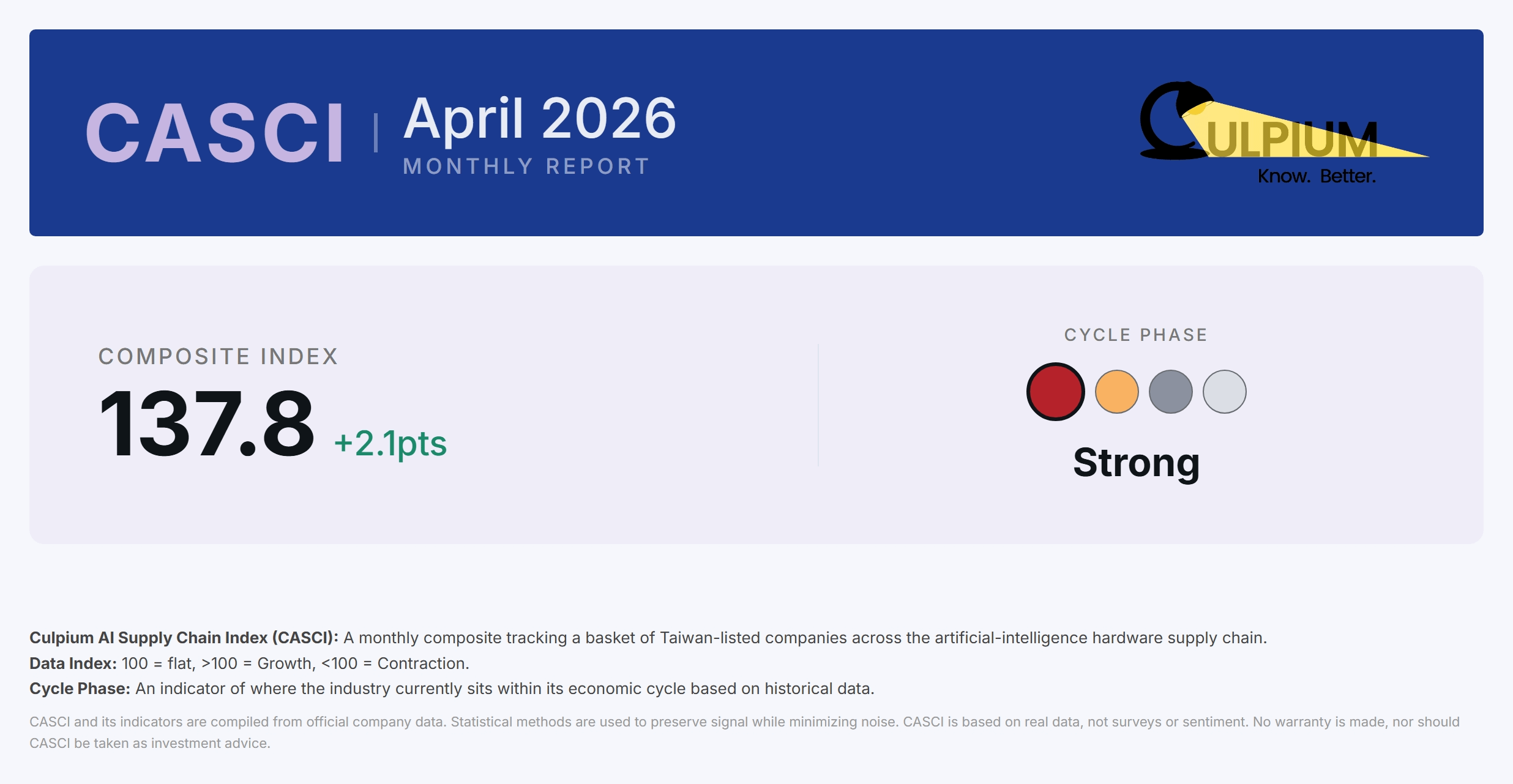
CASCI Composite April 2026 Highlights:
137.8 points, a new record.
+2.1pts, accelerating from +0.2pts in March
Upstream growth is rising, Mid-stream, Capacity both slowed significantly.
Upstream:
Upstream suppliers in semiconductors, materials, and passive components once again saw a large increase in growth, an indication of strong momentum for the primary parts used in AI servers.
This tier still lags the growth levels seen in mid- and downstream, but points to more product being pushed down the channel and into the supply chain.
Mid-Stream:
Companies in the middle of the supply chain weakened.
While they’re still showing growth, module makers, mechanical suppliers for racks, drawers, and fittings, as well as cooling systems manufacturers are collectively showing their weakest levels of expansion since April 2025.
Downstream:
Companies focused on system integration and final assembly of AI servers saw their growth rates unchanged in April, the mildest pace in many months.
Coupled with slowing supply from mid-stream, we can see early signs of a possible pause in AI-server growth.
Capacity:
The business of supplying equipment and constructing facilities remains strong, but is weakening significantly.
It’s important to remember that this tier of the supply chain reflects long-term trends, with monthly swings often unstable as it reflects completion of phases rather than specific changes in contracts or sales. That said, it’s worth watching capacity suppliers over a period of months to assess whether manufacturers are adjusting their expansion plans.
CASCI is a weighted index tracking revenue of Taiwanese companies in the AI compute supply chain. Taiwanese companies make up the majority of upstream, mid-stream, and downstream of AI server manufacturing.
Notes for Editors & Analysts:
CASCI is published monthly by Culpium as a service to readers.
Media and analysts are welcome to cite CASCI or the Culpium AI Supply Chain index, with attribution and link. For example, “AI server manufacturing remains strong, according to the latest CASCI report from Culpium.”
Data graphics may be reproduced with credit.
Entire contents of Culpium or CASCI reports may not be reproduced unless a publishing fee is paid.
Exclusive: Apple Doubles MacBook Neo Production, Orders Fresh Batch of Chips
6 May 2026 at 11:50
Good Evening from Taipei,
Apple has doubled its MacBook Neo production plans after the laptop’s runaway success, my sources tell me.
Last month Culpium broke news that Neo sales were doing better than Apple had expected, pushing the company into a tough dilemma. Demand heavily outstripped supply, forcing the company to quickly make a decision about the product’s near-term future, Culpium wrote at the time.
Apple is in talks with suppliers to handle a massive dilemma posed by sales of its MacBook Neo that have surpassed expectations, I am told. The question they must answer, and soon, is whether to boost production of the hit laptop, or let their inventory of parts run out, my sources tell me — Culpium, 7 April 2026.
Its earnings report last week brought this issue to life, with Neo driving Apple’s best fiscal second-quarter for Mac revenue since the Covid pandemic.
“Right now we’re supply-constrained on the MacBook Neo,” CEO Tim Cook said in the company’s April 30 investor conference call. “We were very bullish on the product before announcing it, but we under-called the level of enthusiasm that would be with it.”
Tune in to this week’s Supply-Chained with Tim Culpan (Culpium) & Jon Y (Asianometry).
Episode 3: ARM Might be Swallowing its Own Poison Pill
MacBook Neo is now seen as a legitimate alternative to Chromebooks, powered by Google’s ChromeOS, as well as low-end Windows laptops. The cheapest member of the MacBook series is likely to lure more companies and students into adopting the MacOS ecosystem, broadening Apple’s user base.
We’re swapping out Chromebooks for Neos over the next few weeks
by u/shinyshirtlesssulu in MacbookNeo
This unprecedented popularity left Apple with an important decision to make: It could sell out of the Neo, thus forgoing sales but preserving profit margins. Or order up a new batch and face a severe cut in gross margins amid escalating DRAM prices and a higher cost-base for the core processor.
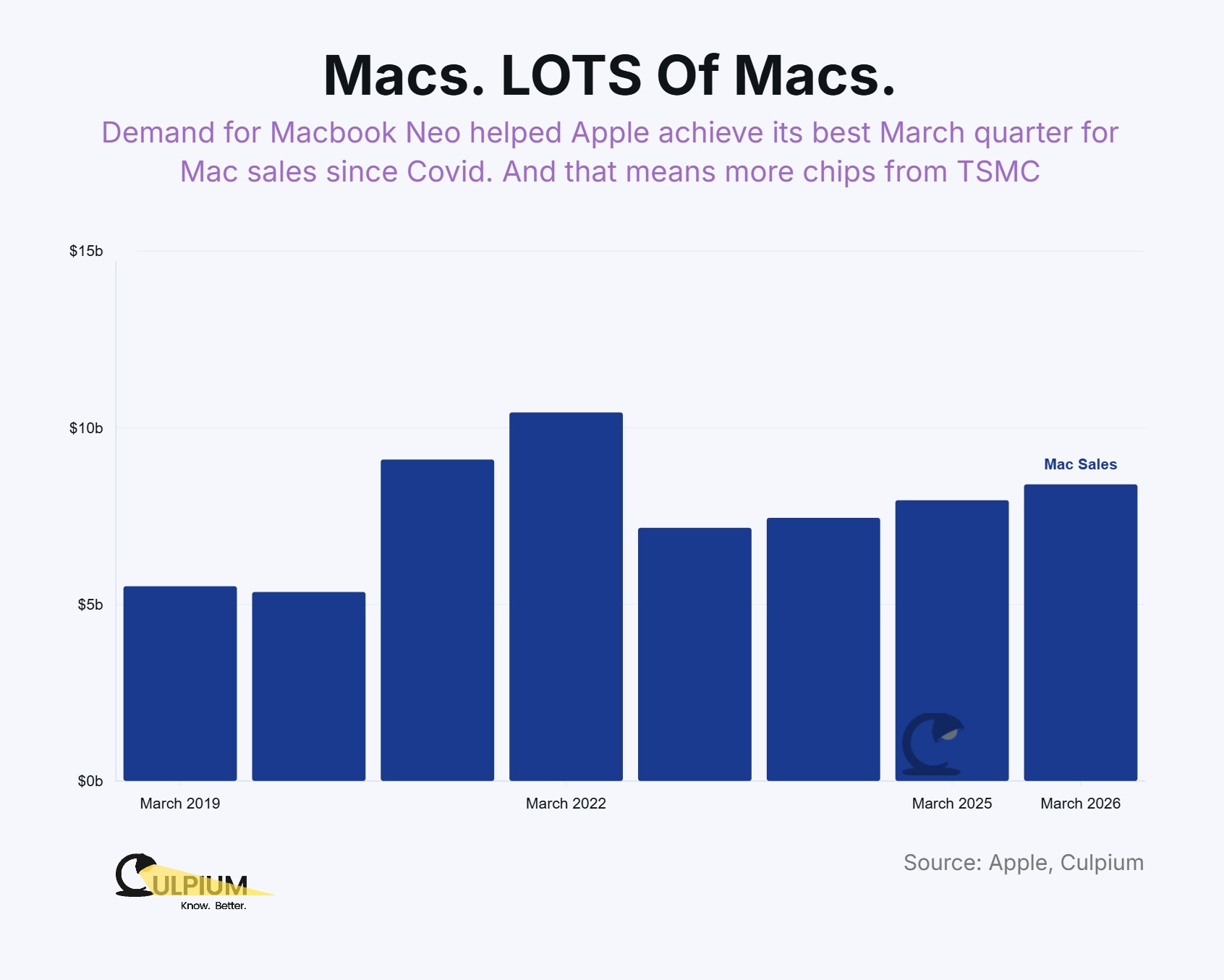
Apple recently made its decision and opted to put more units of the Neo in customer hands.
As a result, it’s now asking suppliers to prepare capacity for 10 million units of the debut version of the Neo, up from an initial estimate of 5 million to 6 million, my sources tell me. Delivery times for the laptop have ballooned to as much as four weeks as Taiwan’s Quanta and Foxconn rush to fill orders from factories in Vietnam and China.

This renewed commitment to meeting demand means Apple must also ask TSMC for a hot lot of A18 Pro chips, the same processor used in the iPhone 16 Pro. The system-on-chip is made using TSMC’s N3E process, with the initial production run underway at least two years ago.
Exclusive. Independent. Reliable. Thousands of subscribers now get their news from Culpium.
However, the chips used in the Neo are actually downbinned versions of the one used in the iPhone, meaning some parts of the die were considered defective or unable to run at its full design spec.
In keeping with industry practice, instead of scrapping these “less-than-perfect” chips, Apple turned off the defect parts and repurposed it for another product. As Ben Thompson of Stratechery wrote at the time, this downbin strategy means the SoCs in the Neo are effectively “free chips.”
Jon and I discussed binning at length in a recent episode of Supply-Chained.
The iPhone 16 Pro’s processor has six GPUs, whereas the MacBook Neo’s has only five — it’s the same chip, but with one GPU core turned off.
With a fresh batch of A18 Pro SoCs, most of the new processors for the Neo will actually be top-tier and only some would fall into the downbin category. This means that in most cases the six GPUs would be fully functional. Apple is likely to deal with the disparity by simply switching off one of the GPUs through software.
The other issue Apple must face is the higher price. While TSMC may forego massive price premiums for a hot-lot run, the SoC will still be more expensive than the first batch because they’ll mostly be top-tier rather than downbin versions. In addition, DRAM prices have escalated since the initial production run, driving the Neo’s bill of materials much higher.
Apple currently offers the Neo in 256GB ($599) and 512GB ($699) versions with four colors apiece. A month ago I suggested that to deal with the higher cost and lower margins of a new batch, Apple may kill the cheaper version and only offer the 512GB variant. It recently followed that strategy with the Mac Mini, pulling the $599 256GB model from sale leaving only the $799 512GB version available.
Alternatively, Apple might add some new colors to the Neo lineup to soften the impact of higher prices and boost enthusiasm for the device.
Thanks for reading.
Culpium scoops are widely cited. Be the first to show that you’re in the know. And it helps the algo, too. Thanks.
More from Culpium:
Memory Makers Are Strangling the Rest of the Tech Industry
30 April 2026 at 12:15
Good Evening from Taipei,
Samsung reported first-quarter earnings Thursday morning. What it revealed was great news for itself and fellow memory-chip makers but bodes very badly for everyone else.
Revenue at the South Korean company’s memory division doubled from the prior quarter as it started catching up to smaller compatriot SK Hynix in the lucrative market for high-bandwidth memory (HBM). Like SK Hynix a week ago, Samsung made all the right noises about HBM being important and its determination to boost supply.
Reading between the lines, though, it doesn’t feel like either company is taking the AI boom seriously enough, and they certainly don’t seem to care much about their long-time clients in the smartphone and computer sectors. At best, it looks like Samsung, SK Hynix, and US rival Micron are more intent on leveraging their pricing power than helping clients get the products they need.
Tune in to this week’s Supply-Chained with Tim Culpan (Culpium) & Jon Y (Asianometry).
Episode 2: Binning. An Old Nvidia Practice that’s Also Behind Sparse Supply of Macbook Neo
Witness SK Hynix’s first-quarter results. DRAM revenue, which accounts for 78% of its business, climbed around 65% while the average selling price also climbed around 65%.
SK Hynix didn’t sell more DRAM, it just charged more for it.
Samsung and Micron told a similar story. At Micron, whose latest quarter ended in February, ASP was up a mid-60s percent with revenue growth in the low-70s — its actual shipments, measured in bit-growth, barely budged. Similarly, Samsung’s DRAM revenue-growth tracked prices not output: ASP was up more than 90%, while shipments inched up just a few percentage points.
Read today what everyone else will be talking about tomorrow.
There have been loud complaints that TSMC didn’t expand enough to meet growing AI-driven demand from Nvidia, AMD, and cloud-service providers. But there’s been scant attention paid to the fact that these three major memory-chip suppliers collectively failed to either see, or take seriously, this historic moment.
I find that staggering, because I foresaw it three years ago.
“AI companies are likely to buy up more DRAM than any other slice of the technology sector in history,” I wrote in a previous life (gift link). “Established giants like Microsoft Corp. and newcomers such as OpenAI are set to pound on the doors of Samsung, SK Hynix and Micron”
That was back in May 2023, and over the past year this “pounding on the door” scenario has played out exactly as I predicted. And if I, a mere outside observer, could see what was about to happen then it’s impossible that executives at three huge semiconductor companies couldn’t.
Instead, what we’ve seen in recent quarters is management enjoying huge gains in revenue and profit without having to do the actual work of, well, shipping more product. The commodity nature of memory chips is such that when demand exceeds supply, prices quickly rise. The reverse is also true.
What’s worse, they’re all now crowing that this situation won’t end anytime soon.
“Amid this supply-demand imbalance, customers are prioritizing securing volume over pricing which is sustaining the current pricing strength,” SK Hynix CFO Kim Woo-hyun boasted last week. “Accordingly, we expect a favorable pricing environment to continue for the time being.”
Samsung was just as blunt about how desperate its customers are, and how the world’s biggest memory-chip maker plans to keep taking advantage of them.
“Unlike previous years, customers who are concerned about supply shortages are actually bringing forward their demand for 2027 already,” it said in Thursday’s investor call. “So, currently just based on pre-booked demand alone, the supply-demand gap is looking to widen further in 2027 versus this year.”
From a purely capitalistic point of view, I guess you can’t blame them. The memory sector is cyclical. You enjoy the growth years when you can, and limit pain of the down cycle when it comes. That’s the business model, and both management and investors have learnt to accept it.
Unfortunately, on this occasion customers are learning that they too must accept the vagaries of the memory industry. But it’s causing a lot of pain, will likely lead to billions of dollars in lost revenue, and hand more control to Chinese rivals just as global technology competition escalates.
Worst hit will be PC and smartphone makers, who are having to rethink their product strategies given the long-term higher costs of both DRAM and NAND. We’re already seeing this play out.
All but Apple experienced a drop in first-quarter smartphone shipments, according to data from Counterpoint Technology Market Research. Xiaomi was worst hit, with a 19% fall.
“The brand is facing acute pressure as its heavy exposure to the price-sensitive entry-level segment makes it highly vulnerable to rising memory costs,” Counterpoint wrote of Xiaomi’s struggles. A delay in Samsung’s premium S26 series meant that even the Korean brand couldn’t stave off a downturn brought on by shrinking demand for mass-market devices.
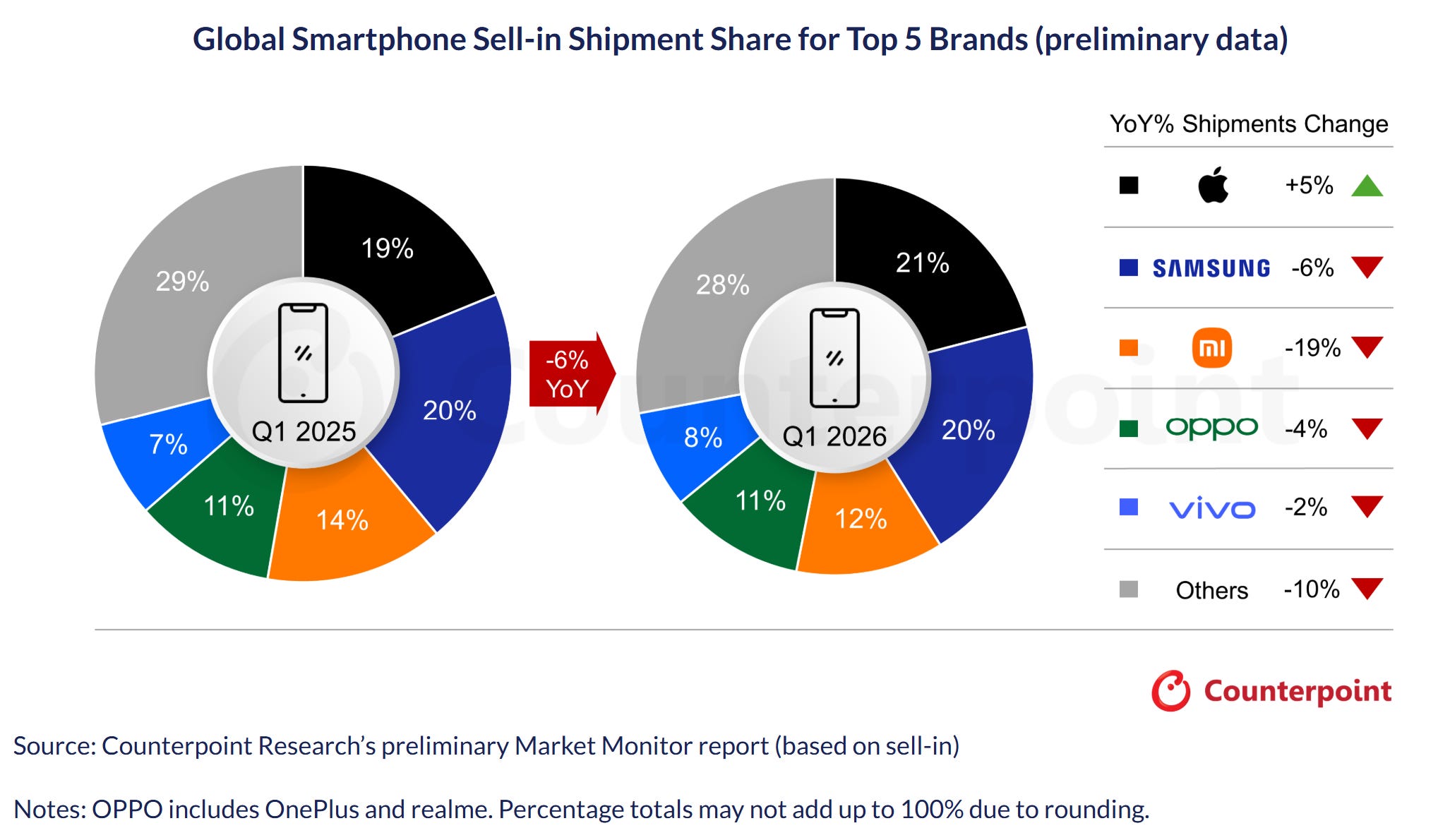
Samsung’s smartphone chief addressed this issue in Thursday’s earnings call, noting the need to manage cost pressures and reorient toward premium devices over low-end models. I discussed this dilemma at length last week with Jon of Asianometry in our debut episode of Supply-Chained.
The PC sector will be similarly affected. Lenovo, which is number one with around 25% of the market, skews toward consumer and small & medium-sized business customers. That makes it potentially more vulnerable than HP and Dell who lean more heavily on larger corporate customers by selling both personal computers as well as infrastructure products like servers.
The three big memory-chip makers needn’t care. They have customers lining up for the next few years, many trying to lock in multi-year purchasing agreements. That’s given these oligopolists the confidence to finally start boosting capex, albeit too late and by too little.
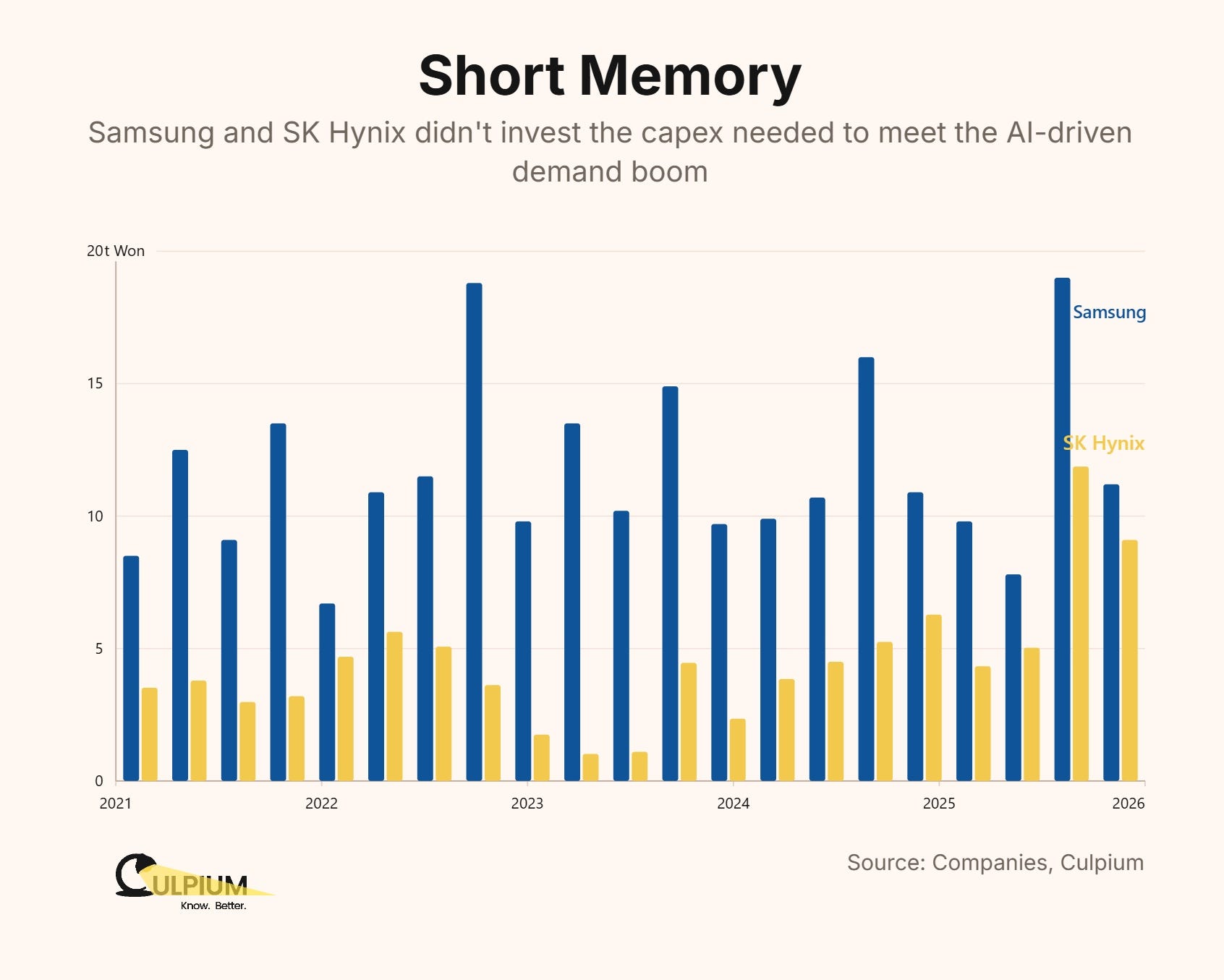
But it’s not going to much help the rest of the tech sector, because most of that money is going toward boosting HBM supply used in AI servers, leaving those requiring legacy DRAM to flounder.
Boring old DRAM is needed in PCs, smartphones, games consoles, security cameras, cash registers, and cars. It’s boring because it’s ubiquitous. And it cannot be replaced by HBM because the high-bandwidth variant is attached directly to a processor via advanced-packaging techniques such as TSMC’s Chip-on-Wafer-on-Substrate (CoWoS). Legacy DRAM is often just soldered onto a printed circuit board and slotted into the final device.
The top three, which collectively control 90% of the DRAM market, may feel that they don’t need the old-school DRAM market anymore. But that’s very short sighted, because they’re handing orders and client relationships over to rivals in China, which threatens to take over the memory sector like it did legacy semiconductors and LCD display panels.
Whereas Western brands had become wary of buying memory chips from China, they now have no choice. Even HP, with its long-term No China policy, must turn to ChangXin Memory Technologies (CXMT), a growing player in DRAM and Yangtze Memory Technologies Co. (YMTC), which is now a force in NAND.
HBM may be the hot item now, but legacy DRAM will forever be important to the world because of its simple but critical role in how information is computed. The risk is that, as with other commodities like rare earths, China may soon have command of a critical product crucial to the global technology sector. Not that it’s Samsung, SK Hynix, or Micron’s job to care. Their job is to make money, not protect supply chains or national security.
Maybe Seoul, Tokyo and Washington might start to care, but given the current emnity between them all, I struggle to see their governments working together to effectively address the issue.
In the short term, those parts of global tech sector which are not building AI servers — which is most of the global tech sector — will continue to suffer. In the long-term, the entire tech sector may find itself facing an even worse problem than high memory-chip prices. Unless someone stands up and does something about it, before it’s too late.
Thanks for reading.
Culpium is free, but only available to subscribers. Make sure you’re on the list.
More From Culpium
