❌

Normal view

Transit-based exoplanet survey finds its first microlensing exoplanet

11 August 2026 at 14:00

NASA’s Transiting Exoplanet Survey Satellite (TESS) mission has notched up its first discovery of an exoplanet via a method known as microlensing. The planet is a “super Jupiter” known as Gaia23bra b, and TESS observed it when the planet and its host star acted as a gravitational lens, magnifying the light from a second, more distant background star.

Astronomers have several ways of finding planets beyond our solar system. The most successful of these by far – and the one that TESS was designed for – is the transit method, which is responsible for roughly 75% of all exoplanet detections to date. This approach relies on observing the periodic dimming of a star’s light as a planet passes between the star and an observer here on Earth.

The transit method does have limitations, however. The main limitation is that we can see transits for only a small number of planets, namely those with orbital planes that are almost exactly edge-on to Earth. An alternative approach known as photometric microlensing is somewhat more flexible in this respect, as it relies on the star-planet system magnifying the light from a background star, which is known as the source. This magnification occurs because the gravitational pull of the planet-star system warps space, bending and magnifying the source’s light (as Albert Einstein predicted as part of his general theory of relativity) like a lens and producing characteristic spikes in its brightness.

A second bite at the exoplanetary cherry

Astronomers initially identified a planet in the Gaia23bra system using observations made in 2023 by the European Space Agency’s now-retired Gaia space telescope. However, while Gaia picked up the unexpected brightening of a background star, it did not identify this event as coming from a binary-star system, and it could not pick out the planet itself because its observations were too sparse, explains Mallory Harris, an astronomer at the University of New Mexico, US who led the TESS study.

In the new work, Harris and colleagues scoured TESS data from the same period. Because TESS’ observations were much denser – it observed the region every 200 seconds for nearly 60 days – they were able to identify extra features in the brightness of the light curve that indicated the presence of a planet in the system. Subsequent analyses revealed that this planet is about 1.63 times the size of Jupiter, and it orbits its host – an orange dwarf star 20% smaller than our Sun – at a distance similar to that of Jupiter from our Sun.

Complementary techniques

The transit technique is particularly sensitive to planets that orbit close to their star because these planets are the most likely to transit and block out most of their host stars’ light as they pass in front of them. In contrast, Harris explains that microlensing is most sensitive to planets orbiting at Earth-like distances or further from their stars, making it better for studying planetary systems more like our own solar system. “With microlensing, we can find smaller planets with greater orbital distances, including worlds in the habitable zone of their star and even farther away,” she says.

The transit technique and microlensing are therefore complementary because each reveals a category of planet that the other may not be able to detect, adds team member Diana Dragomir. The only problem, Harris notes, is that microlensing observations are limited-time opportunities. “Microlensing events happen once and they’re gone – they don’t repeat,” Harris says. “I like to joke that we’ll probably find the first Earth analogue with microlensing and then wave at it as it goes by because we’ll never see it again.”

That said, Harris says that Gaia23bra will be an important observing target for the Nancy Grace Roman Space Telescope. “Microlensing is currently the only method capable of detecting Earth‑mass planets at Earth‑like orbital distances,” she explains. “We already knew that this technique could find planets, because it has done so in the past using ground-based observatories.

“What we demonstrated in this work is that high-cadence observations (even with low spatial precision) and high-precision long-baseline observations can work together to find a microlensing planet. And that it is possible to specifically do this by pairing TESS observations with those from another instrument.”

This synergy between long-time-scale surveys and high cadence observations could be therefore applied towards future searches for potentially habitable worlds, she tells Physics World. Although Gaia was retired last January, making it unlikely that astronomers will find many additional events via a Gaia–TESS combination, Harris adds that there could nevertheless be other microlensing planets in the past eight years of archived TESS observations. “I’m excited to see whether there are other events like this already hiding in the TESS data and whether future surveys can work together with TESS to find more microlensing planets in different parts of the galaxy,” she says.

The post Transit-based exoplanet survey finds its first microlensing exoplanet appeared first on Physics World.
Thermal imaging technique helps overcome a major problem for gravitational-wave astronomy

11 August 2026 at 09:00

Black hole collisions, merging neutron stars, exploding supernovae – these massive cosmic events are all observed by interferometer-based gravitational-wave observatories such as LIGO. Detection of the ripples in space-time caused by these phenomena is dependent on the careful control of the mirrors used in these observatories.

Led by Jonathan Richardson at University of California, Riverside, a research team has demonstrated a new wavefront actuator that can correct deformations in the surface of the mirrors by applying carefully mapped heating patterns. In a new development, reported in Classical and Quantum Gravity, Richardson’s team has used thermal imaging cameras to pinpoint where the corrections are needed. This approach should massively reduce the main limitation on the sensitivity of gravitational-wave observations.

Limiting LIGO

Since their first detection in 2015, the world of gravitational-wave observation has thrived. Now, with two major updates planned for pioneer interferometer observatory LIGO (LIGO A+ and LIGO A#) and plans for a more powerful generation of new sites, the field has reached a major turning point. Richardson describes this transition as moving from “an initial discovery era – a time when the closest, loudest events were just barely resolvable above the detectors’ noise floors – to an era of precision science”.

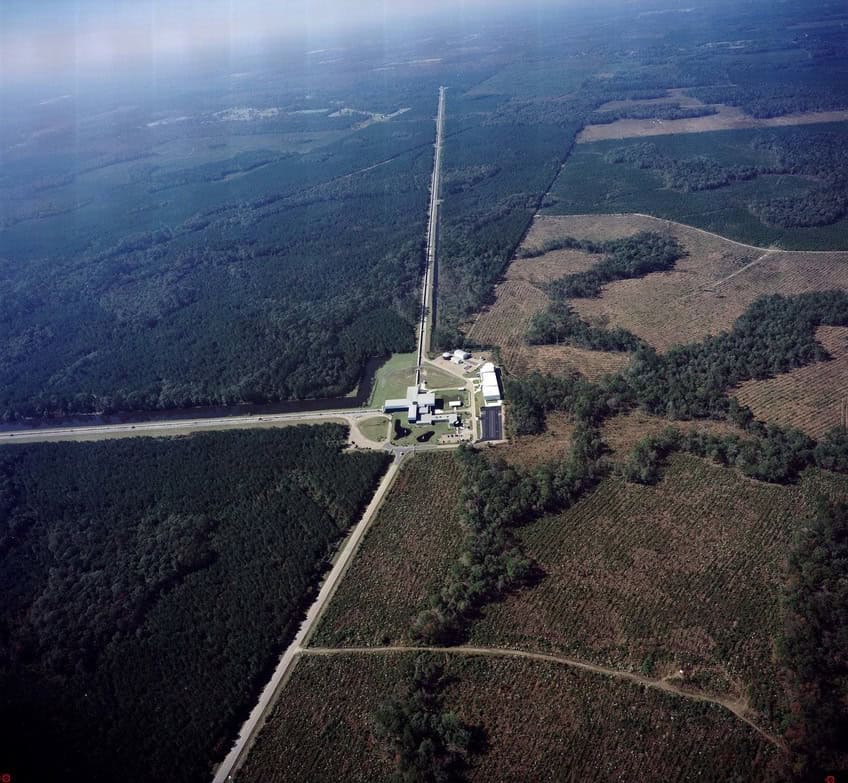
LIGO’s Livingston site
View from above An overhead view demonstrates the immense scale of LIGO’s Livingston site. (Courtesy: Caltech/MIT/LIGO Lab)

Richardson notes that, even now, observations such as that of a binary black hole merger with a record signal-to-noise ratio of 80 are allowing researchers to test our most fundamental theories of the nature of gravity and black holes. Heightened sensitivity will allow the observation of waves that have travelled far greater distances, over longer time periods, and are weaker as a result. These new developments will allow astrophysicists to peer further out into our universe and further back in cosmic time than ever before.

This major increase in sensitivity requires new levels of power, with LIGO A# reaching an unprecedented 1.5 MW of circulating laser arm power. The mirrors used in these detectors absorb some of the power of the incident lasers as thermal energy, resulting in heat-induced distortions that have a detrimental effect on the sensitivity of the detector. It is these deformations that place a limiting factor on the capabilities of gravitational-wave observatories.

A surprisingly simple solution

Richardson’s team has already taken huge steps towards reducing this effect with the development of new adaptive optics. In principle, these devices can apply a variable blanket of heat across the surface of the mirror that cancels out the thermal deformation from the laser heating at the nanoscale. Unfortunately, the application of this method is limited by researchers’ ability to precisely map these aberrations. This lack of sensing capability posed a roadblock on the path to high-powered gravitational-wave observation.

Richardson’s group discovered a solution to this problem when testing this new technology on a full-scale 40 kg LIGO mirror. They realised that they could accurately reconstruct the optical distortions across the entire 34 cm-diameter mirror by combining direct measurements of the surface temperature with a well programmed model of heat flow in the material.

In a surprising turn of events, the thermal imaging cameras needed to survey the full aperture of the mirror are widely commercially available and can be calibrated using LIGO’s Hartmann wavefront sensors that are already in place. Without the need for a lengthy process of technology development, as is usually required to solve LIGO instrumentation problems, Richardson is “all the more hopeful that we will reach megawatt-scale interferometry in the coming years”.

The future of gravitational-wave detection

The planned improvements to LIGO will drastically increase the observational power of this leading facility, but designs for a new generation of observatories could present even greater opportunities.

Cosmic Explorer is the US-led contribution to a new class of interferometers. Its arms will reach an enormous 40 km each, with ten times the sensitivity of LIGO. Richardson’s team will be responsible for implementing their cutting-edge research in laser wavefront sensing and correction as part of Cosmic Explorer’s base design. As a testing ground for these developments, LIGO will pave the way for an exciting new era of gravitational-wave detection.

With these levels of sensitivity, Cosmic Explorer aims to observe gravitational waves from hundreds of thousands to millions of black hole and neutron star mergers per year. Gravitational-wave detection will then reach close to the edge of our observable universe, looking back approximately 14 billion years across cosmic time.

Using existing, widely available technology, Richardson’s research group is pushing the limits of gravitational-wave detection and spurring on the development of a new, more powerful class of observatory.

The post Thermal imaging technique helps overcome a major problem for gravitational-wave astronomy appeared first on Physics World.

Quantum principle allows heat to flow from cold to hot

10 August 2026 at 15:00
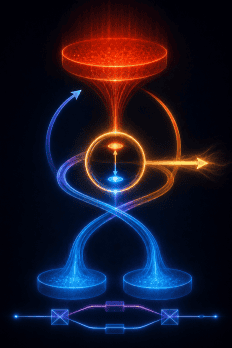
Artistic illustration showing cold reservoirs (in blue) flowing towards a hot one (in red) while also leaking heat to the environment. A diagram below the illustration shows the different pathways followed in the experiment
Cold to hot: A visualization of using a quantum switch to implement anomalous heat flow. (Courtesy: Giulio Chiribella, Rosario Lo Franco and Zhong-Xiao Man)

Heat flows from hot objects to cold objects – or does it? Although unidirectional heat flow is a natural consequence of the second law of thermodynamics, which states that entropy must either increase or stay the same, an international team has experimentally demonstrated that a quantum mechanism can reverse this flow of heat while remaining consistent with the laws of thermodynamics. The team then used the same mechanism to design a quantum engine that acts as a refrigerator while simultaneously extracting work.

The demon in the details

Imagine two chambers of gas side by side, separated by a permeable membrane. If the gas in one chamber is hotter than the other, then as time passes, more particles from the hotter chamber will move to the cooler chamber than vice-versa and heat will flow from the hotter chamber to the cooler one.

Now imagine a small agent, or “demon”, standing next to the partition. What if the demon allows cold gas particles to move into the hotter chamber, but stops the hot gas particles from moving to the colder chamber? In this scenario, we have achieved something called anomalous heat flow: the transfer of heat from a cold object to a hot object.

But there’s a catch. For the demon to accomplish this task, it must have a finite memory. That means that eventually, its memory will need to be erased before it can store new information. And it turns out that the erasure of this memory, even when combined with the anomalous heat flow, increases the total entropy. Thus, the second law is not violated.

Causality and the quantum switch

How can one realize such a demon? In the latest work, which is published in Physical Review Letters, Giulio Chiribella, Enrico Russo and Rosario Lo Franco worked with Zhong-Xiao Man and colleagues at Qufu Normal University in China to show that a quantum mechanical tool could perform the task of such a demon experimentally.

Three head shots of people
Quantum ideas: Team members Enrico Russo, Giulio Chiribella and Rosario Lo Franco. (Courtesy: Enrico Russo, HKU Faculty of Engineering and @onimicphotos)

In quantum mechanics, things don’t need to be in a definite state all the time. They can be in a superposition of multiple states. For instance, a cat in a box can be both dead and alive at the same time until you open the box (perform a measurement). Then the cat’s wavefunction “collapses” into a definite state of either dead or alive.

Similarly, quantum mechanics also allows superpositions in the order of events. In the classical world, event A might happen before event B or vice versa. However, in quantum mechanics, we can instead have a scenario where the orders of operations are in a superposition. This indeterminate sequence of events is known as indefinite causal order, and it was crucial for achieving anomalous heat flow.

“The direction of heat exchange is not determined only by temperatures,” explains Man, a physicist who studies quantum information and quantum optics at Qufu. “When the order of two thermalization processes is coherently controlled, a quantum system can show heat flows that would be impossible in an ordinary classical picture.”

Experimental implementation

The team implemented this control using a device called a quantum switch that has an extra input known as the control quantum bit, or qubit. If the control qubit is in a 0 state, the order of operations is A followed by B. If it is in a 1 state, the order of operations is reversed (B followed by A). However, because the control qubit is a quantum object, it can also be in a superposition of the 1 and 0 state, just like the cat in a box. It is this superposition that implements indefinite causality.

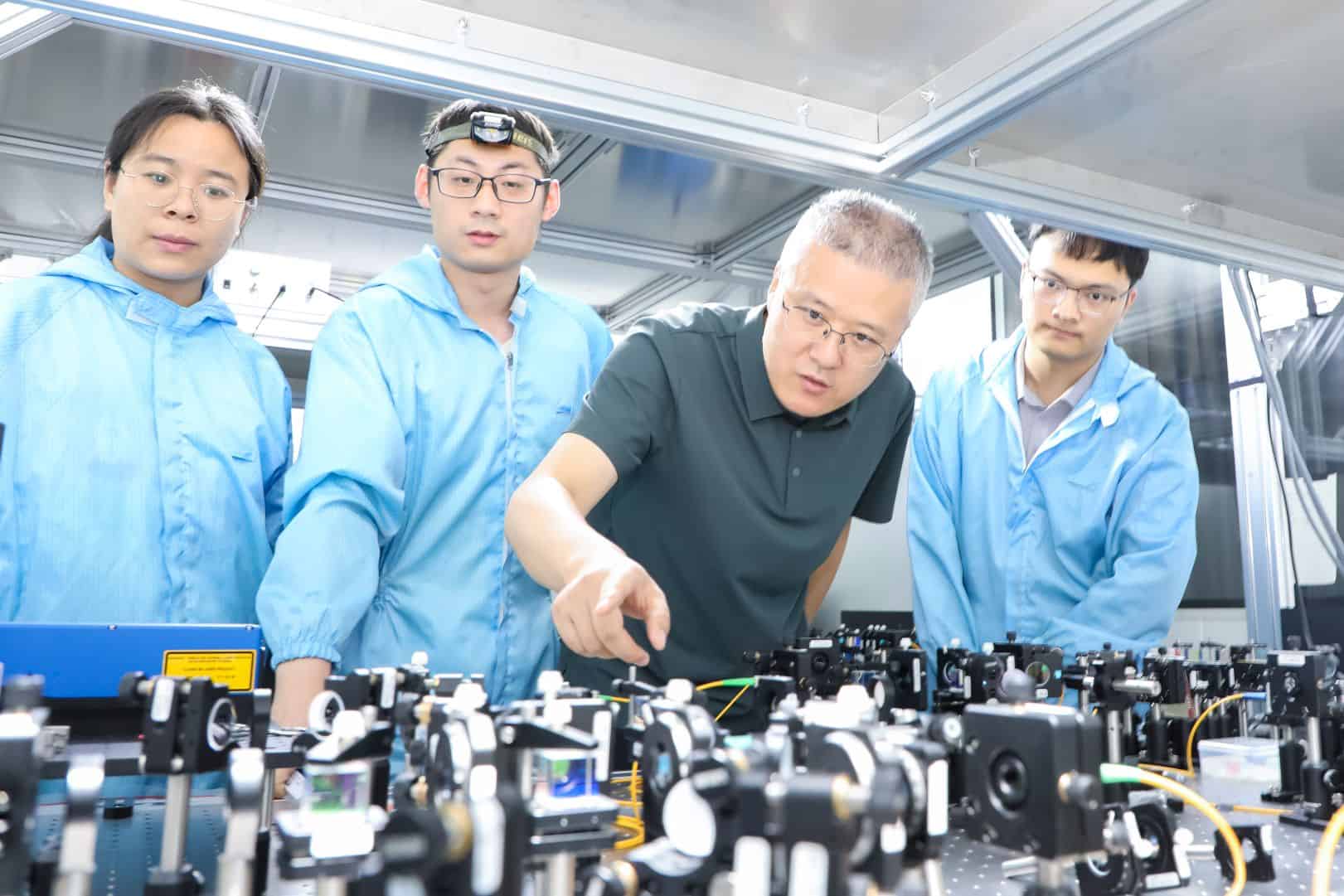
Photo of four people (Qi Zhang, Xu-Cai Zhuang, Zhong-Xiao Man and Qing-Feng Xue) standing next to an optical bench. Man is wearing a button-up polo shirt and pointing an an optical element on the table. The other three are wearing blue clean-room suits. Zhuang wears a head lamp and appears to be adjusting something on the table
Experimental team: (left-right) Qi Zhang, Xu-Cai Zhuang, Zhong-Xiao Man and Qing-Feng Xue in their lab at Qufu Normal University (Courtesy: Wen-Zhen Li/Qufu Normal University)

To create this quantum switch, the experimentalists in the team used an interferometer to put light in a superposition of two different paths, with the photons experiencing a different order of events in each path. “A photonic set up…reproduces the effect of a quantum switch with modest resources,” explains Chiribella, a quantum information theorist at the University of Hong Kong.

The team also used this set-up to build a version of an engine that transfers heat from a cold body to a hot body while performing work. This is counterintuitive, given that in one framing of the second law of thermodynamics, heat transfer from a cold to hot body must be accompanied by work being done on the engine (rather than being done by it). However, the experiment didn’t break the second law because the control qubit of the quantum switch behaves like the memory of the demon. At the end of each engine cycle, the control qubit must be reset to its initial superposition state. In totality, the second law is obeyed.

“One of the most exciting aspects of this work is that a highly counterintuitive thermodynamic effect can be explored with photons in an optical laboratory,” observes Lo Franco, a quantum physicist in the Department of Engineering of the Università degli Studi di Palermo, Italy. “This makes the result not only conceptually interesting, but also experimentally accessible and relevant for future quantum technologies.”

The post Quantum principle allows heat to flow from cold to hot appeared first on Physics World.

Why physics should move beyond prestige in PhD admissions

10 August 2026 at 11:00

Physics faces a persistent and uncomfortable paradox. While we repeatedly assert that scientific excellence depends on creativity, rigour, resilience and collaborative problem-solving, the way we select the next generation of researchers still relies heavily on institutional prestige, grades and prior access to opportunity. Although easy to use, these criteria are deeply entangled with structural advantage resulting in a system that is efficient to operate and familiar – yet systematically exclusionary.

Traditional admissions criteria are heavily shaped by unequal access to resources, inside knowledge, mentors and cultural capital

Most academics recognize the limitations of traditional admissions criteria, but we continue to rely on them. Degree classification, university ranking, publications and reference letters feel like comfortable objective indicators of merit. In reality, however, they are heavily shaped by unequal access to resources, inside knowledge, mentors and cultural capital.

Two students with equal underlying potential, for example, can present very different CVs depending on whether they had access to a research-intensive institution, informal advice networks, paid research internships, or simply, the financial security to take risks. When admissions panels default to these signals as primary filters, they are not solely selecting for ability – they are also selecting for accumulated advantage.

This is not merely a matter of fairness but a strategic problem for science. Science and technical subjects in the UK face chronic recruitment and retention challenges. At the same time, major issues facing our society are too complex to solve from a single perspective. Physics skills are in growing demand across the UK and Ireland with PhD graduates entering industry, policy, entrepreneurship, education and beyond. This demands not only technical brilliance, but adaptability, communication and ethical judgement.

To achieve the interdisciplinary breadth required to tackle today’s issues, we need to implement thoughtful strategies and processes. If we continue to draw from a narrow and self-reproducing talent pool, we constrain not only who gets to participate in science, but the kind of science we are able to do.

A new approach

At the Centre for Doctoral Training (CDT) in Diversity-Led, Mission-Driven Research (DiveIn) based at the University of Glasgow, we saw an opportunity to move away from PhD admissions criteria being focused on prior privilege towards one based on demonstrable competencies relevant to excellent research and successful completion of a PhD. While most PhD programmes recruit students to predefined projects, which rewards prior disciplinary alignment and insider knowledge, DiveIn instead recruits a cohort first and co-creates projects later.

We worked with the Equity in Doctoral Education through Partnership and Innovation (EDEPI) programme to design a CDT with this mind. EDEPI was created to tackle persistent inequalities that create barriers to access and participation for racially minoritized groups. The EDEPI framework identifies three broad areas: comprehension and evaluation (analytical and problem solving, communication, planning and organization); delivering results (integrity, working with others, independence); and socio-emotional competencies (motivation, curiosity, resilience). We expanded the EDEPI framework to emphasize an appetite for interdisciplinary research; cohort-based development; and advocacy.

A core pillar of the DiveIn approach to the EDEPI framework is anonymization. Our applications are divided into separate components, with personal data, CVs and competency statements de-linked during evaluation. Assessors also never see names, genders, nationalities or institutional affiliations.

The DiveIn admissions process consists of four key elements. The first is an anonymized, competency-based written application, structured around five targeted questions probing motivation, resilience, curiosity and self-reflection. The second is a task-based exercise, in which all applicants analyse the same dataset and explain their reasoning – testing analytical thinking and communication independently of discipline.

Another aspect of the process is a double-marked, wide-ranging assessment, ensuring that no single impression dominates and that different aspects of the application are judged independently. The final aspect is a transparent, structured interview with questions shared in advance and mapped explicitly to competencies.

Applicants are assessed for their ability to thrive in a diverse, collaborative cohort

Importantly, applicants also receive active support, which includes webinars explaining the process, guidance videos for each question and live drop-in sessions. This is not coaching for advantage – it is an explicit attempt to dismantle the “hidden curriculum” that privileges those already familiar with academic selection rituals. Applicants are, therefore, assessed not only for individual PhD readiness, but for their ability to thrive in a diverse, collaborative cohort.

Diversity gains

DiveIn’s first full recruitment cycle provides some encouraging evidence that our approach is working. The resulting cohort is naturally diverse in background, discipline and experience. Our results also suggest that undergoing such a shift can widen participation without lowering standards and may, in fact, improve the quality and impact of the research that the PhD cohort carry out. In other words, the process did not abandon standards but changed what those standards were designed to measure.

If we continue to admit PhD candidates primarily based on narrow retrospective signals, we will systematically under-select precisely the kinds of researchers the future requires. Conversely, if we treat admissions as a design problem – something that can be structured, tested, iterated and improved – we open the door to a more resilient, creative and socially responsive generation of researchers. As diversity gains in the technology sector are stalling, this reform to admissions could help sustainably boost diversity in UK Tech.

We can build systems that are fairer, more principled, and more aligned with the realities of modern research

We now need to refine, scale and continue to evaluate the programme. But the core insight is robust: we can do better than prestige-driven selection. We urge anyone who selects PhD students for their programme to think about these issues and make use of the resources available at EDEPI on inclusive PGR admissions. We can build systems that are fairer, more principled, and better aligned with the realities of modern research.

For a discipline built on careful measurement and experimental design, it is striking how little physics has applied those principles to choosing who gets to become a scientist. Perhaps it is time we did.

  • This article was written with Ross Forgan, Sandra Dopico Ardao, Qammer Abbasi and Caroline Gauchotte-Lindsay.

The post Why physics should move beyond prestige in PhD admissions appeared first on Physics World.

Artificially rotating system reflects radiation like a black hole

10 August 2026 at 08:30

A radio signal has been amplified by scattering it from a stationary coin-sized electronic circuit that behaves as though it is rotating at an enormous rate. Conceived by a team at the City University of New York, the experiment is said to provide the first observation of rotational super-radiance involving electromagnetic waves. This wave-amplification effect is inspired by rotating black holes and was predicted more than half a century ago. Andrea Alù and colleagues found that only radio waves carrying a particular kind of twist were boosted, by as much as a factor of six in power.

In 1969 Roger Penrose pointed out that a rotating black hole holds a vast reservoir of energy that, in principle, can be tapped. “An object entering the region around the black hole can split into two parts, one falls into the black hole while the other escapes with more energy than the original object had, effectively taking some rotational energy from the black hole,” Alù, explains.

Two years later the Soviet physicist Yakov Zel’dovich realized that the same thing should happen to waves. “If a wave carrying angular momentum reflects from a rapidly rotating absorbing cylinder, the reflected wave could be amplified and come back stronger than it arrived,” says Alù. That amplification is called rotational super-radiance, which Alù describes as, “a process in which a wave becomes stronger by extracting energy from a system that rotates very rapidly”.

The catch has always been the word “rapidly”. For the effect to occur, the rotation must outrun the wave itself, and for light or radio waves that means rotational rates no mechanical object could survive. The effect has been coaxed out of water waves swirling around a vortex and out of sound waves bouncing off a spinning absorber, but electromagnetic waves had been out of reach. “While the idea is fascinating, no experimental demonstration was reported for electromagnetic waves, due to the required very fast speeds,” Alù says.

Clever solution

The CUNY team has found a clever way around the speed restriction. “Instead of physically spinning an object, we created an artificial rotation by periodically changing the properties of a network of resonators in space and time in a way that mimics rotation,” says Alù. The new device is disarmingly simple, comprising three small electrical circuits wired into a loop roughly two centimetres across, each one tuneable like a radio dial. The tuning of all three is wobbled up and down, with each kept slightly out of step with its neighbours, so the pattern sweeps around the loop like a wave passing through a stadium crowd.

“Although no physical object is rotating, this travelling modulation pattern acts like a rotating system,” Alù explains. And because the apparent speed is set purely by how quickly the electronics are driven, it can be pushed as high as one likes. “In fact, this speed can be faster than the velocity of light without violating any physical law.” Nothing material moves, so nothing outruns light.

The researchers fed a 100 MHz radio signal into the loop. This light was in a specific twisted state (possessing orbital angular momentum). They then swept the rotational rate from 5 MHz up to 195 MHz. Below 100 MHz the reflected light weakened steadily, as expected. Above 100 MHz, however, the synthetic rotation overtook the wave and the behaviour flipped. The reflected signals reappeared at the same frequencies as before — 60, 70 and 80 MHz — but were twisted the opposite way, and were stronger rather than weaker. That reversal, Alù notes, is “a key signature of entering the regime associated with super-radiance”. The gain arises in special windows the team calls angular-momentum bandgaps, which open once the synthetic rotation is fast enough and through which “energy can be transferred from the synthetic rotation to the wave”.

Fussy amplfier

The amplification was fussy about its input. “Our observed amplification was selective to the angular momentum of the input wave, only waves with particular angular-momentum properties experienced gain,” says Alù. Stranger still, the effect feeds on waste. In an ordinary amplifier, energy leaking out of the device is the enemy. Here a leakier circuit gave more gain, exactly as the thermodynamic reasoning behind super-radiance demands.

Alù is careful about what the experiment does and does not deliver. “The experiment does not study actual black holes or quantum gravity. Instead, it creates a laboratory system that reproduces some of the same physical principles involved in rotational energy extraction.” What it offers, he says, is “a controllable analogue platform where researchers can test and explore concepts that are otherwise difficult or impossible to study experimentally in astrophysical black holes”.

Three circuits in the loop allow only three distinct twists, so the immediate goal is bigger loops supporting a wider range. Beyond that lies the jump from radio waves to visible light, and a quantum version in which synthetic rotation might conjure photons out of empty space. Practical spin-offs may arrive sooner. Amplifying only one twist at a time is a natural fit for encoding information, and, Alù suggests, “new forms of lasers, with selective emission of angular momentum, can be envisioned”.

The research is described in Nature.

The post Artificially rotating system reflects radiation like a black hole appeared first on Physics World.

❌