
❌

Normal view

How can you fast-forward a quantum simulation?

1 July 2026 at 08:48

Quantum computers promise to simulate physical systems far beyond the reach of classical machines. But even quantum algorithms face fundamental limits: no fast-forwarding theorems. These say that if you want to simulate a system for longer, the computational effort increases at least in proportion.

In many real algorithms, the situation is even worse than the ideal case. This is because the requirements of accuracy and runtime compound one another, so that running longer and running precisely become entangled and costly together.

In their new study, a team of researchers from Beijing and Hong Kong showed that this link between time and cost is not as rigid as it seems, at least for a broad class of realistic systems that interact with their surroundings. These so‑called open quantum systems are described by Lindbladian dynamics, which include both ordinary evolution and the effects of noise or dissipation.

In earlier approaches, improving the accuracy of a simulation made long-time calculations much more demanding, because the two effects multiplied together. The new method separates these contributions, so that the cost of simulating longer times does not automatically amplify the cost of achieving accuracy. In practical terms, this means that extending a simulation in time becomes far more manageable than before.

An even more surprising result appears when the dissipative processes in the system have a particular structure common in quantum physics. In these cases, the number of sequential computational steps needed grows only very slowly as the simulated time increases. Instead of needing proportionally more effort to simulate longer dynamics, the algorithm can effectively skip ahead, compressing what would normally be a long sequence of steps into a much shorter one. This fast‑forwarding is a dramatic departure from the usual expectation that longer simulations must always take longer to run.

The team also demonstrated how these ideas can be applied to studying thermal properties of quantum systems. These are essential for understanding matter at finite temperature. Such calculations are especially challenging at low temperatures, where lots of interesting physics often occurs. By exploiting their more favourable scaling, the new approach can extract certain thermal properties more efficiently, making it easier to probe regimes that are typically hard to access.

Beyond the specific application of this advance itself, the work highlights an important shift in perspective. Rather than focusing only on the worst‑case limits imposed by general theorems, it shows that carefully chosen physical structure can loosen those limits. Only time will tell what the implications for quantum simulation and computation will be in the future.

Read the full article

Exponential Lindbladian fast forwarding and exponential amplification of certain Gibbs state properties – IOPscience

Zhong-Xia Shang et al 2026 Rep. Prog. Phys. 89 057602

The post How can you fast-forward a quantum simulation? appeared first on Physics World.
How do collisions cause light to condense in solid-state devices?

17 June 2026 at 09:00

Light normally spreads out and escapes from optical devices, so it is not obvious how photons can ever behave like the atoms in a Bose–Einstein condensate (BEC). Yet experiments have shown that, under the right conditions, photons trapped in microscopic semiconductor cavities can collect into a single quantum state, even at room temperature. What has been missing is a clear explanation of how this happens in real semiconductor materials.

New research provides that explanation. The authors develop a detailed theory that tracks how photons interact with the electrons and holes inside a semiconductor while the system is continuously pumped with energy. Unlike earlier models that treated the semiconductor as a simple thermal background, this theory follows how all parts of the system evolve together, including particle collisions, energy losses and heat exchange with the surrounding material.

The key finding is that collisions between charge carriers (Coulomb scattering) allow the photons to share energy and effectively cool down. At high particle densities, this process is strong enough to make photons behave as if they were in thermal equilibrium, enabling them to form a condensate. This mechanism is very different from that in dye‑based photon condensates, where vibrations of molecules do most of the thermalising.

The theory also predicts several distinct regimes: ordinary thermal light, single‑mode and multimode photon condensation, and standard laser behaviour. Importantly, experiments can move between these regimes by adjusting parameters such as the cavity design and the pumping strength.

By explaining how quantum states of light can emerge in compact, room‑temperature semiconductor devices, this work could enable new quantum photonic technologies, including advanced light sources for communications, sensing and information processing.

Read the full article

A quantum kinetic theory of photon Bose–Einstein condensation in semiconductors – IOPscience

J. L. Figueiredo et al 2026 Rep. Prog. Phys. 89 057901

The post How do collisions cause light to condense in solid-state devices? appeared first on Physics World.

Exotic physics revealed in a simple circuit

17 June 2026 at 08:58

Physics ideas often travel far from their origins, but few make the leap from the Standard Model of particle physics to a circuit board. A surprising new experiment shows that custodial symmetry, best known for stabilising fundamental particle masses, can also emerge in an entirely classical electrical system built from off‑the‑shelf components.

Symmetry plays a central role across physics. As formalised by Noether’s theorem, every continuous symmetry is linked to a conserved quantity. This principle underpins everything from energy conservation to modern field theory. In particle physics, custodial symmetry acts as a safeguard, suppressing large corrections and keeping key quantities stable even when other symmetries are broken. A classical analogue of this idea was theoretically proposed several years ago, but its experimental realisation had remained elusive until now.

A team of researchers from China have now brought this concept to the laboratory using a topolectrical circuit — an electrical analogue of a topological lattice. Their system is based on the Su–Schrieffer–Heeger (SSH) model, a one‑dimensional chain known for hosting edge states that remain pinned to a boundary as long as a certain symmetry is present. The researchers deliberately disrupted that symmetry by introducing memristors: circuit elements whose resistance changes depending on how they have been used in the past.

Surprisingly, the edge states do not simply vanish. Instead, the team finds that a weaker form of protection remains. By measuring how the circuit’s behaviour changes, they identified a correction that shrinks smoothly as the memristive effect is reduced. This closely mirrors how custodial symmetry suppresses mass‑like corrections in quantum field theory.

The novel work shows how tabletop circuits can serve as accessible testbeds for ideas drawn from fundamental physics, opening new ways to explore symmetry, topology and memory using electronics rather than particles.

Read the full article

Observation of custodial chiral symmetry in memristive topological circuits – IOPscience

W. Li et al 2026 Rep. Prog. Phys. 89 048004

The post Exotic physics revealed in a simple circuit appeared first on Physics World.

Attosecond interferometry meets quantum optics

3 June 2026 at 07:26

Experimental attosecond science is built around the ability to generate and control light flashes lasting billionths of a billionth of a second. Such extreme pulses can be created through high harmonic generation (HHG), where an intense laser field drives electrons out of atoms or solids and then forces them back, releasing bursts of extreme ultraviolet radiation. Techniques like this have transformed our ability to observe electron motion on its natural timescale.

To extract information from such ultrafast processes, physicists often rely on attosecond interferometry. By combining a strong laser field with a weaker second colour, different electron trajectories are made to interfere, imprinting timing and phase information onto the emitted harmonics. Over recent years, these schemes have become standard tools for attosecond metrology and spectroscopy.

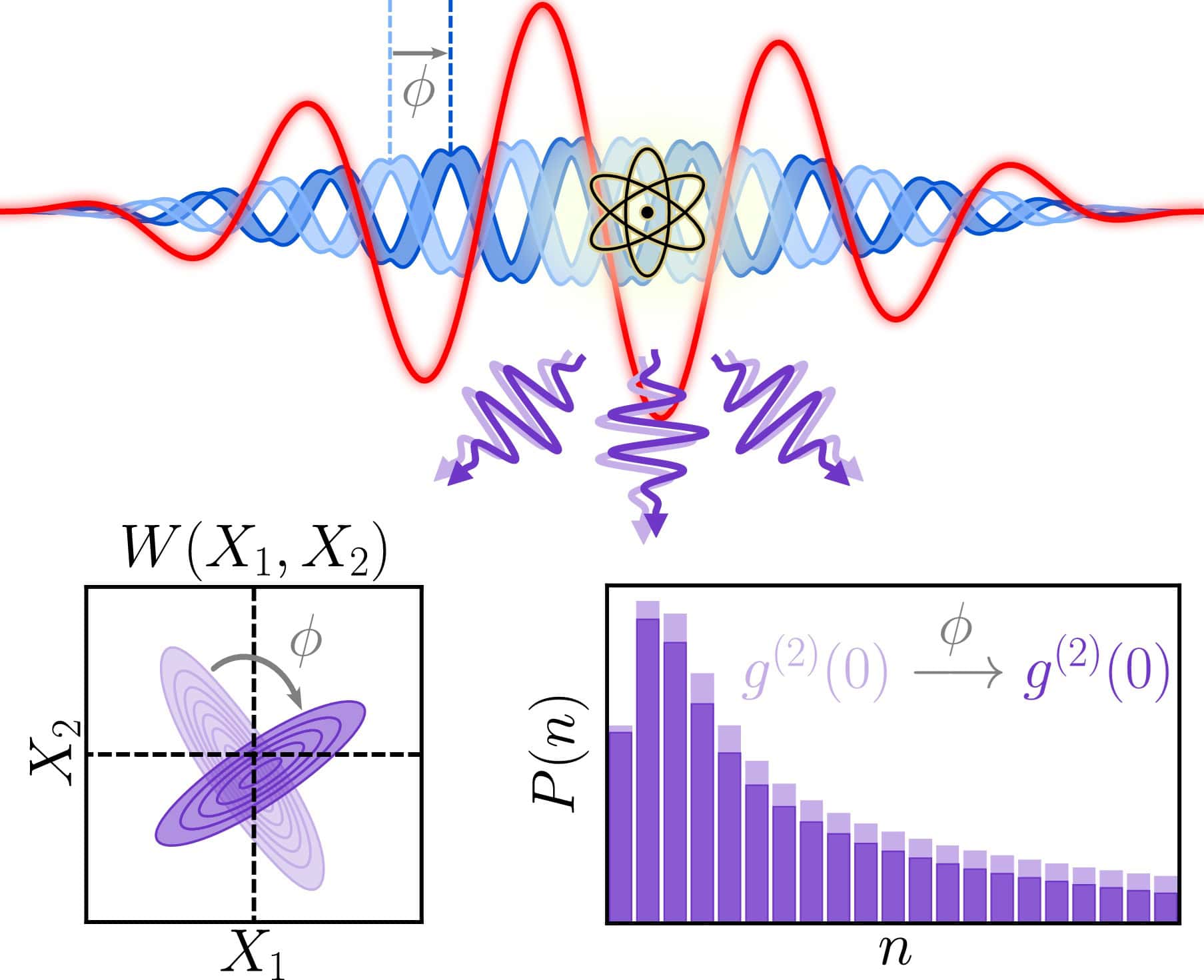
In a recent paper published in Reports on Progress in Physics, Javier Rivera Dean et al, revisited this idea from a quantum optical perspective. Treating both the driving fields and the emitted harmonics as quantum rather than classical objects, they analysed how attosecond interferometric control influences the photon statistics, correlations and phase space structure of the generated light. Their calculations show that even when harmonic radiation appears classical in its average properties, its underlying quantum state can carry rich and measurable structure.

The study also explores how interferometric phase control can be repurposed as a practical probe of quantum optical features in spectral regions where standard techniques, such as homodyne detection, are unavailable. This represents a new approach for measuring phase-space distributions through tomographic reconstruction: attosecond quantum tomography.

Attosecond quantum scheme
Illustrative image new of experimental scheme proposed in their paper (Credit: J. Rivera-Dean).

By combining quantum optics with common attosecond techniques, the work shows how ultrafast science is increasingly becoming a platform not just for watching electrons move, but also for studying light itself at the shortest timescales accessible in the laboratory.

Read the full article

Attosecond quantum optical interferometry – IOPscience

J. Rivera-Dean et al 2026 Rep. Prog. Phys. 89 047901

Do you want to learn more about this topic?

The physics of attosecond light pulses – IOPscience by P. Agostini and L. F. DiMauro (2004)

The post Attosecond interferometry meets quantum optics appeared first on Physics World.

Pushing many-body entanglement to its absolute limit

27 May 2026 at 08:07

An absolutely maximally entangled (AME) state is one in which every possible division of a many-body system into two groups is as entangled as quantum mechanics allows. This makes AME states uniquely valuable as benchmarks for quantum theory and as resources for quantum technologies. Yet basic questions about their existence, structure and classification have remained unresolved, even after two decades of study.

In a new work, dedicated to Ryszard Horodecki, this field has been advanced in several important ways. First, the authors provided a comprehensive and up to date overview of known methods for constructing AME states, going beyond traditional approaches based on stabilizer and graph states. The authors showed how recent ideas from combinatorics, matrix and group theory generate entirely new families of highly entangled states that were previously unknown.

They also went on to study how entanglement behaves when particles are removed from an AME system. This reveals how robust these extreme states are to loss and noise, an essential consideration for real quantum technologies.

One highlight is a solution to the quantum version of Euler’s famous “36 officers” problem.  This puzzle asks whether 36 officers from six ranks and six regiments can be arranged in a 6 x 6 grid so that no row or column repeats a rank or regiment. Classical mathematics proves this is impossible.

The paper shows however, that quantum mechanics can bypass this restriction altogether. By using an absolutely maximally entangled quantum state, the researchers constructed a quantum version of the puzzle in which all constraints are satisfied simultaneously. The solution relies on superposition and quantum entanglement rather than fixed arrangements, illustrating how quantum theory enables outcomes forbidden in classical mathematics.

By mapping the limits of multipartite entanglement, this work connects abstract theory with practical goals such as quantum error correction, secure communication, and benchmarking future quantum computers.

Read the full article

Absolutely maximally entangled pure states of multipartite quantum systems – IOPscience

Grzegorz Rajchel-Mieldzioć et al 2026 Rep. Prog. Phys. 89 057601

The post Pushing many-body entanglement to its absolute limit appeared first on Physics World.

❌