❌

Normal view

Your beer can only cool so fast. Blame quantum mechanics

15 October 2026 at 14:30

How fast can a kettle boil water for your cup of tea, or a refrigerator cool down a bottle of beer? The answer depends on the details of the machines, but according to new work published in Nature Physics, the minimum wait time does not. Instead, it’s quantum mechanics that imposes a limit on how fast something can thermalize to a particular temperature.

Objects thermalize, or reach a state of thermal equilibrium, when they no longer exchange any net heat with their environment. Physicists already suspected that this process couldn’t happen arbitrarily quickly. “There was suggestive evidence from experiments, numerical simulations and analytical calculations that a physical system can’t be made to thermalize faster than some fundamental limit,” says Martí Perarnau-Llobet, a quantum scientist in the Quantum Information Group  at the Autonomous University of Barcelona, Spain, and one of the paper’s authors.

Although the exact conditions under which thermalization is always guaranteed remain an unanswered puzzle, the researchers chose to focus on systems that do have this feature. To guarantee thermalization, Perarnau-Llobet and colleagues in Barcelona; Vienna, Austria; and Geneva, Switzerland came up with the mathematical notion of a thermalization machine. Given a quantum system in some initial state, this thermalization machine evolves it to a thermal state (that is, one that doesn’t spontaneously exchange net heat with its environment) at a particular well-defined temperature. In the previous example, the refrigerator and kettle would be considered thermalization machines, and your beer and water would be the systems.

No cheating

In some cases, one can engineer a machine that takes a particular system to its equilibrium state arbitrarily fast. For instance, a machine might quickly swap a hot cup of coffee for an iced one. But that would be cheating, says team member Pavel Sekatski, a researcher at the University of Geneva. “Such examples where you can finely tune your algorithm to thermalize a specific system can be avoided by carefully defining thermalization,” he tells Physics World.
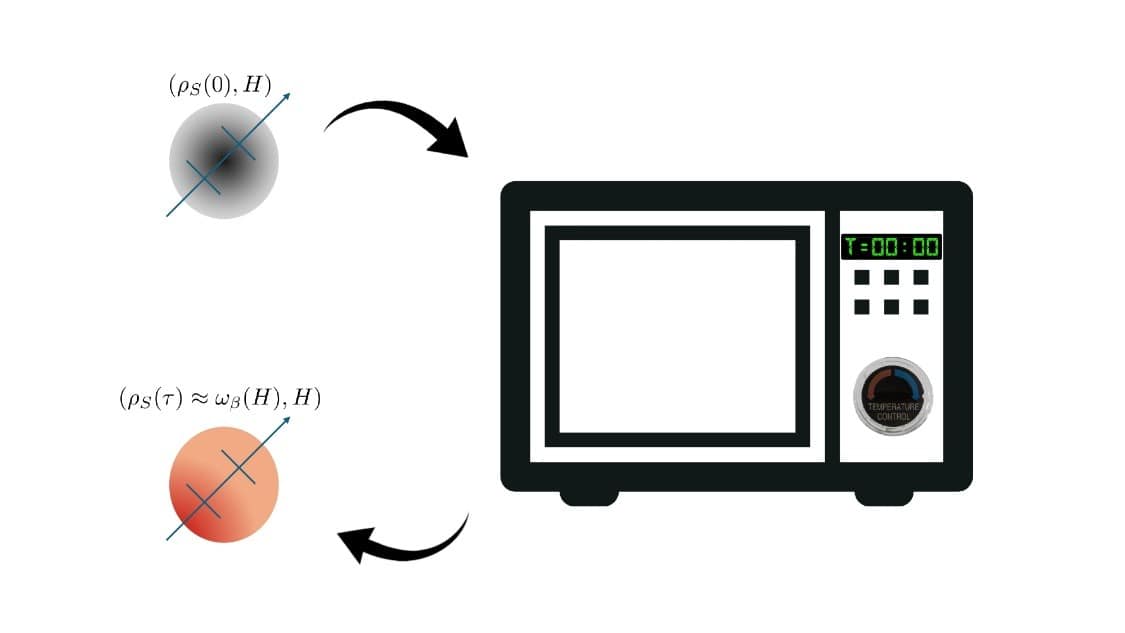
A diagram showing a microwave-like object taking in a quantum system in an initial state rho_s(0), H and outputting it in a state rho_s(t) that is approximately equal to omega_beta(H), H
Your quantum system is ready: A visualization of a thermalization machine that takes some quantum system in some initial state as input and outputs the system in its thermal state. (Courtesy: Paolo Abiuso, Alberto Rolandi, John Calsamiglia, Pavel Sekatski and Martí Perarnau-Llobet).

The researchers did this using a mathematical object called a Hamiltonian, which describes the possible energies a system can have. If a quantum system has a Hamiltonian that is close to the original one, then they require that the thermalization machine must be able to thermalize that system, too. In other words, the same thermalization machine that cools your cup of coffee must also be able to cool down other cups of coffee that may have slightly different amounts of sugar or milk. This rules out the instant swap tricks as the machine can no longer be tailored to a specific cup of coffee.

Based on the assumptions that such a thermalization machine is consistent with laws of quantum mechanics and that it works for some quantum systems that are close to each other, the researchers show that, away from absolute zero, the fastest thermalization time is approximately ℏ/(2kBT), where ℏ is Planck’s constant and kB is Boltzmann’s constant. “These restrictions on these thermal machines are actually very weak, and the notion is very general,” notes Perarnau-Llobet.

Related problems in computer science

The researchers note that their work is closely related to interesting tasks in computer science. One such task, known as Gibbs state sampling (GSS), involves taking a known Hamiltonian and using it to work out the corresponding thermal state at a particular temperature. This task can be performed arbitrarily fast. In contrast, if you have access to the quantum system, but you don’t know its mathematical description (that is, its Hamiltonian) you must perform a task called Hamiltonian learning (HL). This task admits a bound on the time taken for it to be solved.

“The task that we considered was somewhere in between the two,“ explains team member Paolo Abiuso, a physicist at the Institute for Quantum Optics and Quantum Information in Vienna. “We don’t know what the Hamiltonian of the quantum system is, but we do have access to the quantum system, and we want to produce the thermal state.” His Barcelona co-author John Calsamiglia adds that while the task they considered is “harder than GSS, it is still easier than HL”.

Beyond these connections to computer science, the researchers say their strategy could lead to insights on broader questions in physics. “We are now investigating what this approach can tell us about the fundamental limits imposed by the second and third laws of thermodynamics,” says Alberto Rolandi of TU Wien.

The post Your beer can only cool so fast. Blame quantum mechanics appeared first on Physics World.
What can cutting a photon in half tell us about causality and local equivalence?

24 September 2026 at 08:32
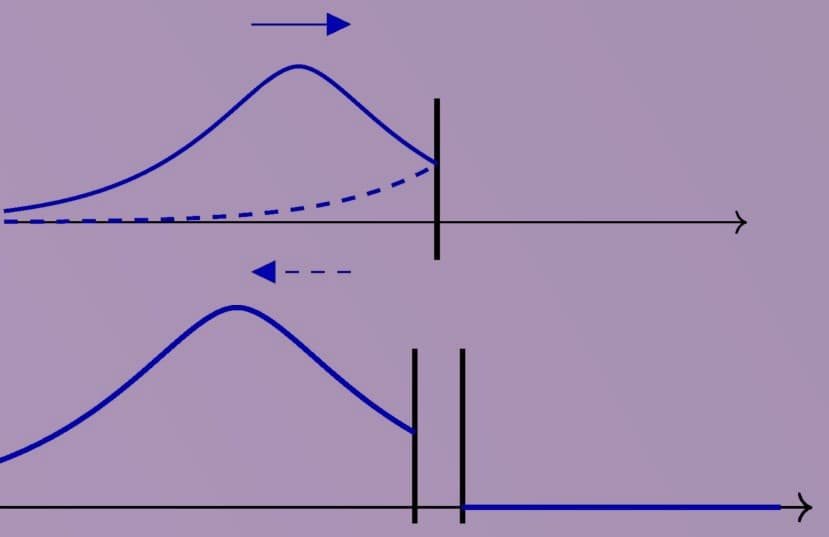
Illustration of a truncated photon
Chop and change The top panel shows a photon (represented as a wave) being reflected from a mirror. The wave is incident from left to right with the solid blue line showing the portion of the wave travelling left to right and the dashed line showing the portion of the wave that has been reflected back to the left. The lower panel shows the situation shortly after the mirror has been removed. The narrow central portion is the complicated transition region containing multiple photons. The region to the left shows a truncated photon state that is locally equivalent to a single photon. To the right is the truncated photon shown as locally equivalent to the vacuum state. (Courtesy: Isak Cecil Onsager Rukan, Jan Gulla, Johannes Skaar/Phys. Rev. Lett.)

Physicists in Norway have combined quantum mechanics with relativity to show that the act of “cutting a photon in half” has no immediate effect on how that photon appears to an observer outside of a small transition region where the truncation took place. Within that region, however, their calculations suggest that large numbers of photons are required to describe the truncated photon.

Light is complex. For some phenomenon, it exhibits particle-like behaviour, and for others, it exhibits wave-like behaviour. This duality is reconciled by quantum field theory, which describes light as both a particle and a wave at the same time. More precisely, in this framework, light can be considered as consisting of particles called photons, and these photons are defined as excitations in quantum electromagnetic fields.

A common technique in optical experiments is to chop a beam of light into divisions called pulses, and an interesting – and until recently, unexplored – question is what happens to a single photon when it is chopped? The physicists Isak Cecil Onsager Rukan, Jan Gulla and Johannes Skaar at Norway’s University of Oslo set out to answer exactly this question.

Can one cut a photon in half?

What do the researchers mean by cutting a photon in half? In the wave picture of light one can imagine an electromagnetic wave that is separated in two parts by an ideal shutter. Writing in Physical Review Letters, the trio considers that thought experiment with a set-up displayed in the upper portion of the figure.

Here, a photon is represented by an electromagnetic wave that is moving from left to right towards a mirror. If the mirror is ideal, then the photon is reflected completely.

A photon can be truncated by removing (either gradually or abruptly) the mirror while the wave is being reflected. Because some of the wave has already been reflected when the mirror is removed, the result is forward-moving and backward-moving modes – the solid and dashed lines respectively.

In this way, the action of removing the mirror has effectively “cut” the photon in half if we ignore the backward-moving modes.  The outcome is surprising. In the particle picture of light, one would expect to find or not find a forward propagating photon. However, calculations done by the trio show that the outcome is a complicated state consisting of a classical mix and a quantum superposition of multiple photons.

Shifting perspectives

Returning to our earlier definition of a photon, the absence of excitations of the quantum electromagnetic field corresponds to the absence of photons. This is called a vacuum (or empty) state. However, this notion of photons (and particles in general), is not always fixed, and can be observer or scenario dependent. For instance, what looks like a vacuum to a stationary observer, might look like radiation (a bunch of photons) to an accelerating observer. This is known as the Unruh effect.

In a similar manner, what is considered a vacuum state and a photon is different before and after the mirror is removed. This is because the presence of the mirror divides the physical space in half. The nature of excitations before and after the reflector is removed is different, thereby changing the notion of what is considered as a particle. The definition of vacuum in different frames (observers) is related mathematically by the Bogoliubov transformation. It is the same mathematics that also describes why black holes must eventually decay by emitting radiation. In this case the incoming vacuum state is related to outgoing thermal radiation via these transformations.

Using these mathematical tools, the researchers were able to calculate the complicated final state. First, they assumed that the reflector was removed instantaneously. In such a scenario, they had the unphysical result that the expected number of photons in the final state is infinity. If they assume that the mirror is slowly removed, they get a finite number of expected photons in the final state. However, you can still observe any number of photons. “There is a non-zero probability of observing any number of photons,” explains Skaar.

Nothing is faster than the speed of light

Understanding what happens when the mirror is removed requires the invocation of both classical and quantum physics. On one hand, the quantum state of the electromagnetic field changes on removal of the mirror, with the very definition of a particle or a vacuum state being a very non-local concept. This is because quantum mechanics requires that the excitation must be defined over the entire physical space. On the other hand, the classical principle of causality dictates that information cannot travel faster than the speed of light. As a result, the change in the physical state of the electromagnetic fields caused by the removal of the reflector cannot propagate faster than the speed of light. This means that, for an observer at a location far enough from the mirror such that light has not had enough time to travel there yet, should experience no change in physical state.

So, quantum mechanics requires the instantaneous change of the entire global physical state on removing the mirror, whereas causality requires a finite speed limit on the propagation of any change. The challenge for the Oslo trio was how to reconcile these two requirements.

They do this by considering what an observer can actually measure about the electromagnetic field at any point.  By considering only such localized measurements, the researchers ascertain that beyond a certain region around the mirror (which they call the transition region), the final state looks exactly like the initial state. This is illustrated in the lower portion of the figure.

On the right of the reflector, far enough such that light has not had enough time to travel there (right of the transition region), the region is indistinguishable from the vacuum state if one were to only rely on these localized measurements. Similarly, on the left side of the transition region, the state cannot be differentiated from a single photon state. This is known as “local equivalence” whereby a quantum state in a finite region is locally equivalent to another, if they cannot be distinguished by local measurements in that region.

Skaar comments, “We find it interesting that in quantum field theory, a complicated state can look very simple locally, in this case everywhere except in a narrow transition region.”

The post What can cutting a photon in half tell us about causality and local equivalence? appeared first on Physics World.

Quantum principle allows heat to flow from cold to hot

10 August 2026 at 15:00
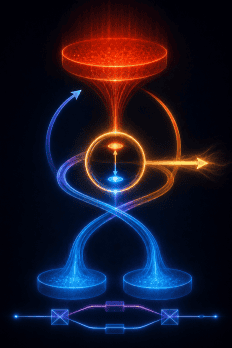
Artistic illustration showing cold reservoirs (in blue) flowing towards a hot one (in red) while also leaking heat to the environment. A diagram below the illustration shows the different pathways followed in the experiment
Cold to hot: A visualization of using a quantum switch to implement anomalous heat flow. (Courtesy: Giulio Chiribella, Rosario Lo Franco and Zhong-Xiao Man)

Heat flows from hot objects to cold objects – or does it? Although unidirectional heat flow is a natural consequence of the second law of thermodynamics, which states that entropy must either increase or stay the same, an international team has experimentally demonstrated that a quantum mechanism can reverse this flow of heat while remaining consistent with the laws of thermodynamics. The team then used the same mechanism to design a quantum engine that acts as a refrigerator while simultaneously extracting work.

The demon in the details

Imagine two chambers of gas side by side, separated by a permeable membrane. If the gas in one chamber is hotter than the other, then as time passes, more particles from the hotter chamber will move to the cooler chamber than vice-versa and heat will flow from the hotter chamber to the cooler one.

Now imagine a small agent, or “demon”, standing next to the partition. What if the demon allows cold gas particles to move into the hotter chamber, but stops the hot gas particles from moving to the colder chamber? In this scenario, we have achieved something called anomalous heat flow: the transfer of heat from a cold object to a hot object.

But there’s a catch. For the demon to accomplish this task, it must have a finite memory. That means that eventually, its memory will need to be erased before it can store new information. And it turns out that the erasure of this memory, even when combined with the anomalous heat flow, increases the total entropy. Thus, the second law is not violated.

Causality and the quantum switch

How can one realize such a demon? In the latest work, which is published in Physical Review Letters, Giulio Chiribella, Enrico Russo and Rosario Lo Franco worked with Zhong-Xiao Man and colleagues at Qufu Normal University in China to show that a quantum mechanical tool could perform the task of such a demon experimentally.

Three head shots of people
Quantum ideas: Team members Enrico Russo, Giulio Chiribella and Rosario Lo Franco. (Courtesy: Enrico Russo, HKU Faculty of Engineering and @onimicphotos)

In quantum mechanics, things don’t need to be in a definite state all the time. They can be in a superposition of multiple states. For instance, a cat in a box can be both dead and alive at the same time until you open the box (perform a measurement). Then the cat’s wavefunction “collapses” into a definite state of either dead or alive.

Similarly, quantum mechanics also allows superpositions in the order of events. In the classical world, event A might happen before event B or vice versa. However, in quantum mechanics, we can instead have a scenario where the orders of operations are in a superposition. This indeterminate sequence of events is known as indefinite causal order, and it was crucial for achieving anomalous heat flow.

“The direction of heat exchange is not determined only by temperatures,” explains Man, a physicist who studies quantum information and quantum optics at Qufu. “When the order of two thermalization processes is coherently controlled, a quantum system can show heat flows that would be impossible in an ordinary classical picture.”

Experimental implementation

The team implemented this control using a device called a quantum switch that has an extra input known as the control quantum bit, or qubit. If the control qubit is in a 0 state, the order of operations is A followed by B. If it is in a 1 state, the order of operations is reversed (B followed by A). However, because the control qubit is a quantum object, it can also be in a superposition of the 1 and 0 state, just like the cat in a box. It is this superposition that implements indefinite causality.

Photo of four people (Qi Zhang, Xu-Cai Zhuang, Zhong-Xiao Man and Qing-Feng Xue) standing next to an optical bench. Man is wearing a button-up polo shirt and pointing an an optical element on the table. The other three are wearing blue clean-room suits. Zhuang wears a head lamp and appears to be adjusting something on the table
Experimental team: (left-right) Qi Zhang, Xu-Cai Zhuang, Zhong-Xiao Man and Qing-Feng Xue in their lab at Qufu Normal University (Courtesy: Wen-Zhen Li/Qufu Normal University)

To create this quantum switch, the experimentalists in the team used an interferometer to put light in a superposition of two different paths, with the photons experiencing a different order of events in each path. “A photonic set up…reproduces the effect of a quantum switch with modest resources,” explains Chiribella, a quantum information theorist at the University of Hong Kong.

The team also used this set-up to build a version of an engine that transfers heat from a cold body to a hot body while performing work. This is counterintuitive, given that in one framing of the second law of thermodynamics, heat transfer from a cold to hot body must be accompanied by work being done on the engine (rather than being done by it). However, the experiment didn’t break the second law because the control qubit of the quantum switch behaves like the memory of the demon. At the end of each engine cycle, the control qubit must be reset to its initial superposition state. In totality, the second law is obeyed.

“One of the most exciting aspects of this work is that a highly counterintuitive thermodynamic effect can be explored with photons in an optical laboratory,” observes Lo Franco, a quantum physicist in the Department of Engineering of the Università degli Studi di Palermo, Italy. “This makes the result not only conceptually interesting, but also experimentally accessible and relevant for future quantum technologies.”

The post Quantum principle allows heat to flow from cold to hot appeared first on Physics World.

❌