❌

Normal view

IA deixou celulares mais difíceis de consertar, diz empresa

17 June 2026 at 21:46

A inteligência artificial deixou os celulares mais difíceis de consertar, segundo o Grupo PLL. A empresa especializada em manutenção de dispositivos móveis afirma que a integração crescente entre hardware e software aumentou a complexidade dos diagnósticos, reparos e validações técnicas dos aparelhos.

A atual geração de smartphones apresenta funções mais avançadas e um nível maior de integração entre componentes. Com isso, profissionais de assistência técnica precisam lidar com processos mais complexos para identificar falhas e garantir que os sistemas continuem funcionando corretamente após a substituição de peças.

Segundo a empresa, esse cenário também impacta o tempo de manutenção e os custos operacionais. A tecnologia inteligente influencia tanto os diagnósticos quanto as etapas de validação dos dispositivos após os reparos.

-
Entre no Canal do WhatsApp do Canaltech e fique por dentro das últimas notícias sobre tecnologia, lançamentos, dicas e tutoriais incríveis.
-

O tema reforça as discussões sobre direito ao reparo e obsolescência no Brasil. Propostas em debate buscam ampliar a vida útil dos eletrônicos e facilitar o acesso dos consumidores à manutenção, em um momento em que os smartphones concentram cada vez mais funções do dia a dia.

Inteligência artificial deixa reparos de celulares mais difíceis (Imagem: Divulgação/Grupo PLL)

Lucas Linhares, sócio-fundador e porta-voz do Grupo PLL, comentou a visão da companhia sobre o assunto. Segundo ele, o reparo qualificado se tornou um elo fundamental entre inovação e durabilidade. A empresa atende fabricantes e seguradoras e mantém um centro próprio de reparos em São Paulo com capacidade para 24 mil ordens mensais.

Divulgado recentemente, outro estudo apontou que o conserto de celular usado cresceu 68% no Brasil.

Leia a matéria no Canaltech.

ChatGPT muda e agora vai ajudar você a se lembrar de tudo

17 June 2026 at 21:38

O ChatGPT agora conta com um recurso para programar tarefas sem depender do Codex. A novidade começou a ser liberada aos usuários nesta quarta-feira (17) na versão web e nos apps para Android e iOS.

“Com as tarefas agendadas, os usuários podem solicitar ao ChatGPT que envie lembretes, gerencie tarefas recorrentes ou monitore atividades”, anunciou a companhia. “Esta atualização torna as tarefas mais fáceis de encontrar e gerenciar, mais rápidas e confiáveis, com notificações mais úteis.”

Para programar as demandas, basta enviar um prompt como “ao amanhecer, acesse o meu calendário e resuma as tarefas do dia”. Depois, a plataforma irá executá-la dentro do horário definido e emitirá uma notificação ao usuário após a conclusão do pedido.

-
Entre no Canal do WhatsApp do Canaltech e fique por dentro das últimas notícias sobre tecnologia, lançamentos, dicas e tutoriais incríveis.
-

Segundo a companhia, é possível escolher horários específicos ou indicar períodos, como manhã, tarde e noite.

Já a gestão de tarefas é realizada através da opção “Agendados”, localizada no menu lateral. A nova área centraliza todos os agendamentos feitos, com opção para editá-los e removê-los.

O espaço também oferece sugestões de tarefas para serem programados. Ao selecioná-los, o chatbot inicia um questionário para personalizar a demanda de acordo com as necessidades dos usuários.

ChatGPT ganha recurso para agendar tarefas (Imagem: Captura de tela/Bruno De Blasi/Canaltech)

Restrito a assinantes

O novo recurso, no entanto, é restrito a assinantes do ChatGPT. Neste caso, a OpenAI informa que é necessário aderir ao plano Plus, Pro, Business e Enterprise

Já o limite de tarefas varia de acordo com o pacote escolhido. “As tarefas não podem ser executadas mais de uma vez por hora, e as tarefas não supervisionadas podem ser pausadas automaticamente após um período de inatividade”, informa a companhia.

Pulse será encerrado

Com a estreia das tarefas agendadas, a OpenAI também iniciou um período de encerramento ao Pulse, recurso até então restrito a contas Pro.

“O Pulse está sendo desativado, pois as atualizações proativas serão substituídas por tarefas agendadas”, explica a dona do ChatGPT nesta quarta. “Os usuários Pro continuarão tendo acesso por 14 dias a partir de hoje.”

Para manter a entrega das atualizações diárias, é preciso agendar um resumo diário com base em seus interesses e conversas anteriores pelo ChatGPT.

Leia a matéria no Canaltech.

AAS 248: Day 2

17 June 2026 at 21:33

NGC 2210

Editor’s Note: This week we’re at the 248th AAS meeting in Pasadena, CA. Along with a team of authors from Astrobites, we will be writing updates on selected events at the meeting and posting each day. Follow along here or at astrobites.com for daily summaries, or follow @astrobites.bsky.social on Bluesky for more coverage. The usual posting schedule for AAS Nova will resume on 22 June.

Table of Contents:


Helen B. Warner Prize Lecture: Kyle Kremer, Globular Clusters: Astronomical Factories of Gravitational-Wave and Electromagnetic Transients (by Lucas Brown)

Kyler Kremer (University of California, San Diego) kicked off day two of AAS 248 with a “dynamic” talk on the complex interactions and environments that exist within globular clusters — the most massive category of stellar clusters, which can contain upwards of one billion stars. Because of the extreme stellar density of these environments, they are thought to be good factories of systems ranging from accreting white dwarfs to millisecond pulsars, which are often spun up to high speeds via accretion from companion stars. Such accretion, whether onto pulsars or other compact objects, can often generate bright X-rays, and as Kremer noted early on in his talk, it was in fact these X-ray sources that provided some of the earliest evidence of the abundance of exotic systems within globular clusters. By the early 2000s, hundreds of X-ray sources had been identified in globular clusters.

Along with these brightly emitting compact binary systems, we expect globular clusters to be home to a vast population of darker, more elusive objects — black holes. Kremer noted that because about one out of every thousand stars is thought to be massive enough to evolve into a black hole, older globular clusters are thought to produce tens or hundreds of thousands of black holes over time. These black holes are then expected to gradually sink towards the centers of the clusters through dynamical friction, where they will increasingly find themselves in the company of other black holes, or black hole binaries. As these massive objects swing by each other, they can occasionally merge or eject black holes out of clusters entirely. This leads to a complex evolutionary history, leaving many open questions in regards to how many black holes should persist in globular clusters today and with what properties.

Luckily, strong evidence for the presence of black holes in globular clusters began to come in around the early 2000s as a result of the direct measurements of stellar orbits around an invisible, at least 4-solar-mass object in NGC 3201. Since this discovery, multiple others have been made via similar techniques. The role of black holes in shaping our observation of globular clusters may go well beyond these isolated systems, however. Theoretical work has also shown that the presence of black hole binaries in the centers of globular clusters may contribute to dynamical heating of the overall cluster. This suggests that globular clusters that have not undergone core collapse, which represents over 80% of clusters, should retain significant black hole populations today.

While individual black holes can often be hard to spot, black hole binaries are becoming increasingly easy to hear, thanks to the advent of gravitational wave astronomy. At facilities like LIGO, Virgo, and KAGRA, merging black hole binaries are now regularly detected, creating a population-level catalog of black hole binary properties. While many of these systems can be well explained by black holes formed in the “isolated” channel, meaning originating from a preexisting binary star system, some mergers show signs of a “dynamical” formation history, which can arise in the sort of dense environments globular clusters provide. As one example, there seems to be more black holes in the 40-solar-mass and above range than many models predicted. At these high masses, more potential progenitor stars actually become too large to form black holes thanks to a phenomenon called pair instability. However, such massive black holes could be formed from the repeated mergers of smaller black holes — a hierarchical process that simulations have consistently shown can be highly efficient in globular clusters, especially the most massive ones. On top of this, Kremer noted that individual gravitational wave signals have recently shown other telltale signs of hierarchically formed binary black holes, such as asymmetric masses and spin–orbit misalignment.

Finally, Kremer turned to another class of exotic astrophysical objects to explore other ways globular clusters can generate interesting phenomena: pulsars. Pulsars, like black holes, form from the collapse of massive stars. This rapidly rotating sub-category of neutron stars beams radiation from their poles, which gradually slows them down and depletes the strength of their radio emission over millions or billions of years. Because of this, one would expect older globular clusters to have a slowly rotating and mostly invisible population of pulsars. Instead, we see many rapidly rotating millisecond pulsars in these environments, suggesting that the dense cluster environment allows for many of these systems to be spun back up through accretion from other stars. In contrast, we also see young globular clusters which contain slowly rotating pulsars — another puzzle, yet one that may again be explained by the dense environment. Some researchers believe that these pulsars are formed via the direct merger of multiple white dwarfs, rather than from the collapse of a massive star. Such systems may also be the source of some fast radio bursts; the first fast radio burst associated with a globular cluster was discovered in 2020. It seems like globular clusters may be the gift that just keeps on giving!

Return to Table of Contents.


Press Conference: Our Changing Galaxy and the Skies We See (Briefing video) (by Niloofar Sharei)

This press conference walked through four very different ways our view of the Milky Way and our skies are changing right now — from extreme gas physics at the Galactic Center, to the hidden stellar populations of a cluster, to the rapid flickers of dying stars, and finally, to a very practical question: what are dark night skies actually worth to the public?

Resolving the Supersonic-to-Subsonic Gas Transition in the Galactic Center for the First Time

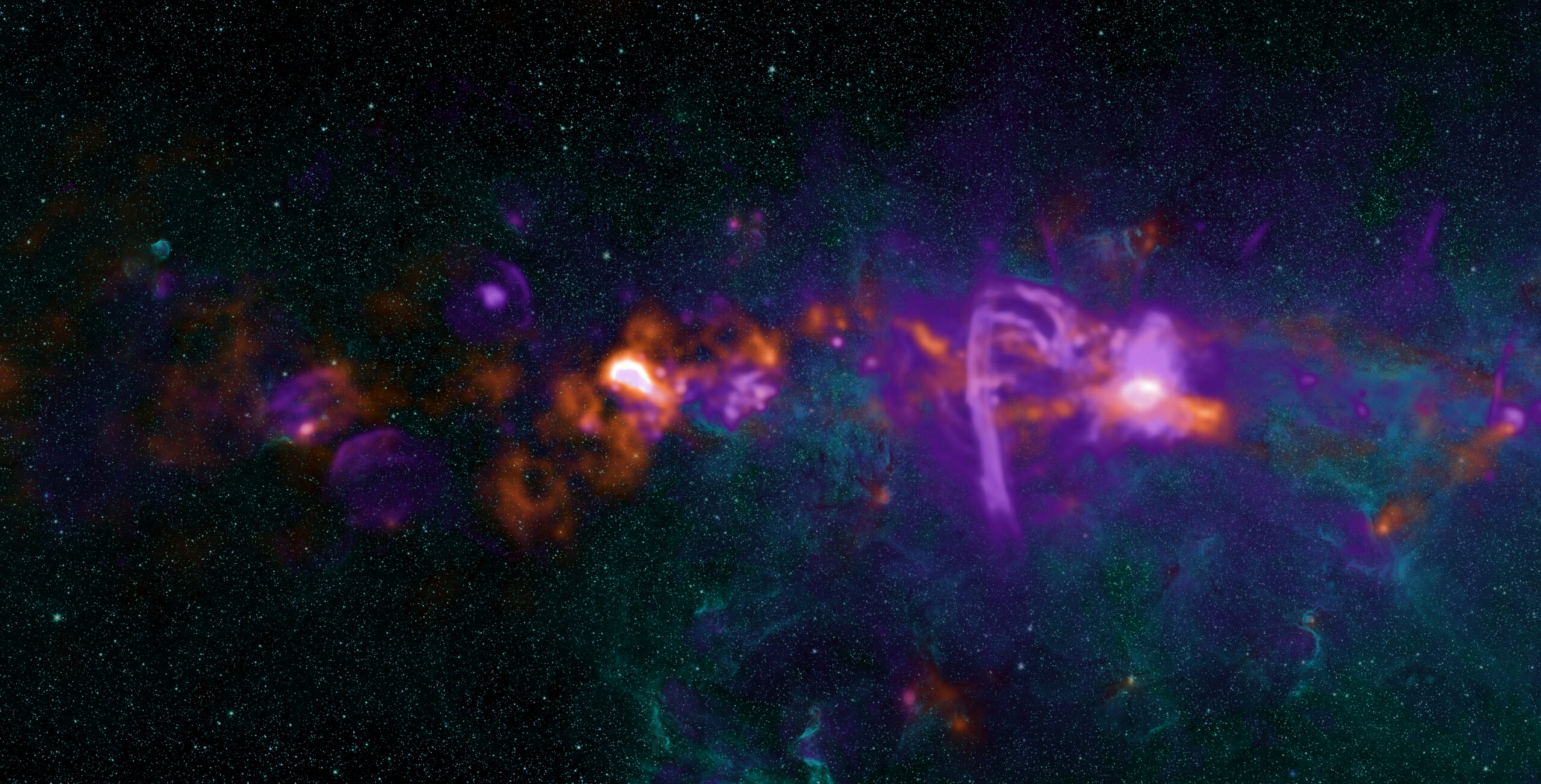
central molecular zone

The galactic center and the surrounding central molecular zone make up the most active star formation region in the Milky Way. [NRAO/AUI/NSF; CC BY 4.0]

Rojita Buddhacharya (Center for Astrophysics | Harvard & Smithsonian; Liverpool John Moores University) presented new results from the central molecular zone (CMZ), the dense gas reservoir at the center of our galaxy about 25,000 light-years from Earth. The CMZ is one of the most extreme environments we know of: gas there is roughly a hundred times denser, hotter, and more turbulent than what we see in nearby molecular clouds. Despite holding huge amounts of star-forming fuel, the CMZ forms stars at a surprisingly inefficient rate, and one of the puzzles is what conditions actually let any of that gas collapse into stars.

Buddhacharya mapped how gas transitions from highly turbulent, supersonic motion to calmer, subsonic motion across a region in the CMZ. This transition is well known in nearby clouds, where it usually precedes gravitational collapse, but it had never been clearly resolved in the CMZ before. Their team found a “calm island” of subsonic gas embedded in the otherwise turbulent sea. This is the first observation of its kind in the galactic center.

The Multi-Age Stellar Populations of Terzan 5 as Revealed by JWST

R. Michael Rich (University of California, Los Angeles) presented new JWST and Hubble Space Telescope observations of Terzan 5, an unusual stellar system near the center of the Milky Way that looks like a globular cluster but doesn’t act like one. Earlier work had already shown that Terzan 5 hosts at least two distinct stellar populations with very different ages and chemical abundances, which is unusual for a typical globular cluster.

Because Terzan 5 sits behind a thick screen of foreground stars and dust, separating real cluster members from contamination is one of the hardest parts of the analysis. The team combined JWST and Hubble imaging to measure stellar proper motions, then used a vector point diagram to isolate the stars that move together with the cluster. They identified two additional stellar populations beyond the two already known. Rich argued that Terzan 5 may be a “fossil fragment,” possibly the leftover core of a small galaxy or early bulge structure that was accreted long ago.

Sub-Day Periodic Variability of Two Central Stars of Planetary Nebulae

Gaoyang Du (Dalian University of Technology) reported the discovery of new short-period signals in the central stars of two planetary nebulae. These central stars are the hot, exposed cores left behind by Sun-like stars at the end of their lives, and finding rapid brightness variations in them tells us about their interior structure and pulsation physics.

Short-period signals well under a day are very hard to recover from the ground because Earth’s rotation introduces strong one-day aliasing, so the team turned to the Transiting Exoplanet Survey Satellite, which observes continuously from space. Using a neural-network pipeline designed to handle the crowded, contaminated backgrounds these stars sit in, they recovered the previously known variability in NGC 1501 and detected a new signal at roughly half an hour. Follow-up spectroscopy will be needed to pin down whether the signals come from pulsations, rotation, or something else, but the result opens a new window on the rapid variability of dying-star cores.

Artificial Light at Night Significantly Degrades the Value of Public Lands

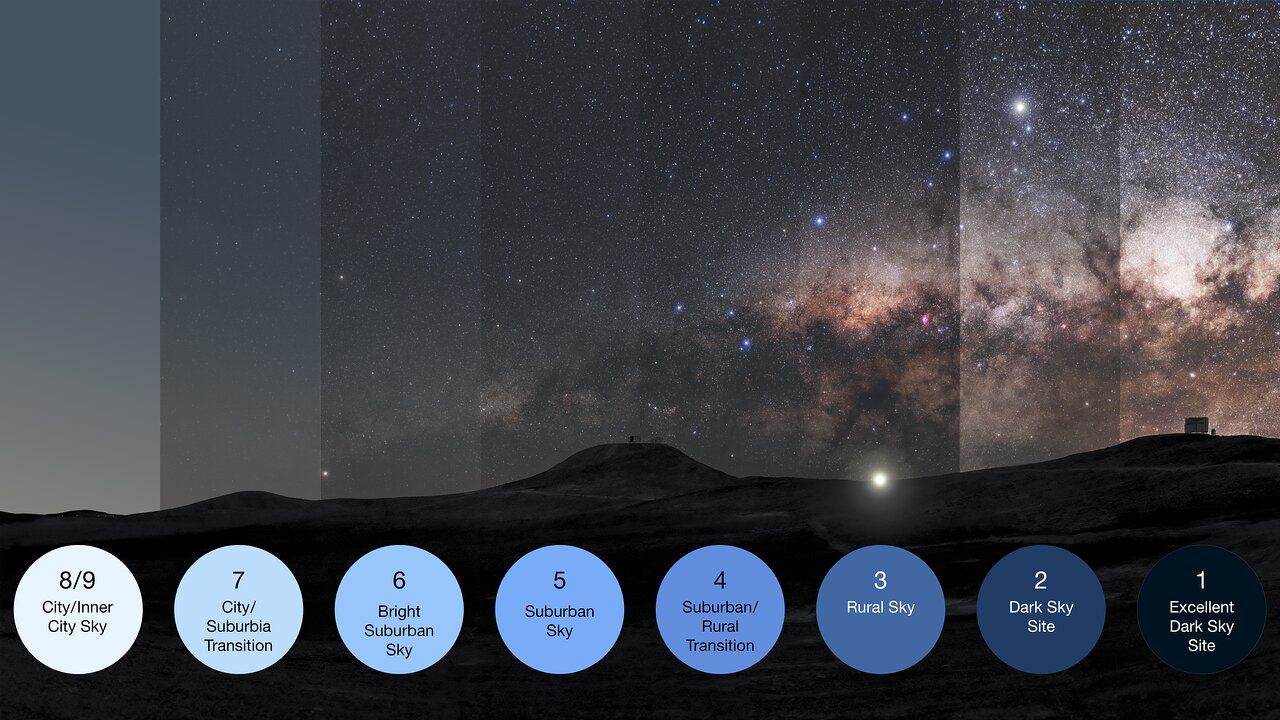
Jordan Smith (Utah State University) closed the press conference with a very different kind of measurement: the economic value of dark night skies. While astronomers usually treat light pollution as an observing problem, Smith and his collaborators are asking what the public is actually losing and what people would pay to keep dark skies on public lands. The team surveyed 634 visitors across International Dark Sky-certified parks, asking detailed questions about visitation behavior, motivations, and willingness to pay. Combining those surveys with satellite-based sky-brightness data, they estimated how the actual darkness of a site translates into the value visitors place on a trip. Based on the survey results, they found that visitors were willing to pay $45 more per visit to go to a park with skies one level darker on the Bortle scale. That sounds small per visitor, but scaled across all visits to all dark-sky public lands, it represents a very large economic value tied to a public good that current policy frameworks rarely account for.

illustration of the Bortle scale

An illustration of the Bortle scale, which quantifies the degree of light pollution at a given location. [ESO/P. Horálek, M. Wallner; CC BY 4.0]

Return to Table of Contents.

High Energy Astrophysics Division Early Career Prize Lecture: Carolyn Kierans, Developing Next-Generation MeV Telescopes (by Niloofar Sharei)

Carolyn Kierans (NASA Goddard Space Flight Center) was awarded the AAS High Energy Astrophysics Division Early Career Prize for her work on developing the next generation of megaelectronvolt (MeV) gamma-ray telescopes. Her talk laid out why the MeV band is so valuable (it contains nuclear emission lines like the 511 keV positron-annihilation line that traces high-energy processes in our galaxy) and why it has been so technologically difficult to observe well, since photons at these energies do not focus easily and the dominant interaction in the detector is Compton scattering. She walked through her work using balloon-borne Compton telescopes to mature the technology, the tools her team has developed in recent years to improve event reconstruction, and the broader roadmap for the next generation of MeV instruments.

Read Astrobites’s interview with Carolyn Kierans.

Return to Table of Contents.


Press Conference: Fire and Ice in Planetary Systems Near and Far (Briefing video) (by Kerry Hensley)

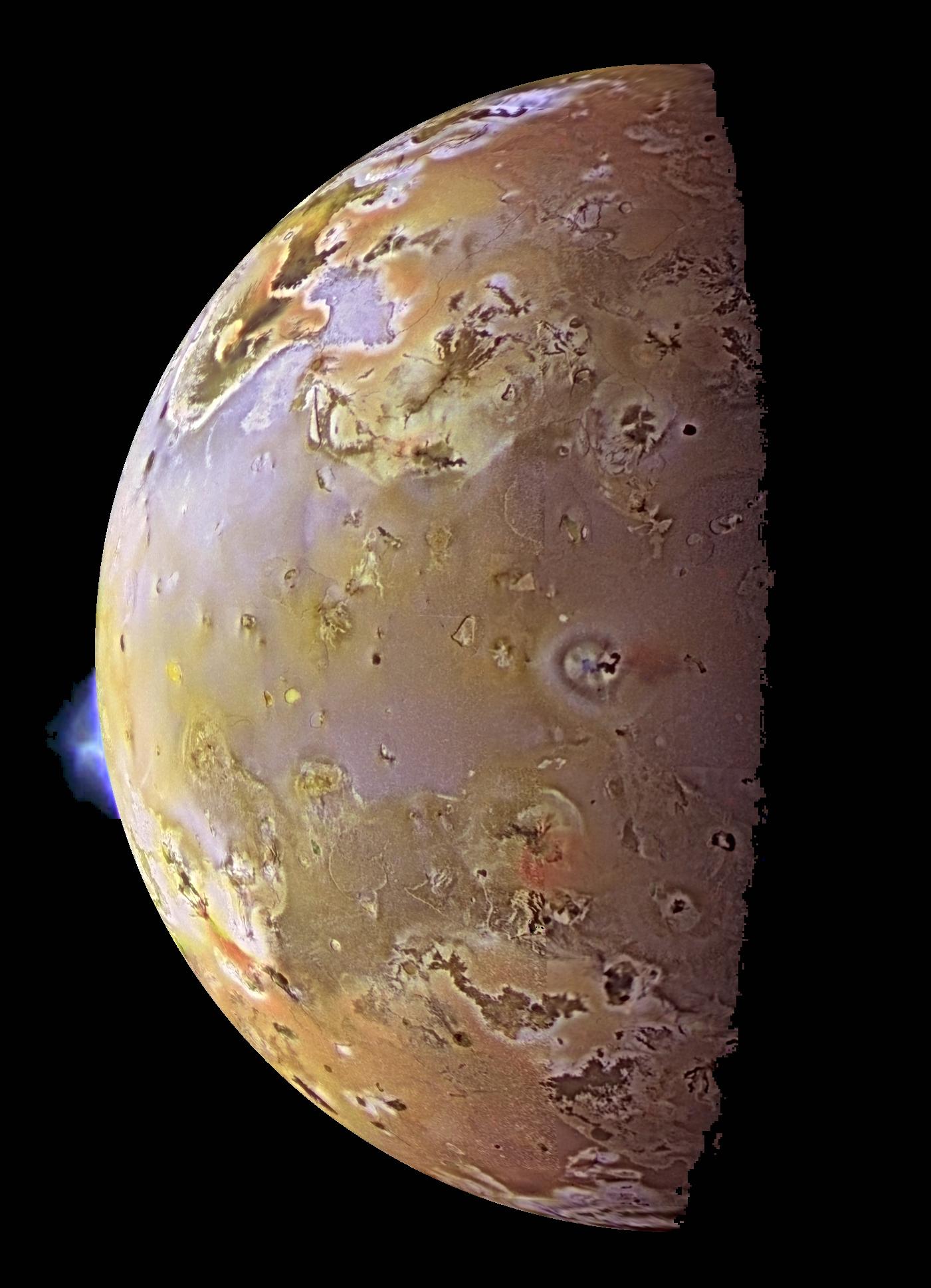
volcanic plume on Io

An image from the Galileo spacecraft of a volcanic plume on Jupiter’s moon Io. [NASA/JPL/University of Arizona]

The afternoon press conference was convened by Astrobites’s own Niloofar Sharei, this meeting’s Astrobites Media Intern. First up in the parade of planetary presentations was Neal Turner (NASA’s Jet Propulsion Laboratory/Caltech). Turner’s focus was Io, a moon of Jupiter and the most volcanically active body in the solar system. Turner’s team put forward a new claim: that the long-lived volcanoes that speckle Io’s surface spew out volcanic ash in their plumes, producing enough of this material to rapidly erase impact craters.

The team modeled Io’s plumes in order to explain the moon’s lack of impact craters, understand how certain plumes have persisted on Io for more than 45 years, and motivate a possible mission concept that includes a plume flythrough and sample return. They modeled the formation of ash as magma rises in a volcanic vent as well as the trajectory of the ash once it’s ejected into the plume, aiming to 1) match the plume observations from the Galileo spacecraft and 2) understand how an ash-filled plume might look different from one filled only with sulfur dioxide. While Turner found that Galileo data couldn’t discern between the two scenarios, ash makes a dramatic difference at the sub-millimeter wavelengths accessible to the Atacama Large Millimeter/submillimeter Array, which the team hopes to use to test this prediction. Finally, returning to the development of the mission concept, Turner proposed using a probe to first fly through the shadow of a plume to assess the particle size before sending the spacecraft through to collect a sample.

Up next, Tunhui Xie (University of California, Los Angeles) turned to Io’s neighbor, Europa. Europa and the other large icy moons of Jupiter are of interest to researchers because they might have subsurface oceans. Observations of Europa from ~30 years ago show that the moon has strange radar properties: its radar albedo is large, and the return signal retains the strong circular polarization of the outgoing signal.

To investigate the moon’s radar weirdness further, Xie’s team observed Europa from 2011 to 2024 and showed that the moon’s albedo (fraction of light reflected from its surface) is roughly constant with longitude. There is some evidence of differences between Europa’s hemispheres, which could be a sign of spiky ice structures called penitentes protruding from the frosty surface; Europa’s trailing hemisphere might be subjected to more particles from Jupiter’s magnetosphere, which could suppress the growth of penitentes in that region and cause a difference in the albedo. Xie also addressed the polarization behavior of the radar signal, showing that this is likely due to the coherent backscatter opposition effect. Finally, Xie showed how observations helped to place an upper bound of 32 meters for the penetration depth of X-band radar photons into Europa’s icy shell.

penitentes

Penitentes in the Atacama Desert. [ESO/B. Tafreshi (twanight.org); CC BY 4.0]

Bryce Bolin (Eureka Scientific) reported on the third known visitor from another star system: 3I/ATLAS. Using the Multi-Object Spectrograph for Infrared Exploration on the Keck I telescope, Bolin’s team obtained some of the first infrared images of the interstellar visitor and detected its fuzzy coma — the cloud of gas and dust that surrounds the solid body of the comet — shortly after its discovery in July 2025. In August, observations revealed that the comet had started to grow a tail. As the team monitored 3I/ATLAS during its journey through our solar system, they saw significant changes. The comet was initially very red, likely due to space weathering from the galactic environment, but it became greener as the comet became active and refreshed its surface.

In some of the earliest spectroscopy taken by a large-aperture telescope, Bolin’s team found cometary volatiles like CN, but not C2 or C3, which are common in comets, giving them a green color. These missing species emerged a couple of months later, which coincided with the comet taking on a greener appearance. As the comet retreated from its encounter with the Sun, these emission features faded. This presentation by Bolin showed how early and continuing monitoring of an interstellar object by a large-aperture telescope can reveal how these objects are affected by their journeys through our solar system.

Moving out of the solar system entirely, Tiffany Kataria (NASA JPL/Caltech) turned the discussion toward exoplanets. Kataria discussed HD 80606b, a 4.1-Jupiter-mass planet on an extremely eccentric (e = 0.93) orbit with a period of 111 days around a solar-type star. Kataria used JWST to observe HD 80606b’s phase curve, which revealed different parts of the planet as it travels along its orbit. Each time the planet makes its extremely close approach to its host star, it gets “flash roasted” and experiences a rapid increase in temperature. This rapid heating event is complex, depending on factors like the planet’s atmospheric chemistry and winds. The JWST data revealed that HD 80606b’s temperature skyrockets an incredible 1,100℉ over the course of its orbit. There’s still much more to learn from the rich spectroscopic dataset from JWST, so keep an eye out for more findings about this flash-roasted exoplanet in the future!

Finally, Aurora Kesseli (IPAC/Caltech) discussed another toasty exoplanet called CoRoT-2b, which is a hot Jupiter on a 1.7-day orbit around its star. Because hot Jupiters orbit their hosts so closely, astronomers expect all of these extreme exoplanets to be tidally locked, with one side of the planet perpetually facing the star and the other side in perpetual darkness. However, CoRoT-2b might be breaking that trend. In 2018, researchers reported that CoRoT-2b had winds that blew in the opposite direction from all other known hot Jupiters. They drew this conclusion from the location of the hottest point on CoRoT-2b, which appeared just after the planet ducked behind its star, rather than just before — unlike all other hot Jupiters studied so far. At the time, researchers hypothesized that the unusual location of the hotspot was due to clouds on one side of the planet, a magnetically induced westward wind, or a lack of tidal locking.

Using new data from the Very Large Telescope and Gemini South, Kesseli found that the planet’s strange properties can be explained best by a lack of tidal locking. CoRoT-2b appears to rotate at 2.24 km/s — far slower than the 4.37 km/s expected if the planet were tidally locked. There are no theories yet that explain why CoRoT-2b wouldn’t be tidally locked, so it remains a mystery for now!

Return to Table of Contents.


Solar Physics Division George Ellery Hale Prize Lecture: Yi-Ming Wang, The Sun as a Laboratory for Astrophysical Magnetic Fields (by Kerry Hensley)

Yi-Ming Wang (Naval Research Laboratory) gave the AAS Solar Physics Division’s George Ellery Hale Prize Lecture for “sustained, foundational contributions to understanding solar magnetism, the solar cycle, and the solar wind.” Wang is perhaps most known for the Wang–Sheeley–Arge solar wind model, which is widely used in space weather forecasting.

Wang began by musing on how his winding career path brought him to solar physics. Initially a theorist who modeled neutron stars, Wang was later hired to do radio astronomy but arrived for the position later than expected, so he was roped into working on solar physics instead — where he learned many things about magnetic fields that he wished he’d known when working on neutron stars!

extreme-ultraviolet image of the Sun

This 19.3-nanometer image, taken by the Solar Dynamics Observatory on 11 December 2023, shows at the center of the Sun’s disk the remnant of a large coronal hole. [NASA/SDO and the AIA, EVE, and HMI science teams]

In this talk, Wang gave an overview of three aspects of the Sun related to its magnetic field: quasi-rigid rotation of coronal holes, the source of coronal heating, and the speed of the solar wind. First up, coronal holes: these are dark areas in the solar corona where magnetic field lines stream out into space, which solar physicists call “open” field lines. (“Closed” field lines curve back to the solar surface.) Wang described how we know that coronal holes are regions of open field lines by extrapolating the photospheric magnetic field. (The photosphere is the visible “surface” of the Sun.) Because coronal holes rotate quasi-rigidly (compared to the photosphere, which rotates differentially), magnetic field lines must be continually converted from closed to open and vice versa at the boundaries of these holes.

Next, Wang discussed the source of coronal heating. The solar corona is famously extremely hot, running at a few million degrees compared to the ~6000K solar photosphere. For decades, the Parker nanoflare model has been the leading explanation for how the corona gets so hot. In this model, the places where coronal loops touch down in the solar photosphere are continually wiggled around by random motions of the photosphere, which tangles up the magnetic field lines in the coronal loop. When the current sheets in this system dissipate, the corona is heated. Instead, Wang favors an observationally based model in which the heating comes from magnetic reconnection with underlying small-scale fields.

Finally, Wang briefly touched on the connection between the Sun’s magnetic field and the speed of the solar wind. The solar wind has been measured at Earth since the 1960s, and these measurements have shown that the mass and energy flux density of the solar wind scales with the strength of the footprint magnetic field strength, but the observed solar wind speed is independent of the footprint field strength. Instead, the speed scales inversely with the rate of magnetic flux-tube expansion in the corona. Thus, the solar wind speed at Earth can be calculated from the rate of flux-tube expansion along open magnetic field lines using maps of the photospheric magnetic field.

In the end, Wang’s work on the solar magnetic field did connect back to his earlier work in high-energy astrophysics, with relevance to period changes in binary pulsar systems and other areas. Magnetic fields really do connect all parts of astrophysics!

Read Astrobites’s interview with Yi-Ming Wang.

Return to Table of Contents.


Plenary Lecture: David Jewitt, The Interstellar Interlopers (by Niloofar Sharei)

David Jewitt focused his plenary talk on a rare kind of small body: the three confirmed interstellar objects that have passed through the solar system so far. He opened with the Oort cloud as a framing device. Comets in the Oort cloud did not form there — they formed near the giant planets and were scattered out by gravitational interactions. The same process leaks comets to interstellar space very efficiently: only about 1–10% are trapped into a star’s own Oort cloud. Across the galaxy, that implies a free-floating population on the order of 1024–1025 objects. Seeing some of them pass through our solar system is exactly what we should expect.

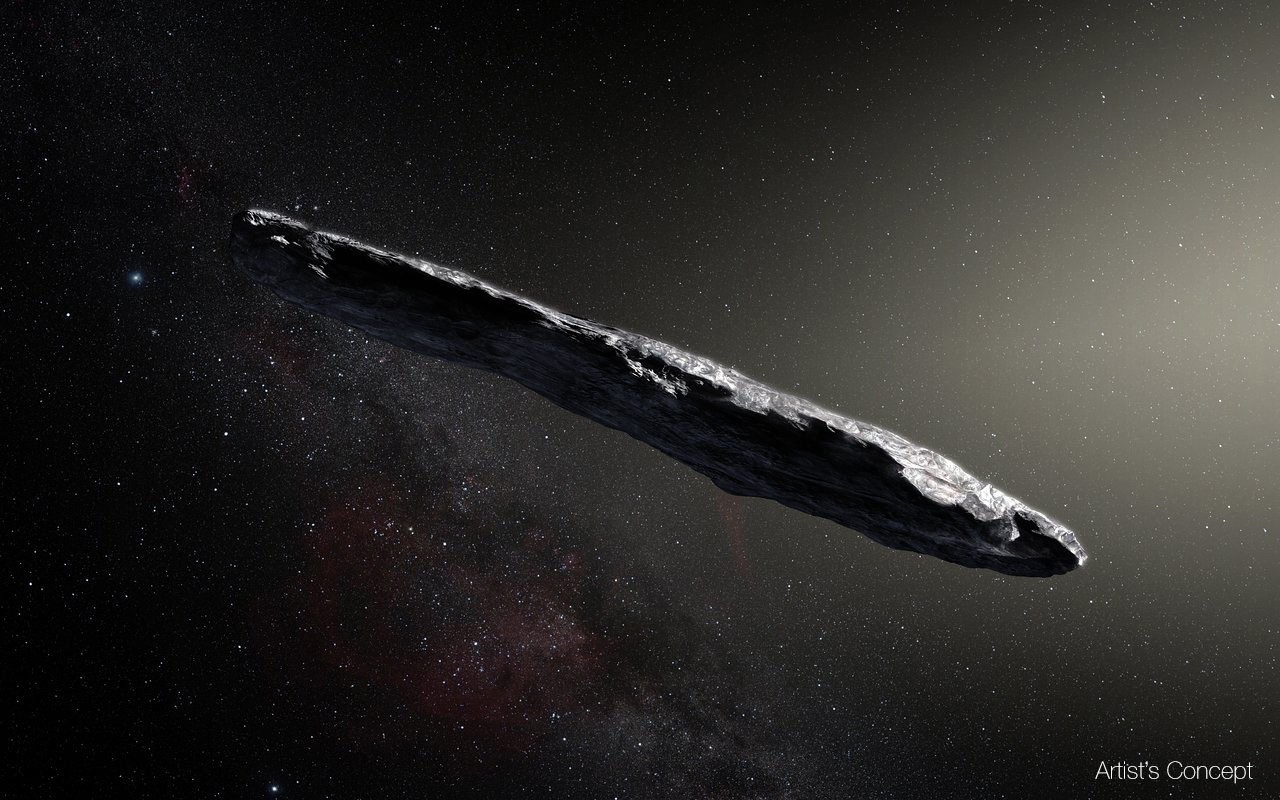
artist's impression of Oumuamua

Artist’s impression of the first known interstellar object to visit our solar system. ʻOumuamua. [ESO/M. Kornmesser; CC BY 4.0]

The bulk of the talk walked through the three known interlopers. ʻOumuamua (1I/2017 U1) is the strangest: a tiny inert body about 80 meters across, with an extreme light curve consistent with either a 6:1 elongated shape or a flattened disk, and a non-gravitational acceleration of about 0.1% of solar gravity despite no detectable outgassing. Jewitt walked through the proposed explanations: exotic ices, ultra-low-density fluffballs, and sail-like sheets, and showed why each runs into a physical problem. 2I/Borisov (2019), by contrast, looks like a perfectly normal comet, with a ~400–500-meter nucleus, a coma, a tail, and a solar-system-like composition. 3I/ATLAS is the largest at roughly a kilometer, and JWST infrared spectroscopy has revealed CO2 emission about an order of magnitude richer than typical solar system comets. This is the first detailed look at the volatile inventory of an interstellar visitor.

Jewitt then turned to what the three objects tell us as a population. The strongest constraint comes from ʻOumuamua, precisely because its discovery was such a near miss: catching one in that brief visibility window implies roughly 1,000 similar objects crossing the solar system per year. The three objects look very different in size, activity, and composition, which is consistent with sampling a broad galactic population, and their velocity dispersion lines up with the disk-heating picture, in which older galactic populations are kinematically hotter. The leading origin story is the same one he set up at the start: scattering from the protoplanetary disks of giant planets around other stars.

Read Astrobites’s interview with David Jewitt.

Return to Table of Contents.

The post AAS 248: Day 2 appeared first on AAS Nova.

Novo trailer de Homem-Aranha: Um Novo Dia mostra duelo contra Hulk

17 June 2026 at 21:15

A Sony Pictures Brasil divulgou o novo trailer de Homem-Aranha: Um Novo Dia nesta quarta-feira (17), com cenas inéditas e um duelo inesperado: o Amigão da Vizinhança terá de encarar Hulk durante os eventos do longa-metragem.

Outro destaque é a mutação que Peter Parker (Tom Holland) enfrenta, que além de criar teias orgânicas também o torna mais violento. De algum modo, é isso que impede o grande vilão da trama de controlar a sua mente.

Somado a isso, pode-se notar que a figura encapuzada não se trata da personagem de Sadie Sink. Ao fim da prévia, uma voz masculina prepara o super-herói para enfrentar um dos maiores desafios de sua vida: o Golias Esmeralda.

-
Entre no Canal do WhatsApp do Canaltech e fique por dentro das últimas notícias sobre tecnologia, lançamentos, dicas e tutoriais incríveis.
-

Além disso, em determinados momentos pode-se ver mais da participação do Justiceiro em Homem-Aranha: Um Novo Dia, o Escorpião devidamente trajado e o confronto do aracnídeo contra o clã da Mão — que são vilões do Demolidor. Confira o trailer abaixo:

Preparativos para o novo Homem-Aranha

O quarto filme do escalador de paredes é muito esperado pelo público e, a partir de hoje, a pré-venda dos ingressos já está disponível em todos os cinemas que exibirão a obra. Sua estreia também foi adiantada: agora ele chega em 29 de julho de 2026. 

A Sony Pictures Brasil celebra as novidades com a abertura de um novo site, chamado de Rastreador Aranha. Criado pelo personagem Ned Leeds (Jacob Batalon), ele centraliza as informações do Homem-Aranha e celebra seus feitos em Nova York. Se aceita recomendações, preste atenção nos detalhes.

Vale destacar que grande parte das informações apresentadas pela prévia reforçam alguns rumores e vazamentos, indicando que Jean Grey de fato estará na história. 

Era esperado que o "vilão oculto" de Homem-Aranha: Um Novo Dia pode ser membro dos X-Men, mas com o novo trailer é mostrado um outro caminho. 

Leia a matéria no Canaltech.

Google, Microsoft, and OpenAI Back Linux Foundation's Appia AI Standards Initiative

By: BeauHD
17 June 2026 at 21:03
BrianFagioli writes: Google, Microsoft, OpenAI, Arm, Mastercard, Siemens, and other companies have joined the newly launched Appia Foundation under the Linux Foundation. The project aims to create common specifications and assessment frameworks that organizations can use to demonstrate AI systems meet emerging safety, trust, and compliance requirements. According to the Linux Foundation, the framework is designed to allow conformity evidence to be reused across the AI supply chain, potentially reducing duplicate assessments and compliance costs. The announcement comes as governments around the world move toward enforcing AI regulations and organizations face increasing pressure to prove AI systems are trustworthy. "As international standards and legal frameworks become more established, global organizations need a consistent, practical way to verify that AI systems conform to new expectations," said Jim Zemlin, CEO of the Linux Foundation. "The Appia Foundation establishes a neutrally governed environment where the entire industry can collaborate on a common assessment framework. By building this infrastructure in the open, we are helping organizations reduce complexity, lower operational costs and build trust." Craig Shank, Executive Director of the Appia Foundation, added: "AI systems now make decisions about people's loans, their children's schools and their jobs. People on the receiving end deserve to know those systems were built and assessed against criteria that hold up to scrutiny. The Appia Foundation was formed to do that work: creating publicly available specifications that organizations across the AI value chain use to demonstrate their systems meet those criteria. By establishing this open framework, we are building the accountability layer required to scale safe and trusted AI across major industries."

Read more of this story at Slashdot.

TIM e Vivo entram em conflito na Anatel por bloqueio de ligações indesejadas

17 June 2026 at 20:56

Um novo embate movimenta o setor de telecomunicações. A TIM e a Vivo entraram em conflito direto na Anatel por conta do serviço de bloqueio de ligações indesejadas da Vivo. A agência reguladora precisou intervir na disputa para tentar mediar a situação.

O problema é o serviço Vivo Anti-Spam. A ferramenta foi ativada para toda a base móvel da operadora de forma automática. Em seguida, a TIM protocolou uma reclamação administrativa na Anatel alegando que o serviço pode restringir o recebimento de chamadas feitas por seus clientes. A agência convocou uma reunião de conciliação para amanhã, 18 de junho.

Outras empresas de telecomunicações também manifestaram insatisfação. Algar Telecom, IDT Telecom e Adyl Telecom registraram queixas na agência. As manifestações indicam que os efeitos da ferramenta podem atingir diferentes agentes do mercado.

-
Entre no Canal do WhatsApp do Canaltech e fique por dentro das últimas notícias sobre tecnologia, lançamentos, dicas e tutoriais incríveis.
-

A Adyl apresentou uma denúncia rica em detalhes. A empresa relata dificuldades para completar chamadas com destino a clientes da Vivo desde o início de junho. A falha ocorre até em cenários de interconexão direta entre as redes.

A operadora afirma que a Vivo aplica critérios internos sem clareza para realizar esses bloqueios. Segundo a Adyl, números vinculados a instituições hospitalares acabaram enquadrados nos mecanismos de bloqueio mesmo utilizando serviços legítimos e ferramentas oficiais de autenticação.

Serviço anti spam da Vivo causa conflito com outras operadoras (Imagem: Danilo Berti/Canaltech)

Segundo a empresa, cerca de 700 chamadas deixam de ser completadas por dia. A Adyl também afirma que não há um procedimento estruturado para contestar e corrigir classificações consideradas equivocadas. 

Fontes do setor relatam ainda dificuldades enfrentadas por centrais de monitoramento de alarmes, empresas de logística e outros serviços que utilizam chamadas automáticas ou semiautomáticas.

Vivo reforça segurança do recurso

A Vivo defende a validade da sua ferramenta. A empresa afirma que o sistema identifica e barra chamadas automáticas em grande volume. O objetivo é combater números rotativos e práticas de fraude na rede.

A operadora reforça seu apoio à autenticação de todas as chamadas entre prestadoras. A companhia afirma que não bloqueia o tráfego de empresas que estejam em conformidade com as regras do Anti-Spam e os mecanismos de autenticação. Um canal online permite solicitar a revisão de possíveis falhas no sistema.

A Anatel avalia o cenário com cautela. A agência trata a questão de forma individualizada neste primeiro momento. Fontes do órgão regulador apontam a necessidade de separar o combate ao spam de eventuais condutas indevidas relacionadas à interconexão entre operadoras.

O serviço anti spam da Vivo foi lançado em 2024, como uma ferramenta para bloquear ligações suspeitas. 

Leia a matéria no Canaltech.

Avatar: quem são os personagens importantes da 2ª temporada?

17 June 2026 at 20:55

A série Avatar: O Último Mestre do Ar volta para a sua 2ª temporada na Netflix, com a jornada de Aang para dominar todos os elementos antes que a Nação do Fogo conclua seus planos malignos de dominação global.

Contudo, com a chegada dos novos episódios, diversos personagens serão apresentados ao público — assim como alguns vistos no ano anterior ganharão uma importância ainda maior na história.

Para te ajudar, hoje o Canaltech mostra quem terá grande importância no seriado e em quem precisará prestar atenção nos próximos capítulos.

-
Entre no Canal do WhatsApp do Canaltech e fique por dentro das últimas notícias sobre tecnologia, lançamentos, dicas e tutoriais incríveis.
-

10. Toupeira Texugo

Ainda que não seja um personagem propriamente dito, as toupeiras texugos são criaturas cegas que carregam uma importância imensa no universo de Avatar: O Último Mestre do Ar. Se dragões ensinaram a dominação de fogo aos dobradores, estes seres são responsáveis por mostrar aos humanos a dobra de terra.

Eles são mamíferos imensos e não possuem olhos, capazes apenas de sentir as vibrações que o terreno oferece. Foram estes seres que ensinaram Toph Beifong a compreender seu potencial e se tornar uma das maiores usuárias da habilidade — e uma gênia, diga-se de passagem. 

9. Guru Pathik

Um guia espiritual centenário, o Guru Pathik é um idoso que tenta ensinar a Aang como trilhar o seu caminho como Avatar. Com um grande conhecimento, sua missão é mostrar ao herói como utilizar o seu estado de dominância completa dos elementos sem causar tragédias ao seu redor.

No entanto, ele terá um grande desafio em meio à sua aula: o protagonista da série se recusa a negar toda a sua conexão com o mundo terreno — o que é exigido para que ele possa usar todo o seu potencial. Com lições valiosas, seu papel é mostrar que tudo que almejamos pede um sacrifício. 

8. Jato

Após uma curta aparição na primeira temporada de Avatar: O Último Mestre do Ar, Jato retorna — agora como um dos prisioneiros em Ba Sing Se. No esconderijo dos Dai Li, ele é torturado e sofre lavagem cerebral, o que expõe bastante dos segredos que a cidade esconde. 

Sua trama atual trará uma maturidade ainda maior para o enredo, já que mostrará que nem todos recebem uma segunda chance na vida — mesmo com esforço e vontade. Ainda que seu coração tenha chegado ao “lugar certo”, isso não impede um fim que partirá corações na jornada do grupo ao Reino da Terra. 

Imagem de Jato
Jato busca uma segunda chance, mas seu destino pode ser mais cruel (Imagem: Reprodução/Netflix)

7. Tio Iroh

A importância de tio Iroh é indiscutível na primeira temporada de Avatar: O Último Mestre do Ar, mas isso será ainda mais desenvolvido no segundo ano. O “ancião” vive escondido em Ba Sing Se com seu sobrinho, o que permite aos dois um respiro necessário para compreenderem o que precisam fazer.

Entretanto, além da Nação do Fogo sempre estar à espreita dos dois, ele também é assombrado pelo seu passado e pela forma que foi moldado pelos anos — assim como as escolhas que teve de fazer e se arrepende. É importante prestar atenção no enriquecimento de sua história, já que terá uma maior importância no futuro da série.

Imagem de Iroh
Na 2ª temporada, as intenções e passado do tio Iroh estarão mais claras aos fãs (Imagem: Divulgação/Netflix)

6. Joo Dee

Assim que o grupo Avatar chega em Ba Sing Se, eles exigem uma audiência com o rei, porém terão de se resolver com Joo Dee — uma embaixadora que diz estar ali para mostrar a cidade a eles e explicar tudo sobre o lugar. A verdade sobre ela, no entanto, é ainda mais sombria na grande narrativa.

Aang e seus amigos têm de lidar com toda a burocracia imposta pela personagem, enquanto esconde segredos que podem comprometer a relação do governo e dos Dai Li com o “escolhido” e seus aliados. Ainda que não tenha uma participação imensa, sua presença determina bastante a forma como enxerga as operações do distrito. 

Imagem de Joo Dee
Para Joo Dee, "não há guerra em Ba Sing Se" (Imagem: Reprodução/Netflix)

5. Wan Shi Tong

Antes de chegarem a Ba Sing Se, os heróis buscam uma lendária biblioteca que pode trazer respostas sobre os planos da Nação do Fogo e como impedi-los. Em meio ao deserto, eles encontram o acervo de Wan Shi Tong, um espírito que guarda todo o conhecimento da humanidade. 

A coruja gigante só exige que as informações obtidas ali não sejam usadas para fins de violência. Contudo, Aang e seus amigos descobrem que eles precisam impedir o Senhor do Fogo Ozai a todo custo — nem que exija um confronto direto contra o vilão. A partir disso, o herói descobrirá que não se pode contrariar seres místicos e dotados de uma grande fúria.

4. Ty Lee

Uma das maiores aliadas de Azula, Ty Lee é uma acrobata da Nação do Fogo que luta de forma impressionante. Entretanto, um dos grandes destaques da personagem é que ela possui uma técnica muito perigosa para Aang e Katara: ela literalmente pode restringir os pontos de chakra de dominação, o que deixa ambos indefesos em combate.

Desse modo, ela se torna uma grande ameaça em Avatar: O Último Mestre do Ar, mesmo que ela não carregue intenções malignas ou planos mirabolantes. Seu único desejo é apoiar a amiga, enquanto utiliza o seu potencial para uma função “útil” para o Senhor do Fogo e sua família. 

Imagem de Ty Lee
Ty Lee (direita) representa um grande risco para o Time Avatar (Imagem: Reprodução/Netflix)

3. Appa

O bisão gigante de Aang, Appa, terá uma participação ainda maior na segunda temporada do seriado — o que mostrará o quanto é importante para o grupo. Ainda que ele tenha poucos momentos de brilhar nos primeiros episódios, aqui será mostrado que ele é essencial para a trama.

Além de ser um grande colosso físico, capaz de derrubar muralhas e destruir o que for preciso em seu caminho, ele também é o principal meio de transporte dos personagens principais. Também não se deve esquecer que ele é o melhor amigo do Avatar, que iria até as últimas consequências para proteger o seu companheiro.

Imagem de Appa
O bisão voador terá uma importância ainda maior na 2ª temporada da série (Imagem: Divulgação/Netflix)

2. Azula

Irmã de Zuko, Azula agora participa mais ativamente das ações da Nação do Fogo após a sequência de fracassos de seu familiar. Agora, por ordens de seu próprio pai, ela é responsável por capturar e levar o Avatar sob custódia para Ozai — que deseja tirar do seu caminho a única coisa que pode atrapalhar seus planos.

Ao contrário do irmão, que questiona e tem consciência das condições que o mundo sob o comando deles sofre, ela não tem pudores e fará de tudo para concluir os seus objetivos. Nem que, para isso, tenha de confrontar e derrubar Zuko junto. Sua dominação de fogo é tão poderosa que criou uma nova vertente, algo que representará um risco ainda maior para Aang.

Imagem de Azula
Azula passará por cima de todos, até de seu próprio irmão, para capturar o Avatar (Imagem: Reprodução/Netflix)

1. Toph

Uma das personagens mais esperadas em Avatar: O Último Mestre do Ar, Toph Beifong é a última integrante do grupo e a mestre do protagonista na dominação da terra. Filha de uma família nobre, a menina cega se cansou de ser tratada com pena e decidiu usar suas habilidades para lutar contra brutamontes.

Com um sucesso considerável no meio, ela mostra que a habilidade exige mais do que os cinco sentidos para ser dominada. Um dos grandes destaques da personagem é que ela é extremamente desbocada e não poupa ninguém de comentários ácidos — inclusive os próprios aliados.

Imagem de Toph Beifong
Toph ensinará Aang a ouvir as vibrações da terra para dominar o elemento (Imagem: Reprodução/Netflix)

Personagens da série Avatar na Netflix

Obviamente, o grupo principal ganha um destaque ainda maior na série. Aang, Katara e Sokka devem amadurecer demais ao ver que o mundo não tem apenas “um vilão”, mas sim diversas pessoas com fins próprios dispostas a ultrapassar todos os limites para atingi-los. Como salvar um mundo que mostra que a salvação vai além de derrotar o Senhor do Fogo?

No decorrer da história, os personagens importantes nos quais você deve prestar atenção na segunda temporada de Avatar: O Último Mestre do Ar são:

  • Toph
  • Azula
  • Appa
  • Ty Lee
  • Wan Shi Tong
  • Joo Dee
  • Tio Iroh
  • Jato
  • Guru Pathik
  • Toupeira Texugo

Leia a matéria no Canaltech.

Trump administration repeals rule that allowed bison to graze on public lands

17 June 2026 at 20:36
U.S. President Donald Trump’s administration recently repealed the 2024 Public Lands Rule, which established that conservation should have equal priority with industry when it comes to accessing leases for U.S. public land. That shift in priorities will apply to 245 million acres (99 million hectares) of public land managed by the Bureau of Land Management (BLM). That’s roughly 10% of U.S. land that the agency leases for a multitude of private uses including grazing, mining, energy development and, until recently, conservation. In the federal register the Department of the Interior (DOI) said, “[b]y rescinding the 2024 Rule, the BLM eliminates mechanisms — such as restoration and mitigation leasing — that threatened to restrict productive use of the public lands.” An example of the decision’s impact can be found in the state of Montana. Roughly 950 American bison (Bison bison) have grazed on 63,000 acres (25,495 hectares) of federal land there since 2022. However, the DOI, which oversees BLM, revoked that grazing permit on May 8, just days before repealing the Public Lands Rule. Interior secretary Doug Burgman said that according to federal grazing laws, public land leases can only be given to animals, “intended for use primarily for their meat, milk, or other animal products.” He added that “considerable evidence” suggests the bison are intended for “for some other purpose, such as conservation.” Before western settlement, upwards of 100 million bison roamed the plains, serving as “ecosystem engineers shape[ing] healthy and diverse ecological communities,” the DOI acknowledged in its 2020 Bison Conservation…This article was originally published on Mongabay

XBOX quebra o silêncio e responde a boatos sobre fim dos jogos exclusivos

17 June 2026 at 20:35

O chefe de estratégia do XBOX, Matthew Ball, desmentiu um rumor levantado pelo insider SneakerOS de que a divisão estaria voltando atrás em sua nova estratégia de exclusivos.

Para quem não acompanhou o XBOX Game Showcase 2026, a CEO da divisão de games da Microsoft, Asha Sharma, revelou que Gears of War: E-Day se tornará um exclusivo vitalício do XBOX nos consoles. Além do shooter da The Coalition, o RPG Clockwork Revolution, com lançamento previsto para 2027, também será um exclusivo da marca.

No entanto, um rumor levantado pelo usuário SneakerOS dizia que "O papo de 'exclusivo' não passou de um show para a temporada de convenções" e que "já se fala sobre como voltar atrás nisso". O boato ganhou ainda mais força após jornalistas afirmarem que a divisão sofrerá uma grande leva de demissões e que estúdios como Compulsion Games, Double Fine e Ninja Theory estariam em risco de ser fechados ou vendidos.

-
Entre no Canal do WhatsApp do Canaltech e fique por dentro das últimas notícias sobre tecnologia, lançamentos, dicas e tutoriais incríveis.
-

Ball, no entanto, negou que o XBOX vá voltar atrás na questão dos exclusivos. "Esses rumores são falsos", comentou o executivo em resposta a um tweet do editor-chefe do Windows Central, Jez Corden. "Gears of War: E-Day e Clockwork Revolution continuarão exclusivos."

These rumors are false. Gears of War: E-Day and Clockwork Revolution will stay exclusive. There are no conversations and have been no conversations to "reverse course." And as we said last week, players can continue to expect signature exclusives from us every year.

— Matthew Ball (@ballmatthew) June 16, 2026

O chefe de estratégia da divisão reforçou que não há nem nunca houve conversas sobre "mudar de rumo". Ball finalizou afirmando que "como dissemos na semana passada, os jogadores podem continuar esperando exclusivos marcantes da nossa parte todos os anos".

Quatro estúdios XBOX podem ser fechados em breve

Embora muitos tenham gostado da conferência do XBOX durante a Summer Game Fest 2026, a festa durou pouco. Na última quarta-feira (10), Sharma anunciou o plano radical de 100 dias para reiniciar o XBOX. A executiva admitiu que a empresa perdeu US$ 500 milhões em receita nos últimos cinco anos, mas gastou US$ 20 bilhões em investimentos contínuos em hardware, conteúdo e serviços.

Parte dessa reformulação inclui uma demissão em massa que deve ser feita em toda a divisão XBOX a partir de julho, após o fim do ano fiscal da Microsoft. Entre os cortes estarão o fechamento da Ninja Theory, que parece encaminhado, e as negociações das lideranças da Double Fine e Compulsion Games para se tornarem independentes, como a Toys for Bob.

Leia a matéria no Canaltech.

Eastern Washington wildfire forces evacuations and destroys homes

17 June 2026 at 20:26
SPOKANE, Wash. (AP) — High winds drove a wildfire into an eastern Washington neighborhood, forcing the evacuation of about 1,500 people and destroying some homes, fire officials said Wednesday. It’s unclear how many homes were lost in Spokane. Fire officials were working Wednesday to determine the number and the full extent of the damage, said Matthew Vinci, fire chief for Spokane County Fire District 9. He confirmed Tuesday that some homes were engulfed in flames. The evacuation order for the 1,500 residents remained in effect Wednesday, said Chandra Fox, deputy director for Spokane County Emergency Management. “Our concern is for increased winds Wednesday afternoon,” Fox said. The blaze started just after noon on Tuesday and quickly moved up a hill, said fire district spokesman Robert Gray. Winds then shifted, sending flames into a neighborhood, Gray said. Fire crews from Washington state and Idaho attacked the fire from the ground and air, but it quickly grew to 225 acres (.35 square miles). It was 10% contained Wednesday morning, according to the National Interagency Fire Center. More than 32,000 fires have burned more than 3,900 square miles (10,100 square kilometers) so far this year in the United States, according to the fire center, which coordinates the mobilization of large-scale firefighting efforts. That’s significantly higher than the 10-year average of just under 24,000 fires burning about 2,200 square miles (5,700 square kilometers) by early June, according to the fire center, even though fire activity has been relatively light in recent weeks. Weather and…This article was originally published on Mongabay

Anthropic Employees Accuse Trump Administration of Targeting Them

By: BeauHD
17 June 2026 at 20:00
Anthropic employees say they remain confused and increasingly convinced that the Trump administration is singling out the company after officials gave it less than 90 minutes to disable Fable 5 and Mythos 5 over alleged national security concerns. Cybersecurity experts, however, argue that the cited behavior of helping to identify vulnerabilities in software is also available in rival models and is more valuable to defenders than attackers. The New York Times reports: Inside the company, employees' private group chats immediately lit up. Managers were instructed to prepare customers for a potential service disruption to the models, called Fable 5 and Mythos 5. But the messaging kept changing, with workers initially being told that the security problem was the ability of foreign companies to gain access to the systems, and later that a major vulnerability had been discovered in the models. In employee chats, Anthropic engineers asked one another if the company's plan to go public this year would be harmed by the White House directive. Many shared news reports that offered conflicting information about why the White House had ordered Anthropic to suspend access to Fable 5 and Mythos 5 for all foreign nationals. "What are you telling your clients?" one employee asked in a chat viewed by The New York Times. Another said, "Does anyone know what to believe?" In another message, a worker said, "I don't understand what the issue is." Six days later, Anthropic's roughly 3,000 employees still have few answers. The San Francisco company is continuing to grapple with internal confusion as Dario Amodei, the chief executive, and some of his lieutenants meet with the Trump administration to try and resolve the situation. But after discussions on Monday and Tuesday, there was no breakthrough over ending the U.S. order to limit access to the company's new A.I. models. In a statement on Monday, Anthropic said it would continue meeting with government officials and pledged its "ongoing commitment to working alongside the administration." The dispute highlights how singular Anthropic has become in Washington. It was the second time in six months that the fast-growing A.I. start-up has become embroiled in a fight with the Trump administration over its powerful technologies, even as other A.I. companies offer similar models that have not received the same attention. And it has left Anthropic's employees in what they described as a holding pattern, with some wondering if they were being picked on by President Trump. "Are we being bullied based on bad vibes?" one employee asked in a chat viewed by The Times. Yesterday, TechCrunch's Zack Whittaker argued that the move sets a troubling precedent: the government can unilaterally disrupt American software products without court approval, potentially undermining trust in U.S. AI providers.

Read more of this story at Slashdot.

Register

17 June 2026 at 19:42

Register to Observe the Moon with NASA

Image credit: Zach Tejral | Location: Antarctica

How to Register for International Observe the Moon Night

Choose the type of registration that best matches your Moon observing plans:

Colorized photo of kid pointing to a screen with the Moon, with text overlay: Individual / Household Registration.

Individual/Household Registration

If you are observing the Moon on your own or with people in your household, register here.

Colorized photo a group of people gathered at night to look through a telescope. In the foreground, a screen displays "International Observe the Moon Night"; text overlay: Host a Public Event

Host a Public Event

If you are organizing and hosting a Moon observing event that is free and open to everyone, register here.

Colorized photo of school children holding up certificates, with text overlay: Host a Private Event

Host a Private Event

If you are organizing and hosting a Moon observing event for a private group, register here.

Planning Resources

A man adjusting a telescope outdoors.

Event Planning Guide

How to host an International Observe the Moon Night event, in 8 easy steps.

A hand holding a passport next to a telescope outdoors

Sample Event Outline

Looking for ideas about how to structure your event? This outline can help.

A white Moon is painted on a bluish gray background, with rings of color surrounding the Moon. The thin branches of a tree stretch upwards towards the Moon. Black flowers speckle the lower right portion of the painting.

10 Ways to Observe the Moon from Home

Observing the Moon is something you can do no matter the weather, time of day, or location! Here are some of our favorite ways to observe.

Librarian reads a story next to a gigantic Moon model, outdoors, with a crowd of families seated on chairs and on the grass and standing on the sidewalk nearby.

Find a Local Event to Join

Check the Find-An-Event Database for International Observe the Moon Night events near you, or to find a virtual event.

The post Register appeared first on NASA Science.

La Lenovo Legion Y700 3rd à moins de 400 € : Snapdragon 8 Gen 3, écran 165 Hz et format 8,8 pouces pour la tablette gaming qui change la donne

17 June 2026 at 19:30
La Lenovo Legion Y700 3rd génération ne ressemble pas aux tablettes Android classiques, et c'est précisément ce qui la rend intéressante. Snapdragon 8 Gen 3 dernière génération, écran 8,8 pouces en 2,5K à 165 Hz, batterie de 6 550 mAh et un format compact pensé spécifiquement pour le gaming...

❌